
These media theories form the backbone of A-level Media Studies...
 Media Studies523 views·Updated Jun 24, 2026·4 pages
19 Essential Media Theories for Eduqas A-Level Media Studies

mar@myst1cmars


1 / 4
1
of 4
Core Media Theory Foundations
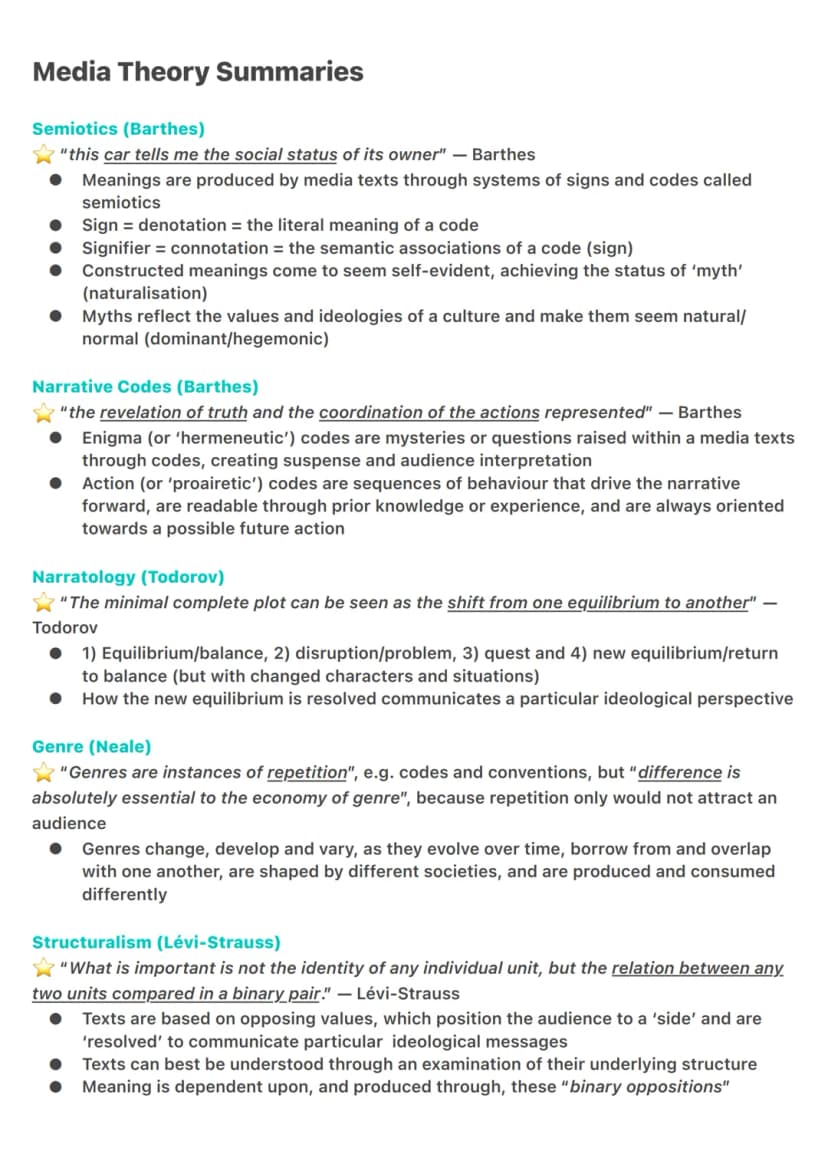
Ever wondered why a luxury car advert makes you think about wealth and success? Semiotics explains this perfectly - it's all about how media texts use signs and codes to create meaning beyond the obvious.
Roland Barthes showed us that every sign has two layers: denotation (the literal meaning) and connotation (the deeper cultural associations). When these meanings become so normal we don't question them, they turn into myths that reinforce dominant ideologies.
Barthes also identified narrative codes that keep you hooked on stories. Enigma codes create mysteries that make you desperate for answers, whilst action codes drive the plot forward through familiar sequences of events.
Todorov's narratology reveals the classic story structure you'll spot everywhere: equilibrium → disruption → quest → new equilibrium. The way stories resolve tells us what values society wants to promote. Genre theory (Neale) explains why we love both familiar elements and surprising twists - pure repetition would be boring, but complete originality would be confusing.
Quick Tip: Use Lévi-Strauss's binary oppositions to analyse any text - look for opposing values like good vs evil, civilised vs primitive, or rich vs poor to uncover the ideological messages.
2
of 4
Identity, Gender and Power Structures
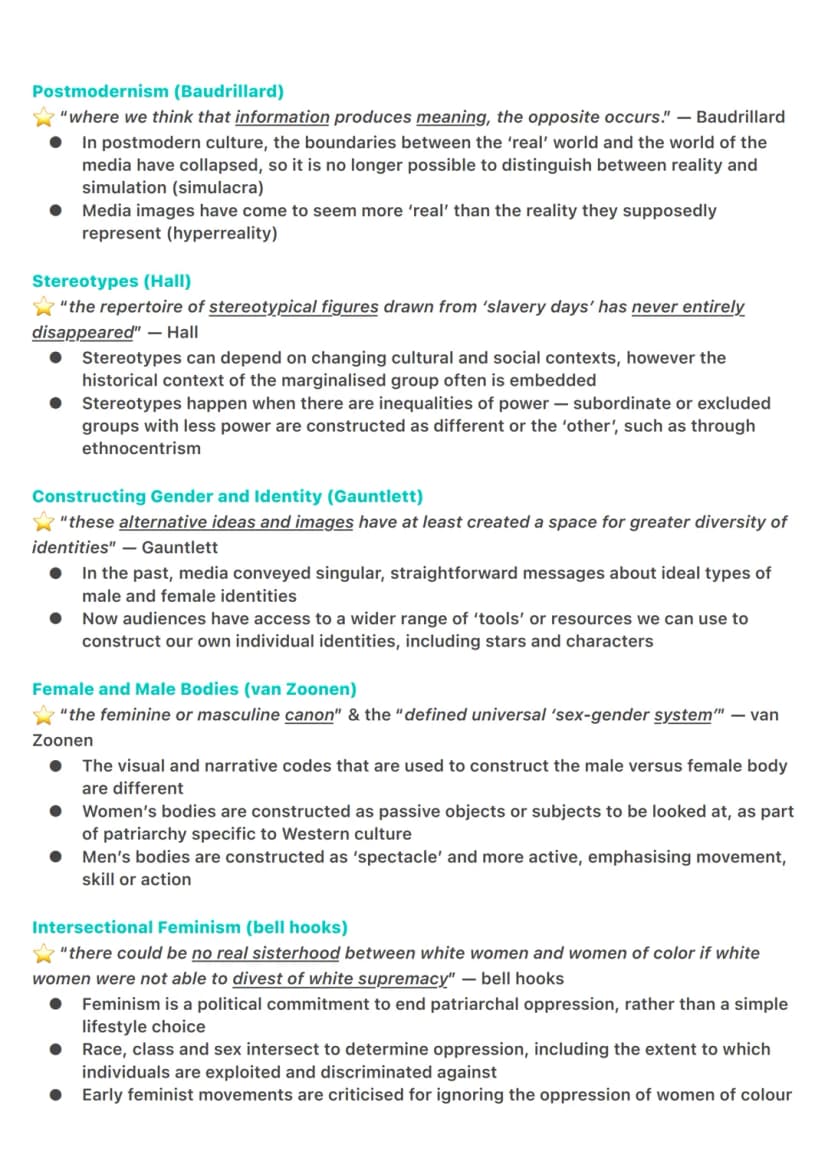
Your reality might be more constructed than you think. Baudrillard's postmodernism argues that media images have become more "real" than actual reality - think about how Instagram filters shape beauty standards or how TV crime shows influence what we think about police work.
Stuart Hall's work on stereotypes reveals how media representations often reinforce power imbalances. Stereotypes aren't just harmless shortcuts - they're tools that keep marginalised groups positioned as "other" whilst maintaining existing hierarchies.
Gender representation has evolved dramatically. Gauntlett notes how we've moved from rigid male/female roles to a diverse toolkit of identity resources. However, van Zoonen highlights persistent differences: women's bodies are still often presented as passive objects to be looked at, whilst men's bodies emphasise action and movement.
Bell hooks' intersectional feminism pushes further, arguing that race, class and gender intersect to create different levels of oppression. Judith Butler takes this even further, suggesting gender itself is a performance we repeat daily rather than something we simply "are".
Remember: Paul Gilroy's postcolonial theory explains how Britain's colonial past still influences today's media, creating "postcolonial melancholia" and maintaining white cultural dominance.
3
of 4
Industry Power and Control
Three massive theories explain who really controls what you watch and why. Curran & Seaton argue that media concentration in the hands of few companies limits creativity and variety - profit motives override public interest.
Livingstone & Lunt highlight the ongoing tension in media regulation: protecting citizens from harm versus giving consumers choice and value. Digital technology has made this balancing act even trickier for regulators.
Hesmondhalgh's cultural industries theory reveals how media companies minimise risk through vertical integration (controlling production to distribution) and horizontal integration (owning multiple media types). They format content using proven formulas - star casting, genre conventions, and familiar narratives.
The internet hasn't democratised media as much as we hoped. Instead, it's created new profit-oriented cultural industries that still prioritise commercial success over diverse content.
Key Insight: These ownership patterns directly affect what content gets made and how it represents different groups in society.
4
of 4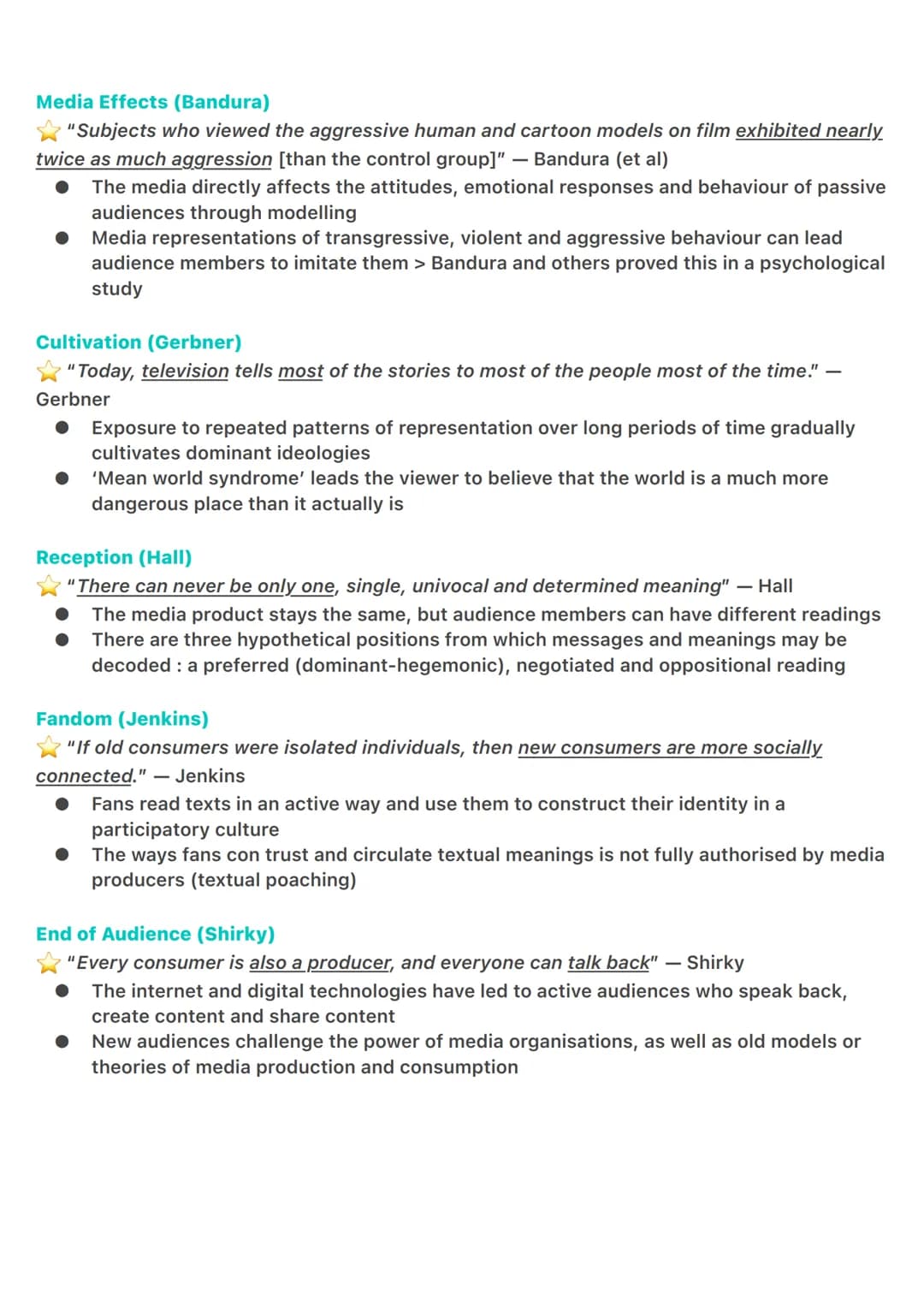
Audience Effects and Digital Revolution
How much does media actually influence you? Bandura's social learning theory suggests direct effects through modelling - his famous Bobo doll experiments showed children imitating aggressive behaviour they'd seen on screen.
Gerbner's cultivation theory takes a longer view, arguing that repeated exposure gradually shapes our worldview. Heavy TV viewers often develop "mean world syndrome," believing reality is more dangerous than it actually is.
But audiences aren't passive. Stuart Hall's reception theory identifies three reading positions: preferred (accepting the intended message), negotiated (partially accepting), and oppositional (rejecting the message entirely).
Henry Jenkins celebrates active fandom where fans create their own meanings through "textual poaching" - think fan fiction, memes, and remix culture. Clay Shirky goes further, declaring the "end of audience" in digital culture where everyone can be a producer.
Digital Reality Check: Shirky's theory explains how social media has transformed passive consumers into active participants who challenge traditional media power structures.
We thought you’d never ask...
What is the Knowunity AI companion?
Our AI companion is specifically built for the needs of students. Based on the millions of content pieces we have on the platform we can provide truly meaningful and relevant answers to students. But its not only about answers, the companion is even more about guiding students through their daily learning challenges, with personalised study plans, quizzes or content pieces in the chat and 100% personalisation based on the students skills and developments.
Where can I download the Knowunity app?
You can download the app in the Google Play Store and in the Apple App Store.
Is Knowunity really free of charge?
That's right! Enjoy free access to study content, connect with fellow students, and get instant help – all at your fingertips.
Most popular content in Media Studies
9Media StudiesGCSE Media Studies Essentials
This concise knowledge organiser provides key insights for the GCSE Eduqas Media Studies Paper 1 exam. It includes 5 essential bullet points for each focus area: context, media language, representation, industries, and audiences. Updated for the 2024 exam, this resource is designed to help students grasp critical concepts and succeed in their studies.
102,96670
Media StudiesEssential Media Theories Overview
Explore a comprehensive summary of key media theories essential for Eduqas A-Level Media Studies. This concise 4-page resource covers critical concepts such as media representation, audience effects, and industry dynamics, featuring relevant examples for practical application. Perfect for quick revision and flashcard preparation.
122,70174
Media StudiesChannel 4's Super. Human. Analysis
In-depth analysis of Channel 4's 2020 'Super. Human.' advertisement for the Paralympics. Explore the media language, representation, and historical context of the campaign, including audio codes, technical elements, and the impact of social media. Ideal for A Level Media Studies students seeking to understand the nuances of advertising and representation in media. Includes bullet points and visual references.
121,42037
Media StudiesEduqas GCSE Media Studies Overview
Comprehensive notes for the Eduqas GCSE Media Studies Paper 1, covering key topics such as gender representation, media industries, and film analysis. This resource is structured for easy navigation and focuses on essential concepts without delving into theories. Perfect for exam preparation and understanding contemporary media contexts.
104,612117
Media StudiesA-Level Media Vogue (Revision sheet)
(Sorry if the images are placed weirdly) Part of A-Level Eduqas syllabus in Component 2, Section B; asked as either a standalone question (usually 15 marks) or comparison with The Big Issue (30 marks)
1261412
Media StudiesA-Level Media Black Panther (Revision Sheet)
Part of Eduqas syllabus for Comp 1; comes up in Section B as an industry question (although audience should be considered). Remember that marketing is crucial for the set film texts!
124208
Media StudiesA-Level Media The Big Issue (Revision sheet)
(Sorry if the PDF has placed images weirdly) Part of the A-Level Eduqas syllabus as part of Component 2, Section B; can be assessed on any media aspect, either through a standalone question (usually 15 marks) or comparison with Vogue (30 marks)
126189
M
Media StudiesMedia audience quiz
a quiz on the audience theories in media
131801
Media StudiesA-Level Media I Daniel Blake (Revision Sheet)
Part of Eduqas syllabus in Comp 1; comes up in Section B for Industry (though it’s important to consider audience too). Hopefully my notes help, marketing is crucial with the set film texts!
133067
Most popular content
9 Sociology
Sociology of Education Overview
Explore comprehensive A-Level Sociology notes on the education system, covering key theories, policies, and sociological perspectives. This resource includes insights on marketisation, gender roles, cultural deprivation, and educational inequalities, providing a thorough understanding of how education shapes social stratification and individual achievement. Ideal for exam preparation and in-depth study.
12102,8693,040
SociologySociology of Families: Comprehensive Revision
Dive into an extensive overview of family dynamics, perspectives, and patterns in sociology. This resource covers key concepts such as family diversity, gender roles, marriage, and the impact of social policies on family structures. Perfect for A-Level Sociology students preparing for Paper 2.
1273,6612,307
CriminologyCriminology: Crime & Punishment Overview
Comprehensive mindmaps covering key concepts in the Crime and Punishment topic for WJEC Criminology Unit 4. This resource includes detailed insights into the Criminal Justice System, crime prevention strategies, sentencing models, and the roles of various agencies. Ideal for A-Level revision, ensuring you grasp essential theories and legislative processes to excel in your exams.
1254,8721,059
SociologyComprehensive Crime & Deviance Overview
Explore an extensive revision of crime and deviance topics, including theories, types of crime, and the impact of media. This resource covers key concepts such as Marxism, functionalism, gender and crime, and the influence of globalization on criminal behavior. Ideal for students seeking a thorough understanding of criminology and its various theories. Type: Full Topic Revision.
1251,6541,399
C
 Biology
Cell Biology and Cell structure
cell structures
93,2490
 English Literature
An Inspector Calls: Character Insights
Explore in-depth analysis and key quotes for characters in J.B. Priestley's 'An Inspector Calls'. This resource covers Gerald Croft, Inspector Goole, Sheila Birling, Mrs. Birling, Eric Birling, and Eva Smith, focusing on themes of class, gender roles, and social responsibility. Ideal for students aiming for Grade 8 and above.
1025,429907
CriminologyWJEC Unit 4 Criminology
Criminology unit 4 detailed revision note
127,151125
CriminologyCriminology Theories Overview
Explore key criminology theories and their implications on crime and deviance. This comprehensive summary covers biological, psychological, and sociological perspectives, including labelling theory, right realism, and the impact of social campaigns on policy development. Ideal for A-Level criminology students seeking to understand the complexities of criminal behaviour and the factors influencing crime prevention strategies.
129,760210
English LiteratureRomeo and Juliet: Key themes
Key Romeo and Juliet themes and analysed quotes
106,708198
Can't find what you're looking for? Explore other subjects.
Students love us — and so will you.
4.6/5App Store
4.7/5Google Play
The app is very easy to use and well designed. I have found everything I was looking for so far and have been able to learn a lot from the presentations! I will definitely use the app for a class assignment! And of course it also helps a lot as an inspiration.
Stefan SiOS user
This app is really great. There are so many study notes and help [...]. My problem subject is French, for example, and the app has so many options for help. Thanks to this app, I have improved my French. I would recommend it to anyone.
Samantha KlichAndroid user
Wow, I am really amazed. I just tried the app because I've seen it advertised many times and was absolutely stunned. This app is THE HELP you want for school and above all, it offers so many things, such as workouts and fact sheets, which have been VERY helpful to me personally.
AnnaiOS user
Media Studies523 views·Updated Jun 24, 2026·4 pages19 Essential Media Theories for Eduqas A-Level Media Studies
mar@myst1cmars
These media theories form the backbone of A-level Media Studies and help you understand how media texts create meaning and influence audiences. From Barthes' semiotics to modern digital culture theories, these concepts explain everything from why certain films make you...
1
of 4
Sign up to see the content. It's free!
- Access to all documents
- Improve your grades
- Join milions of students
Core Media Theory Foundations
Ever wondered why a luxury car advert makes you think about wealth and success? Semiotics explains this perfectly - it's all about how media texts use signs and codes to create meaning beyond the obvious.
Roland Barthes showed us that every sign has two layers: denotation (the literal meaning) and connotation (the deeper cultural associations). When these meanings become so normal we don't question them, they turn into myths that reinforce dominant ideologies.
Barthes also identified narrative codes that keep you hooked on stories. Enigma codes create mysteries that make you desperate for answers, whilst action codes drive the plot forward through familiar sequences of events.
Todorov's narratology reveals the classic story structure you'll spot everywhere: equilibrium → disruption → quest → new equilibrium. The way stories resolve tells us what values society wants to promote. Genre theory (Neale) explains why we love both familiar elements and surprising twists - pure repetition would be boring, but complete originality would be confusing.
Quick Tip: Use Lévi-Strauss's binary oppositions to analyse any text - look for opposing values like good vs evil, civilised vs primitive, or rich vs poor to uncover the ideological messages.
2
of 4Sign up to see the content. It's free!
- Access to all documents
- Improve your grades
- Join milions of students
Identity, Gender and Power Structures
Your reality might be more constructed than you think. Baudrillard's postmodernism argues that media images have become more "real" than actual reality - think about how Instagram filters shape beauty standards or how TV crime shows influence what we think about police work.
Stuart Hall's work on stereotypes reveals how media representations often reinforce power imbalances. Stereotypes aren't just harmless shortcuts - they're tools that keep marginalised groups positioned as "other" whilst maintaining existing hierarchies.
Gender representation has evolved dramatically. Gauntlett notes how we've moved from rigid male/female roles to a diverse toolkit of identity resources. However, van Zoonen highlights persistent differences: women's bodies are still often presented as passive objects to be looked at, whilst men's bodies emphasise action and movement.
Bell hooks' intersectional feminism pushes further, arguing that race, class and gender intersect to create different levels of oppression. Judith Butler takes this even further, suggesting gender itself is a performance we repeat daily rather than something we simply "are".
Remember: Paul Gilroy's postcolonial theory explains how Britain's colonial past still influences today's media, creating "postcolonial melancholia" and maintaining white cultural dominance.
3
of 4Sign up to see the content. It's free!
- Access to all documents
- Improve your grades
- Join milions of students
Industry Power and Control
Three massive theories explain who really controls what you watch and why. Curran & Seaton argue that media concentration in the hands of few companies limits creativity and variety - profit motives override public interest.
Livingstone & Lunt highlight the ongoing tension in media regulation: protecting citizens from harm versus giving consumers choice and value. Digital technology has made this balancing act even trickier for regulators.
Hesmondhalgh's cultural industries theory reveals how media companies minimise risk through vertical integration (controlling production to distribution) and horizontal integration (owning multiple media types). They format content using proven formulas - star casting, genre conventions, and familiar narratives.
The internet hasn't democratised media as much as we hoped. Instead, it's created new profit-oriented cultural industries that still prioritise commercial success over diverse content.
Key Insight: These ownership patterns directly affect what content gets made and how it represents different groups in society.
4
of 4Sign up to see the content. It's free!
- Access to all documents
- Improve your grades
- Join milions of students
Audience Effects and Digital Revolution
How much does media actually influence you? Bandura's social learning theory suggests direct effects through modelling - his famous Bobo doll experiments showed children imitating aggressive behaviour they'd seen on screen.
Gerbner's cultivation theory takes a longer view, arguing that repeated exposure gradually shapes our worldview. Heavy TV viewers often develop "mean world syndrome," believing reality is more dangerous than it actually is.
But audiences aren't passive. Stuart Hall's reception theory identifies three reading positions: preferred (accepting the intended message), negotiated (partially accepting), and oppositional (rejecting the message entirely).
Henry Jenkins celebrates active fandom where fans create their own meanings through "textual poaching" - think fan fiction, memes, and remix culture. Clay Shirky goes further, declaring the "end of audience" in digital culture where everyone can be a producer.
Digital Reality Check: Shirky's theory explains how social media has transformed passive consumers into active participants who challenge traditional media power structures.
We thought you’d never ask...
What is the Knowunity AI companion?
Our AI companion is specifically built for the needs of students. Based on the millions of content pieces we have on the platform we can provide truly meaningful and relevant answers to students. But its not only about answers, the companion is even more about guiding students through their daily learning challenges, with personalised study plans, quizzes or content pieces in the chat and 100% personalisation based on the students skills and developments.
Where can I download the Knowunity app?
You can download the app in the Google Play Store and in the Apple App Store.
Is Knowunity really free of charge?
That's right! Enjoy free access to study content, connect with fellow students, and get instant help – all at your fingertips.
Most popular content in Media Studies
9Media StudiesGCSE Media Studies Essentials
This concise knowledge organiser provides key insights for the GCSE Eduqas Media Studies Paper 1 exam. It includes 5 essential bullet points for each focus area: context, media language, representation, industries, and audiences. Updated for the 2024 exam, this resource is designed to help students grasp critical concepts and succeed in their studies.
102,96670
Media StudiesEssential Media Theories Overview
Explore a comprehensive summary of key media theories essential for Eduqas A-Level Media Studies. This concise 4-page resource covers critical concepts such as media representation, audience effects, and industry dynamics, featuring relevant examples for practical application. Perfect for quick revision and flashcard preparation.
122,70174
Media StudiesChannel 4's Super. Human. Analysis
In-depth analysis of Channel 4's 2020 'Super. Human.' advertisement for the Paralympics. Explore the media language, representation, and historical context of the campaign, including audio codes, technical elements, and the impact of social media. Ideal for A Level Media Studies students seeking to understand the nuances of advertising and representation in media. Includes bullet points and visual references.
121,42037
Media StudiesEduqas GCSE Media Studies Overview
Comprehensive notes for the Eduqas GCSE Media Studies Paper 1, covering key topics such as gender representation, media industries, and film analysis. This resource is structured for easy navigation and focuses on essential concepts without delving into theories. Perfect for exam preparation and understanding contemporary media contexts.
104,612117
Media StudiesA-Level Media Vogue (Revision sheet)
(Sorry if the images are placed weirdly) Part of A-Level Eduqas syllabus in Component 2, Section B; asked as either a standalone question (usually 15 marks) or comparison with The Big Issue (30 marks)
1261412
Media StudiesA-Level Media Black Panther (Revision Sheet)
Part of Eduqas syllabus for Comp 1; comes up in Section B as an industry question (although audience should be considered). Remember that marketing is crucial for the set film texts!
124208
Media StudiesA-Level Media The Big Issue (Revision sheet)
(Sorry if the PDF has placed images weirdly) Part of the A-Level Eduqas syllabus as part of Component 2, Section B; can be assessed on any media aspect, either through a standalone question (usually 15 marks) or comparison with Vogue (30 marks)
126189
M
Media StudiesMedia audience quiz
a quiz on the audience theories in media
131801
Media StudiesA-Level Media I Daniel Blake (Revision Sheet)
Part of Eduqas syllabus in Comp 1; comes up in Section B for Industry (though it’s important to consider audience too). Hopefully my notes help, marketing is crucial with the set film texts!
133067
Most popular content
9SociologySociology of Education Overview
Explore comprehensive A-Level Sociology notes on the education system, covering key theories, policies, and sociological perspectives. This resource includes insights on marketisation, gender roles, cultural deprivation, and educational inequalities, providing a thorough understanding of how education shapes social stratification and individual achievement. Ideal for exam preparation and in-depth study.
12102,8693,040
SociologySociology of Families: Comprehensive Revision
Dive into an extensive overview of family dynamics, perspectives, and patterns in sociology. This resource covers key concepts such as family diversity, gender roles, marriage, and the impact of social policies on family structures. Perfect for A-Level Sociology students preparing for Paper 2.
1273,6612,307
CriminologyCriminology: Crime & Punishment Overview
Comprehensive mindmaps covering key concepts in the Crime and Punishment topic for WJEC Criminology Unit 4. This resource includes detailed insights into the Criminal Justice System, crime prevention strategies, sentencing models, and the roles of various agencies. Ideal for A-Level revision, ensuring you grasp essential theories and legislative processes to excel in your exams.
1254,8721,059
SociologyComprehensive Crime & Deviance Overview
Explore an extensive revision of crime and deviance topics, including theories, types of crime, and the impact of media. This resource covers key concepts such as Marxism, functionalism, gender and crime, and the influence of globalization on criminal behavior. Ideal for students seeking a thorough understanding of criminology and its various theories. Type: Full Topic Revision.
1251,6541,399
C
BiologyCell Biology and Cell structure
cell structures
93,2490
English LiteratureAn Inspector Calls: Character Insights
Explore in-depth analysis and key quotes for characters in J.B. Priestley's 'An Inspector Calls'. This resource covers Gerald Croft, Inspector Goole, Sheila Birling, Mrs. Birling, Eric Birling, and Eva Smith, focusing on themes of class, gender roles, and social responsibility. Ideal for students aiming for Grade 8 and above.
1025,429907
CriminologyWJEC Unit 4 Criminology
Criminology unit 4 detailed revision note
127,151125
CriminologyCriminology Theories Overview
Explore key criminology theories and their implications on crime and deviance. This comprehensive summary covers biological, psychological, and sociological perspectives, including labelling theory, right realism, and the impact of social campaigns on policy development. Ideal for A-Level criminology students seeking to understand the complexities of criminal behaviour and the factors influencing crime prevention strategies.
129,760210
English LiteratureRomeo and Juliet: Key themes
Key Romeo and Juliet themes and analysed quotes
106,708198
Can't find what you're looking for? Explore other subjects.
Students love us — and so will you.
4.6/5App Store
4.7/5Google Play
The app is very easy to use and well designed. I have found everything I was looking for so far and have been able to learn a lot from the presentations! I will definitely use the app for a class assignment! And of course it also helps a lot as an inspiration.
Stefan SiOS user
This app is really great. There are so many study notes and help [...]. My problem subject is French, for example, and the app has so many options for help. Thanks to this app, I have improved my French. I would recommend it to anyone.
Samantha KlichAndroid user
Wow, I am really amazed. I just tried the app because I've seen it advertised many times and was absolutely stunned. This app is THE HELP you want for school and above all, it offers so many things, such as workouts and fact sheets, which have been VERY helpful to me personally.
AnnaiOS user