
Channel 4's "Super.Human" advert for the 2021 Paralympics completely flipped...
 Media Studies559 views·Updated Jun 24, 2026·8 pages
Unlocking Superhuman Notes for EDUQAS Success

meg@megbentley18


1 / 8
1
of 8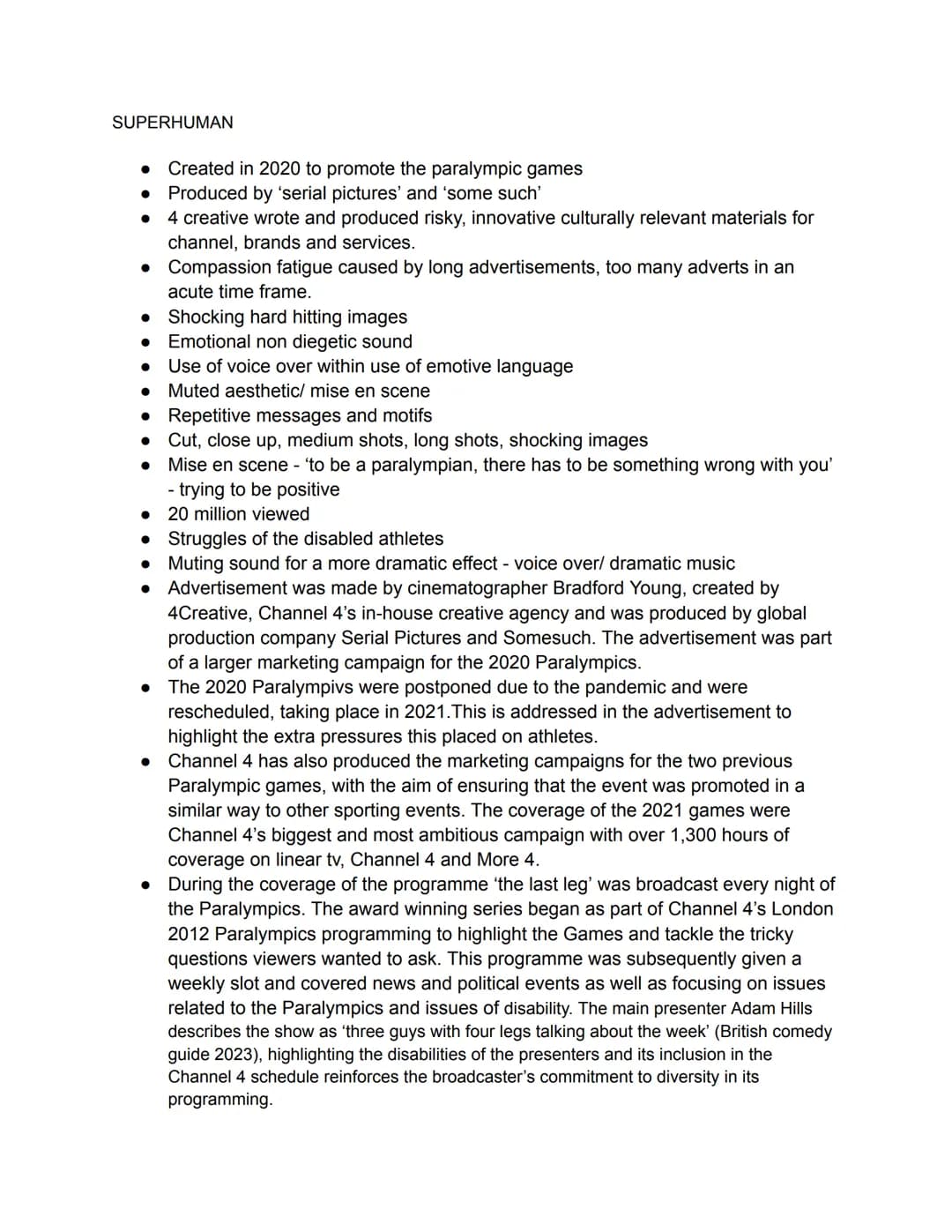
The Campaign That Changed Everything
Ever wondered why some adverts stick with you whilst others are instantly forgotten? Channel 4's Super.Human campaign proves that breaking the rules works. Created in 2020 for the Paralympics, this wasn't your typical inspirational sports advert.
The creative team at 4Creative and production companies Serial Pictures and Somesuch took a massive risk. They knew audiences were suffering from compassion fatigue - basically, we'd all become numb to endless charity adverts with sad music and pitying voiceovers.
Their solution? Show Paralympic athletes as they really are: talented, determined people who happen to have disabilities. The advert reached 20 million viewers and became Channel 4's most ambitious Paralympics campaign ever, with over 1,300 hours of coverage.
Remember: This advert works because it treats disabled athletes as athletes first, not as inspiration for able-bodied people.
2
of 8
Media Theory in Action
Here's where it gets interesting for your exams. Gerbner's cultivation theory suggests that repeated exposure to certain representations shapes how we see the world. Traditional disability adverts often showed people as victims or "superhumans" to be amazed by.
Super.Human challenges this by avoiding desensitisation - it doesn't shock you with tragic images. Instead, it shows athletes training, getting blisters, struggling with everyday barriers like café steps, and celebrating victories just like any other sports coverage.
The advert also tackles mean world syndrome - the idea that media makes us see the world as more hostile than it actually is. By showing disabled people as ordinary humans with extraordinary athletic abilities, it offers a more realistic worldview.
Barthes' semiotics comes into play with the visual codes. Swimming goggles, track clothing, and gym equipment quickly establish these people as serious athletes. The binary opposition between dream sequences and harsh training reality creates powerful meaning.
Key insight: The advert works because it uses familiar advertising techniques but applies them in unexpected ways.
3
of 8
Breaking Down the Media Language
The soundtrack choice is genius - "So You Want to be a Boxer" from Bugsy Malone gives an upbeat feel whilst the lyrics relate to struggle and determination. This avoids the typical dramatic orchestral music that screams "feel sorry for these people."
Technical codes work overtime here. Close-up shots of expressions engage you directly, whilst the editing cuts between powerful training moments and everyday life. That slow-motion cycling crash with muted sound? It's designed to show athletic reality, not create sympathy.
The visual codes are carefully chosen. We see athletes in their sports environments - pools, gyms, tracks - but also in domestic settings like hospital rooms and cafés. This juxtaposition normalises disability whilst highlighting the barriers disabled people face daily.
The iconography includes some brilliant touches: the hamster wheel animation and "puke bucket" use humour to show the gruelling nature of training. These visual signifiers communicate struggle without making it depressing.
Exam tip: Notice how the advert uses conventional advertising techniques but subverts audience expectations about disability representation.
4
of 8
Challenging Representations
This is where Channel 4's ideology really shows. The broadcaster's remit is to represent diverse voices, and Super.Human does exactly that by avoiding stereotypical representations of disabled people as either victims or "inspiration porn."
Stuart Hall's reception theory explains how this works. The advert uses easily recognisable signs - athletic clothing, training equipment, expressions of effort - but applies them to challenge stereotyping. Instead of showing disability as something to overcome, it presents athletes as three-dimensional people.
The binary opposition between audience perceptions ("there's got to be something wrong with you") and reality (these are elite athletes) forces viewers to examine their own misconceptions. This creates what Hall would call a preferred reading - we should see Paralympic athletes as athletes first.
Gauntlett's identity theory is crucial here. The advert gives positive representation to disabled people, allowing them to see themselves reflected in media in empowering ways. It broadens understanding of what disability actually means in 2021.
Think about it: How often do you see disabled people in adverts who aren't either tragic figures or inspirational heroes?
5
of 8
Audience Impact and Reception
The target audience isn't just sports fans - it's Channel 4's core demographic of 16-34 year olds, plus anyone wanting more inclusive media representation. The personalisation strategy works because real human stories always engage audiences better than abstract concepts.
Technical codes grab attention through slightly uncomfortable close-ups - that blister being popped, the prosthetic blade being attached. These moments hold your attention because they're genuine rather than sanitised. The editing between gruelling training and cartoon moments keeps the tone balanced.
The unique selling point is showing rather than telling. No patronising voiceover explains how we should feel. Instead, you're left with that powerful final message to examine your own assumptions about disability and athletic achievement.
The results speak for themselves: 22% of viewers were aged 16-34, the campaign reached 81% of the UK population, and research showed 65% felt more positive about disabled people after watching. That's genuine attitude change through media representation.
Success factor: Treating your audience as intelligent enough to form their own opinions, rather than telling them how to feel.
6
of 8
Social and Cultural Context
Advertising always reflects the society that creates it, and Super.Human emerged from growing awareness about representation and inclusion. Channel 4 actively decided to present athletes as neither victims nor heroes, but as ordinary people facing extraordinary challenges.
The social context matters hugely here. This campaign reflects 2020's appetite for authentic success stories rather than inspiration porn. The dream sequence shattering into reality at the start perfectly captures this cultural moment - we want real stories, not fantasy.
Hall's encoding/decoding model helps explain audience responses. The preferred reading encourages investment in these athletes' stories and watching the Paralympics. A negotiated reading might accept the positive approach whilst feeling distant from sport itself.
Oppositional readings could come from viewers uncomfortable with Channel 4's inclusive ethos or those uninterested in sport generally. However, the advert's success suggests most audiences embraced its challenge to traditional disability representation.
Cultural impact: Sometimes the most powerful way to change attitudes is to show people as they actually are, rather than as stereotypes suggest they should be.
7
of 8
8
of 8
We thought you’d never ask...
What is the Knowunity AI companion?
Our AI companion is specifically built for the needs of students. Based on the millions of content pieces we have on the platform we can provide truly meaningful and relevant answers to students. But its not only about answers, the companion is even more about guiding students through their daily learning challenges, with personalised study plans, quizzes or content pieces in the chat and 100% personalisation based on the students skills and developments.
Where can I download the Knowunity app?
You can download the app in the Google Play Store and in the Apple App Store.
Is Knowunity really free of charge?
That's right! Enjoy free access to study content, connect with fellow students, and get instant help – all at your fingertips.
Similar Content
 Artes
ArtesMost popular content: Cultural Context
9Media StudiesGCSE Media Studies Essentials
This concise knowledge organiser provides key insights for the GCSE Eduqas Media Studies Paper 1 exam. It includes 5 essential bullet points for each focus area: context, media language, representation, industries, and audiences. Updated for the 2024 exam, this resource is designed to help students grasp critical concepts and succeed in their studies.
102,96670
Media StudiesChannel 4's Super. Human. Analysis
In-depth analysis of Channel 4's 2020 'Super. Human.' advertisement for the Paralympics. Explore the media language, representation, and historical context of the campaign, including audio codes, technical elements, and the impact of social media. Ideal for A Level Media Studies students seeking to understand the nuances of advertising and representation in media. Includes bullet points and visual references.
121,42037
Media StudiesEmpowerment in Media
Explore the 'This Girl Can' campaign through a detailed analysis of its context, media language, representation, and underlying theories. This summary highlights key concepts such as empowerment, confidence, and self-belief, making it an essential resource for Eduqas GCSE Media Studies. Perfect for understanding how media shapes perceptions of women in sports.
101,31041
Media StudiesVogue's Cultural Impact
Explore the evolution of Vogue magazine from its inception in 1892 to its modern-day influence on fashion and women's representation. This summary delves into key themes such as women's empowerment, media representation, and the intersection of class and gender in the context of Vogue's historical and contemporary narratives. Ideal for students studying media representation and gender studies.
121,08124
Media StudiesTide Advert Mind map analysis
Tide print advert breakdown with mise-en-scene, product context, audience and representation theorists.
1226716
Media StudiesGender Representation in Bond
Explore the complexities of gender representation in 'The Man With The Golden Gun' through an in-depth analysis of media language, character roles, and historical context. This study note covers key theories such as Propp's Character Types and Mulvey's Male Gaze, highlighting the portrayal of women and men in the 1970s spy genre. Ideal for Eduqas GCSE Media Studies Paper 1 revision.
1163218
Media StudiesVogue
Case study and overview, for exam
122645
Media StudiesBieber's Intentions: Media Analysis
Explore the key themes of representation, audience engagement, and media language in Justin Bieber's 'Intentions' music video. This presentation covers the cultural context, industry impact, and social messages conveyed through dance and storytelling, making it essential for GCSE Media Studies students. Gain insights into how the video promotes community support and addresses important social issues.
1149013
Media Studies1960s Gender Representation Analysis
Explore the cultural and political context of the 1960s through the lens of the 'Kiss of the Vampire' poster. This analysis delves into media representation, gender roles, and feminist theory, highlighting the evolving dynamics between male and female characters. Key concepts include Stuart Hall's representation theory, Judith Butler's gender performativity, and the impact of societal changes on media portrayals. Ideal for A Level Media Studies students seeking to understand the intersection of gender and media.
1388523
Most popular content in Media Studies
9Media StudiesGCSE Media Studies Essentials
This concise knowledge organiser provides key insights for the GCSE Eduqas Media Studies Paper 1 exam. It includes 5 essential bullet points for each focus area: context, media language, representation, industries, and audiences. Updated for the 2024 exam, this resource is designed to help students grasp critical concepts and succeed in their studies.
102,96670
Media StudiesEssential Media Theories Overview
Explore a comprehensive summary of key media theories essential for Eduqas A-Level Media Studies. This concise 4-page resource covers critical concepts such as media representation, audience effects, and industry dynamics, featuring relevant examples for practical application. Perfect for quick revision and flashcard preparation.
122,70174
Media StudiesChannel 4's Super. Human. Analysis
In-depth analysis of Channel 4's 2020 'Super. Human.' advertisement for the Paralympics. Explore the media language, representation, and historical context of the campaign, including audio codes, technical elements, and the impact of social media. Ideal for A Level Media Studies students seeking to understand the nuances of advertising and representation in media. Includes bullet points and visual references.
121,42037
Media StudiesEduqas GCSE Media Studies Overview
Comprehensive notes for the Eduqas GCSE Media Studies Paper 1, covering key topics such as gender representation, media industries, and film analysis. This resource is structured for easy navigation and focuses on essential concepts without delving into theories. Perfect for exam preparation and understanding contemporary media contexts.
104,612117
Media StudiesA-Level Media Vogue (Revision sheet)
(Sorry if the images are placed weirdly) Part of A-Level Eduqas syllabus in Component 2, Section B; asked as either a standalone question (usually 15 marks) or comparison with The Big Issue (30 marks)
1261412
Media StudiesThe 19 Set Media Theories for Eduqas A-level Media Studies
Name of theory, sur- or main name of theorist, quote from the theorist (about the theory), and multiple literal POINTS of the theory
1252315
Media StudiesA-Level Media Black Panther (Revision Sheet)
Part of Eduqas syllabus for Comp 1; comes up in Section B as an industry question (although audience should be considered). Remember that marketing is crucial for the set film texts!
124208
Media StudiesA-Level Media The Big Issue (Revision sheet)
(Sorry if the PDF has placed images weirdly) Part of the A-Level Eduqas syllabus as part of Component 2, Section B; can be assessed on any media aspect, either through a standalone question (usually 15 marks) or comparison with Vogue (30 marks)
126189
M
Media StudiesMedia audience quiz
a quiz on the audience theories in media
131801
Most popular content
9 Sociology
Sociology of Education Overview
Explore comprehensive A-Level Sociology notes on the education system, covering key theories, policies, and sociological perspectives. This resource includes insights on marketisation, gender roles, cultural deprivation, and educational inequalities, providing a thorough understanding of how education shapes social stratification and individual achievement. Ideal for exam preparation and in-depth study.
12102,8693,040
SociologySociology of Families: Comprehensive Revision
Dive into an extensive overview of family dynamics, perspectives, and patterns in sociology. This resource covers key concepts such as family diversity, gender roles, marriage, and the impact of social policies on family structures. Perfect for A-Level Sociology students preparing for Paper 2.
1273,6662,307
CriminologyCriminology: Crime & Punishment Overview
Comprehensive mindmaps covering key concepts in the Crime and Punishment topic for WJEC Criminology Unit 4. This resource includes detailed insights into the Criminal Justice System, crime prevention strategies, sentencing models, and the roles of various agencies. Ideal for A-Level revision, ensuring you grasp essential theories and legislative processes to excel in your exams.
1254,8721,059
SociologyComprehensive Crime & Deviance Overview
Explore an extensive revision of crime and deviance topics, including theories, types of crime, and the impact of media. This resource covers key concepts such as Marxism, functionalism, gender and crime, and the influence of globalization on criminal behavior. Ideal for students seeking a thorough understanding of criminology and its various theories. Type: Full Topic Revision.
1251,6541,399
C
 Biology
Cell Biology and Cell structure
cell structures
93,2490
 English Literature
An Inspector Calls: Character Insights
Explore in-depth analysis and key quotes for characters in J.B. Priestley's 'An Inspector Calls'. This resource covers Gerald Croft, Inspector Goole, Sheila Birling, Mrs. Birling, Eric Birling, and Eva Smith, focusing on themes of class, gender roles, and social responsibility. Ideal for students aiming for Grade 8 and above.
1025,429907
CriminologyWJEC Unit 4 Criminology
Criminology unit 4 detailed revision note
127,151125
CriminologyCriminology Theories Overview
Explore key criminology theories and their implications on crime and deviance. This comprehensive summary covers biological, psychological, and sociological perspectives, including labelling theory, right realism, and the impact of social campaigns on policy development. Ideal for A-Level criminology students seeking to understand the complexities of criminal behaviour and the factors influencing crime prevention strategies.
129,760210
English LiteratureRomeo and Juliet: Key themes
Key Romeo and Juliet themes and analysed quotes
106,708198
Can't find what you're looking for? Explore other subjects.
Students love us — and so will you.
4.6/5App Store
4.7/5Google Play
The app is very easy to use and well designed. I have found everything I was looking for so far and have been able to learn a lot from the presentations! I will definitely use the app for a class assignment! And of course it also helps a lot as an inspiration.
Stefan SiOS user
This app is really great. There are so many study notes and help [...]. My problem subject is French, for example, and the app has so many options for help. Thanks to this app, I have improved my French. I would recommend it to anyone.
Samantha KlichAndroid user
Wow, I am really amazed. I just tried the app because I've seen it advertised many times and was absolutely stunned. This app is THE HELP you want for school and above all, it offers so many things, such as workouts and fact sheets, which have been VERY helpful to me personally.
AnnaiOS user
Media Studies559 views·Updated Jun 24, 2026·8 pagesUnlocking Superhuman Notes for EDUQAS Success
meg@megbentley18
Channel 4's "Super.Human" advert for the 2021 Paralympics completely flipped how we see disabled athletes. Instead of the usual pity-focused charity adverts, it showed real people dealing with real struggles - both in training and everyday life.
1
of 8
Sign up to see the content. It's free!
- Access to all documents
- Improve your grades
- Join milions of students
The Campaign That Changed Everything
Ever wondered why some adverts stick with you whilst others are instantly forgotten? Channel 4's Super.Human campaign proves that breaking the rules works. Created in 2020 for the Paralympics, this wasn't your typical inspirational sports advert.
The creative team at 4Creative and production companies Serial Pictures and Somesuch took a massive risk. They knew audiences were suffering from compassion fatigue - basically, we'd all become numb to endless charity adverts with sad music and pitying voiceovers.
Their solution? Show Paralympic athletes as they really are: talented, determined people who happen to have disabilities. The advert reached 20 million viewers and became Channel 4's most ambitious Paralympics campaign ever, with over 1,300 hours of coverage.
Remember: This advert works because it treats disabled athletes as athletes first, not as inspiration for able-bodied people.
2
of 8Sign up to see the content. It's free!
- Access to all documents
- Improve your grades
- Join milions of students
Media Theory in Action
Here's where it gets interesting for your exams. Gerbner's cultivation theory suggests that repeated exposure to certain representations shapes how we see the world. Traditional disability adverts often showed people as victims or "superhumans" to be amazed by.
Super.Human challenges this by avoiding desensitisation - it doesn't shock you with tragic images. Instead, it shows athletes training, getting blisters, struggling with everyday barriers like café steps, and celebrating victories just like any other sports coverage.
The advert also tackles mean world syndrome - the idea that media makes us see the world as more hostile than it actually is. By showing disabled people as ordinary humans with extraordinary athletic abilities, it offers a more realistic worldview.
Barthes' semiotics comes into play with the visual codes. Swimming goggles, track clothing, and gym equipment quickly establish these people as serious athletes. The binary opposition between dream sequences and harsh training reality creates powerful meaning.
Key insight: The advert works because it uses familiar advertising techniques but applies them in unexpected ways.
3
of 8Sign up to see the content. It's free!
- Access to all documents
- Improve your grades
- Join milions of students
Breaking Down the Media Language
The soundtrack choice is genius - "So You Want to be a Boxer" from Bugsy Malone gives an upbeat feel whilst the lyrics relate to struggle and determination. This avoids the typical dramatic orchestral music that screams "feel sorry for these people."
Technical codes work overtime here. Close-up shots of expressions engage you directly, whilst the editing cuts between powerful training moments and everyday life. That slow-motion cycling crash with muted sound? It's designed to show athletic reality, not create sympathy.
The visual codes are carefully chosen. We see athletes in their sports environments - pools, gyms, tracks - but also in domestic settings like hospital rooms and cafés. This juxtaposition normalises disability whilst highlighting the barriers disabled people face daily.
The iconography includes some brilliant touches: the hamster wheel animation and "puke bucket" use humour to show the gruelling nature of training. These visual signifiers communicate struggle without making it depressing.
Exam tip: Notice how the advert uses conventional advertising techniques but subverts audience expectations about disability representation.
4
of 8Sign up to see the content. It's free!
- Access to all documents
- Improve your grades
- Join milions of students
Challenging Representations
This is where Channel 4's ideology really shows. The broadcaster's remit is to represent diverse voices, and Super.Human does exactly that by avoiding stereotypical representations of disabled people as either victims or "inspiration porn."
Stuart Hall's reception theory explains how this works. The advert uses easily recognisable signs - athletic clothing, training equipment, expressions of effort - but applies them to challenge stereotyping. Instead of showing disability as something to overcome, it presents athletes as three-dimensional people.
The binary opposition between audience perceptions ("there's got to be something wrong with you") and reality (these are elite athletes) forces viewers to examine their own misconceptions. This creates what Hall would call a preferred reading - we should see Paralympic athletes as athletes first.
Gauntlett's identity theory is crucial here. The advert gives positive representation to disabled people, allowing them to see themselves reflected in media in empowering ways. It broadens understanding of what disability actually means in 2021.
Think about it: How often do you see disabled people in adverts who aren't either tragic figures or inspirational heroes?
5
of 8Sign up to see the content. It's free!
- Access to all documents
- Improve your grades
- Join milions of students
Audience Impact and Reception
The target audience isn't just sports fans - it's Channel 4's core demographic of 16-34 year olds, plus anyone wanting more inclusive media representation. The personalisation strategy works because real human stories always engage audiences better than abstract concepts.
Technical codes grab attention through slightly uncomfortable close-ups - that blister being popped, the prosthetic blade being attached. These moments hold your attention because they're genuine rather than sanitised. The editing between gruelling training and cartoon moments keeps the tone balanced.
The unique selling point is showing rather than telling. No patronising voiceover explains how we should feel. Instead, you're left with that powerful final message to examine your own assumptions about disability and athletic achievement.
The results speak for themselves: 22% of viewers were aged 16-34, the campaign reached 81% of the UK population, and research showed 65% felt more positive about disabled people after watching. That's genuine attitude change through media representation.
Success factor: Treating your audience as intelligent enough to form their own opinions, rather than telling them how to feel.
6
of 8Sign up to see the content. It's free!
- Access to all documents
- Improve your grades
- Join milions of students
Social and Cultural Context
Advertising always reflects the society that creates it, and Super.Human emerged from growing awareness about representation and inclusion. Channel 4 actively decided to present athletes as neither victims nor heroes, but as ordinary people facing extraordinary challenges.
The social context matters hugely here. This campaign reflects 2020's appetite for authentic success stories rather than inspiration porn. The dream sequence shattering into reality at the start perfectly captures this cultural moment - we want real stories, not fantasy.
Hall's encoding/decoding model helps explain audience responses. The preferred reading encourages investment in these athletes' stories and watching the Paralympics. A negotiated reading might accept the positive approach whilst feeling distant from sport itself.
Oppositional readings could come from viewers uncomfortable with Channel 4's inclusive ethos or those uninterested in sport generally. However, the advert's success suggests most audiences embraced its challenge to traditional disability representation.
Cultural impact: Sometimes the most powerful way to change attitudes is to show people as they actually are, rather than as stereotypes suggest they should be.
7
of 8Sign up to see the content. It's free!
- Access to all documents
- Improve your grades
- Join milions of students
8
of 8Sign up to see the content. It's free!
- Access to all documents
- Improve your grades
- Join milions of students
We thought you’d never ask...
What is the Knowunity AI companion?
Our AI companion is specifically built for the needs of students. Based on the millions of content pieces we have on the platform we can provide truly meaningful and relevant answers to students. But its not only about answers, the companion is even more about guiding students through their daily learning challenges, with personalised study plans, quizzes or content pieces in the chat and 100% personalisation based on the students skills and developments.
Where can I download the Knowunity app?
You can download the app in the Google Play Store and in the Apple App Store.
Is Knowunity really free of charge?
That's right! Enjoy free access to study content, connect with fellow students, and get instant help – all at your fingertips.
Similar Content
Most popular content: Cultural Context
9Media StudiesGCSE Media Studies Essentials
This concise knowledge organiser provides key insights for the GCSE Eduqas Media Studies Paper 1 exam. It includes 5 essential bullet points for each focus area: context, media language, representation, industries, and audiences. Updated for the 2024 exam, this resource is designed to help students grasp critical concepts and succeed in their studies.
102,96670
Media StudiesChannel 4's Super. Human. Analysis
In-depth analysis of Channel 4's 2020 'Super. Human.' advertisement for the Paralympics. Explore the media language, representation, and historical context of the campaign, including audio codes, technical elements, and the impact of social media. Ideal for A Level Media Studies students seeking to understand the nuances of advertising and representation in media. Includes bullet points and visual references.
121,42037
Media StudiesEmpowerment in Media
Explore the 'This Girl Can' campaign through a detailed analysis of its context, media language, representation, and underlying theories. This summary highlights key concepts such as empowerment, confidence, and self-belief, making it an essential resource for Eduqas GCSE Media Studies. Perfect for understanding how media shapes perceptions of women in sports.
101,31041
Media StudiesVogue's Cultural Impact
Explore the evolution of Vogue magazine from its inception in 1892 to its modern-day influence on fashion and women's representation. This summary delves into key themes such as women's empowerment, media representation, and the intersection of class and gender in the context of Vogue's historical and contemporary narratives. Ideal for students studying media representation and gender studies.
121,08124
Media StudiesTide Advert Mind map analysis
Tide print advert breakdown with mise-en-scene, product context, audience and representation theorists.
1226716
Media StudiesGender Representation in Bond
Explore the complexities of gender representation in 'The Man With The Golden Gun' through an in-depth analysis of media language, character roles, and historical context. This study note covers key theories such as Propp's Character Types and Mulvey's Male Gaze, highlighting the portrayal of women and men in the 1970s spy genre. Ideal for Eduqas GCSE Media Studies Paper 1 revision.
1163218
Media StudiesVogue
Case study and overview, for exam
122645
Media StudiesBieber's Intentions: Media Analysis
Explore the key themes of representation, audience engagement, and media language in Justin Bieber's 'Intentions' music video. This presentation covers the cultural context, industry impact, and social messages conveyed through dance and storytelling, making it essential for GCSE Media Studies students. Gain insights into how the video promotes community support and addresses important social issues.
1149013
Media Studies1960s Gender Representation Analysis
Explore the cultural and political context of the 1960s through the lens of the 'Kiss of the Vampire' poster. This analysis delves into media representation, gender roles, and feminist theory, highlighting the evolving dynamics between male and female characters. Key concepts include Stuart Hall's representation theory, Judith Butler's gender performativity, and the impact of societal changes on media portrayals. Ideal for A Level Media Studies students seeking to understand the intersection of gender and media.
1388523
Most popular content in Media Studies
9Media StudiesGCSE Media Studies Essentials
This concise knowledge organiser provides key insights for the GCSE Eduqas Media Studies Paper 1 exam. It includes 5 essential bullet points for each focus area: context, media language, representation, industries, and audiences. Updated for the 2024 exam, this resource is designed to help students grasp critical concepts and succeed in their studies.
102,96670
Media StudiesEssential Media Theories Overview
Explore a comprehensive summary of key media theories essential for Eduqas A-Level Media Studies. This concise 4-page resource covers critical concepts such as media representation, audience effects, and industry dynamics, featuring relevant examples for practical application. Perfect for quick revision and flashcard preparation.
122,70174
Media StudiesChannel 4's Super. Human. Analysis
In-depth analysis of Channel 4's 2020 'Super. Human.' advertisement for the Paralympics. Explore the media language, representation, and historical context of the campaign, including audio codes, technical elements, and the impact of social media. Ideal for A Level Media Studies students seeking to understand the nuances of advertising and representation in media. Includes bullet points and visual references.
121,42037
Media StudiesEduqas GCSE Media Studies Overview
Comprehensive notes for the Eduqas GCSE Media Studies Paper 1, covering key topics such as gender representation, media industries, and film analysis. This resource is structured for easy navigation and focuses on essential concepts without delving into theories. Perfect for exam preparation and understanding contemporary media contexts.
104,612117
Media StudiesA-Level Media Vogue (Revision sheet)
(Sorry if the images are placed weirdly) Part of A-Level Eduqas syllabus in Component 2, Section B; asked as either a standalone question (usually 15 marks) or comparison with The Big Issue (30 marks)
1261412
Media StudiesThe 19 Set Media Theories for Eduqas A-level Media Studies
Name of theory, sur- or main name of theorist, quote from the theorist (about the theory), and multiple literal POINTS of the theory
1252315
Media StudiesA-Level Media Black Panther (Revision Sheet)
Part of Eduqas syllabus for Comp 1; comes up in Section B as an industry question (although audience should be considered). Remember that marketing is crucial for the set film texts!
124208
Media StudiesA-Level Media The Big Issue (Revision sheet)
(Sorry if the PDF has placed images weirdly) Part of the A-Level Eduqas syllabus as part of Component 2, Section B; can be assessed on any media aspect, either through a standalone question (usually 15 marks) or comparison with Vogue (30 marks)
126189
M
Media StudiesMedia audience quiz
a quiz on the audience theories in media
131801
Most popular content
9SociologySociology of Education Overview
Explore comprehensive A-Level Sociology notes on the education system, covering key theories, policies, and sociological perspectives. This resource includes insights on marketisation, gender roles, cultural deprivation, and educational inequalities, providing a thorough understanding of how education shapes social stratification and individual achievement. Ideal for exam preparation and in-depth study.
12102,8693,040
SociologySociology of Families: Comprehensive Revision
Dive into an extensive overview of family dynamics, perspectives, and patterns in sociology. This resource covers key concepts such as family diversity, gender roles, marriage, and the impact of social policies on family structures. Perfect for A-Level Sociology students preparing for Paper 2.
1273,6662,307
CriminologyCriminology: Crime & Punishment Overview
Comprehensive mindmaps covering key concepts in the Crime and Punishment topic for WJEC Criminology Unit 4. This resource includes detailed insights into the Criminal Justice System, crime prevention strategies, sentencing models, and the roles of various agencies. Ideal for A-Level revision, ensuring you grasp essential theories and legislative processes to excel in your exams.
1254,8721,059
SociologyComprehensive Crime & Deviance Overview
Explore an extensive revision of crime and deviance topics, including theories, types of crime, and the impact of media. This resource covers key concepts such as Marxism, functionalism, gender and crime, and the influence of globalization on criminal behavior. Ideal for students seeking a thorough understanding of criminology and its various theories. Type: Full Topic Revision.
1251,6541,399
C
BiologyCell Biology and Cell structure
cell structures
93,2490
English LiteratureAn Inspector Calls: Character Insights
Explore in-depth analysis and key quotes for characters in J.B. Priestley's 'An Inspector Calls'. This resource covers Gerald Croft, Inspector Goole, Sheila Birling, Mrs. Birling, Eric Birling, and Eva Smith, focusing on themes of class, gender roles, and social responsibility. Ideal for students aiming for Grade 8 and above.
1025,429907
CriminologyWJEC Unit 4 Criminology
Criminology unit 4 detailed revision note
127,151125
CriminologyCriminology Theories Overview
Explore key criminology theories and their implications on crime and deviance. This comprehensive summary covers biological, psychological, and sociological perspectives, including labelling theory, right realism, and the impact of social campaigns on policy development. Ideal for A-Level criminology students seeking to understand the complexities of criminal behaviour and the factors influencing crime prevention strategies.
129,760210
English LiteratureRomeo and Juliet: Key themes
Key Romeo and Juliet themes and analysed quotes
106,708198
Can't find what you're looking for? Explore other subjects.
Students love us — and so will you.
4.6/5App Store
4.7/5Google Play
The app is very easy to use and well designed. I have found everything I was looking for so far and have been able to learn a lot from the presentations! I will definitely use the app for a class assignment! And of course it also helps a lot as an inspiration.
Stefan SiOS user
This app is really great. There are so many study notes and help [...]. My problem subject is French, for example, and the app has so many options for help. Thanks to this app, I have improved my French. I would recommend it to anyone.
Samantha KlichAndroid user
Wow, I am really amazed. I just tried the app because I've seen it advertised many times and was absolutely stunned. This app is THE HELP you want for school and above all, it offers so many things, such as workouts and fact sheets, which have been VERY helpful to me personally.
AnnaiOS user