

Media Studies GCSEexamination preparation requires comprehensive understanding of key...
 Media Studies4,612 views·Updated Jun 26, 2026·46 pages
Eduqas GCSE Media Studies Paper 1 Notes & Study Guides - Free PDFs!



1 / 10
1
of 10
Understanding Pride Magazine: A Comprehensive Media Studies Analysis
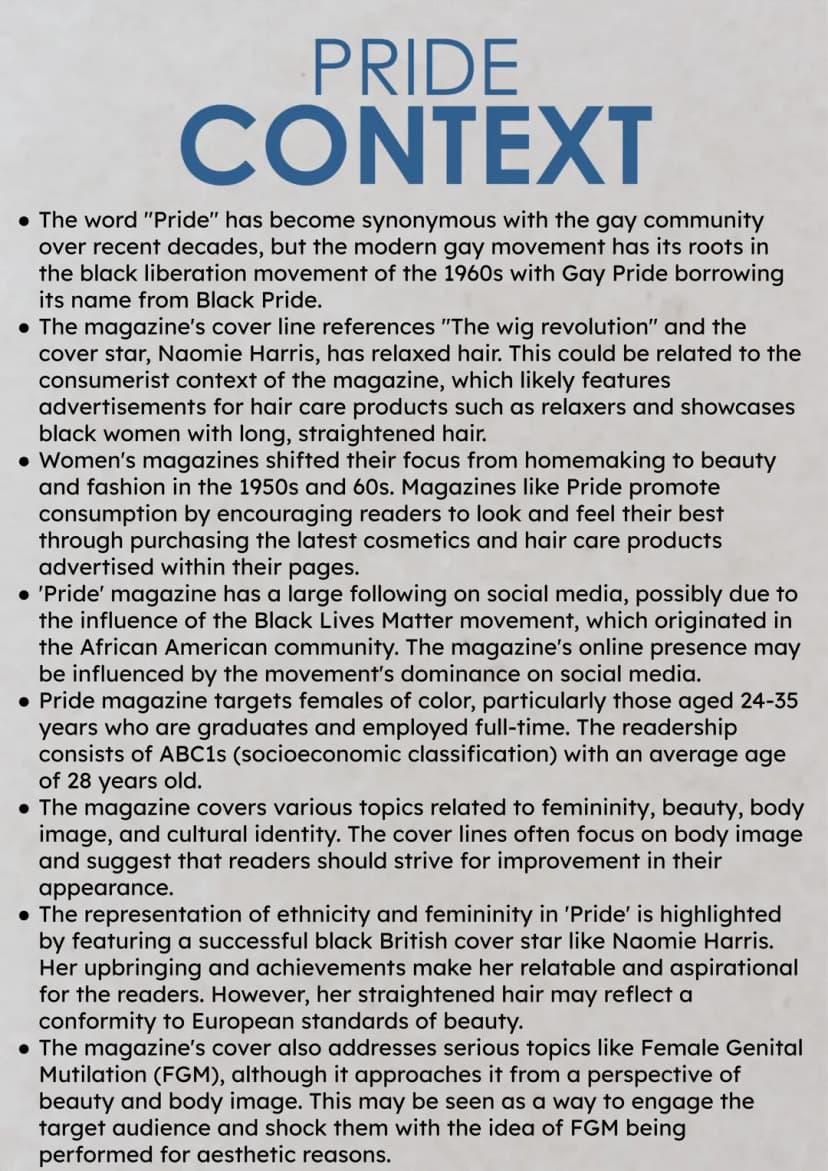
Pride magazine stands as a significant publication in Media Studies GCSE curriculum, particularly for students studying the Eduqas GCSE Media Studies set products 2024. Pride Magazine was founded in 1991, targeting professional women of color aged 24-35, predominantly ABC1 socioeconomic groups with an average reader age of 28.
The magazine's cultural significance extends beyond its commercial success. While celebrating black identity and achievement, it simultaneously navigates complex intersections of beauty standards, cultural representation, and consumer culture. The publication's approach to serious topics like Female Genital Mutilation (FGM) alongside beauty and lifestyle content demonstrates its unique editorial positioning.
Definition: ABC1 socioeconomic classification refers to the upper middle class, middle class, and lower middle class segments of society, typically comprising managerial, administrative, and professional occupations.
2
of 10
Visual and Textual Analysis of Pride Magazine Cover
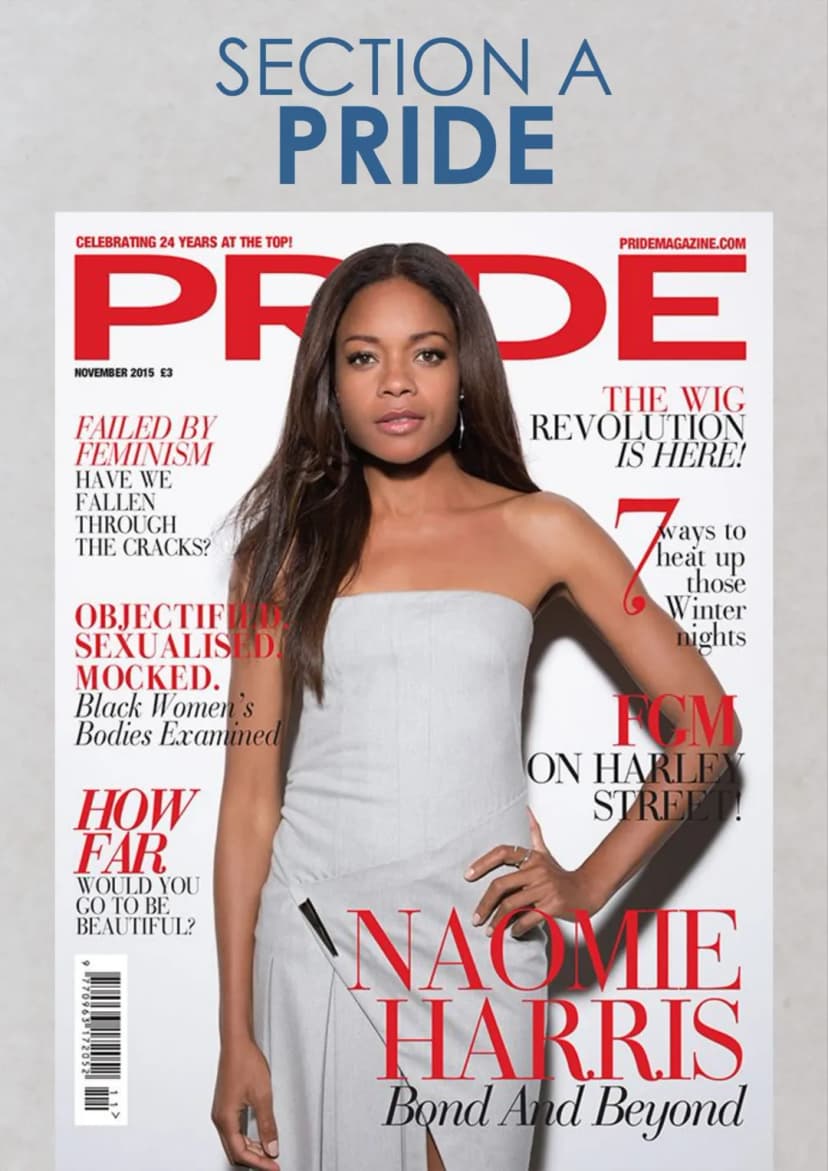
The November 2015 cover of Pride magazine, featuring Naomie Harris, presents rich material for Media Studies GCSE coursework analysis. The masthead design, partially obscured by Harris's image, demonstrates brand confidence while maintaining visual hierarchy. The color scheme employs bold red and black, colors traditionally associated with strength and power.
The cover's composition follows established magazine conventions while incorporating unique elements that speak to its target demographic. Harris's pose - hand on hip, direct gaze - creates both aspirational and relatable content for readers. The layout balances multiple cover lines with varying typography to create visual interest and information hierarchy.
Example: The cover line "FAILED BY FEMINISM" uses large, bold typography to draw attention, while smaller text provides supporting details, demonstrating sophisticated editorial design principles.
3
of 10
Cultural Context and Representation
For students preparing for Media Studies GCSE Revision, understanding Pride magazine's cultural context is crucial. The publication emerged during a significant shift in media representation of black women and continues to navigate complex discussions around beauty standards, cultural identity, and feminism.
The magazine's treatment of topics like the "wig revolution" and beauty standards reveals tensions between cultural authenticity and commercial beauty ideals. This provides excellent material for analyzing media representation and ideology, key components of Media Studies GCSE past papers.
Highlight: Pride magazine's coverage of both lifestyle content and serious social issues reflects its unique position in addressing both the personal and political aspects of its readers' lives.
4
of 10
Media Language and Audience Engagement
Understanding how Pride magazine communicates with its audience is essential for Media Studies GCSE model answers. The publication employs sophisticated media language through its choice of cover lines, imagery, and editorial tone. The magazine assumes an educated, socially aware readership, evidenced by its use of acronyms and complex social commentary.
The magazine's approach to beauty and fashion demonstrates how media products can simultaneously challenge and reinforce conventional standards. This duality provides rich material for analysis in Eduqas GCSE Media Studies Paper 1 notes.
Vocabulary: Media language refers to the ways media products communicate meaning through elements like layout, typography, color, and imagery.
5
of 10
Understanding Pride Magazine's Representation in Media Studies
Pride Magazine stands as a significant publication in Media Studies GCSE curriculum, particularly notable for its representation of ethnicity and femininity. The magazine's choice of Naomie Harris as a cover star provides crucial insight into how lifestyle magazines approach diversity and beauty standards.
The representation of black women in Pride demonstrates complex layers of identity and societal expectations. Founded in 1991, Pride Magazine specifically targets black British women, making it a pioneering publication in the UK media landscape. The magazine's approach to representation balances celebration of black identity while navigating mainstream beauty standards.
Naomie Harris's cover appearance exemplifies the magazine's dual messaging. As a successful black British actress, she represents achievement and aspiration, particularly resonating with the magazine's core demographic. However, her styling choices, including chemically straightened hair, raise important questions about conformity to European beauty standards in media representation.
Definition: Pride Magazine positions itself as a lifestyle publication for black British women, combining celebrity features, fashion, and cultural commentary while addressing specific community concerns.
6
of 10
GQ Magazine: Context and Evolution in Media Studies
Media Studies GCSE students examining GQ Magazine must understand its evolution from Gentleman's Quarterly to a modern lifestyle publication. Launched in 1931, GQ has transformed from a fashion industry insider publication to a multi-platform brand under Condé Nast's ownership.
The magazine's target demographic of ABC1 men aged 20-44 influences its content strategy and presentation. With a monthly print readership of 212,000 and over 2 million monthly unique users online, GQ demonstrates the successful adaptation of traditional print media to the digital age.
Highlight: GQ's business model relies on both magazine sales and advertising revenue, with research showing high purchase intent among readers for featured products.
7
of 10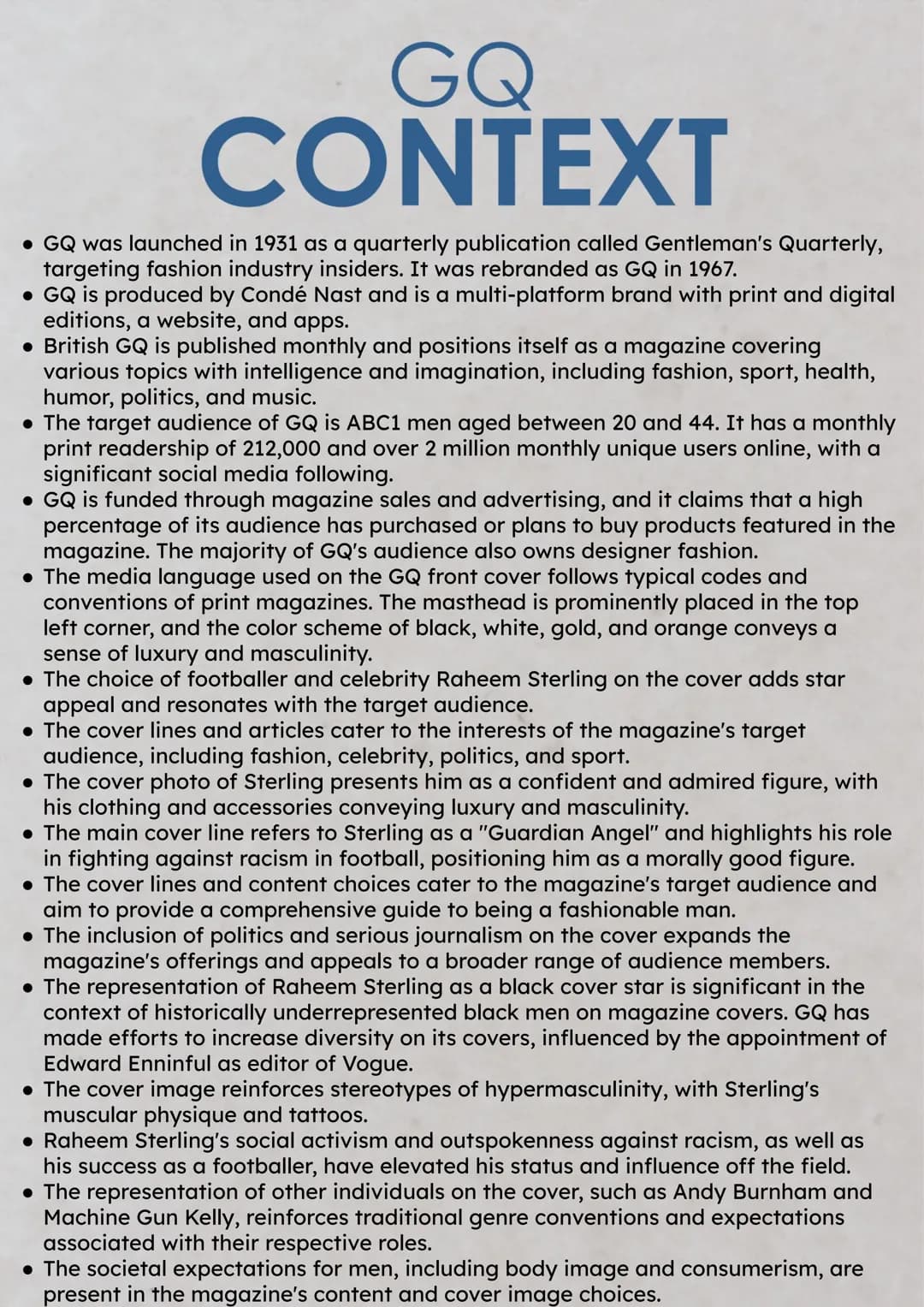
Media Language Analysis in Contemporary Magazine Covers
Understanding media language is crucial for GCSE Media Studies examination success. GQ's cover design employs sophisticated visual hierarchy, with the masthead strategically placed following the "Z-rule" principle. The limited color palette of black, white, gold, and orange creates deliberate connotations of luxury and masculinity.
The cover's composition demonstrates advanced media language techniques. Long shots of celebrities, direct gazing, and carefully chosen typography all contribute to the magazine's messaging and brand identity. Cover lines serve multiple purposes, from establishing authority to creating purchasing incentives.
Example: The main cover line "Guardian Angel" accompanying Raheem Sterling's image demonstrates how text and visual elements work together to construct meaning and reinforce editorial messaging.
8
of 10
Representation Analysis in Modern Media Publications
Contemporary media representation analysis forms a critical component of Media Studies GCSE coursework. The increasing diversity in magazine cover stars reflects broader societal changes and industry responses to calls for better representation. GQ's featuring of Raheem Sterling exemplifies this evolution, presenting him not just as a sports figure but as a cultural influencer.
The magazine's approach to masculinity merits careful analysis. Traditional masculine ideals are both reinforced and redefined through styling, pose selection, and editorial framing. The representation extends beyond physical appearance to encompass success, influence, and social responsibility.
Vocabulary: Hypermasculinity - The exaggeration of stereotypical male behavior, such as an emphasis on physical strength, aggression, and sexuality.
9
of 10
Understanding The Man with the Golden Gun Opening Credits in Media Studies GCSE Revision
The 1974 James Bond film "The Man with the Golden Gun" represents a significant case study for Media Studies GCSE coursework and analysis. The opening credits sequence demonstrates key media language and industry conventions that remain influential in modern film production.
The credits establish the film's status as a major studio production through prominent placement of United Artists branding and producer credits for Albert R. Broccoli and Harry Saltzman. This institutional context is crucial for understanding how Hollywood's studio system operated in the 1970s. The PG rating and copyright notice (shown as "MCMLXXIV") provide important industrial and legal frameworks that Media Studies GCSE past papers frequently examine.
The creative team credits highlight the collaborative nature of film production. Guy Hamilton's direction, Richard Maibaum and Tom Mankiewicz's screenplay, and John Barry's musical score demonstrate how different professional roles contribute to the final product. This understanding of production roles and responsibilities is essential for Media Studies GCSE Revision and coursework analysis.
Definition: Motion picture credits serve multiple functions: they fulfill legal requirements, establish creative ownership, and create audience expectations through their style and presentation.
10
of 10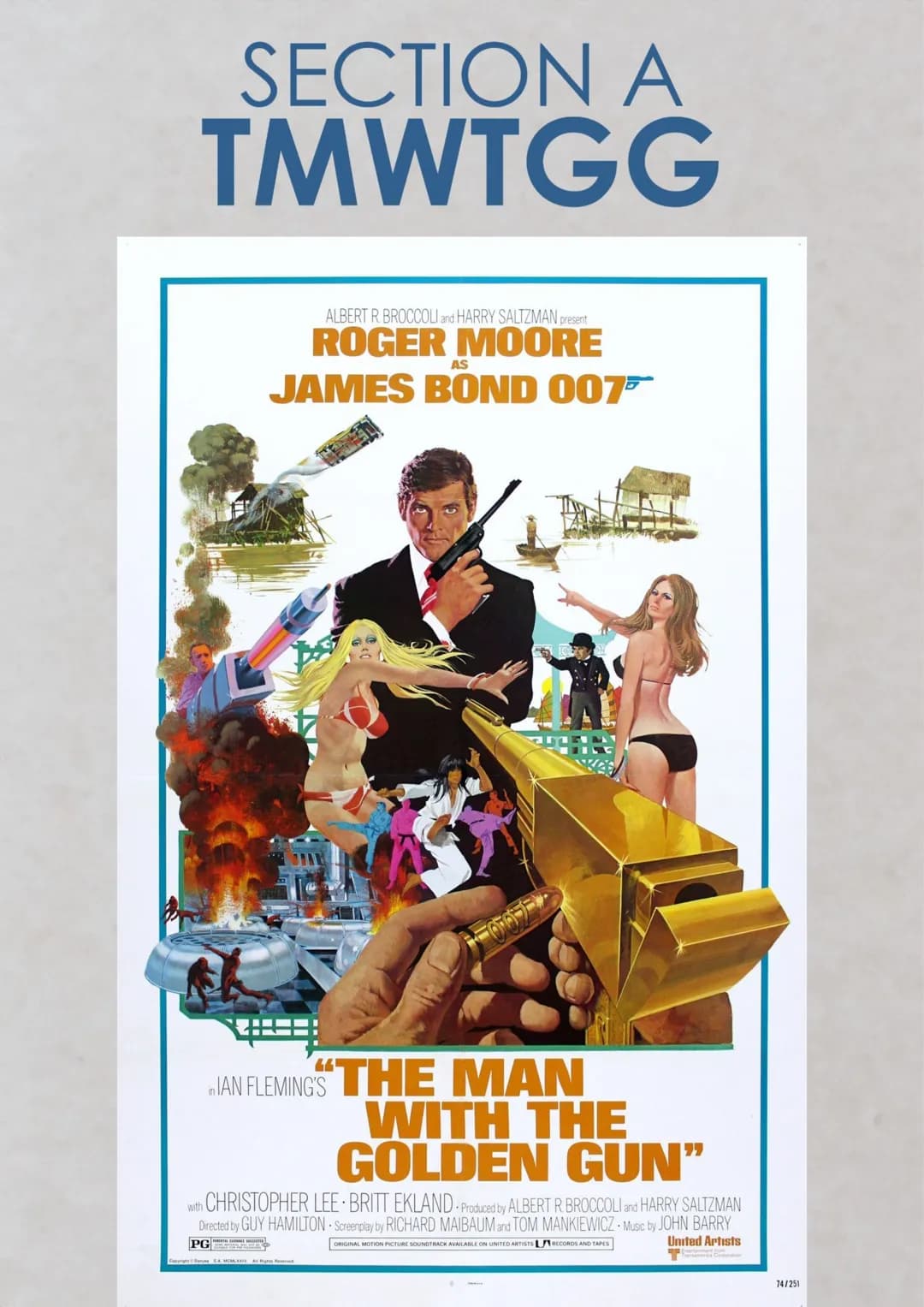
Analyzing Film Marketing and Branding in Media Studies GCSE
The promotional aspects of the opening credits reveal sophisticated marketing strategies that remain relevant to contemporary media analysis. The prominent placement of "ROGER MOORE AS JAMES BOND 007" demonstrates star power's role in film marketing, while connecting to Ian Fleming's source material adds literary credibility.
The inclusion of "ORIGINAL MOTION PICTURE SOUNDTRACK AVAILABLE ON UNITED ARTISTS RECORDS AND TAPES" shows early cross-media promotion and multiple revenue streams - concepts central to understanding media industries. This marketing strategy exemplifies synergy between film and music industries, a key topic in Media Studies GCSE model answers.
The visual presentation of credits, including typography and composition, reflects both period aesthetics and brand identity. The James Bond franchise's distinctive style in credit sequences has become an influential template studied in Media Studies GCSE coursework. This demonstrates how media texts establish and maintain brand recognition through consistent visual elements.
Highlight: The opening credits sequence serves multiple functions beyond simple information delivery - it establishes genre expectations, promotes related products, and reinforces brand identity.
We thought you’d never ask...
What is the Knowunity AI companion?
Our AI companion is specifically built for the needs of students. Based on the millions of content pieces we have on the platform we can provide truly meaningful and relevant answers to students. But its not only about answers, the companion is even more about guiding students through their daily learning challenges, with personalised study plans, quizzes or content pieces in the chat and 100% personalisation based on the students skills and developments.
Where can I download the Knowunity app?
You can download the app in the Google Play Store and in the Apple App Store.
Is Knowunity really free of charge?
That's right! Enjoy free access to study content, connect with fellow students, and get instant help – all at your fingertips.
Similar Content
 Otros
Otros Música
 MAPEH
MAPEHMost popular content: James Bond
3Media StudiesNo Time to Die Analysis
Explore a comprehensive analysis of 'No Time to Die' for EDUQAS GCSE Media Studies. This resource covers key concepts including media language, representation, industry context, and audience engagement. Perfect for Paper 1, Sections A and B, this PDF provides essential insights into the film's production, narrative techniques, and cultural significance.
111,86538
Media StudiesThe Man With The Golden Gun Analysis
Explore key concepts of 'The Man With The Golden Gun' in this concise analysis tailored for Eduqas GCSE Media Studies. This resource covers film representation, media language, and character dynamics, providing essential insights for exam preparation. Perfect for quick revision and understanding of the film's themes and techniques.
1179028
Media StudiesGolden Gun Media Analysis
Explore key concepts of 'The Man With The Golden Gun' in this concise 3-page summary. Understand media language, representation, and the socio-cultural context of the film. Essential for GCSE Media Studies, this resource highlights Bond's portrayal, gender dynamics, and historical influences, helping you maximize your exam performance.
111,00826
Most popular content in Media Studies
9Media StudiesGCSE Media Studies Essentials
This concise knowledge organiser provides key insights for the GCSE Eduqas Media Studies Paper 1 exam. It includes 5 essential bullet points for each focus area: context, media language, representation, industries, and audiences. Updated for the 2024 exam, this resource is designed to help students grasp critical concepts and succeed in their studies.
102,96670
Media StudiesEssential Media Theories Overview
Explore a comprehensive summary of key media theories essential for Eduqas A-Level Media Studies. This concise 4-page resource covers critical concepts such as media representation, audience effects, and industry dynamics, featuring relevant examples for practical application. Perfect for quick revision and flashcard preparation.
122,70174
Media StudiesChannel 4's Super. Human. Analysis
In-depth analysis of Channel 4's 2020 'Super. Human.' advertisement for the Paralympics. Explore the media language, representation, and historical context of the campaign, including audio codes, technical elements, and the impact of social media. Ideal for A Level Media Studies students seeking to understand the nuances of advertising and representation in media. Includes bullet points and visual references.
121,42037
Media StudiesA-Level Media Vogue (Revision sheet)
(Sorry if the images are placed weirdly) Part of A-Level Eduqas syllabus in Component 2, Section B; asked as either a standalone question (usually 15 marks) or comparison with The Big Issue (30 marks)
1261412
Media StudiesThe 19 Set Media Theories for Eduqas A-level Media Studies
Name of theory, sur- or main name of theorist, quote from the theorist (about the theory), and multiple literal POINTS of the theory
1252315
Media StudiesA-Level Media Black Panther (Revision Sheet)
Part of Eduqas syllabus for Comp 1; comes up in Section B as an industry question (although audience should be considered). Remember that marketing is crucial for the set film texts!
124208
Media StudiesA-Level Media The Big Issue (Revision sheet)
(Sorry if the PDF has placed images weirdly) Part of the A-Level Eduqas syllabus as part of Component 2, Section B; can be assessed on any media aspect, either through a standalone question (usually 15 marks) or comparison with Vogue (30 marks)
126189
M
Media StudiesMedia audience quiz
a quiz on the audience theories in media
131801
Media StudiesA-Level Media I Daniel Blake (Revision Sheet)
Part of Eduqas syllabus in Comp 1; comes up in Section B for Industry (though it’s important to consider audience too). Hopefully my notes help, marketing is crucial with the set film texts!
133067
Most popular content
9 Sociology
Sociology of Education Overview
Explore comprehensive A-Level Sociology notes on the education system, covering key theories, policies, and sociological perspectives. This resource includes insights on marketisation, gender roles, cultural deprivation, and educational inequalities, providing a thorough understanding of how education shapes social stratification and individual achievement. Ideal for exam preparation and in-depth study.
12102,8693,040
SociologySociology of Families: Comprehensive Revision
Dive into an extensive overview of family dynamics, perspectives, and patterns in sociology. This resource covers key concepts such as family diversity, gender roles, marriage, and the impact of social policies on family structures. Perfect for A-Level Sociology students preparing for Paper 2.
1273,6612,307
CriminologyCriminology: Crime & Punishment Overview
Comprehensive mindmaps covering key concepts in the Crime and Punishment topic for WJEC Criminology Unit 4. This resource includes detailed insights into the Criminal Justice System, crime prevention strategies, sentencing models, and the roles of various agencies. Ideal for A-Level revision, ensuring you grasp essential theories and legislative processes to excel in your exams.
1254,8721,059
SociologyComprehensive Crime & Deviance Overview
Explore an extensive revision of crime and deviance topics, including theories, types of crime, and the impact of media. This resource covers key concepts such as Marxism, functionalism, gender and crime, and the influence of globalization on criminal behavior. Ideal for students seeking a thorough understanding of criminology and its various theories. Type: Full Topic Revision.
1251,6541,399
C
 Biology
Cell Biology and Cell structure
cell structures
93,2490
 English Literature
An Inspector Calls: Character Insights
Explore in-depth analysis and key quotes for characters in J.B. Priestley's 'An Inspector Calls'. This resource covers Gerald Croft, Inspector Goole, Sheila Birling, Mrs. Birling, Eric Birling, and Eva Smith, focusing on themes of class, gender roles, and social responsibility. Ideal for students aiming for Grade 8 and above.
1025,429907
CriminologyWJEC Unit 4 Criminology
Criminology unit 4 detailed revision note
127,151125
CriminologyCriminology Theories Overview
Explore key criminology theories and their implications on crime and deviance. This comprehensive summary covers biological, psychological, and sociological perspectives, including labelling theory, right realism, and the impact of social campaigns on policy development. Ideal for A-Level criminology students seeking to understand the complexities of criminal behaviour and the factors influencing crime prevention strategies.
129,760210
English LiteratureRomeo and Juliet: Key themes
Key Romeo and Juliet themes and analysed quotes
106,708198
Can't find what you're looking for? Explore other subjects.
Students love us — and so will you.
4.6/5App Store
4.7/5Google Play
The app is very easy to use and well designed. I have found everything I was looking for so far and have been able to learn a lot from the presentations! I will definitely use the app for a class assignment! And of course it also helps a lot as an inspiration.
Stefan SiOS user
This app is really great. There are so many study notes and help [...]. My problem subject is French, for example, and the app has so many options for help. Thanks to this app, I have improved my French. I would recommend it to anyone.
Samantha KlichAndroid user
Wow, I am really amazed. I just tried the app because I've seen it advertised many times and was absolutely stunned. This app is THE HELP you want for school and above all, it offers so many things, such as workouts and fact sheets, which have been VERY helpful to me personally.
AnnaiOS user
Media Studies4,612 views·Updated Jun 26, 2026·46 pagesEduqas GCSE Media Studies Paper 1 Notes & Study Guides - Free PDFs!
Media Studies GCSE examination preparation requires comprehensive understanding of key media products and analytical frameworks.
The Eduqas GCSE Media Studies curriculum focuses on analyzing various media forms including magazines, advertisements, and digital media platforms. Students studying Pride Magazineneed to...
1
of 10
Sign up to see the content. It's free!
- Access to all documents
- Improve your grades
- Join milions of students
Understanding Pride Magazine: A Comprehensive Media Studies Analysis
Pride magazine stands as a significant publication in Media Studies GCSE curriculum, particularly for students studying the Eduqas GCSE Media Studies set products 2024. Pride Magazine was founded in 1991, targeting professional women of color aged 24-35, predominantly ABC1 socioeconomic groups with an average reader age of 28.
The magazine's cultural significance extends beyond its commercial success. While celebrating black identity and achievement, it simultaneously navigates complex intersections of beauty standards, cultural representation, and consumer culture. The publication's approach to serious topics like Female Genital Mutilation (FGM) alongside beauty and lifestyle content demonstrates its unique editorial positioning.
Definition: ABC1 socioeconomic classification refers to the upper middle class, middle class, and lower middle class segments of society, typically comprising managerial, administrative, and professional occupations.
2
of 10Sign up to see the content. It's free!
- Access to all documents
- Improve your grades
- Join milions of students
Visual and Textual Analysis of Pride Magazine Cover
The November 2015 cover of Pride magazine, featuring Naomie Harris, presents rich material for Media Studies GCSE coursework analysis. The masthead design, partially obscured by Harris's image, demonstrates brand confidence while maintaining visual hierarchy. The color scheme employs bold red and black, colors traditionally associated with strength and power.
The cover's composition follows established magazine conventions while incorporating unique elements that speak to its target demographic. Harris's pose - hand on hip, direct gaze - creates both aspirational and relatable content for readers. The layout balances multiple cover lines with varying typography to create visual interest and information hierarchy.
Example: The cover line "FAILED BY FEMINISM" uses large, bold typography to draw attention, while smaller text provides supporting details, demonstrating sophisticated editorial design principles.
3
of 10Sign up to see the content. It's free!
- Access to all documents
- Improve your grades
- Join milions of students
Cultural Context and Representation
For students preparing for Media Studies GCSE Revision, understanding Pride magazine's cultural context is crucial. The publication emerged during a significant shift in media representation of black women and continues to navigate complex discussions around beauty standards, cultural identity, and feminism.
The magazine's treatment of topics like the "wig revolution" and beauty standards reveals tensions between cultural authenticity and commercial beauty ideals. This provides excellent material for analyzing media representation and ideology, key components of Media Studies GCSE past papers.
Highlight: Pride magazine's coverage of both lifestyle content and serious social issues reflects its unique position in addressing both the personal and political aspects of its readers' lives.
4
of 10Sign up to see the content. It's free!
- Access to all documents
- Improve your grades
- Join milions of students
Media Language and Audience Engagement
Understanding how Pride magazine communicates with its audience is essential for Media Studies GCSE model answers. The publication employs sophisticated media language through its choice of cover lines, imagery, and editorial tone. The magazine assumes an educated, socially aware readership, evidenced by its use of acronyms and complex social commentary.
The magazine's approach to beauty and fashion demonstrates how media products can simultaneously challenge and reinforce conventional standards. This duality provides rich material for analysis in Eduqas GCSE Media Studies Paper 1 notes.
Vocabulary: Media language refers to the ways media products communicate meaning through elements like layout, typography, color, and imagery.
5
of 10Sign up to see the content. It's free!
- Access to all documents
- Improve your grades
- Join milions of students
Understanding Pride Magazine's Representation in Media Studies
Pride Magazine stands as a significant publication in Media Studies GCSE curriculum, particularly notable for its representation of ethnicity and femininity. The magazine's choice of Naomie Harris as a cover star provides crucial insight into how lifestyle magazines approach diversity and beauty standards.
The representation of black women in Pride demonstrates complex layers of identity and societal expectations. Founded in 1991, Pride Magazine specifically targets black British women, making it a pioneering publication in the UK media landscape. The magazine's approach to representation balances celebration of black identity while navigating mainstream beauty standards.
Naomie Harris's cover appearance exemplifies the magazine's dual messaging. As a successful black British actress, she represents achievement and aspiration, particularly resonating with the magazine's core demographic. However, her styling choices, including chemically straightened hair, raise important questions about conformity to European beauty standards in media representation.
Definition: Pride Magazine positions itself as a lifestyle publication for black British women, combining celebrity features, fashion, and cultural commentary while addressing specific community concerns.
6
of 10Sign up to see the content. It's free!
- Access to all documents
- Improve your grades
- Join milions of students
GQ Magazine: Context and Evolution in Media Studies
Media Studies GCSE students examining GQ Magazine must understand its evolution from Gentleman's Quarterly to a modern lifestyle publication. Launched in 1931, GQ has transformed from a fashion industry insider publication to a multi-platform brand under Condé Nast's ownership.
The magazine's target demographic of ABC1 men aged 20-44 influences its content strategy and presentation. With a monthly print readership of 212,000 and over 2 million monthly unique users online, GQ demonstrates the successful adaptation of traditional print media to the digital age.
Highlight: GQ's business model relies on both magazine sales and advertising revenue, with research showing high purchase intent among readers for featured products.
7
of 10Sign up to see the content. It's free!
- Access to all documents
- Improve your grades
- Join milions of students
Media Language Analysis in Contemporary Magazine Covers
Understanding media language is crucial for GCSE Media Studies examination success. GQ's cover design employs sophisticated visual hierarchy, with the masthead strategically placed following the "Z-rule" principle. The limited color palette of black, white, gold, and orange creates deliberate connotations of luxury and masculinity.
The cover's composition demonstrates advanced media language techniques. Long shots of celebrities, direct gazing, and carefully chosen typography all contribute to the magazine's messaging and brand identity. Cover lines serve multiple purposes, from establishing authority to creating purchasing incentives.
Example: The main cover line "Guardian Angel" accompanying Raheem Sterling's image demonstrates how text and visual elements work together to construct meaning and reinforce editorial messaging.
8
of 10Sign up to see the content. It's free!
- Access to all documents
- Improve your grades
- Join milions of students
Representation Analysis in Modern Media Publications
Contemporary media representation analysis forms a critical component of Media Studies GCSE coursework. The increasing diversity in magazine cover stars reflects broader societal changes and industry responses to calls for better representation. GQ's featuring of Raheem Sterling exemplifies this evolution, presenting him not just as a sports figure but as a cultural influencer.
The magazine's approach to masculinity merits careful analysis. Traditional masculine ideals are both reinforced and redefined through styling, pose selection, and editorial framing. The representation extends beyond physical appearance to encompass success, influence, and social responsibility.
Vocabulary: Hypermasculinity - The exaggeration of stereotypical male behavior, such as an emphasis on physical strength, aggression, and sexuality.
9
of 10Sign up to see the content. It's free!
- Access to all documents
- Improve your grades
- Join milions of students
Understanding The Man with the Golden Gun Opening Credits in Media Studies GCSE Revision
The 1974 James Bond film "The Man with the Golden Gun" represents a significant case study for Media Studies GCSE coursework and analysis. The opening credits sequence demonstrates key media language and industry conventions that remain influential in modern film production.
The credits establish the film's status as a major studio production through prominent placement of United Artists branding and producer credits for Albert R. Broccoli and Harry Saltzman. This institutional context is crucial for understanding how Hollywood's studio system operated in the 1970s. The PG rating and copyright notice (shown as "MCMLXXIV") provide important industrial and legal frameworks that Media Studies GCSE past papers frequently examine.
The creative team credits highlight the collaborative nature of film production. Guy Hamilton's direction, Richard Maibaum and Tom Mankiewicz's screenplay, and John Barry's musical score demonstrate how different professional roles contribute to the final product. This understanding of production roles and responsibilities is essential for Media Studies GCSE Revision and coursework analysis.
Definition: Motion picture credits serve multiple functions: they fulfill legal requirements, establish creative ownership, and create audience expectations through their style and presentation.
10
of 10Sign up to see the content. It's free!
- Access to all documents
- Improve your grades
- Join milions of students
Analyzing Film Marketing and Branding in Media Studies GCSE
The promotional aspects of the opening credits reveal sophisticated marketing strategies that remain relevant to contemporary media analysis. The prominent placement of "ROGER MOORE AS JAMES BOND 007" demonstrates star power's role in film marketing, while connecting to Ian Fleming's source material adds literary credibility.
The inclusion of "ORIGINAL MOTION PICTURE SOUNDTRACK AVAILABLE ON UNITED ARTISTS RECORDS AND TAPES" shows early cross-media promotion and multiple revenue streams - concepts central to understanding media industries. This marketing strategy exemplifies synergy between film and music industries, a key topic in Media Studies GCSE model answers.
The visual presentation of credits, including typography and composition, reflects both period aesthetics and brand identity. The James Bond franchise's distinctive style in credit sequences has become an influential template studied in Media Studies GCSE coursework. This demonstrates how media texts establish and maintain brand recognition through consistent visual elements.
Highlight: The opening credits sequence serves multiple functions beyond simple information delivery - it establishes genre expectations, promotes related products, and reinforces brand identity.
We thought you’d never ask...
What is the Knowunity AI companion?
Our AI companion is specifically built for the needs of students. Based on the millions of content pieces we have on the platform we can provide truly meaningful and relevant answers to students. But its not only about answers, the companion is even more about guiding students through their daily learning challenges, with personalised study plans, quizzes or content pieces in the chat and 100% personalisation based on the students skills and developments.
Where can I download the Knowunity app?
You can download the app in the Google Play Store and in the Apple App Store.
Is Knowunity really free of charge?
That's right! Enjoy free access to study content, connect with fellow students, and get instant help – all at your fingertips.
Similar Content
Most popular content: James Bond
3Media StudiesNo Time to Die Analysis
Explore a comprehensive analysis of 'No Time to Die' for EDUQAS GCSE Media Studies. This resource covers key concepts including media language, representation, industry context, and audience engagement. Perfect for Paper 1, Sections A and B, this PDF provides essential insights into the film's production, narrative techniques, and cultural significance.
111,86538
Media StudiesThe Man With The Golden Gun Analysis
Explore key concepts of 'The Man With The Golden Gun' in this concise analysis tailored for Eduqas GCSE Media Studies. This resource covers film representation, media language, and character dynamics, providing essential insights for exam preparation. Perfect for quick revision and understanding of the film's themes and techniques.
1179028
Media StudiesGolden Gun Media Analysis
Explore key concepts of 'The Man With The Golden Gun' in this concise 3-page summary. Understand media language, representation, and the socio-cultural context of the film. Essential for GCSE Media Studies, this resource highlights Bond's portrayal, gender dynamics, and historical influences, helping you maximize your exam performance.
111,00826
Most popular content in Media Studies
9Media StudiesGCSE Media Studies Essentials
This concise knowledge organiser provides key insights for the GCSE Eduqas Media Studies Paper 1 exam. It includes 5 essential bullet points for each focus area: context, media language, representation, industries, and audiences. Updated for the 2024 exam, this resource is designed to help students grasp critical concepts and succeed in their studies.
102,96670
Media StudiesEssential Media Theories Overview
Explore a comprehensive summary of key media theories essential for Eduqas A-Level Media Studies. This concise 4-page resource covers critical concepts such as media representation, audience effects, and industry dynamics, featuring relevant examples for practical application. Perfect for quick revision and flashcard preparation.
122,70174
Media StudiesChannel 4's Super. Human. Analysis
In-depth analysis of Channel 4's 2020 'Super. Human.' advertisement for the Paralympics. Explore the media language, representation, and historical context of the campaign, including audio codes, technical elements, and the impact of social media. Ideal for A Level Media Studies students seeking to understand the nuances of advertising and representation in media. Includes bullet points and visual references.
121,42037
Media StudiesA-Level Media Vogue (Revision sheet)
(Sorry if the images are placed weirdly) Part of A-Level Eduqas syllabus in Component 2, Section B; asked as either a standalone question (usually 15 marks) or comparison with The Big Issue (30 marks)
1261412
Media StudiesThe 19 Set Media Theories for Eduqas A-level Media Studies
Name of theory, sur- or main name of theorist, quote from the theorist (about the theory), and multiple literal POINTS of the theory
1252315
Media StudiesA-Level Media Black Panther (Revision Sheet)
Part of Eduqas syllabus for Comp 1; comes up in Section B as an industry question (although audience should be considered). Remember that marketing is crucial for the set film texts!
124208
Media StudiesA-Level Media The Big Issue (Revision sheet)
(Sorry if the PDF has placed images weirdly) Part of the A-Level Eduqas syllabus as part of Component 2, Section B; can be assessed on any media aspect, either through a standalone question (usually 15 marks) or comparison with Vogue (30 marks)
126189
M
Media StudiesMedia audience quiz
a quiz on the audience theories in media
131801
Media StudiesA-Level Media I Daniel Blake (Revision Sheet)
Part of Eduqas syllabus in Comp 1; comes up in Section B for Industry (though it’s important to consider audience too). Hopefully my notes help, marketing is crucial with the set film texts!
133067
Most popular content
9SociologySociology of Education Overview
Explore comprehensive A-Level Sociology notes on the education system, covering key theories, policies, and sociological perspectives. This resource includes insights on marketisation, gender roles, cultural deprivation, and educational inequalities, providing a thorough understanding of how education shapes social stratification and individual achievement. Ideal for exam preparation and in-depth study.
12102,8693,040
SociologySociology of Families: Comprehensive Revision
Dive into an extensive overview of family dynamics, perspectives, and patterns in sociology. This resource covers key concepts such as family diversity, gender roles, marriage, and the impact of social policies on family structures. Perfect for A-Level Sociology students preparing for Paper 2.
1273,6612,307
CriminologyCriminology: Crime & Punishment Overview
Comprehensive mindmaps covering key concepts in the Crime and Punishment topic for WJEC Criminology Unit 4. This resource includes detailed insights into the Criminal Justice System, crime prevention strategies, sentencing models, and the roles of various agencies. Ideal for A-Level revision, ensuring you grasp essential theories and legislative processes to excel in your exams.
1254,8721,059
SociologyComprehensive Crime & Deviance Overview
Explore an extensive revision of crime and deviance topics, including theories, types of crime, and the impact of media. This resource covers key concepts such as Marxism, functionalism, gender and crime, and the influence of globalization on criminal behavior. Ideal for students seeking a thorough understanding of criminology and its various theories. Type: Full Topic Revision.
1251,6541,399
C
BiologyCell Biology and Cell structure
cell structures
93,2490
English LiteratureAn Inspector Calls: Character Insights
Explore in-depth analysis and key quotes for characters in J.B. Priestley's 'An Inspector Calls'. This resource covers Gerald Croft, Inspector Goole, Sheila Birling, Mrs. Birling, Eric Birling, and Eva Smith, focusing on themes of class, gender roles, and social responsibility. Ideal for students aiming for Grade 8 and above.
1025,429907
CriminologyWJEC Unit 4 Criminology
Criminology unit 4 detailed revision note
127,151125
CriminologyCriminology Theories Overview
Explore key criminology theories and their implications on crime and deviance. This comprehensive summary covers biological, psychological, and sociological perspectives, including labelling theory, right realism, and the impact of social campaigns on policy development. Ideal for A-Level criminology students seeking to understand the complexities of criminal behaviour and the factors influencing crime prevention strategies.
129,760210
English LiteratureRomeo and Juliet: Key themes
Key Romeo and Juliet themes and analysed quotes
106,708198
Can't find what you're looking for? Explore other subjects.
Students love us — and so will you.
4.6/5App Store
4.7/5Google Play
The app is very easy to use and well designed. I have found everything I was looking for so far and have been able to learn a lot from the presentations! I will definitely use the app for a class assignment! And of course it also helps a lot as an inspiration.
Stefan SiOS user
This app is really great. There are so many study notes and help [...]. My problem subject is French, for example, and the app has so many options for help. Thanks to this app, I have improved my French. I would recommend it to anyone.
Samantha KlichAndroid user
Wow, I am really amazed. I just tried the app because I've seen it advertised many times and was absolutely stunned. This app is THE HELP you want for school and above all, it offers so many things, such as workouts and fact sheets, which have been VERY helpful to me personally.
AnnaiOS user