
A comprehensive exploration of media and cultural theories focusing on...
 Media Studies1,689 views·Updated Jun 24, 2026·4 pages
Stuart Hall and David Gauntlett Media Theories

Rebecca Carter@rebeccacarter_upmw

1 / 4
1
of 4
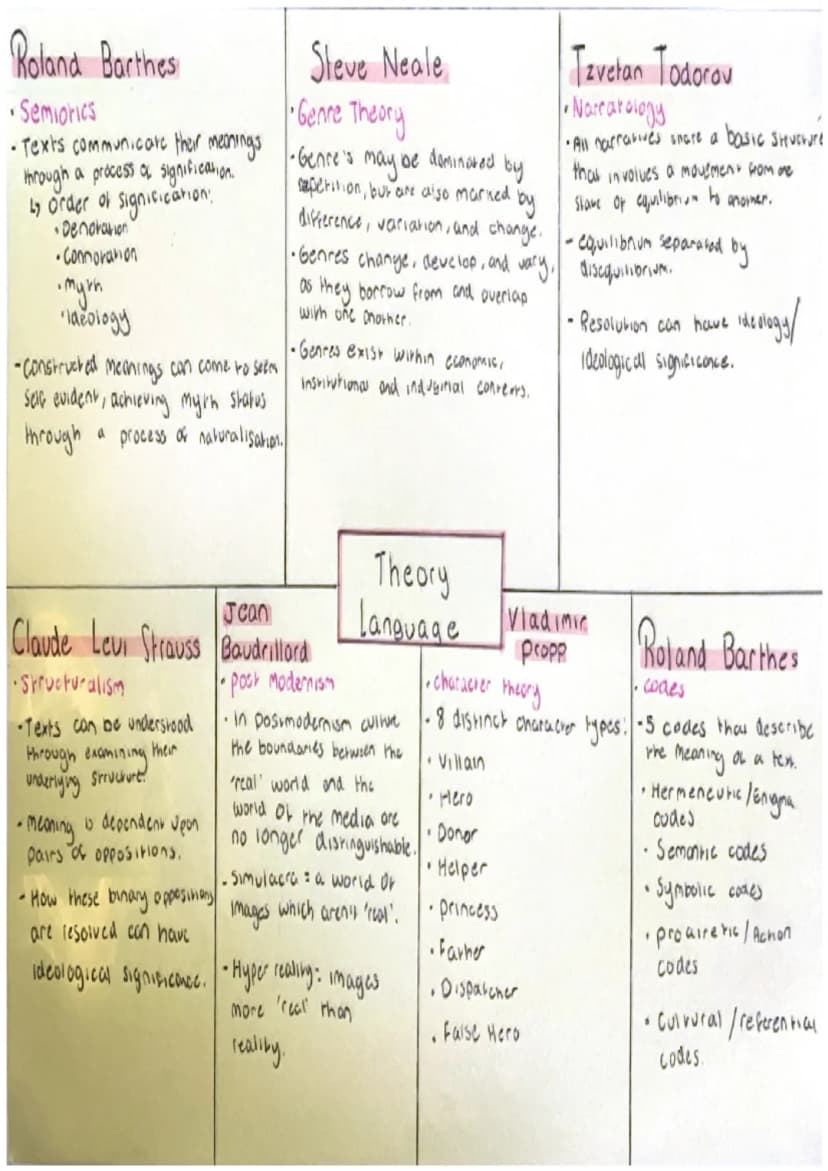
Page 2: Semiotics and Structural Approaches
This page delves into semiotics, structuralism, and genre theory, presenting frameworks for analyzing media texts and their meanings. Roland Barthes' contribution to semiotics and Jean Baudrillard's postmodern perspective are central to understanding media representation.
Vocabulary: Simulacra refers to a world of images where the distinction between reality and media representation becomes blurred.
Definition: Genre theory examines how different media categories evolve, overlap, and operate within economic and industrial contexts.
Example: The eight character types in Vladimir Propp's theory include villain, hero, donor, helper, princess, father, dispatcher, and false hero.
Highlight: Barthes' five codes (hermeneutic, semantic, symbolic, proairetic, and cultural) provide a comprehensive framework for textual analysis.
2
of 4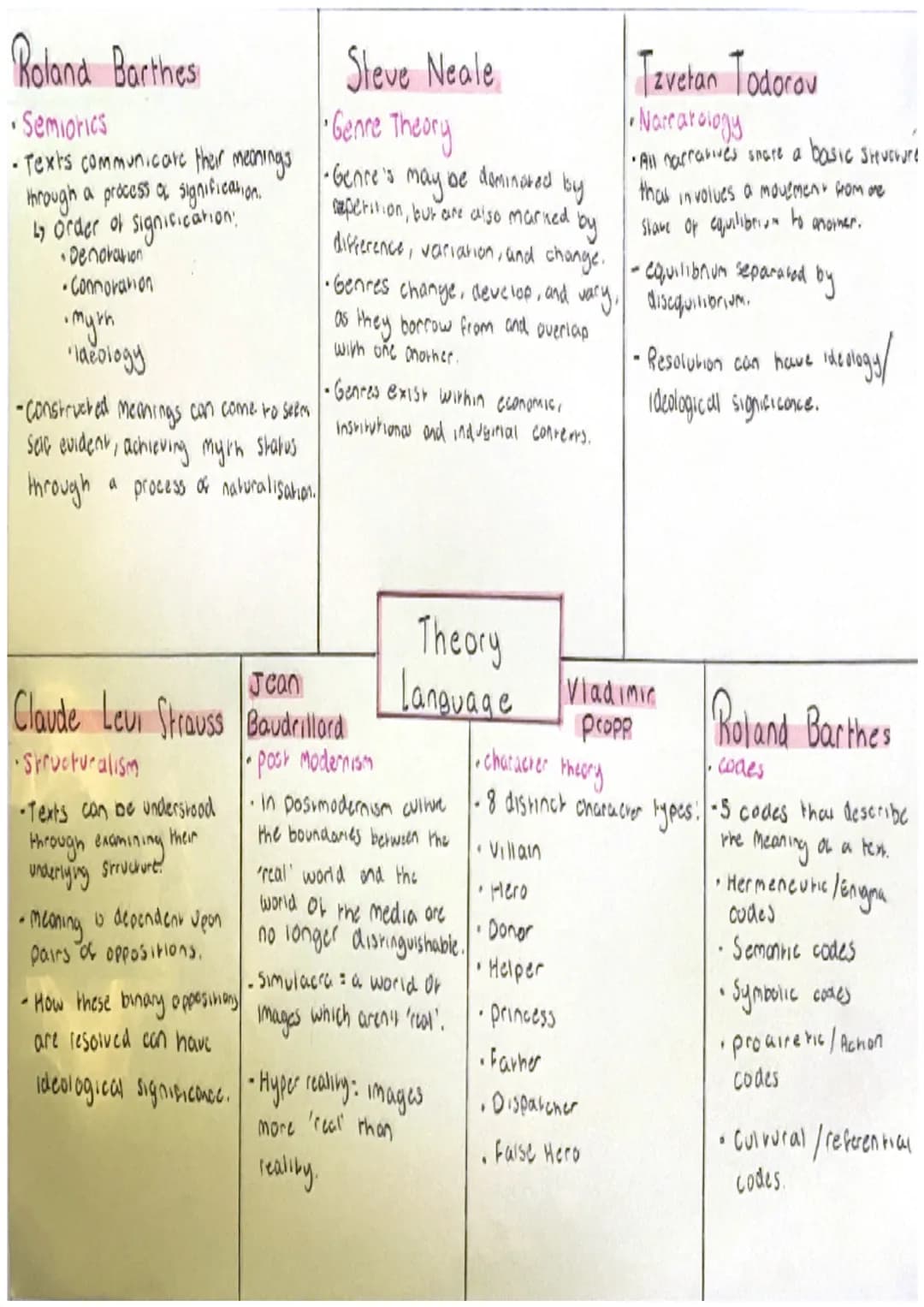
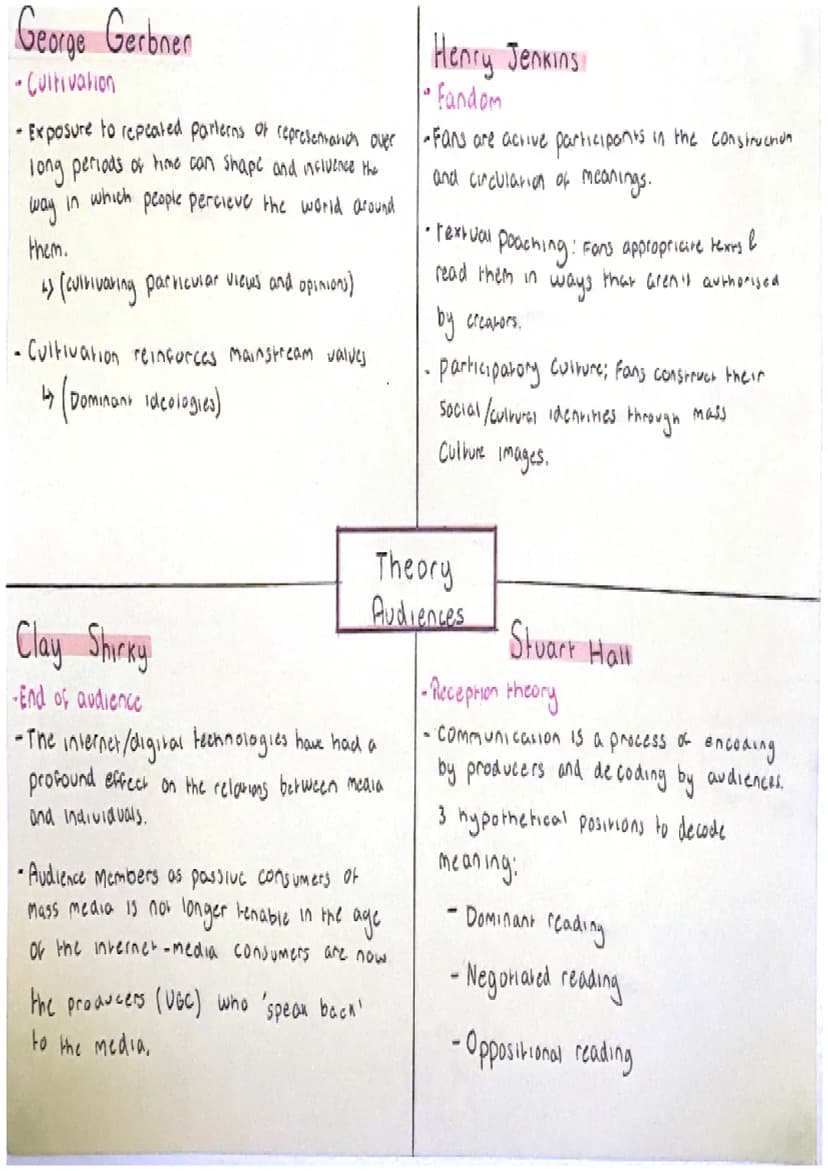
Page 3: Audience Theory and Reception
This page explores how audiences interact with media content, featuring theories about media influence and audience participation. George Gerbner's cultivation theory and Henry Jenkins' work on fandom are particularly significant.
Definition: Cultivation theory suggests that long-term exposure to media patterns shapes people's worldview.
Example: Textual poaching occurs when fans appropriate media texts and interpret them in unauthorized ways.
Highlight: Stuart hall 3 theories of representation include dominant, negotiated, and oppositional reading positions.
Quote: "Audience members are no longer passive consumers but producers who 'speak back' to the media."
3
of 4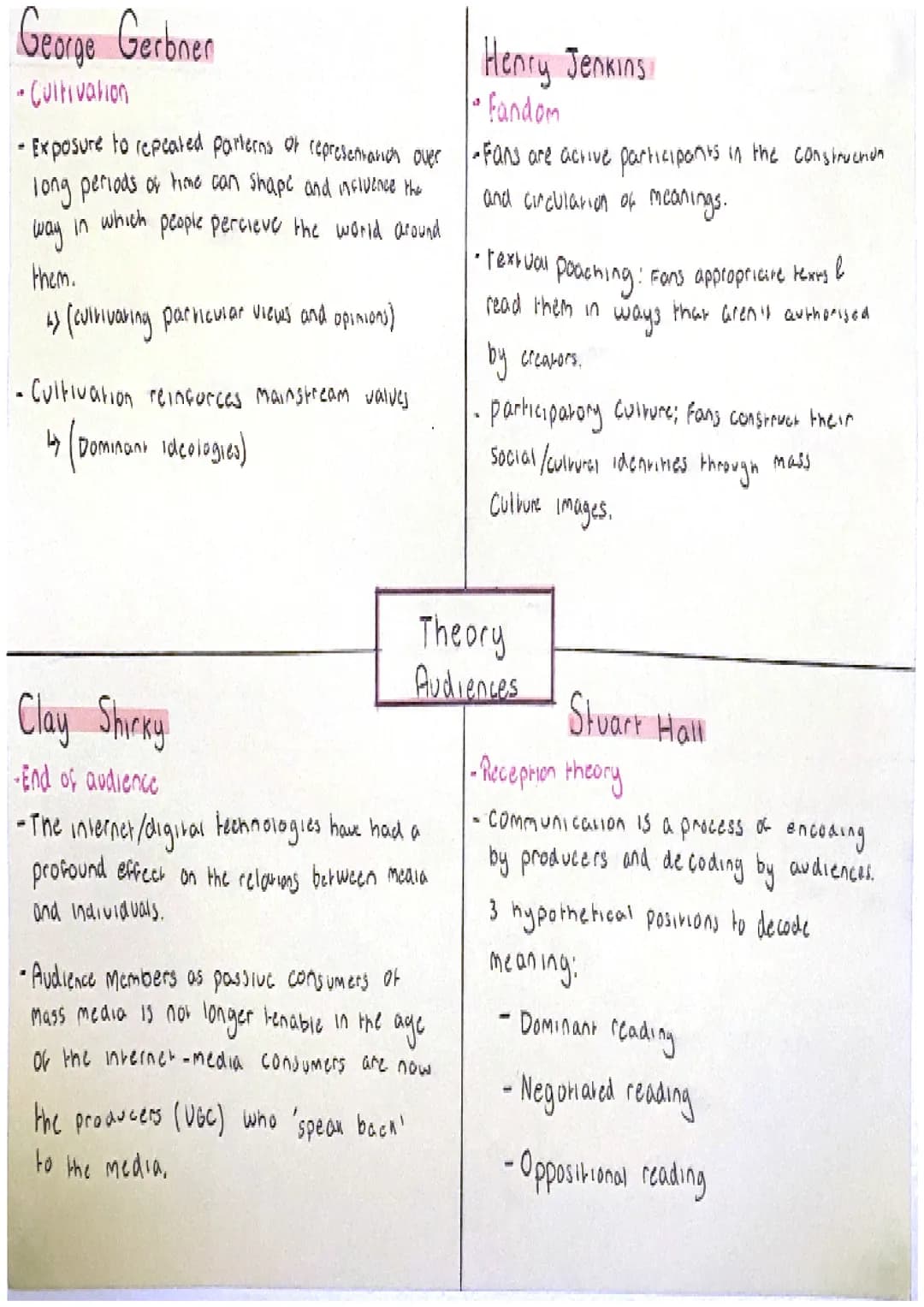
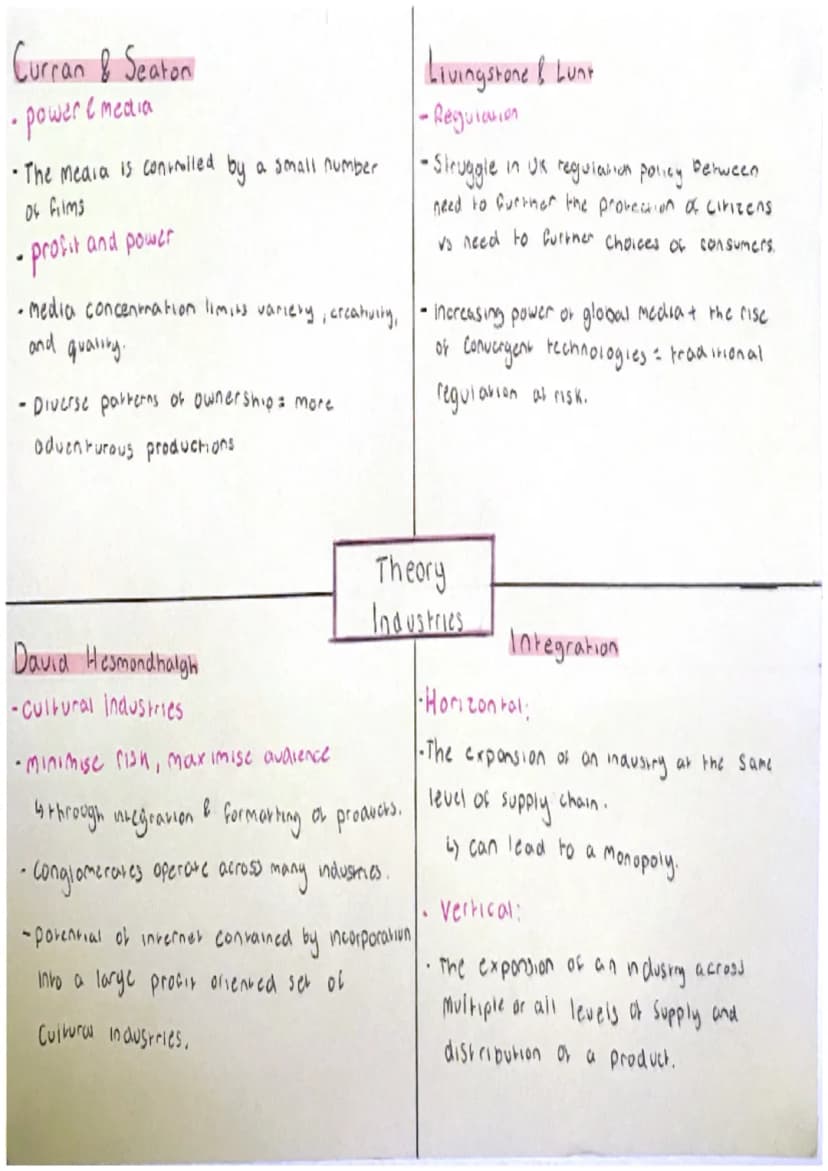
Page 4: Media Power and Control
This page examines media power structures and control mechanisms. Curran & Seaton's analysis focuses on media ownership concentration and its implications for profit and power dynamics.
Highlight: Media control is concentrated among a small number of firms, affecting content and representation.
Definition: Media power structures influence both profit generation and societal control mechanisms.
Example: The concentration of media ownership demonstrates how economic power translates into cultural influence.
4
of 4
Page 1: Foundational Theories and Perspectives
This page introduces key media theorists and their contributions to understanding representation, identity, and gender in media. Stuart hall representation theory emphasizes how meaning is produced through language and codes. David gauntlett media theory focuses on identity construction through media tools.
Definition: Representation is the production of meaning through language, governed by specific codes and conventions.
Example: David gauntlett identity theory examples include how people construct their identities by selecting and mixing different media representations.
Highlight: Bell hooks' theory emphasizes the intersection of race, class, and sex in determining exploitation and oppression.
Quote: "Gender is constructed through discourse and depends on context" - Lisbel van zoonen feminist theory
We thought you’d never ask...
What is the Knowunity AI companion?
Our AI companion is specifically built for the needs of students. Based on the millions of content pieces we have on the platform we can provide truly meaningful and relevant answers to students. But its not only about answers, the companion is even more about guiding students through their daily learning challenges, with personalised study plans, quizzes or content pieces in the chat and 100% personalisation based on the students skills and developments.
Where can I download the Knowunity app?
You can download the app in the Google Play Store and in the Apple App Store.
Is Knowunity really free of charge?
That's right! Enjoy free access to study content, connect with fellow students, and get instant help – all at your fingertips.
Similar Content
 Artes
Artes Histoire
 Musik
MusikMost popular content: Film Studies
9Media StudiesEssential Media Theories Overview
Explore a comprehensive summary of key media theories essential for Eduqas A-Level Media Studies. This concise 4-page resource covers critical concepts such as media representation, audience effects, and industry dynamics, featuring relevant examples for practical application. Perfect for quick revision and flashcard preparation.
122,70174
Media StudiesMedia Industry Dynamics
Explore the complexities of media ownership and production in this comprehensive overview. This study note covers key concepts such as business globalization, mergers and acquisitions, and the impact of technology on media practices. Analyze case studies including The Daily Mirror, The Times, I, Daniel Blake, Black Panther, Women’s Hour, and Assassins Creed. Ideal for Eduqas A Level Media Studies students seeking to deepen their understanding of the media landscape.
121,57730
Media Studiesmedia comp 1
set products 2025
131606
Media StudiesLuther: Media Language Insights
Explore key concepts of media language, narrative structure, and representation in the BBC crime drama 'Luther'. This revision resource covers genre conventions, audience engagement, and the show's cultural context, making it essential for EDUQAS GCSE Media Studies. Ideal for exam preparation and understanding the complexities of contemporary media.
101,90140
Media StudiesKey Media Theories Overview
Explore essential media theories including Todorov's narrative stages, Propp's character types, and Mulvey's Male Gaze. This concise PowerPoint summary is designed for Eduqas GCSE students, providing a clear understanding of narrative elements, character roles, and media representation. Enhance your exam responses with these critical concepts.
102,24072
Film StudiesImpact of Digital Media on Amy
Explore the influence of digital technology on Amy Winehouse's life and career through this detailed analysis of the documentary. Key concepts include the use of archival footage, cinematography techniques, and the portrayal of fame and vulnerability. This study note provides insights into documentary filmmaking methods and the cultural implications of Amy's story.
1261023
Film StudiesA-level Film Studies Spec overview
In this document has an overview of Exam board spec explained in detail of which parts we will be studying.
122365
Film StudiesShaun of the Dead Analysis
Explore the critical themes and cinematic techniques of 'Shaun of the Dead' in this comprehensive film analysis. This study note covers key concepts such as Generation X representation, anti-establishment themes, and postmodernism, providing insights into the film's cultural context and narrative structure. Ideal for A Level Film Studies students preparing for EDUQAS exams.
1238115
Film StudiesVertigo Film Analysis
Explore the intricate themes of Alfred Hitchcock's 'Vertigo' (1958) in this comprehensive analysis. Delve into concepts such as toxic masculinity, voyeurism, identity, and the male gaze, alongside the film's historical context and its impact on modern cinema. This summary highlights key scenes, character dynamics, and the significance of visual motifs, making it an essential resource for film studies students.
124578
Most popular content in Media Studies
9Media StudiesGCSE Media Studies Essentials
This concise knowledge organiser provides key insights for the GCSE Eduqas Media Studies Paper 1 exam. It includes 5 essential bullet points for each focus area: context, media language, representation, industries, and audiences. Updated for the 2024 exam, this resource is designed to help students grasp critical concepts and succeed in their studies.
102,96670
Media StudiesEssential Media Theories Overview
Explore a comprehensive summary of key media theories essential for Eduqas A-Level Media Studies. This concise 4-page resource covers critical concepts such as media representation, audience effects, and industry dynamics, featuring relevant examples for practical application. Perfect for quick revision and flashcard preparation.
122,70174
Media StudiesChannel 4's Super. Human. Analysis
In-depth analysis of Channel 4's 2020 'Super. Human.' advertisement for the Paralympics. Explore the media language, representation, and historical context of the campaign, including audio codes, technical elements, and the impact of social media. Ideal for A Level Media Studies students seeking to understand the nuances of advertising and representation in media. Includes bullet points and visual references.
121,42037
Media StudiesEduqas GCSE Media Studies Overview
Comprehensive notes for the Eduqas GCSE Media Studies Paper 1, covering key topics such as gender representation, media industries, and film analysis. This resource is structured for easy navigation and focuses on essential concepts without delving into theories. Perfect for exam preparation and understanding contemporary media contexts.
104,612117
Media StudiesA-Level Media Vogue (Revision sheet)
(Sorry if the images are placed weirdly) Part of A-Level Eduqas syllabus in Component 2, Section B; asked as either a standalone question (usually 15 marks) or comparison with The Big Issue (30 marks)
1261412
Media StudiesThe 19 Set Media Theories for Eduqas A-level Media Studies
Name of theory, sur- or main name of theorist, quote from the theorist (about the theory), and multiple literal POINTS of the theory
1252315
Media StudiesA-Level Media Black Panther (Revision Sheet)
Part of Eduqas syllabus for Comp 1; comes up in Section B as an industry question (although audience should be considered). Remember that marketing is crucial for the set film texts!
124208
Media StudiesA-Level Media The Big Issue (Revision sheet)
(Sorry if the PDF has placed images weirdly) Part of the A-Level Eduqas syllabus as part of Component 2, Section B; can be assessed on any media aspect, either through a standalone question (usually 15 marks) or comparison with Vogue (30 marks)
126189
M
Media StudiesMedia audience quiz
a quiz on the audience theories in media
131801
Most popular content
9 Sociology
Sociology of Education Overview
Explore comprehensive A-Level Sociology notes on the education system, covering key theories, policies, and sociological perspectives. This resource includes insights on marketisation, gender roles, cultural deprivation, and educational inequalities, providing a thorough understanding of how education shapes social stratification and individual achievement. Ideal for exam preparation and in-depth study.
12102,8693,040
SociologySociology of Families: Comprehensive Revision
Dive into an extensive overview of family dynamics, perspectives, and patterns in sociology. This resource covers key concepts such as family diversity, gender roles, marriage, and the impact of social policies on family structures. Perfect for A-Level Sociology students preparing for Paper 2.
1273,6662,307
CriminologyCriminology: Crime & Punishment Overview
Comprehensive mindmaps covering key concepts in the Crime and Punishment topic for WJEC Criminology Unit 4. This resource includes detailed insights into the Criminal Justice System, crime prevention strategies, sentencing models, and the roles of various agencies. Ideal for A-Level revision, ensuring you grasp essential theories and legislative processes to excel in your exams.
1254,8721,059
SociologyComprehensive Crime & Deviance Overview
Explore an extensive revision of crime and deviance topics, including theories, types of crime, and the impact of media. This resource covers key concepts such as Marxism, functionalism, gender and crime, and the influence of globalization on criminal behavior. Ideal for students seeking a thorough understanding of criminology and its various theories. Type: Full Topic Revision.
1251,6541,399
C
 Biology
Cell Biology and Cell structure
cell structures
93,2490
 English Literature
An Inspector Calls: Character Insights
Explore in-depth analysis and key quotes for characters in J.B. Priestley's 'An Inspector Calls'. This resource covers Gerald Croft, Inspector Goole, Sheila Birling, Mrs. Birling, Eric Birling, and Eva Smith, focusing on themes of class, gender roles, and social responsibility. Ideal for students aiming for Grade 8 and above.
1025,429907
CriminologyWJEC Unit 4 Criminology
Criminology unit 4 detailed revision note
127,151125
CriminologyCriminology Theories Overview
Explore key criminology theories and their implications on crime and deviance. This comprehensive summary covers biological, psychological, and sociological perspectives, including labelling theory, right realism, and the impact of social campaigns on policy development. Ideal for A-Level criminology students seeking to understand the complexities of criminal behaviour and the factors influencing crime prevention strategies.
129,760210
English LiteratureRomeo and Juliet: Key themes
Key Romeo and Juliet themes and analysed quotes
106,708198
Can't find what you're looking for? Explore other subjects.
Students love us — and so will you.
4.6/5App Store
4.7/5Google Play
The app is very easy to use and well designed. I have found everything I was looking for so far and have been able to learn a lot from the presentations! I will definitely use the app for a class assignment! And of course it also helps a lot as an inspiration.
Stefan SiOS user
This app is really great. There are so many study notes and help [...]. My problem subject is French, for example, and the app has so many options for help. Thanks to this app, I have improved my French. I would recommend it to anyone.
Samantha KlichAndroid user
Wow, I am really amazed. I just tried the app because I've seen it advertised many times and was absolutely stunned. This app is THE HELP you want for school and above all, it offers so many things, such as workouts and fact sheets, which have been VERY helpful to me personally.
AnnaiOS user
Media Studies1,689 views·Updated Jun 24, 2026·4 pagesStuart Hall and David Gauntlett Media Theories
Rebecca Carter@rebeccacarter_upmw
A comprehensive exploration of media and cultural theories focusing on representation, identity, and audience engagement. The theories span from stuart hall representation theoryto modern perspectives on media consumption and power dynamics, providing crucial frameworks for understanding media's role in...
1
of 4
Sign up to see the content. It's free!
- Access to all documents
- Improve your grades
- Join milions of students
Page 2: Semiotics and Structural Approaches
This page delves into semiotics, structuralism, and genre theory, presenting frameworks for analyzing media texts and their meanings. Roland Barthes' contribution to semiotics and Jean Baudrillard's postmodern perspective are central to understanding media representation.
Vocabulary: Simulacra refers to a world of images where the distinction between reality and media representation becomes blurred.
Definition: Genre theory examines how different media categories evolve, overlap, and operate within economic and industrial contexts.
Example: The eight character types in Vladimir Propp's theory include villain, hero, donor, helper, princess, father, dispatcher, and false hero.
Highlight: Barthes' five codes (hermeneutic, semantic, symbolic, proairetic, and cultural) provide a comprehensive framework for textual analysis.
2
of 4Sign up to see the content. It's free!
- Access to all documents
- Improve your grades
- Join milions of students
Page 3: Audience Theory and Reception
This page explores how audiences interact with media content, featuring theories about media influence and audience participation. George Gerbner's cultivation theory and Henry Jenkins' work on fandom are particularly significant.
Definition: Cultivation theory suggests that long-term exposure to media patterns shapes people's worldview.
Example: Textual poaching occurs when fans appropriate media texts and interpret them in unauthorized ways.
Highlight: Stuart hall 3 theories of representation include dominant, negotiated, and oppositional reading positions.
Quote: "Audience members are no longer passive consumers but producers who 'speak back' to the media."
3
of 4Sign up to see the content. It's free!
- Access to all documents
- Improve your grades
- Join milions of students
Page 4: Media Power and Control
This page examines media power structures and control mechanisms. Curran & Seaton's analysis focuses on media ownership concentration and its implications for profit and power dynamics.
Highlight: Media control is concentrated among a small number of firms, affecting content and representation.
Definition: Media power structures influence both profit generation and societal control mechanisms.
Example: The concentration of media ownership demonstrates how economic power translates into cultural influence.
4
of 4Sign up to see the content. It's free!
- Access to all documents
- Improve your grades
- Join milions of students
Page 1: Foundational Theories and Perspectives
This page introduces key media theorists and their contributions to understanding representation, identity, and gender in media. Stuart hall representation theory emphasizes how meaning is produced through language and codes. David gauntlett media theory focuses on identity construction through media tools.
Definition: Representation is the production of meaning through language, governed by specific codes and conventions.
Example: David gauntlett identity theory examples include how people construct their identities by selecting and mixing different media representations.
Highlight: Bell hooks' theory emphasizes the intersection of race, class, and sex in determining exploitation and oppression.
Quote: "Gender is constructed through discourse and depends on context" - Lisbel van zoonen feminist theory
We thought you’d never ask...
What is the Knowunity AI companion?
Our AI companion is specifically built for the needs of students. Based on the millions of content pieces we have on the platform we can provide truly meaningful and relevant answers to students. But its not only about answers, the companion is even more about guiding students through their daily learning challenges, with personalised study plans, quizzes or content pieces in the chat and 100% personalisation based on the students skills and developments.
Where can I download the Knowunity app?
You can download the app in the Google Play Store and in the Apple App Store.
Is Knowunity really free of charge?
That's right! Enjoy free access to study content, connect with fellow students, and get instant help – all at your fingertips.
Similar Content
Most popular content: Film Studies
9Media StudiesEssential Media Theories Overview
Explore a comprehensive summary of key media theories essential for Eduqas A-Level Media Studies. This concise 4-page resource covers critical concepts such as media representation, audience effects, and industry dynamics, featuring relevant examples for practical application. Perfect for quick revision and flashcard preparation.
122,70174
Media StudiesMedia Industry Dynamics
Explore the complexities of media ownership and production in this comprehensive overview. This study note covers key concepts such as business globalization, mergers and acquisitions, and the impact of technology on media practices. Analyze case studies including The Daily Mirror, The Times, I, Daniel Blake, Black Panther, Women’s Hour, and Assassins Creed. Ideal for Eduqas A Level Media Studies students seeking to deepen their understanding of the media landscape.
121,57730
Media Studiesmedia comp 1
set products 2025
131606
Media StudiesLuther: Media Language Insights
Explore key concepts of media language, narrative structure, and representation in the BBC crime drama 'Luther'. This revision resource covers genre conventions, audience engagement, and the show's cultural context, making it essential for EDUQAS GCSE Media Studies. Ideal for exam preparation and understanding the complexities of contemporary media.
101,90140
Media StudiesKey Media Theories Overview
Explore essential media theories including Todorov's narrative stages, Propp's character types, and Mulvey's Male Gaze. This concise PowerPoint summary is designed for Eduqas GCSE students, providing a clear understanding of narrative elements, character roles, and media representation. Enhance your exam responses with these critical concepts.
102,24072
Film StudiesImpact of Digital Media on Amy
Explore the influence of digital technology on Amy Winehouse's life and career through this detailed analysis of the documentary. Key concepts include the use of archival footage, cinematography techniques, and the portrayal of fame and vulnerability. This study note provides insights into documentary filmmaking methods and the cultural implications of Amy's story.
1261023
Film StudiesA-level Film Studies Spec overview
In this document has an overview of Exam board spec explained in detail of which parts we will be studying.
122365
Film StudiesShaun of the Dead Analysis
Explore the critical themes and cinematic techniques of 'Shaun of the Dead' in this comprehensive film analysis. This study note covers key concepts such as Generation X representation, anti-establishment themes, and postmodernism, providing insights into the film's cultural context and narrative structure. Ideal for A Level Film Studies students preparing for EDUQAS exams.
1238115
Film StudiesVertigo Film Analysis
Explore the intricate themes of Alfred Hitchcock's 'Vertigo' (1958) in this comprehensive analysis. Delve into concepts such as toxic masculinity, voyeurism, identity, and the male gaze, alongside the film's historical context and its impact on modern cinema. This summary highlights key scenes, character dynamics, and the significance of visual motifs, making it an essential resource for film studies students.
124578
Most popular content in Media Studies
9Media StudiesGCSE Media Studies Essentials
This concise knowledge organiser provides key insights for the GCSE Eduqas Media Studies Paper 1 exam. It includes 5 essential bullet points for each focus area: context, media language, representation, industries, and audiences. Updated for the 2024 exam, this resource is designed to help students grasp critical concepts and succeed in their studies.
102,96670
Media StudiesEssential Media Theories Overview
Explore a comprehensive summary of key media theories essential for Eduqas A-Level Media Studies. This concise 4-page resource covers critical concepts such as media representation, audience effects, and industry dynamics, featuring relevant examples for practical application. Perfect for quick revision and flashcard preparation.
122,70174
Media StudiesChannel 4's Super. Human. Analysis
In-depth analysis of Channel 4's 2020 'Super. Human.' advertisement for the Paralympics. Explore the media language, representation, and historical context of the campaign, including audio codes, technical elements, and the impact of social media. Ideal for A Level Media Studies students seeking to understand the nuances of advertising and representation in media. Includes bullet points and visual references.
121,42037
Media StudiesEduqas GCSE Media Studies Overview
Comprehensive notes for the Eduqas GCSE Media Studies Paper 1, covering key topics such as gender representation, media industries, and film analysis. This resource is structured for easy navigation and focuses on essential concepts without delving into theories. Perfect for exam preparation and understanding contemporary media contexts.
104,612117
Media StudiesA-Level Media Vogue (Revision sheet)
(Sorry if the images are placed weirdly) Part of A-Level Eduqas syllabus in Component 2, Section B; asked as either a standalone question (usually 15 marks) or comparison with The Big Issue (30 marks)
1261412
Media StudiesThe 19 Set Media Theories for Eduqas A-level Media Studies
Name of theory, sur- or main name of theorist, quote from the theorist (about the theory), and multiple literal POINTS of the theory
1252315
Media StudiesA-Level Media Black Panther (Revision Sheet)
Part of Eduqas syllabus for Comp 1; comes up in Section B as an industry question (although audience should be considered). Remember that marketing is crucial for the set film texts!
124208
Media StudiesA-Level Media The Big Issue (Revision sheet)
(Sorry if the PDF has placed images weirdly) Part of the A-Level Eduqas syllabus as part of Component 2, Section B; can be assessed on any media aspect, either through a standalone question (usually 15 marks) or comparison with Vogue (30 marks)
126189
M
Media StudiesMedia audience quiz
a quiz on the audience theories in media
131801
Most popular content
9SociologySociology of Education Overview
Explore comprehensive A-Level Sociology notes on the education system, covering key theories, policies, and sociological perspectives. This resource includes insights on marketisation, gender roles, cultural deprivation, and educational inequalities, providing a thorough understanding of how education shapes social stratification and individual achievement. Ideal for exam preparation and in-depth study.
12102,8693,040
SociologySociology of Families: Comprehensive Revision
Dive into an extensive overview of family dynamics, perspectives, and patterns in sociology. This resource covers key concepts such as family diversity, gender roles, marriage, and the impact of social policies on family structures. Perfect for A-Level Sociology students preparing for Paper 2.
1273,6662,307
CriminologyCriminology: Crime & Punishment Overview
Comprehensive mindmaps covering key concepts in the Crime and Punishment topic for WJEC Criminology Unit 4. This resource includes detailed insights into the Criminal Justice System, crime prevention strategies, sentencing models, and the roles of various agencies. Ideal for A-Level revision, ensuring you grasp essential theories and legislative processes to excel in your exams.
1254,8721,059
SociologyComprehensive Crime & Deviance Overview
Explore an extensive revision of crime and deviance topics, including theories, types of crime, and the impact of media. This resource covers key concepts such as Marxism, functionalism, gender and crime, and the influence of globalization on criminal behavior. Ideal for students seeking a thorough understanding of criminology and its various theories. Type: Full Topic Revision.
1251,6541,399
C
BiologyCell Biology and Cell structure
cell structures
93,2490
English LiteratureAn Inspector Calls: Character Insights
Explore in-depth analysis and key quotes for characters in J.B. Priestley's 'An Inspector Calls'. This resource covers Gerald Croft, Inspector Goole, Sheila Birling, Mrs. Birling, Eric Birling, and Eva Smith, focusing on themes of class, gender roles, and social responsibility. Ideal for students aiming for Grade 8 and above.
1025,429907
CriminologyWJEC Unit 4 Criminology
Criminology unit 4 detailed revision note
127,151125
CriminologyCriminology Theories Overview
Explore key criminology theories and their implications on crime and deviance. This comprehensive summary covers biological, psychological, and sociological perspectives, including labelling theory, right realism, and the impact of social campaigns on policy development. Ideal for A-Level criminology students seeking to understand the complexities of criminal behaviour and the factors influencing crime prevention strategies.
129,760210
English LiteratureRomeo and Juliet: Key themes
Key Romeo and Juliet themes and analysed quotes
106,708198
Can't find what you're looking for? Explore other subjects.
Students love us — and so will you.
4.6/5App Store
4.7/5Google Play
The app is very easy to use and well designed. I have found everything I was looking for so far and have been able to learn a lot from the presentations! I will definitely use the app for a class assignment! And of course it also helps a lot as an inspiration.
Stefan SiOS user
This app is really great. There are so many study notes and help [...]. My problem subject is French, for example, and the app has so many options for help. Thanks to this app, I have improved my French. I would recommend it to anyone.
Samantha KlichAndroid user
Wow, I am really amazed. I just tried the app because I've seen it advertised many times and was absolutely stunned. This app is THE HELP you want for school and above all, it offers so many things, such as workouts and fact sheets, which have been VERY helpful to me personally.
AnnaiOS user