

The Kiss of the Vampireis a 1963 horror film...
 Media Studies1,413 views·Updated Jun 22, 2026·2 pages
Kiss of the Vampire: Fun A Level Media Study Guide
1
of 2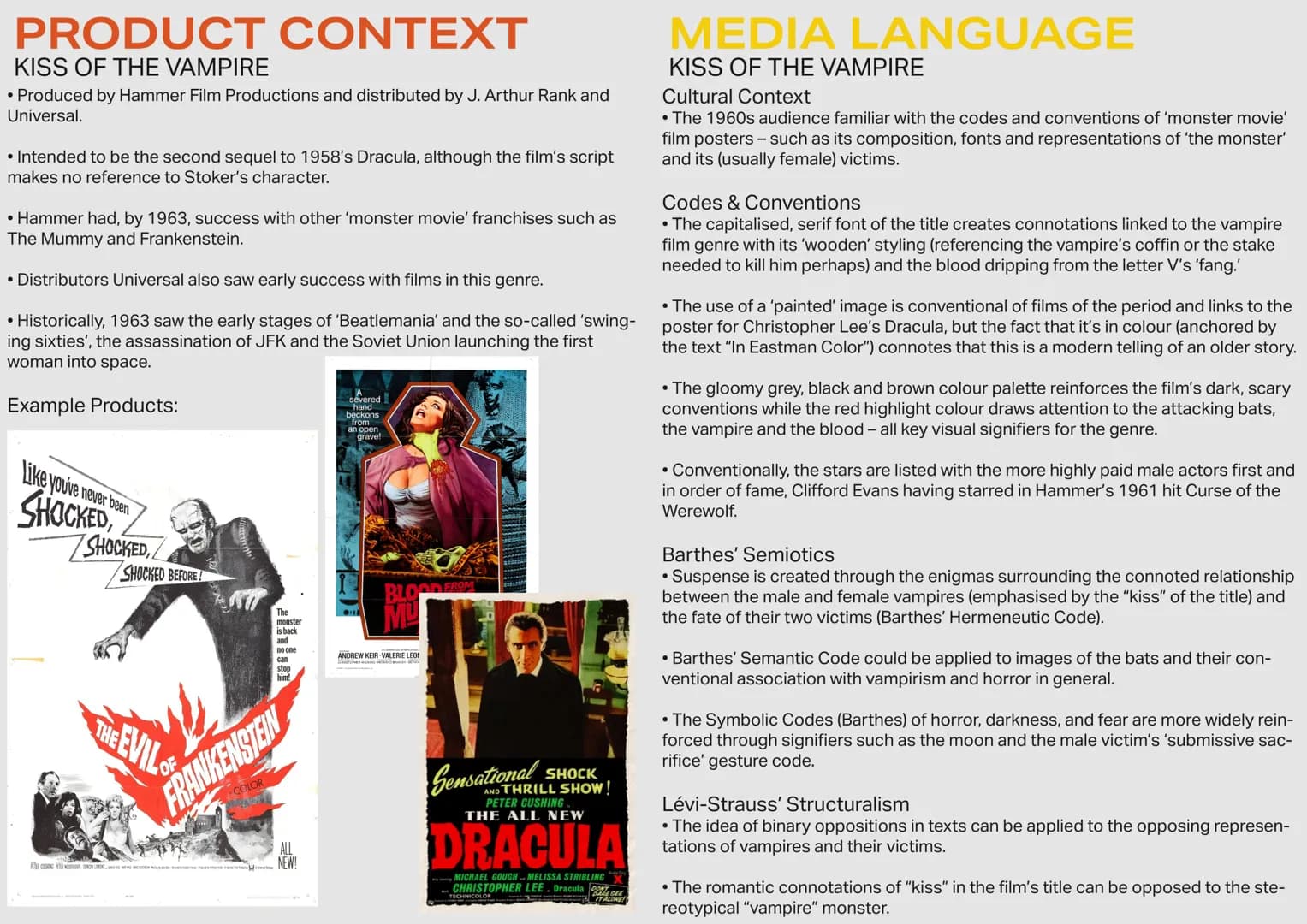
Representation
The Kiss of the Vampire poster provides rich material for analyzing representations, particularly in the context of 1960s social and political changes.
Political & Social Context
The 1960s marked the beginning of women's sexual liberation and saw significant advancements in women's rights:
- Introduction of the contraceptive pill in 1960
- More women entering the paid workforce
- Feminist campaigns for equal pay and an end to sexual harassment
- Equal pay legislation passed in America in 1963
Highlight: The film poster encodes both older stereotypes of women as passive victims and more modern male fears of women challenging male dominance.
Construction of Representations
The poster's visual elements construct complex representations of gender:
-
Women's clothing: Pale dresses made of light materials, highlighting curves and revealing flesh.
-
Contrasting female representations:
- Left woman: Stereotypical passive victim
- Right woman: Non-stereotypically dominant, with aggressive gesture codes
-
Male vampire: Uncharacteristically fearful, with defensive gesture codes
Definition: Gesture codes - The way characters are posed or positioned in an image to convey meaning or emotion.
Hall's Representation
Stuart Hall's theory of representation can be applied to the poster's use of familiar horror iconography:
- Castle, bats, vampire's cape, and dripping blood form part of the "shared conceptual road map" that gives meaning to the poster's world.
- The audience is encouraged to actively decode this familiar generic iconography.
Gauntlett's Identity
David Gauntlett's ideas on media and identity suggest that the female vampire could serve as a role model for women struggling against male oppression or seeking equality.
Quote: "The female vampire could act as a role model for women who are struggling against male oppression or want to be seen as equals of men."
This representation is significant regardless of the film's actual narrative or the character's role within it, as it offers a powerful visual symbol of female strength and dominance in a traditionally male-dominated genre.
2
of 2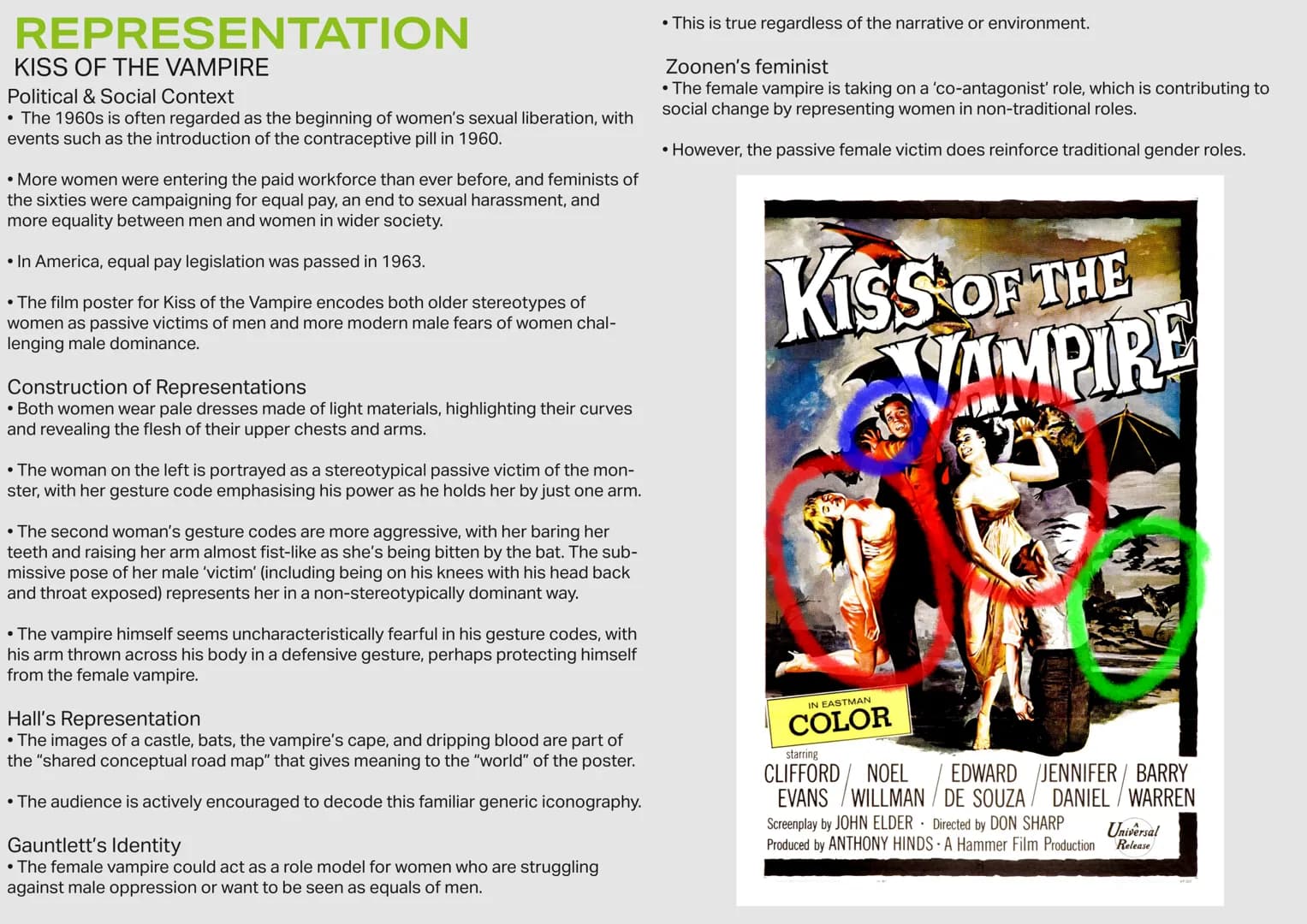
Product Context and Media Language
The Kiss of the Vampire was produced by Hammer Film Productions in 1963, intended as a sequel to their successful Dracula franchise. This period marked the beginning of the "swinging sixties" and saw significant cultural and political events unfold globally.
Cultural Context
The 1960s audience was well-versed in the codes and conventions of "monster movie" film posters. These typically included specific composition styles, font choices, and representations of monsters and their victims.
Highlight: The film's release coincided with the early stages of 'Beatlemania', the assassination of JFK, and the Soviet Union launching the first woman into space.
Codes and Conventions
The poster for Kiss of the Vampire employs several genre-specific elements:
-
The title font creates connotations linked to the vampire film genre, with its 'wooden' styling and blood-dripping 'fang' on the letter V.
-
The use of a 'painted' image is conventional for the period, but the color aspect (highlighted by the text "In Eastman Color") suggests a modern retelling of an old story.
-
The color palette reinforces the film's dark, scary conventions, with red highlights drawing attention to key horror elements like bats, the vampire, and blood.
-
The listing of stars follows the convention of placing more highly paid male actors first and in order of fame.
Example: Clifford Evans, listed first among the stars, had previously starred in Hammer's 1961 hit "Curse of the Werewolf".
Barthes' Semiotics
The poster can be analyzed using Roland Barthes' semiotic codes:
-
Hermeneutic Code: Suspense is created through enigmas surrounding the relationship between the male and female vampires and the fate of their victims.
-
Semantic Code: Images of bats are conventionally associated with vampirism and horror.
-
Symbolic Code: Horror, darkness, and fear are reinforced through signifiers like the moon and the male victim's 'submissive sacrifice' gesture.
Lévi-Strauss' Structuralism
Claude Lévi-Strauss's concept of binary oppositions can be applied to the contrasting representations of vampires and their victims, as well as the juxtaposition of "kiss" and "vampire" in the title.
Vocabulary: Binary oppositions - A structuralist theory that suggests meaning is created through the contrast between two opposing concepts.
We thought you’d never ask...
What is the Knowunity AI companion?
Our AI companion is specifically built for the needs of students. Based on the millions of content pieces we have on the platform we can provide truly meaningful and relevant answers to students. But its not only about answers, the companion is even more about guiding students through their daily learning challenges, with personalised study plans, quizzes or content pieces in the chat and 100% personalisation based on the students skills and developments.
Where can I download the Knowunity app?
You can download the app in the Google Play Store and in the Apple App Store.
Is Knowunity really free of charge?
That's right! Enjoy free access to study content, connect with fellow students, and get instant help – all at your fingertips.
Similar Content
Most popular content: Horror Genre
8Media StudiesKiss of the Vampire Analysis
Explore the cultural and political context of 'Kiss of the Vampire' in this detailed film analysis. This study note covers key concepts such as representation, gender roles, and semiotic codes within the vampire genre, highlighting the film's significance in the 1960s. Ideal for A-level Media Studies students, this resource provides insights into the film's advertising strategies and visual storytelling techniques.
1267617
Film StudiesGet Out: Social Horror Analysis
Explore a comprehensive analysis of Jordan Peele's 'Get Out' focusing on key themes such as social horror, spectatorship, and representation. This study note covers scene breakdowns, ideological critiques, and intertextual references, providing insights into the film's commentary on race and identity. Ideal for A Level Film Studies students preparing for Component 1 Section B.
123395
Media StudiesKiss of the vampire
poster analysis
122405
Media StudiesMedia Language Analysis
Explore in-depth mind maps and analyses of key media language concepts across various set texts, including 'Tide', 'KOTV', 'Super Human', 'Formation', 'Riptide', 'The Times', and 'The Daily Mirror'. This resource covers essential elements such as sound, lighting, dress codes, and genre conventions, providing a comprehensive understanding for students studying media language.
1252112
Film StudiesGet Out: Film Analysis
Explore the critical elements of Jordan Peele's 'Get Out' (2017) with this comprehensive analysis. This study note covers key themes such as racial tension, representation, and ideology, alongside detailed scene breakdowns and contextual insights. Ideal for Eduqas A Level Film Studies, this resource aids in understanding mise-en-scène, media language, and the film's cultural significance.
122675
Media StudiesTodorov's Narrative Structure
Explore Tzvetan Todorov's narrative theory, focusing on the three-part structure of equilibrium, disruption, and new equilibrium. This summary highlights key concepts and their application across various media texts, including film and print. Ideal for AS Level Media Studies students preparing for exams or coursework.
1235014
Media StudiesGender Representation in KOTV
Explore the complex portrayal of gender in the 1960s horror film 'Kiss of the Vampire'. This analysis delves into the visual and narrative codes that depict male and female characters, highlighting themes of power dynamics, objectification, and the evolving roles of women in media. Understand how societal shifts influenced these representations and the implications for feminist discourse. Type: Summary.
123059
Media StudiesVampire Iconography Analysis
Explore the visual and thematic elements of vampire film posters, focusing on the representation of gender roles, cultural context, and semiotic analysis. This summary delves into the connotations of imagery, color palettes, and the societal implications of the vampire genre, particularly in the 1960s. Ideal for students studying gothic literature and film theory.
1236812
Most popular content in Media Studies
9Media StudiesGCSE Media Studies Essentials
This concise knowledge organiser provides key insights for the GCSE Eduqas Media Studies Paper 1 exam. It includes 5 essential bullet points for each focus area: context, media language, representation, industries, and audiences. Updated for the 2024 exam, this resource is designed to help students grasp critical concepts and succeed in their studies.
102,96670
Media StudiesEssential Media Theories Overview
Explore a comprehensive summary of key media theories essential for Eduqas A-Level Media Studies. This concise 4-page resource covers critical concepts such as media representation, audience effects, and industry dynamics, featuring relevant examples for practical application. Perfect for quick revision and flashcard preparation.
122,70174
Media StudiesChannel 4's Super. Human. Analysis
In-depth analysis of Channel 4's 2020 'Super. Human.' advertisement for the Paralympics. Explore the media language, representation, and historical context of the campaign, including audio codes, technical elements, and the impact of social media. Ideal for A Level Media Studies students seeking to understand the nuances of advertising and representation in media. Includes bullet points and visual references.
121,42037
Media StudiesEduqas GCSE Media Studies Overview
Comprehensive notes for the Eduqas GCSE Media Studies Paper 1, covering key topics such as gender representation, media industries, and film analysis. This resource is structured for easy navigation and focuses on essential concepts without delving into theories. Perfect for exam preparation and understanding contemporary media contexts.
104,612117
Media StudiesA-Level Media Vogue (Revision sheet)
(Sorry if the images are placed weirdly) Part of A-Level Eduqas syllabus in Component 2, Section B; asked as either a standalone question (usually 15 marks) or comparison with The Big Issue (30 marks)
1261412
Media StudiesThe 19 Set Media Theories for Eduqas A-level Media Studies
Name of theory, sur- or main name of theorist, quote from the theorist (about the theory), and multiple literal POINTS of the theory
1252315
Media StudiesA-Level Media Black Panther (Revision Sheet)
Part of Eduqas syllabus for Comp 1; comes up in Section B as an industry question (although audience should be considered). Remember that marketing is crucial for the set film texts!
124208
Media StudiesA-Level Media The Big Issue (Revision sheet)
(Sorry if the PDF has placed images weirdly) Part of the A-Level Eduqas syllabus as part of Component 2, Section B; can be assessed on any media aspect, either through a standalone question (usually 15 marks) or comparison with Vogue (30 marks)
126189
M
Media StudiesMedia audience quiz
a quiz on the audience theories in media
131801
Most popular content
9 Sociology
Sociology of Education Overview
Explore comprehensive A-Level Sociology notes on the education system, covering key theories, policies, and sociological perspectives. This resource includes insights on marketisation, gender roles, cultural deprivation, and educational inequalities, providing a thorough understanding of how education shapes social stratification and individual achievement. Ideal for exam preparation and in-depth study.
12102,8703,040
SociologySociology of Families: Comprehensive Revision
Dive into an extensive overview of family dynamics, perspectives, and patterns in sociology. This resource covers key concepts such as family diversity, gender roles, marriage, and the impact of social policies on family structures. Perfect for A-Level Sociology students preparing for Paper 2.
1273,6662,307
CriminologyCriminology: Crime & Punishment Overview
Comprehensive mindmaps covering key concepts in the Crime and Punishment topic for WJEC Criminology Unit 4. This resource includes detailed insights into the Criminal Justice System, crime prevention strategies, sentencing models, and the roles of various agencies. Ideal for A-Level revision, ensuring you grasp essential theories and legislative processes to excel in your exams.
1254,8721,059
SociologyComprehensive Crime & Deviance Overview
Explore an extensive revision of crime and deviance topics, including theories, types of crime, and the impact of media. This resource covers key concepts such as Marxism, functionalism, gender and crime, and the influence of globalization on criminal behavior. Ideal for students seeking a thorough understanding of criminology and its various theories. Type: Full Topic Revision.
1251,6541,399
C
 Biology
Cell Biology and Cell structure
cell structures
93,2490
 English Literature
An Inspector Calls: Character Insights
Explore in-depth analysis and key quotes for characters in J.B. Priestley's 'An Inspector Calls'. This resource covers Gerald Croft, Inspector Goole, Sheila Birling, Mrs. Birling, Eric Birling, and Eva Smith, focusing on themes of class, gender roles, and social responsibility. Ideal for students aiming for Grade 8 and above.
1025,429907
CriminologyWJEC Unit 4 Criminology
Criminology unit 4 detailed revision note
127,154125
CriminologyCriminology Theories Overview
Explore key criminology theories and their implications on crime and deviance. This comprehensive summary covers biological, psychological, and sociological perspectives, including labelling theory, right realism, and the impact of social campaigns on policy development. Ideal for A-Level criminology students seeking to understand the complexities of criminal behaviour and the factors influencing crime prevention strategies.
129,760210
English LiteratureRomeo and Juliet: Key themes
Key Romeo and Juliet themes and analysed quotes
106,708198
Can't find what you're looking for? Explore other subjects.
Students love us — and so will you.
4.6/5App Store
4.7/5Google Play
The app is very easy to use and well designed. I have found everything I was looking for so far and have been able to learn a lot from the presentations! I will definitely use the app for a class assignment! And of course it also helps a lot as an inspiration.
Stefan SiOS user
This app is really great. There are so many study notes and help [...]. My problem subject is French, for example, and the app has so many options for help. Thanks to this app, I have improved my French. I would recommend it to anyone.
Samantha KlichAndroid user
Wow, I am really amazed. I just tried the app because I've seen it advertised many times and was absolutely stunned. This app is THE HELP you want for school and above all, it offers so many things, such as workouts and fact sheets, which have been VERY helpful to me personally.
AnnaiOS user
Media Studies1,413 views·Updated Jun 22, 2026·2 pagesKiss of the Vampire: Fun A Level Media Study Guide
The Kiss of the Vampire is a 1963 horror film produced by Hammer Film Productions, offering a unique take on vampire lore. This A level media study guideexplores the film's context, media language, and representation, providing valuable insights for...
1
of 2
Sign up to see the content. It's free!
- Access to all documents
- Improve your grades
- Join milions of students
Representation
The Kiss of the Vampire poster provides rich material for analyzing representations, particularly in the context of 1960s social and political changes.
Political & Social Context
The 1960s marked the beginning of women's sexual liberation and saw significant advancements in women's rights:
- Introduction of the contraceptive pill in 1960
- More women entering the paid workforce
- Feminist campaigns for equal pay and an end to sexual harassment
- Equal pay legislation passed in America in 1963
Highlight: The film poster encodes both older stereotypes of women as passive victims and more modern male fears of women challenging male dominance.
Construction of Representations
The poster's visual elements construct complex representations of gender:
-
Women's clothing: Pale dresses made of light materials, highlighting curves and revealing flesh.
-
Contrasting female representations:
- Left woman: Stereotypical passive victim
- Right woman: Non-stereotypically dominant, with aggressive gesture codes
-
Male vampire: Uncharacteristically fearful, with defensive gesture codes
Definition: Gesture codes - The way characters are posed or positioned in an image to convey meaning or emotion.
Hall's Representation
Stuart Hall's theory of representation can be applied to the poster's use of familiar horror iconography:
- Castle, bats, vampire's cape, and dripping blood form part of the "shared conceptual road map" that gives meaning to the poster's world.
- The audience is encouraged to actively decode this familiar generic iconography.
Gauntlett's Identity
David Gauntlett's ideas on media and identity suggest that the female vampire could serve as a role model for women struggling against male oppression or seeking equality.
Quote: "The female vampire could act as a role model for women who are struggling against male oppression or want to be seen as equals of men."
This representation is significant regardless of the film's actual narrative or the character's role within it, as it offers a powerful visual symbol of female strength and dominance in a traditionally male-dominated genre.
2
of 2Sign up to see the content. It's free!
- Access to all documents
- Improve your grades
- Join milions of students
Product Context and Media Language
The Kiss of the Vampire was produced by Hammer Film Productions in 1963, intended as a sequel to their successful Dracula franchise. This period marked the beginning of the "swinging sixties" and saw significant cultural and political events unfold globally.
Cultural Context
The 1960s audience was well-versed in the codes and conventions of "monster movie" film posters. These typically included specific composition styles, font choices, and representations of monsters and their victims.
Highlight: The film's release coincided with the early stages of 'Beatlemania', the assassination of JFK, and the Soviet Union launching the first woman into space.
Codes and Conventions
The poster for Kiss of the Vampire employs several genre-specific elements:
-
The title font creates connotations linked to the vampire film genre, with its 'wooden' styling and blood-dripping 'fang' on the letter V.
-
The use of a 'painted' image is conventional for the period, but the color aspect (highlighted by the text "In Eastman Color") suggests a modern retelling of an old story.
-
The color palette reinforces the film's dark, scary conventions, with red highlights drawing attention to key horror elements like bats, the vampire, and blood.
-
The listing of stars follows the convention of placing more highly paid male actors first and in order of fame.
Example: Clifford Evans, listed first among the stars, had previously starred in Hammer's 1961 hit "Curse of the Werewolf".
Barthes' Semiotics
The poster can be analyzed using Roland Barthes' semiotic codes:
-
Hermeneutic Code: Suspense is created through enigmas surrounding the relationship between the male and female vampires and the fate of their victims.
-
Semantic Code: Images of bats are conventionally associated with vampirism and horror.
-
Symbolic Code: Horror, darkness, and fear are reinforced through signifiers like the moon and the male victim's 'submissive sacrifice' gesture.
Lévi-Strauss' Structuralism
Claude Lévi-Strauss's concept of binary oppositions can be applied to the contrasting representations of vampires and their victims, as well as the juxtaposition of "kiss" and "vampire" in the title.
Vocabulary: Binary oppositions - A structuralist theory that suggests meaning is created through the contrast between two opposing concepts.
We thought you’d never ask...
What is the Knowunity AI companion?
Our AI companion is specifically built for the needs of students. Based on the millions of content pieces we have on the platform we can provide truly meaningful and relevant answers to students. But its not only about answers, the companion is even more about guiding students through their daily learning challenges, with personalised study plans, quizzes or content pieces in the chat and 100% personalisation based on the students skills and developments.
Where can I download the Knowunity app?
You can download the app in the Google Play Store and in the Apple App Store.
Is Knowunity really free of charge?
That's right! Enjoy free access to study content, connect with fellow students, and get instant help – all at your fingertips.
Similar Content
Most popular content: Horror Genre
8Media StudiesKiss of the Vampire Analysis
Explore the cultural and political context of 'Kiss of the Vampire' in this detailed film analysis. This study note covers key concepts such as representation, gender roles, and semiotic codes within the vampire genre, highlighting the film's significance in the 1960s. Ideal for A-level Media Studies students, this resource provides insights into the film's advertising strategies and visual storytelling techniques.
1267617
Film StudiesGet Out: Social Horror Analysis
Explore a comprehensive analysis of Jordan Peele's 'Get Out' focusing on key themes such as social horror, spectatorship, and representation. This study note covers scene breakdowns, ideological critiques, and intertextual references, providing insights into the film's commentary on race and identity. Ideal for A Level Film Studies students preparing for Component 1 Section B.
123395
Media StudiesKiss of the vampire
poster analysis
122405
Media StudiesMedia Language Analysis
Explore in-depth mind maps and analyses of key media language concepts across various set texts, including 'Tide', 'KOTV', 'Super Human', 'Formation', 'Riptide', 'The Times', and 'The Daily Mirror'. This resource covers essential elements such as sound, lighting, dress codes, and genre conventions, providing a comprehensive understanding for students studying media language.
1252112
Film StudiesGet Out: Film Analysis
Explore the critical elements of Jordan Peele's 'Get Out' (2017) with this comprehensive analysis. This study note covers key themes such as racial tension, representation, and ideology, alongside detailed scene breakdowns and contextual insights. Ideal for Eduqas A Level Film Studies, this resource aids in understanding mise-en-scène, media language, and the film's cultural significance.
122675
Media StudiesTodorov's Narrative Structure
Explore Tzvetan Todorov's narrative theory, focusing on the three-part structure of equilibrium, disruption, and new equilibrium. This summary highlights key concepts and their application across various media texts, including film and print. Ideal for AS Level Media Studies students preparing for exams or coursework.
1235014
Media StudiesGender Representation in KOTV
Explore the complex portrayal of gender in the 1960s horror film 'Kiss of the Vampire'. This analysis delves into the visual and narrative codes that depict male and female characters, highlighting themes of power dynamics, objectification, and the evolving roles of women in media. Understand how societal shifts influenced these representations and the implications for feminist discourse. Type: Summary.
123059
Media StudiesVampire Iconography Analysis
Explore the visual and thematic elements of vampire film posters, focusing on the representation of gender roles, cultural context, and semiotic analysis. This summary delves into the connotations of imagery, color palettes, and the societal implications of the vampire genre, particularly in the 1960s. Ideal for students studying gothic literature and film theory.
1236812
Most popular content in Media Studies
9Media StudiesGCSE Media Studies Essentials
This concise knowledge organiser provides key insights for the GCSE Eduqas Media Studies Paper 1 exam. It includes 5 essential bullet points for each focus area: context, media language, representation, industries, and audiences. Updated for the 2024 exam, this resource is designed to help students grasp critical concepts and succeed in their studies.
102,96670
Media StudiesEssential Media Theories Overview
Explore a comprehensive summary of key media theories essential for Eduqas A-Level Media Studies. This concise 4-page resource covers critical concepts such as media representation, audience effects, and industry dynamics, featuring relevant examples for practical application. Perfect for quick revision and flashcard preparation.
122,70174
Media StudiesChannel 4's Super. Human. Analysis
In-depth analysis of Channel 4's 2020 'Super. Human.' advertisement for the Paralympics. Explore the media language, representation, and historical context of the campaign, including audio codes, technical elements, and the impact of social media. Ideal for A Level Media Studies students seeking to understand the nuances of advertising and representation in media. Includes bullet points and visual references.
121,42037
Media StudiesEduqas GCSE Media Studies Overview
Comprehensive notes for the Eduqas GCSE Media Studies Paper 1, covering key topics such as gender representation, media industries, and film analysis. This resource is structured for easy navigation and focuses on essential concepts without delving into theories. Perfect for exam preparation and understanding contemporary media contexts.
104,612117
Media StudiesA-Level Media Vogue (Revision sheet)
(Sorry if the images are placed weirdly) Part of A-Level Eduqas syllabus in Component 2, Section B; asked as either a standalone question (usually 15 marks) or comparison with The Big Issue (30 marks)
1261412
Media StudiesThe 19 Set Media Theories for Eduqas A-level Media Studies
Name of theory, sur- or main name of theorist, quote from the theorist (about the theory), and multiple literal POINTS of the theory
1252315
Media StudiesA-Level Media Black Panther (Revision Sheet)
Part of Eduqas syllabus for Comp 1; comes up in Section B as an industry question (although audience should be considered). Remember that marketing is crucial for the set film texts!
124208
Media StudiesA-Level Media The Big Issue (Revision sheet)
(Sorry if the PDF has placed images weirdly) Part of the A-Level Eduqas syllabus as part of Component 2, Section B; can be assessed on any media aspect, either through a standalone question (usually 15 marks) or comparison with Vogue (30 marks)
126189
M
Media StudiesMedia audience quiz
a quiz on the audience theories in media
131801
Most popular content
9SociologySociology of Education Overview
Explore comprehensive A-Level Sociology notes on the education system, covering key theories, policies, and sociological perspectives. This resource includes insights on marketisation, gender roles, cultural deprivation, and educational inequalities, providing a thorough understanding of how education shapes social stratification and individual achievement. Ideal for exam preparation and in-depth study.
12102,8703,040
SociologySociology of Families: Comprehensive Revision
Dive into an extensive overview of family dynamics, perspectives, and patterns in sociology. This resource covers key concepts such as family diversity, gender roles, marriage, and the impact of social policies on family structures. Perfect for A-Level Sociology students preparing for Paper 2.
1273,6662,307
CriminologyCriminology: Crime & Punishment Overview
Comprehensive mindmaps covering key concepts in the Crime and Punishment topic for WJEC Criminology Unit 4. This resource includes detailed insights into the Criminal Justice System, crime prevention strategies, sentencing models, and the roles of various agencies. Ideal for A-Level revision, ensuring you grasp essential theories and legislative processes to excel in your exams.
1254,8721,059
SociologyComprehensive Crime & Deviance Overview
Explore an extensive revision of crime and deviance topics, including theories, types of crime, and the impact of media. This resource covers key concepts such as Marxism, functionalism, gender and crime, and the influence of globalization on criminal behavior. Ideal for students seeking a thorough understanding of criminology and its various theories. Type: Full Topic Revision.
1251,6541,399
C
BiologyCell Biology and Cell structure
cell structures
93,2490
English LiteratureAn Inspector Calls: Character Insights
Explore in-depth analysis and key quotes for characters in J.B. Priestley's 'An Inspector Calls'. This resource covers Gerald Croft, Inspector Goole, Sheila Birling, Mrs. Birling, Eric Birling, and Eva Smith, focusing on themes of class, gender roles, and social responsibility. Ideal for students aiming for Grade 8 and above.
1025,429907
CriminologyWJEC Unit 4 Criminology
Criminology unit 4 detailed revision note
127,154125
CriminologyCriminology Theories Overview
Explore key criminology theories and their implications on crime and deviance. This comprehensive summary covers biological, psychological, and sociological perspectives, including labelling theory, right realism, and the impact of social campaigns on policy development. Ideal for A-Level criminology students seeking to understand the complexities of criminal behaviour and the factors influencing crime prevention strategies.
129,760210
English LiteratureRomeo and Juliet: Key themes
Key Romeo and Juliet themes and analysed quotes
106,708198
Can't find what you're looking for? Explore other subjects.
Students love us — and so will you.
4.6/5App Store
4.7/5Google Play
The app is very easy to use and well designed. I have found everything I was looking for so far and have been able to learn a lot from the presentations! I will definitely use the app for a class assignment! And of course it also helps a lot as an inspiration.
Stefan SiOS user
This app is really great. There are so many study notes and help [...]. My problem subject is French, for example, and the app has so many options for help. Thanks to this app, I have improved my French. I would recommend it to anyone.
Samantha KlichAndroid user
Wow, I am really amazed. I just tried the app because I've seen it advertised many times and was absolutely stunned. This app is THE HELP you want for school and above all, it offers so many things, such as workouts and fact sheets, which have been VERY helpful to me personally.
AnnaiOS user