
Algebra's world of Linear Equations and Inequalities is like having...
 Mathematics213 views·Updated Jun 19, 2026·7 pages
Understanding Linear Equations and Inequalities in Algebra
D
David Taylor@davidtaylor_hqbl



1 / 7
1
of 7
Understanding Linear Equations and Inequalities
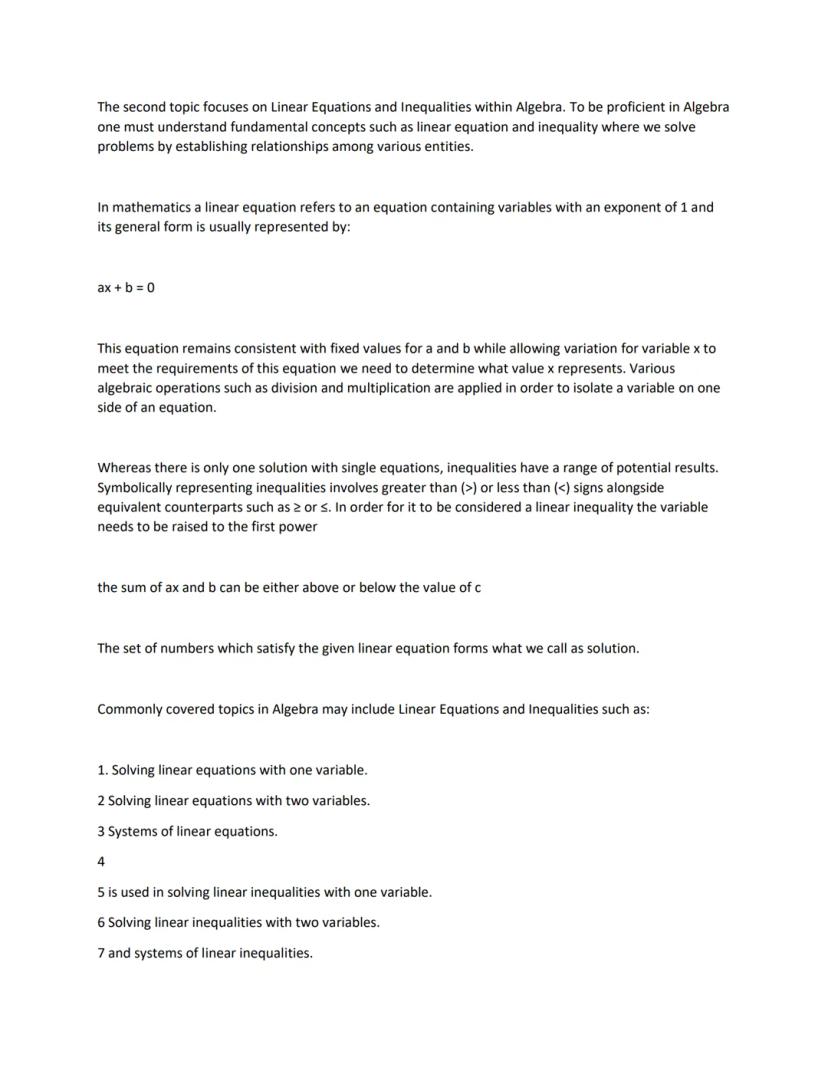
Linear equations are math sentences where variables have an exponent of 1. They typically look like ax + b = 0 where a and b are fixed numbers. When you solve a linear equation, you're finding the exact value of x that makes the equation true. You'll use operations like division and multiplication to isolate x on one side.
Inequalities are different because they give you a range of answers instead of just one. They use symbols like greater than (>), less than (<), greater than or equal to (≥), or less than or equal to (≤). The cool thing about linear inequalities is that they also have the variable raised to the first power.
Solutions to linear equations and inequalities are the values that make the statement true. You'll often work with different types of linear problems, from single-variable equations to systems of equations and inequalities.
Try This! Think about your allowance money. If you have 5, the equation for having $10 left would be x - 5 = 10. Can you solve it?
2
of 7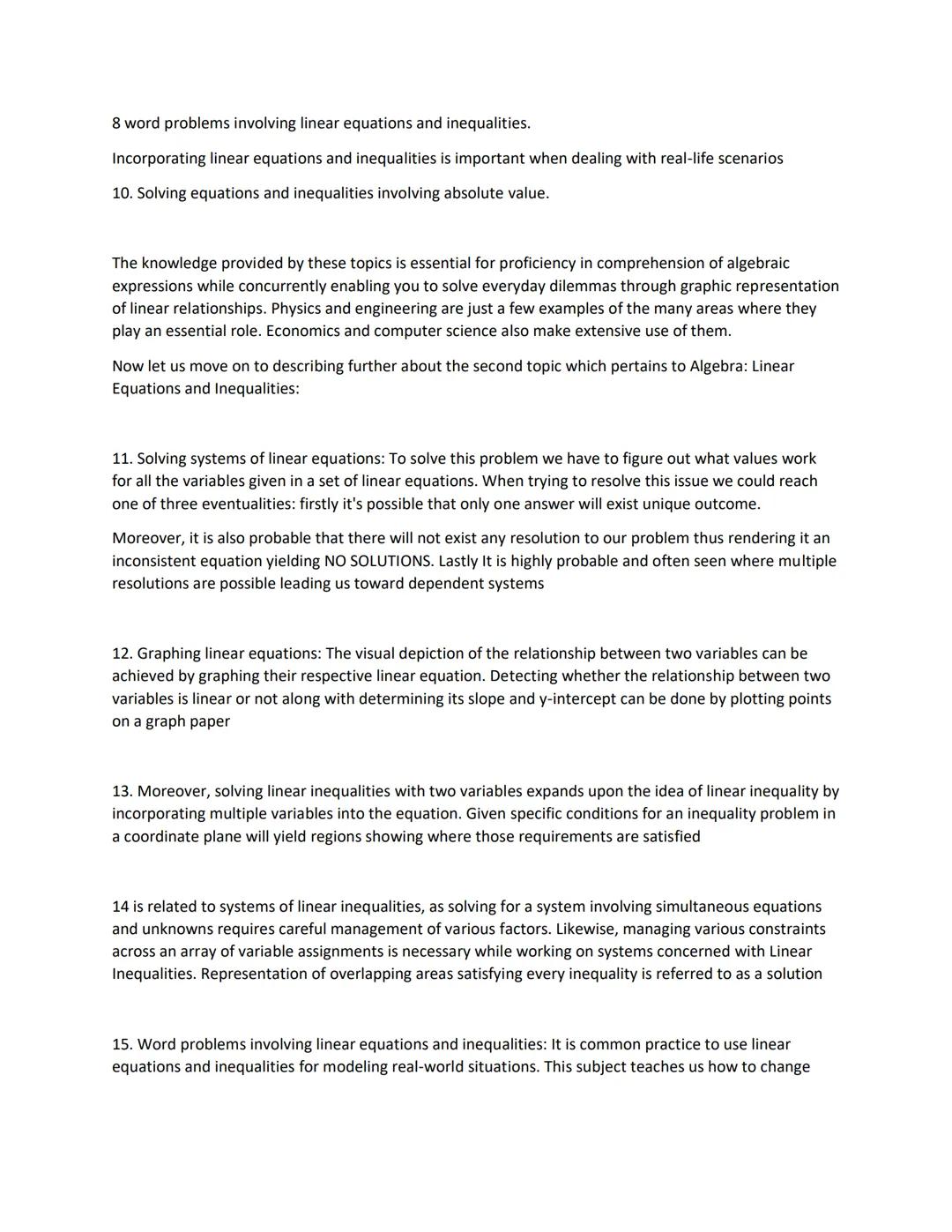
Real-World Applications
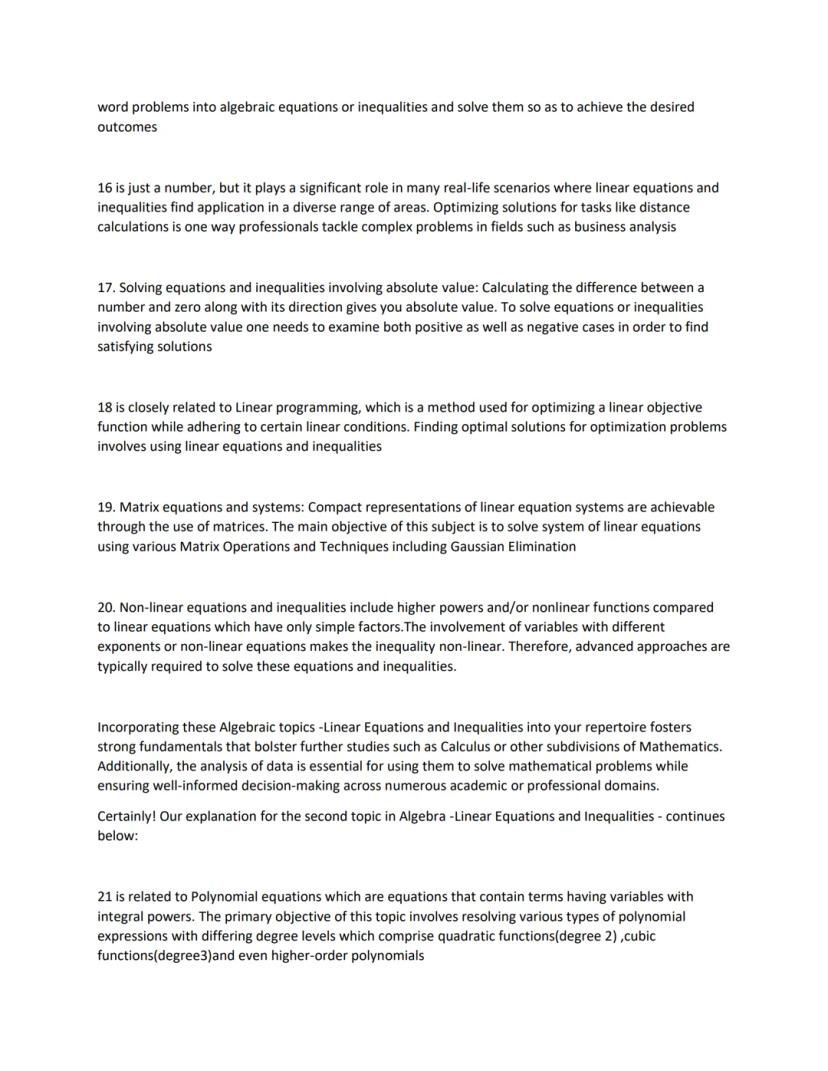
Linear equations and inequalities aren't just classroom math - they're tools used in real life! They help solve problems in physics, engineering, economics, and even computer science. Whenever you need to find an unknown value or check if something falls within certain limits, these math tools come in handy.
When solving systems of linear equations, you're looking for values that work for all equations at once. There are three possible outcomes: one unique solution, no solution (inconsistent), or many solutions (dependent systems).
Graphing linear equations gives you a visual picture of the relationship between variables. By plotting points on a graph, you can see the line that represents all solutions. This helps you determine the slope and y-intercept, which tell you how the variables relate to each other.
For linear inequalities with two variables, your solution isn't a single point but an entire region on a coordinate plane. When working with systems of inequalities, you're looking for the overlapping region that satisfies all conditions at once!
3
of 7
Word Problems and Real-Life Scenarios
Word problems might seem tricky, but they're actually where math becomes useful! When you convert a word problem into an equation or inequality, you're translating real-world situations into math language you can solve.
Linear equations and inequalities help with many everyday calculations, from figuring out distances to analyzing business problems. The skills you learn here will help you make smart decisions in many situations.
Absolute value problems add another dimension to equations and inequalities. Absolute value measures the distance from zero, ignoring direction. When solving these problems, you need to check both the positive and negative cases to find all possible solutions.
Did You Know? Linear programming, which uses linear equations and inequalities, helps businesses maximize profits while staying within their budget constraints. The same math you're learning is used by major companies every day!
4
of 7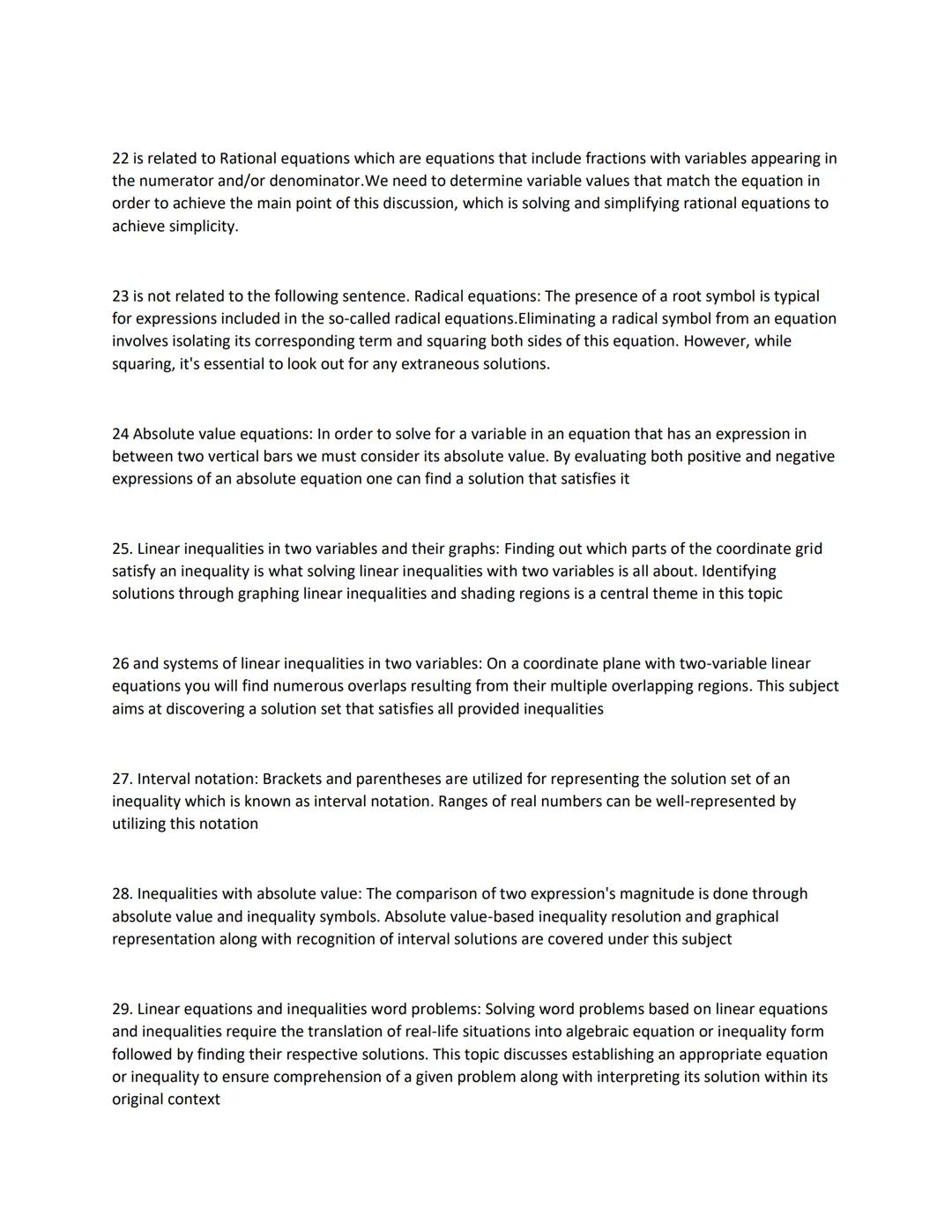
Advanced Types of Equations and Inequalities
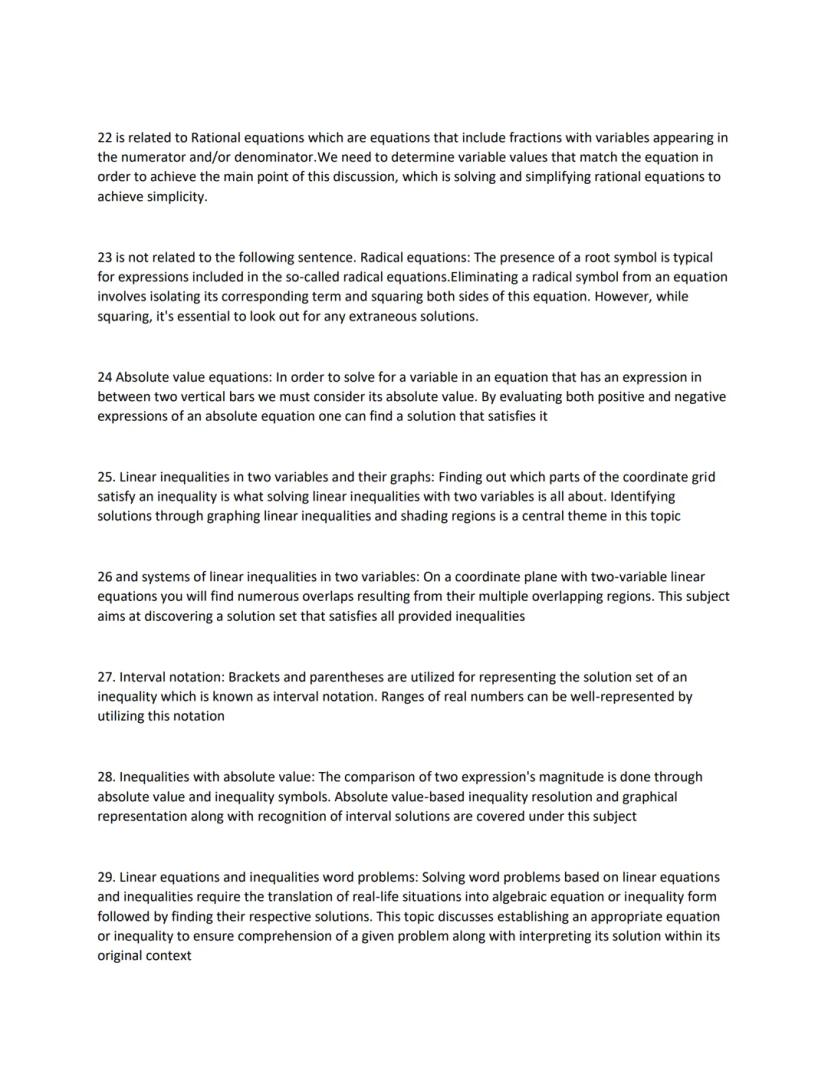
As you progress in algebra, you'll encounter different types of equations. Polynomial equations contain variables with whole number powers, like x², x³, or higher. Rational equations contain fractions with variables in the numerator or denominator.
Radical equations contain square roots or other root symbols. To solve these, you often isolate the radical and square both sides, but watch out for extra solutions that don't work in the original equation!
When working with absolute value equations, remember that |x| represents the distance from zero. This means |x| = 5 has two solutions: x = 5 or x = -5, since both are 5 units away from zero.
Linear inequalities in two variables create regions on a graph. Instead of a single line, you get an entire half-plane that satisfies the inequality. You'll shade this region and use a solid line for ≤ or ≥, and a dashed line for < or >.
5
of 7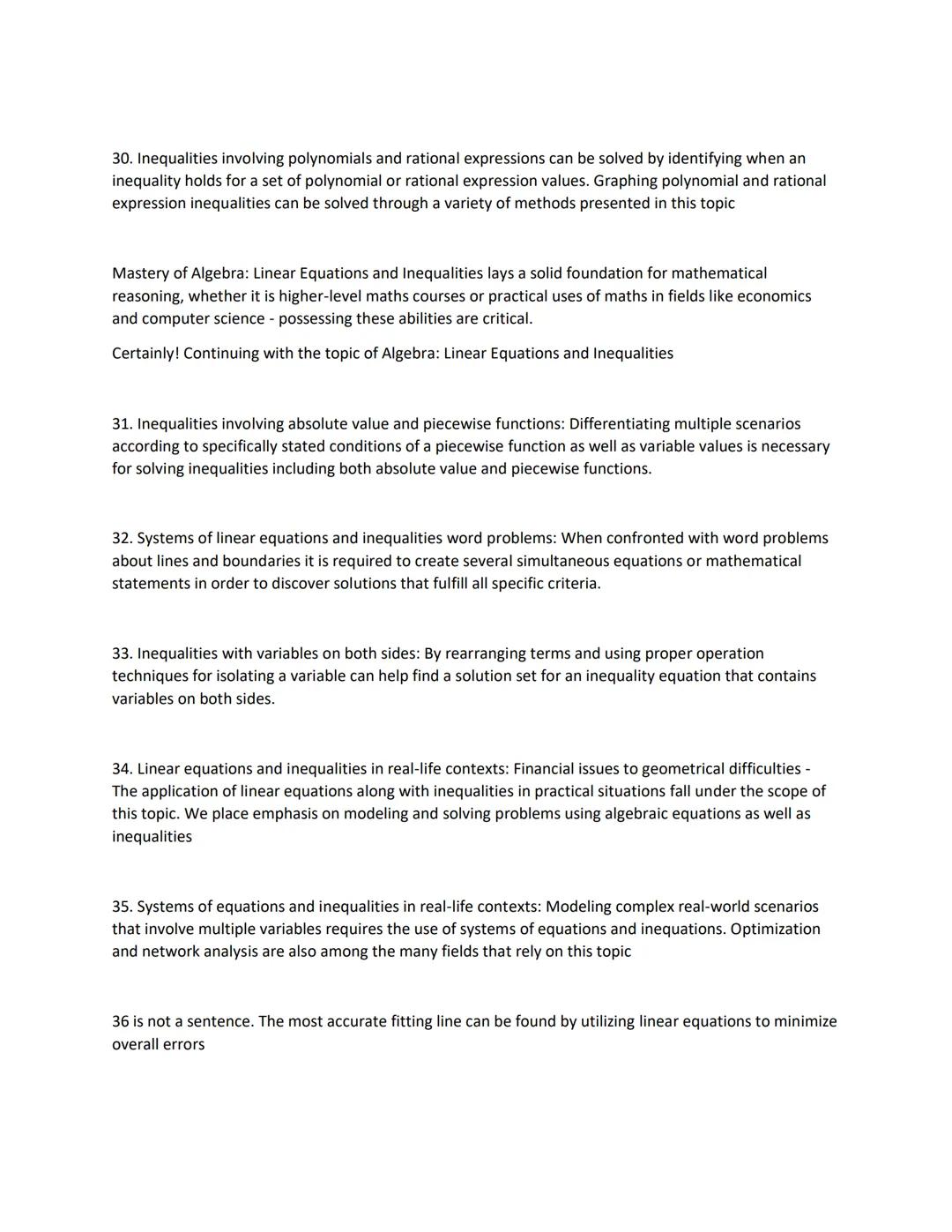
Notation and Complex Problems
Interval notation uses brackets and parentheses to show solution ranges. For example, [3,5] means all numbers from 3 to 5, including 3 and 5. Parentheses like (3,5) would exclude the endpoints.
When solving inequalities with polynomials and rational expressions, you'll need to find where the inequality holds true. These problems often require testing intervals and paying attention to where expressions change sign.
Piecewise functions are like mathematical "if-then" statements - they use different formulas depending on the input value. These functions can create interesting graphs and are useful for modeling real situations that behave differently under different conditions.
Challenge Yourself: Can you write an inequality for "I need at least $20 to go to the movies and buy popcorn"? If x is the money you have, the inequality would be x ≥ 20.
6
of 7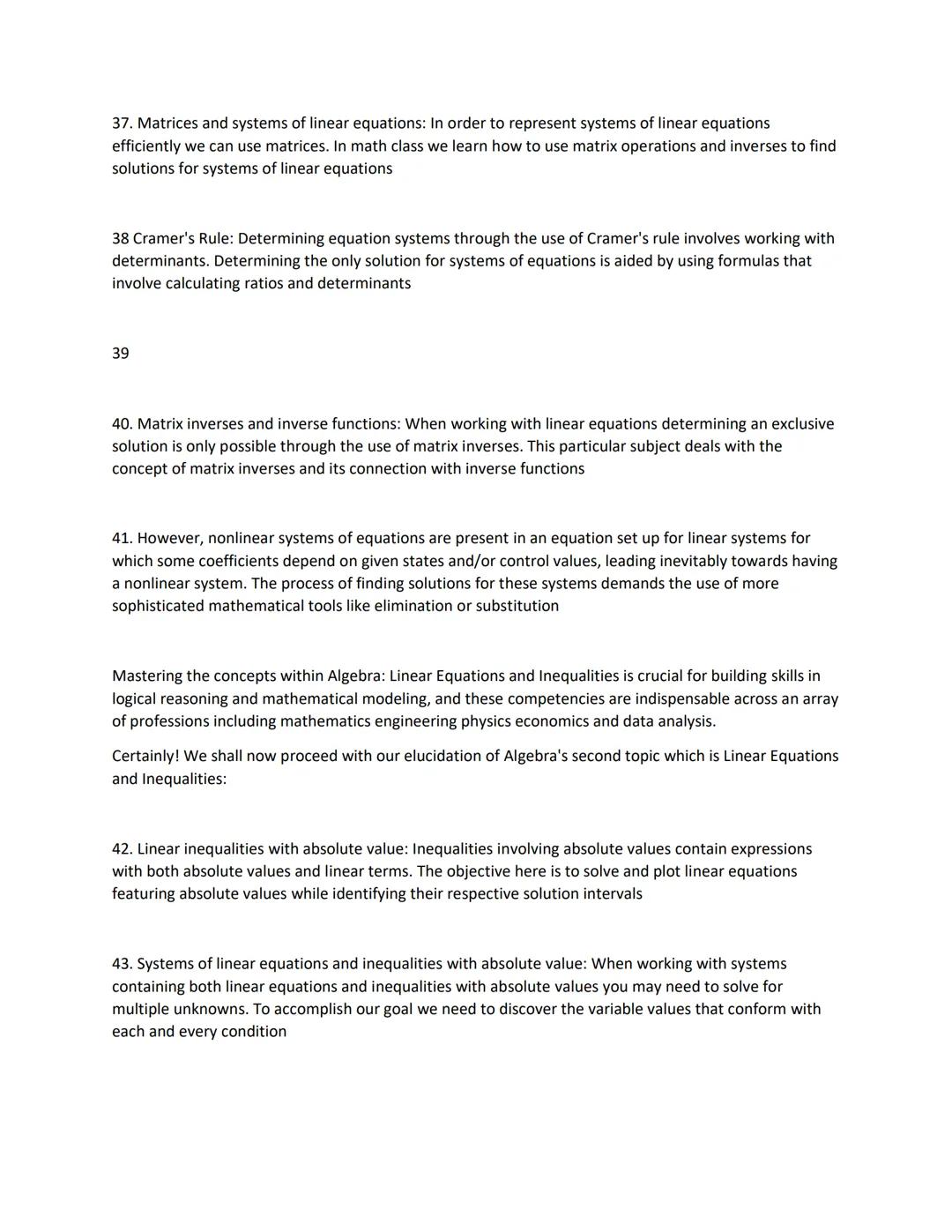
Systems and Matrix Methods
Systems of equations and inequalities show up in many real-world contexts, from planning a budget to analyzing traffic patterns. These systems let you model complex situations with multiple requirements.
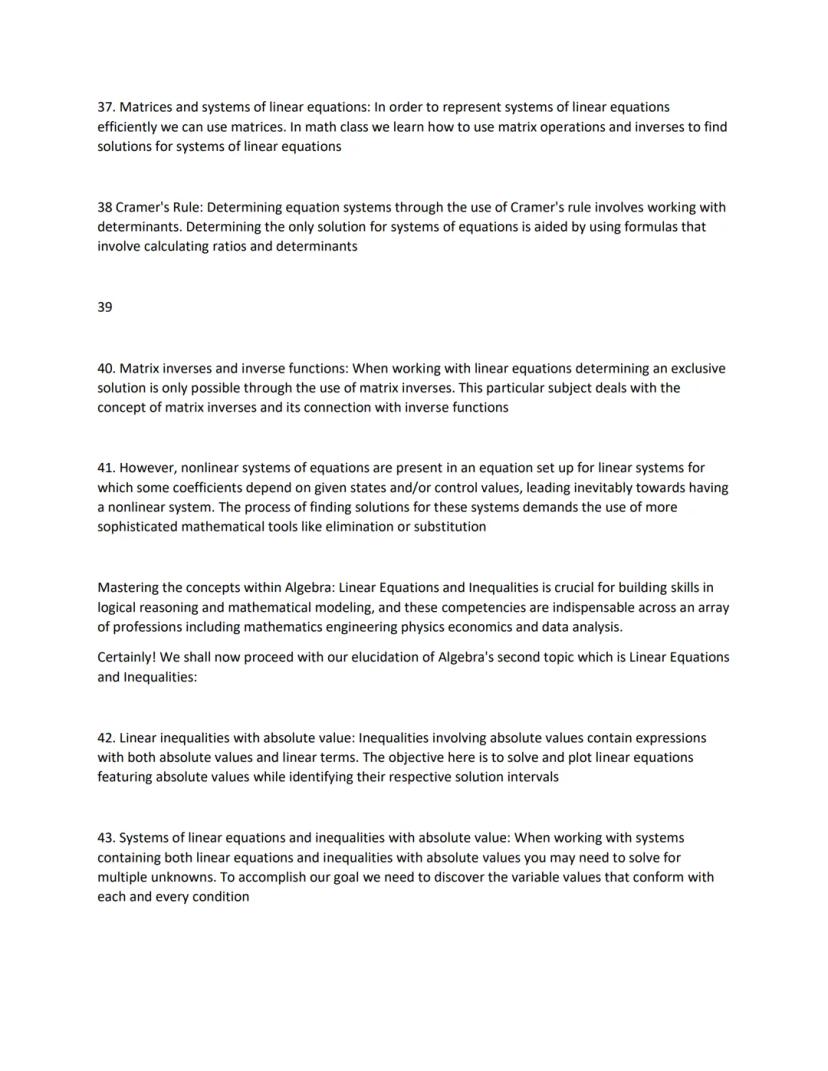
Matrices provide a powerful shorthand for working with systems of linear equations. Instead of writing out each equation, you can put all the coefficients in a rectangular array and use matrix operations to find solutions quickly.
Cramer's Rule is a formula that uses determinants (special numbers calculated from matrices) to solve systems of equations. It's like having a magic formula that instantly gives you the solution!
Matrix inverses are similar to reciprocals in arithmetic. Just as 1/5 is the reciprocal of 5, a matrix inverse undoes the effect of the original matrix. When working with linear systems, matrix inverses help find unique solutions.
7
of 7
Advanced Applications
Linear programming is a powerful technique that uses linear inequalities to find the best solution to problems with many constraints. Businesses use this to maximize profits while staying within budget, resource, and time limitations.
Direct and inverse variation show relationships between variables. In direct variation, when one variable increases, the other increases proportionally. In inverse variation, when one increases, the other decreases proportionally.
Nonlinear inequalities contain variables with powers greater than 1 or other nonlinear functions. These create curved boundaries in graphs rather than straight lines, leading to more complex solution regions.
Real-Life Connection: The next time you hear about a company "optimizing" their operations or a scientist "modeling" a natural phenomenon, remember they're probably using the same types of equations and inequalities you're learning now!
We thought you’d never ask...
What is the Knowunity AI companion?
Our AI companion is specifically built for the needs of students. Based on the millions of content pieces we have on the platform we can provide truly meaningful and relevant answers to students. But its not only about answers, the companion is even more about guiding students through their daily learning challenges, with personalised study plans, quizzes or content pieces in the chat and 100% personalisation based on the students skills and developments.
Where can I download the Knowunity app?
You can download the app in the Google Play Store and in the Apple App Store.
Is Knowunity really free of charge?
That's right! Enjoy free access to study content, connect with fellow students, and get instant help – all at your fingertips.
Most popular content in Mathematics
9M
MathematicsMath Made Easy: Essential Concepts for Grade 7
Master key math concepts with this comprehensive flashcard set designed specifically for 7th graders. Boost your understanding and ace your exams!
7th7201
C
MathematicsChapter 2 Quiz. Algebra 1
Equations with variables on both side, literal equations, ratios, conversions, proportions
9th4672
M
GeometryMath Flashcards: Triangles, Angles, and Congruent Triangles
Master the fundamentals of geometry with these math flashcards covering triangle angles, parallel lines, and congruent triangles. Test your knowledge and ace your exams!
10th2520
G
GeometryGeometry Flashcards: Triangles, Proofs, Angles, and Lines
Master the fundamentals of geometry with these flashcards covering triangles, proofs, angles, and parallel lines. Test your knowledge and ace your exams!
9th3050
G
GeometryGeometry Essentials
Master the fundamentals of geometry with these flashcards covering angles, triangles, congruent triangles, parallel lines, and polygons.
10th3410
S
MathematicsSolving X on both sides of an equation
Solve for x when there is x on both sides of equation.
9th2721
B
MathematicsBasic multiplication and division
like 6th grade math
6th46010
P
MathematicsPEMDAS
PEMDAS (parentheses, exponents, multiplication, division, addition, subtraction) Order of operation to solve math problems.
6th3790
M
Mathematicsmath
learn some new math
6th4003
Most popular content
9O
 AP US History
Origins and Dynamics of the Columbian Exchange
Analyze the ecological and economic motivations behind the initial transfer of goods, people, and diseases between the Old and New Worlds.
9th3,1280
I
AP US HistoryIntroduction to Early Cultural Interactions
Analyze the initial social and religious encounters between Europeans, Africans, and Indigenous peoples in the colonial Americas.
9th2,7730
O
 AP World History
Origins of Ancient River Civilizations
Analyze the environmental factors and technological innovations that led to the rise of early states in Mesopotamia, Egypt, and the Indus Valley.
9th3,1870
M
AP US HistoryMotivations for European Exploration
Analyze the economic, religious, and political factors that drove European powers to the Americas during the 15th and 16th centuries.
9th1,7780
F
 AP Psychology
Foundations of Ethical Guidelines in Research
Practice the core principles of the APA ethical code including informed consent, debriefing, and the role of Institutional Review Boards.
9th1,3360
I
AP US HistoryIntroduction to Native American Societies
Examine the diverse social, political, and economic structures of North American indigenous groups prior to European contact.
9th1,1100
I
 AP Biology
Introduction to Biological Elements of Life
Practice identifying the essential elements including carbon, nitrogen, phosphorus, and sulfur that compose biological macromolecules.
9th1,7390
I
AP US HistoryIntroduction to the Spanish Encomienda System
Explore the fundamental economic and social structures of the Spanish colonial system, focusing on the encomienda and the casta social hierarchy.
9th8890
O
AP World HistoryOrigins and Continuity of the Byzantine Empire
Analyze the political and cultural transitions from the Roman Empire to the Byzantine Empire, focusing on the reign of Justinian I and his code.
9th1,6320
Can't find what you're looking for? Explore other subjects.
Students love us — and so will you.
4.6/5App Store
4.7/5Google Play
The app is very easy to use and well designed. I have found everything I was looking for so far and have been able to learn a lot from the presentations! I will definitely use the app for a class assignment! And of course it also helps a lot as an inspiration.
Stefan SiOS user
This app is really great. There are so many study notes and help [...]. My problem subject is French, for example, and the app has so many options for help. Thanks to this app, I have improved my French. I would recommend it to anyone.
Samantha KlichAndroid user
Wow, I am really amazed. I just tried the app because I've seen it advertised many times and was absolutely stunned. This app is THE HELP you want for school and above all, it offers so many things, such as workouts and fact sheets, which have been VERY helpful to me personally.
AnnaiOS user
Mathematics213 views·Updated Jun 19, 2026·7 pagesUnderstanding Linear Equations and Inequalities in Algebra
D
David Taylor@davidtaylor_hqbl
Algebra's world of Linear Equations and Inequalities is like having a secret code to solve real-world problems. These mathematical tools help us find unknown values and determine ranges of possible answers. Once you understand these basics, you'll be able to...
1
of 7
Sign up to see the content. It's free!
- Access to all documents
- Improve your grades
- Join milions of students
Understanding Linear Equations and Inequalities
Linear equations are math sentences where variables have an exponent of 1. They typically look like ax + b = 0 where a and b are fixed numbers. When you solve a linear equation, you're finding the exact value of x that makes the equation true. You'll use operations like division and multiplication to isolate x on one side.
Inequalities are different because they give you a range of answers instead of just one. They use symbols like greater than (>), less than (<), greater than or equal to (≥), or less than or equal to (≤). The cool thing about linear inequalities is that they also have the variable raised to the first power.
Solutions to linear equations and inequalities are the values that make the statement true. You'll often work with different types of linear problems, from single-variable equations to systems of equations and inequalities.
Try This! Think about your allowance money. If you have 5, the equation for having $10 left would be x - 5 = 10. Can you solve it?
2
of 7Sign up to see the content. It's free!
- Access to all documents
- Improve your grades
- Join milions of students
Real-World Applications
Linear equations and inequalities aren't just classroom math - they're tools used in real life! They help solve problems in physics, engineering, economics, and even computer science. Whenever you need to find an unknown value or check if something falls within certain limits, these math tools come in handy.
When solving systems of linear equations, you're looking for values that work for all equations at once. There are three possible outcomes: one unique solution, no solution (inconsistent), or many solutions (dependent systems).
Graphing linear equations gives you a visual picture of the relationship between variables. By plotting points on a graph, you can see the line that represents all solutions. This helps you determine the slope and y-intercept, which tell you how the variables relate to each other.
For linear inequalities with two variables, your solution isn't a single point but an entire region on a coordinate plane. When working with systems of inequalities, you're looking for the overlapping region that satisfies all conditions at once!
3
of 7Sign up to see the content. It's free!
- Access to all documents
- Improve your grades
- Join milions of students
Word Problems and Real-Life Scenarios
Word problems might seem tricky, but they're actually where math becomes useful! When you convert a word problem into an equation or inequality, you're translating real-world situations into math language you can solve.
Linear equations and inequalities help with many everyday calculations, from figuring out distances to analyzing business problems. The skills you learn here will help you make smart decisions in many situations.
Absolute value problems add another dimension to equations and inequalities. Absolute value measures the distance from zero, ignoring direction. When solving these problems, you need to check both the positive and negative cases to find all possible solutions.
Did You Know? Linear programming, which uses linear equations and inequalities, helps businesses maximize profits while staying within their budget constraints. The same math you're learning is used by major companies every day!
4
of 7Sign up to see the content. It's free!
- Access to all documents
- Improve your grades
- Join milions of students
Advanced Types of Equations and Inequalities
As you progress in algebra, you'll encounter different types of equations. Polynomial equations contain variables with whole number powers, like x², x³, or higher. Rational equations contain fractions with variables in the numerator or denominator.
Radical equations contain square roots or other root symbols. To solve these, you often isolate the radical and square both sides, but watch out for extra solutions that don't work in the original equation!
When working with absolute value equations, remember that |x| represents the distance from zero. This means |x| = 5 has two solutions: x = 5 or x = -5, since both are 5 units away from zero.
Linear inequalities in two variables create regions on a graph. Instead of a single line, you get an entire half-plane that satisfies the inequality. You'll shade this region and use a solid line for ≤ or ≥, and a dashed line for < or >.
5
of 7Sign up to see the content. It's free!
- Access to all documents
- Improve your grades
- Join milions of students
Notation and Complex Problems
Interval notation uses brackets and parentheses to show solution ranges. For example, [3,5] means all numbers from 3 to 5, including 3 and 5. Parentheses like (3,5) would exclude the endpoints.
When solving inequalities with polynomials and rational expressions, you'll need to find where the inequality holds true. These problems often require testing intervals and paying attention to where expressions change sign.
Piecewise functions are like mathematical "if-then" statements - they use different formulas depending on the input value. These functions can create interesting graphs and are useful for modeling real situations that behave differently under different conditions.
Challenge Yourself: Can you write an inequality for "I need at least $20 to go to the movies and buy popcorn"? If x is the money you have, the inequality would be x ≥ 20.
6
of 7Sign up to see the content. It's free!
- Access to all documents
- Improve your grades
- Join milions of students
Systems and Matrix Methods
Systems of equations and inequalities show up in many real-world contexts, from planning a budget to analyzing traffic patterns. These systems let you model complex situations with multiple requirements.
Matrices provide a powerful shorthand for working with systems of linear equations. Instead of writing out each equation, you can put all the coefficients in a rectangular array and use matrix operations to find solutions quickly.
Cramer's Rule is a formula that uses determinants (special numbers calculated from matrices) to solve systems of equations. It's like having a magic formula that instantly gives you the solution!
Matrix inverses are similar to reciprocals in arithmetic. Just as 1/5 is the reciprocal of 5, a matrix inverse undoes the effect of the original matrix. When working with linear systems, matrix inverses help find unique solutions.
7
of 7Sign up to see the content. It's free!
- Access to all documents
- Improve your grades
- Join milions of students
Advanced Applications
Linear programming is a powerful technique that uses linear inequalities to find the best solution to problems with many constraints. Businesses use this to maximize profits while staying within budget, resource, and time limitations.
Direct and inverse variation show relationships between variables. In direct variation, when one variable increases, the other increases proportionally. In inverse variation, when one increases, the other decreases proportionally.
Nonlinear inequalities contain variables with powers greater than 1 or other nonlinear functions. These create curved boundaries in graphs rather than straight lines, leading to more complex solution regions.
Real-Life Connection: The next time you hear about a company "optimizing" their operations or a scientist "modeling" a natural phenomenon, remember they're probably using the same types of equations and inequalities you're learning now!
We thought you’d never ask...
What is the Knowunity AI companion?
Our AI companion is specifically built for the needs of students. Based on the millions of content pieces we have on the platform we can provide truly meaningful and relevant answers to students. But its not only about answers, the companion is even more about guiding students through their daily learning challenges, with personalised study plans, quizzes or content pieces in the chat and 100% personalisation based on the students skills and developments.
Where can I download the Knowunity app?
You can download the app in the Google Play Store and in the Apple App Store.
Is Knowunity really free of charge?
That's right! Enjoy free access to study content, connect with fellow students, and get instant help – all at your fingertips.
Most popular content in Mathematics
9M
MathematicsMath Made Easy: Essential Concepts for Grade 7
Master key math concepts with this comprehensive flashcard set designed specifically for 7th graders. Boost your understanding and ace your exams!
7th7201
C
MathematicsChapter 2 Quiz. Algebra 1
Equations with variables on both side, literal equations, ratios, conversions, proportions
9th4672
M
GeometryMath Flashcards: Triangles, Angles, and Congruent Triangles
Master the fundamentals of geometry with these math flashcards covering triangle angles, parallel lines, and congruent triangles. Test your knowledge and ace your exams!
10th2520
G
GeometryGeometry Flashcards: Triangles, Proofs, Angles, and Lines
Master the fundamentals of geometry with these flashcards covering triangles, proofs, angles, and parallel lines. Test your knowledge and ace your exams!
9th3050
G
GeometryGeometry Essentials
Master the fundamentals of geometry with these flashcards covering angles, triangles, congruent triangles, parallel lines, and polygons.
10th3410
S
MathematicsSolving X on both sides of an equation
Solve for x when there is x on both sides of equation.
9th2721
B
MathematicsBasic multiplication and division
like 6th grade math
6th46010
P
MathematicsPEMDAS
PEMDAS (parentheses, exponents, multiplication, division, addition, subtraction) Order of operation to solve math problems.
6th3790
M
Mathematicsmath
learn some new math
6th4003
Most popular content
9O
AP US HistoryOrigins and Dynamics of the Columbian Exchange
Analyze the ecological and economic motivations behind the initial transfer of goods, people, and diseases between the Old and New Worlds.
9th3,1280
I
AP US HistoryIntroduction to Early Cultural Interactions
Analyze the initial social and religious encounters between Europeans, Africans, and Indigenous peoples in the colonial Americas.
9th2,7730
O
AP World HistoryOrigins of Ancient River Civilizations
Analyze the environmental factors and technological innovations that led to the rise of early states in Mesopotamia, Egypt, and the Indus Valley.
9th3,1870
M
AP US HistoryMotivations for European Exploration
Analyze the economic, religious, and political factors that drove European powers to the Americas during the 15th and 16th centuries.
9th1,7780
F
AP PsychologyFoundations of Ethical Guidelines in Research
Practice the core principles of the APA ethical code including informed consent, debriefing, and the role of Institutional Review Boards.
9th1,3360
I
AP US HistoryIntroduction to Native American Societies
Examine the diverse social, political, and economic structures of North American indigenous groups prior to European contact.
9th1,1100
I
AP BiologyIntroduction to Biological Elements of Life
Practice identifying the essential elements including carbon, nitrogen, phosphorus, and sulfur that compose biological macromolecules.
9th1,7390
I
AP US HistoryIntroduction to the Spanish Encomienda System
Explore the fundamental economic and social structures of the Spanish colonial system, focusing on the encomienda and the casta social hierarchy.
9th8890
O
AP World HistoryOrigins and Continuity of the Byzantine Empire
Analyze the political and cultural transitions from the Roman Empire to the Byzantine Empire, focusing on the reign of Justinian I and his code.
9th1,6320
Can't find what you're looking for? Explore other subjects.
Students love us — and so will you.
4.6/5App Store
4.7/5Google Play
The app is very easy to use and well designed. I have found everything I was looking for so far and have been able to learn a lot from the presentations! I will definitely use the app for a class assignment! And of course it also helps a lot as an inspiration.
Stefan SiOS user
This app is really great. There are so many study notes and help [...]. My problem subject is French, for example, and the app has so many options for help. Thanks to this app, I have improved my French. I would recommend it to anyone.
Samantha KlichAndroid user
Wow, I am really amazed. I just tried the app because I've seen it advertised many times and was absolutely stunned. This app is THE HELP you want for school and above all, it offers so many things, such as workouts and fact sheets, which have been VERY helpful to me personally.
AnnaiOS user