
Laws of exponentsform the fundamental building blocks for algebraic...
 Mathematics1,002 views·Updated Jun 11, 2026·2 pages
Exponent Rules: Examples and Worksheet for Algebra 1

kylie@k.devv1231
1
of 2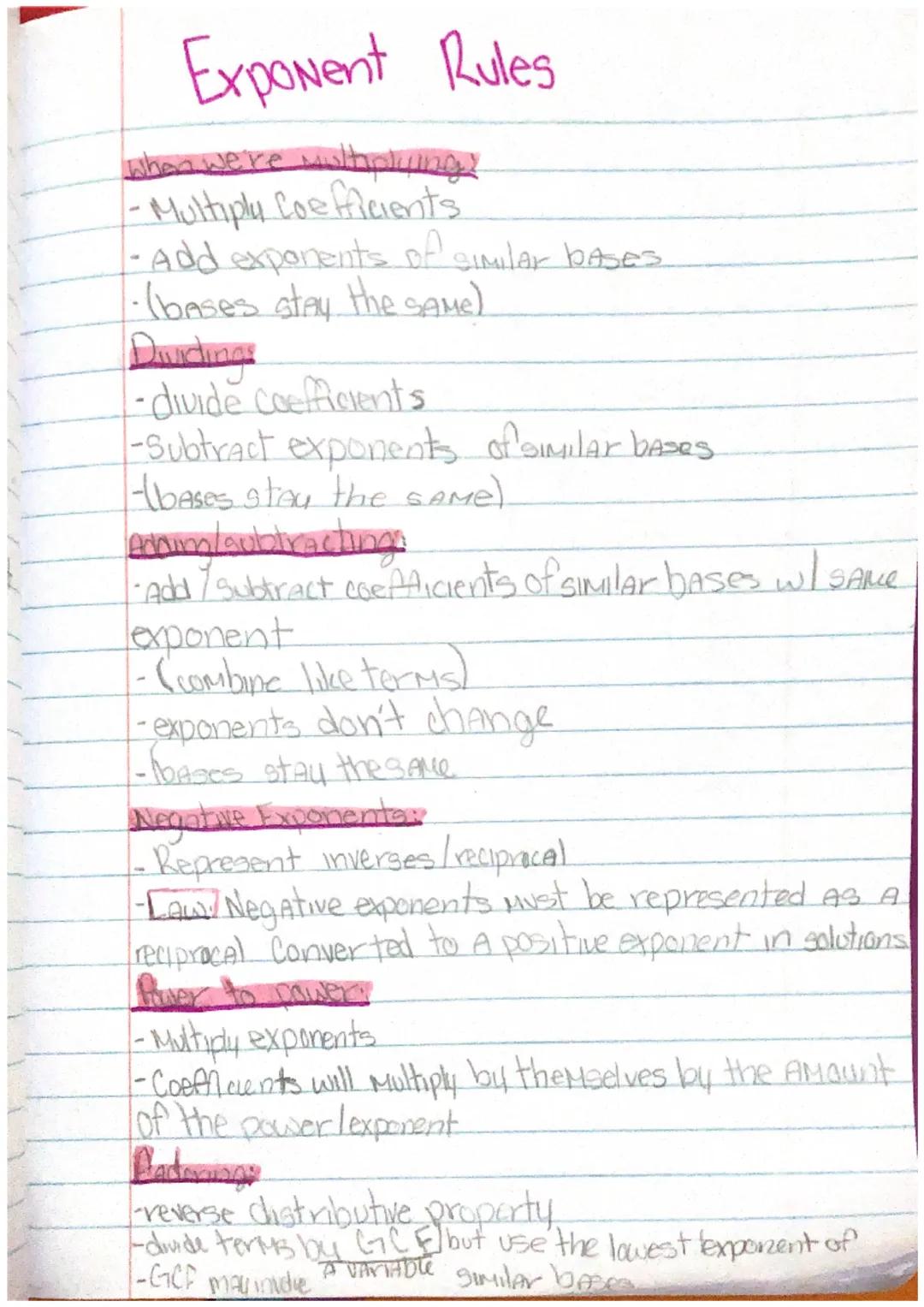
Page 2: Scientific Notation and Advanced Applications
This page focuses on scientific notation and its relationship to exponent rules algebra 1 examples, particularly emphasizing base-10 operations.
Definition: Scientific notation is a standardized way of writing very large or very small numbers using powers of 10.
Key characteristics of scientific notation include:
- Base is always 10
- Multiplication symbol is represented by "×"
- Exponent (b) must be an integer
- Positive exponents indicate large numbers
- Negative exponents indicate small numbers
Highlight: When adding or subtracting numbers in scientific notation, exponents must be manipulated to achieve common powers of 10.
Example: Converting between standard and scientific notation: 1,000 = 1 × 10³
The page emphasizes the importance of maintaining consistent exponent manipulation when performing operations in scientific notation, particularly when adding and subtracting exponents with same base.
2
of 2
Page 1: Core Exponent Rules
This page outlines the fundamental laws of exponents with examples and their applications in algebraic operations. The content focuses on multiplication, division, addition/subtraction, and negative exponents.
Definition: Exponent rules are mathematical principles that govern how we manipulate expressions with powers.
Highlight: When multiplying terms with exponents, coefficients multiply while exponents of similar bases add.
Example: For multiplication: x³ • x² = x⁵ (adding exponents with same base)
The page details several key operations:
For multiplication operations (exponent rules algebra 1 multiplication):
- Multiply the coefficients
- Add exponents of like bases
- Bases remain unchanged
For division operations (dividing exponents):
- Divide the coefficients
- Subtract exponents of like bases
- Maintain the same bases
Vocabulary: Negative exponents indicate reciprocals of expressions, requiring conversion to positive exponents in solutions.
We thought you’d never ask...
What is the Knowunity AI companion?
Our AI companion is specifically built for the needs of students. Based on the millions of content pieces we have on the platform we can provide truly meaningful and relevant answers to students. But its not only about answers, the companion is even more about guiding students through their daily learning challenges, with personalised study plans, quizzes or content pieces in the chat and 100% personalisation based on the students skills and developments.
Where can I download the Knowunity app?
You can download the app in the Google Play Store and in the Apple App Store.
Is Knowunity really free of charge?
That's right! Enjoy free access to study content, connect with fellow students, and get instant help – all at your fingertips.
Similar Content
Most popular content in Mathematics
9M
MathematicsMath Made Easy: Essential Concepts for Grade 7
Master key math concepts with this comprehensive flashcard set designed specifically for 7th graders. Boost your understanding and ace your exams!
7th7201
C
MathematicsChapter 2 Quiz. Algebra 1
Equations with variables on both side, literal equations, ratios, conversions, proportions
9th4672
M
GeometryMath Flashcards: Triangles, Angles, and Congruent Triangles
Master the fundamentals of geometry with these math flashcards covering triangle angles, parallel lines, and congruent triangles. Test your knowledge and ace your exams!
10th2520
G
GeometryGeometry Flashcards: Triangles, Proofs, Angles, and Lines
Master the fundamentals of geometry with these flashcards covering triangles, proofs, angles, and parallel lines. Test your knowledge and ace your exams!
9th3050
G
GeometryGeometry Essentials
Master the fundamentals of geometry with these flashcards covering angles, triangles, congruent triangles, parallel lines, and polygons.
10th3410
S
MathematicsSolving X on both sides of an equation
Solve for x when there is x on both sides of equation.
9th2721
B
MathematicsBasic multiplication and division
like 6th grade math
6th46010
P
MathematicsPEMDAS
PEMDAS (parentheses, exponents, multiplication, division, addition, subtraction) Order of operation to solve math problems.
6th3790
M
Mathematicsmath
learn some new math
6th4003
Most popular content
9O
 AP US History
Origins and Dynamics of the Columbian Exchange
Analyze the ecological and economic motivations behind the initial transfer of goods, people, and diseases between the Old and New Worlds.
9th3,1280
I
AP US HistoryIntroduction to Early Cultural Interactions
Analyze the initial social and religious encounters between Europeans, Africans, and Indigenous peoples in the colonial Americas.
9th2,7730
O
 AP World History
Origins of Ancient River Civilizations
Analyze the environmental factors and technological innovations that led to the rise of early states in Mesopotamia, Egypt, and the Indus Valley.
9th3,1870
M
AP US HistoryMotivations for European Exploration
Analyze the economic, religious, and political factors that drove European powers to the Americas during the 15th and 16th centuries.
9th1,7780
F
 AP Psychology
Foundations of Ethical Guidelines in Research
Practice the core principles of the APA ethical code including informed consent, debriefing, and the role of Institutional Review Boards.
9th1,3360
I
AP US HistoryIntroduction to Native American Societies
Examine the diverse social, political, and economic structures of North American indigenous groups prior to European contact.
9th1,1100
I
 AP Biology
Introduction to Biological Elements of Life
Practice identifying the essential elements including carbon, nitrogen, phosphorus, and sulfur that compose biological macromolecules.
9th1,7390
I
AP US HistoryIntroduction to the Spanish Encomienda System
Explore the fundamental economic and social structures of the Spanish colonial system, focusing on the encomienda and the casta social hierarchy.
9th8890
O
AP World HistoryOrigins and Continuity of the Byzantine Empire
Analyze the political and cultural transitions from the Roman Empire to the Byzantine Empire, focusing on the reign of Justinian I and his code.
9th1,6320
Can't find what you're looking for? Explore other subjects.
Students love us — and so will you.
4.6/5App Store
4.7/5Google Play
The app is very easy to use and well designed. I have found everything I was looking for so far and have been able to learn a lot from the presentations! I will definitely use the app for a class assignment! And of course it also helps a lot as an inspiration.
Stefan SiOS user
This app is really great. There are so many study notes and help [...]. My problem subject is French, for example, and the app has so many options for help. Thanks to this app, I have improved my French. I would recommend it to anyone.
Samantha KlichAndroid user
Wow, I am really amazed. I just tried the app because I've seen it advertised many times and was absolutely stunned. This app is THE HELP you want for school and above all, it offers so many things, such as workouts and fact sheets, which have been VERY helpful to me personally.
AnnaiOS user
Mathematics1,002 views·Updated Jun 11, 2026·2 pagesExponent Rules: Examples and Worksheet for Algebra 1
kylie@k.devv1231
Laws of exponents form the fundamental building blocks for algebraic manipulation, particularly when dealing with exponential expressions.
• The core rules cover multiplication, division, and operations with negative exponents
• Understanding these rules is essential for exponent rules algebra 1...
1
of 2
Sign up to see the content. It's free!
- Access to all documents
- Improve your grades
- Join milions of students
Page 2: Scientific Notation and Advanced Applications
This page focuses on scientific notation and its relationship to exponent rules algebra 1 examples, particularly emphasizing base-10 operations.
Definition: Scientific notation is a standardized way of writing very large or very small numbers using powers of 10.
Key characteristics of scientific notation include:
- Base is always 10
- Multiplication symbol is represented by "×"
- Exponent (b) must be an integer
- Positive exponents indicate large numbers
- Negative exponents indicate small numbers
Highlight: When adding or subtracting numbers in scientific notation, exponents must be manipulated to achieve common powers of 10.
Example: Converting between standard and scientific notation: 1,000 = 1 × 10³
The page emphasizes the importance of maintaining consistent exponent manipulation when performing operations in scientific notation, particularly when adding and subtracting exponents with same base.
2
of 2Sign up to see the content. It's free!
- Access to all documents
- Improve your grades
- Join milions of students
Page 1: Core Exponent Rules
This page outlines the fundamental laws of exponents with examples and their applications in algebraic operations. The content focuses on multiplication, division, addition/subtraction, and negative exponents.
Definition: Exponent rules are mathematical principles that govern how we manipulate expressions with powers.
Highlight: When multiplying terms with exponents, coefficients multiply while exponents of similar bases add.
Example: For multiplication: x³ • x² = x⁵ (adding exponents with same base)
The page details several key operations:
For multiplication operations (exponent rules algebra 1 multiplication):
- Multiply the coefficients
- Add exponents of like bases
- Bases remain unchanged
For division operations (dividing exponents):
- Divide the coefficients
- Subtract exponents of like bases
- Maintain the same bases
Vocabulary: Negative exponents indicate reciprocals of expressions, requiring conversion to positive exponents in solutions.
We thought you’d never ask...
What is the Knowunity AI companion?
Our AI companion is specifically built for the needs of students. Based on the millions of content pieces we have on the platform we can provide truly meaningful and relevant answers to students. But its not only about answers, the companion is even more about guiding students through their daily learning challenges, with personalised study plans, quizzes or content pieces in the chat and 100% personalisation based on the students skills and developments.
Where can I download the Knowunity app?
You can download the app in the Google Play Store and in the Apple App Store.
Is Knowunity really free of charge?
That's right! Enjoy free access to study content, connect with fellow students, and get instant help – all at your fingertips.
Similar Content
Most popular content in Mathematics
9M
MathematicsMath Made Easy: Essential Concepts for Grade 7
Master key math concepts with this comprehensive flashcard set designed specifically for 7th graders. Boost your understanding and ace your exams!
7th7201
C
MathematicsChapter 2 Quiz. Algebra 1
Equations with variables on both side, literal equations, ratios, conversions, proportions
9th4672
M
GeometryMath Flashcards: Triangles, Angles, and Congruent Triangles
Master the fundamentals of geometry with these math flashcards covering triangle angles, parallel lines, and congruent triangles. Test your knowledge and ace your exams!
10th2520
G
GeometryGeometry Flashcards: Triangles, Proofs, Angles, and Lines
Master the fundamentals of geometry with these flashcards covering triangles, proofs, angles, and parallel lines. Test your knowledge and ace your exams!
9th3050
G
GeometryGeometry Essentials
Master the fundamentals of geometry with these flashcards covering angles, triangles, congruent triangles, parallel lines, and polygons.
10th3410
S
MathematicsSolving X on both sides of an equation
Solve for x when there is x on both sides of equation.
9th2721
B
MathematicsBasic multiplication and division
like 6th grade math
6th46010
P
MathematicsPEMDAS
PEMDAS (parentheses, exponents, multiplication, division, addition, subtraction) Order of operation to solve math problems.
6th3790
M
Mathematicsmath
learn some new math
6th4003
Most popular content
9O
AP US HistoryOrigins and Dynamics of the Columbian Exchange
Analyze the ecological and economic motivations behind the initial transfer of goods, people, and diseases between the Old and New Worlds.
9th3,1280
I
AP US HistoryIntroduction to Early Cultural Interactions
Analyze the initial social and religious encounters between Europeans, Africans, and Indigenous peoples in the colonial Americas.
9th2,7730
O
AP World HistoryOrigins of Ancient River Civilizations
Analyze the environmental factors and technological innovations that led to the rise of early states in Mesopotamia, Egypt, and the Indus Valley.
9th3,1870
M
AP US HistoryMotivations for European Exploration
Analyze the economic, religious, and political factors that drove European powers to the Americas during the 15th and 16th centuries.
9th1,7780
F
AP PsychologyFoundations of Ethical Guidelines in Research
Practice the core principles of the APA ethical code including informed consent, debriefing, and the role of Institutional Review Boards.
9th1,3360
I
AP US HistoryIntroduction to Native American Societies
Examine the diverse social, political, and economic structures of North American indigenous groups prior to European contact.
9th1,1100
I
AP BiologyIntroduction to Biological Elements of Life
Practice identifying the essential elements including carbon, nitrogen, phosphorus, and sulfur that compose biological macromolecules.
9th1,7390
I
AP US HistoryIntroduction to the Spanish Encomienda System
Explore the fundamental economic and social structures of the Spanish colonial system, focusing on the encomienda and the casta social hierarchy.
9th8890
O
AP World HistoryOrigins and Continuity of the Byzantine Empire
Analyze the political and cultural transitions from the Roman Empire to the Byzantine Empire, focusing on the reign of Justinian I and his code.
9th1,6320
Can't find what you're looking for? Explore other subjects.
Students love us — and so will you.
4.6/5App Store
4.7/5Google Play
The app is very easy to use and well designed. I have found everything I was looking for so far and have been able to learn a lot from the presentations! I will definitely use the app for a class assignment! And of course it also helps a lot as an inspiration.
Stefan SiOS user
This app is really great. There are so many study notes and help [...]. My problem subject is French, for example, and the app has so many options for help. Thanks to this app, I have improved my French. I would recommend it to anyone.
Samantha KlichAndroid user
Wow, I am really amazed. I just tried the app because I've seen it advertised many times and was absolutely stunned. This app is THE HELP you want for school and above all, it offers so many things, such as workouts and fact sheets, which have been VERY helpful to me personally.
AnnaiOS user