

Los sistemas de ecuaciones lineales son herramientas matemáticas fundamentales que...
 Matemáticas277 views·Updated Jun 16, 2026·5 pages
Resolución de Sistemas de Ecuaciones Lineales



1 / 5
1
of 5
Determinando el tipo de solución
Cuando te enfrentas a un sistema de ecuaciones lineales, tu primer paso es calcular el determinante de la matriz de coeficientes. Este determinante te dirá si el sistema tiene solución única o no.
En el ejemplo del examen de julio, tienes que encontrar para qué valores de "a" el determinante es cero. Esto se hace calculando el determinante y resolviendo la ecuación resultante: a³ + a² - a - 1 = 0.
Usando el método de Ruffini con los divisores ±1, encuentras que a = 1 y a = -1 hacen que el determinante sea cero. Por tanto, para a ≠ 1 y a ≠ -1, el sistema tiene solución única (es un sistema compatible determinado).
💡 Truco: Si el determinante ≠ 0, tienes solución única garantizada. ¡Es así de simple!
2
of 5
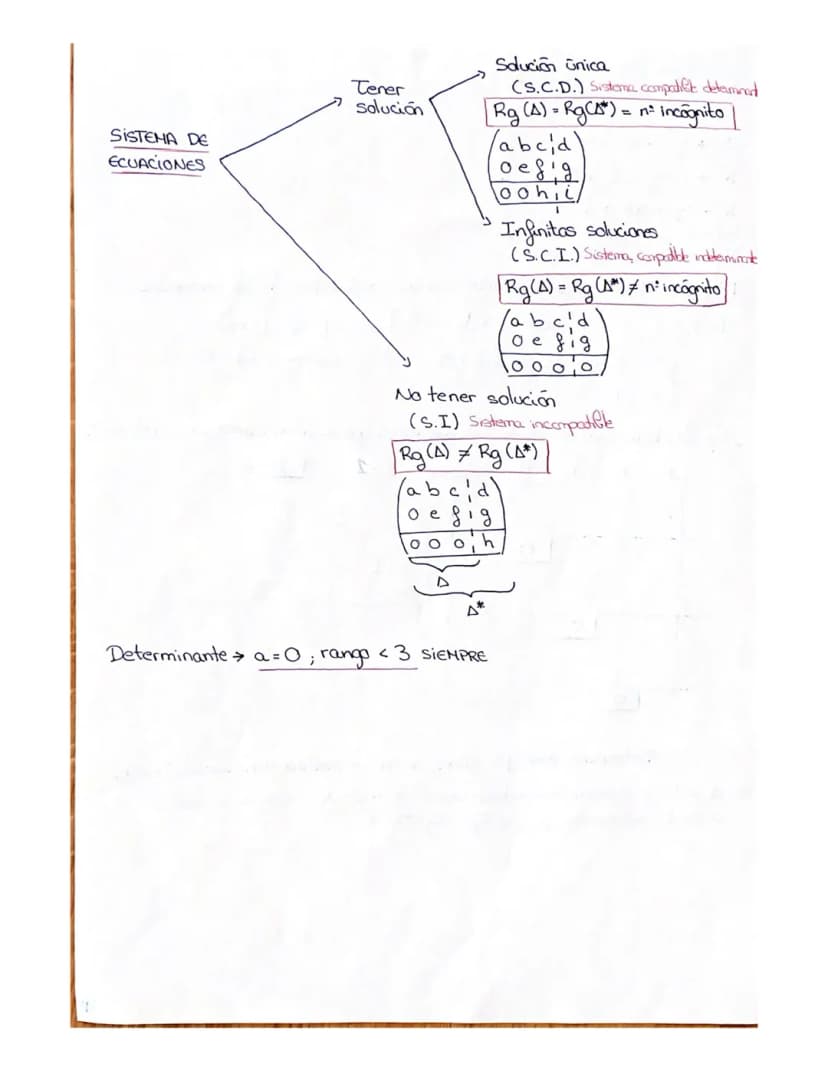
Clasificación de sistemas según Rouché-Frobenius
Aquí tienes las tres situaciones posibles que te puedes encontrar en cualquier examen. El teorema de Rouché-Frobenius es tu mejor amigo para clasificar sistemas.
Sistema Compatible Determinado (S.C.D.): Cuando Rg(A) = Rg = número de incógnitas. Esto significa que tienes una solución única y el determinante es diferente de cero.
Sistema Compatible Indeterminado (S.C.I.): Cuando Rg(A) = Rg ≠ número de incógnitas. En este caso tienes infinitas soluciones porque hay menos ecuaciones independientes que incógnitas.
Sistema Incompatible (S.I.): Cuando Rg(A) ≠ Rg. No existe solución porque las ecuaciones se contradicen entre sí.
⚠️ Recuerda: Siempre compara los rangos de A y A* para saber qué tipo de sistema tienes.
3
of 5
Resolviendo sistemas con Gauss
Cuando el determinante es cero, necesitas usar el método de Gauss para encontrar las soluciones. Este método te permite transformar el sistema en otro equivalente más fácil de resolver.
Para a = 0 en el ejemplo, sustituyes el valor en las ecuaciones y aplicas operaciones elementales entre filas. El objetivo es conseguir una matriz triangular superior con ceros debajo de la diagonal principal.
Tras las operaciones de Gauss, obtienes que z = -1, y = 1, x = 2. Puedes verificar tu respuesta sustituyendo estos valores en las ecuaciones originales.
El truco está en hacer las operaciones de fila correctas: F₁ - F₂, F₁ - F₃, y así sucesivamente hasta conseguir la forma triangular que necesitas.
✅ Consejo: Siempre verifica tu solución sustituyendo en las ecuaciones originales.
4
of 5
Infinitas soluciones vs ninguna solución
Los valores críticos a = 1 y a = -1 determinan comportamientos muy diferentes del sistema. Cuando sustituyes estos valores y aplicas Gauss, puedes ver claramente qué ocurre.
Para a = 1: Al hacer Gauss obtienes Rg(A) = 2 pero Rg = 3. Como los rangos son diferentes, el sistema es incompatible (no tiene solución). Esto sucede porque aparece una fila tipo "0 0 0 | -2", lo que es imposible.
Para a = -1: Tras las operaciones de Gauss consigues Rg(A) = Rg = 2. Como hay 3 incógnitas pero solo 2 ecuaciones independientes, el sistema es compatible indeterminado con infinitas soluciones.
La clave está en contar correctamente las filas no nulas después de hacer Gauss y comparar los rangos según Rouché-Frobenius.
🎯 Importante: Una fila de la forma "0 0 0 | número≠0" indica sistema incompatible.
5
of 5
Sistemas que nunca tienen solución única
En el examen de septiembre aparece un caso especial: un sistema que nunca tiene solución única, independientemente del valor del parámetro. Esto ocurre cuando el determinante siempre es cero.
Al calcular el determinante obtienes que es igual a 0 para cualquier valor de "a". Esto significa que el sistema nunca será compatible determinado, solo puede ser compatible indeterminado o incompatible.
Para determinar cuándo tiene infinitas soluciones, aplicas Gauss y estudias cuándo Rg(A) = Rg. En este caso, encuentras que para a = 2 el sistema es compatible indeterminado, mientras que para a ≠ 2 es incompatible.
Este tipo de ejercicios demuestra la importancia de analizar el determinante primero, ya que te ahorra tiempo al saber que nunca tendrás solución única.
🔍 Observación: Algunos sistemas están diseñados para nunca tener solución única, ¡fíjate bien en el enunciado!
We thought you’d never ask...
What is the Knowunity AI companion?
Our AI companion is specifically built for the needs of students. Based on the millions of content pieces we have on the platform we can provide truly meaningful and relevant answers to students. But its not only about answers, the companion is even more about guiding students through their daily learning challenges, with personalised study plans, quizzes or content pieces in the chat and 100% personalisation based on the students skills and developments.
Where can I download the Knowunity app?
You can download the app in the Google Play Store and in the Apple App Store.
Is Knowunity really free of charge?
That's right! Enjoy free access to study content, connect with fellow students, and get instant help – all at your fingertips.
Similar Content
Most popular content: determinante
9MatemáticasMatrices 2⁰ Bach
Tema de matrices 2⁰ Bachillerato de ciencias.
2° Bach2,95187
MatemáticasMatrices para 2 de bachillerato
Apuntes sobre matrices para 2 de bachillerato de ciencias.
2° Bach3,53094
MatemáticasMatemáticas CCSS EBAU ANDALUCÍA
Todo para la EBAU Andalucía de matemáticas de CCSS
2° Bach79317
MatemáticasAlgebra
Apuntes de 2° de bachillerato del Bloque I de Matemáticas. Suma, restay multiplicación de matrices, determinantes, matriz inversa, matriz identidad, sistemas de ecuaciones y problemas.
2° Bach2,84258
MatemáticasExamen - Ejercicios tipo EvAU Matemáticas
Examen - Ejercicios tipo EvAU Matemáticas
2° Bach54911
MatemáticasDeterminantes
determinantes con propiedades métodos y ejemplos
2° Bach74821
MatemáticasDeterminantes
Explicación detallada sobre cómo calcular determinantes (propiedades), menor complementario, adjuntos, matriz adjunta(propiedades), rangos a partir por menores no nulos, cálculo determinantes (mediante adjuntos) con ejemplo. (Hay vídeos de Susi)
2° Bach3274
MatemáticasPropiedades de los determinantes
Explicación de cómo aplicar las propiedades de los determinantes
2° Bach3332
MatemáticasExamen - Ejercicios tipo EvAU Matemáticas
Examen - Ejercicios tipo EvAU Matemáticas
2° Bach2468
Most popular content in Matemáticas
9E
Matemáticasecuaciones
esta la segunda parte
1° ESO1,4397
MatemáticasFunciones, límites y continuidad
Apuntes de funciones, límites y continuidad para 1-2 Bachillerato
1° Bach7,737228
D
MatemáticasDescubre el mundo de Las Matematicas
Explora los conceptos y técnicas de la Plástica en este emocionante conjunto de tarjetas de estudio.
3° ESO2,2170
MatemáticasProbabilidad
Apuntes de probabilidad completos
1° Bach2,41753
MatemáticasFunciones
Teoría básica sobre las funciones y los graficos
3° ESO13,8403,813
E
MatemáticasEcuaciones
Es de 1 de la Eso
1° ESO1,5045
L
MatemáticasLos triangulos y los angulos
4 de primaria
5º primaria1,1886
MatemáticasMatemáticas II (análisis) 2Bach
Primera parte de los apuntes de todo el temario de matemáticas II de cara a la PAU. Nota PAU: 10
1° Bach2,18272
MatemáticasAPUNTES PROBABILIDAD
Con todos los dibujos para entender mejor las fórmulas como AUB
2° Bach4,215122
Most popular content
9I
 Inglés
irregular verbs quiz
Domina el idioma inglés de manera sencilla y divertida con estos flashcards diseñados especialmente para estudiantes de sexto grado.
6º primaria2,8981
R
 Geografía e Historia
roma
a estudiar Roma!!
1° ESO2,3122
G
Geografía e HistoriaGrecia: Inicio de la democracia
Más o menos las preguntas que me pusieron a mí en el examen
1° ESO2,3622
D
InglésDominando la gramática inglesa: Flashcards desafiantes
Mejora tus habilidades gramaticales en inglés con estos flashcards desafiantes diseñados para estudiantes de grado 11. ¡Prepárate para dominar la gramática inglesa de manera divertida y efectiva!
3° ESO2,2480
M
Geografía e HistoriaMesopotamia y Egipto
Contenidos sobre la civilización mesopotámica y egipcia
1° ESO3,9381
O
 Lengua Castellana y Literatura
OBRAS Y AUTORES II
Quiz donde tendrás que relacionar las siguientes obras con sus respectivos autores: edición Romanticismo.
4° ESO3,3610
I
InglésIngles para repasar
quiz de ingles para entrar a clase preparados
2° ESO2,6290
F
 Filosofía
filosofía
repaso filosofía "el arje , la metafísica y la crítica de Nietszche a platon"
1° Bach2,8421
I
InglésIrregular verbs
Aprende nuevas palabras y expande tu vocabulario en inglés con esta colección de tarjetas de estudio interactivas.
3° ESO1,7442
Can't find what you're looking for? Explore other subjects.
Students love us — and so will you.
4.6/5App Store
4.7/5Google Play
The app is very easy to use and well designed. I have found everything I was looking for so far and have been able to learn a lot from the presentations! I will definitely use the app for a class assignment! And of course it also helps a lot as an inspiration.
Stefan SiOS user
This app is really great. There are so many study notes and help [...]. My problem subject is French, for example, and the app has so many options for help. Thanks to this app, I have improved my French. I would recommend it to anyone.
Samantha KlichAndroid user
Wow, I am really amazed. I just tried the app because I've seen it advertised many times and was absolutely stunned. This app is THE HELP you want for school and above all, it offers so many things, such as workouts and fact sheets, which have been VERY helpful to me personally.
AnnaiOS user
Matemáticas277 views·Updated Jun 16, 2026·5 pagesResolución de Sistemas de Ecuaciones Lineales
Los sistemas de ecuaciones lineales son herramientas matemáticas fundamentales que aparecen constantemente en Bachillerato. Dominar cuándo tienen solución única, infinitas soluciones o ninguna solución te será súper útil tanto para los exámenes como para entender muchos problemas de la vida...
1
of 5
Sign up to see the content. It's free!
- Access to all documents
- Improve your grades
- Join milions of students
Determinando el tipo de solución
Cuando te enfrentas a un sistema de ecuaciones lineales, tu primer paso es calcular el determinante de la matriz de coeficientes. Este determinante te dirá si el sistema tiene solución única o no.
En el ejemplo del examen de julio, tienes que encontrar para qué valores de "a" el determinante es cero. Esto se hace calculando el determinante y resolviendo la ecuación resultante: a³ + a² - a - 1 = 0.
Usando el método de Ruffini con los divisores ±1, encuentras que a = 1 y a = -1 hacen que el determinante sea cero. Por tanto, para a ≠ 1 y a ≠ -1, el sistema tiene solución única (es un sistema compatible determinado).
💡 Truco: Si el determinante ≠ 0, tienes solución única garantizada. ¡Es así de simple!
2
of 5Sign up to see the content. It's free!
- Access to all documents
- Improve your grades
- Join milions of students
Clasificación de sistemas según Rouché-Frobenius
Aquí tienes las tres situaciones posibles que te puedes encontrar en cualquier examen. El teorema de Rouché-Frobenius es tu mejor amigo para clasificar sistemas.
Sistema Compatible Determinado (S.C.D.): Cuando Rg(A) = Rg = número de incógnitas. Esto significa que tienes una solución única y el determinante es diferente de cero.
Sistema Compatible Indeterminado (S.C.I.): Cuando Rg(A) = Rg ≠ número de incógnitas. En este caso tienes infinitas soluciones porque hay menos ecuaciones independientes que incógnitas.
Sistema Incompatible (S.I.): Cuando Rg(A) ≠ Rg. No existe solución porque las ecuaciones se contradicen entre sí.
⚠️ Recuerda: Siempre compara los rangos de A y A* para saber qué tipo de sistema tienes.
3
of 5Sign up to see the content. It's free!
- Access to all documents
- Improve your grades
- Join milions of students
Resolviendo sistemas con Gauss
Cuando el determinante es cero, necesitas usar el método de Gauss para encontrar las soluciones. Este método te permite transformar el sistema en otro equivalente más fácil de resolver.
Para a = 0 en el ejemplo, sustituyes el valor en las ecuaciones y aplicas operaciones elementales entre filas. El objetivo es conseguir una matriz triangular superior con ceros debajo de la diagonal principal.
Tras las operaciones de Gauss, obtienes que z = -1, y = 1, x = 2. Puedes verificar tu respuesta sustituyendo estos valores en las ecuaciones originales.
El truco está en hacer las operaciones de fila correctas: F₁ - F₂, F₁ - F₃, y así sucesivamente hasta conseguir la forma triangular que necesitas.
✅ Consejo: Siempre verifica tu solución sustituyendo en las ecuaciones originales.
4
of 5Sign up to see the content. It's free!
- Access to all documents
- Improve your grades
- Join milions of students
Infinitas soluciones vs ninguna solución
Los valores críticos a = 1 y a = -1 determinan comportamientos muy diferentes del sistema. Cuando sustituyes estos valores y aplicas Gauss, puedes ver claramente qué ocurre.
Para a = 1: Al hacer Gauss obtienes Rg(A) = 2 pero Rg = 3. Como los rangos son diferentes, el sistema es incompatible (no tiene solución). Esto sucede porque aparece una fila tipo "0 0 0 | -2", lo que es imposible.
Para a = -1: Tras las operaciones de Gauss consigues Rg(A) = Rg = 2. Como hay 3 incógnitas pero solo 2 ecuaciones independientes, el sistema es compatible indeterminado con infinitas soluciones.
La clave está en contar correctamente las filas no nulas después de hacer Gauss y comparar los rangos según Rouché-Frobenius.
🎯 Importante: Una fila de la forma "0 0 0 | número≠0" indica sistema incompatible.
5
of 5Sign up to see the content. It's free!
- Access to all documents
- Improve your grades
- Join milions of students
Sistemas que nunca tienen solución única
En el examen de septiembre aparece un caso especial: un sistema que nunca tiene solución única, independientemente del valor del parámetro. Esto ocurre cuando el determinante siempre es cero.
Al calcular el determinante obtienes que es igual a 0 para cualquier valor de "a". Esto significa que el sistema nunca será compatible determinado, solo puede ser compatible indeterminado o incompatible.
Para determinar cuándo tiene infinitas soluciones, aplicas Gauss y estudias cuándo Rg(A) = Rg. En este caso, encuentras que para a = 2 el sistema es compatible indeterminado, mientras que para a ≠ 2 es incompatible.
Este tipo de ejercicios demuestra la importancia de analizar el determinante primero, ya que te ahorra tiempo al saber que nunca tendrás solución única.
🔍 Observación: Algunos sistemas están diseñados para nunca tener solución única, ¡fíjate bien en el enunciado!
We thought you’d never ask...
What is the Knowunity AI companion?
Our AI companion is specifically built for the needs of students. Based on the millions of content pieces we have on the platform we can provide truly meaningful and relevant answers to students. But its not only about answers, the companion is even more about guiding students through their daily learning challenges, with personalised study plans, quizzes or content pieces in the chat and 100% personalisation based on the students skills and developments.
Where can I download the Knowunity app?
You can download the app in the Google Play Store and in the Apple App Store.
Is Knowunity really free of charge?
That's right! Enjoy free access to study content, connect with fellow students, and get instant help – all at your fingertips.
Similar Content
Most popular content: determinante
9MatemáticasMatrices 2⁰ Bach
Tema de matrices 2⁰ Bachillerato de ciencias.
2° Bach2,95187
MatemáticasMatrices para 2 de bachillerato
Apuntes sobre matrices para 2 de bachillerato de ciencias.
2° Bach3,53094
MatemáticasMatemáticas CCSS EBAU ANDALUCÍA
Todo para la EBAU Andalucía de matemáticas de CCSS
2° Bach79317
MatemáticasAlgebra
Apuntes de 2° de bachillerato del Bloque I de Matemáticas. Suma, restay multiplicación de matrices, determinantes, matriz inversa, matriz identidad, sistemas de ecuaciones y problemas.
2° Bach2,84258
MatemáticasExamen - Ejercicios tipo EvAU Matemáticas
Examen - Ejercicios tipo EvAU Matemáticas
2° Bach54911
MatemáticasDeterminantes
determinantes con propiedades métodos y ejemplos
2° Bach74821
MatemáticasDeterminantes
Explicación detallada sobre cómo calcular determinantes (propiedades), menor complementario, adjuntos, matriz adjunta(propiedades), rangos a partir por menores no nulos, cálculo determinantes (mediante adjuntos) con ejemplo. (Hay vídeos de Susi)
2° Bach3274
MatemáticasPropiedades de los determinantes
Explicación de cómo aplicar las propiedades de los determinantes
2° Bach3332
MatemáticasExamen - Ejercicios tipo EvAU Matemáticas
Examen - Ejercicios tipo EvAU Matemáticas
2° Bach2468
Most popular content in Matemáticas
9E
Matemáticasecuaciones
esta la segunda parte
1° ESO1,4397
MatemáticasFunciones, límites y continuidad
Apuntes de funciones, límites y continuidad para 1-2 Bachillerato
1° Bach7,737228
D
MatemáticasDescubre el mundo de Las Matematicas
Explora los conceptos y técnicas de la Plástica en este emocionante conjunto de tarjetas de estudio.
3° ESO2,2170
MatemáticasProbabilidad
Apuntes de probabilidad completos
1° Bach2,41753
MatemáticasFunciones
Teoría básica sobre las funciones y los graficos
3° ESO13,8403,813
E
MatemáticasEcuaciones
Es de 1 de la Eso
1° ESO1,5045
L
MatemáticasLos triangulos y los angulos
4 de primaria
5º primaria1,1886
MatemáticasMatemáticas II (análisis) 2Bach
Primera parte de los apuntes de todo el temario de matemáticas II de cara a la PAU. Nota PAU: 10
1° Bach2,18272
MatemáticasAPUNTES PROBABILIDAD
Con todos los dibujos para entender mejor las fórmulas como AUB
2° Bach4,215122
Most popular content
9I
Inglésirregular verbs quiz
Domina el idioma inglés de manera sencilla y divertida con estos flashcards diseñados especialmente para estudiantes de sexto grado.
6º primaria2,8981
R
Geografía e Historiaroma
a estudiar Roma!!
1° ESO2,3122
G
Geografía e HistoriaGrecia: Inicio de la democracia
Más o menos las preguntas que me pusieron a mí en el examen
1° ESO2,3622
D
InglésDominando la gramática inglesa: Flashcards desafiantes
Mejora tus habilidades gramaticales en inglés con estos flashcards desafiantes diseñados para estudiantes de grado 11. ¡Prepárate para dominar la gramática inglesa de manera divertida y efectiva!
3° ESO2,2480
M
Geografía e HistoriaMesopotamia y Egipto
Contenidos sobre la civilización mesopotámica y egipcia
1° ESO3,9381
O
Lengua Castellana y LiteraturaOBRAS Y AUTORES II
Quiz donde tendrás que relacionar las siguientes obras con sus respectivos autores: edición Romanticismo.
4° ESO3,3610
I
InglésIngles para repasar
quiz de ingles para entrar a clase preparados
2° ESO2,6290
F
Filosofíafilosofía
repaso filosofía "el arje , la metafísica y la crítica de Nietszche a platon"
1° Bach2,8421
I
InglésIrregular verbs
Aprende nuevas palabras y expande tu vocabulario en inglés con esta colección de tarjetas de estudio interactivas.
3° ESO1,7442
Can't find what you're looking for? Explore other subjects.
Students love us — and so will you.
4.6/5App Store
4.7/5Google Play
The app is very easy to use and well designed. I have found everything I was looking for so far and have been able to learn a lot from the presentations! I will definitely use the app for a class assignment! And of course it also helps a lot as an inspiration.
Stefan SiOS user
This app is really great. There are so many study notes and help [...]. My problem subject is French, for example, and the app has so many options for help. Thanks to this app, I have improved my French. I would recommend it to anyone.
Samantha KlichAndroid user
Wow, I am really amazed. I just tried the app because I've seen it advertised many times and was absolutely stunned. This app is THE HELP you want for school and above all, it offers so many things, such as workouts and fact sheets, which have been VERY helpful to me personally.
AnnaiOS user