
Las funciones y límites son conceptos fundamentales en las matemáticas...
 Matemáticas1,149 views·Updated Jun 16, 2026·12 pages
Funciones y Límites: Resumen para 1° Bachillerato
M
Maria @maria_mjpi8



1 / 10
1
of 10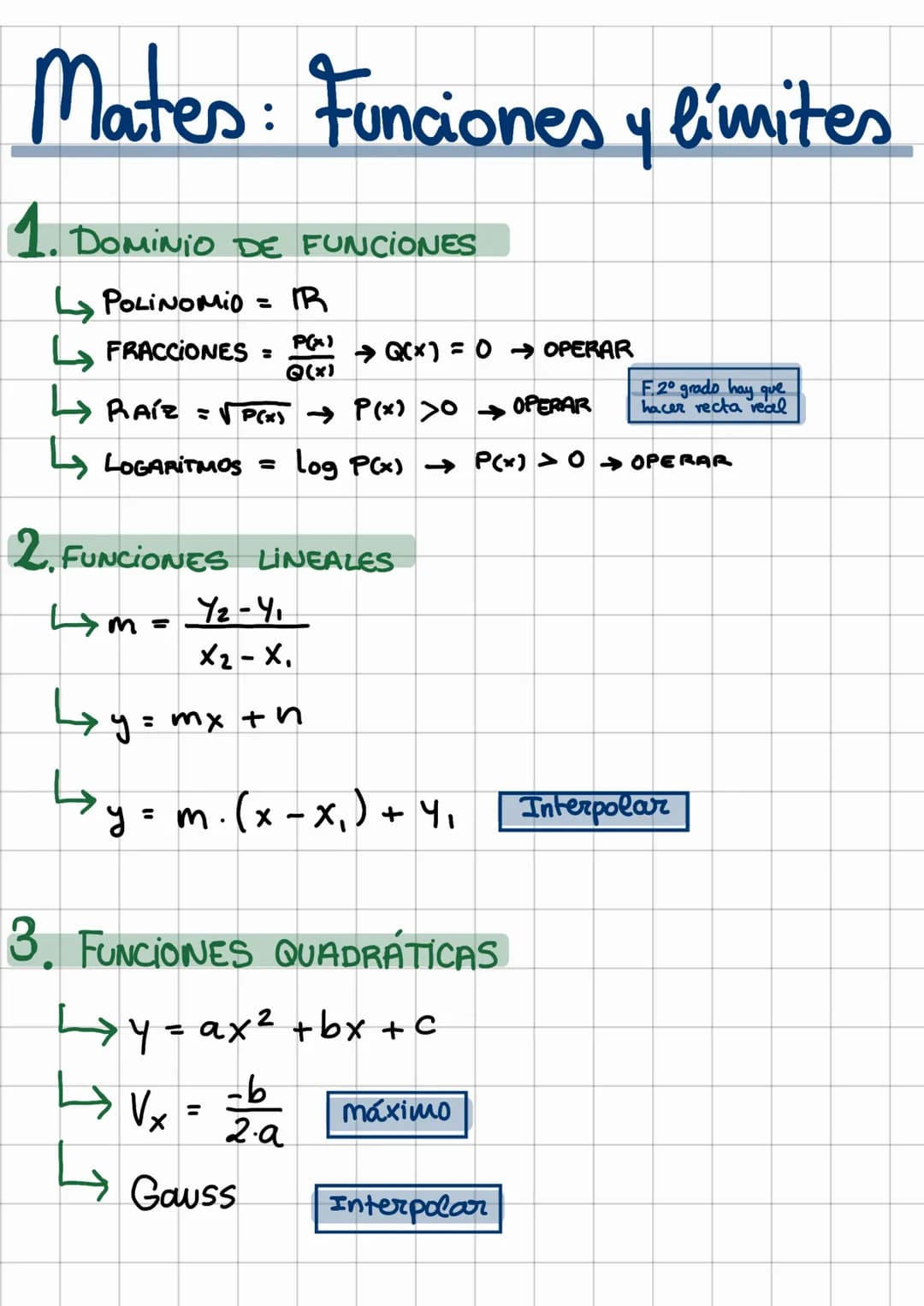
Dominio de funciones y funciones básicas
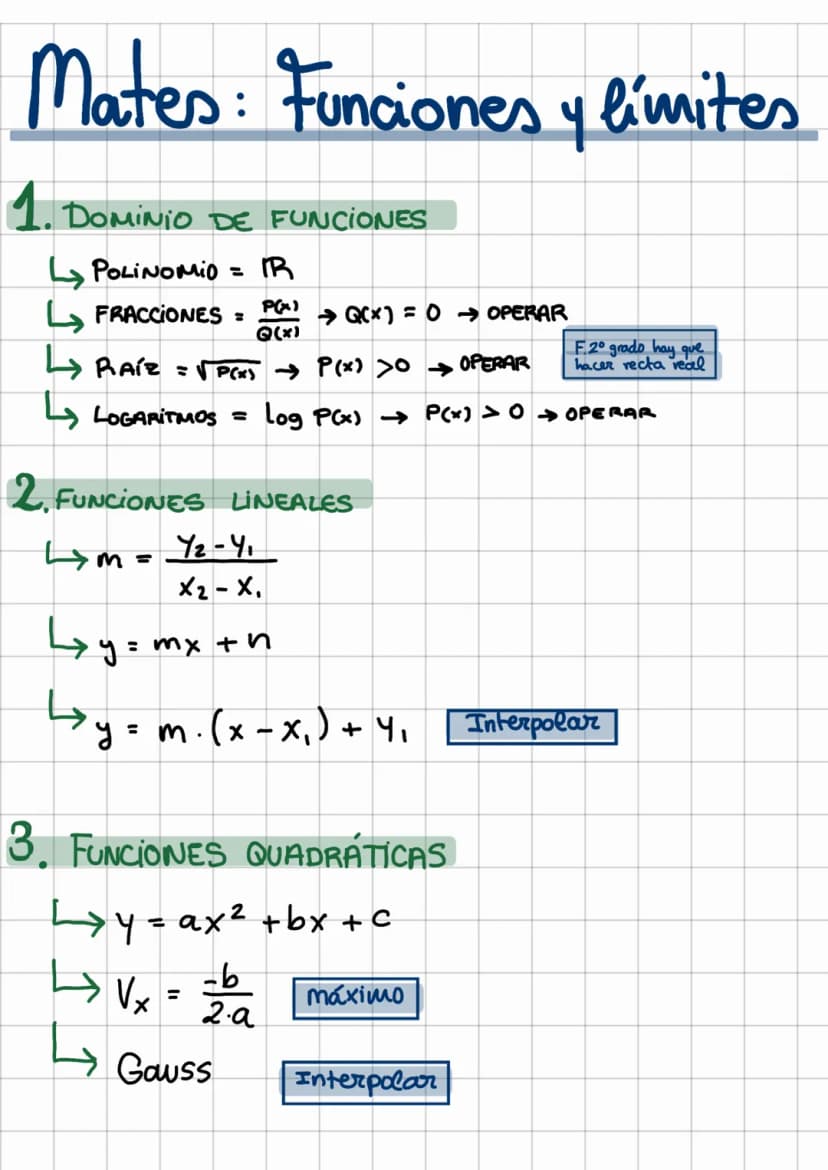
El dominio de una función es el conjunto de valores que puede tomar la variable independiente. Cada tipo de función tiene sus reglas:
- Polinomios: su dominio es siempre ℝ (todos los números reales)
- Fracciones : el denominador no puede ser cero, así que excluimos los valores donde Q(x)=0
- Raíces: en √P(x), necesitamos que P(x)≥0
- Logaritmos: en log P(x), necesitamos que P(x)>0
Las funciones lineales representan rectas donde m es la pendiente que se calcula como /. También podemos escribirlas como y=m+y₁ cuando conocemos un punto.
💡 Consejo práctico: Para analizar el dominio, identifica primero qué tipo de función tienes y luego aplica las restricciones correspondientes. Dibuja una recta real para visualizar mejor el resultado.
Las funciones cuadráticas tienen forma de parábola, con su vértice en x=-b/(2a). Este punto será un máximo si a<0 o un mínimo si a>0.
2
of 10
Límites y continuidad
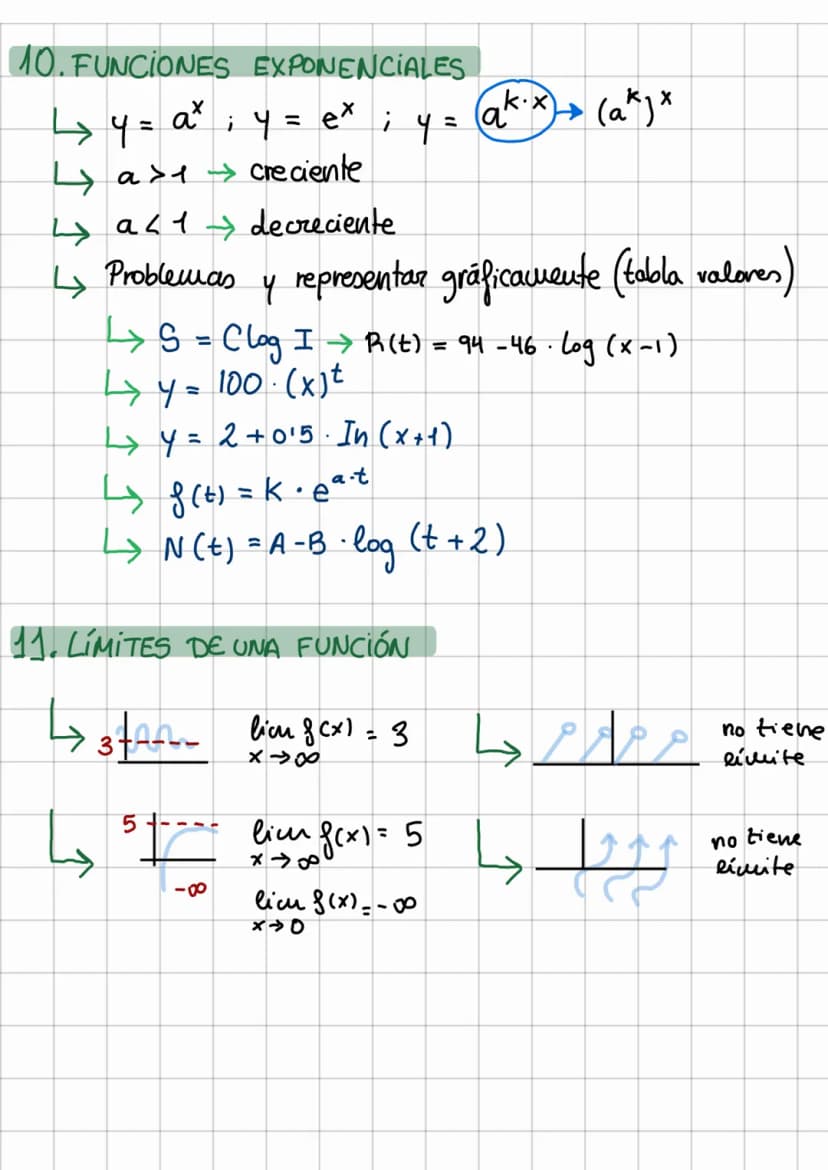
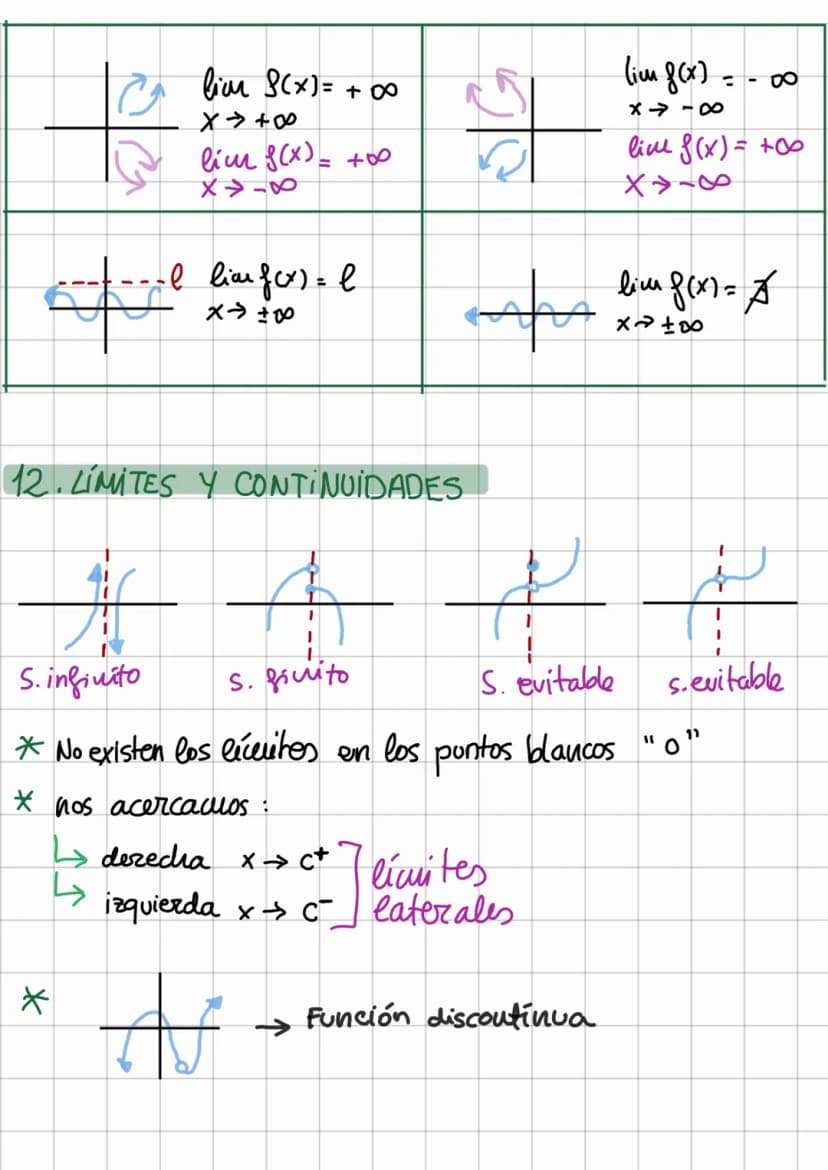
Los límites nos permiten entender hacia qué valor tiende una función cuando x se acerca a un punto determinado. Hay diferentes tipos:
- Límites hacia infinito: cuando x→±∞
- Límites laterales: acercándonos por la derecha (x→c⁺) o por la izquierda (x→c⁻)
Una función es continua en un punto cuando existe el límite en ese punto y coincide con el valor de la función. Si miramos una gráfica, podríamos dibujarla sin levantar el lápiz del papel.
🔍 Recuerda: Los puntos representados con "o" (puntos blancos) en una gráfica indican que el límite no existe en ese punto, y por tanto hay una discontinuidad.
Para estudiar la continuidad debemos comprobar si los límites laterales coinciden. Si no coinciden o no existen, la función presenta una discontinuidad en ese punto.
3
of 10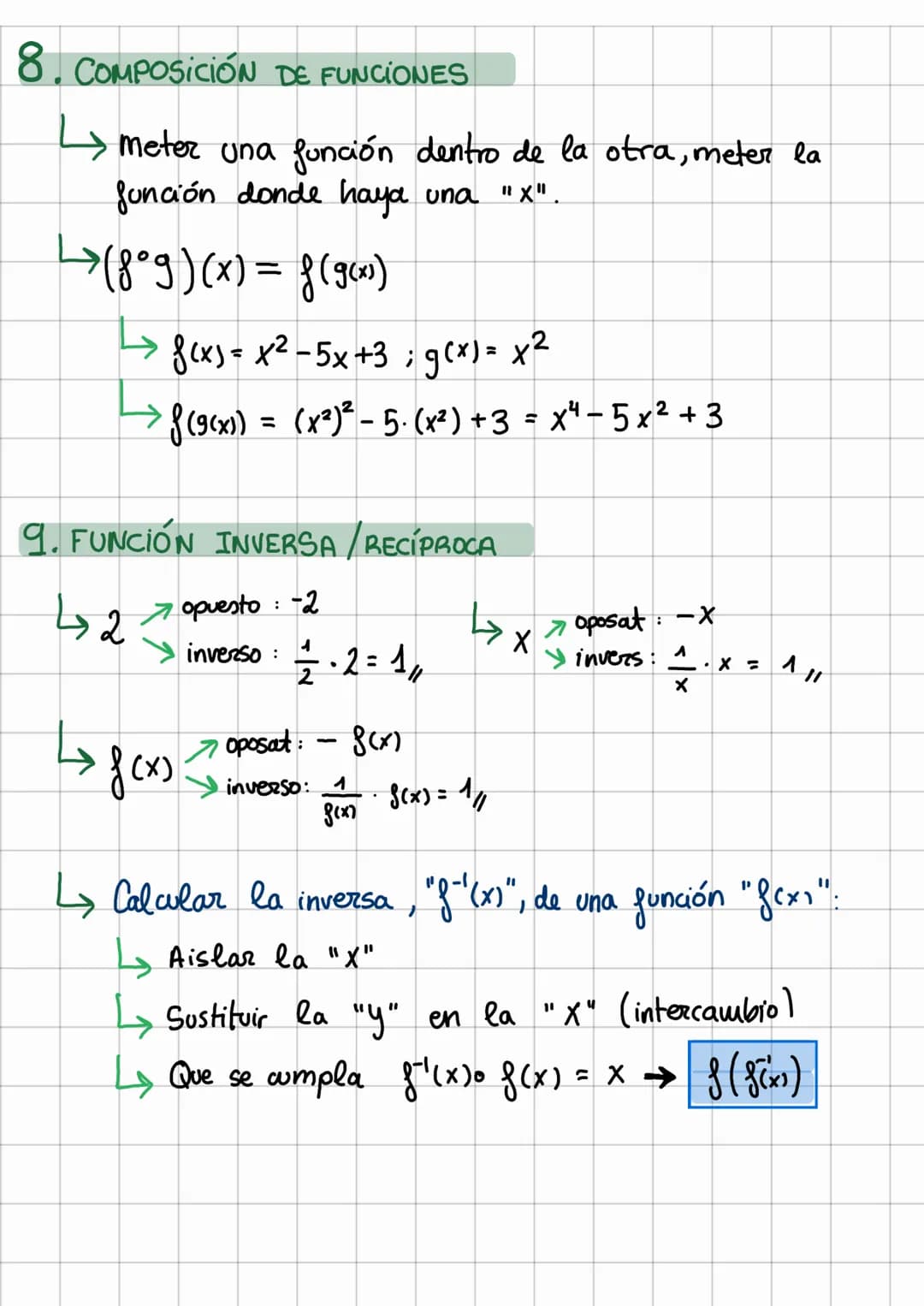
Indeterminaciones
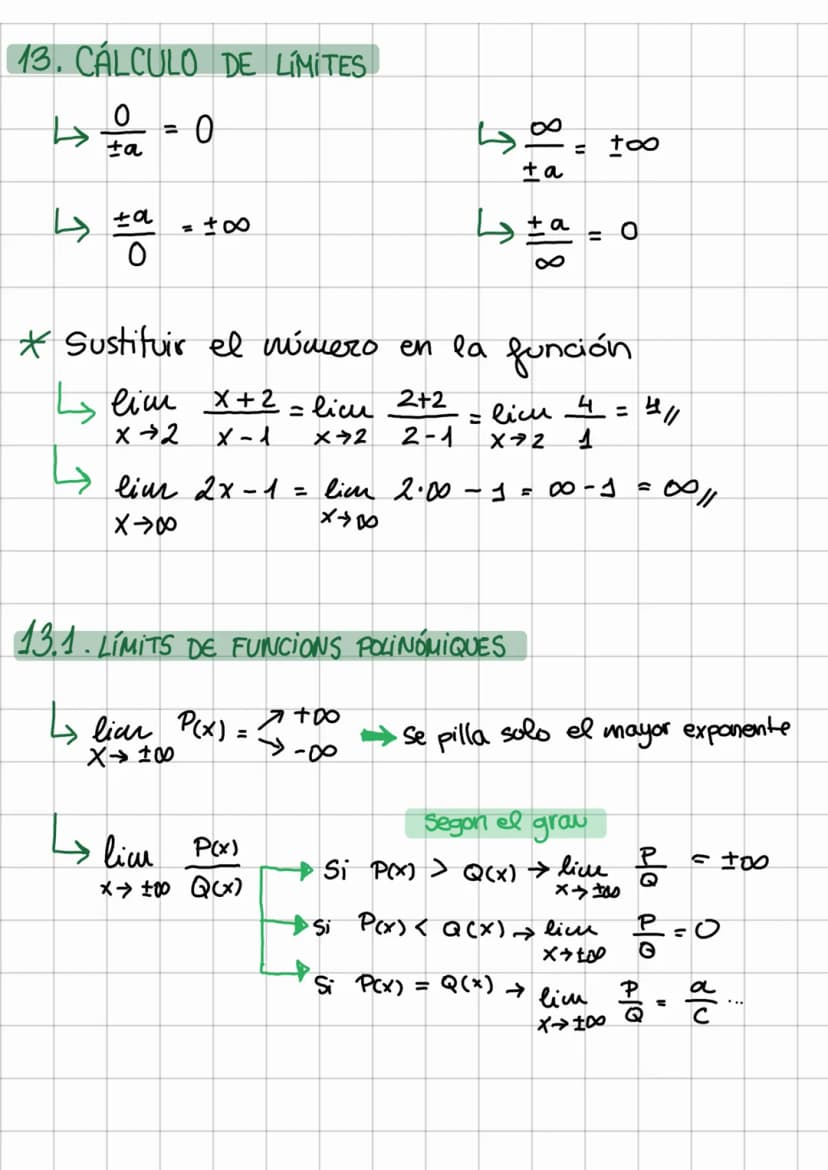
Las indeterminaciones son expresiones de límites que no podemos resolver directamente. Las más comunes son:
- ∞/∞: Divide todo entre la variable con el exponente más alto
- 0/0: Factoriza (usando factor común, identidades notables, etc.)
- ∞-∞: Racionaliza aunque no sea una fracción
- ∞^∞: Transforma en exponencial usando e^
Para resolver indeterminaciones del tipo 0/0, es útil factorizar tanto numerador como denominador y simplificar factores comunes.
🔑 Estrategia clave: Cada tipo de indeterminación requiere una técnica específica. Identifica primero qué tipo tienes antes de aplicar el método correspondiente.
Para las indeterminaciones ∞-∞, transformar la expresión en una fracción mediante suma/resta de fracciones algebraicas puede ser muy útil. Busca el mínimo común múltiplo (mcm) para unificar denominadores.
4
of 10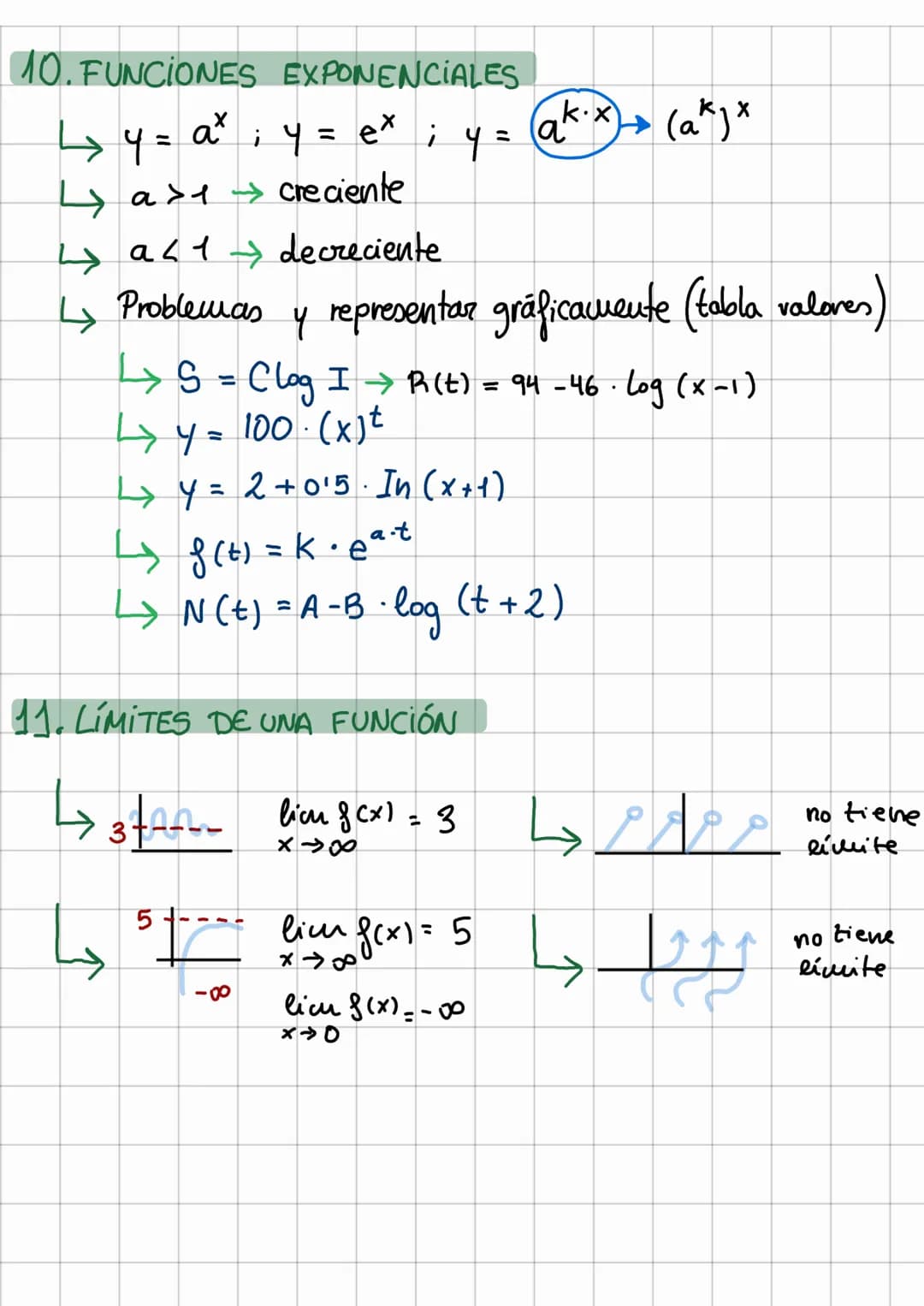
Continuidad y tipos de discontinuidades
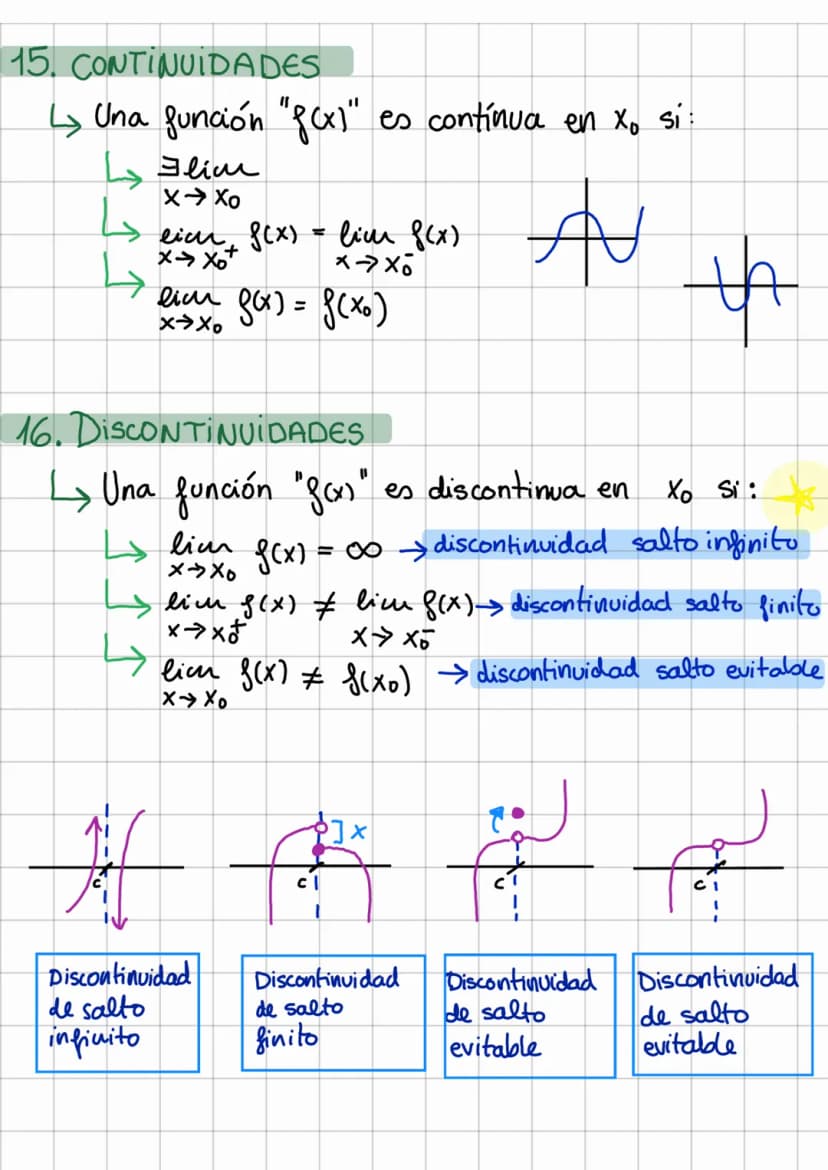
Una función g(x) es continua en un punto x₀ si cumple tres condiciones:
- Existe el límite cuando x→x₀
- Los límites laterales coinciden: lim₊ g(x) = lim₋ g(x)
- El límite coincide con el valor de la función: lim g(x) = g(x₀)
Las discontinuidades pueden ser de tres tipos:
- Discontinuidad de salto infinito: cuando el límite es infinito
- Discontinuidad de salto finito: cuando los límites laterales no coinciden
- Discontinuidad evitable: cuando existe el límite pero no coincide con el valor de la función
📌 Visualización: Piensa en una discontinuidad evitable como un "agujero" en la gráfica que podría rellenarse; un salto finito como un "escalón"; y un salto infinito como una "asíntota vertical".
Las discontinuidades se pueden identificar fácilmente en las gráficas: los saltos infinitos aparecen como líneas verticales, los saltos finitos como cortes en la función, y las evitables como puntos aislados.
5
of 10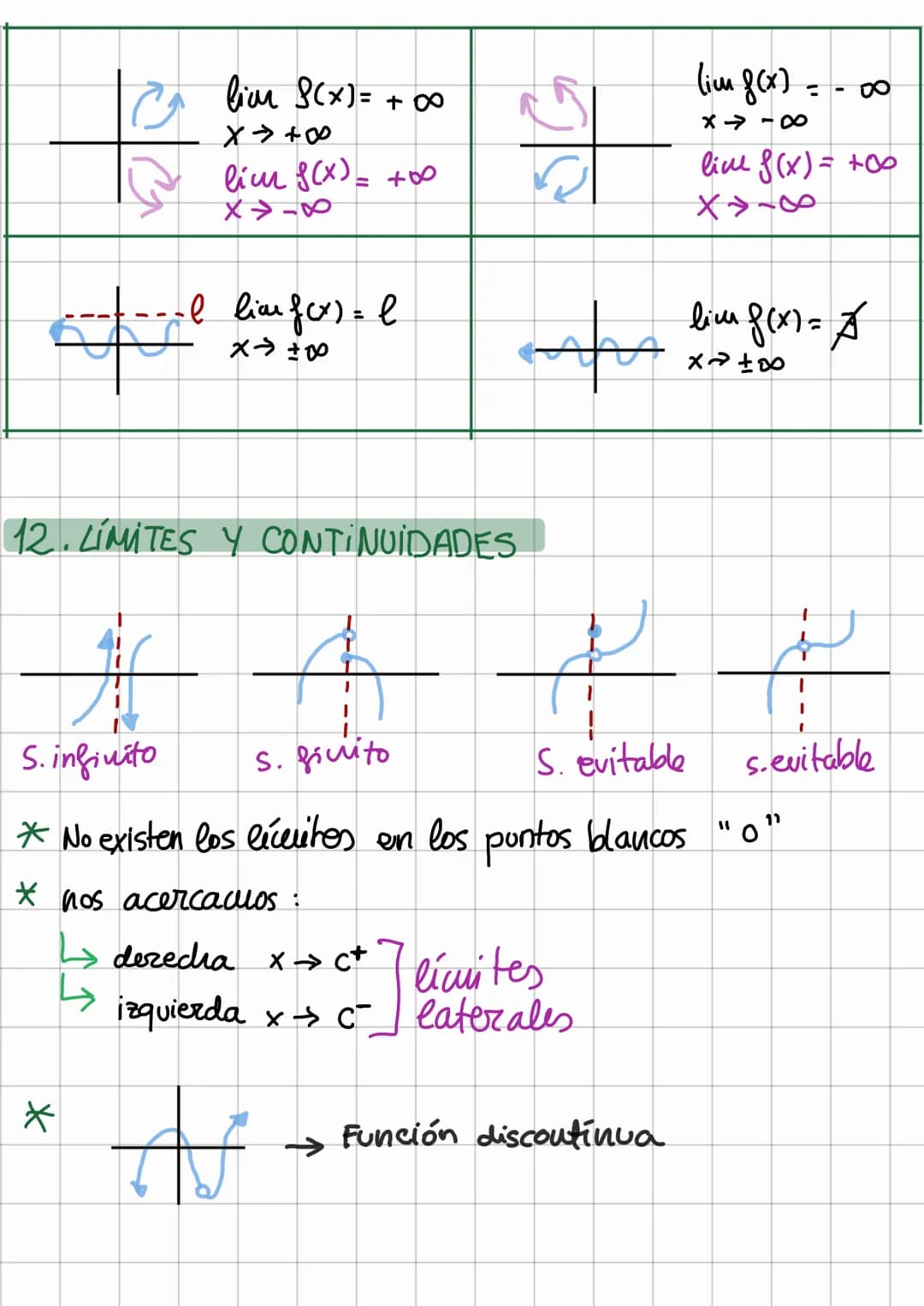
Estudio de discontinuidades
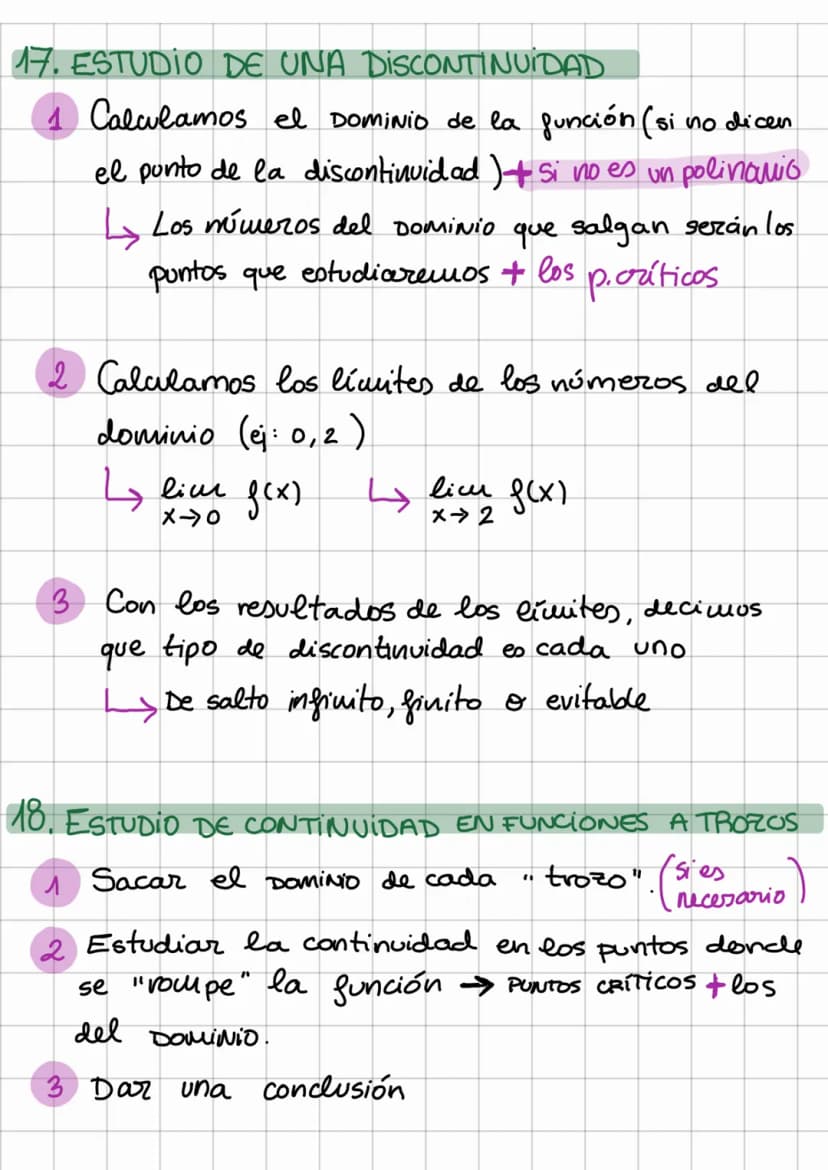
Para estudiar las discontinuidades de una función, sigue estos pasos:
- Calcula el dominio de la función. Los puntos que no pertenecen al dominio son candidatos a ser discontinuidades.
- Para cada punto crítico, calcula los límites laterales y el valor de la función (si existe).
- Clasifica cada discontinuidad según su tipo: infinita, finita o evitable.
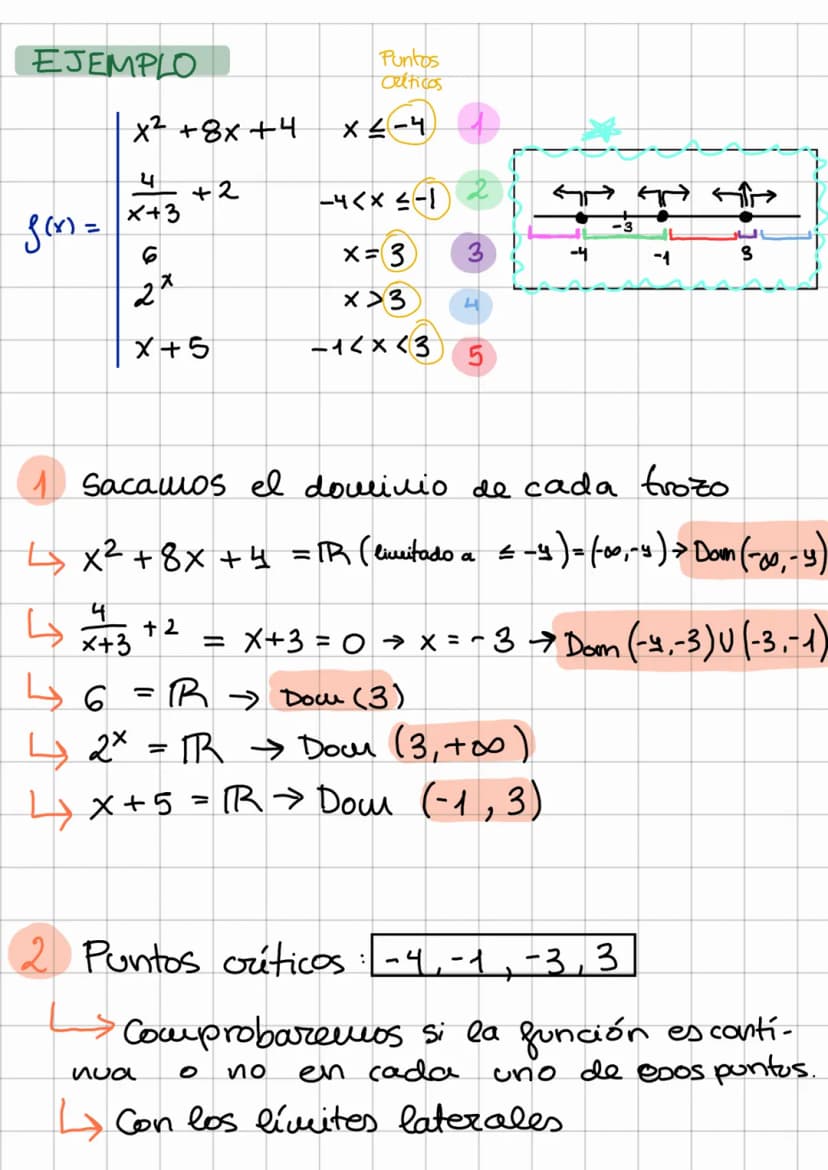
En funciones definidas a trozos, es especialmente importante:
- Estudiar el dominio de cada trozo por separado.
- Analizar la continuidad en los "puntos de corte" donde cambia la definición de la función.
- Comprobar si los límites laterales coinciden en esos puntos.
🧩 Método práctico: Dibuja la gráfica aproximada de cada trozo para visualizar mejor dónde pueden ocurrir las discontinuidades.
El análisis completo debe concluir con una descripción clara de dónde la función es continua y dónde presenta discontinuidades, especificando el tipo de cada una.
6
of 10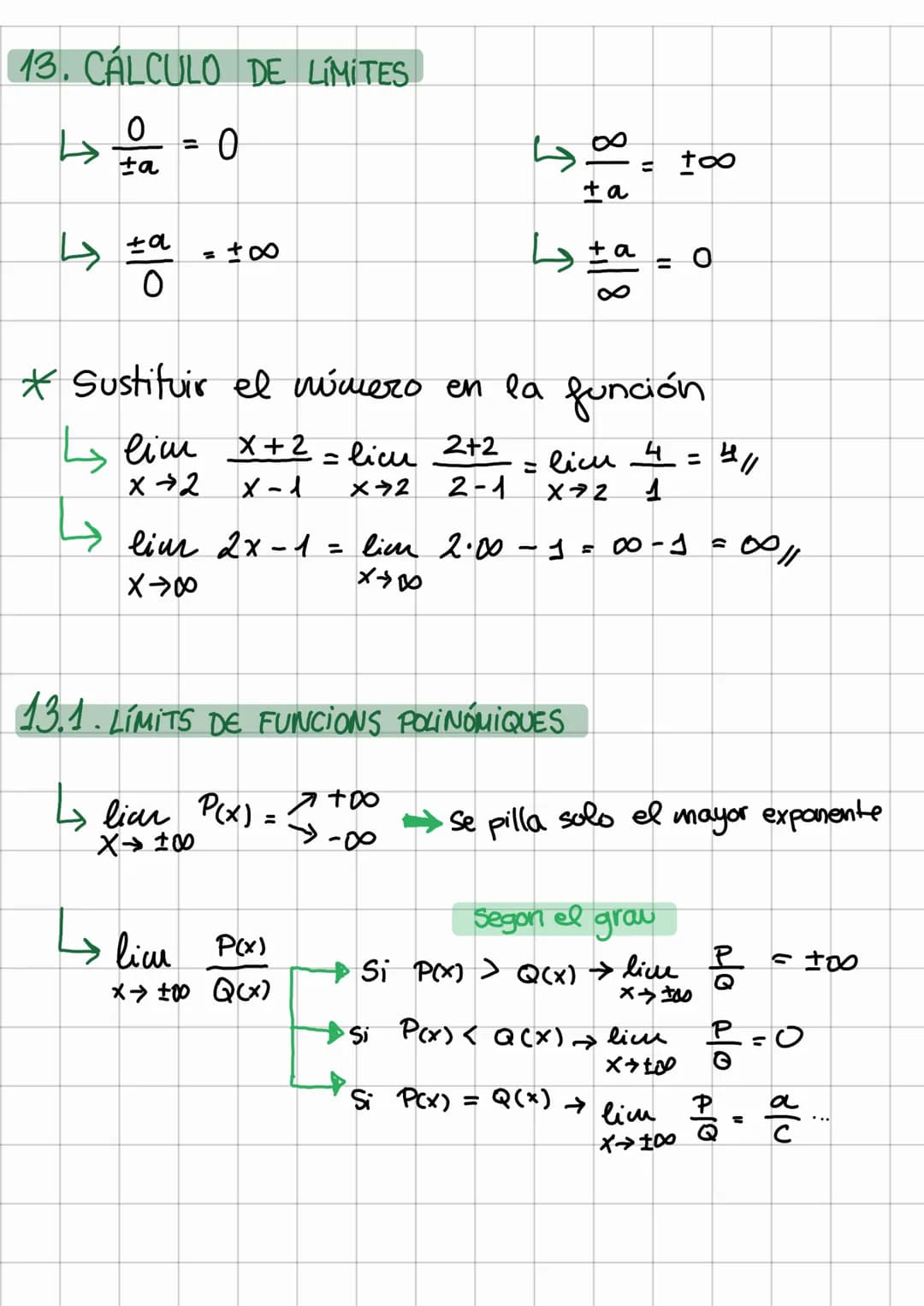
7
of 10
8
of 10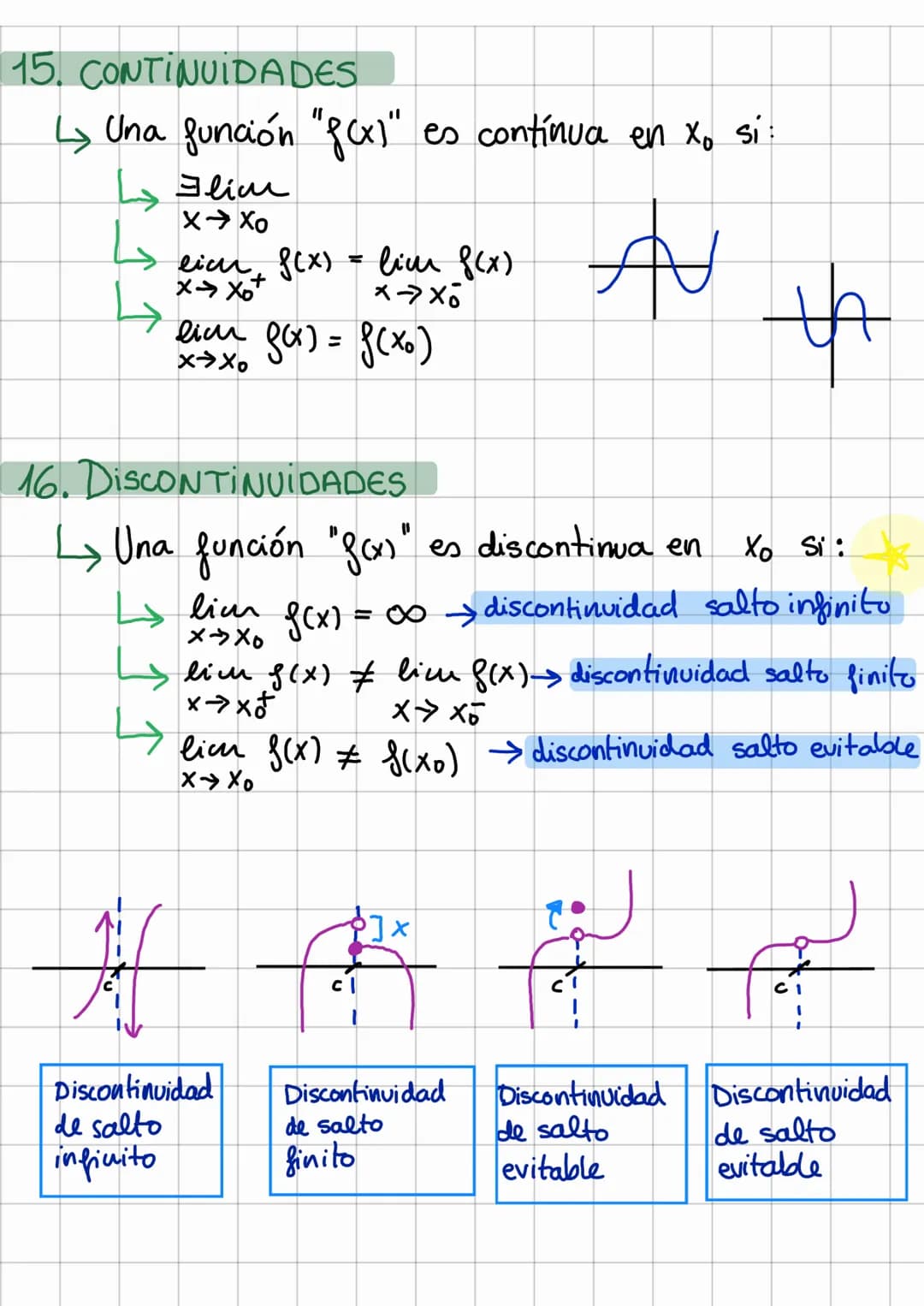
9
of 10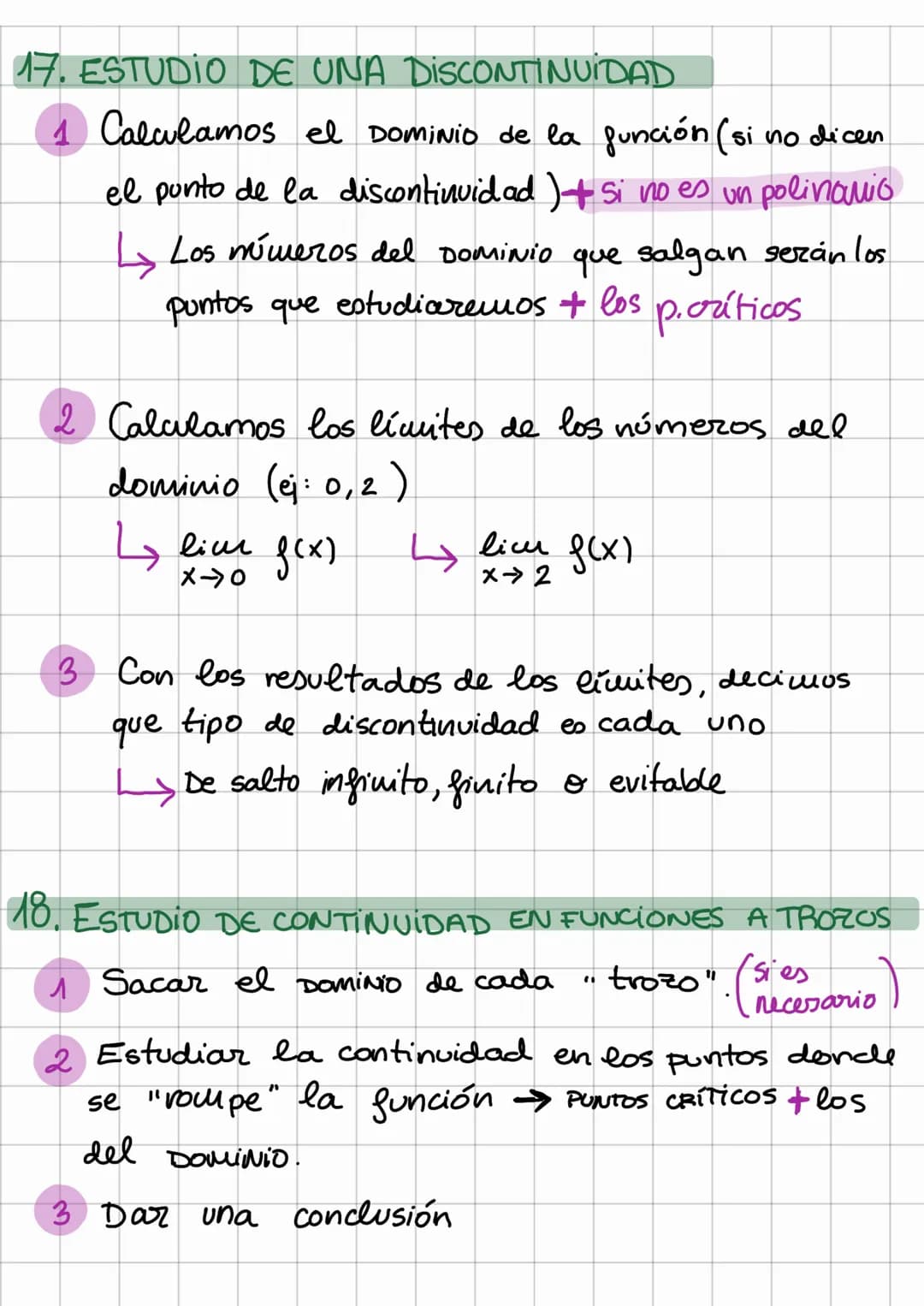
10
of 10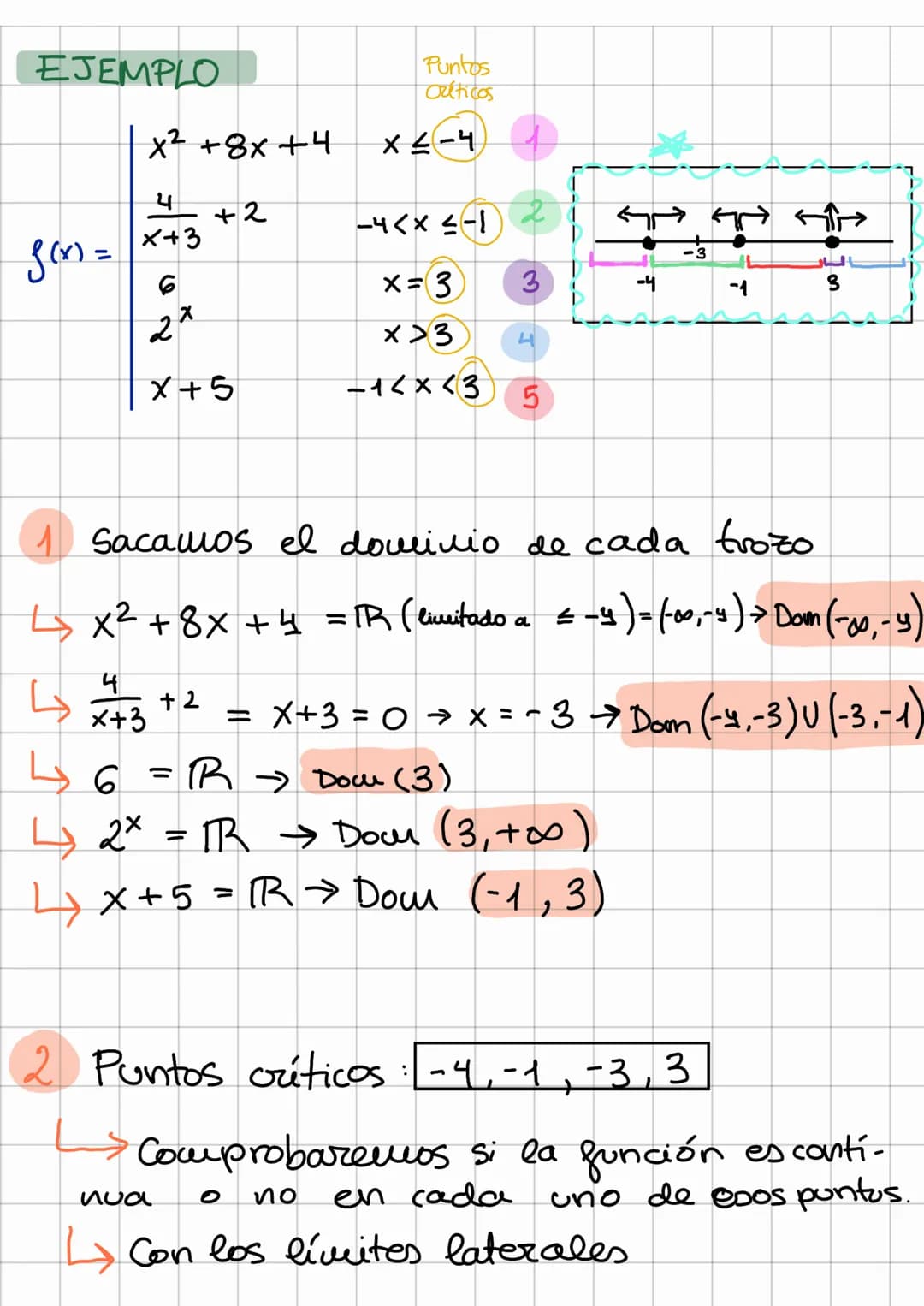
We thought you’d never ask...
What is the Knowunity AI companion?
Our AI companion is specifically built for the needs of students. Based on the millions of content pieces we have on the platform we can provide truly meaningful and relevant answers to students. But its not only about answers, the companion is even more about guiding students through their daily learning challenges, with personalised study plans, quizzes or content pieces in the chat and 100% personalisation based on the students skills and developments.
Where can I download the Knowunity app?
You can download the app in the Google Play Store and in the Apple App Store.
Is Knowunity really free of charge?
That's right! Enjoy free access to study content, connect with fellow students, and get instant help – all at your fingertips.
Similar Content
Most popular content: límite
9MatemáticasLimites y continuidad
Tema limites y continuidad 1 bach
1° Bach3,54991
MatemáticasLímites y Continuidad
En estos apuntes encontrarás todo lo que tienes que saber sobre límites, continuidad y asíntotas
1° Bach10,587412
MatemáticasApuntes análisis (límites, continuidad y derivadas)
Apuntes matemáticas 2 bachillerato del tema de análisis: Limites y continuidad, funciones, derivabilidad, optimización.
2° Bach2,34331
MatemáticasDominio funciones y límites
Se encuentra teoría con algunos ejercicios resueltos
1° Bach66318
MatemáticasLímites y funciones
Tema de matemáticas sobre limites y funciones, bastante extenso
4° ESO94422
MatemáticasBLOQUE FUNCIONES 2 BACHILLERATO
Bloque entero de funciones para selectividad, bien explicado y con ejemplos para algunos ejercicios.
1° Bach1,35139
MatemáticasLímites, derivadas y representación de funciones
Límites, indeterminaciones, asíntotas, derivadas, derivabilidad, y representación de funciones. Con trucos. Apuntes/resumen para repasar.
2° Bach2916
MatemáticasAplicaciones de límite y de derivadas, teoremas relacionados y resolución de problemas.
Análisis matemáticas 2º de Bachillerato selectividad EBAU EVAU matematicas
1° Bach1,41123
MatemáticasLímites de funciones
.
2° Bach6137
Most popular content in Matemáticas
9E
Matemáticasecuaciones
esta la segunda parte
1° ESO1,4397
MatemáticasFunciones, límites y continuidad
Apuntes de funciones, límites y continuidad para 1-2 Bachillerato
1° Bach7,737228
D
MatemáticasDescubre el mundo de Las Matematicas
Explora los conceptos y técnicas de la Plástica en este emocionante conjunto de tarjetas de estudio.
3° ESO2,2170
MatemáticasProbabilidad
Apuntes de probabilidad completos
1° Bach2,41753
MatemáticasFunciones
Teoría básica sobre las funciones y los graficos
3° ESO13,8403,813
E
MatemáticasEcuaciones
Es de 1 de la Eso
1° ESO1,5045
L
MatemáticasLos triangulos y los angulos
4 de primaria
5º primaria1,1886
MatemáticasMatemáticas II (análisis) 2Bach
Primera parte de los apuntes de todo el temario de matemáticas II de cara a la PAU. Nota PAU: 10
1° Bach2,18272
MatemáticasAPUNTES PROBABILIDAD
Con todos los dibujos para entender mejor las fórmulas como AUB
2° Bach4,215122
Most popular content
9I
 Inglés
irregular verbs quiz
Domina el idioma inglés de manera sencilla y divertida con estos flashcards diseñados especialmente para estudiantes de sexto grado.
6º primaria2,8981
R
 Geografía e Historia
roma
a estudiar Roma!!
1° ESO2,3122
G
Geografía e HistoriaGrecia: Inicio de la democracia
Más o menos las preguntas que me pusieron a mí en el examen
1° ESO2,3622
D
InglésDominando la gramática inglesa: Flashcards desafiantes
Mejora tus habilidades gramaticales en inglés con estos flashcards desafiantes diseñados para estudiantes de grado 11. ¡Prepárate para dominar la gramática inglesa de manera divertida y efectiva!
3° ESO2,2480
M
Geografía e HistoriaMesopotamia y Egipto
Contenidos sobre la civilización mesopotámica y egipcia
1° ESO3,9381
O
 Lengua Castellana y Literatura
OBRAS Y AUTORES II
Quiz donde tendrás que relacionar las siguientes obras con sus respectivos autores: edición Romanticismo.
4° ESO3,3610
I
InglésIngles para repasar
quiz de ingles para entrar a clase preparados
2° ESO2,6290
F
 Filosofía
filosofía
repaso filosofía "el arje , la metafísica y la crítica de Nietszche a platon"
1° Bach2,8421
I
InglésIrregular verbs
Aprende nuevas palabras y expande tu vocabulario en inglés con esta colección de tarjetas de estudio interactivas.
3° ESO1,7442
Can't find what you're looking for? Explore other subjects.
Students love us — and so will you.
4.6/5App Store
4.7/5Google Play
The app is very easy to use and well designed. I have found everything I was looking for so far and have been able to learn a lot from the presentations! I will definitely use the app for a class assignment! And of course it also helps a lot as an inspiration.
Stefan SiOS user
This app is really great. There are so many study notes and help [...]. My problem subject is French, for example, and the app has so many options for help. Thanks to this app, I have improved my French. I would recommend it to anyone.
Samantha KlichAndroid user
Wow, I am really amazed. I just tried the app because I've seen it advertised many times and was absolutely stunned. This app is THE HELP you want for school and above all, it offers so many things, such as workouts and fact sheets, which have been VERY helpful to me personally.
AnnaiOS user
Matemáticas1,149 views·Updated Jun 16, 2026·12 pagesFunciones y Límites: Resumen para 1° Bachillerato
M
Maria @maria_mjpi8
Las funciones y límites son conceptos fundamentales en las matemáticas que te ayudarán a entender cómo se comportan las expresiones algebraicas. Dominar estos temas te permitirá resolver problemas más avanzados y comprender mejor el cálculo matemático que utilizarás en tus...
1
of 10
Sign up to see the content. It's free!
- Access to all documents
- Improve your grades
- Join milions of students
Dominio de funciones y funciones básicas
El dominio de una función es el conjunto de valores que puede tomar la variable independiente. Cada tipo de función tiene sus reglas:
- Polinomios: su dominio es siempre ℝ (todos los números reales)
- Fracciones : el denominador no puede ser cero, así que excluimos los valores donde Q(x)=0
- Raíces: en √P(x), necesitamos que P(x)≥0
- Logaritmos: en log P(x), necesitamos que P(x)>0
Las funciones lineales representan rectas donde m es la pendiente que se calcula como /. También podemos escribirlas como y=m+y₁ cuando conocemos un punto.
💡 Consejo práctico: Para analizar el dominio, identifica primero qué tipo de función tienes y luego aplica las restricciones correspondientes. Dibuja una recta real para visualizar mejor el resultado.
Las funciones cuadráticas tienen forma de parábola, con su vértice en x=-b/(2a). Este punto será un máximo si a<0 o un mínimo si a>0.
2
of 10Sign up to see the content. It's free!
- Access to all documents
- Improve your grades
- Join milions of students
Límites y continuidad
Los límites nos permiten entender hacia qué valor tiende una función cuando x se acerca a un punto determinado. Hay diferentes tipos:
- Límites hacia infinito: cuando x→±∞
- Límites laterales: acercándonos por la derecha (x→c⁺) o por la izquierda (x→c⁻)
Una función es continua en un punto cuando existe el límite en ese punto y coincide con el valor de la función. Si miramos una gráfica, podríamos dibujarla sin levantar el lápiz del papel.
🔍 Recuerda: Los puntos representados con "o" (puntos blancos) en una gráfica indican que el límite no existe en ese punto, y por tanto hay una discontinuidad.
Para estudiar la continuidad debemos comprobar si los límites laterales coinciden. Si no coinciden o no existen, la función presenta una discontinuidad en ese punto.
3
of 10Sign up to see the content. It's free!
- Access to all documents
- Improve your grades
- Join milions of students
Indeterminaciones
Las indeterminaciones son expresiones de límites que no podemos resolver directamente. Las más comunes son:
- ∞/∞: Divide todo entre la variable con el exponente más alto
- 0/0: Factoriza (usando factor común, identidades notables, etc.)
- ∞-∞: Racionaliza aunque no sea una fracción
- ∞^∞: Transforma en exponencial usando e^
Para resolver indeterminaciones del tipo 0/0, es útil factorizar tanto numerador como denominador y simplificar factores comunes.
🔑 Estrategia clave: Cada tipo de indeterminación requiere una técnica específica. Identifica primero qué tipo tienes antes de aplicar el método correspondiente.
Para las indeterminaciones ∞-∞, transformar la expresión en una fracción mediante suma/resta de fracciones algebraicas puede ser muy útil. Busca el mínimo común múltiplo (mcm) para unificar denominadores.
4
of 10Sign up to see the content. It's free!
- Access to all documents
- Improve your grades
- Join milions of students
Continuidad y tipos de discontinuidades
Una función g(x) es continua en un punto x₀ si cumple tres condiciones:
- Existe el límite cuando x→x₀
- Los límites laterales coinciden: lim₊ g(x) = lim₋ g(x)
- El límite coincide con el valor de la función: lim g(x) = g(x₀)
Las discontinuidades pueden ser de tres tipos:
- Discontinuidad de salto infinito: cuando el límite es infinito
- Discontinuidad de salto finito: cuando los límites laterales no coinciden
- Discontinuidad evitable: cuando existe el límite pero no coincide con el valor de la función
📌 Visualización: Piensa en una discontinuidad evitable como un "agujero" en la gráfica que podría rellenarse; un salto finito como un "escalón"; y un salto infinito como una "asíntota vertical".
Las discontinuidades se pueden identificar fácilmente en las gráficas: los saltos infinitos aparecen como líneas verticales, los saltos finitos como cortes en la función, y las evitables como puntos aislados.
5
of 10Sign up to see the content. It's free!
- Access to all documents
- Improve your grades
- Join milions of students
Estudio de discontinuidades
Para estudiar las discontinuidades de una función, sigue estos pasos:
- Calcula el dominio de la función. Los puntos que no pertenecen al dominio son candidatos a ser discontinuidades.
- Para cada punto crítico, calcula los límites laterales y el valor de la función (si existe).
- Clasifica cada discontinuidad según su tipo: infinita, finita o evitable.
En funciones definidas a trozos, es especialmente importante:
- Estudiar el dominio de cada trozo por separado.
- Analizar la continuidad en los "puntos de corte" donde cambia la definición de la función.
- Comprobar si los límites laterales coinciden en esos puntos.
🧩 Método práctico: Dibuja la gráfica aproximada de cada trozo para visualizar mejor dónde pueden ocurrir las discontinuidades.
El análisis completo debe concluir con una descripción clara de dónde la función es continua y dónde presenta discontinuidades, especificando el tipo de cada una.
6
of 10Sign up to see the content. It's free!
- Access to all documents
- Improve your grades
- Join milions of students
7
of 10Sign up to see the content. It's free!
- Access to all documents
- Improve your grades
- Join milions of students
8
of 10Sign up to see the content. It's free!
- Access to all documents
- Improve your grades
- Join milions of students
9
of 10Sign up to see the content. It's free!
- Access to all documents
- Improve your grades
- Join milions of students
10
of 10Sign up to see the content. It's free!
- Access to all documents
- Improve your grades
- Join milions of students
We thought you’d never ask...
What is the Knowunity AI companion?
Our AI companion is specifically built for the needs of students. Based on the millions of content pieces we have on the platform we can provide truly meaningful and relevant answers to students. But its not only about answers, the companion is even more about guiding students through their daily learning challenges, with personalised study plans, quizzes or content pieces in the chat and 100% personalisation based on the students skills and developments.
Where can I download the Knowunity app?
You can download the app in the Google Play Store and in the Apple App Store.
Is Knowunity really free of charge?
That's right! Enjoy free access to study content, connect with fellow students, and get instant help – all at your fingertips.
Similar Content
Most popular content: límite
9MatemáticasLimites y continuidad
Tema limites y continuidad 1 bach
1° Bach3,54991
MatemáticasLímites y Continuidad
En estos apuntes encontrarás todo lo que tienes que saber sobre límites, continuidad y asíntotas
1° Bach10,587412
MatemáticasApuntes análisis (límites, continuidad y derivadas)
Apuntes matemáticas 2 bachillerato del tema de análisis: Limites y continuidad, funciones, derivabilidad, optimización.
2° Bach2,34331
MatemáticasDominio funciones y límites
Se encuentra teoría con algunos ejercicios resueltos
1° Bach66318
MatemáticasLímites y funciones
Tema de matemáticas sobre limites y funciones, bastante extenso
4° ESO94422
MatemáticasBLOQUE FUNCIONES 2 BACHILLERATO
Bloque entero de funciones para selectividad, bien explicado y con ejemplos para algunos ejercicios.
1° Bach1,35139
MatemáticasLímites, derivadas y representación de funciones
Límites, indeterminaciones, asíntotas, derivadas, derivabilidad, y representación de funciones. Con trucos. Apuntes/resumen para repasar.
2° Bach2916
MatemáticasAplicaciones de límite y de derivadas, teoremas relacionados y resolución de problemas.
Análisis matemáticas 2º de Bachillerato selectividad EBAU EVAU matematicas
1° Bach1,41123
MatemáticasLímites de funciones
.
2° Bach6137
Most popular content in Matemáticas
9E
Matemáticasecuaciones
esta la segunda parte
1° ESO1,4397
MatemáticasFunciones, límites y continuidad
Apuntes de funciones, límites y continuidad para 1-2 Bachillerato
1° Bach7,737228
D
MatemáticasDescubre el mundo de Las Matematicas
Explora los conceptos y técnicas de la Plástica en este emocionante conjunto de tarjetas de estudio.
3° ESO2,2170
MatemáticasProbabilidad
Apuntes de probabilidad completos
1° Bach2,41753
MatemáticasFunciones
Teoría básica sobre las funciones y los graficos
3° ESO13,8403,813
E
MatemáticasEcuaciones
Es de 1 de la Eso
1° ESO1,5045
L
MatemáticasLos triangulos y los angulos
4 de primaria
5º primaria1,1886
MatemáticasMatemáticas II (análisis) 2Bach
Primera parte de los apuntes de todo el temario de matemáticas II de cara a la PAU. Nota PAU: 10
1° Bach2,18272
MatemáticasAPUNTES PROBABILIDAD
Con todos los dibujos para entender mejor las fórmulas como AUB
2° Bach4,215122
Most popular content
9I
Inglésirregular verbs quiz
Domina el idioma inglés de manera sencilla y divertida con estos flashcards diseñados especialmente para estudiantes de sexto grado.
6º primaria2,8981
R
Geografía e Historiaroma
a estudiar Roma!!
1° ESO2,3122
G
Geografía e HistoriaGrecia: Inicio de la democracia
Más o menos las preguntas que me pusieron a mí en el examen
1° ESO2,3622
D
InglésDominando la gramática inglesa: Flashcards desafiantes
Mejora tus habilidades gramaticales en inglés con estos flashcards desafiantes diseñados para estudiantes de grado 11. ¡Prepárate para dominar la gramática inglesa de manera divertida y efectiva!
3° ESO2,2480
M
Geografía e HistoriaMesopotamia y Egipto
Contenidos sobre la civilización mesopotámica y egipcia
1° ESO3,9381
O
Lengua Castellana y LiteraturaOBRAS Y AUTORES II
Quiz donde tendrás que relacionar las siguientes obras con sus respectivos autores: edición Romanticismo.
4° ESO3,3610
I
InglésIngles para repasar
quiz de ingles para entrar a clase preparados
2° ESO2,6290
F
Filosofíafilosofía
repaso filosofía "el arje , la metafísica y la crítica de Nietszche a platon"
1° Bach2,8421
I
InglésIrregular verbs
Aprende nuevas palabras y expande tu vocabulario en inglés con esta colección de tarjetas de estudio interactivas.
3° ESO1,7442
Can't find what you're looking for? Explore other subjects.
Students love us — and so will you.
4.6/5App Store
4.7/5Google Play
The app is very easy to use and well designed. I have found everything I was looking for so far and have been able to learn a lot from the presentations! I will definitely use the app for a class assignment! And of course it also helps a lot as an inspiration.
Stefan SiOS user
This app is really great. There are so many study notes and help [...]. My problem subject is French, for example, and the app has so many options for help. Thanks to this app, I have improved my French. I would recommend it to anyone.
Samantha KlichAndroid user
Wow, I am really amazed. I just tried the app because I've seen it advertised many times and was absolutely stunned. This app is THE HELP you want for school and above all, it offers so many things, such as workouts and fact sheets, which have been VERY helpful to me personally.
AnnaiOS user