
The document provides essential mathematical formulas and concepts for the...
 Matematyka55,352 views·Updated Jun 27, 2026·6 pages
Wszystkie Wzory i Notatki na Egzamin Ósmoklasisty 2024 PDF

Matematyka Gryzie@matematykagryzie
1 / 6
1
of 6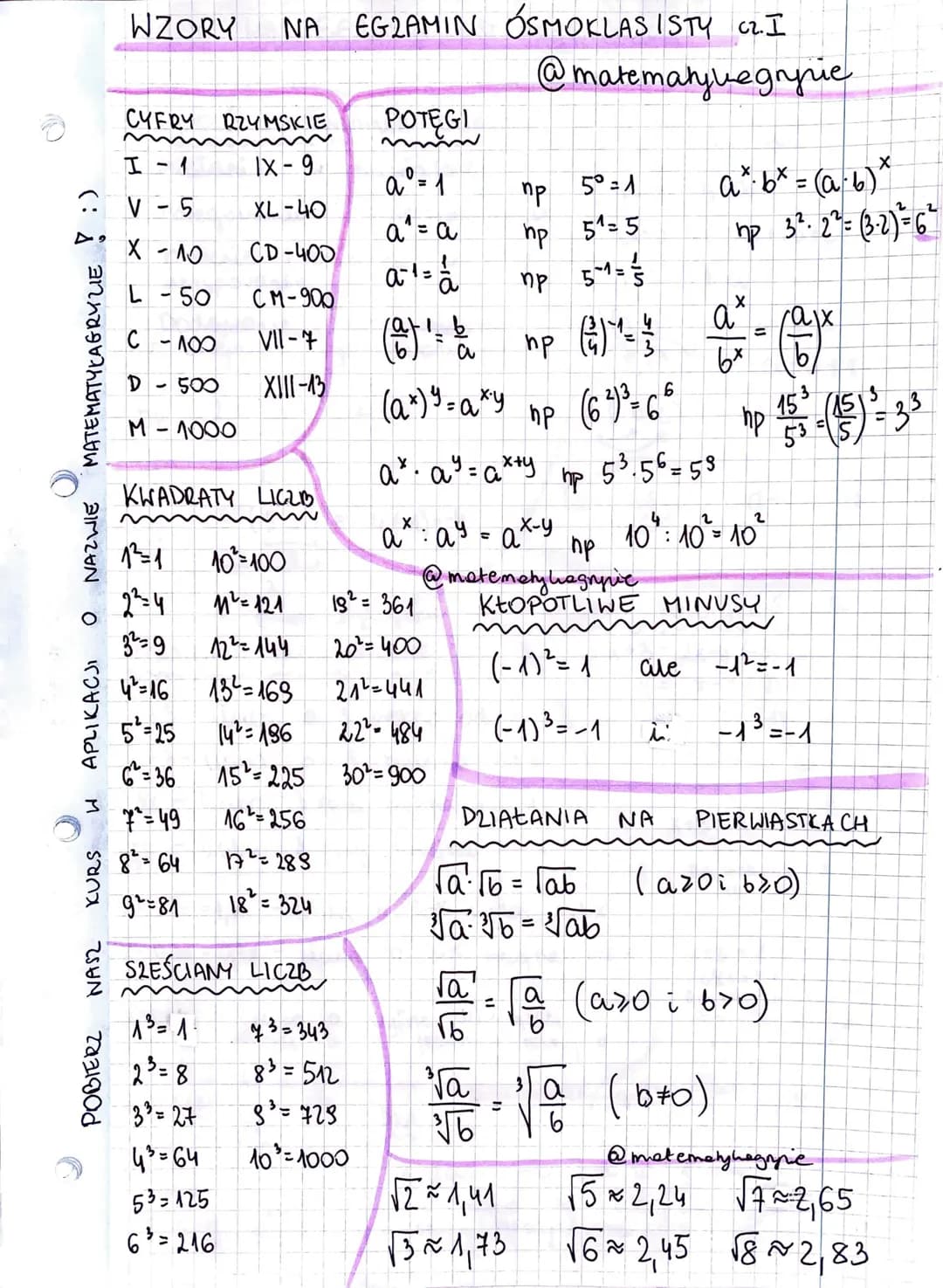
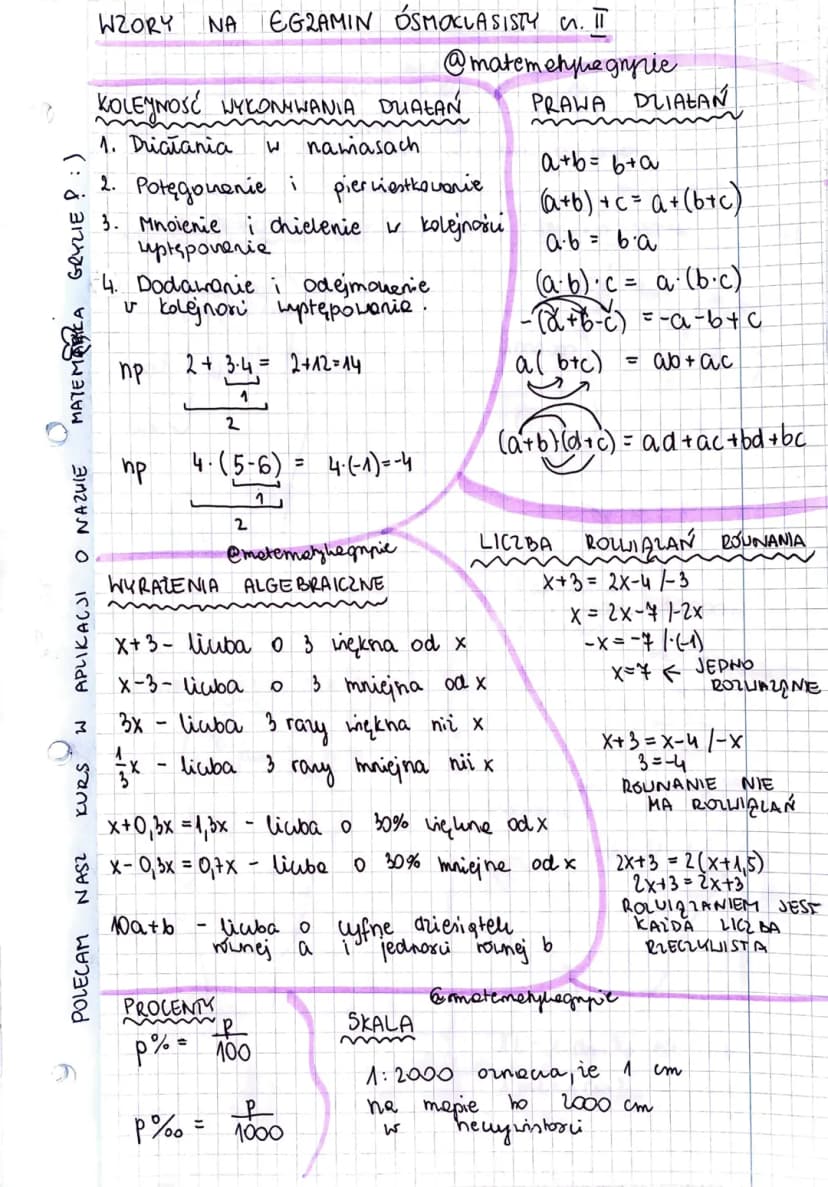
Mathematical Formulas for 8th Grade Exam - Part II
This page focuses on algebraic expressions, order of operations, and percentage calculations. It provides crucial information for students preparing for the Wzory na Egzamin Ósmoklasisty.
The order of operations is clearly outlined:
- Operations in parentheses
- Exponentiation
- Multiplication and division
- Addition and subtraction
Highlight: The page emphasizes the importance of following the order of operations to solve mathematical problems correctly.
Algebraic expressions are explained with examples, helping students understand concepts like variables and coefficients. The page also covers percentage calculations, which are frequently tested in the Egzamin Ósmoklasisty.
Example: x + 30% x = 1.3x (increasing a number by 30%)
Vocabulary: Wyrażenia algebraiczne - Algebraic expressions
The laws of operations, such as the commutative and associative properties, are also presented, providing a solid foundation for more advanced mathematical concepts.
2
of 6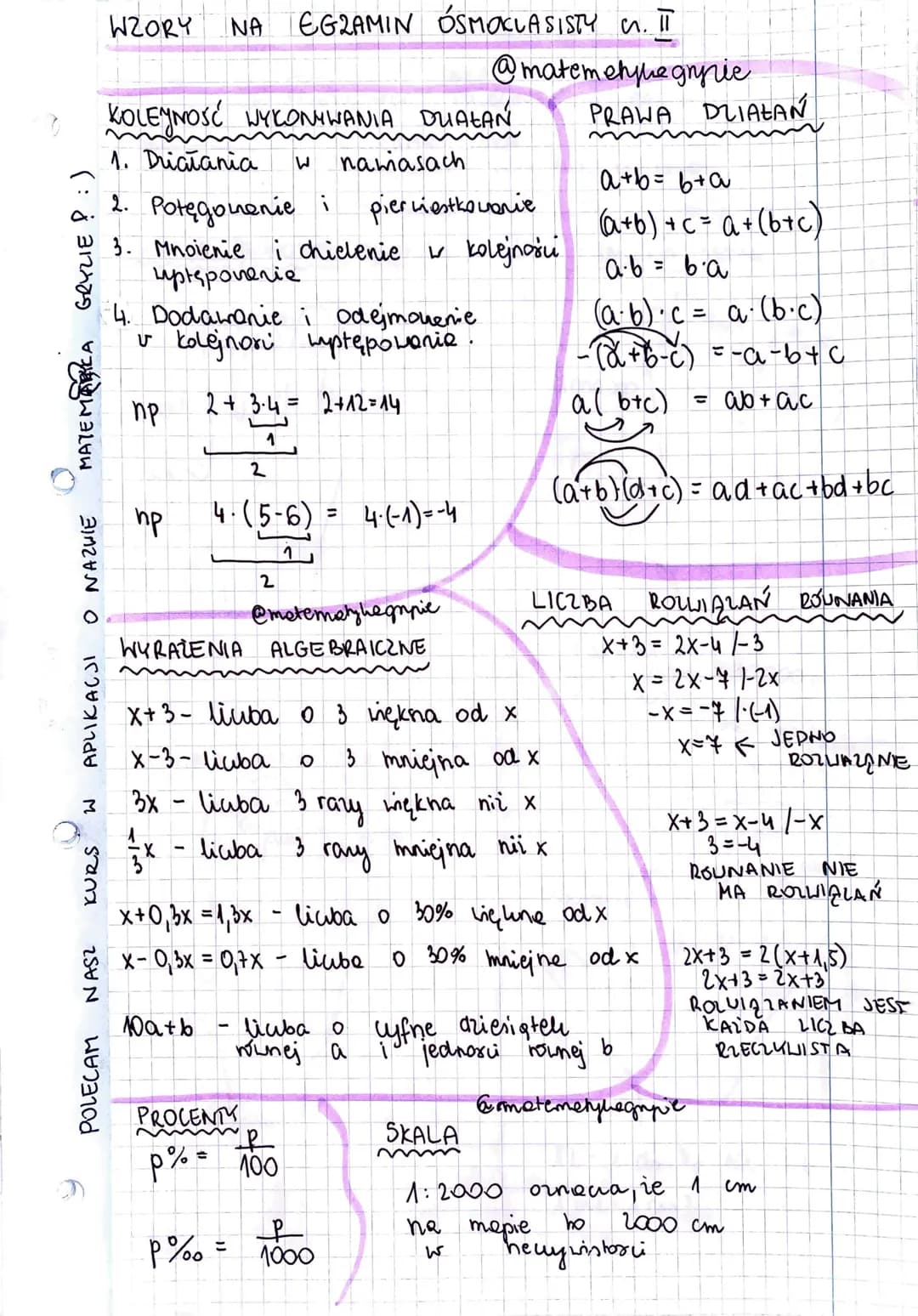
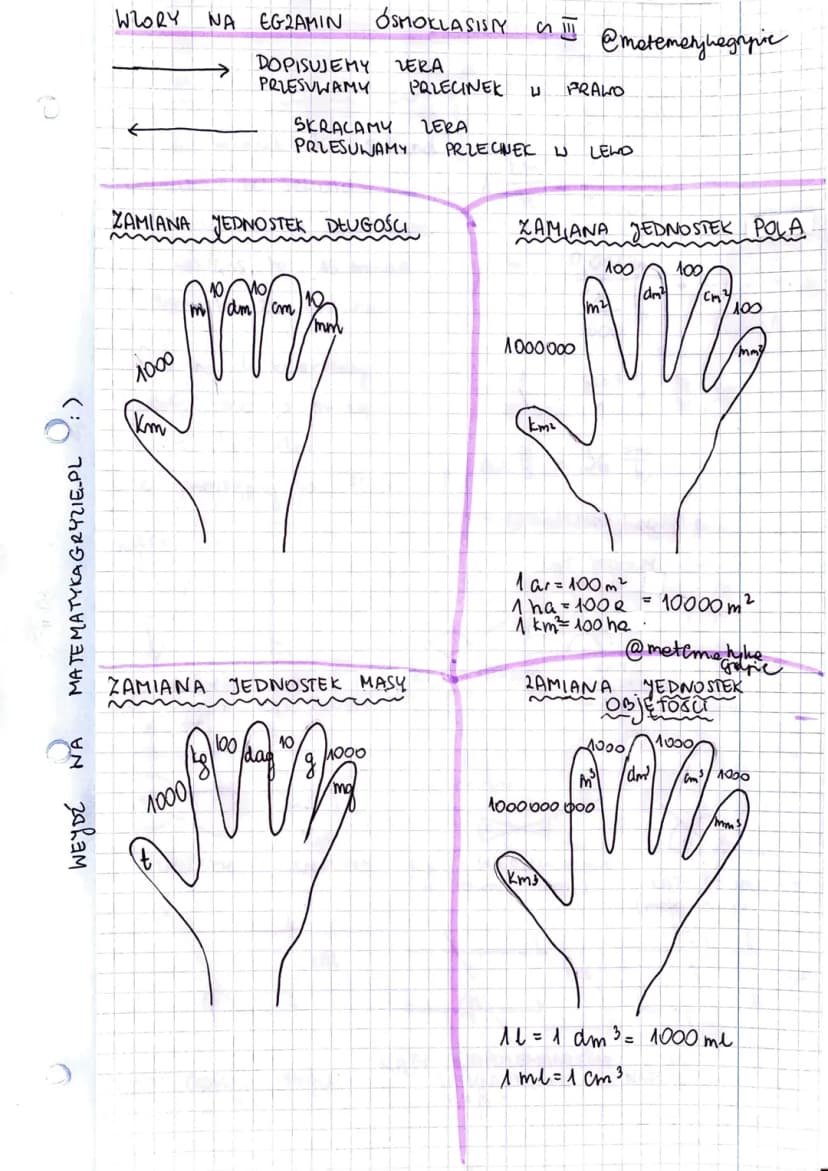
Unit Conversions and Scale
This page covers essential unit conversions for length, mass, area, and volume. It also introduces the concept of scale in maps, which is crucial for solving real-world problems in the Egzamin Ósmoklasisty.
Highlight: The page uses visual aids to demonstrate the relationships between different units, making it easier for students to remember conversion factors.
Length conversions are shown from kilometers to millimeters, with each step representing a factor of 10. Similar charts are provided for mass (from tons to milligrams) and area (from square kilometers to square millimeters).
Example: 1 km² = 100 ha (1 square kilometer equals 100 hectares)
Volume conversions are also covered, including the relationship between cubic units and liters.
Definition: 1 L = 1 dm³ = 1000 mL (1 liter equals 1 cubic decimeter or 1000 milliliters)
The concept of scale is introduced, which is important for map-related questions in the exam.
Example: A scale of 1:2000 means that 1 cm on the map represents 2000 cm in reality.
3
of 6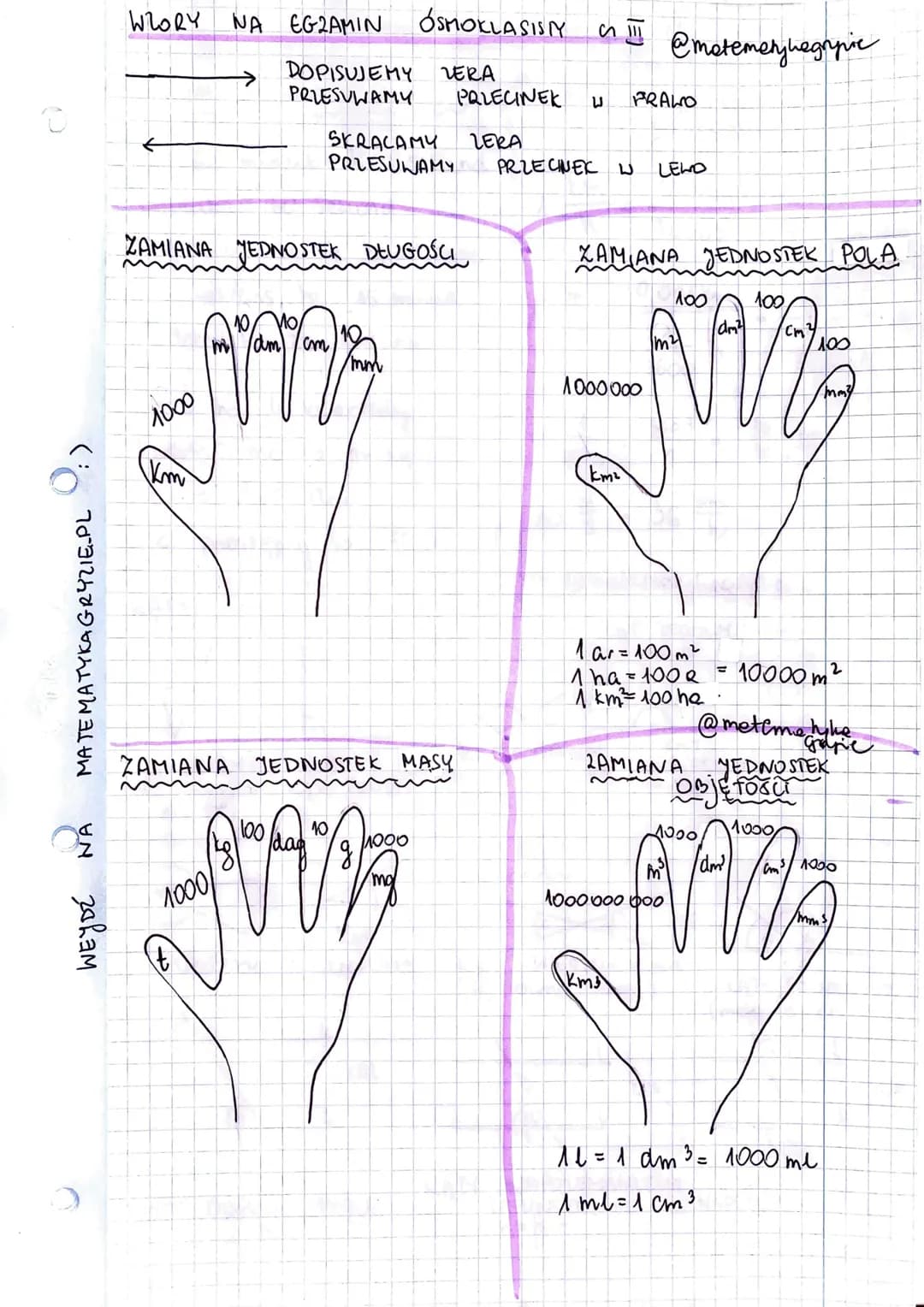
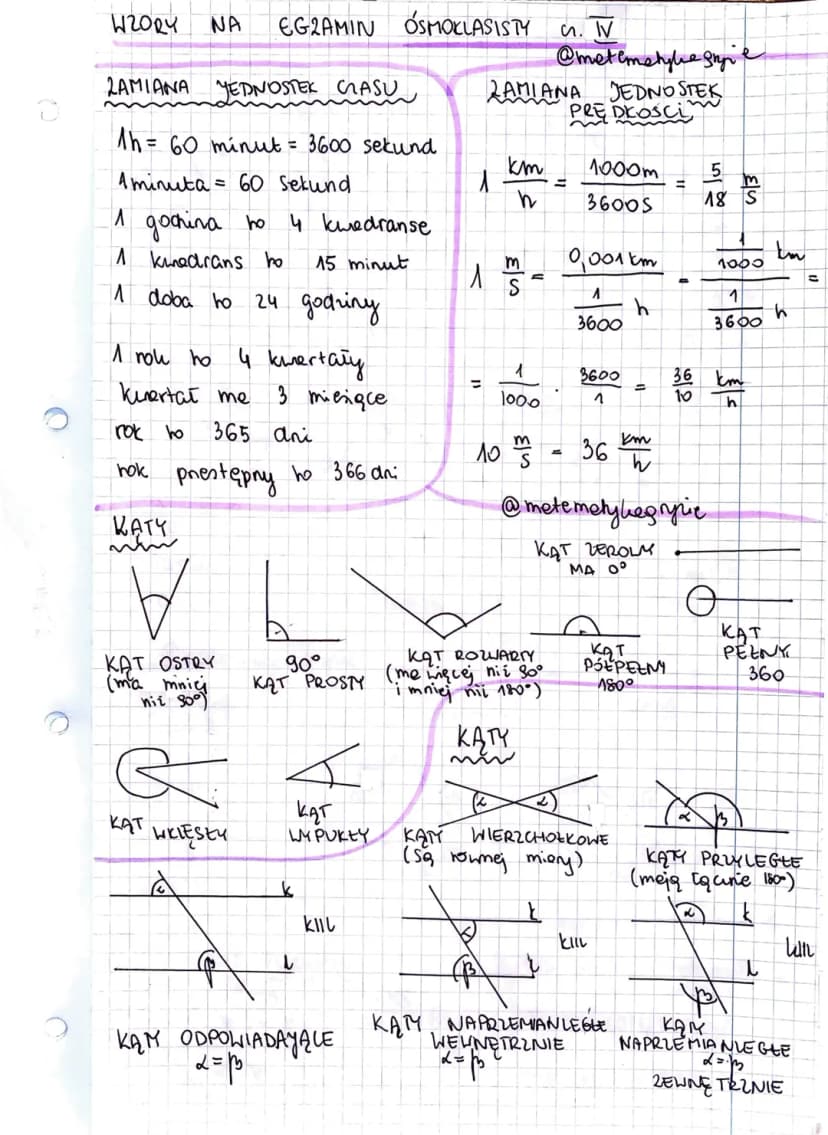
Time Units and Angle Types
This page focuses on time unit conversions and different types of angles, both of which are important topics for the Egzamin Ósmoklasisty.
Time unit conversions are presented in detail, covering relationships between hours, minutes, seconds, and even larger units like quarters and years.
Example: 1 hour = 60 minutes = 3600 seconds
Vocabulary: Rok przestępny - Leap year (366 days)
The page then introduces various types of angles, providing both visual representations and definitions:
- Acute angle (less than 90°)
- Right angle (90°)
- Obtuse angle (between 90° and 180°)
- Straight angle (180°)
- Reflex angle (between 180° and 360°)
- Full angle (360°)
Highlight: The page also covers important angle relationships, such as vertical angles, alternate angles, and adjacent angles, which are crucial for geometry problems in the exam.
Speed unit conversions are also included, showing the relationship between km/h and m/s.
Example: 36 km/h = 10 m/s
4
of 6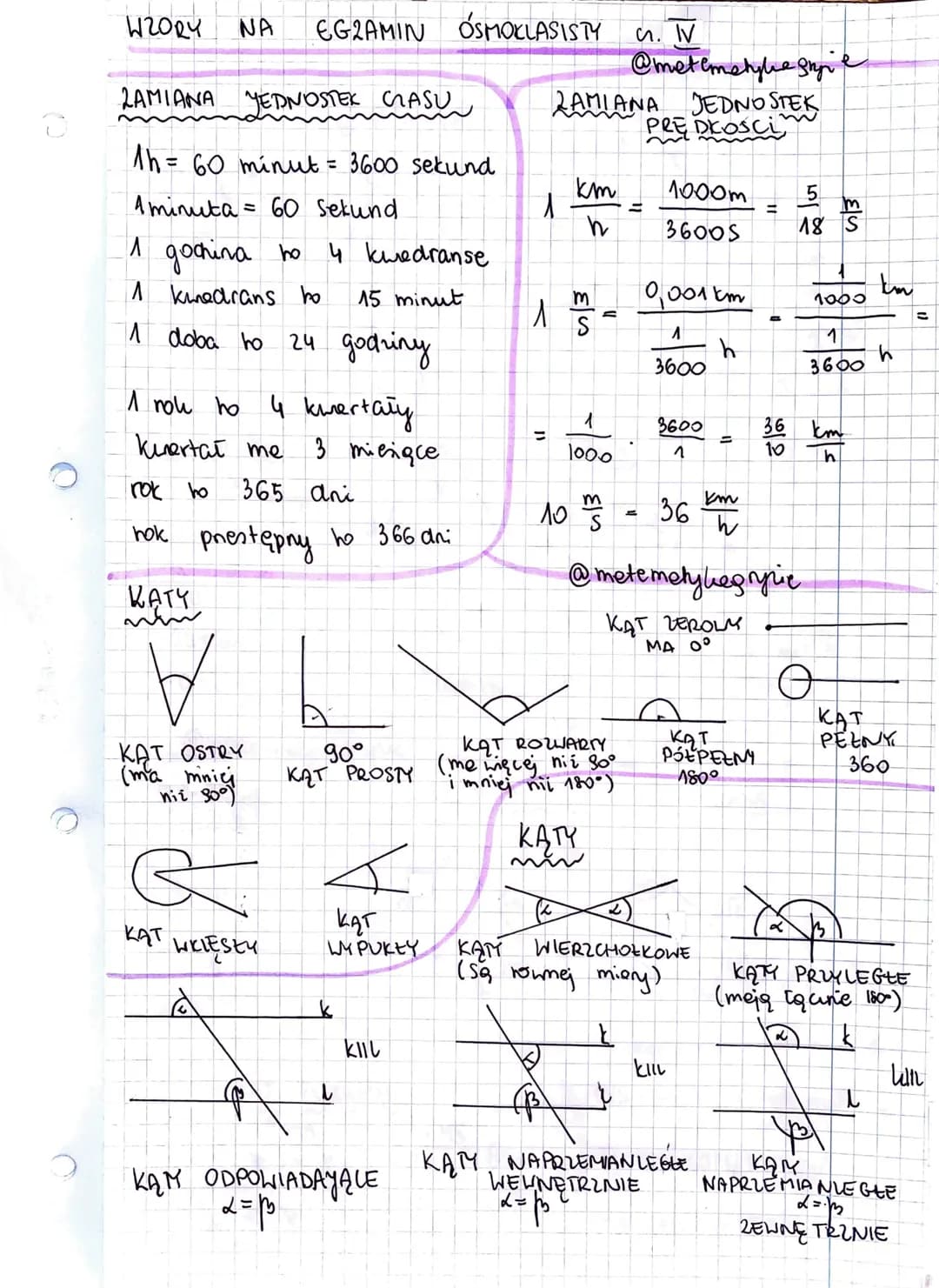
Geometric Shapes and Formulas
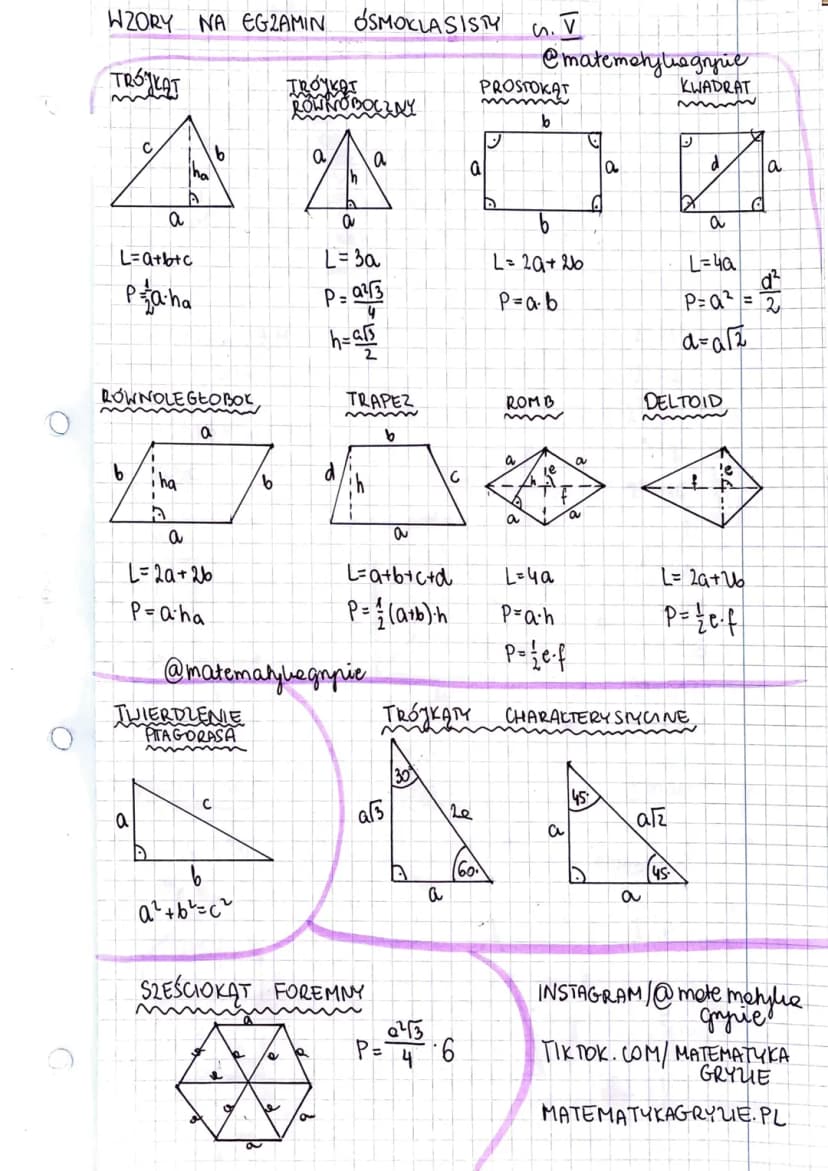
This page provides essential formulas for various geometric shapes, which are frequently tested in the Egzamin Ósmoklasisty. It covers triangles, parallelograms, trapezoids, and regular polygons.
Highlight: The Pythagorean theorem is prominently featured, as it's a fundamental concept for many geometry problems.
Quote: "a² + b² = c²" - The Pythagorean theorem
For each shape, the page provides formulas for perimeter (L) and area (P), along with diagrams illustrating important dimensions.
Example: For a triangle: L = a + b + c, P = ½ah (where a is the base and h is the height)
Special attention is given to the equilateral triangle and regular hexagon, providing formulas for their areas using side length.
Vocabulary: Sześciokąt foremny - Regular hexagon
The page also covers quadrilaterals, including rectangles, squares, rhombuses, and kites, providing formulas for their perimeters, areas, and diagonals.
Definition: For a square: d = a√2 (diagonal length in terms of side length)
5
of 6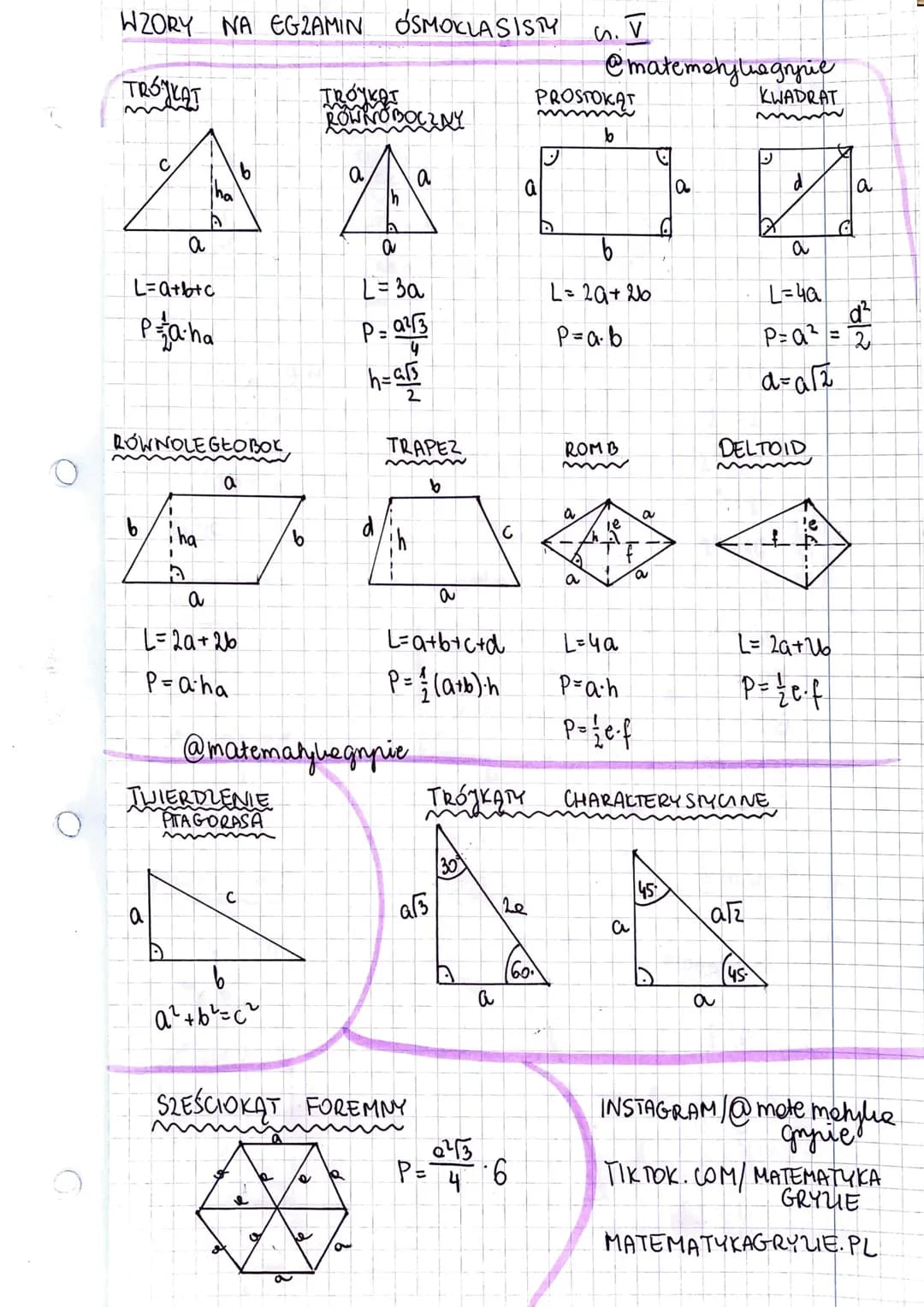
3D Shapes and Probability
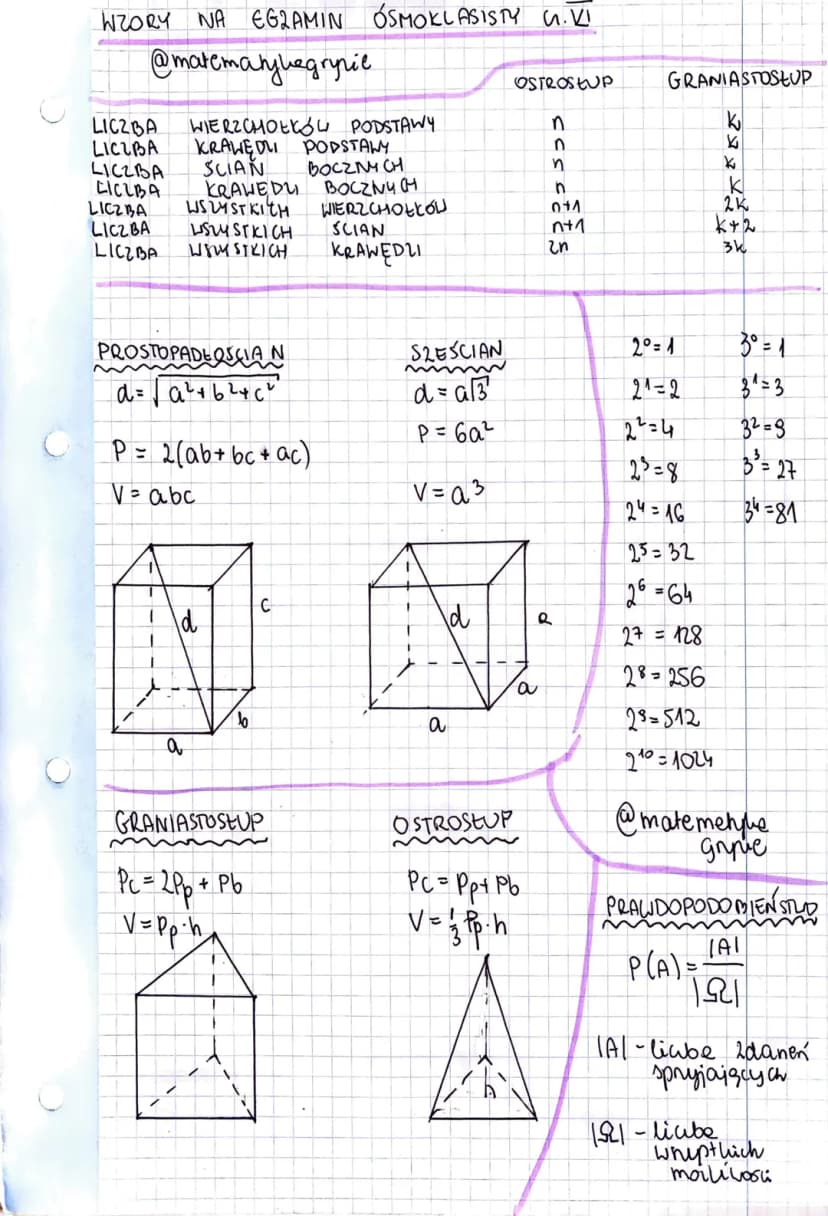
The final page covers three-dimensional shapes and introduces the concept of probability, both crucial topics for the Egzamin Ósmoklasisty.
For 3D shapes like cuboids, prisms, cubes, and pyramids, the page provides formulas for surface area, volume, and diagonal length.
Example: For a cube: V = a³ (volume), P = 6a² (surface area), d = a√3 (diagonal length)
The page also includes a table showing the number of vertices, edges, and faces for these 3D shapes, which is helpful for understanding their properties.
Highlight: Powers of 2 and 3 are listed up to 2¹⁰ and 3⁵, which are useful for various calculations.
Finally, the concept of probability is introduced with a simple formula:
Definition: P(A) = m / n, where m is the number of favorable outcomes and n is the total number of possible outcomes.
This comprehensive coverage of geometric shapes, 3D objects, and probability provides students with essential tools for tackling a wide range of problems in the Egzamin Ósmoklasisty.
6
of 6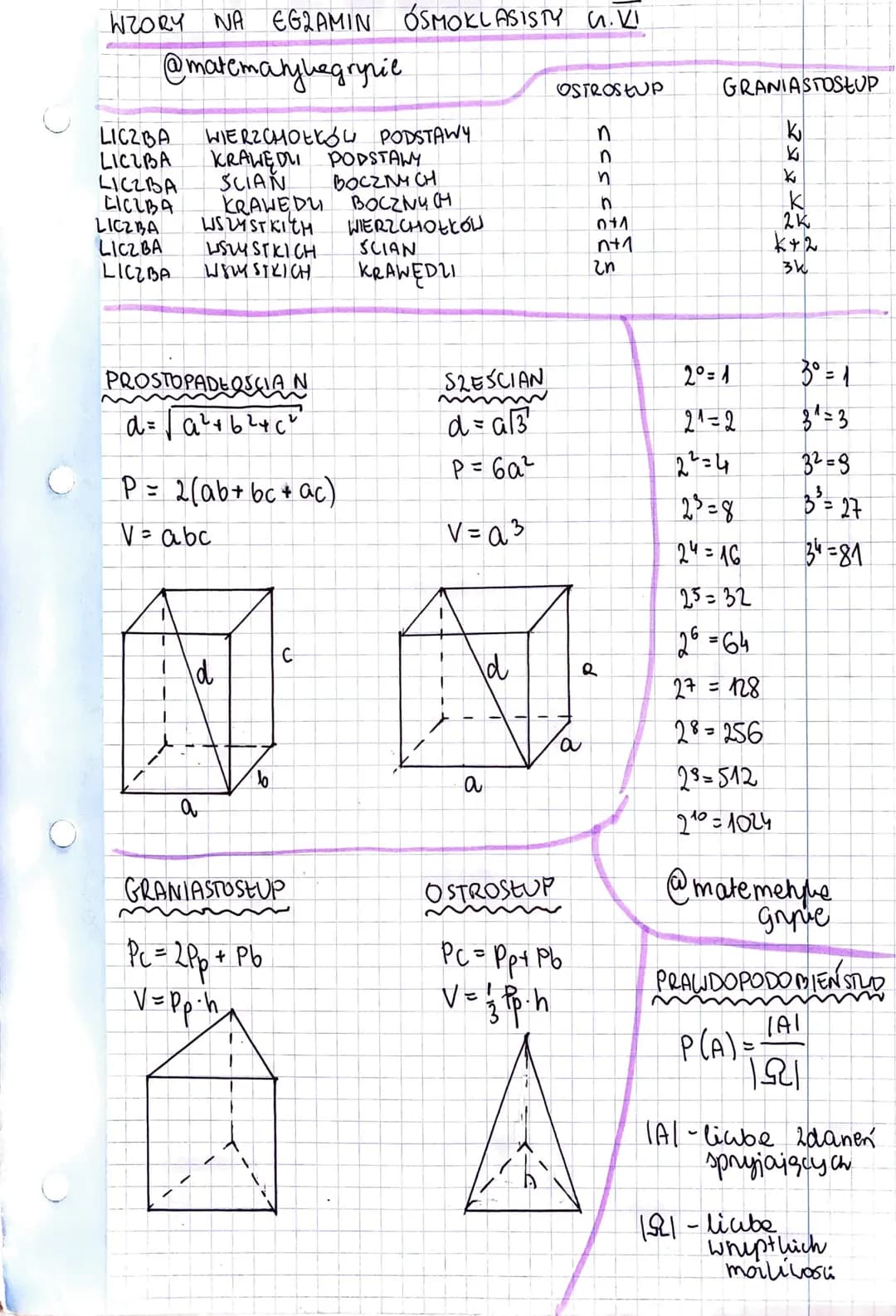
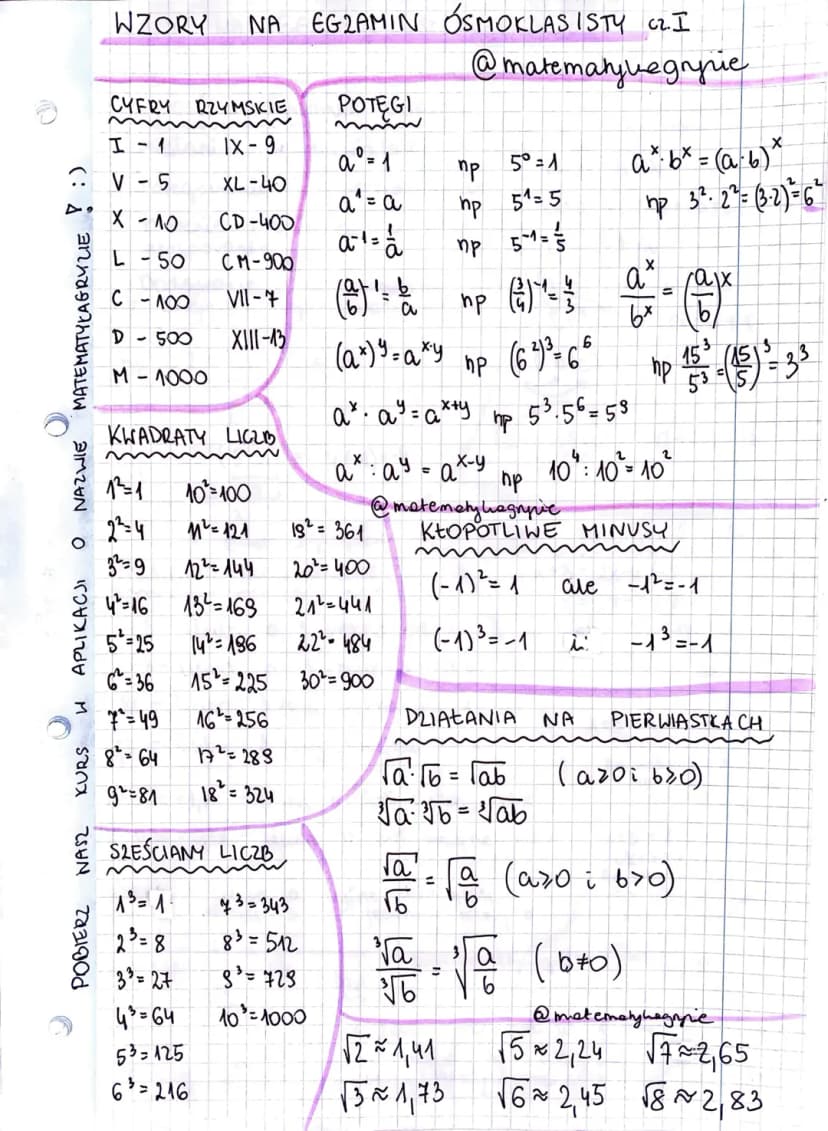
Mathematical Formulas for 8th Grade Exam - Part I
This page introduces fundamental mathematical concepts crucial for the Egzamin Ósmoklasisty. It covers Roman numerals, powers, squares, and cubes of numbers, as well as basic rules for exponents and square roots.
Vocabulary: Egzamin Ósmoklasisty - The 8th grade exam in the Polish education system.
Highlight: The page includes a QR code and social media handle @matematyuegrynie, suggesting additional online resources for exam preparation.
Example: Square numbers are provided up to 22², such as 5² = 25 and 10² = 100.
The page also presents important rules for working with exponents and square roots, which are essential for solving more complex mathematical problems in the exam.
Definition: a⁰ = 1 (any number raised to the power of zero equals one)
Quote: "√a · √b = √ab (a≥0 i b≥0)" - This formula shows how to multiply square roots.
We thought you’d never ask...
What is the Knowunity AI companion?
Our AI companion is specifically built for the needs of students. Based on the millions of content pieces we have on the platform we can provide truly meaningful and relevant answers to students. But its not only about answers, the companion is even more about guiding students through their daily learning challenges, with personalised study plans, quizzes or content pieces in the chat and 100% personalisation based on the students skills and developments.
Where can I download the Knowunity app?
You can download the app in the Google Play Store and in the Apple App Store.
Is Knowunity really free of charge?
That's right! Enjoy free access to study content, connect with fellow students, and get instant help – all at your fingertips.
Similar Content
Most popular content: Wzory geometryczne
9MatematykaWzory Geometrii i Prawdopodobieństwa
Kompleksowy zbiór wzorów i zasad dotyczących geometrii, objętości brył, kątów oraz prawdopodobieństwa, niezbędny do przygotowania się do egzaminu ósmoklasisty. Zawiera wzory na prostopadłościany, sześciany, ostrosłupy, graniastosłupy oraz zasady dotyczące kątów i działań na potęgach.
830,9003,301
MatematykaWzory Geometrii: Powierzchnia i Objętość
Zbiór kluczowych wzorów na pole, objętość i obwód figur geometrycznych, w tym kwadratów, prostokątów, trójkątów i brył. Idealne materiały do nauki dla uczniów przygotowujących się do egzaminu E8 z matematyki.
88,407352
MatematykaWzory Geometrii i Potęg
Kompleksowy zbiór kluczowych wzorów z geometrii i potęg, idealny do przygotowania się do egzaminu ósmoklasisty. Zawiera wzory na pola i obwody różnych figur geometrycznych oraz zasady dotyczące potęg i pierwiastków.
832,3602,040
MatematykaWzory figur płaskich
Zbiór wzorów na obwody i pola różnych figur płaskich, w tym kwadratów, prostokątów, trójkątów i równoległoboków. Idealne materiały do nauki przed egzaminem ósmoklasisty. Zawiera kluczowe informacje o wysokości, przekątnych oraz właściwościach geometrycznych.
814,094441
MatematykaWzory Geometrii i Obliczeń
Zbiór kluczowych wzorów geometrycznych dotyczących pól, obwodów oraz objętości różnych figur, w tym trójkątów, prostokątów, rombów i graniastosłupów. Idealne materiały do nauki przed egzaminem ósmoklasisty. Obejmuje wzory na pole powierzchni, objętość oraz obwód figur płaskich i przestrzennych.
81,20624
MatematykaWzory Matematyczne 8-klasisty
Zbiór kluczowych wzorów matematycznych na egzamin ósmoklasisty, obejmujący potęgi, pierwiastki oraz obliczenia pól i obwodów figur geometrycznych, takich jak kwadrat, prostokąt, romb i trójkąt równoboczny.
829,5032,077
MatematykaFormuły Pola i Obwodu
Zrozumienie formuł obwodów i pól dla podstawowych figur płaskich, takich jak kwadrat, prostokąt, trójkąt, równoległobok, trapez, romb i koło. Materiał zawiera wzory na obwody i pola, co ułatwia naukę geometrii. Idealne dla uczniów przygotowujących się do egzaminów z matematyki.
83,25365
MatematykaMatematyczne Wzory na Egzamin
Zbiór kluczowych wzorów matematycznych na egzamin ósmoklasisty. Obejmuje twierdzenie Pitagorasa, trójkąty szczególne, zasady podzielności, operacje na ułamkach, pola i objętości figur płaskich oraz graniastosłupów i ostrosłupów. Idealne do nauki i powtórki przed egzaminem.
81,64816
MatematykaWzory Matematyczne E8
Zbiór kluczowych wzorów matematycznych na poziomie E8, obejmujący obliczanie pól, obwodów oraz objętości brył. Idealny materiał do nauki dla uczniów przygotowujących się do egzaminów. Wzory dotyczą m.in. prostokątów, trójkątów, sześcianów i innych figur geometrycznych.
82,99851
Most popular content in Matematyka
9W
MatematykaWzory na pola wielokątów
Rozpoznawanie i utrwalanie podstawowych wzorów na pola prostokątów, kwadratów, trójkątów i trapezów.
64,8850
D
MatematykaDodawanie ułamków o tych samych mianownikach
Ćwiczenia z dodawania prostych ułamków o identycznych mianownikach bez przekraczania całości.
53,3580
MatematykaEgzamin ósmoklasisty: Matematyka
Kompleksowe powtórzenie z matematyki na egzamin ósmoklasisty. Obejmuje kluczowe zagadnienia takie jak działania na ułamkach, potęgi, obliczanie pól i objętości figur, średnia arytmetyczna, mediana oraz twierdzenie Pitagorasa. Idealne dla uczniów przygotowujących się do egzaminu. Typ: podsumowanie.
860,2325,678
T
Matematykatabliczka mnożenia do 100
tabliczka mnożenia do 100
53,6662
D
MatematykaDodawanie i odejmowanie ułamków dziesiętnych
Wykonywanie obliczeń pamięciowych i pisemnych na ułamkach dziesiętnych z uwzględnieniem poprawnego dopasowania przecinka.
63,6440
O
MatematykaObliczanie pola wielokątów
Rozwiązywanie prostych zadań rachunkowych na obliczanie pól figur przy podanych długościach boków i wysokości.
64,3510
P
MatematykaPodstawy tworzenia wyrażeń algebraicznych
Rozpoznawanie składników wyrażeń i zapisywanie prostych zależności liczbowych za pomocą liter i symboli.
73,6220
MatematykaGraniastosłupy i Ostrosłupy
Zrozumienie graniastosłupów i ostrosłupów: definicje, właściwości, wzory na objętość i pole powierzchni. Dowiedz się, jak obliczać objętość i pole różnych typów wielościanów, w tym graniastosłupów prostych i ostrosłupów prawdziwych. Idealne dla uczniów klasy 8.
843,6661,376
MatematykaOperacje na Pierwiastkach
Zrozumienie pierwiastków: definicje, wzory oraz metody obliczania. Dowiedz się, jak dodawać, odejmować, mnożyć i dzielić pierwiastki, a także jak wyciągać czynniki przed pierwiastek. Idealne dla uczniów przygotowujących się do egzaminów z matematyki.
841,6532,535
Most popular content
9 Język polski
Przedwiośnie: Analiza Tematów
Zanurz się w analizę powieści 'Przedwiośnie' Stefana Żeromskiego. Odkryj kluczowe motywy, takie jak dojrzewanie, rewolucja i podróż, oraz ich znaczenie w kontekście niepodległej Polski. Notatka zawiera szczegółowe omówienie bohaterów, narracji oraz symboliki, co czyni ją idealnym materiałem do nauki i przygotowania do egzaminów.
1181,2417,271
Język polskiAnaliza Lalki Prusa
Szczegółowa analiza powieści 'Lalka' Bolesława Prusa, obejmująca kompozycję, problematykę, głównych bohaterów oraz kontekst społeczny Warszawy lat 70. i 80. XIX wieku. Zawiera omówienie miłości Wokulskiego do Izabeli Łęckiej, różnorodności narracji oraz otwartości zakończenia. Idealna dla studentów literatury i miłośników polskiej prozy.
4133,9114,302
Język polskiAnaliza 'Lalki' Prusa
Szczegółowa analiza powieści 'Lalka' Bolesława Prusa, obejmująca gatunek, czas i miejsce akcji, kluczowych bohaterów, oraz motywy literackie. Zawiera omówienie postaci Stanisława Wokulskiego jako romantyka i pozytywisty oraz realistyczny obraz Warszawy i Paryża. Idealne dla studentów literatury polskiej.
4130,4526,097
W
Język polskiWprowadzenie do lektury Zemsta
Sprawdź znajomość czasu i miejsca akcji oraz głównych wątków komedii Aleksandra Fredry.
85,9700
Język polskiMakbet: Analiza Tragedii Szekspira
Odkryj kluczowe cechy dramatu 'Makbet' Williama Szekspira, w tym złamanie zasady decorum, psychologię postaci oraz tematykę zbrodni i ambicji. Zrozum, jak Szekspir przekształca klasyczną tragedię, wprowadzając elementy fantastyki i psychologii. Idealne dla uczniów i studentów literatury. Typ: analiza literacka.
4104,1894,738
B
 Biologia
biologia- ryby klasa 6
Przed odpowiedzią ustnią idealny do powtórki ❤️
64,8014
Język polskiWesele: Analiza Symboli
Zanurz się w głęboką analizę dramatu 'Wesele' Stanisława Wyspiańskiego. Odkryj kluczowe symbole, takie jak chochoł i złoty róg, oraz ich znaczenie w kontekście polskiego społeczeństwa przełomu XIX i XX wieku. Notatka zawiera omówienie genezy, kompozycji, tematów oraz portretu społecznego, co czyni ją idealnym materiałem do nauki i przygotowań do egzaminów.
1183,6957,869
K
BiologiaKorzeń- organ podziemny rośliny
prawie wszystko w temacie "korzeń- organ podziemny rośliny "
54,3982
K
 Technika
Karta rowerowa
UwU
45,4003
Can't find what you're looking for? Explore other subjects.
Students love us — and so will you.
4.6/5App Store
4.7/5Google Play
The app is very easy to use and well designed. I have found everything I was looking for so far and have been able to learn a lot from the presentations! I will definitely use the app for a class assignment! And of course it also helps a lot as an inspiration.
Stefan SiOS user
This app is really great. There are so many study notes and help [...]. My problem subject is French, for example, and the app has so many options for help. Thanks to this app, I have improved my French. I would recommend it to anyone.
Samantha KlichAndroid user
Wow, I am really amazed. I just tried the app because I've seen it advertised many times and was absolutely stunned. This app is THE HELP you want for school and above all, it offers so many things, such as workouts and fact sheets, which have been VERY helpful to me personally.
AnnaiOS user
Matematyka55,352 views·Updated Jun 27, 2026·6 pagesWszystkie Wzory i Notatki na Egzamin Ósmoklasisty 2024 PDF
Matematyka Gryzie@matematykagryzie
The document provides essential mathematical formulas and concepts for the 8th grade exam, covering topics like Roman numerals, powers, square roots, algebraic expressions, percentages, and geometric shapes. It serves as a comprehensive study guide for students preparing for their Egzamin...
1
of 6
Sign up to see the content. It's free!
- Access to all documents
- Improve your grades
- Join milions of students
Mathematical Formulas for 8th Grade Exam - Part II
This page focuses on algebraic expressions, order of operations, and percentage calculations. It provides crucial information for students preparing for the Wzory na Egzamin Ósmoklasisty.
The order of operations is clearly outlined:
- Operations in parentheses
- Exponentiation
- Multiplication and division
- Addition and subtraction
Highlight: The page emphasizes the importance of following the order of operations to solve mathematical problems correctly.
Algebraic expressions are explained with examples, helping students understand concepts like variables and coefficients. The page also covers percentage calculations, which are frequently tested in the Egzamin Ósmoklasisty.
Example: x + 30% x = 1.3x (increasing a number by 30%)
Vocabulary: Wyrażenia algebraiczne - Algebraic expressions
The laws of operations, such as the commutative and associative properties, are also presented, providing a solid foundation for more advanced mathematical concepts.
2
of 6Sign up to see the content. It's free!
- Access to all documents
- Improve your grades
- Join milions of students
Unit Conversions and Scale
This page covers essential unit conversions for length, mass, area, and volume. It also introduces the concept of scale in maps, which is crucial for solving real-world problems in the Egzamin Ósmoklasisty.
Highlight: The page uses visual aids to demonstrate the relationships between different units, making it easier for students to remember conversion factors.
Length conversions are shown from kilometers to millimeters, with each step representing a factor of 10. Similar charts are provided for mass (from tons to milligrams) and area (from square kilometers to square millimeters).
Example: 1 km² = 100 ha (1 square kilometer equals 100 hectares)
Volume conversions are also covered, including the relationship between cubic units and liters.
Definition: 1 L = 1 dm³ = 1000 mL (1 liter equals 1 cubic decimeter or 1000 milliliters)
The concept of scale is introduced, which is important for map-related questions in the exam.
Example: A scale of 1:2000 means that 1 cm on the map represents 2000 cm in reality.
3
of 6Sign up to see the content. It's free!
- Access to all documents
- Improve your grades
- Join milions of students
Time Units and Angle Types
This page focuses on time unit conversions and different types of angles, both of which are important topics for the Egzamin Ósmoklasisty.
Time unit conversions are presented in detail, covering relationships between hours, minutes, seconds, and even larger units like quarters and years.
Example: 1 hour = 60 minutes = 3600 seconds
Vocabulary: Rok przestępny - Leap year (366 days)
The page then introduces various types of angles, providing both visual representations and definitions:
- Acute angle (less than 90°)
- Right angle (90°)
- Obtuse angle (between 90° and 180°)
- Straight angle (180°)
- Reflex angle (between 180° and 360°)
- Full angle (360°)
Highlight: The page also covers important angle relationships, such as vertical angles, alternate angles, and adjacent angles, which are crucial for geometry problems in the exam.
Speed unit conversions are also included, showing the relationship between km/h and m/s.
Example: 36 km/h = 10 m/s
4
of 6Sign up to see the content. It's free!
- Access to all documents
- Improve your grades
- Join milions of students
Geometric Shapes and Formulas
This page provides essential formulas for various geometric shapes, which are frequently tested in the Egzamin Ósmoklasisty. It covers triangles, parallelograms, trapezoids, and regular polygons.
Highlight: The Pythagorean theorem is prominently featured, as it's a fundamental concept for many geometry problems.
Quote: "a² + b² = c²" - The Pythagorean theorem
For each shape, the page provides formulas for perimeter (L) and area (P), along with diagrams illustrating important dimensions.
Example: For a triangle: L = a + b + c, P = ½ah (where a is the base and h is the height)
Special attention is given to the equilateral triangle and regular hexagon, providing formulas for their areas using side length.
Vocabulary: Sześciokąt foremny - Regular hexagon
The page also covers quadrilaterals, including rectangles, squares, rhombuses, and kites, providing formulas for their perimeters, areas, and diagonals.
Definition: For a square: d = a√2 (diagonal length in terms of side length)
5
of 6Sign up to see the content. It's free!
- Access to all documents
- Improve your grades
- Join milions of students
3D Shapes and Probability
The final page covers three-dimensional shapes and introduces the concept of probability, both crucial topics for the Egzamin Ósmoklasisty.
For 3D shapes like cuboids, prisms, cubes, and pyramids, the page provides formulas for surface area, volume, and diagonal length.
Example: For a cube: V = a³ (volume), P = 6a² (surface area), d = a√3 (diagonal length)
The page also includes a table showing the number of vertices, edges, and faces for these 3D shapes, which is helpful for understanding their properties.
Highlight: Powers of 2 and 3 are listed up to 2¹⁰ and 3⁵, which are useful for various calculations.
Finally, the concept of probability is introduced with a simple formula:
Definition: P(A) = m / n, where m is the number of favorable outcomes and n is the total number of possible outcomes.
This comprehensive coverage of geometric shapes, 3D objects, and probability provides students with essential tools for tackling a wide range of problems in the Egzamin Ósmoklasisty.
6
of 6Sign up to see the content. It's free!
- Access to all documents
- Improve your grades
- Join milions of students
Mathematical Formulas for 8th Grade Exam - Part I
This page introduces fundamental mathematical concepts crucial for the Egzamin Ósmoklasisty. It covers Roman numerals, powers, squares, and cubes of numbers, as well as basic rules for exponents and square roots.
Vocabulary: Egzamin Ósmoklasisty - The 8th grade exam in the Polish education system.
Highlight: The page includes a QR code and social media handle @matematyuegrynie, suggesting additional online resources for exam preparation.
Example: Square numbers are provided up to 22², such as 5² = 25 and 10² = 100.
The page also presents important rules for working with exponents and square roots, which are essential for solving more complex mathematical problems in the exam.
Definition: a⁰ = 1 (any number raised to the power of zero equals one)
Quote: "√a · √b = √ab (a≥0 i b≥0)" - This formula shows how to multiply square roots.
We thought you’d never ask...
What is the Knowunity AI companion?
Our AI companion is specifically built for the needs of students. Based on the millions of content pieces we have on the platform we can provide truly meaningful and relevant answers to students. But its not only about answers, the companion is even more about guiding students through their daily learning challenges, with personalised study plans, quizzes or content pieces in the chat and 100% personalisation based on the students skills and developments.
Where can I download the Knowunity app?
You can download the app in the Google Play Store and in the Apple App Store.
Is Knowunity really free of charge?
That's right! Enjoy free access to study content, connect with fellow students, and get instant help – all at your fingertips.
Similar Content
Most popular content: Wzory geometryczne
9MatematykaWzory Geometrii i Prawdopodobieństwa
Kompleksowy zbiór wzorów i zasad dotyczących geometrii, objętości brył, kątów oraz prawdopodobieństwa, niezbędny do przygotowania się do egzaminu ósmoklasisty. Zawiera wzory na prostopadłościany, sześciany, ostrosłupy, graniastosłupy oraz zasady dotyczące kątów i działań na potęgach.
830,9003,301
MatematykaWzory Geometrii: Powierzchnia i Objętość
Zbiór kluczowych wzorów na pole, objętość i obwód figur geometrycznych, w tym kwadratów, prostokątów, trójkątów i brył. Idealne materiały do nauki dla uczniów przygotowujących się do egzaminu E8 z matematyki.
88,407352
MatematykaWzory Geometrii i Potęg
Kompleksowy zbiór kluczowych wzorów z geometrii i potęg, idealny do przygotowania się do egzaminu ósmoklasisty. Zawiera wzory na pola i obwody różnych figur geometrycznych oraz zasady dotyczące potęg i pierwiastków.
832,3602,040
MatematykaWzory figur płaskich
Zbiór wzorów na obwody i pola różnych figur płaskich, w tym kwadratów, prostokątów, trójkątów i równoległoboków. Idealne materiały do nauki przed egzaminem ósmoklasisty. Zawiera kluczowe informacje o wysokości, przekątnych oraz właściwościach geometrycznych.
814,094441
MatematykaWzory Geometrii i Obliczeń
Zbiór kluczowych wzorów geometrycznych dotyczących pól, obwodów oraz objętości różnych figur, w tym trójkątów, prostokątów, rombów i graniastosłupów. Idealne materiały do nauki przed egzaminem ósmoklasisty. Obejmuje wzory na pole powierzchni, objętość oraz obwód figur płaskich i przestrzennych.
81,20624
MatematykaWzory Matematyczne 8-klasisty
Zbiór kluczowych wzorów matematycznych na egzamin ósmoklasisty, obejmujący potęgi, pierwiastki oraz obliczenia pól i obwodów figur geometrycznych, takich jak kwadrat, prostokąt, romb i trójkąt równoboczny.
829,5032,077
MatematykaFormuły Pola i Obwodu
Zrozumienie formuł obwodów i pól dla podstawowych figur płaskich, takich jak kwadrat, prostokąt, trójkąt, równoległobok, trapez, romb i koło. Materiał zawiera wzory na obwody i pola, co ułatwia naukę geometrii. Idealne dla uczniów przygotowujących się do egzaminów z matematyki.
83,25365
MatematykaMatematyczne Wzory na Egzamin
Zbiór kluczowych wzorów matematycznych na egzamin ósmoklasisty. Obejmuje twierdzenie Pitagorasa, trójkąty szczególne, zasady podzielności, operacje na ułamkach, pola i objętości figur płaskich oraz graniastosłupów i ostrosłupów. Idealne do nauki i powtórki przed egzaminem.
81,64816
MatematykaWzory Matematyczne E8
Zbiór kluczowych wzorów matematycznych na poziomie E8, obejmujący obliczanie pól, obwodów oraz objętości brył. Idealny materiał do nauki dla uczniów przygotowujących się do egzaminów. Wzory dotyczą m.in. prostokątów, trójkątów, sześcianów i innych figur geometrycznych.
82,99851
Most popular content in Matematyka
9W
MatematykaWzory na pola wielokątów
Rozpoznawanie i utrwalanie podstawowych wzorów na pola prostokątów, kwadratów, trójkątów i trapezów.
64,8850
D
MatematykaDodawanie ułamków o tych samych mianownikach
Ćwiczenia z dodawania prostych ułamków o identycznych mianownikach bez przekraczania całości.
53,3580
MatematykaEgzamin ósmoklasisty: Matematyka
Kompleksowe powtórzenie z matematyki na egzamin ósmoklasisty. Obejmuje kluczowe zagadnienia takie jak działania na ułamkach, potęgi, obliczanie pól i objętości figur, średnia arytmetyczna, mediana oraz twierdzenie Pitagorasa. Idealne dla uczniów przygotowujących się do egzaminu. Typ: podsumowanie.
860,2325,678
T
Matematykatabliczka mnożenia do 100
tabliczka mnożenia do 100
53,6662
D
MatematykaDodawanie i odejmowanie ułamków dziesiętnych
Wykonywanie obliczeń pamięciowych i pisemnych na ułamkach dziesiętnych z uwzględnieniem poprawnego dopasowania przecinka.
63,6440
O
MatematykaObliczanie pola wielokątów
Rozwiązywanie prostych zadań rachunkowych na obliczanie pól figur przy podanych długościach boków i wysokości.
64,3510
P
MatematykaPodstawy tworzenia wyrażeń algebraicznych
Rozpoznawanie składników wyrażeń i zapisywanie prostych zależności liczbowych za pomocą liter i symboli.
73,6220
MatematykaGraniastosłupy i Ostrosłupy
Zrozumienie graniastosłupów i ostrosłupów: definicje, właściwości, wzory na objętość i pole powierzchni. Dowiedz się, jak obliczać objętość i pole różnych typów wielościanów, w tym graniastosłupów prostych i ostrosłupów prawdziwych. Idealne dla uczniów klasy 8.
843,6661,376
MatematykaOperacje na Pierwiastkach
Zrozumienie pierwiastków: definicje, wzory oraz metody obliczania. Dowiedz się, jak dodawać, odejmować, mnożyć i dzielić pierwiastki, a także jak wyciągać czynniki przed pierwiastek. Idealne dla uczniów przygotowujących się do egzaminów z matematyki.
841,6532,535
Most popular content
9Język polskiPrzedwiośnie: Analiza Tematów
Zanurz się w analizę powieści 'Przedwiośnie' Stefana Żeromskiego. Odkryj kluczowe motywy, takie jak dojrzewanie, rewolucja i podróż, oraz ich znaczenie w kontekście niepodległej Polski. Notatka zawiera szczegółowe omówienie bohaterów, narracji oraz symboliki, co czyni ją idealnym materiałem do nauki i przygotowania do egzaminów.
1181,2417,271
Język polskiAnaliza Lalki Prusa
Szczegółowa analiza powieści 'Lalka' Bolesława Prusa, obejmująca kompozycję, problematykę, głównych bohaterów oraz kontekst społeczny Warszawy lat 70. i 80. XIX wieku. Zawiera omówienie miłości Wokulskiego do Izabeli Łęckiej, różnorodności narracji oraz otwartości zakończenia. Idealna dla studentów literatury i miłośników polskiej prozy.
4133,9114,302
Język polskiAnaliza 'Lalki' Prusa
Szczegółowa analiza powieści 'Lalka' Bolesława Prusa, obejmująca gatunek, czas i miejsce akcji, kluczowych bohaterów, oraz motywy literackie. Zawiera omówienie postaci Stanisława Wokulskiego jako romantyka i pozytywisty oraz realistyczny obraz Warszawy i Paryża. Idealne dla studentów literatury polskiej.
4130,4526,097
W
Język polskiWprowadzenie do lektury Zemsta
Sprawdź znajomość czasu i miejsca akcji oraz głównych wątków komedii Aleksandra Fredry.
85,9700
Język polskiMakbet: Analiza Tragedii Szekspira
Odkryj kluczowe cechy dramatu 'Makbet' Williama Szekspira, w tym złamanie zasady decorum, psychologię postaci oraz tematykę zbrodni i ambicji. Zrozum, jak Szekspir przekształca klasyczną tragedię, wprowadzając elementy fantastyki i psychologii. Idealne dla uczniów i studentów literatury. Typ: analiza literacka.
4104,1894,738
B
Biologiabiologia- ryby klasa 6
Przed odpowiedzią ustnią idealny do powtórki ❤️
64,8014
Język polskiWesele: Analiza Symboli
Zanurz się w głęboką analizę dramatu 'Wesele' Stanisława Wyspiańskiego. Odkryj kluczowe symbole, takie jak chochoł i złoty róg, oraz ich znaczenie w kontekście polskiego społeczeństwa przełomu XIX i XX wieku. Notatka zawiera omówienie genezy, kompozycji, tematów oraz portretu społecznego, co czyni ją idealnym materiałem do nauki i przygotowań do egzaminów.
1183,6957,869
K
BiologiaKorzeń- organ podziemny rośliny
prawie wszystko w temacie "korzeń- organ podziemny rośliny "
54,3982
K
TechnikaKarta rowerowa
UwU
45,4003
Can't find what you're looking for? Explore other subjects.
Students love us — and so will you.
4.6/5App Store
4.7/5Google Play
The app is very easy to use and well designed. I have found everything I was looking for so far and have been able to learn a lot from the presentations! I will definitely use the app for a class assignment! And of course it also helps a lot as an inspiration.
Stefan SiOS user
This app is really great. There are so many study notes and help [...]. My problem subject is French, for example, and the app has so many options for help. Thanks to this app, I have improved my French. I would recommend it to anyone.
Samantha KlichAndroid user
Wow, I am really amazed. I just tried the app because I've seen it advertised many times and was absolutely stunned. This app is THE HELP you want for school and above all, it offers so many things, such as workouts and fact sheets, which have been VERY helpful to me personally.
AnnaiOS user