
A comprehensive guide to goniometry and trigonometric functions on the...
 Matematica6,903 views·Updated Jun 22, 2026·11 pages
Impara la Circonferenza Goniometrica: Seno, Coseno e Tangente con Raggio Unitario

kami @kami_basi


1 / 10
1
of 10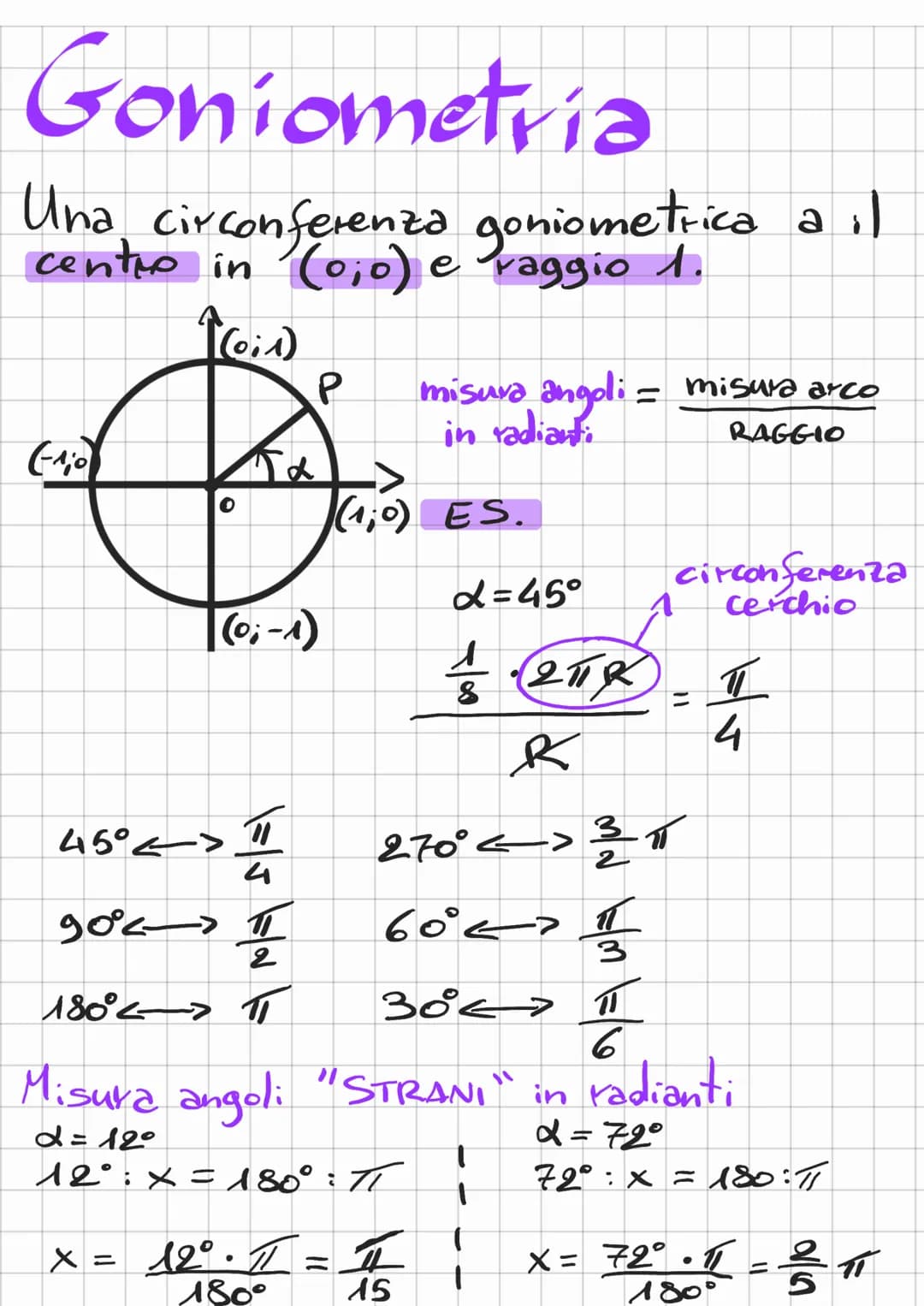
Trigonometric Functions on the Unit Circle
This page delves into the definitions of cosine and sine using the unit circle, as well as introducing the concept of radians.
Key points:
- Cosine and sine are defined using points on the unit circle.
- One radian is the angle subtended by an arc length equal to the radius.
- The relationship between degrees and radians is given: π radians = 180°.
Definition: Circonferenza goniometrica seno e coseno refers to the representation of sine and cosine on the unit circle.
Formula: sin²θ + cos²θ = 1 (Pythagorean identity)
The page also provides key values for sine and cosine at notable angles (0°, 90°, 180°, 270°, 360°).
Example: cos 0° = 1, sin 0° = 0; cos 90° = 0, sin 90° = 1
2
of 10
Quadrants and Tangent Function
This section explores the signs of trigonometric functions in different quadrants and introduces the tangent function.
Key points:
- The signs of sine and cosine vary depending on the quadrant.
- Tangent is defined as the ratio of sine to cosine: tan θ = sin θ / cos θ.
Definition: Circonferenza goniometrica tangente refers to the tangent function in relation to the unit circle.
The page includes diagrams showing the signs of sine and cosine in each quadrant, as well as the graphical representation of the tangent function on the unit circle.
Formula: cos θ = ±1 / √, sin θ = ±tan θ / √
3
of 10
Graphical Representations
This page presents the graphs of cosine, sine, and tangent functions.
Key features:
- Cosine and sine graphs have a period of 2π.
- Tangent graph has a period of π.
- Cosine graph is shifted π/2 to the left compared to the sine graph.
Highlight: Grafico coseno, seno, coseno, tangente formule are visually represented, showing their periodic nature and key characteristics.
The graphs include important points such as x-intercepts, y-intercepts, and asymptotes (for tangent).
Example: The sine function has y-intercepts at 0°, 180°, and 360°, while reaching maximum values of 1 at 90° and minimum values of -1 at 270°.
4
of 10
Trigonometric Values Table
This section provides a comprehensive table of trigonometric values for common angles.
The table includes:
- Angles in degrees and radians
- Sine, cosine, and tangent values
Highlight: The Circonferenza goniometrica tabella offers a quick reference for important trigonometric values.
Key angles covered: 0°, 30°, 45°, 60°, 90°, 180°, 270°, 360°
Example: For 45°, sin 45° = cos 45° = √2/2, and tan 45° = 1
The page also emphasizes the periodicity of these functions and their relationships.
5
of 10
Associated Angles
This section introduces the concept of associated angles and their relationships in trigonometry.
Key relationships covered:
- Supplementary angles: (π - θ)
- Opposite angles: (-θ)
- Complementary angles: (π/2 - θ)
Definition: Angoli associati goniometria refers to angles that have specific relationships with a given angle θ.
For each relationship, the guide provides formulas for sine, cosine, and tangent.
Formula: For supplementary angles, cos(π - θ) = -cos θ, sin(π - θ) = sin θ, tan(π - θ) = -tan θ
Example: cos 120° = -cos(180° - 60°) = -cos 60° = -1/2
The page includes visual representations of these relationships on the unit circle.
6
of 10
More Associated Angles
This page continues the discussion of associated angles, focusing on angles that differ by π.
Key relationship covered:
- Angles differing by π: (π + θ)
Formula: cos(π + θ) = -cos θ, sin(π + θ) = -sin θ, tan(π + θ) = tan θ
The guide provides examples and visual representations on the unit circle.
Example: sin 210° = sin(180° + 30°) = -sin 30° = -1/2
The page also revisits opposite angles (-θ) with additional examples.
Highlight: Understanding Angoli associati formule is crucial for solving complex trigonometric problems.
7
of 10
Complementary Angles and Cotangent
This section explores the relationship between complementary angles and introduces the cotangent function.
Key points:
- Complementary angles sum to π/2 (90°).
- The sine of an angle equals the cosine of its complement.
Definition: Cotangent is defined as the reciprocal of tangent: cot θ = 1 / tan θ = cos θ / sin θ
The page includes a visual representation of complementary angles on the unit circle and formulas relating sine and cosine of complementary angles.
Formula: sin(π/2 - θ) = cos θ, cos(π/2 - θ) = sin θ
A table of cotangent values for common angles is provided, along with its graph.
Highlight: The Circonferenza goniometrica valori for cotangent complement those of sine, cosine, and tangent.
8
of 10
Inverse Trigonometric Functions
This page introduces inverse trigonometric functions, focusing on arcsine and arccosine.
Key points:
- Inverse functions "undo" the original trigonometric functions.
- The domain and range of inverse functions are restricted to ensure they are functions.
For arcsine:
- Domain: [-1, 1]
- Range: [-π/2, π/2]
For arccosine:
- Domain: [-1, 1]
- Range: [0, π]
Highlight: Graphs of inverse trigonometric functions are obtained by reflecting the original function over the line y = x and restricting the domain.
The page includes graphical representations of both arcsine and arccosine functions.
Example: arcsin(1/2) = π/6 (30°), as sin(π/6) = 1/2
9
of 10
Inverse Trigonometric Functions (Continued)
This page continues the discussion of inverse trigonometric functions, focusing on arccosine.
Key points:
- The arccosine function is the inverse of the cosine function with a restricted domain.
- The graph of arccosine is obtained by reflecting the cosine graph over y = x and restricting the domain.
Definition: Arccosine (arccos x) gives the angle whose cosine is x, restricted to the range [0, π].
The page includes a detailed graph of the arccosine function, showing its domain and range.
Example: arccos(1/2) = π/3 (60°), as cos(π/3) = 1/2
Highlight: Understanding inverse trigonometric functions is crucial for solving equations involving trigonometric functions.
The guide emphasizes the importance of domain and range restrictions in defining these inverse functions.
10
of 10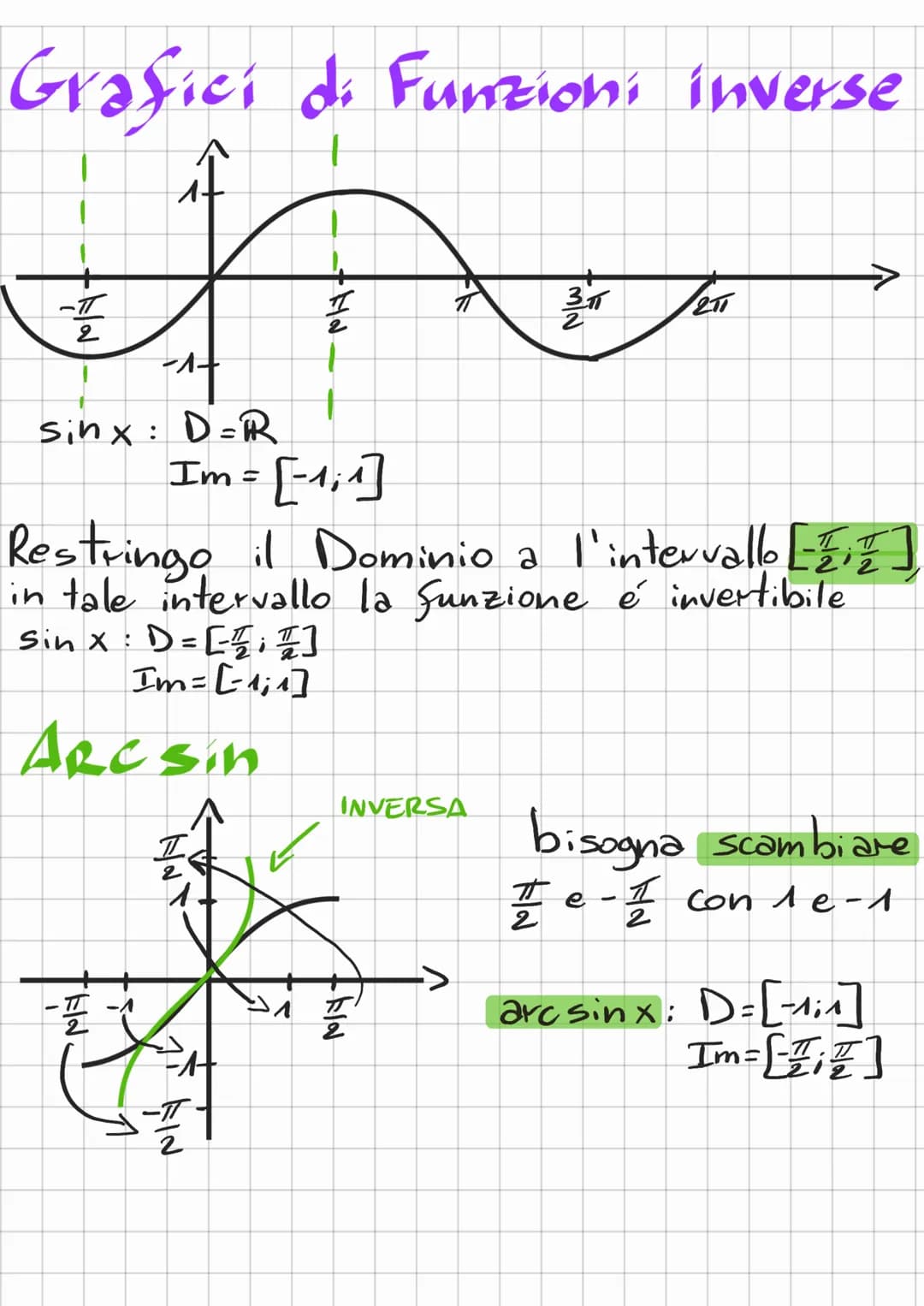
Inverse Trigonometric Functions - Part 2
Completion of inverse function analysis.
Definition: Arccosine is the inverse function of cosine when properly restricted.
Example: The domain of arccosine is [-1,1] and its range is [0,π].
We thought you’d never ask...
What is the Knowunity AI companion?
Our AI companion is specifically built for the needs of students. Based on the millions of content pieces we have on the platform we can provide truly meaningful and relevant answers to students. But its not only about answers, the companion is even more about guiding students through their daily learning challenges, with personalised study plans, quizzes or content pieces in the chat and 100% personalisation based on the students skills and developments.
Where can I download the Knowunity app?
You can download the app in the Google Play Store and in the Apple App Store.
Is Knowunity really free of charge?
That's right! Enjoy free access to study content, connect with fellow students, and get instant help – all at your fingertips.
Similar Content
Most popular content: funzioni trigonometriche
9MatematicaGoniometria e trigonometria
Appunti di goniometria e trigonometria
3ªl6,432117
MatematicaGoniometria - funzione seno e coseno
Goniometria - funzione seno e coseno, come cambiano il seno e il coseno in base ad un punto P sulla circonferenza, tabella valori noti seno e coseno, grafico sinusoide e cosinusoide, 1° relazione fondamentale e come calcolare gli angoli negativi
3ªl16,174484
 Fisica
fisica
il piano inclinato
2ªl3,41790
MatematicaGoniometria
Goniometria
2ªl8,885185
MatematicaAngoli e Funzioni Goniometriche
Angoli e Funzioni Goniometriche
3ªl2,37731
MatematicaTrigonometria
le basi di trigonometria, formule di seno, coseno e tangente, equazioni, disequazioni, le funzioni inverse, i teoremi di trigonometria.
3ªl24,336992
MatematicaTrigonometria
introduzione generale alla trigonometria, con formule base e grafici di seno, coseno e tangente
3ªl1,78948
MatematicaGoniometria
Circonferenza goniometrica, relazione fondamentale, archi associati, formule ed equazioni goniometriche
4ªl1,98320
MatematicaGrafici di funzioni elementari
Ecco dei grafici per inziare al meglio lo studio di funzione :)
3ªl2,05033
Most popular content in Matematica
9E
MatematicaEquazioni
esercizi
2ªm3,35715
I
Matematicai criteri di divisibilità
i criteri di divisibilità
1ªm1,4962
F
MatematicaFondamenti del Teorema di Pitagora
Identifica ipotenusa e cateti e apprendi la formula fondamentale del Teorema di Pitagora nei triangoli rettangoli.
2ªm2,8370
MatematicaFormulario di mate
Spero possa esservi utile
3ªl5,242150
MatematicaMatematica per la maturità
Appunti di tutti e cinque gli anni di matematica in vista della maturità (potrebbero mancare alcune cose).
3ªl2,39676
MatematicaDerivate
Appunti di matematica sulle derivate
4ªl22,639528
MatematicaPiano cartesiano e retta
Appunti
1ªl2,94762
MatematicaOperazioni e prodotti notevoli
Operazioni con polinomi e prodotti notevoli
1ªl4,84980
MatematicaFormulario di matematica maturità 2024
Tutte le formule per la prova d'esame di matematica della maturità
5ªl6,824175
Most popular content
9 Italiano
Riassunto patente B
Riassunto patente B - appunti presi a lezione
5ªl29,228943
 Altro
AltroTeoria patente b
Tutti gli argomenti per la patente
1ªl21,114685
 Ed. civ.
Teoria patente di guida B: Segnali stradali
Segnali stradali di pericolo, luminosi, di prescrizione, di indicazione, temporanei, complementari, pannelli integrativi, segnaletica orizzontale, segnalazioni agenti del traffico, distanza di visibilità per l‘arresto, minima di sicurezza.
5ªl40,0421,645
 Filosofia
Aristotele
Aristotele: vita, metafisica, fisica, etica e politica, retorica e poetica
3ªl7,623216
ItalianoI promessi sposi
Riassunti completi di tutti i 38 capitoli dei Promessi sposi.
2ªl14,090314
AltroPATENTE
schemi per esame teorico della patente
Università22,067756
S
ItalianoSintesi finale di Analisi logica
Esercitazione completa di analisi logica su frasi articolate per consolidare la conoscenza di tutti i complementi.
3ªm5,5290
P
 Inglese
Present Simple vs Present Continuous
Develop the ability to choose correctly between the Present Simple for habits and the Present Continuous for ongoing actions.
3ªm4,2110
G
ItalianoGabriele D'Annunzio e l'Estetismo
Domande sull'ideale del superuomo, il panismo e la concezione dell'arte come valore assoluto in D'Annunzio.
4ªl2,6740
Can't find what you're looking for? Explore other subjects.
Students love us — and so will you.
4.6/5App Store
4.7/5Google Play
The app is very easy to use and well designed. I have found everything I was looking for so far and have been able to learn a lot from the presentations! I will definitely use the app for a class assignment! And of course it also helps a lot as an inspiration.
Stefan SiOS user
This app is really great. There are so many study notes and help [...]. My problem subject is French, for example, and the app has so many options for help. Thanks to this app, I have improved my French. I would recommend it to anyone.
Samantha KlichAndroid user
Wow, I am really amazed. I just tried the app because I've seen it advertised many times and was absolutely stunned. This app is THE HELP you want for school and above all, it offers so many things, such as workouts and fact sheets, which have been VERY helpful to me personally.
AnnaiOS user
Matematica6,903 views·Updated Jun 22, 2026·11 pagesImpara la Circonferenza Goniometrica: Seno, Coseno e Tangente con Raggio Unitario
kami @kami_basi
A comprehensive guide to goniometry and trigonometric functions on the unit circle, exploring fundamental concepts of seno, coseno, e tangente and their relationships.
- The unit circle (raggio unitario) serves as the foundation for understanding trigonometric functions
- Key concepts...
1
of 10
Sign up to see the content. It's free!
- Access to all documents
- Improve your grades
- Join milions of students
Trigonometric Functions on the Unit Circle
This page delves into the definitions of cosine and sine using the unit circle, as well as introducing the concept of radians.
Key points:
- Cosine and sine are defined using points on the unit circle.
- One radian is the angle subtended by an arc length equal to the radius.
- The relationship between degrees and radians is given: π radians = 180°.
Definition: Circonferenza goniometrica seno e coseno refers to the representation of sine and cosine on the unit circle.
Formula: sin²θ + cos²θ = 1 (Pythagorean identity)
The page also provides key values for sine and cosine at notable angles (0°, 90°, 180°, 270°, 360°).
Example: cos 0° = 1, sin 0° = 0; cos 90° = 0, sin 90° = 1
2
of 10Sign up to see the content. It's free!
- Access to all documents
- Improve your grades
- Join milions of students
Quadrants and Tangent Function
This section explores the signs of trigonometric functions in different quadrants and introduces the tangent function.
Key points:
- The signs of sine and cosine vary depending on the quadrant.
- Tangent is defined as the ratio of sine to cosine: tan θ = sin θ / cos θ.
Definition: Circonferenza goniometrica tangente refers to the tangent function in relation to the unit circle.
The page includes diagrams showing the signs of sine and cosine in each quadrant, as well as the graphical representation of the tangent function on the unit circle.
Formula: cos θ = ±1 / √, sin θ = ±tan θ / √
3
of 10Sign up to see the content. It's free!
- Access to all documents
- Improve your grades
- Join milions of students
Graphical Representations
This page presents the graphs of cosine, sine, and tangent functions.
Key features:
- Cosine and sine graphs have a period of 2π.
- Tangent graph has a period of π.
- Cosine graph is shifted π/2 to the left compared to the sine graph.
Highlight: Grafico coseno, seno, coseno, tangente formule are visually represented, showing their periodic nature and key characteristics.
The graphs include important points such as x-intercepts, y-intercepts, and asymptotes (for tangent).
Example: The sine function has y-intercepts at 0°, 180°, and 360°, while reaching maximum values of 1 at 90° and minimum values of -1 at 270°.
4
of 10Sign up to see the content. It's free!
- Access to all documents
- Improve your grades
- Join milions of students
Trigonometric Values Table
This section provides a comprehensive table of trigonometric values for common angles.
The table includes:
- Angles in degrees and radians
- Sine, cosine, and tangent values
Highlight: The Circonferenza goniometrica tabella offers a quick reference for important trigonometric values.
Key angles covered: 0°, 30°, 45°, 60°, 90°, 180°, 270°, 360°
Example: For 45°, sin 45° = cos 45° = √2/2, and tan 45° = 1
The page also emphasizes the periodicity of these functions and their relationships.
5
of 10Sign up to see the content. It's free!
- Access to all documents
- Improve your grades
- Join milions of students
Associated Angles
This section introduces the concept of associated angles and their relationships in trigonometry.
Key relationships covered:
- Supplementary angles: (π - θ)
- Opposite angles: (-θ)
- Complementary angles: (π/2 - θ)
Definition: Angoli associati goniometria refers to angles that have specific relationships with a given angle θ.
For each relationship, the guide provides formulas for sine, cosine, and tangent.
Formula: For supplementary angles, cos(π - θ) = -cos θ, sin(π - θ) = sin θ, tan(π - θ) = -tan θ
Example: cos 120° = -cos(180° - 60°) = -cos 60° = -1/2
The page includes visual representations of these relationships on the unit circle.
6
of 10Sign up to see the content. It's free!
- Access to all documents
- Improve your grades
- Join milions of students
More Associated Angles
This page continues the discussion of associated angles, focusing on angles that differ by π.
Key relationship covered:
- Angles differing by π: (π + θ)
Formula: cos(π + θ) = -cos θ, sin(π + θ) = -sin θ, tan(π + θ) = tan θ
The guide provides examples and visual representations on the unit circle.
Example: sin 210° = sin(180° + 30°) = -sin 30° = -1/2
The page also revisits opposite angles (-θ) with additional examples.
Highlight: Understanding Angoli associati formule is crucial for solving complex trigonometric problems.
7
of 10Sign up to see the content. It's free!
- Access to all documents
- Improve your grades
- Join milions of students
Complementary Angles and Cotangent
This section explores the relationship between complementary angles and introduces the cotangent function.
Key points:
- Complementary angles sum to π/2 (90°).
- The sine of an angle equals the cosine of its complement.
Definition: Cotangent is defined as the reciprocal of tangent: cot θ = 1 / tan θ = cos θ / sin θ
The page includes a visual representation of complementary angles on the unit circle and formulas relating sine and cosine of complementary angles.
Formula: sin(π/2 - θ) = cos θ, cos(π/2 - θ) = sin θ
A table of cotangent values for common angles is provided, along with its graph.
Highlight: The Circonferenza goniometrica valori for cotangent complement those of sine, cosine, and tangent.
8
of 10Sign up to see the content. It's free!
- Access to all documents
- Improve your grades
- Join milions of students
Inverse Trigonometric Functions
This page introduces inverse trigonometric functions, focusing on arcsine and arccosine.
Key points:
- Inverse functions "undo" the original trigonometric functions.
- The domain and range of inverse functions are restricted to ensure they are functions.
For arcsine:
- Domain: [-1, 1]
- Range: [-π/2, π/2]
For arccosine:
- Domain: [-1, 1]
- Range: [0, π]
Highlight: Graphs of inverse trigonometric functions are obtained by reflecting the original function over the line y = x and restricting the domain.
The page includes graphical representations of both arcsine and arccosine functions.
Example: arcsin(1/2) = π/6 (30°), as sin(π/6) = 1/2
9
of 10Sign up to see the content. It's free!
- Access to all documents
- Improve your grades
- Join milions of students
Inverse Trigonometric Functions (Continued)
This page continues the discussion of inverse trigonometric functions, focusing on arccosine.
Key points:
- The arccosine function is the inverse of the cosine function with a restricted domain.
- The graph of arccosine is obtained by reflecting the cosine graph over y = x and restricting the domain.
Definition: Arccosine (arccos x) gives the angle whose cosine is x, restricted to the range [0, π].
The page includes a detailed graph of the arccosine function, showing its domain and range.
Example: arccos(1/2) = π/3 (60°), as cos(π/3) = 1/2
Highlight: Understanding inverse trigonometric functions is crucial for solving equations involving trigonometric functions.
The guide emphasizes the importance of domain and range restrictions in defining these inverse functions.
10
of 10Sign up to see the content. It's free!
- Access to all documents
- Improve your grades
- Join milions of students
Inverse Trigonometric Functions - Part 2
Completion of inverse function analysis.
Definition: Arccosine is the inverse function of cosine when properly restricted.
Example: The domain of arccosine is [-1,1] and its range is [0,π].
We thought you’d never ask...
What is the Knowunity AI companion?
Our AI companion is specifically built for the needs of students. Based on the millions of content pieces we have on the platform we can provide truly meaningful and relevant answers to students. But its not only about answers, the companion is even more about guiding students through their daily learning challenges, with personalised study plans, quizzes or content pieces in the chat and 100% personalisation based on the students skills and developments.
Where can I download the Knowunity app?
You can download the app in the Google Play Store and in the Apple App Store.
Is Knowunity really free of charge?
That's right! Enjoy free access to study content, connect with fellow students, and get instant help – all at your fingertips.
Similar Content
Most popular content: funzioni trigonometriche
9MatematicaGoniometria e trigonometria
Appunti di goniometria e trigonometria
3ªl6,432117
MatematicaGoniometria - funzione seno e coseno
Goniometria - funzione seno e coseno, come cambiano il seno e il coseno in base ad un punto P sulla circonferenza, tabella valori noti seno e coseno, grafico sinusoide e cosinusoide, 1° relazione fondamentale e come calcolare gli angoli negativi
3ªl16,174484
Fisicafisica
il piano inclinato
2ªl3,41790
MatematicaGoniometria
Goniometria
2ªl8,885185
MatematicaAngoli e Funzioni Goniometriche
Angoli e Funzioni Goniometriche
3ªl2,37731
MatematicaTrigonometria
le basi di trigonometria, formule di seno, coseno e tangente, equazioni, disequazioni, le funzioni inverse, i teoremi di trigonometria.
3ªl24,336992
MatematicaTrigonometria
introduzione generale alla trigonometria, con formule base e grafici di seno, coseno e tangente
3ªl1,78948
MatematicaGoniometria
Circonferenza goniometrica, relazione fondamentale, archi associati, formule ed equazioni goniometriche
4ªl1,98320
MatematicaGrafici di funzioni elementari
Ecco dei grafici per inziare al meglio lo studio di funzione :)
3ªl2,05033
Most popular content in Matematica
9E
MatematicaEquazioni
esercizi
2ªm3,35715
I
Matematicai criteri di divisibilità
i criteri di divisibilità
1ªm1,4962
F
MatematicaFondamenti del Teorema di Pitagora
Identifica ipotenusa e cateti e apprendi la formula fondamentale del Teorema di Pitagora nei triangoli rettangoli.
2ªm2,8370
MatematicaFormulario di mate
Spero possa esservi utile
3ªl5,242150
MatematicaMatematica per la maturità
Appunti di tutti e cinque gli anni di matematica in vista della maturità (potrebbero mancare alcune cose).
3ªl2,39676
MatematicaDerivate
Appunti di matematica sulle derivate
4ªl22,639528
MatematicaPiano cartesiano e retta
Appunti
1ªl2,94762
MatematicaOperazioni e prodotti notevoli
Operazioni con polinomi e prodotti notevoli
1ªl4,84980
MatematicaFormulario di matematica maturità 2024
Tutte le formule per la prova d'esame di matematica della maturità
5ªl6,824175
Most popular content
9ItalianoRiassunto patente B
Riassunto patente B - appunti presi a lezione
5ªl29,228943
AltroTeoria patente b
Tutti gli argomenti per la patente
1ªl21,114685
Ed. civ.Teoria patente di guida B: Segnali stradali
Segnali stradali di pericolo, luminosi, di prescrizione, di indicazione, temporanei, complementari, pannelli integrativi, segnaletica orizzontale, segnalazioni agenti del traffico, distanza di visibilità per l‘arresto, minima di sicurezza.
5ªl40,0421,645
FilosofiaAristotele
Aristotele: vita, metafisica, fisica, etica e politica, retorica e poetica
3ªl7,623216
ItalianoI promessi sposi
Riassunti completi di tutti i 38 capitoli dei Promessi sposi.
2ªl14,090314
AltroPATENTE
schemi per esame teorico della patente
Università22,067756
S
ItalianoSintesi finale di Analisi logica
Esercitazione completa di analisi logica su frasi articolate per consolidare la conoscenza di tutti i complementi.
3ªm5,5290
P
InglesePresent Simple vs Present Continuous
Develop the ability to choose correctly between the Present Simple for habits and the Present Continuous for ongoing actions.
3ªm4,2110
G
ItalianoGabriele D'Annunzio e l'Estetismo
Domande sull'ideale del superuomo, il panismo e la concezione dell'arte come valore assoluto in D'Annunzio.
4ªl2,6740
Can't find what you're looking for? Explore other subjects.
Students love us — and so will you.
4.6/5App Store
4.7/5Google Play
The app is very easy to use and well designed. I have found everything I was looking for so far and have been able to learn a lot from the presentations! I will definitely use the app for a class assignment! And of course it also helps a lot as an inspiration.
Stefan SiOS user
This app is really great. There are so many study notes and help [...]. My problem subject is French, for example, and the app has so many options for help. Thanks to this app, I have improved my French. I would recommend it to anyone.
Samantha KlichAndroid user
Wow, I am really amazed. I just tried the app because I've seen it advertised many times and was absolutely stunned. This app is THE HELP you want for school and above all, it offers so many things, such as workouts and fact sheets, which have been VERY helpful to me personally.
AnnaiOS user