
The triangles and polygons guide covers essential geometric concepts, focusing...
 Matematica1,829 views·Updated Jun 16, 2026·4 pages
Divertiamoci con i Triangoli e Poligoni: Criteri di Conguenza e Teoremi Semplici

Martina@martina5773


1 / 4
1
of 4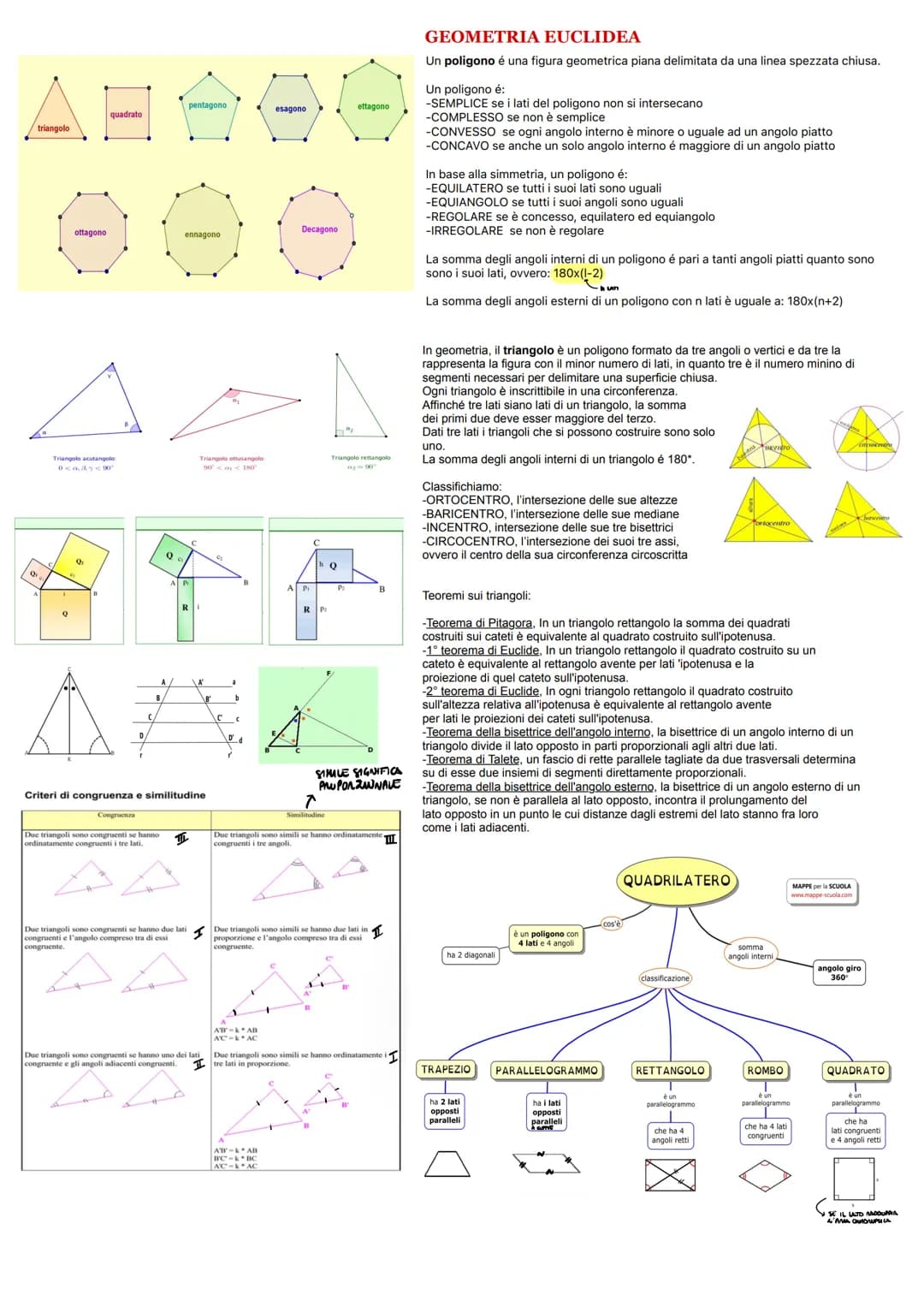
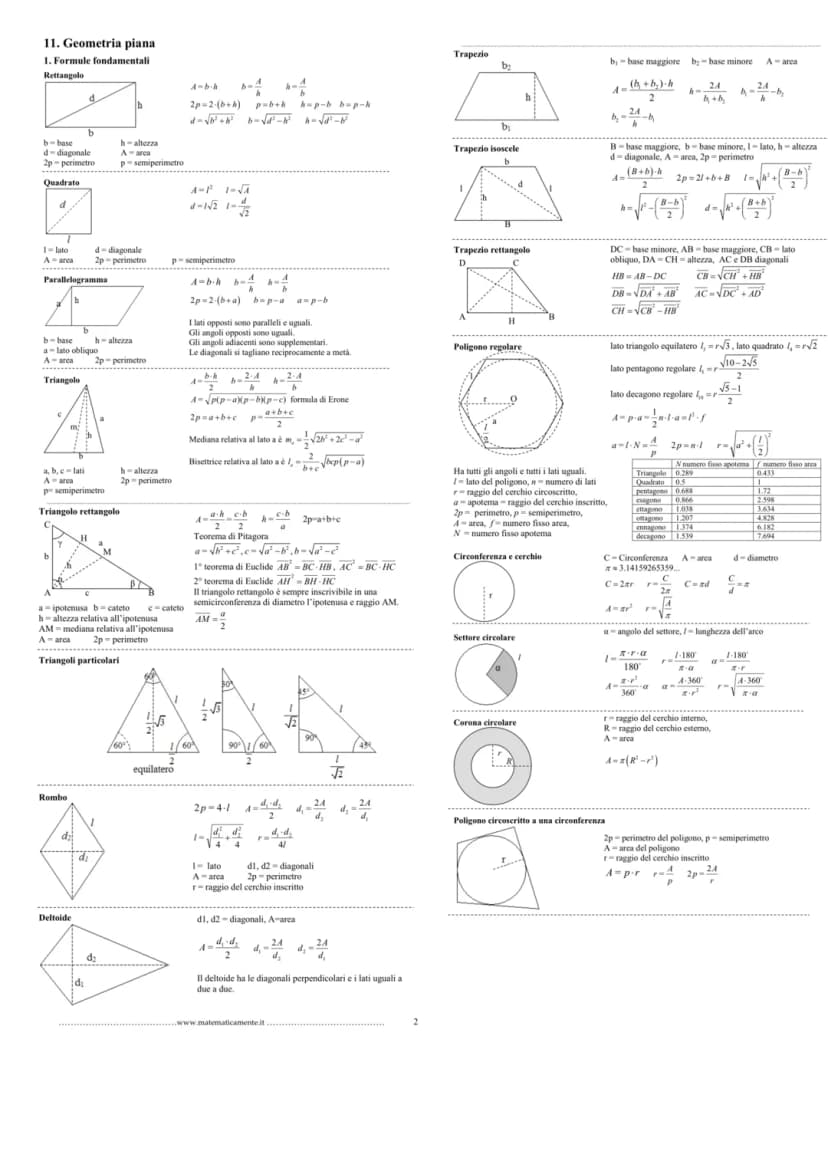
Formule fondamentali della geometria piana
Questa pagina presenta le formule fondamentali per calcolare perimetri e aree delle principali figure piane della geometria euclidea.
Per ogni figura vengono fornite:
- Le formule per il calcolo del perimetro
- Le formule per il calcolo dell'area
- Le relazioni tra i vari elementi (lati, diagonali, altezze)
Le figure trattate sono:
- Rettangolo
- Quadrato
- Parallelogramma
- Triangolo (generico e rettangolo)
- Rombo
- Deltoide
Esempio: Per il rettangolo, l'area A si calcola con la formula A = b × h, dove b è la base e h l'altezza.
Particolare attenzione viene data al triangolo, di cui vengono fornite numerose formule, tra cui:
- La formula di Erone per l'area
- Le formule per calcolare mediane e bisettrici
Highlight: Per il triangolo rettangolo vengono fornite formule specifiche legate al teorema di Pitagora.
Vengono inoltre presentate le proprietà fondamentali del parallelogramma:
- I lati opposti sono paralleli e uguali
- Gli angoli opposti sono uguali
- Le diagonali si tagliano reciprocamente a metà
Vocabolario: Il semiperimetro di un poligono è la metà del suo perimetro.
Queste formule sono essenziali per risolvere problemi di geometria piana e calcolare aree e perimetri di figure composte.
2
of 4
Page 2: Basic Geometric Formulas
This page presents fundamental formulas for various geometric shapes, with particular emphasis on triangles and quadrilaterals.
Example: For a rectangle:
- Area = base × height
- Perimeter = 2
- Diagonal = √
Highlight: The page includes Teoremi sui triangoli rettangoli including the Pythagorean theorem and Euclid's theorems.
Definition: The Pythagorean theorem states that in a right triangle, a² = b² + c², where a is the hypotenuse and b, c are the other sides.
The page also covers special triangles and their properties, including equilateral and right triangles, with detailed formulas for areas, perimeters, and heights.
3
of 4
Page 3: Three-Dimensional Geometry Introduction
This page transitions into solid geometry, introducing polyhedra and curved surfaces.
Definition: Solids are portions of space bounded by closed surfaces, categorized as:
- Polyhedra: solids bounded by polygons
- Curved surface solids: solids bounded by at least one non-polygonal surface
Example: The octahedron has:
- 6 vertices
- 8 triangular faces
- 12 edges
Highlight: Euler's relation for polyhedra: V + F = S + 2
The page also introduces prisms and pyramids, defining their properties and classifications.
4
of 4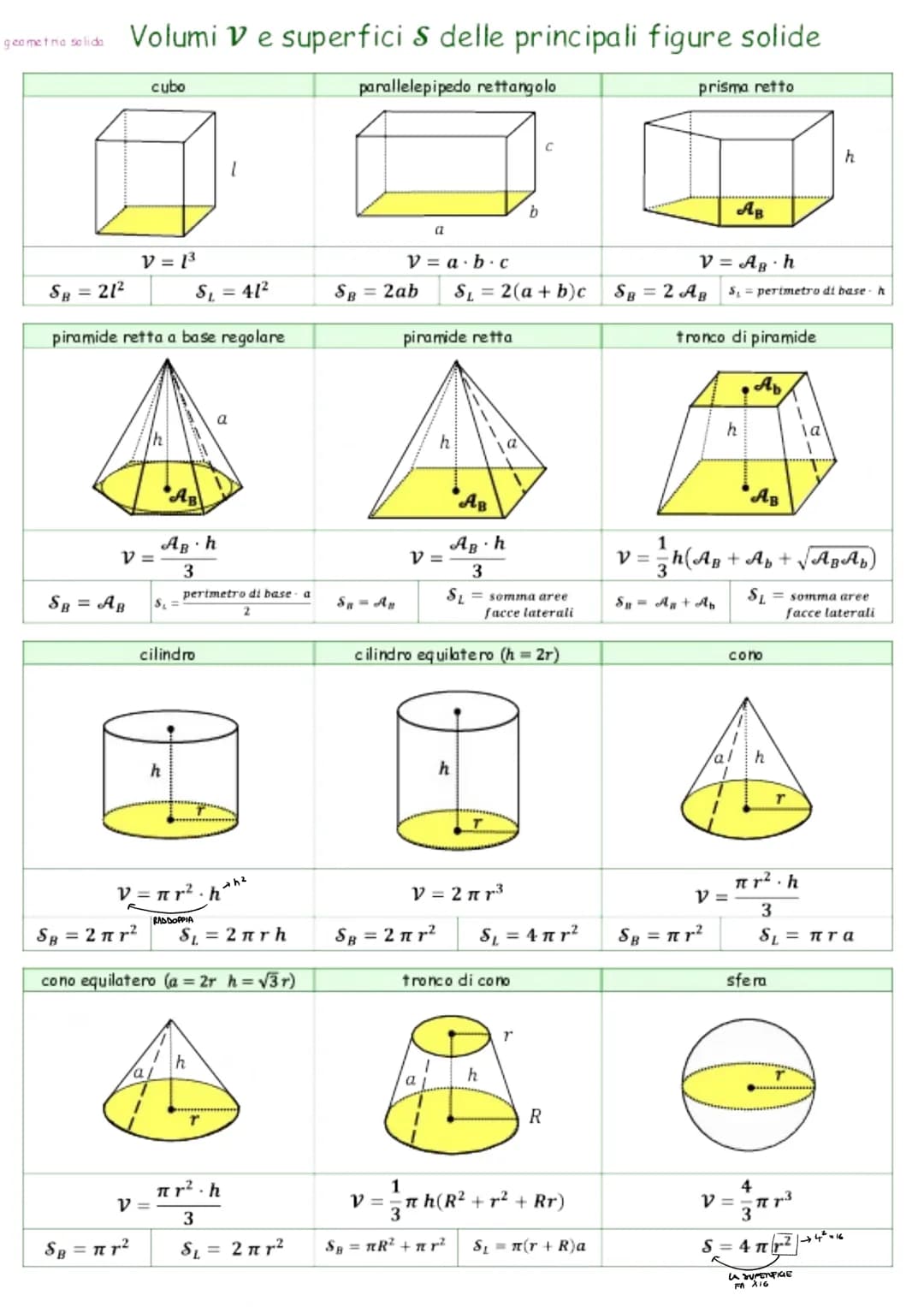
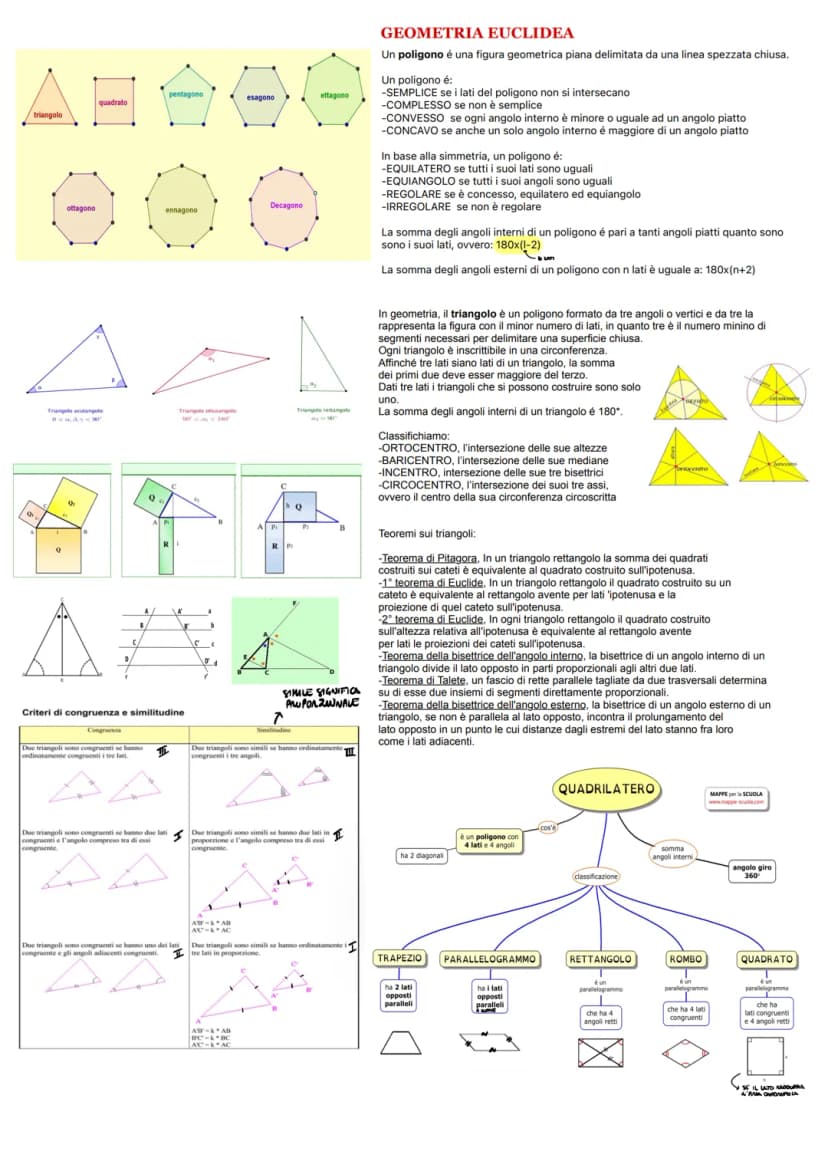
Poligoni e triangoli
La geometria euclidea si occupa dello studio delle figure piane e solide. Questa pagina introduce i concetti fondamentali relativi ai poligoni e ai triangoli.
Un poligono è una figura geometrica piana delimitata da una linea spezzata chiusa. I poligoni possono essere classificati in base a diversi criteri:
- Semplici o complessi
- Convessi o concavi
- Equilateri, equiangoli o regolari
Definizione: Un poligono è regolare se è contemporaneamente equilatero ed equiangolo.
La somma degli angoli interni di un poligono con n lati è data dalla formula: 180° ×
Esempio: Per un ottagono (8 lati), la somma degli angoli interni è: 180° × (8-2) = 1080°
Il triangolo è il poligono con il minor numero di lati (3). Vengono presentate le principali proprietà dei triangoli:
- Sono sempre inscrivibili in una circonferenza
- La somma dei loro angoli interni è sempre 180°
- Hanno punti notevoli come ortocentro, baricentro, incentro e circocentro
Highlight: I criteri di congruenza dei triangoli sono fondamentali per stabilire quando due triangoli sono uguali.
Vengono inoltre enunciati i principali teoremi sui triangoli:
- Teorema di Pitagora
- Primo e secondo teorema di Euclide
- Teorema della bisettrice
- Teorema di Talete
Vocabolario: L'ortocentro è il punto di intersezione delle altezze di un triangolo.
We thought you’d never ask...
What is the Knowunity AI companion?
Our AI companion is specifically built for the needs of students. Based on the millions of content pieces we have on the platform we can provide truly meaningful and relevant answers to students. But its not only about answers, the companion is even more about guiding students through their daily learning challenges, with personalised study plans, quizzes or content pieces in the chat and 100% personalisation based on the students skills and developments.
Where can I download the Knowunity app?
You can download the app in the Google Play Store and in the Apple App Store.
Is Knowunity really free of charge?
That's right! Enjoy free access to study content, connect with fellow students, and get instant help – all at your fingertips.
Similar Content
Most popular content: Geometria Euclidea
7MatematicaGeometria euclidea nello spazio
Appunti sulla geometria euclidea
4ªl1,42629
MatematicaGeometria Euclidea
Riassunto libro matematica multimediale.blu Zanichelli
1ªl1,11525
MatematicaGeometria Euclidea
Recup di geometria euclidea per qualsiasi anno
1ªl1,70130
MatematicaLa geometria del piano
Appunti sulla geometria del piano: la geometria euclidea, postulati appartenenza, postulati d’ordine, figure fondamentali, segmenti
1ªl1,90032
Matematicageometria euclidea
appunti sulla geometria euclidea
1ªl61811
MatematicaPiano Euclideo - concetti primitivi, assiomi, figure geometriche
Geometria, piano euclideo, concetti primitivi, retta, piano, punto, assiomi, figure geometriche, segmento, angolo, semiretta, semipiano, schema / mappa concettuale / riassunto matematica e geometria
1ªm1,50772
MatematicaFormulario di matematica 1 (equazioni di primo grado, geometria euclidea, statistica descritiva)
- le operazioni in N, Z, Q - calcolo letterale - equazioni di primo grado - geometria euclidea (nozioni di base) - triangoli - parallelismo e triangoli + statistica descrittiva
1ªl1,66215
Most popular content in Matematica
9E
MatematicaEquazioni
esercizi
2ªm3,35715
I
Matematicai criteri di divisibilità
i criteri di divisibilità
1ªm1,4962
F
MatematicaFondamenti del Teorema di Pitagora
Identifica ipotenusa e cateti e apprendi la formula fondamentale del Teorema di Pitagora nei triangoli rettangoli.
2ªm2,8370
MatematicaFormulario di mate
Spero possa esservi utile
3ªl5,242150
MatematicaMatematica per la maturità
Appunti di tutti e cinque gli anni di matematica in vista della maturità (potrebbero mancare alcune cose).
3ªl2,39676
MatematicaDerivate
Appunti di matematica sulle derivate
4ªl22,639528
MatematicaPiano cartesiano e retta
Appunti
1ªl2,94762
MatematicaOperazioni e prodotti notevoli
Operazioni con polinomi e prodotti notevoli
1ªm4,84980
MatematicaFormulario di matematica maturità 2024
Tutte le formule per la prova d'esame di matematica della maturità
5ªl6,824175
Most popular content
9 Italiano
Riassunto patente B
Riassunto patente B - appunti presi a lezione
5ªl29,228943
 Altro
AltroTeoria patente b
Tutti gli argomenti per la patente
1ªl21,114685
 Ed. civ.
Teoria patente di guida B: Segnali stradali
Segnali stradali di pericolo, luminosi, di prescrizione, di indicazione, temporanei, complementari, pannelli integrativi, segnaletica orizzontale, segnalazioni agenti del traffico, distanza di visibilità per l‘arresto, minima di sicurezza.
5ªl40,0421,645
 Filosofia
Aristotele
Aristotele: vita, metafisica, fisica, etica e politica, retorica e poetica
3ªl7,623216
ItalianoI promessi sposi
Riassunti completi di tutti i 38 capitoli dei Promessi sposi.
2ªl14,090314
AltroPATENTE
schemi per esame teorico della patente
Università22,067756
S
ItalianoSintesi finale di Analisi logica
Esercitazione completa di analisi logica su frasi articolate per consolidare la conoscenza di tutti i complementi.
3ªm5,5290
P
 Inglese
Present Simple vs Present Continuous
Develop the ability to choose correctly between the Present Simple for habits and the Present Continuous for ongoing actions.
3ªm4,2110
G
ItalianoGabriele D'Annunzio e l'Estetismo
Domande sull'ideale del superuomo, il panismo e la concezione dell'arte come valore assoluto in D'Annunzio.
4ªl2,6740
Can't find what you're looking for? Explore other subjects.
Students love us — and so will you.
4.6/5App Store
4.7/5Google Play
The app is very easy to use and well designed. I have found everything I was looking for so far and have been able to learn a lot from the presentations! I will definitely use the app for a class assignment! And of course it also helps a lot as an inspiration.
Stefan SiOS user
This app is really great. There are so many study notes and help [...]. My problem subject is French, for example, and the app has so many options for help. Thanks to this app, I have improved my French. I would recommend it to anyone.
Samantha KlichAndroid user
Wow, I am really amazed. I just tried the app because I've seen it advertised many times and was absolutely stunned. This app is THE HELP you want for school and above all, it offers so many things, such as workouts and fact sheets, which have been VERY helpful to me personally.
AnnaiOS user
Matematica1,829 views·Updated Jun 16, 2026·4 pagesDivertiamoci con i Triangoli e Poligoni: Criteri di Conguenza e Teoremi Semplici
Martina@martina5773
The triangles and polygons guide covers essential geometric concepts, focusing on Criteri di congruenza dei triangoli and polygon properties. This comprehensive resource details triangle congruence criteria, polygon classifications, and fundamental geometric formulas.
Key points:
- Covers triangle congruence and similarity criteria...
1
of 4
Sign up to see the content. It's free!
- Access to all documents
- Improve your grades
- Join milions of students
Formule fondamentali della geometria piana
Questa pagina presenta le formule fondamentali per calcolare perimetri e aree delle principali figure piane della geometria euclidea.
Per ogni figura vengono fornite:
- Le formule per il calcolo del perimetro
- Le formule per il calcolo dell'area
- Le relazioni tra i vari elementi (lati, diagonali, altezze)
Le figure trattate sono:
- Rettangolo
- Quadrato
- Parallelogramma
- Triangolo (generico e rettangolo)
- Rombo
- Deltoide
Esempio: Per il rettangolo, l'area A si calcola con la formula A = b × h, dove b è la base e h l'altezza.
Particolare attenzione viene data al triangolo, di cui vengono fornite numerose formule, tra cui:
- La formula di Erone per l'area
- Le formule per calcolare mediane e bisettrici
Highlight: Per il triangolo rettangolo vengono fornite formule specifiche legate al teorema di Pitagora.
Vengono inoltre presentate le proprietà fondamentali del parallelogramma:
- I lati opposti sono paralleli e uguali
- Gli angoli opposti sono uguali
- Le diagonali si tagliano reciprocamente a metà
Vocabolario: Il semiperimetro di un poligono è la metà del suo perimetro.
Queste formule sono essenziali per risolvere problemi di geometria piana e calcolare aree e perimetri di figure composte.
2
of 4Sign up to see the content. It's free!
- Access to all documents
- Improve your grades
- Join milions of students
Page 2: Basic Geometric Formulas
This page presents fundamental formulas for various geometric shapes, with particular emphasis on triangles and quadrilaterals.
Example: For a rectangle:
- Area = base × height
- Perimeter = 2
- Diagonal = √
Highlight: The page includes Teoremi sui triangoli rettangoli including the Pythagorean theorem and Euclid's theorems.
Definition: The Pythagorean theorem states that in a right triangle, a² = b² + c², where a is the hypotenuse and b, c are the other sides.
The page also covers special triangles and their properties, including equilateral and right triangles, with detailed formulas for areas, perimeters, and heights.
3
of 4Sign up to see the content. It's free!
- Access to all documents
- Improve your grades
- Join milions of students
Page 3: Three-Dimensional Geometry Introduction
This page transitions into solid geometry, introducing polyhedra and curved surfaces.
Definition: Solids are portions of space bounded by closed surfaces, categorized as:
- Polyhedra: solids bounded by polygons
- Curved surface solids: solids bounded by at least one non-polygonal surface
Example: The octahedron has:
- 6 vertices
- 8 triangular faces
- 12 edges
Highlight: Euler's relation for polyhedra: V + F = S + 2
The page also introduces prisms and pyramids, defining their properties and classifications.
4
of 4Sign up to see the content. It's free!
- Access to all documents
- Improve your grades
- Join milions of students
Poligoni e triangoli
La geometria euclidea si occupa dello studio delle figure piane e solide. Questa pagina introduce i concetti fondamentali relativi ai poligoni e ai triangoli.
Un poligono è una figura geometrica piana delimitata da una linea spezzata chiusa. I poligoni possono essere classificati in base a diversi criteri:
- Semplici o complessi
- Convessi o concavi
- Equilateri, equiangoli o regolari
Definizione: Un poligono è regolare se è contemporaneamente equilatero ed equiangolo.
La somma degli angoli interni di un poligono con n lati è data dalla formula: 180° ×
Esempio: Per un ottagono (8 lati), la somma degli angoli interni è: 180° × (8-2) = 1080°
Il triangolo è il poligono con il minor numero di lati (3). Vengono presentate le principali proprietà dei triangoli:
- Sono sempre inscrivibili in una circonferenza
- La somma dei loro angoli interni è sempre 180°
- Hanno punti notevoli come ortocentro, baricentro, incentro e circocentro
Highlight: I criteri di congruenza dei triangoli sono fondamentali per stabilire quando due triangoli sono uguali.
Vengono inoltre enunciati i principali teoremi sui triangoli:
- Teorema di Pitagora
- Primo e secondo teorema di Euclide
- Teorema della bisettrice
- Teorema di Talete
Vocabolario: L'ortocentro è il punto di intersezione delle altezze di un triangolo.
We thought you’d never ask...
What is the Knowunity AI companion?
Our AI companion is specifically built for the needs of students. Based on the millions of content pieces we have on the platform we can provide truly meaningful and relevant answers to students. But its not only about answers, the companion is even more about guiding students through their daily learning challenges, with personalised study plans, quizzes or content pieces in the chat and 100% personalisation based on the students skills and developments.
Where can I download the Knowunity app?
You can download the app in the Google Play Store and in the Apple App Store.
Is Knowunity really free of charge?
That's right! Enjoy free access to study content, connect with fellow students, and get instant help – all at your fingertips.
Similar Content
Most popular content: Geometria Euclidea
7MatematicaGeometria euclidea nello spazio
Appunti sulla geometria euclidea
4ªl1,42629
MatematicaGeometria Euclidea
Riassunto libro matematica multimediale.blu Zanichelli
1ªl1,11525
MatematicaGeometria Euclidea
Recup di geometria euclidea per qualsiasi anno
1ªl1,70130
MatematicaLa geometria del piano
Appunti sulla geometria del piano: la geometria euclidea, postulati appartenenza, postulati d’ordine, figure fondamentali, segmenti
1ªl1,90032
Matematicageometria euclidea
appunti sulla geometria euclidea
1ªl61811
MatematicaPiano Euclideo - concetti primitivi, assiomi, figure geometriche
Geometria, piano euclideo, concetti primitivi, retta, piano, punto, assiomi, figure geometriche, segmento, angolo, semiretta, semipiano, schema / mappa concettuale / riassunto matematica e geometria
1ªm1,50772
MatematicaFormulario di matematica 1 (equazioni di primo grado, geometria euclidea, statistica descritiva)
- le operazioni in N, Z, Q - calcolo letterale - equazioni di primo grado - geometria euclidea (nozioni di base) - triangoli - parallelismo e triangoli + statistica descrittiva
1ªl1,66215
Most popular content in Matematica
9E
MatematicaEquazioni
esercizi
2ªm3,35715
I
Matematicai criteri di divisibilità
i criteri di divisibilità
1ªm1,4962
F
MatematicaFondamenti del Teorema di Pitagora
Identifica ipotenusa e cateti e apprendi la formula fondamentale del Teorema di Pitagora nei triangoli rettangoli.
2ªm2,8370
MatematicaFormulario di mate
Spero possa esservi utile
3ªl5,242150
MatematicaMatematica per la maturità
Appunti di tutti e cinque gli anni di matematica in vista della maturità (potrebbero mancare alcune cose).
3ªl2,39676
MatematicaDerivate
Appunti di matematica sulle derivate
4ªl22,639528
MatematicaPiano cartesiano e retta
Appunti
1ªl2,94762
MatematicaOperazioni e prodotti notevoli
Operazioni con polinomi e prodotti notevoli
1ªm4,84980
MatematicaFormulario di matematica maturità 2024
Tutte le formule per la prova d'esame di matematica della maturità
5ªl6,824175
Most popular content
9ItalianoRiassunto patente B
Riassunto patente B - appunti presi a lezione
5ªl29,228943
AltroTeoria patente b
Tutti gli argomenti per la patente
1ªl21,114685
Ed. civ.Teoria patente di guida B: Segnali stradali
Segnali stradali di pericolo, luminosi, di prescrizione, di indicazione, temporanei, complementari, pannelli integrativi, segnaletica orizzontale, segnalazioni agenti del traffico, distanza di visibilità per l‘arresto, minima di sicurezza.
5ªl40,0421,645
FilosofiaAristotele
Aristotele: vita, metafisica, fisica, etica e politica, retorica e poetica
3ªl7,623216
ItalianoI promessi sposi
Riassunti completi di tutti i 38 capitoli dei Promessi sposi.
2ªl14,090314
AltroPATENTE
schemi per esame teorico della patente
Università22,067756
S
ItalianoSintesi finale di Analisi logica
Esercitazione completa di analisi logica su frasi articolate per consolidare la conoscenza di tutti i complementi.
3ªm5,5290
P
InglesePresent Simple vs Present Continuous
Develop the ability to choose correctly between the Present Simple for habits and the Present Continuous for ongoing actions.
3ªm4,2110
G
ItalianoGabriele D'Annunzio e l'Estetismo
Domande sull'ideale del superuomo, il panismo e la concezione dell'arte come valore assoluto in D'Annunzio.
4ªl2,6740
Can't find what you're looking for? Explore other subjects.
Students love us — and so will you.
4.6/5App Store
4.7/5Google Play
The app is very easy to use and well designed. I have found everything I was looking for so far and have been able to learn a lot from the presentations! I will definitely use the app for a class assignment! And of course it also helps a lot as an inspiration.
Stefan SiOS user
This app is really great. There are so many study notes and help [...]. My problem subject is French, for example, and the app has so many options for help. Thanks to this app, I have improved my French. I would recommend it to anyone.
Samantha KlichAndroid user
Wow, I am really amazed. I just tried the app because I've seen it advertised many times and was absolutely stunned. This app is THE HELP you want for school and above all, it offers so many things, such as workouts and fact sheets, which have been VERY helpful to me personally.
AnnaiOS user