
Le derivate sono uno strumento matematico fondamentale che ti permette...
 Matematica7,329 views·Updated Jun 26, 2026·46 pages
Introduzione al Calcolo Differenziale e Derivate

Matteo Benna@matteobenna_rues
1 / 10
1
of 10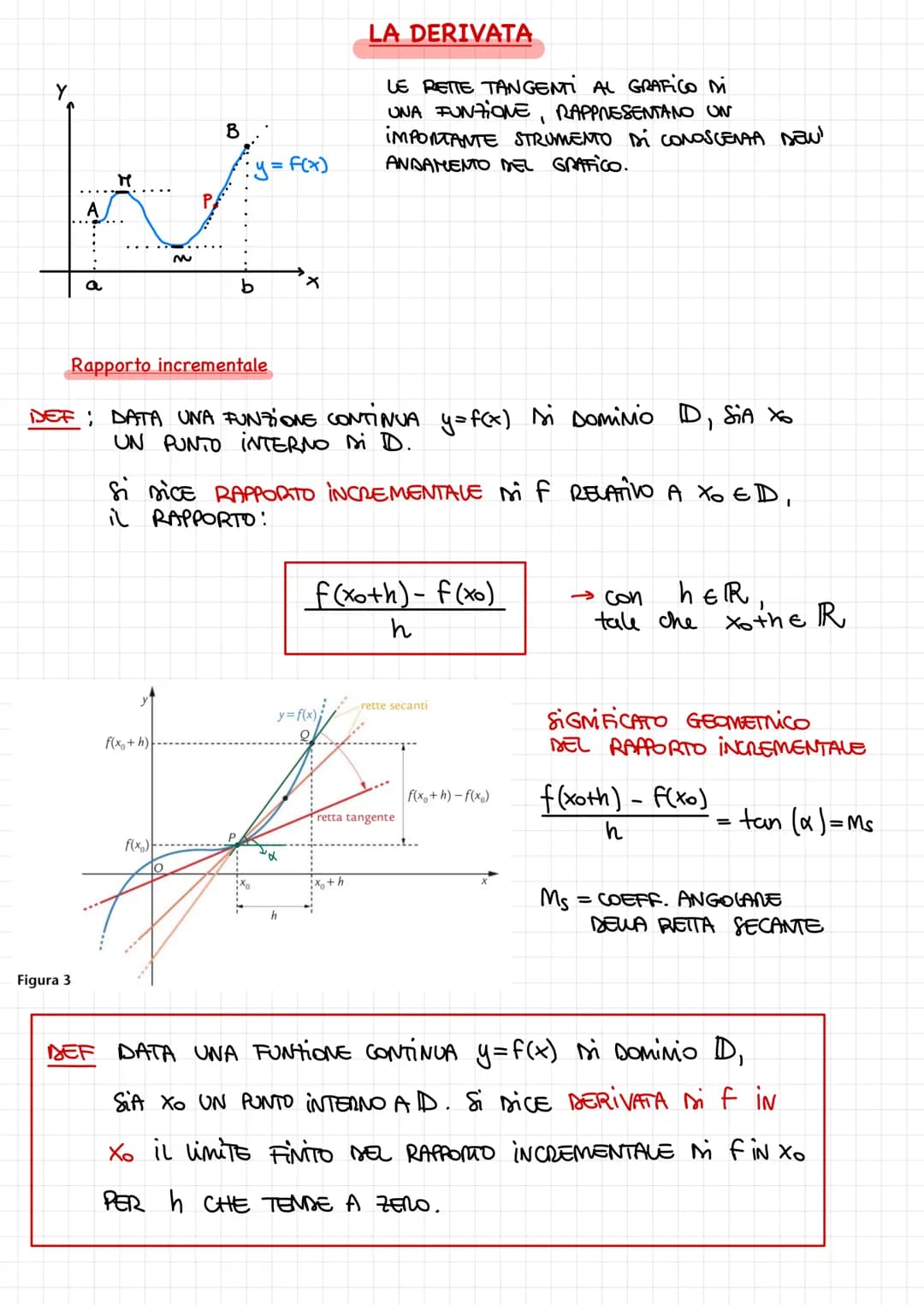
Il Rapporto Incrementale: Il Primo Passo
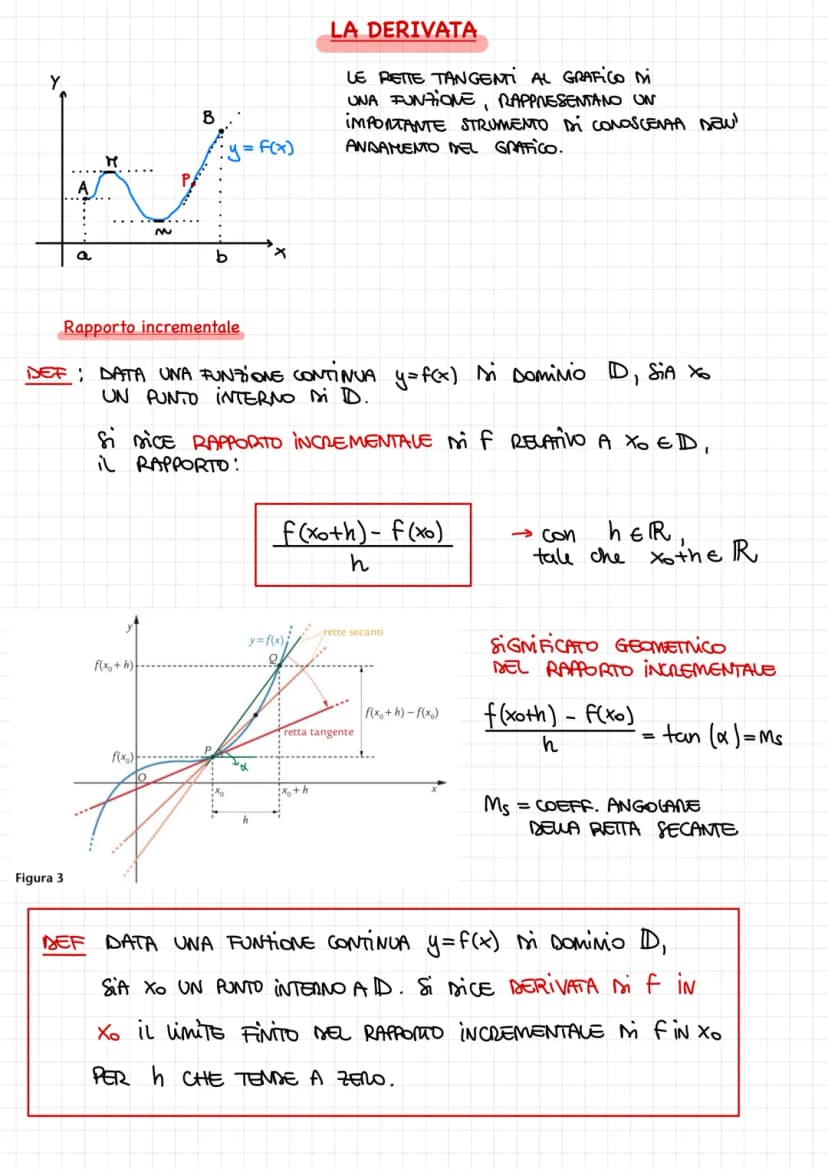
Il rapporto incrementale è la base di tutto il calcolo differenziale. Per una funzione continua y=f(x), questo rapporto si scrive come /h, dove h è un piccolo incremento.
Dal punto di vista geometrico, questo rapporto rappresenta il coefficiente angolare della retta secante che passa per due punti del grafico. È come misurare la pendenza di una rampa tra due punti vicini sulla curva.
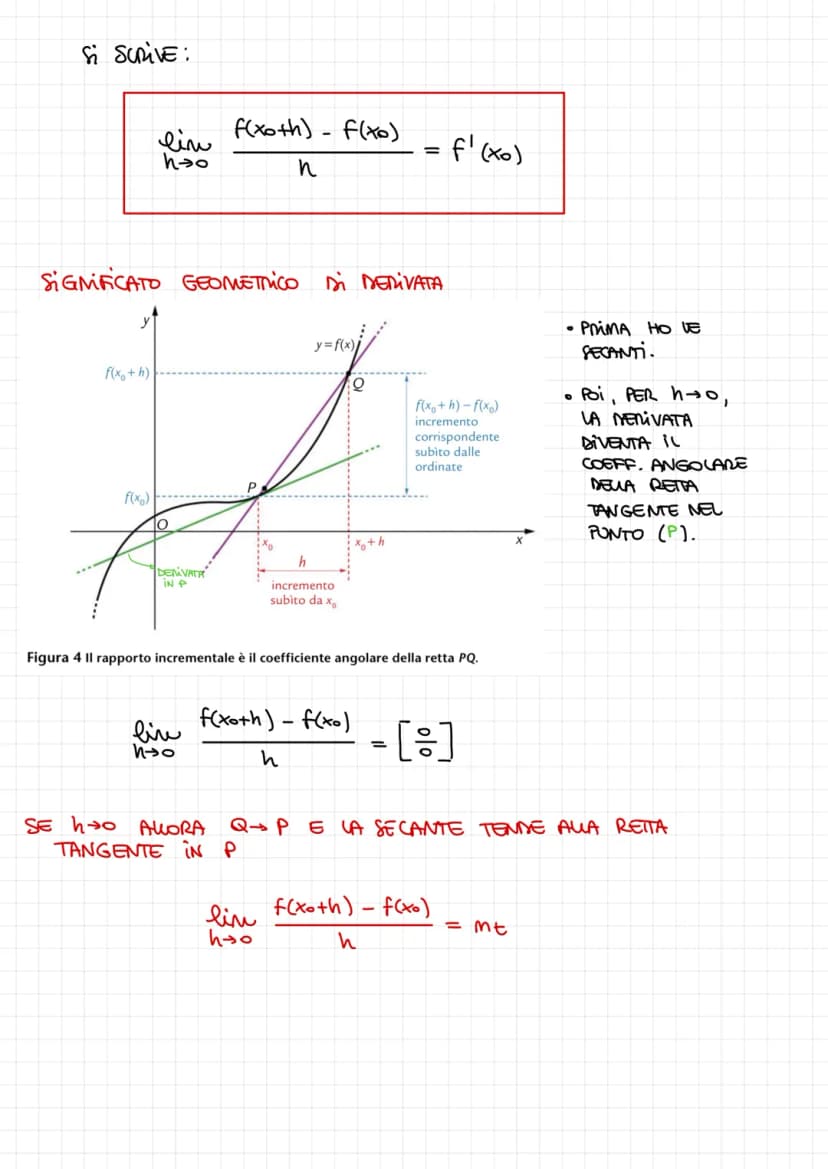
La derivata nasce quando facciamo tendere h a zero: lim(h→0) /h = f'(x₀). In questo modo la retta secante diventa la retta tangente nel punto.
📌 Ricorda: La derivata in un punto è il coefficiente angolare della retta tangente in quel punto!
2
of 10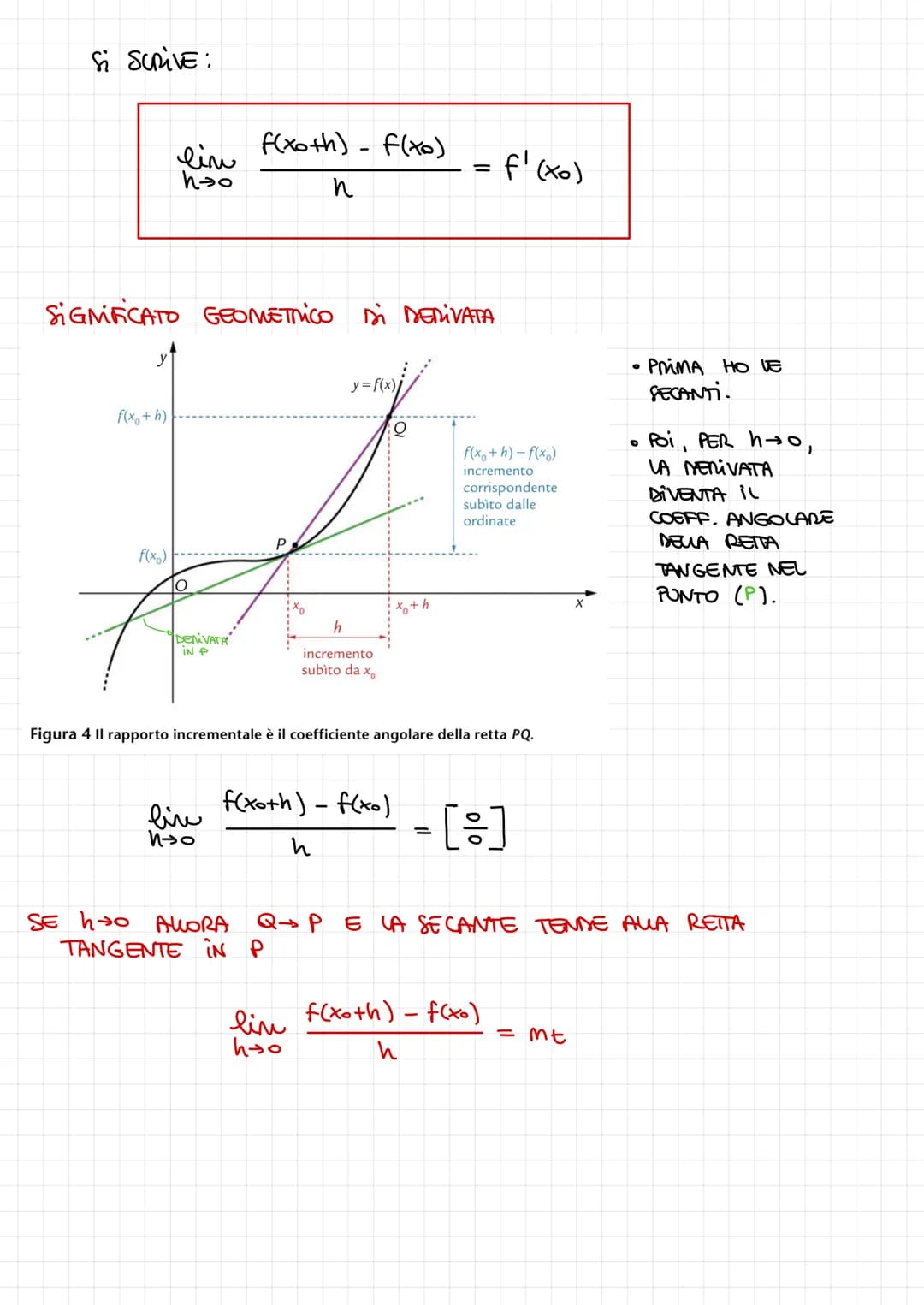
Dalla Secante alla Tangente
Quando h tende a zero, succede qualcosa di magico: la retta secante si trasforma nella retta tangente. Il punto Q si avvicina sempre di più al punto P, e la pendenza della secante diventa la pendenza della tangente.
La formula lim(h→0) /h = m_t ci dà il coefficiente angolare della retta tangente. Questo limite spesso porta alla forma indeterminata [0/0], che risolviamo con le tecniche dei limiti.
Il significato geometrico è chiaro: man mano che l'incremento h diventa sempre più piccolo, stiamo "zoomando" sul punto P fino a vedere solo la direzione della curva in quel punto preciso.
📌 Trucco: Visualizza sempre il processo: secante → tangente quando Q → P!
3
of 10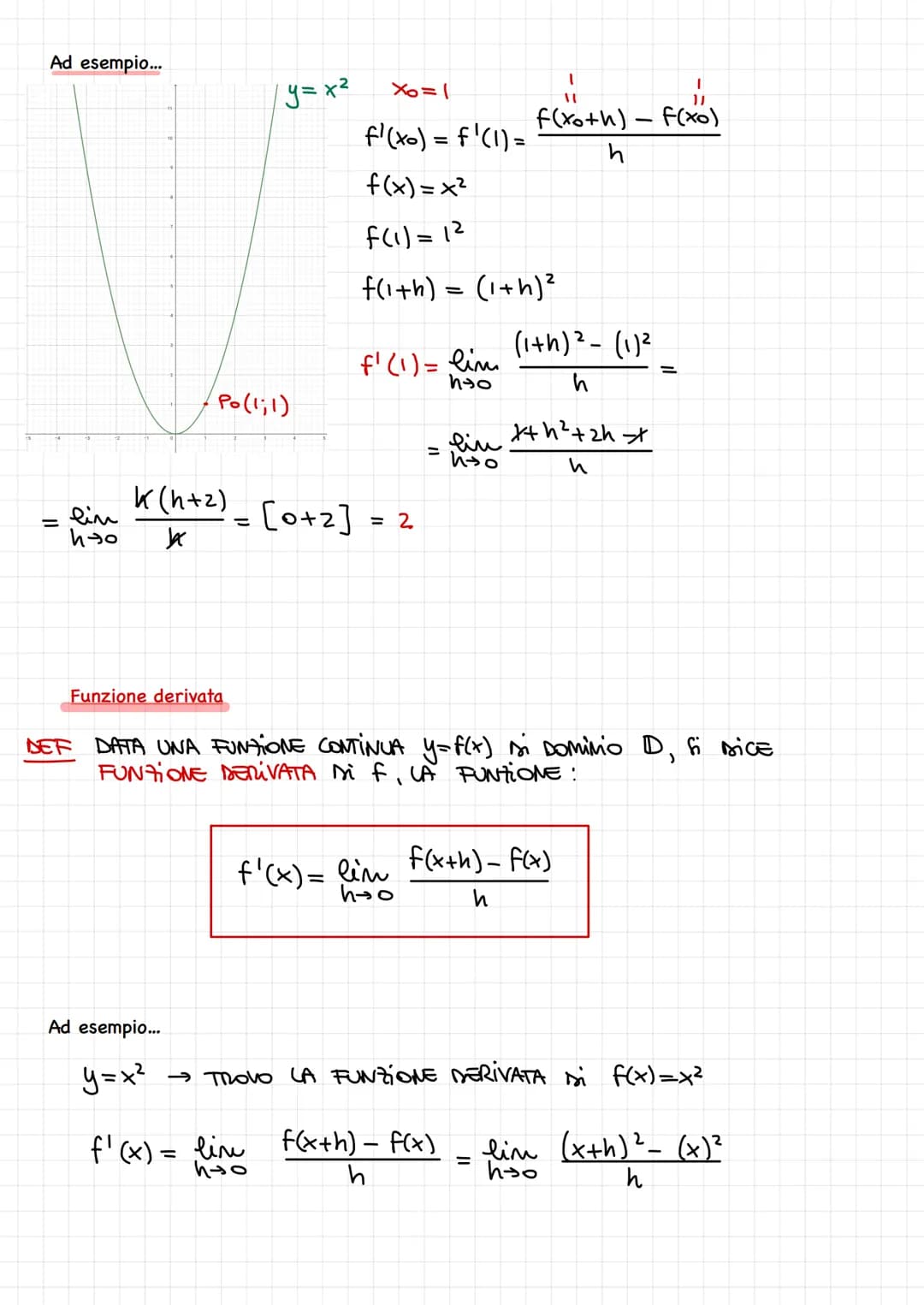
Calcolare le Derivate: Un Esempio Pratico
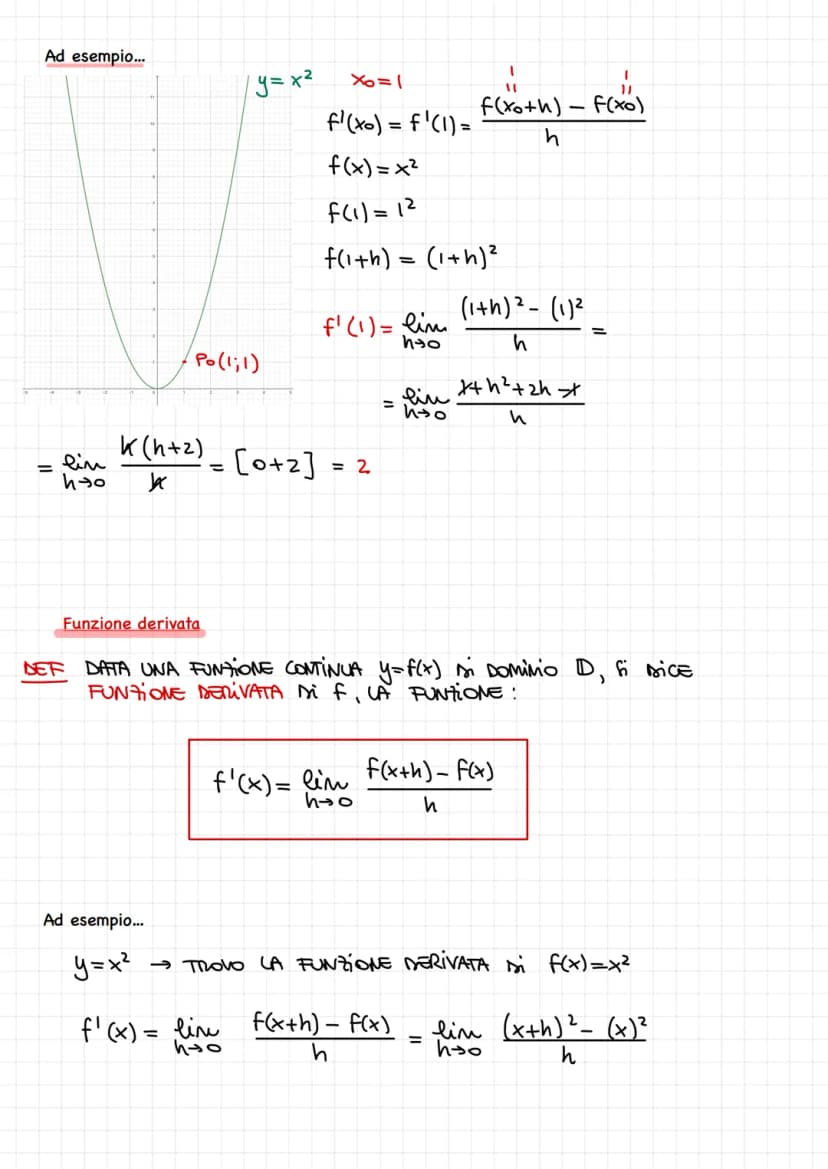
Prendiamo y = x² e calcoliamo f'(1). Applichiamo la definizione: f'(1) = lim(h→0) /h.
Sviluppando il calcolo: ² - 1 = 1 + 2h + h² - 1 = h² + 2h = h. Quindi otteniamo lim(h→0) h/h = lim(h→0) = 2.
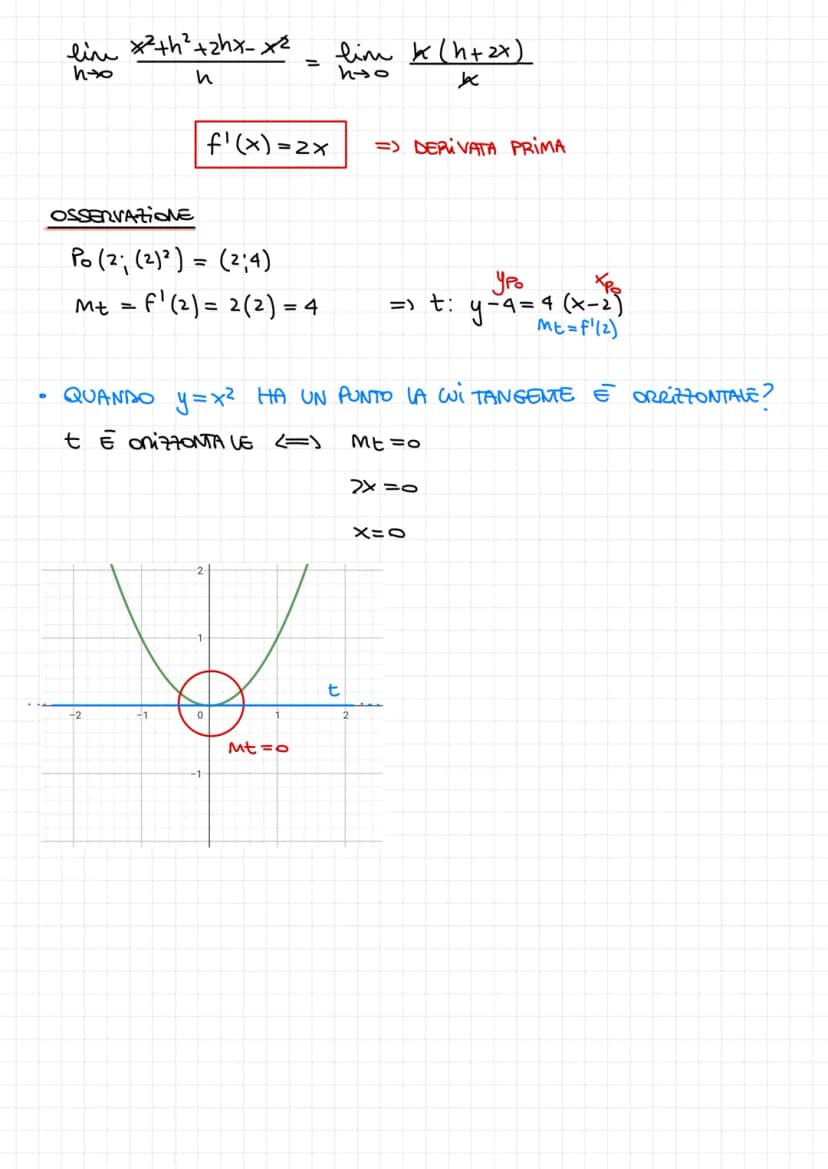
La funzione derivata generalizza questo processo: per f(x) = x², abbiamo f'(x) = lim(h→0) /h. Sviluppando otteniamo f'(x) = 2x, che ci dà la pendenza della tangente in qualsiasi punto.
📌 Applicazione: Nel punto (2,4), la tangente ha pendenza f'(2) = 4, quindi equazione y - 4 = 4!
4
of 10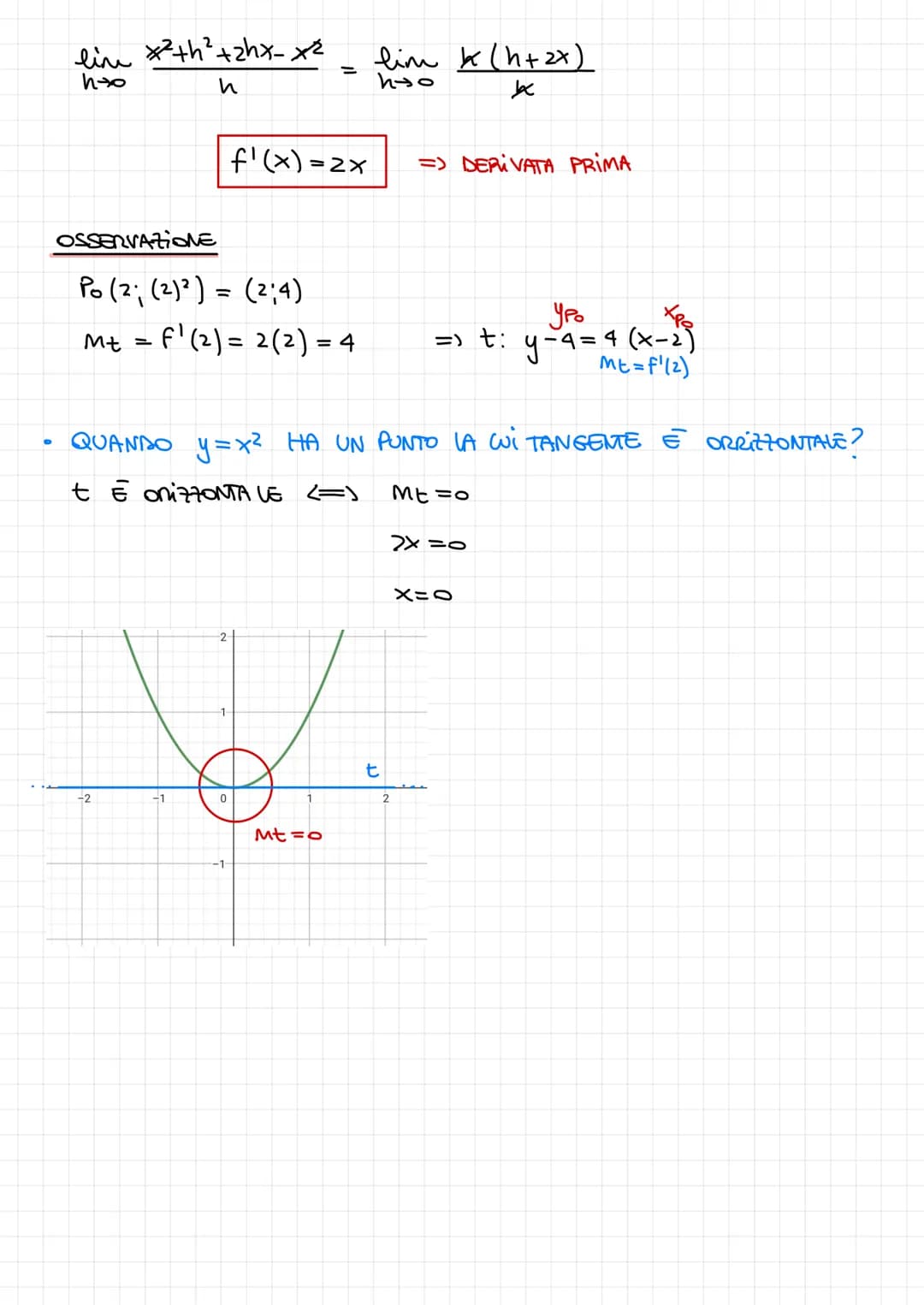
Quando la Tangente Diventa Orizzontale
Completando l'esempio precedente: lim(h→0) /h = lim(h→0) h/h = 2x. Quindi la derivata prima di x² è f'(x) = 2x.
Una domanda importante: quando la tangente è orizzontale? Succede quando m_t = 0, cioè quando f'(x) = 0. Per y = x², questo avviene quando 2x = 0, quindi x = 0.
Nel punto (0,0) la parabola y = x² ha tangente orizzontale. Questo è il punto di minimo della funzione, dove la curva "smette di scendere e inizia a salire".
📌 Insight: I punti dove f'(x) = 0 sono spesso massimi, minimi o punti di flesso!
5
of 10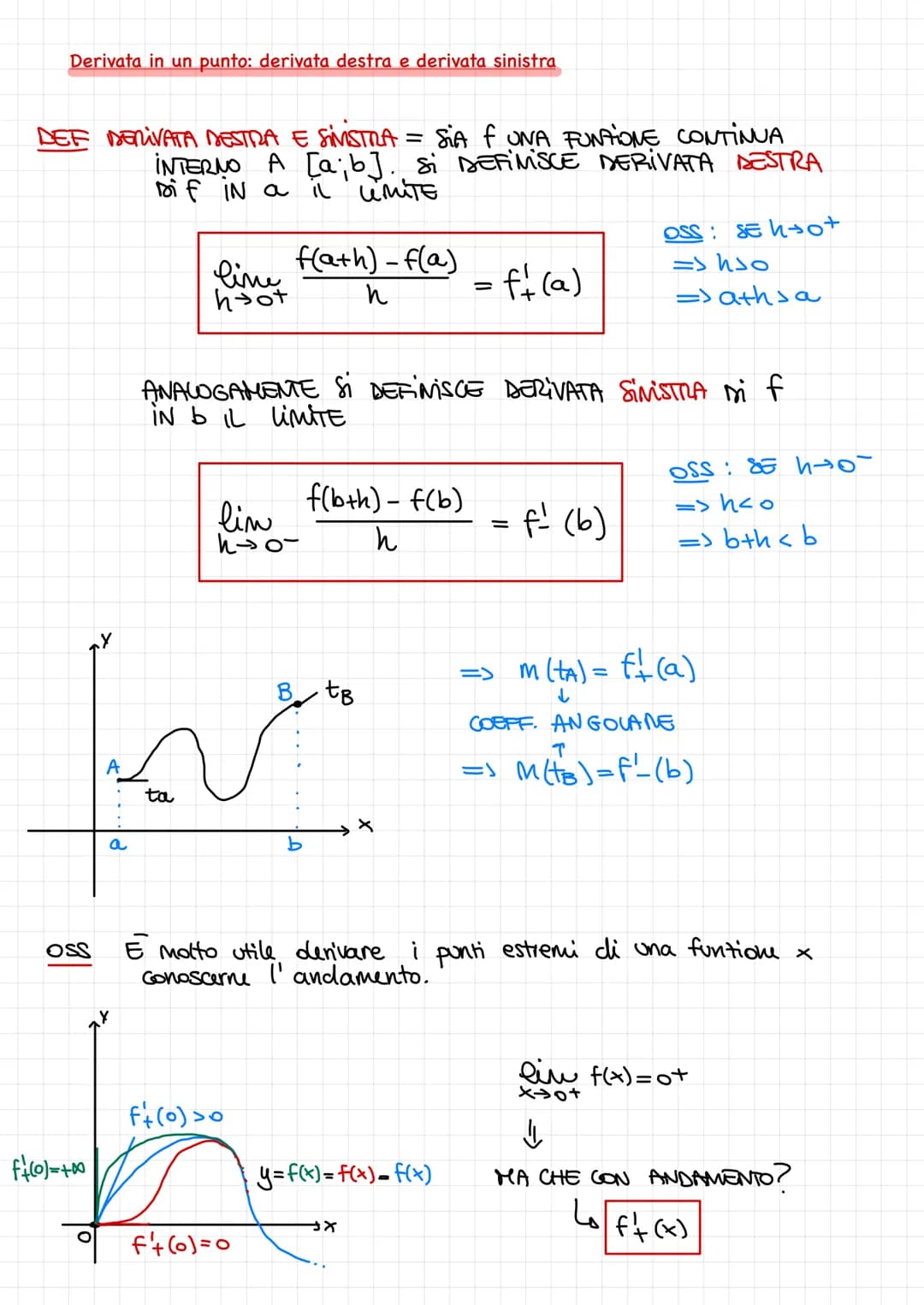
Derivate Destra e Sinistra negli Estremi
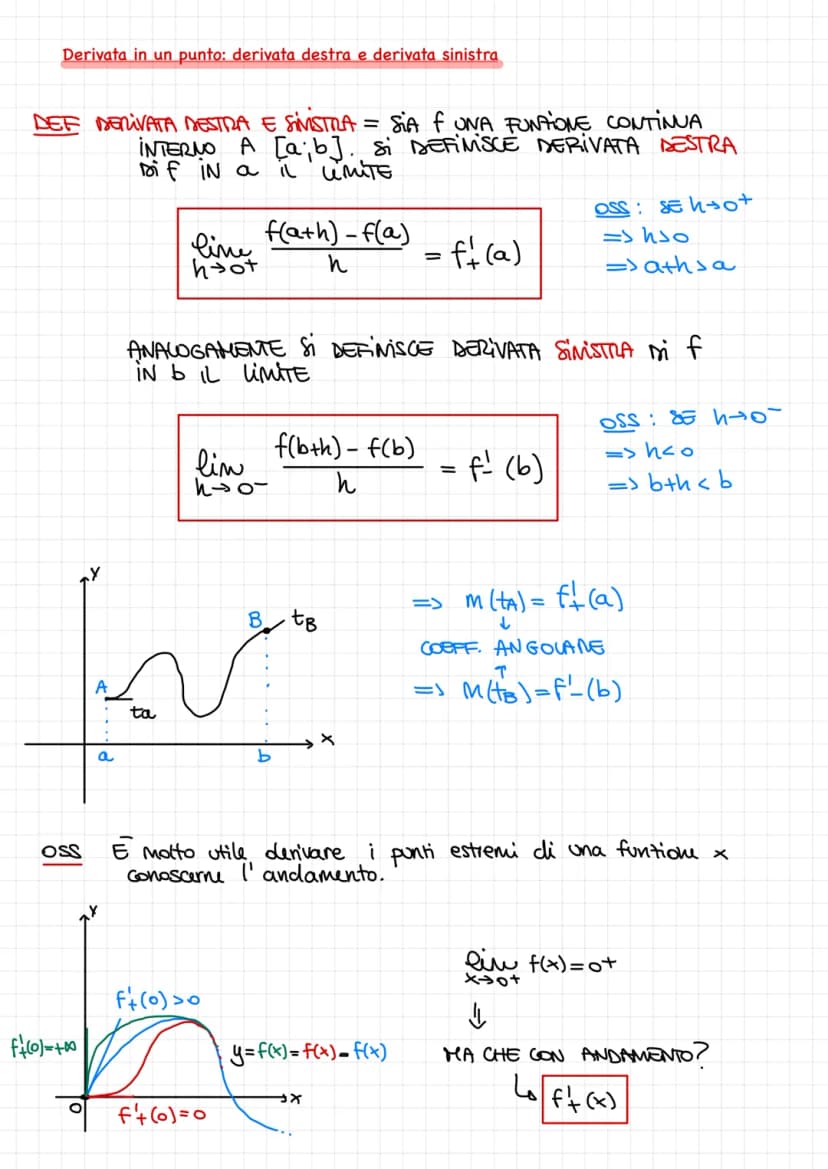
Quando hai una funzione definita su un intervallo [a,b], devi usare le derivate destra e sinistra negli estremi. La derivata destra in a è f⁺(a) = lim(h→0⁺) /h.
La derivata sinistra in b è f⁻(b) = lim(h→0⁻) /h. Nota che h > 0 per la derivata destra e h < 0 per quella sinistra.
Queste derivate ti dicono l'andamento della funzione agli estremi: se f⁺(x) > 0 la funzione è crescente da quel punto in poi, se f⁺(x) < 0 è decrescente.
📌 Utilità pratica: Le derivate destra e sinistra sono fondamentali per studiare l'andamento completo di una funzione!
6
of 10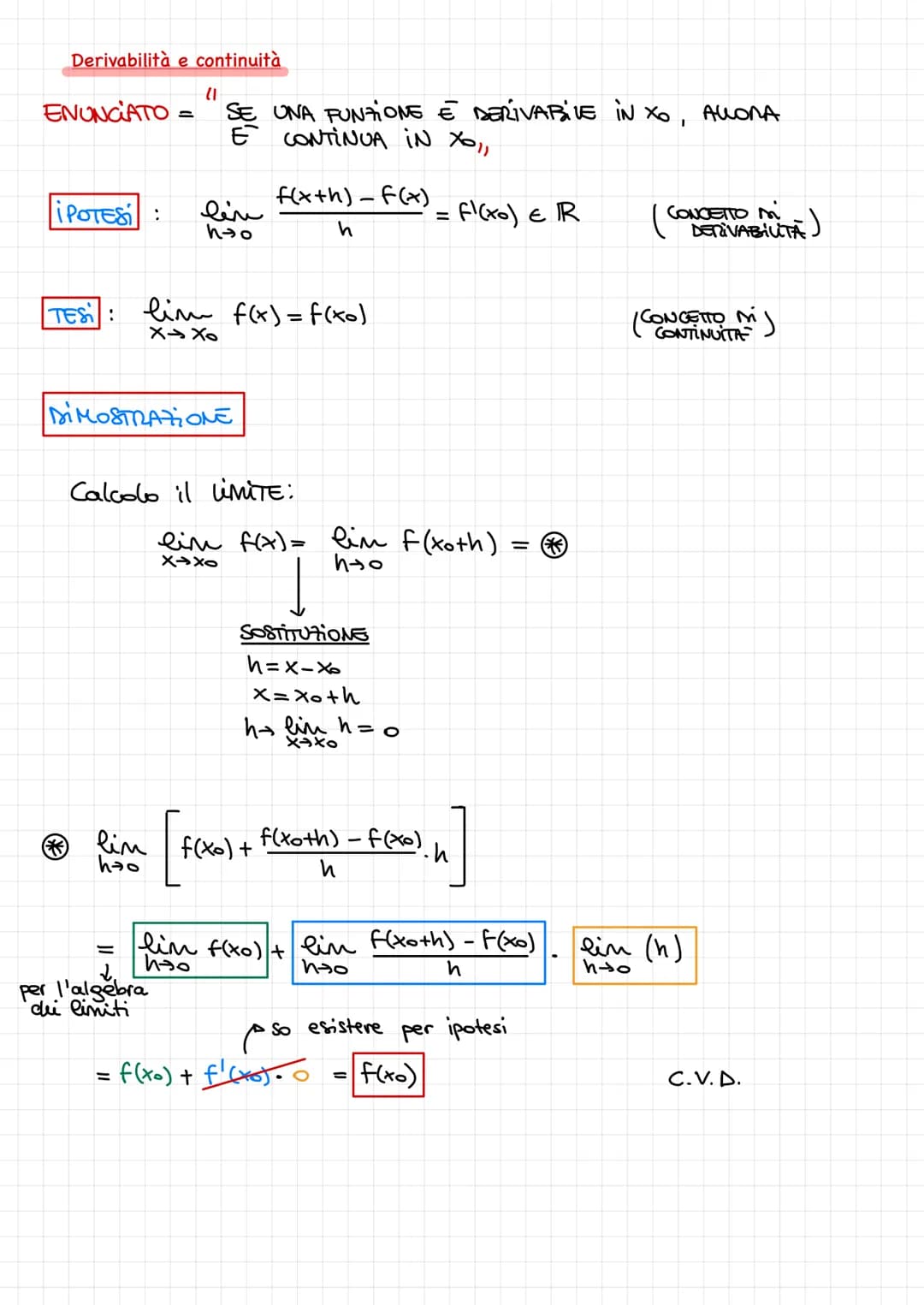
Il Legame tra Derivabilità e Continuità
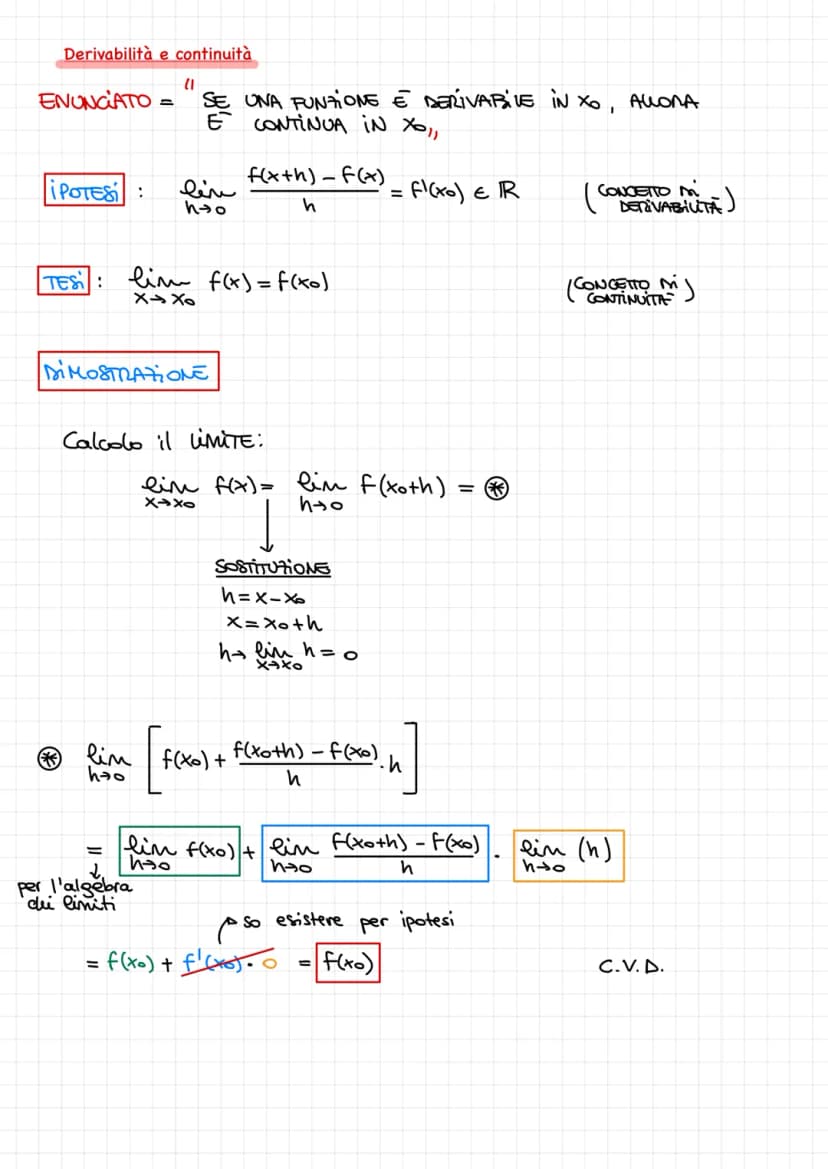
Ecco un teorema fondamentale: se una funzione è derivabile in x₀, allora è continua in x₀. È un'implicazione a senso unico: derivabilità ⇒ continuità, ma non viceversa.
La dimostrazione è elegante: partiamo da lim(x→x₀) f(x) e usiamo la sostituzione h = x - x₀. Riscriviamo f = f(x₀) + /h · h.
Applicando l'algebra dei limiti: lim(h→0) f(x₀) + lim(h→0) /h · lim(h→0) h = f(x₀) + f'(x₀) · 0 = f(x₀). Questo dimostra la continuità.
📌 Attenzione: Una funzione può essere continua ma non derivabile !
7
of 10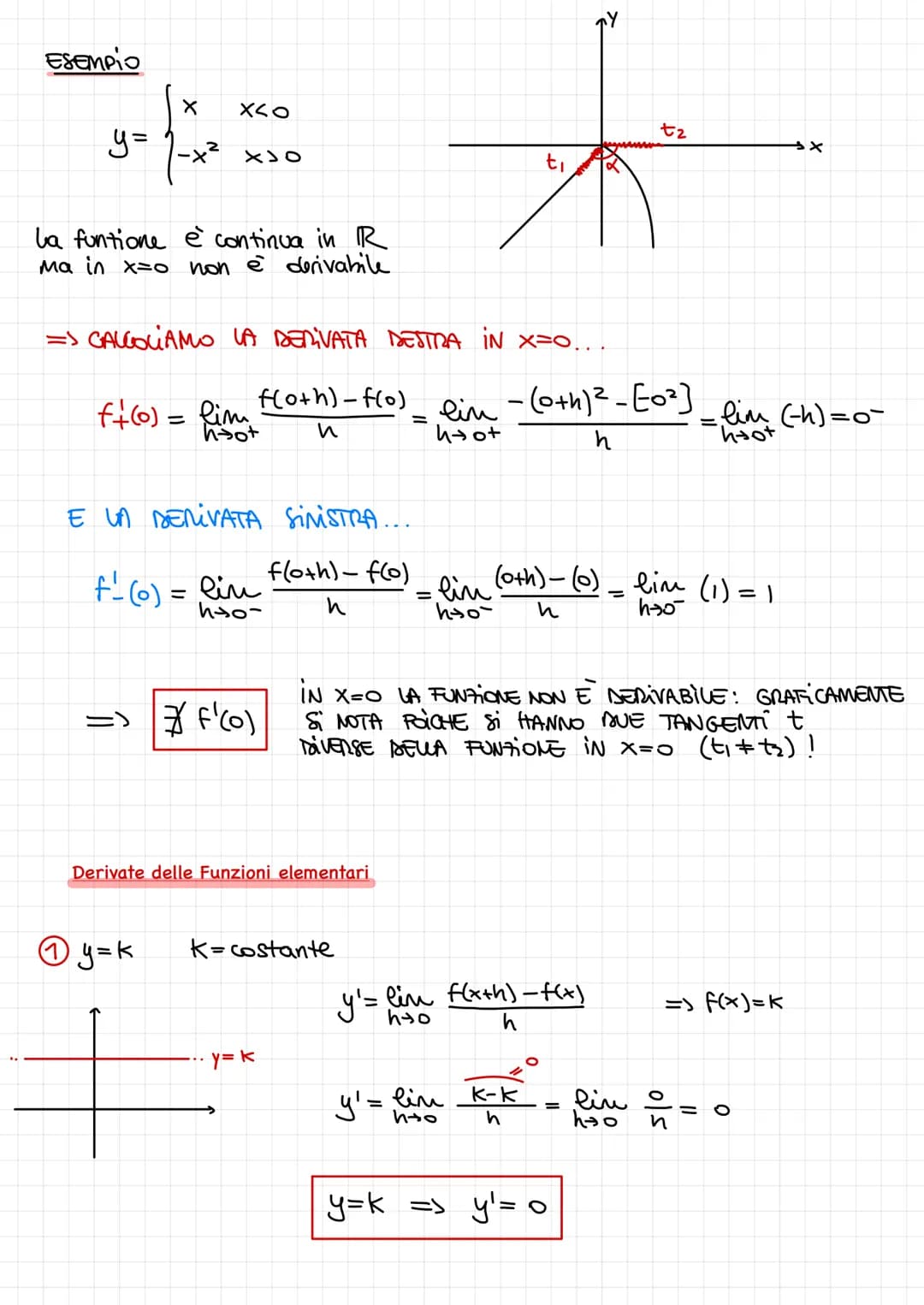
Quando la Derivabilità Viene Meno
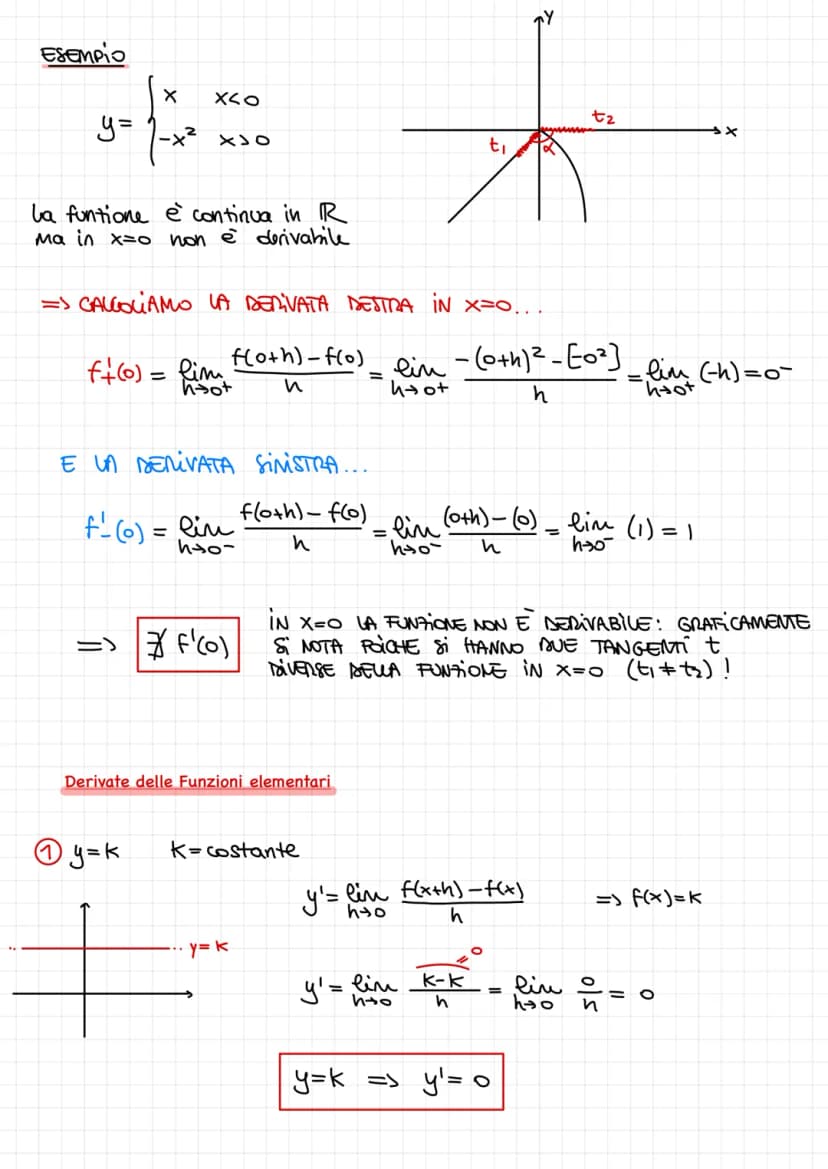
Considera la funzione y = {x se x ≥ 0; -x² se x < 0}. È continua ovunque, ma in x = 0 non è derivabile.
Calcoliamo le derivate destra e sinistra in x = 0. La derivata destra: f⁺(0) = lim(h→0⁺) /h = 1. La derivata sinistra: f⁻(0) = lim(h→0⁻) /h = lim(h→0⁻) = 0.
Poiché f⁺(0) ≠ f⁻(0), la funzione non è derivabile in x = 0. Graficamente vedi due tangenti diverse che si incontrano in quel punto.
Per le funzioni elementari, ricorda le derivate base: y = k ⇒ y' = 0 (le costanti hanno derivata nulla).
📌 Visualizza: I punti angolosi o con tangenti diverse indicano non derivabilità!
8
of 10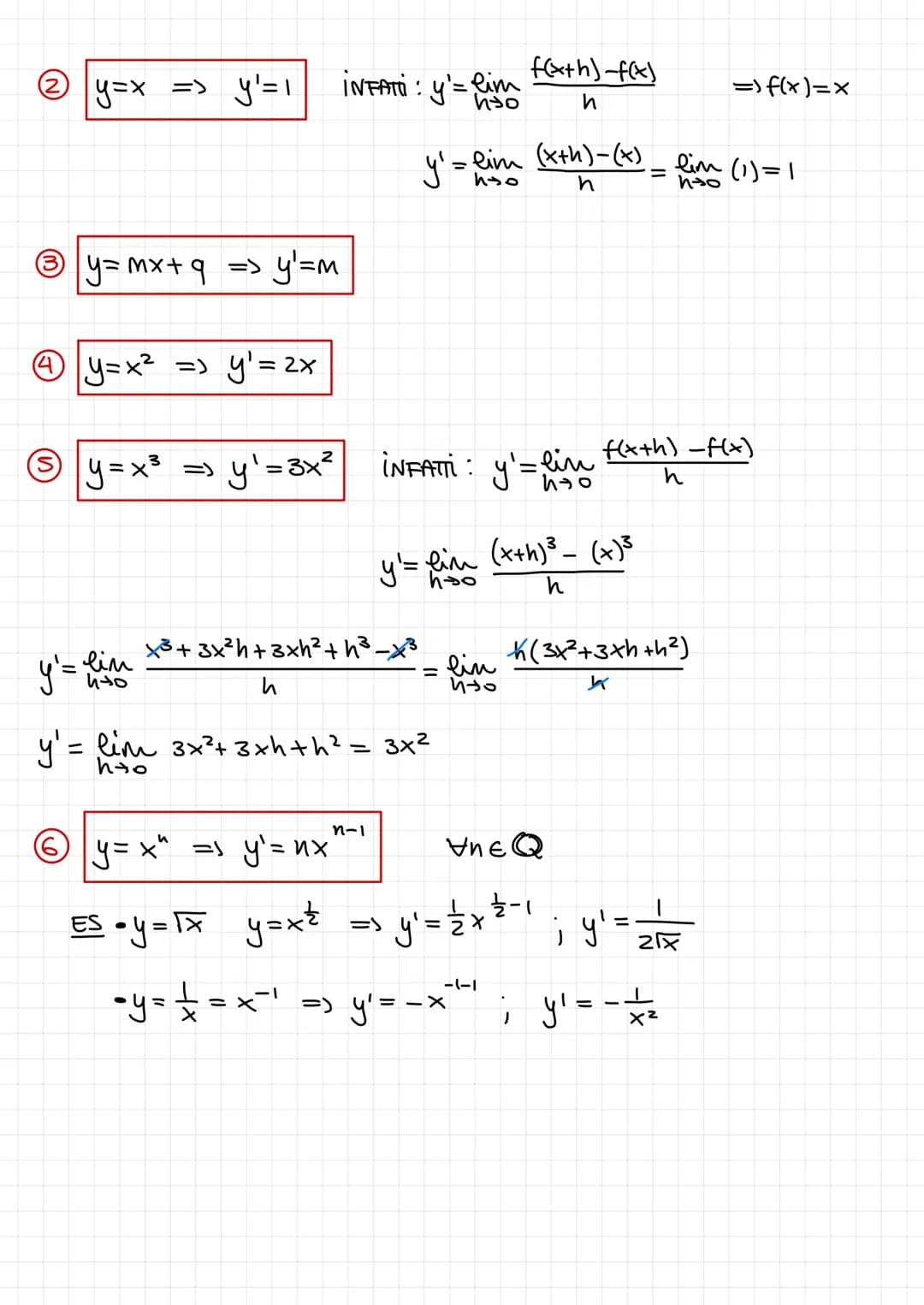
Le Derivate delle Funzioni di Base
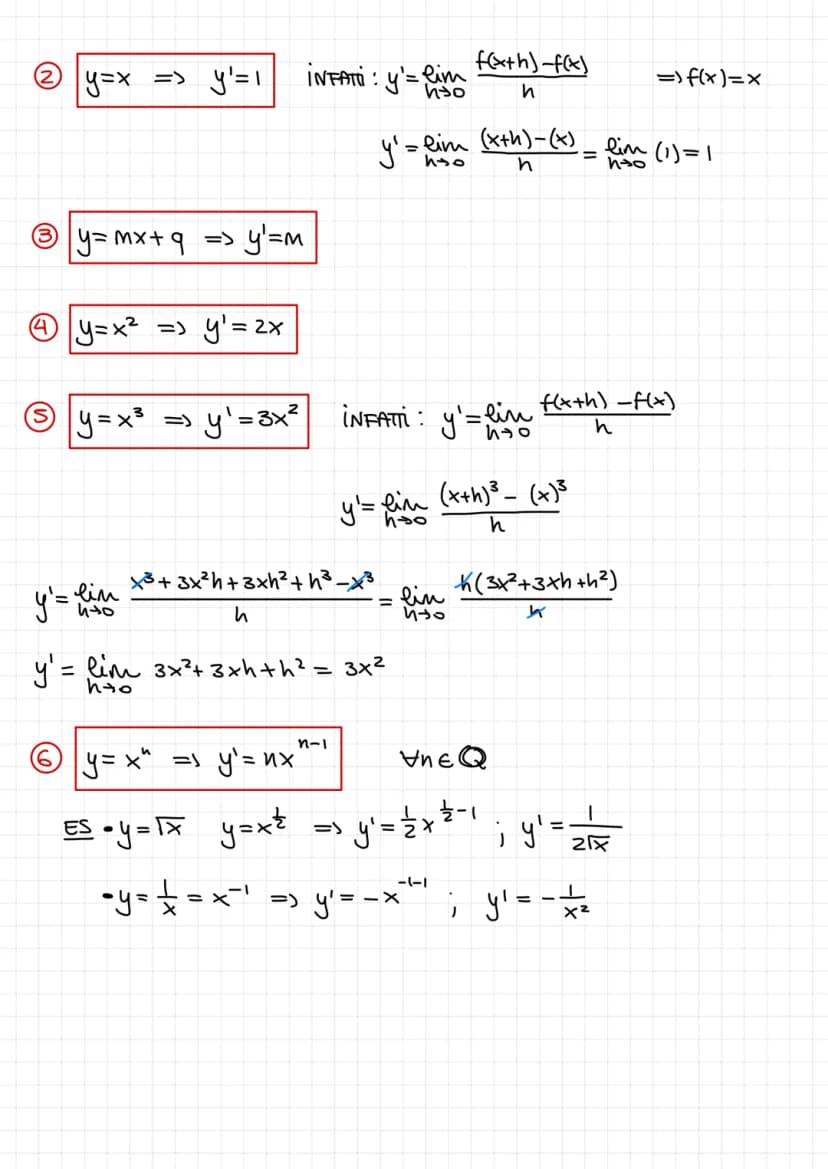
Le derivate delle funzioni elementari sono fondamentali da memorizzare. Iniziamo dalle più semplici: y = x ⇒ y' = 1 e y = mx + q ⇒ y' = m (la derivata di una retta è la sua pendenza).
Per le potenze: y = x² ⇒ y' = 2x, y = x³ ⇒ y' = 3x². La regola generale è y = xⁿ ⇒ y' = nxⁿ⁻¹ per qualsiasi n razionale.
Esempi utili: y = √x = x^(1/2) ⇒ y' = 1/(2√x) e y = 1/x = x⁻¹ ⇒ y' = -1/x². Queste formule ti risparmiano lunghi calcoli con i limiti.
📌 Memorizza: La regola y = xⁿ ⇒ y' = nxⁿ⁻¹ è la tua migliore amica nel calcolo delle derivate!
9
of 10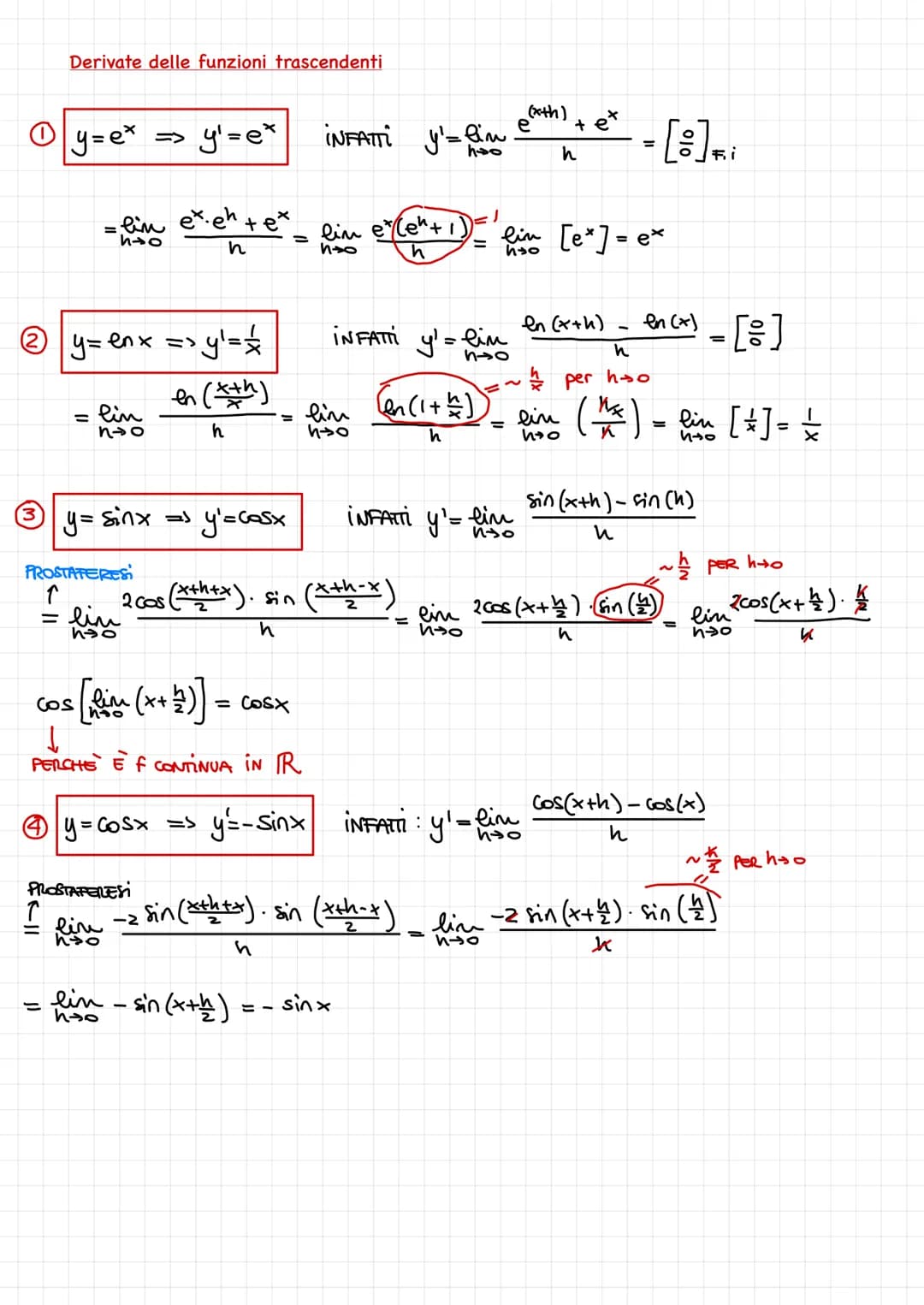
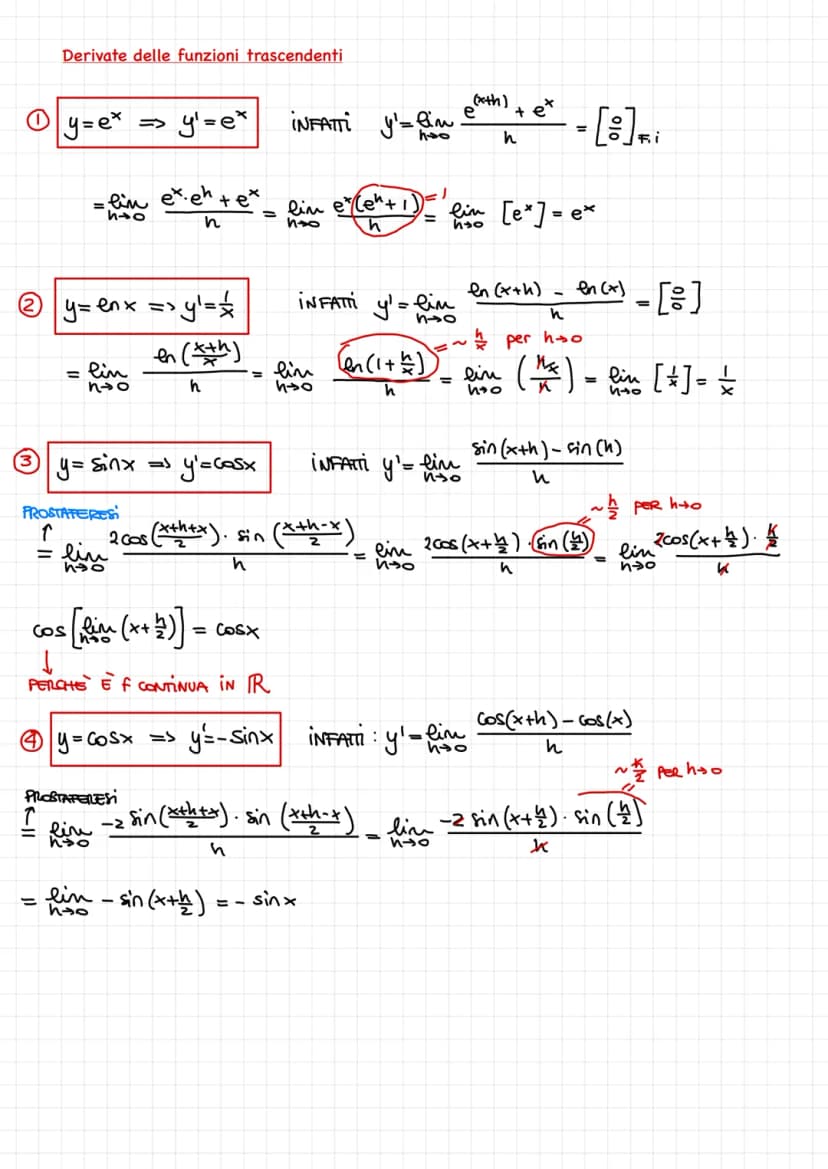
Le Funzioni Trascendenti e le Loro Derivate
Le funzioni trascendenti hanno derivate particolari che devi conoscere a memoria. La funzione esponenziale y = eˣ ha una proprietà unica: y' = eˣ (è uguale alla sua derivata).
Il logaritmo naturale: y = ln x ⇒ y' = 1/x. Questa derivata è definita solo per x > 0, coerentemente con il dominio del logaritmo.
Per le funzioni trigonometriche: y = sin x ⇒ y' = cos x e y = cos x ⇒ y' = -sin x. Nota il segno meno nella derivata del coseno.
La dimostrazione usa le formule di prostaferesi e il limite fondamentale lim(h→0) (sin h)/h = 1.
📌 Pattern: Le funzioni trigonometriche si "trasformano" ciclicamente attraverso la derivazione!
10
of 10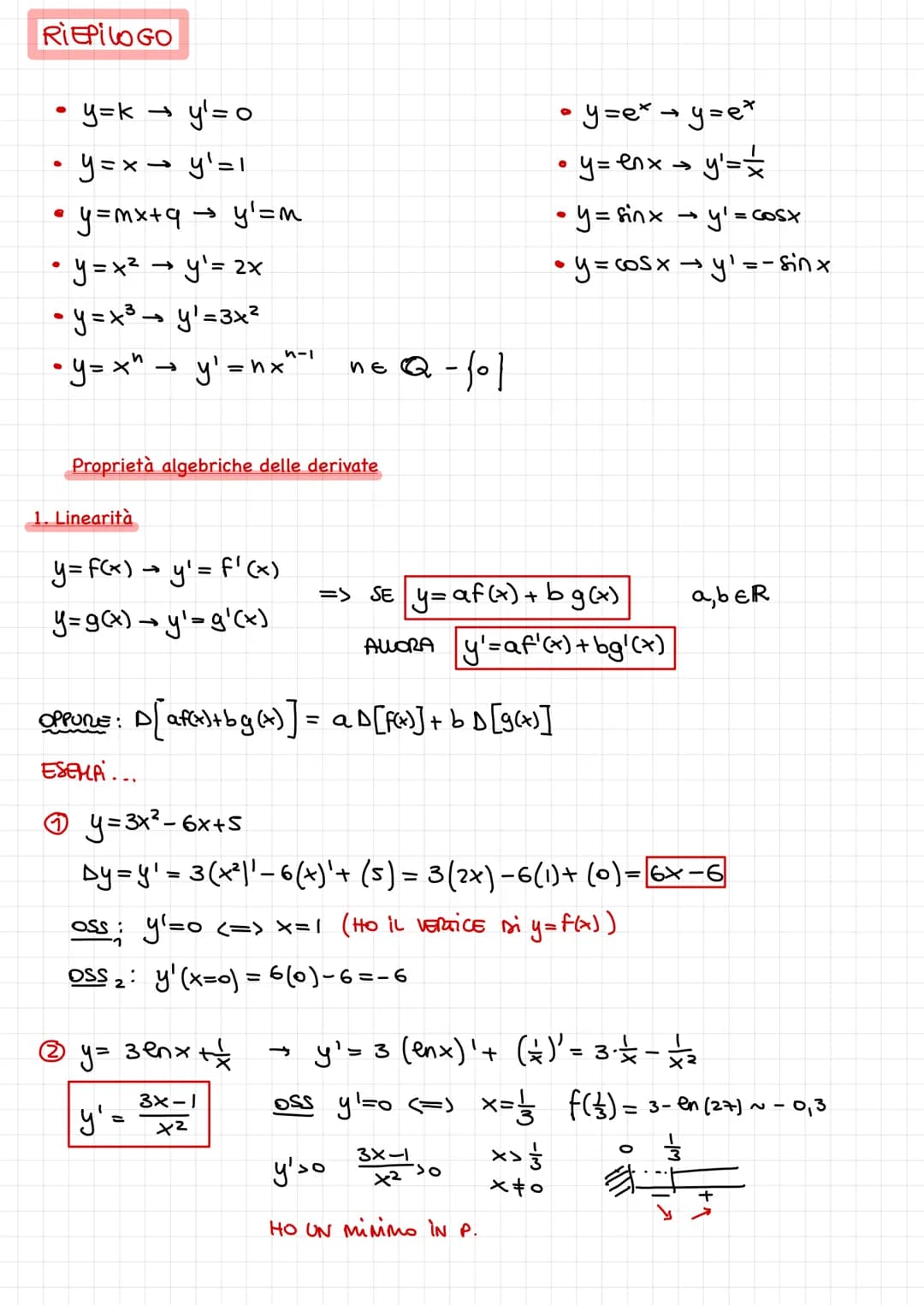
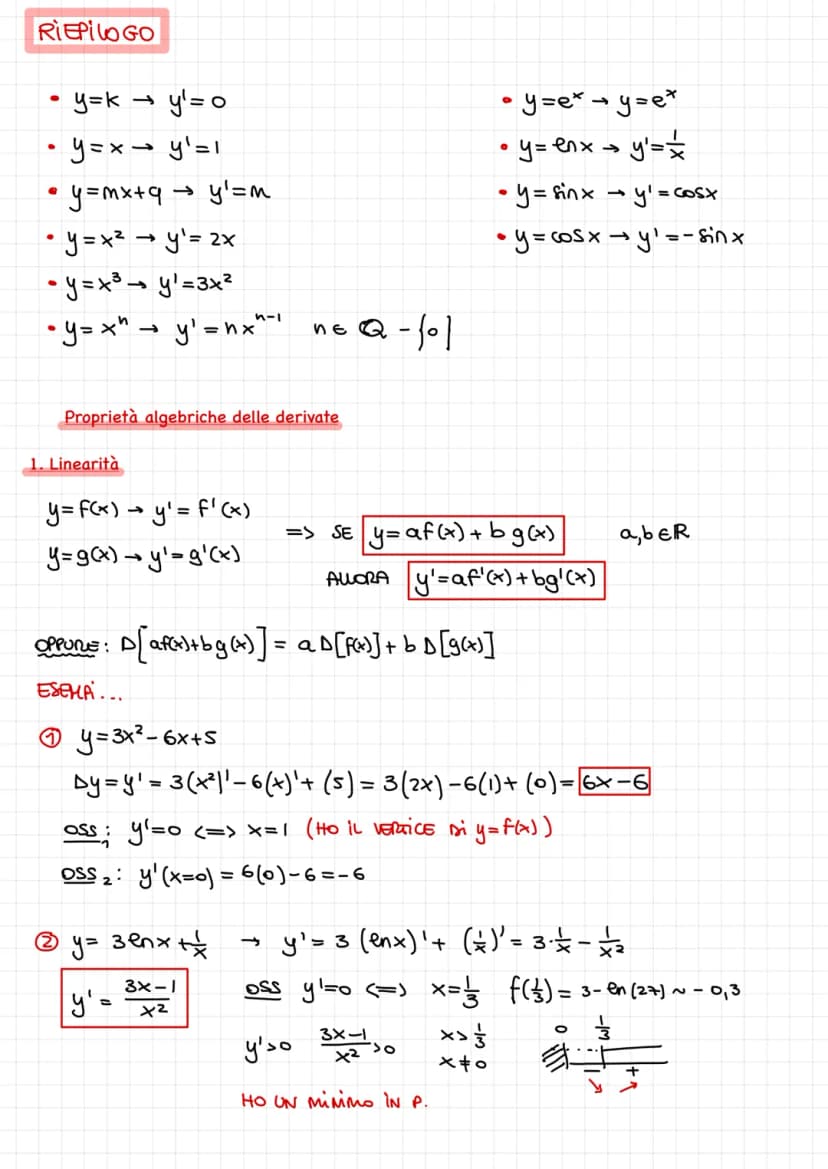
Proprietà Algebriche: La Linearità delle Derivate
La proprietà di linearità è fondamentale: D = aD[f(x)] + bD[g(x)]. Significa che puoi derivare termine per termine e moltiplicare per le costanti.
Esempio pratico: y = 3x² - 6x + 5 ⇒ y' = 3(2x) - 6(1) + 0 = 6x - 6. Per trovare dove la tangente è orizzontale: y' = 0 ⇒ x = 1.
Un esempio più complesso: y = 3ln x + /x² ⇒ y' = 3/x + derivata di /x². La derivata si annulla in x = 1/3, che corrisponde a un punto di minimo.
Ricorda il riepilogo completo: costanti → 0, x → 1, xⁿ → nxⁿ⁻¹, eˣ → eˣ, ln x → 1/x, sin x → cos x, cos x → -sin x.
📌 Strategia: Scomponi sempre funzioni complicate in parti più semplici usando la linearità!
We thought you’d never ask...
What is the Knowunity AI companion?
Our AI companion is specifically built for the needs of students. Based on the millions of content pieces we have on the platform we can provide truly meaningful and relevant answers to students. But its not only about answers, the companion is even more about guiding students through their daily learning challenges, with personalised study plans, quizzes or content pieces in the chat and 100% personalisation based on the students skills and developments.
Where can I download the Knowunity app?
You can download the app in the Google Play Store and in the Apple App Store.
Is Knowunity really free of charge?
That's right! Enjoy free access to study content, connect with fellow students, and get instant help – all at your fingertips.
Similar Content
 AP Calculus AB/BC
Most popular content: derivata
7MatematicaDerivate
Appunti di matematica sulle derivate
4ªl22,639528
MatematicaDerivate
Appunti, formule, dimostrazioni sulle derivate
5ªl27,8281,159
MatematicaDerivate di funzione
Derivate
4ªl3,26360
MatematicaDerivate
Derivate:Il Problema della Tangente,Derivata di Una Funzione, Derivata di Sinistra e di Destra, Significato Geometrico della Derivata, Punti Stazionari,di Non Derivabilità, Cuspidi,Flessi a Tangente Verticale, Punti Angolosi,ecc..
4ªl1,78440
MatematicaStudio di funzione
studio di una funzione fratta Dominio Segno intersezione assi limiti asintoti derivata prima e seconda
5ªl7,566276
MatematicaDerivata
Derivata: evoluzione storica (Newton e Libeniz), il concetto di derivata, derivate elementari, operazioni con le derivate, derivabilità, punti di non derivabilità, introduzione al differenziale
5ªl3,679149
MatematicaDerivate
Analisi 1
5ªl2,26751
Most popular content in Matematica
9E
MatematicaEquazioni
esercizi
2ªm3,35715
I
Matematicai criteri di divisibilità
i criteri di divisibilità
1ªm1,4962
F
MatematicaFondamenti del Teorema di Pitagora
Identifica ipotenusa e cateti e apprendi la formula fondamentale del Teorema di Pitagora nei triangoli rettangoli.
2ªm2,8370
MatematicaFormulario di mate
Spero possa esservi utile
3ªl5,242150
MatematicaMatematica per la maturità
Appunti di tutti e cinque gli anni di matematica in vista della maturità (potrebbero mancare alcune cose).
3ªl2,39676
MatematicaDerivate
Appunti di matematica sulle derivate
4ªl22,639528
MatematicaPiano cartesiano e retta
Appunti
1ªl2,94762
MatematicaOperazioni e prodotti notevoli
Operazioni con polinomi e prodotti notevoli
1ªm4,84980
MatematicaFormulario di matematica maturità 2024
Tutte le formule per la prova d'esame di matematica della maturità
5ªl6,823175
Most popular content
9 Italiano
Riassunto patente B
Riassunto patente B - appunti presi a lezione
5ªl29,228943
 Altro
AltroTeoria patente b
Tutti gli argomenti per la patente
1ªl21,114685
 Ed. civ.
Teoria patente di guida B: Segnali stradali
Segnali stradali di pericolo, luminosi, di prescrizione, di indicazione, temporanei, complementari, pannelli integrativi, segnaletica orizzontale, segnalazioni agenti del traffico, distanza di visibilità per l‘arresto, minima di sicurezza.
5ªl40,0241,644
 Filosofia
Aristotele
Aristotele: vita, metafisica, fisica, etica e politica, retorica e poetica
3ªl7,623216
ItalianoI promessi sposi
Riassunti completi di tutti i 38 capitoli dei Promessi sposi.
2ªl14,088314
AltroPATENTE
schemi per esame teorico della patente
Università22,050755
S
ItalianoSintesi finale di Analisi logica
Esercitazione completa di analisi logica su frasi articolate per consolidare la conoscenza di tutti i complementi.
3ªm5,5290
P
 Inglese
Present Simple vs Present Continuous
Develop the ability to choose correctly between the Present Simple for habits and the Present Continuous for ongoing actions.
3ªm4,2110
G
ItalianoGabriele D'Annunzio e l'Estetismo
Domande sull'ideale del superuomo, il panismo e la concezione dell'arte come valore assoluto in D'Annunzio.
4ªl2,6740
Can't find what you're looking for? Explore other subjects.
Students love us — and so will you.
4.6/5App Store
4.7/5Google Play
The app is very easy to use and well designed. I have found everything I was looking for so far and have been able to learn a lot from the presentations! I will definitely use the app for a class assignment! And of course it also helps a lot as an inspiration.
Stefan SiOS user
This app is really great. There are so many study notes and help [...]. My problem subject is French, for example, and the app has so many options for help. Thanks to this app, I have improved my French. I would recommend it to anyone.
Samantha KlichAndroid user
Wow, I am really amazed. I just tried the app because I've seen it advertised many times and was absolutely stunned. This app is THE HELP you want for school and above all, it offers so many things, such as workouts and fact sheets, which have been VERY helpful to me personally.
AnnaiOS user
Matematica7,329 views·Updated Jun 26, 2026·46 pagesIntroduzione al Calcolo Differenziale e Derivate
Matteo Benna@matteobenna_rues
Le derivate sono uno strumento matematico fondamentale che ti permette di capire come cambia una funzione in ogni punto. Attraverso il rapporto incrementale e il limite, puoi trovare la pendenza della retta tangente e scoprire l'andamento del grafico di qualsiasi...
1
of 10
Sign up to see the content. It's free!
- Access to all documents
- Improve your grades
- Join milions of students
Il Rapporto Incrementale: Il Primo Passo
Il rapporto incrementale è la base di tutto il calcolo differenziale. Per una funzione continua y=f(x), questo rapporto si scrive come /h, dove h è un piccolo incremento.
Dal punto di vista geometrico, questo rapporto rappresenta il coefficiente angolare della retta secante che passa per due punti del grafico. È come misurare la pendenza di una rampa tra due punti vicini sulla curva.
La derivata nasce quando facciamo tendere h a zero: lim(h→0) /h = f'(x₀). In questo modo la retta secante diventa la retta tangente nel punto.
📌 Ricorda: La derivata in un punto è il coefficiente angolare della retta tangente in quel punto!
2
of 10Sign up to see the content. It's free!
- Access to all documents
- Improve your grades
- Join milions of students
Dalla Secante alla Tangente
Quando h tende a zero, succede qualcosa di magico: la retta secante si trasforma nella retta tangente. Il punto Q si avvicina sempre di più al punto P, e la pendenza della secante diventa la pendenza della tangente.
La formula lim(h→0) /h = m_t ci dà il coefficiente angolare della retta tangente. Questo limite spesso porta alla forma indeterminata [0/0], che risolviamo con le tecniche dei limiti.
Il significato geometrico è chiaro: man mano che l'incremento h diventa sempre più piccolo, stiamo "zoomando" sul punto P fino a vedere solo la direzione della curva in quel punto preciso.
📌 Trucco: Visualizza sempre il processo: secante → tangente quando Q → P!
3
of 10Sign up to see the content. It's free!
- Access to all documents
- Improve your grades
- Join milions of students
Calcolare le Derivate: Un Esempio Pratico
Prendiamo y = x² e calcoliamo f'(1). Applichiamo la definizione: f'(1) = lim(h→0) /h.
Sviluppando il calcolo: ² - 1 = 1 + 2h + h² - 1 = h² + 2h = h. Quindi otteniamo lim(h→0) h/h = lim(h→0) = 2.
La funzione derivata generalizza questo processo: per f(x) = x², abbiamo f'(x) = lim(h→0) /h. Sviluppando otteniamo f'(x) = 2x, che ci dà la pendenza della tangente in qualsiasi punto.
📌 Applicazione: Nel punto (2,4), la tangente ha pendenza f'(2) = 4, quindi equazione y - 4 = 4!
4
of 10Sign up to see the content. It's free!
- Access to all documents
- Improve your grades
- Join milions of students
Quando la Tangente Diventa Orizzontale
Completando l'esempio precedente: lim(h→0) /h = lim(h→0) h/h = 2x. Quindi la derivata prima di x² è f'(x) = 2x.
Una domanda importante: quando la tangente è orizzontale? Succede quando m_t = 0, cioè quando f'(x) = 0. Per y = x², questo avviene quando 2x = 0, quindi x = 0.
Nel punto (0,0) la parabola y = x² ha tangente orizzontale. Questo è il punto di minimo della funzione, dove la curva "smette di scendere e inizia a salire".
📌 Insight: I punti dove f'(x) = 0 sono spesso massimi, minimi o punti di flesso!
5
of 10Sign up to see the content. It's free!
- Access to all documents
- Improve your grades
- Join milions of students
Derivate Destra e Sinistra negli Estremi
Quando hai una funzione definita su un intervallo [a,b], devi usare le derivate destra e sinistra negli estremi. La derivata destra in a è f⁺(a) = lim(h→0⁺) /h.
La derivata sinistra in b è f⁻(b) = lim(h→0⁻) /h. Nota che h > 0 per la derivata destra e h < 0 per quella sinistra.
Queste derivate ti dicono l'andamento della funzione agli estremi: se f⁺(x) > 0 la funzione è crescente da quel punto in poi, se f⁺(x) < 0 è decrescente.
📌 Utilità pratica: Le derivate destra e sinistra sono fondamentali per studiare l'andamento completo di una funzione!
6
of 10Sign up to see the content. It's free!
- Access to all documents
- Improve your grades
- Join milions of students
Il Legame tra Derivabilità e Continuità
Ecco un teorema fondamentale: se una funzione è derivabile in x₀, allora è continua in x₀. È un'implicazione a senso unico: derivabilità ⇒ continuità, ma non viceversa.
La dimostrazione è elegante: partiamo da lim(x→x₀) f(x) e usiamo la sostituzione h = x - x₀. Riscriviamo f = f(x₀) + /h · h.
Applicando l'algebra dei limiti: lim(h→0) f(x₀) + lim(h→0) /h · lim(h→0) h = f(x₀) + f'(x₀) · 0 = f(x₀). Questo dimostra la continuità.
📌 Attenzione: Una funzione può essere continua ma non derivabile !
7
of 10Sign up to see the content. It's free!
- Access to all documents
- Improve your grades
- Join milions of students
Quando la Derivabilità Viene Meno
Considera la funzione y = {x se x ≥ 0; -x² se x < 0}. È continua ovunque, ma in x = 0 non è derivabile.
Calcoliamo le derivate destra e sinistra in x = 0. La derivata destra: f⁺(0) = lim(h→0⁺) /h = 1. La derivata sinistra: f⁻(0) = lim(h→0⁻) /h = lim(h→0⁻) = 0.
Poiché f⁺(0) ≠ f⁻(0), la funzione non è derivabile in x = 0. Graficamente vedi due tangenti diverse che si incontrano in quel punto.
Per le funzioni elementari, ricorda le derivate base: y = k ⇒ y' = 0 (le costanti hanno derivata nulla).
📌 Visualizza: I punti angolosi o con tangenti diverse indicano non derivabilità!
8
of 10Sign up to see the content. It's free!
- Access to all documents
- Improve your grades
- Join milions of students
Le Derivate delle Funzioni di Base
Le derivate delle funzioni elementari sono fondamentali da memorizzare. Iniziamo dalle più semplici: y = x ⇒ y' = 1 e y = mx + q ⇒ y' = m (la derivata di una retta è la sua pendenza).
Per le potenze: y = x² ⇒ y' = 2x, y = x³ ⇒ y' = 3x². La regola generale è y = xⁿ ⇒ y' = nxⁿ⁻¹ per qualsiasi n razionale.
Esempi utili: y = √x = x^(1/2) ⇒ y' = 1/(2√x) e y = 1/x = x⁻¹ ⇒ y' = -1/x². Queste formule ti risparmiano lunghi calcoli con i limiti.
📌 Memorizza: La regola y = xⁿ ⇒ y' = nxⁿ⁻¹ è la tua migliore amica nel calcolo delle derivate!
9
of 10Sign up to see the content. It's free!
- Access to all documents
- Improve your grades
- Join milions of students
Le Funzioni Trascendenti e le Loro Derivate
Le funzioni trascendenti hanno derivate particolari che devi conoscere a memoria. La funzione esponenziale y = eˣ ha una proprietà unica: y' = eˣ (è uguale alla sua derivata).
Il logaritmo naturale: y = ln x ⇒ y' = 1/x. Questa derivata è definita solo per x > 0, coerentemente con il dominio del logaritmo.
Per le funzioni trigonometriche: y = sin x ⇒ y' = cos x e y = cos x ⇒ y' = -sin x. Nota il segno meno nella derivata del coseno.
La dimostrazione usa le formule di prostaferesi e il limite fondamentale lim(h→0) (sin h)/h = 1.
📌 Pattern: Le funzioni trigonometriche si "trasformano" ciclicamente attraverso la derivazione!
10
of 10Sign up to see the content. It's free!
- Access to all documents
- Improve your grades
- Join milions of students
Proprietà Algebriche: La Linearità delle Derivate
La proprietà di linearità è fondamentale: D = aD[f(x)] + bD[g(x)]. Significa che puoi derivare termine per termine e moltiplicare per le costanti.
Esempio pratico: y = 3x² - 6x + 5 ⇒ y' = 3(2x) - 6(1) + 0 = 6x - 6. Per trovare dove la tangente è orizzontale: y' = 0 ⇒ x = 1.
Un esempio più complesso: y = 3ln x + /x² ⇒ y' = 3/x + derivata di /x². La derivata si annulla in x = 1/3, che corrisponde a un punto di minimo.
Ricorda il riepilogo completo: costanti → 0, x → 1, xⁿ → nxⁿ⁻¹, eˣ → eˣ, ln x → 1/x, sin x → cos x, cos x → -sin x.
📌 Strategia: Scomponi sempre funzioni complicate in parti più semplici usando la linearità!
We thought you’d never ask...
What is the Knowunity AI companion?
Our AI companion is specifically built for the needs of students. Based on the millions of content pieces we have on the platform we can provide truly meaningful and relevant answers to students. But its not only about answers, the companion is even more about guiding students through their daily learning challenges, with personalised study plans, quizzes or content pieces in the chat and 100% personalisation based on the students skills and developments.
Where can I download the Knowunity app?
You can download the app in the Google Play Store and in the Apple App Store.
Is Knowunity really free of charge?
That's right! Enjoy free access to study content, connect with fellow students, and get instant help – all at your fingertips.
Similar Content
Most popular content: derivata
7MatematicaDerivate
Appunti di matematica sulle derivate
4ªl22,639528
MatematicaDerivate
Appunti, formule, dimostrazioni sulle derivate
5ªl27,8281,159
MatematicaDerivate di funzione
Derivate
4ªl3,26360
MatematicaDerivate
Derivate:Il Problema della Tangente,Derivata di Una Funzione, Derivata di Sinistra e di Destra, Significato Geometrico della Derivata, Punti Stazionari,di Non Derivabilità, Cuspidi,Flessi a Tangente Verticale, Punti Angolosi,ecc..
4ªl1,78440
MatematicaStudio di funzione
studio di una funzione fratta Dominio Segno intersezione assi limiti asintoti derivata prima e seconda
5ªl7,566276
MatematicaDerivata
Derivata: evoluzione storica (Newton e Libeniz), il concetto di derivata, derivate elementari, operazioni con le derivate, derivabilità, punti di non derivabilità, introduzione al differenziale
5ªl3,679149
MatematicaDerivate
Analisi 1
5ªl2,26751
Most popular content in Matematica
9E
MatematicaEquazioni
esercizi
2ªm3,35715
I
Matematicai criteri di divisibilità
i criteri di divisibilità
1ªm1,4962
F
MatematicaFondamenti del Teorema di Pitagora
Identifica ipotenusa e cateti e apprendi la formula fondamentale del Teorema di Pitagora nei triangoli rettangoli.
2ªm2,8370
MatematicaFormulario di mate
Spero possa esservi utile
3ªl5,242150
MatematicaMatematica per la maturità
Appunti di tutti e cinque gli anni di matematica in vista della maturità (potrebbero mancare alcune cose).
3ªl2,39676
MatematicaDerivate
Appunti di matematica sulle derivate
4ªl22,639528
MatematicaPiano cartesiano e retta
Appunti
1ªl2,94762
MatematicaOperazioni e prodotti notevoli
Operazioni con polinomi e prodotti notevoli
1ªm4,84980
MatematicaFormulario di matematica maturità 2024
Tutte le formule per la prova d'esame di matematica della maturità
5ªl6,823175
Most popular content
9ItalianoRiassunto patente B
Riassunto patente B - appunti presi a lezione
5ªl29,228943
AltroTeoria patente b
Tutti gli argomenti per la patente
1ªl21,114685
Ed. civ.Teoria patente di guida B: Segnali stradali
Segnali stradali di pericolo, luminosi, di prescrizione, di indicazione, temporanei, complementari, pannelli integrativi, segnaletica orizzontale, segnalazioni agenti del traffico, distanza di visibilità per l‘arresto, minima di sicurezza.
5ªl40,0241,644
FilosofiaAristotele
Aristotele: vita, metafisica, fisica, etica e politica, retorica e poetica
3ªl7,623216
ItalianoI promessi sposi
Riassunti completi di tutti i 38 capitoli dei Promessi sposi.
2ªl14,088314
AltroPATENTE
schemi per esame teorico della patente
Università22,050755
S
ItalianoSintesi finale di Analisi logica
Esercitazione completa di analisi logica su frasi articolate per consolidare la conoscenza di tutti i complementi.
3ªm5,5290
P
InglesePresent Simple vs Present Continuous
Develop the ability to choose correctly between the Present Simple for habits and the Present Continuous for ongoing actions.
3ªm4,2110
G
ItalianoGabriele D'Annunzio e l'Estetismo
Domande sull'ideale del superuomo, il panismo e la concezione dell'arte come valore assoluto in D'Annunzio.
4ªl2,6740
Can't find what you're looking for? Explore other subjects.
Students love us — and so will you.
4.6/5App Store
4.7/5Google Play
The app is very easy to use and well designed. I have found everything I was looking for so far and have been able to learn a lot from the presentations! I will definitely use the app for a class assignment! And of course it also helps a lot as an inspiration.
Stefan SiOS user
This app is really great. There are so many study notes and help [...]. My problem subject is French, for example, and the app has so many options for help. Thanks to this app, I have improved my French. I would recommend it to anyone.
Samantha KlichAndroid user
Wow, I am really amazed. I just tried the app because I've seen it advertised many times and was absolutely stunned. This app is THE HELP you want for school and above all, it offers so many things, such as workouts and fact sheets, which have been VERY helpful to me personally.
AnnaiOS user