

The storia della derivatatraces back to Newton and Leibniz,...
 Matematica3,679 views·Updated Jun 17, 2026·5 pages
Derivate e Punti di Non Derivabilità: Scopriamo le Formule e la Storia!
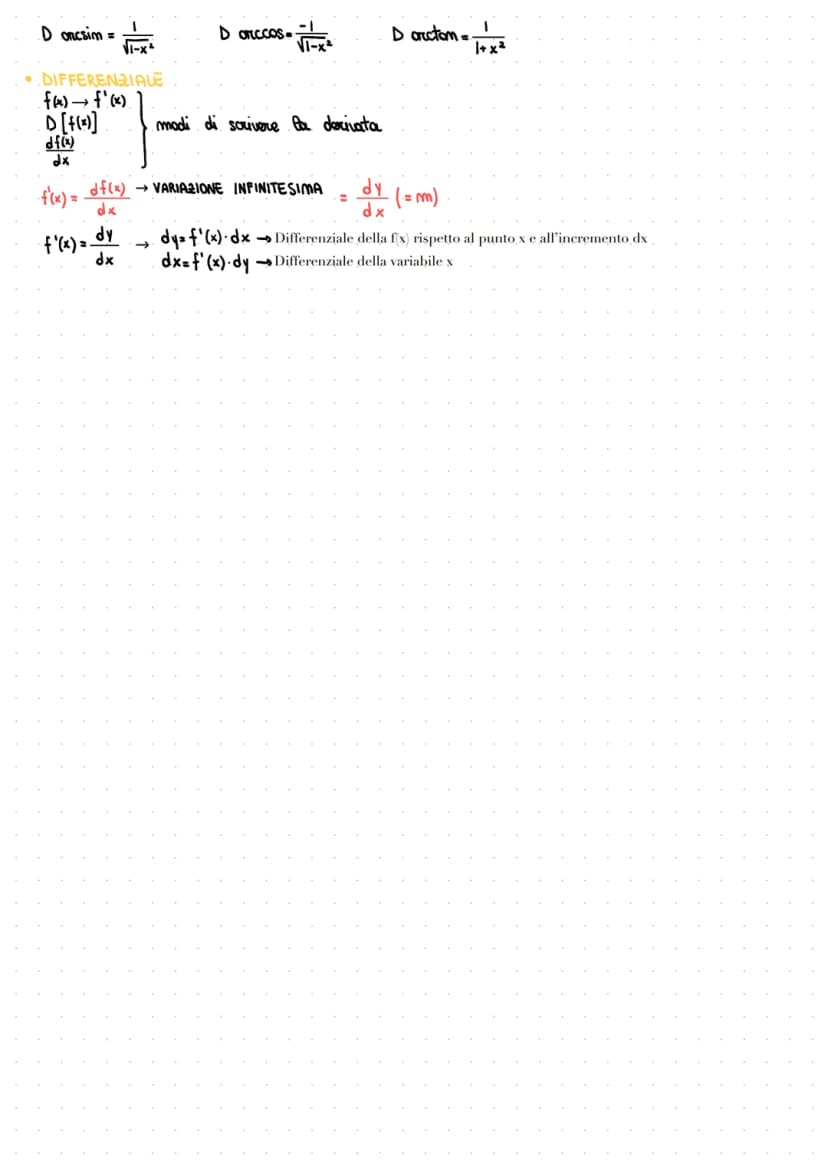
1 / 5
1
of 5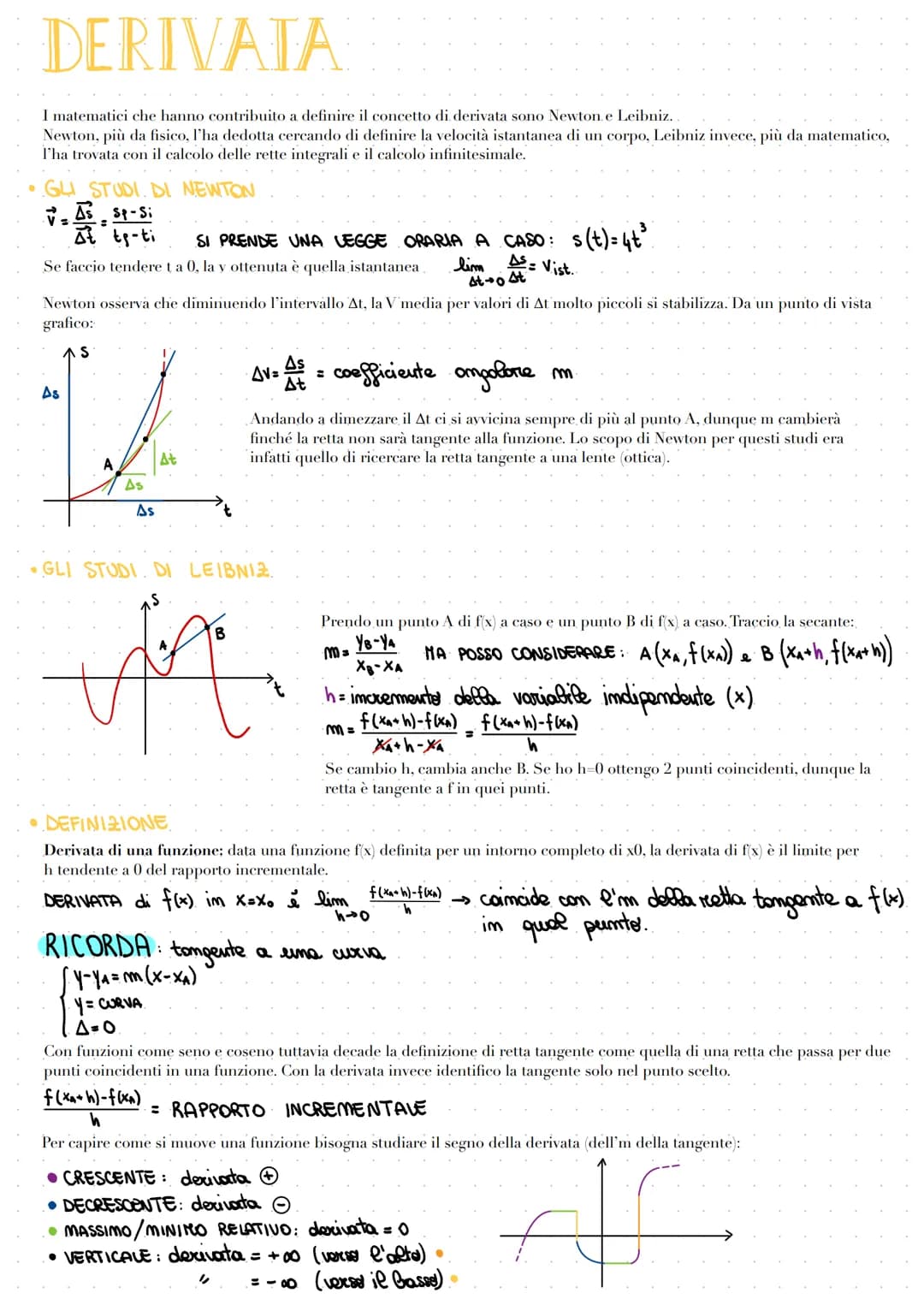
Historical Development of Derivatives
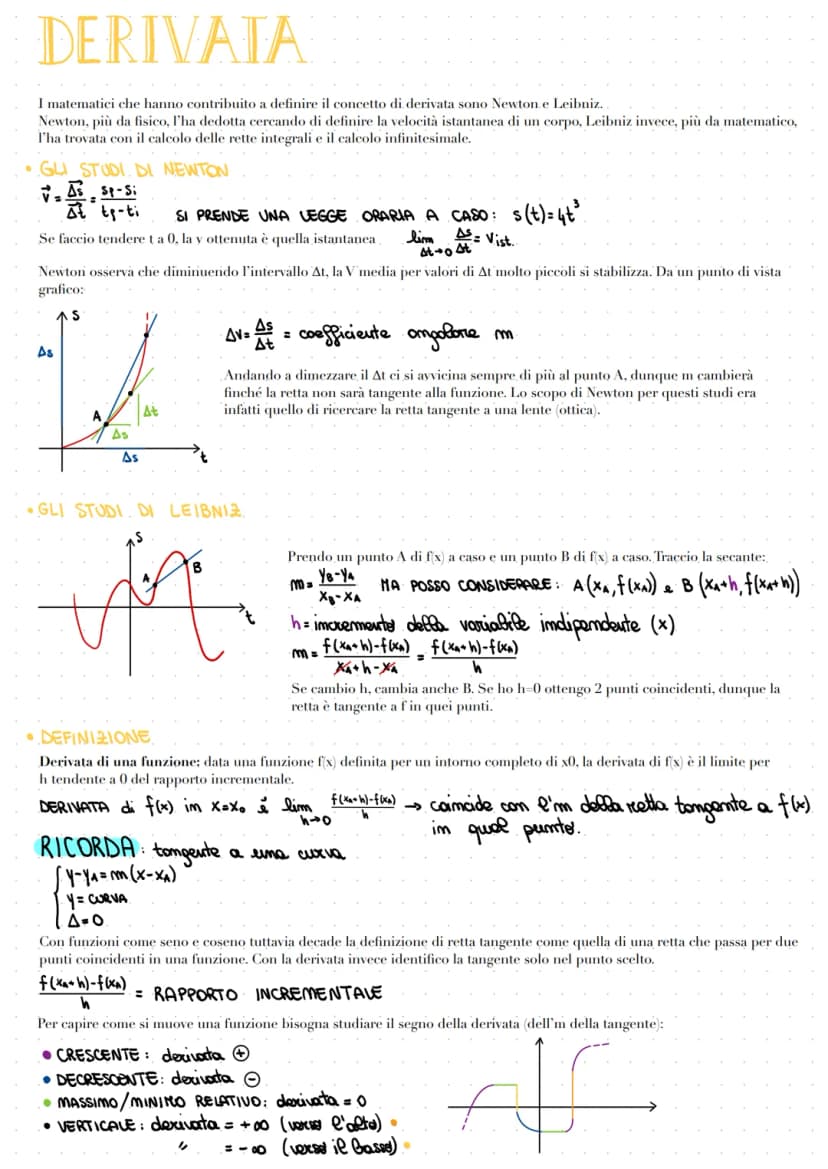
The storia della derivata begins with the groundbreaking work of Newton and Leibniz. Their different approaches led to the same powerful mathematical concept.
Newton's approach:
- Focused on defining instantaneous velocity in physics
- Observed that as the time interval decreases, average velocity stabilizes
- Graphically represented this concept using secant lines approaching a tangent line
Leibniz's approach:
- More mathematically oriented
- Developed through integral calculus and infinitesimal analysis
- Aimed to find tangent lines to curves, with applications in optics
Definition: The derivative of a function f(x) at a point x₀ is the limit of the difference quotient as h approaches zero: f'(x₀) = lim[h→0] / h
Highlight: The derivative represents the slope of the tangent line to a function at a given point, providing crucial information about the function's behavior.
Example: For a position function s(t) = 4t², the derivative represents the instantaneous velocity.
2
of 5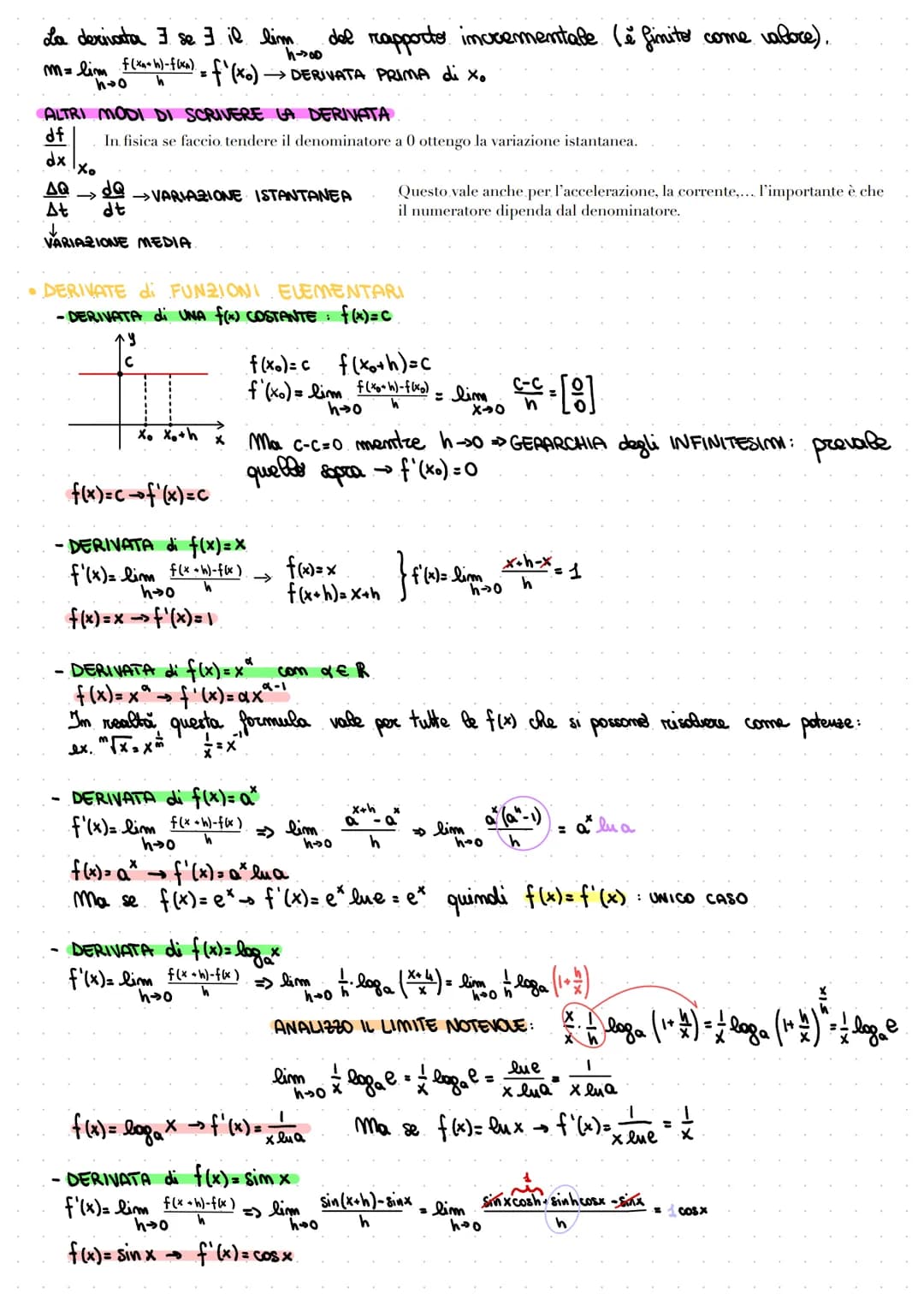
Fundamental Concepts and Notations of Derivatives
This section explores the core concepts and various notations used in derivative calculations.
Key concepts:
- The significato geometrico della derivata as the slope of the tangent line
- Different notations for derivatives, including Leibniz notation and Lagrange notation (f'(x))
- The relationship between derivatives and function behavior (increasing, decreasing, extrema)
Vocabulary: Rapporto incrementale (Difference quotient) - The expression / h, which forms the basis of the derivative definition
Highlight: The sign of the derivative indicates whether a function is increasing (positive derivative) or decreasing (negative derivative)
Example: At a relative maximum or minimum, the derivative equals zero, while at a vertical tangent, the derivative approaches infinity
3
of 5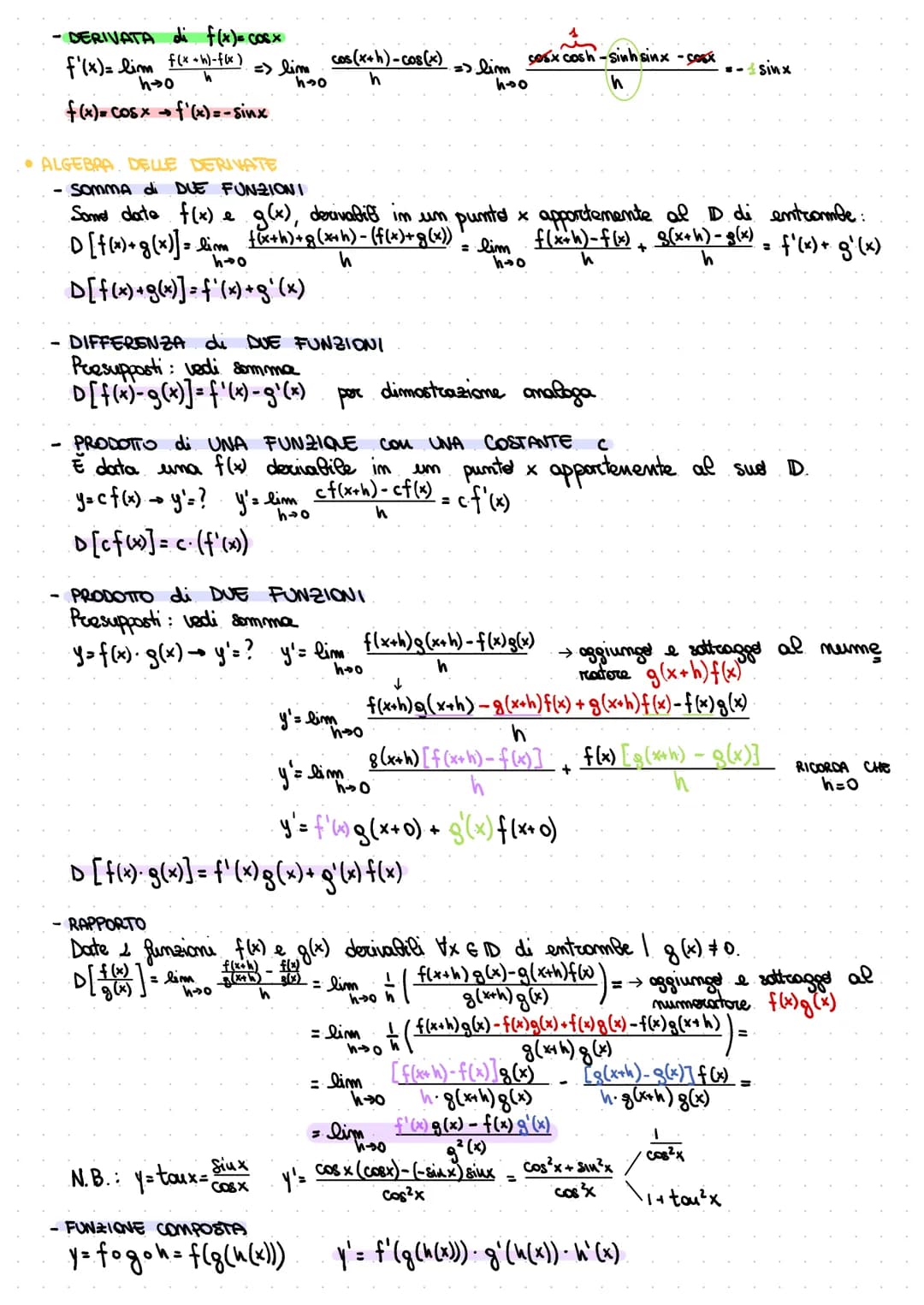
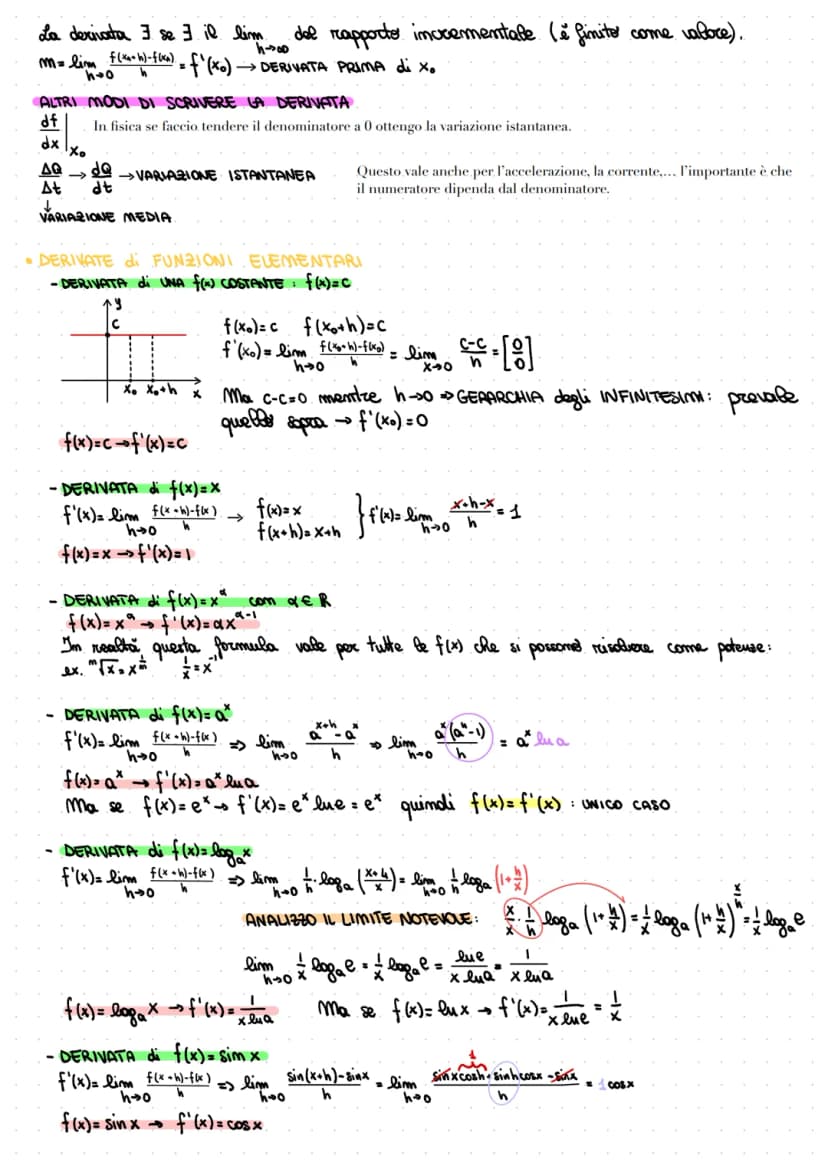
Derivatives of Elementary Functions
This section covers the derivate fondamentali and techniques for finding derivatives of basic functions.
Key points:
- Derivative of a constant function: f(x) = c → f'(x) = 0
- Derivative of f(x) = x: f'(x) = 1
- Power rule: If f(x) = xⁿ, then f'(x) = nxⁿ⁻¹
- Derivatives of trigonometric functions: (sin x)' = cos x, (cos x)' = -sin x
- Derivative of exponential function: (eˣ)' = eˣ
- Derivative of logarithmic function: (ln x)' = 1/x
Definition: The power rule states that for any real number n, the derivative of xⁿ is nxⁿ⁻¹
Example: The derivative of f(x) = x³ is f'(x) = 3x²
Highlight: The exponential function eˣ is unique in that it is its own derivative
4
of 5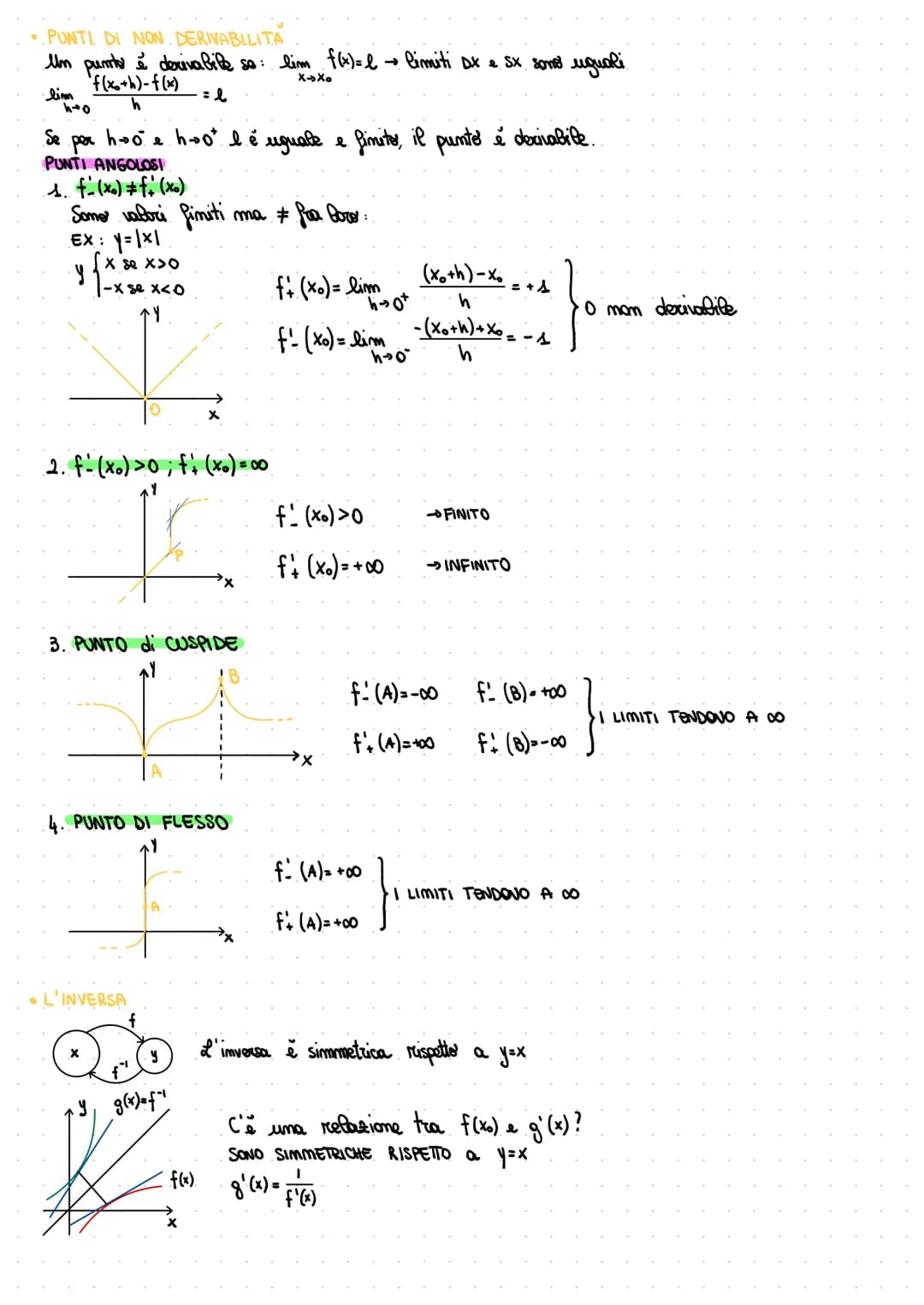
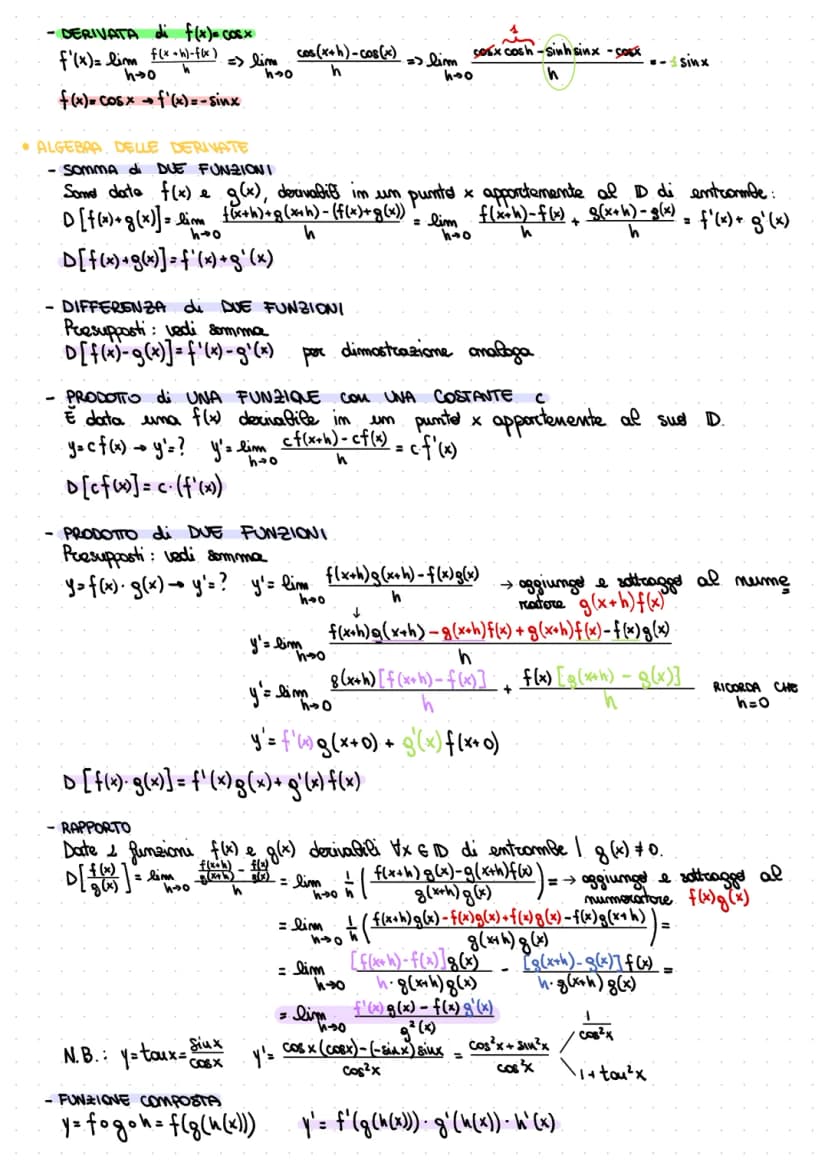
Algebra of Derivatives and Composite Functions
This section explores rules for combining derivatives and handling composite functions.
Key rules:
- Sum rule: ' = f' + g'
- Difference rule: ' = f' - g'
- Product rule: (fg)' = f'g + fg'
- Quotient rule: ' = / g²
- Chain rule for composite functions: (f ∘ g)' = (f' ∘ g) · g'
Example: If y = sin(x²), applying the chain rule gives y' = cos(x²) · 2x
Highlight: The chain rule is crucial for differentiating composite functions and is widely used in calculus applications
Vocabulary: Funzione composta (Composite function) - A function formed by applying one function to the result of another
These rules form the foundation for differentiating complex functions and are essential tools in calculus and its applications across various fields of science and engineering.
5
of 5
Overview of Derivatives
The concept of derivatives, a cornerstone of calculus, was developed independently by Newton and Leibniz in the 17th century. This mathematical tool is essential for analyzing rates of change and finding tangent lines to curves.
Key points:
- Newton approached derivatives from a physics perspective, seeking to define instantaneous velocity
- Leibniz developed derivatives through integral calculus and infinitesimal analysis
- The definizione di derivata formula involves the limit of a difference quotient as the interval approaches zero
- Derivatives have crucial applications in physics, engineering, and other sciences
We thought you’d never ask...
What is the Knowunity AI companion?
Our AI companion is specifically built for the needs of students. Based on the millions of content pieces we have on the platform we can provide truly meaningful and relevant answers to students. But its not only about answers, the companion is even more about guiding students through their daily learning challenges, with personalised study plans, quizzes or content pieces in the chat and 100% personalisation based on the students skills and developments.
Where can I download the Knowunity app?
You can download the app in the Google Play Store and in the Apple App Store.
Is Knowunity really free of charge?
That's right! Enjoy free access to study content, connect with fellow students, and get instant help – all at your fingertips.
Similar Content
 AP Calculus AB/BC
Most popular content: derivata
7MatematicaDerivate
Appunti di matematica sulle derivate
4ªl22,639528
MatematicaDerivate
Appunti, formule, dimostrazioni sulle derivate
5ªl27,8281,159
MatematicaDerivate e Calcolo differenziale
Calcolo differenziale, incremento differenziale, derivate, algebra delle derivate, teoremi sulle derivate, applicazione geometrica delle derivate e inoltre studi di funzioni con applicazione di derivata prima e seconda - Matematica, Analisi
4ªl7,329188
MatematicaDerivate di funzione
Derivate
4ªl3,26360
MatematicaDerivate
Derivate:Il Problema della Tangente,Derivata di Una Funzione, Derivata di Sinistra e di Destra, Significato Geometrico della Derivata, Punti Stazionari,di Non Derivabilità, Cuspidi,Flessi a Tangente Verticale, Punti Angolosi,ecc..
4ªl1,78440
MatematicaStudio di funzione
studio di una funzione fratta Dominio Segno intersezione assi limiti asintoti derivata prima e seconda
5ªl7,566276
MatematicaDerivate
Analisi 1
5ªl2,26751
Most popular content in Matematica
9E
MatematicaEquazioni
esercizi
2ªm3,35715
I
Matematicai criteri di divisibilità
i criteri di divisibilità
1ªm1,4962
F
MatematicaFondamenti del Teorema di Pitagora
Identifica ipotenusa e cateti e apprendi la formula fondamentale del Teorema di Pitagora nei triangoli rettangoli.
2ªm2,8370
MatematicaFormulario di mate
Spero possa esservi utile
3ªl5,242150
MatematicaMatematica per la maturità
Appunti di tutti e cinque gli anni di matematica in vista della maturità (potrebbero mancare alcune cose).
3ªl2,39676
MatematicaDerivate
Appunti di matematica sulle derivate
4ªl22,639528
MatematicaPiano cartesiano e retta
Appunti
1ªl2,94762
MatematicaOperazioni e prodotti notevoli
Operazioni con polinomi e prodotti notevoli
1ªm4,84980
MatematicaFormulario di matematica maturità 2024
Tutte le formule per la prova d'esame di matematica della maturità
5ªl6,823175
Most popular content
9 Italiano
Riassunto patente B
Riassunto patente B - appunti presi a lezione
5ªl29,228943
 Altro
AltroTeoria patente b
Tutti gli argomenti per la patente
1ªl21,114685
 Ed. civ.
Teoria patente di guida B: Segnali stradali
Segnali stradali di pericolo, luminosi, di prescrizione, di indicazione, temporanei, complementari, pannelli integrativi, segnaletica orizzontale, segnalazioni agenti del traffico, distanza di visibilità per l‘arresto, minima di sicurezza.
5ªl40,0241,644
 Filosofia
Aristotele
Aristotele: vita, metafisica, fisica, etica e politica, retorica e poetica
3ªl7,623216
ItalianoI promessi sposi
Riassunti completi di tutti i 38 capitoli dei Promessi sposi.
2ªl14,088314
AltroPATENTE
schemi per esame teorico della patente
Università22,050755
S
ItalianoSintesi finale di Analisi logica
Esercitazione completa di analisi logica su frasi articolate per consolidare la conoscenza di tutti i complementi.
3ªm5,5290
P
 Inglese
Present Simple vs Present Continuous
Develop the ability to choose correctly between the Present Simple for habits and the Present Continuous for ongoing actions.
3ªm4,2110
G
ItalianoGabriele D'Annunzio e l'Estetismo
Domande sull'ideale del superuomo, il panismo e la concezione dell'arte come valore assoluto in D'Annunzio.
4ªl2,6740
Can't find what you're looking for? Explore other subjects.
Students love us — and so will you.
4.6/5App Store
4.7/5Google Play
The app is very easy to use and well designed. I have found everything I was looking for so far and have been able to learn a lot from the presentations! I will definitely use the app for a class assignment! And of course it also helps a lot as an inspiration.
Stefan SiOS user
This app is really great. There are so many study notes and help [...]. My problem subject is French, for example, and the app has so many options for help. Thanks to this app, I have improved my French. I would recommend it to anyone.
Samantha KlichAndroid user
Wow, I am really amazed. I just tried the app because I've seen it advertised many times and was absolutely stunned. This app is THE HELP you want for school and above all, it offers so many things, such as workouts and fact sheets, which have been VERY helpful to me personally.
AnnaiOS user
Matematica3,679 views·Updated Jun 17, 2026·5 pagesDerivate e Punti di Non Derivabilità: Scopriamo le Formule e la Storia!
The storia della derivata traces back to Newton and Leibniz, who developed the concept from different perspectives. This fundamental calculus concept is crucial for understanding rates of change and tangent lines to curves. The derivata definizioneinvolves the limit of...
1
of 5
Sign up to see the content. It's free!
- Access to all documents
- Improve your grades
- Join milions of students
Historical Development of Derivatives
The storia della derivata begins with the groundbreaking work of Newton and Leibniz. Their different approaches led to the same powerful mathematical concept.
Newton's approach:
- Focused on defining instantaneous velocity in physics
- Observed that as the time interval decreases, average velocity stabilizes
- Graphically represented this concept using secant lines approaching a tangent line
Leibniz's approach:
- More mathematically oriented
- Developed through integral calculus and infinitesimal analysis
- Aimed to find tangent lines to curves, with applications in optics
Definition: The derivative of a function f(x) at a point x₀ is the limit of the difference quotient as h approaches zero: f'(x₀) = lim[h→0] / h
Highlight: The derivative represents the slope of the tangent line to a function at a given point, providing crucial information about the function's behavior.
Example: For a position function s(t) = 4t², the derivative represents the instantaneous velocity.
2
of 5Sign up to see the content. It's free!
- Access to all documents
- Improve your grades
- Join milions of students
Fundamental Concepts and Notations of Derivatives
This section explores the core concepts and various notations used in derivative calculations.
Key concepts:
- The significato geometrico della derivata as the slope of the tangent line
- Different notations for derivatives, including Leibniz notation and Lagrange notation (f'(x))
- The relationship between derivatives and function behavior (increasing, decreasing, extrema)
Vocabulary: Rapporto incrementale (Difference quotient) - The expression / h, which forms the basis of the derivative definition
Highlight: The sign of the derivative indicates whether a function is increasing (positive derivative) or decreasing (negative derivative)
Example: At a relative maximum or minimum, the derivative equals zero, while at a vertical tangent, the derivative approaches infinity
3
of 5Sign up to see the content. It's free!
- Access to all documents
- Improve your grades
- Join milions of students
Derivatives of Elementary Functions
This section covers the derivate fondamentali and techniques for finding derivatives of basic functions.
Key points:
- Derivative of a constant function: f(x) = c → f'(x) = 0
- Derivative of f(x) = x: f'(x) = 1
- Power rule: If f(x) = xⁿ, then f'(x) = nxⁿ⁻¹
- Derivatives of trigonometric functions: (sin x)' = cos x, (cos x)' = -sin x
- Derivative of exponential function: (eˣ)' = eˣ
- Derivative of logarithmic function: (ln x)' = 1/x
Definition: The power rule states that for any real number n, the derivative of xⁿ is nxⁿ⁻¹
Example: The derivative of f(x) = x³ is f'(x) = 3x²
Highlight: The exponential function eˣ is unique in that it is its own derivative
4
of 5Sign up to see the content. It's free!
- Access to all documents
- Improve your grades
- Join milions of students
Algebra of Derivatives and Composite Functions
This section explores rules for combining derivatives and handling composite functions.
Key rules:
- Sum rule: ' = f' + g'
- Difference rule: ' = f' - g'
- Product rule: (fg)' = f'g + fg'
- Quotient rule: ' = / g²
- Chain rule for composite functions: (f ∘ g)' = (f' ∘ g) · g'
Example: If y = sin(x²), applying the chain rule gives y' = cos(x²) · 2x
Highlight: The chain rule is crucial for differentiating composite functions and is widely used in calculus applications
Vocabulary: Funzione composta (Composite function) - A function formed by applying one function to the result of another
These rules form the foundation for differentiating complex functions and are essential tools in calculus and its applications across various fields of science and engineering.
5
of 5Sign up to see the content. It's free!
- Access to all documents
- Improve your grades
- Join milions of students
Overview of Derivatives
The concept of derivatives, a cornerstone of calculus, was developed independently by Newton and Leibniz in the 17th century. This mathematical tool is essential for analyzing rates of change and finding tangent lines to curves.
Key points:
- Newton approached derivatives from a physics perspective, seeking to define instantaneous velocity
- Leibniz developed derivatives through integral calculus and infinitesimal analysis
- The definizione di derivata formula involves the limit of a difference quotient as the interval approaches zero
- Derivatives have crucial applications in physics, engineering, and other sciences
We thought you’d never ask...
What is the Knowunity AI companion?
Our AI companion is specifically built for the needs of students. Based on the millions of content pieces we have on the platform we can provide truly meaningful and relevant answers to students. But its not only about answers, the companion is even more about guiding students through their daily learning challenges, with personalised study plans, quizzes or content pieces in the chat and 100% personalisation based on the students skills and developments.
Where can I download the Knowunity app?
You can download the app in the Google Play Store and in the Apple App Store.
Is Knowunity really free of charge?
That's right! Enjoy free access to study content, connect with fellow students, and get instant help – all at your fingertips.
Similar Content
Most popular content: derivata
7MatematicaDerivate
Appunti di matematica sulle derivate
4ªl22,639528
MatematicaDerivate
Appunti, formule, dimostrazioni sulle derivate
5ªl27,8281,159
MatematicaDerivate e Calcolo differenziale
Calcolo differenziale, incremento differenziale, derivate, algebra delle derivate, teoremi sulle derivate, applicazione geometrica delle derivate e inoltre studi di funzioni con applicazione di derivata prima e seconda - Matematica, Analisi
4ªl7,329188
MatematicaDerivate di funzione
Derivate
4ªl3,26360
MatematicaDerivate
Derivate:Il Problema della Tangente,Derivata di Una Funzione, Derivata di Sinistra e di Destra, Significato Geometrico della Derivata, Punti Stazionari,di Non Derivabilità, Cuspidi,Flessi a Tangente Verticale, Punti Angolosi,ecc..
4ªl1,78440
MatematicaStudio di funzione
studio di una funzione fratta Dominio Segno intersezione assi limiti asintoti derivata prima e seconda
5ªl7,566276
MatematicaDerivate
Analisi 1
5ªl2,26751
Most popular content in Matematica
9E
MatematicaEquazioni
esercizi
2ªm3,35715
I
Matematicai criteri di divisibilità
i criteri di divisibilità
1ªm1,4962
F
MatematicaFondamenti del Teorema di Pitagora
Identifica ipotenusa e cateti e apprendi la formula fondamentale del Teorema di Pitagora nei triangoli rettangoli.
2ªm2,8370
MatematicaFormulario di mate
Spero possa esservi utile
3ªl5,242150
MatematicaMatematica per la maturità
Appunti di tutti e cinque gli anni di matematica in vista della maturità (potrebbero mancare alcune cose).
3ªl2,39676
MatematicaDerivate
Appunti di matematica sulle derivate
4ªl22,639528
MatematicaPiano cartesiano e retta
Appunti
1ªl2,94762
MatematicaOperazioni e prodotti notevoli
Operazioni con polinomi e prodotti notevoli
1ªm4,84980
MatematicaFormulario di matematica maturità 2024
Tutte le formule per la prova d'esame di matematica della maturità
5ªl6,823175
Most popular content
9ItalianoRiassunto patente B
Riassunto patente B - appunti presi a lezione
5ªl29,228943
AltroTeoria patente b
Tutti gli argomenti per la patente
1ªl21,114685
Ed. civ.Teoria patente di guida B: Segnali stradali
Segnali stradali di pericolo, luminosi, di prescrizione, di indicazione, temporanei, complementari, pannelli integrativi, segnaletica orizzontale, segnalazioni agenti del traffico, distanza di visibilità per l‘arresto, minima di sicurezza.
5ªl40,0241,644
FilosofiaAristotele
Aristotele: vita, metafisica, fisica, etica e politica, retorica e poetica
3ªl7,623216
ItalianoI promessi sposi
Riassunti completi di tutti i 38 capitoli dei Promessi sposi.
2ªl14,088314
AltroPATENTE
schemi per esame teorico della patente
Università22,050755
S
ItalianoSintesi finale di Analisi logica
Esercitazione completa di analisi logica su frasi articolate per consolidare la conoscenza di tutti i complementi.
3ªm5,5290
P
InglesePresent Simple vs Present Continuous
Develop the ability to choose correctly between the Present Simple for habits and the Present Continuous for ongoing actions.
3ªm4,2110
G
ItalianoGabriele D'Annunzio e l'Estetismo
Domande sull'ideale del superuomo, il panismo e la concezione dell'arte come valore assoluto in D'Annunzio.
4ªl2,6740
Can't find what you're looking for? Explore other subjects.
Students love us — and so will you.
4.6/5App Store
4.7/5Google Play
The app is very easy to use and well designed. I have found everything I was looking for so far and have been able to learn a lot from the presentations! I will definitely use the app for a class assignment! And of course it also helps a lot as an inspiration.
Stefan SiOS user
This app is really great. There are so many study notes and help [...]. My problem subject is French, for example, and the app has so many options for help. Thanks to this app, I have improved my French. I would recommend it to anyone.
Samantha KlichAndroid user
Wow, I am really amazed. I just tried the app because I've seen it advertised many times and was absolutely stunned. This app is THE HELP you want for school and above all, it offers so many things, such as workouts and fact sheets, which have been VERY helpful to me personally.
AnnaiOS user