
Get ready to dive into the fascinating world of 20th...
 MAPEH7,442 views·Updated Jun 23, 2026·10 pages
MAPEH G10 1st Quarter Study Guide
K
kish andres@kishandres



1 / 10
1
of 10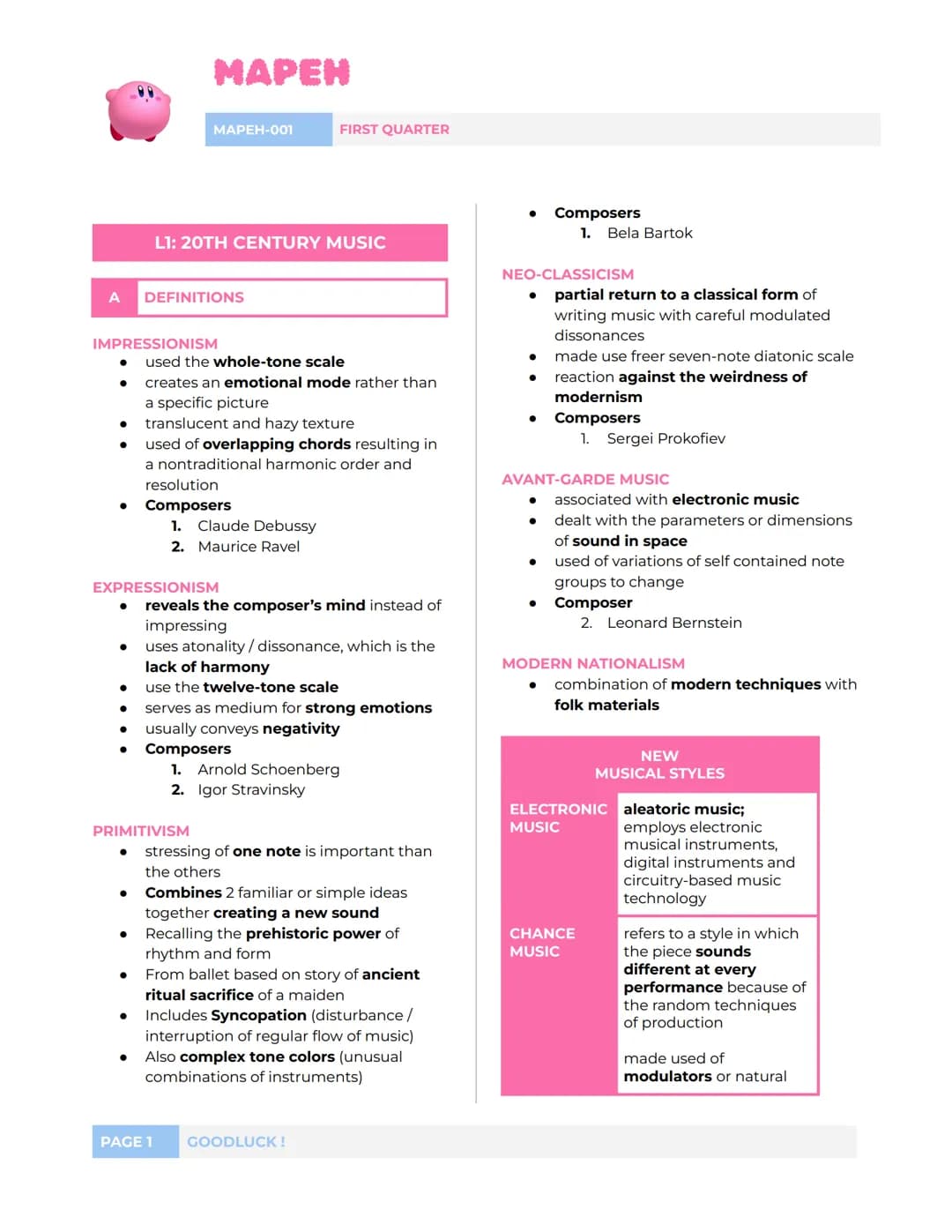
20th Century Music Movements
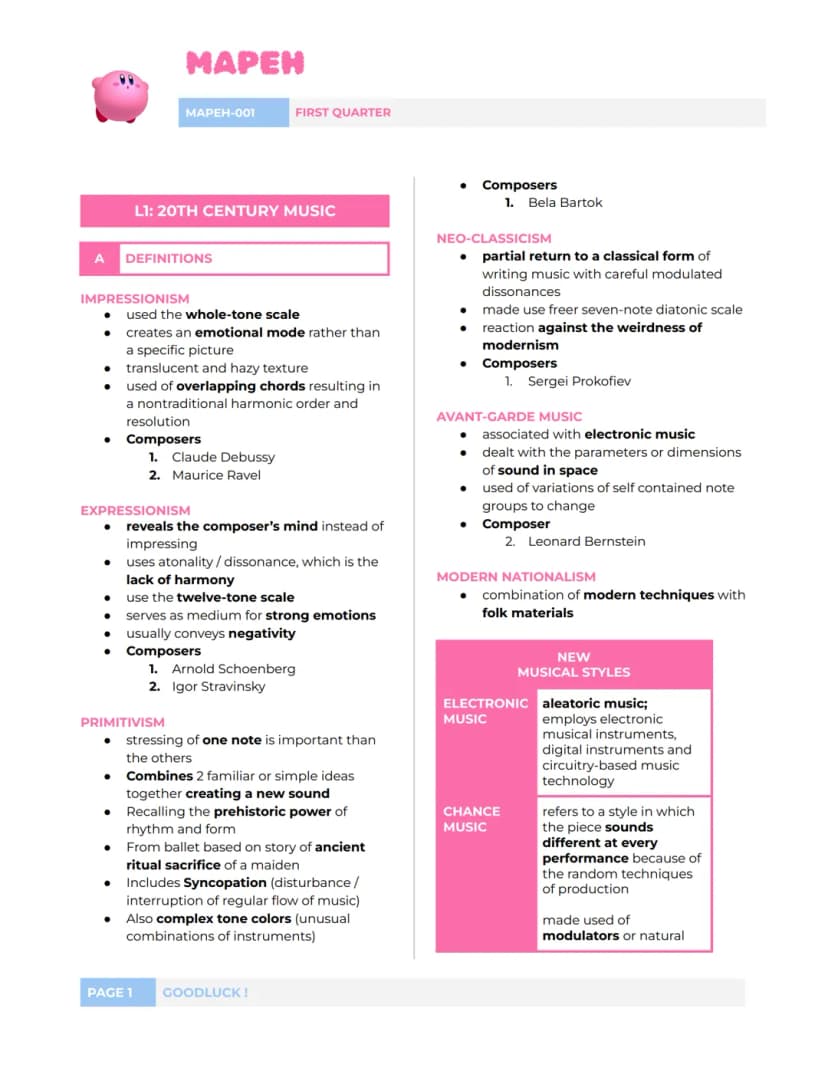
Ever wondered why some classical music sounds so dreamy while others feel intense and dramatic? The 20th century brought revolutionary changes to music that completely broke traditional rules.
Impressionism creates hazy, emotional moods using the whole-tone scale and overlapping chords. Think of it like painting with sound - composers like Claude Debussy and Maurice Ravel wanted to capture feelings rather than tell specific stories.
Expressionism takes the opposite approach, revealing raw emotions through atonality and dissonance (basically, notes that clash on purpose). Arnold Schoenberg pioneered the twelve-tone scale, while these compositions often convey darker, more intense feelings.
Primitivism brought back the power of rhythm, with composers like Bela Bartok combining simple ideas to create entirely new sounds. Meanwhile, Neo-classicism was a reaction against all this weirdness - Sergei Prokofiev and others returned to more classical forms but with modern twists.
Quick Tip: Remember that each movement was a reaction to what came before - just like how fashion trends swing from one extreme to another!
2
of 10
Famous Composers and Their Impact
These musical pioneers didn't just write pretty melodies - they completely changed how we think about music. Claude Debussy became known as the "father of modern composition" by dissolving traditional rules and using gamelan ensemble sounds in his work.
His masterpiece "La Mer" (The Sea) is an atmospheric orchestra work that literally sounds like ocean waves. "Claire de Lune" (Moonlight) remains one of the most recognizable pieces ever written - you've probably heard it in movies or commercials.
Maurice Ravel brought unique innovation with pieces like "Bolero" - a hypnotic work that builds from a whisper to a thunderous climax using the same melody over and over. Both composers performed in opera houses and concert halls for elite audiences.
Arnold Schoenberg established the twelve-tone system and invented Sprechstimme - a weird singing style that's half-speaking, half-singing. His music was so challenging that concerts sometimes caused scandals, but his mathematical approach to choosing notes influenced countless future composers.
Fun Fact: Schoenberg's "Skandal Konzert" literally means "Scandal Concert" - imagine music so revolutionary it caused riots!
3
of 10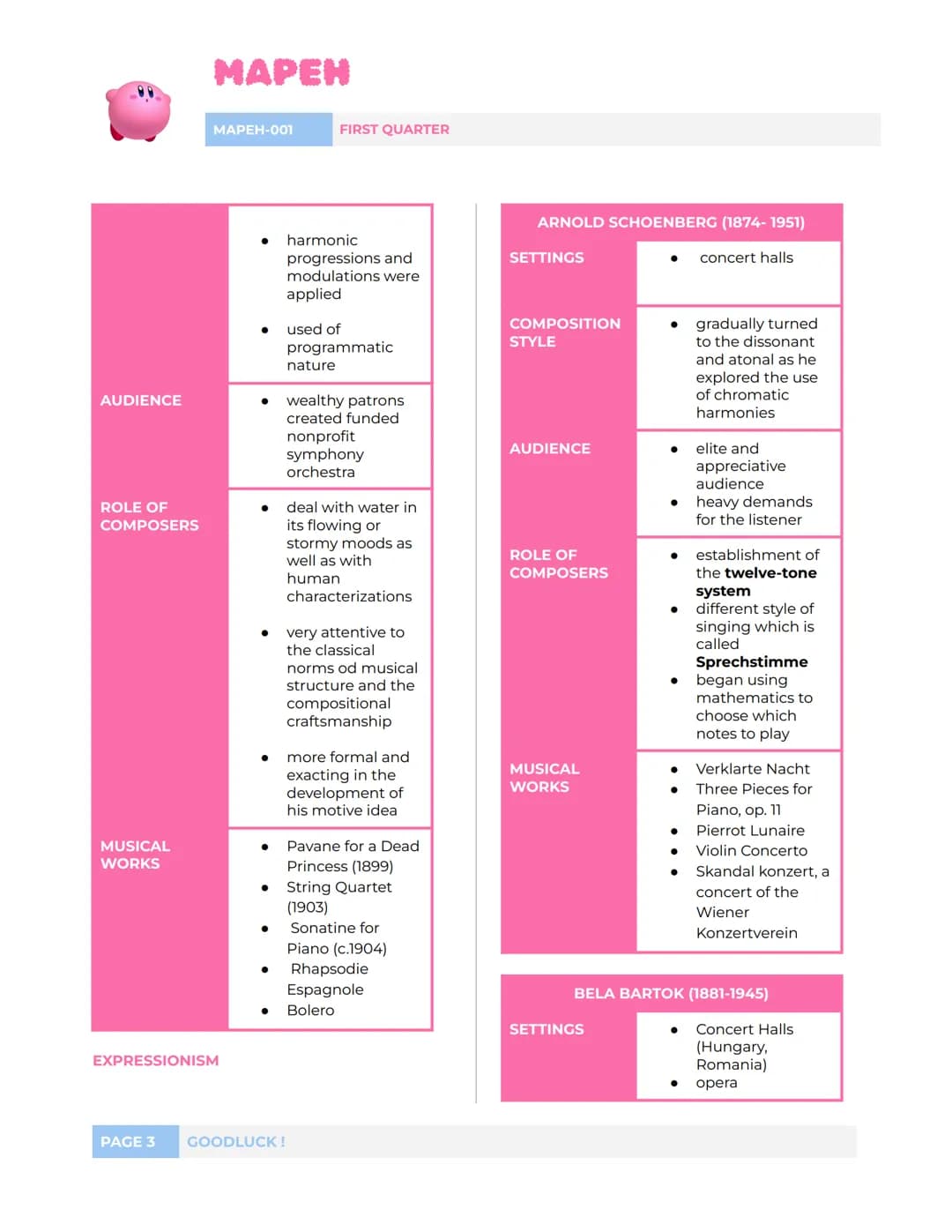
Art Movements That Changed Everything
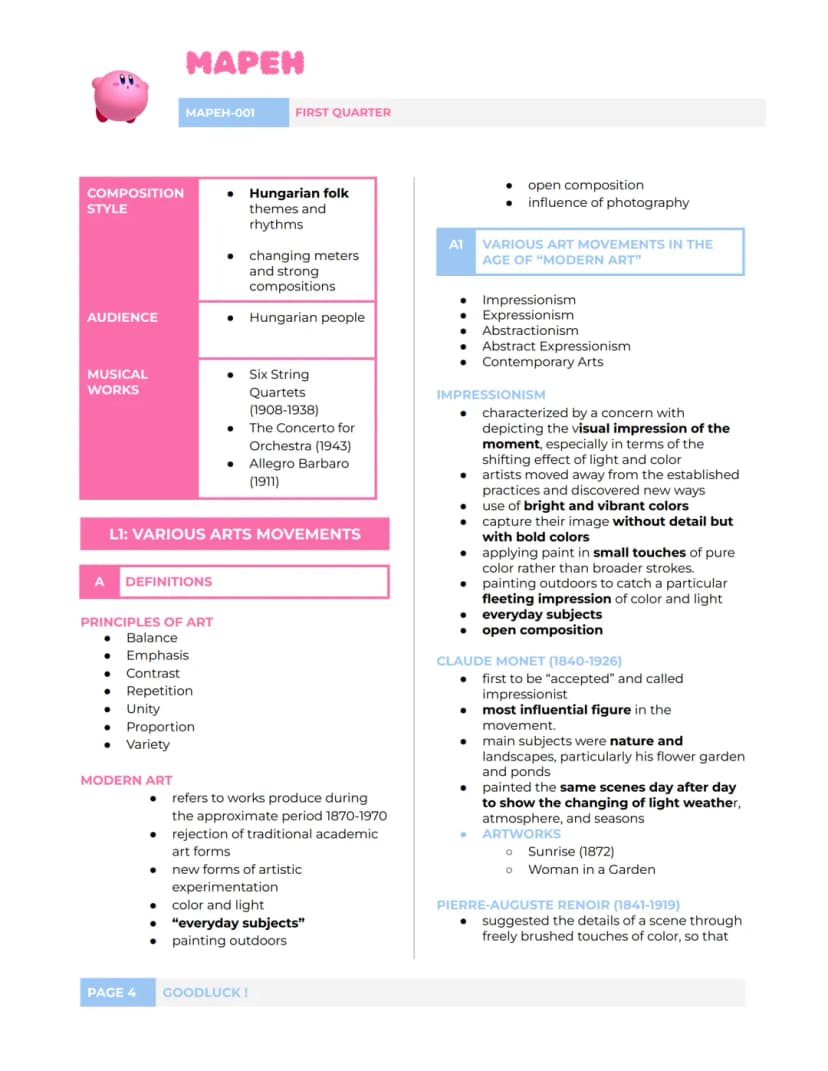
Just like music, visual art exploded with new styles in the late 1800s and early 1900s. Modern art completely rejected traditional academic painting in favor of bold experimentation.
Impressionism in art works exactly like in music - it's all about capturing fleeting moments of light and color. Claude Monet painted the same garden scenes day after day to show how light changes throughout the day. Pierre-Auguste Renoir focused on people in candid, intimate scenes with soft, brushed touches of color.
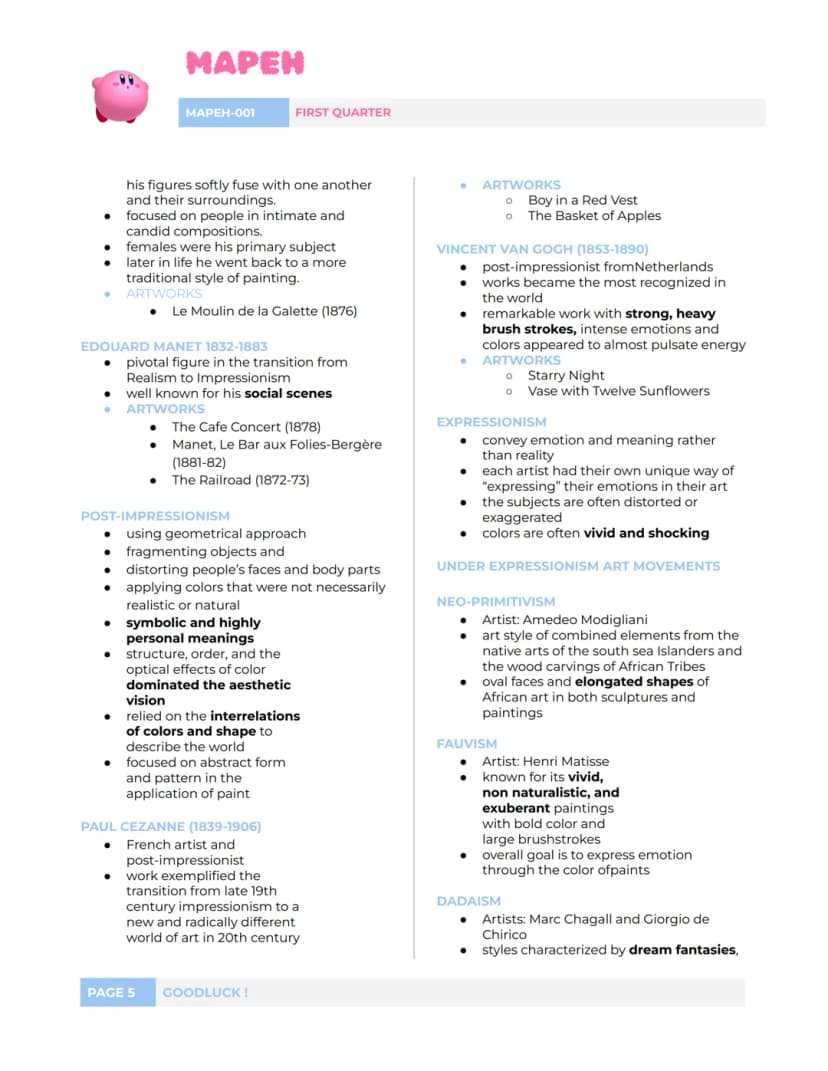
Post-Impressionism took things further with artists like Paul Cézanne using geometric approaches and Vincent van Gogh creating those famous swirling, energetic brushstrokes in "Starry Night." These artists cared more about emotional impact than realistic representation.
Expressionism in art mirrors its musical counterpart - it's all about conveying raw emotion through distorted figures and shocking, vivid colors. Artists literally twisted and exaggerated their subjects to make you feel something intense.
Key Insight: Notice how both music and art movements happened simultaneously - artists across different mediums were all rebelling against the same old traditions!
4
of 10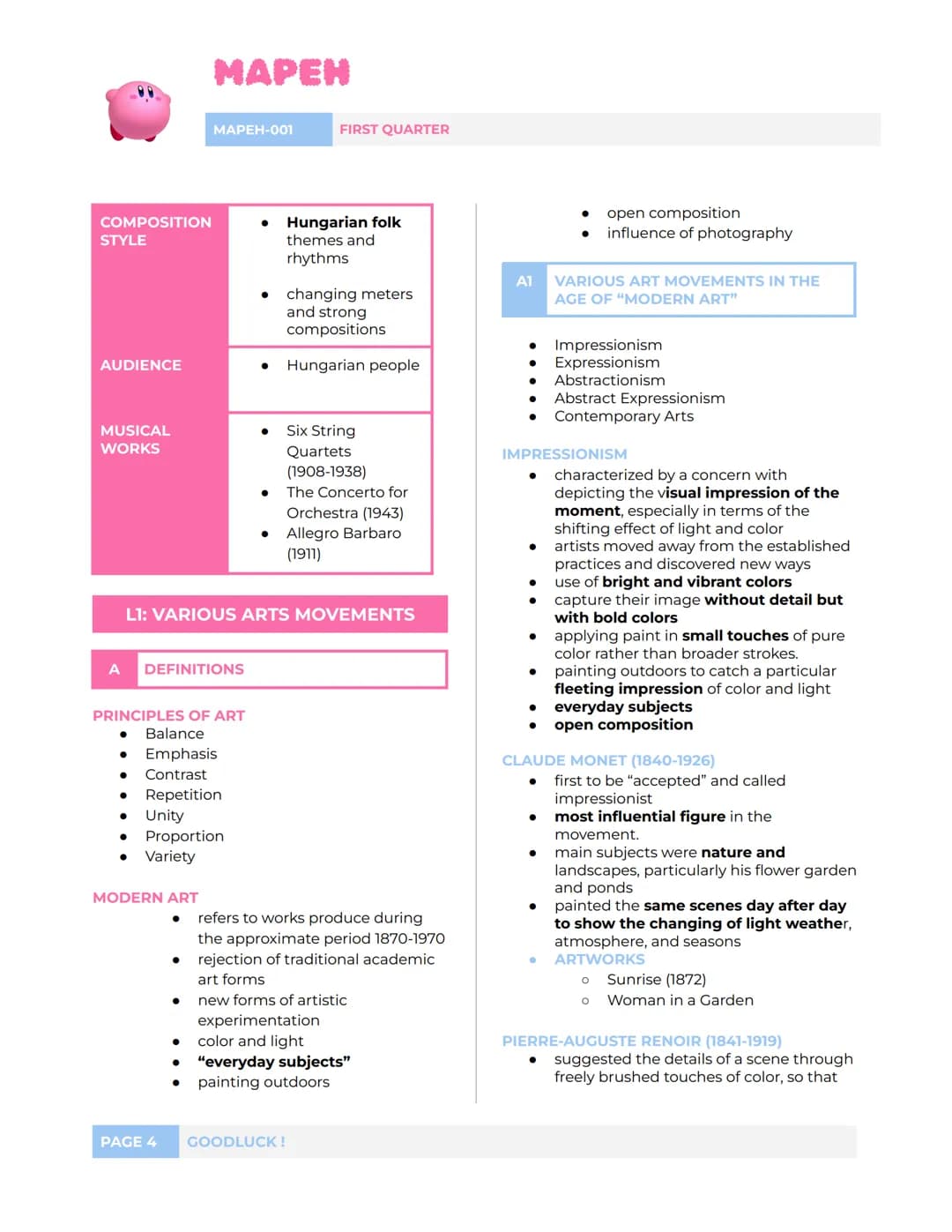
Avant-Garde and Modern Art Movements
The early 20th century got even weirder with movements that completely abandoned reality. Fauvism, led by Henri Matisse, used bold, non-naturalistic colors - imagine painting a person's face bright green just because it felt right emotionally.
Neo-Primitivism drew inspiration from African tribal art and South Sea Islander carvings. Amedeo Modigliani became famous for those elongated faces and oval shapes that looked nothing like traditional portraits.
Dadaism was basically the "anti-art" movement - Marc Chagall and Giorgio de Chirico created dream-like fantasies and visual tricks that made no logical sense. They deliberately turned their backs on traditional techniques.
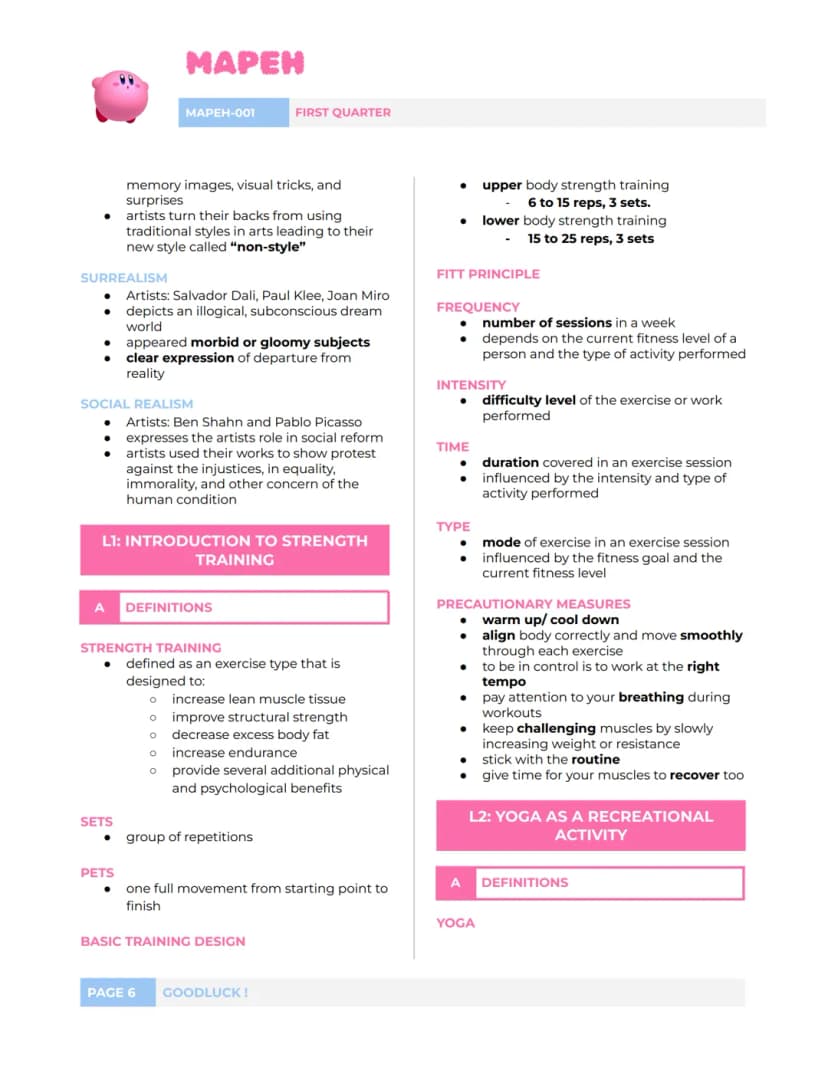
Surrealism took this dream concept even further. Salvador Dalí's melting clocks and Joan Miró's abstract shapes depicted the subconscious mind in ways that were completely divorced from reality. Social Realism, on the other hand, used art to protest injustice and social problems.
Reality Check: These "weird" art movements actually reflect the chaos and rapid changes happening in early 20th century society - two world wars, industrialization, and social upheaval!
5
of 10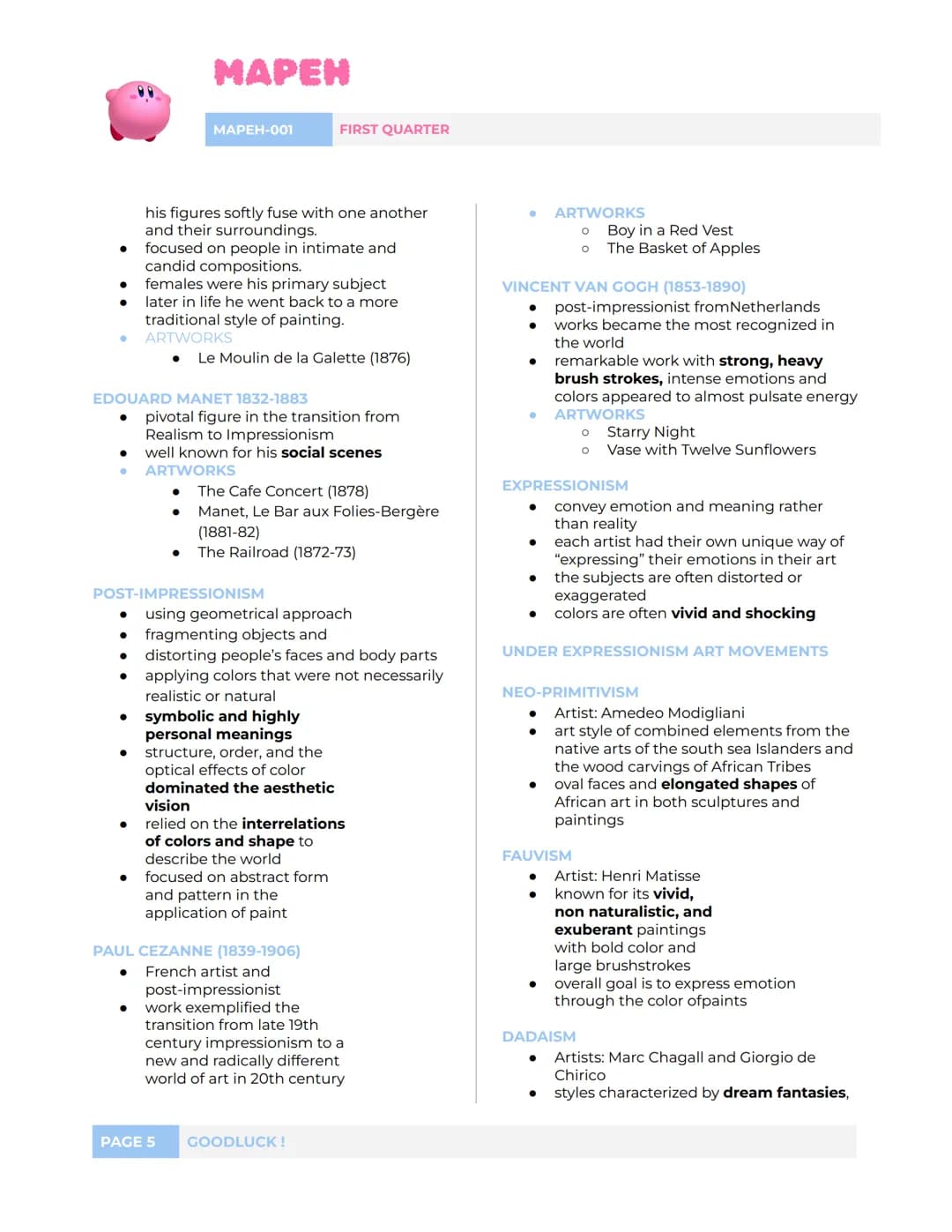
Strength Training and Yoga Basics
Now let's shift gears to physical health! Strength training isn't just about building muscles - it increases lean muscle tissue, improves structural strength, decreases body fat, and boosts endurance. Think of it as a complete body makeover system.
Understanding the basics is simple: sets are groups of repetitions, and reps are single full movements from start to finish. The key is designing a program that gradually challenges your body without overdoing it.
Yoga comes from the Sanskrit word "yuj" meaning "to join" or "unite." This ancient Indian practice builds both strength and flexibility while serving as therapy for mind and body. The two main components are posture and breathing - master these and you're golden.
Essential poses include Mountain Pose (Tadasana) where you raise hands overhead like the number 11, Downward Dog (your body makes an inverted V), and Warrior III with one knee at 90 degrees and arms extended. Each pose should be held for specific time periods while focusing on proper breathing.
Pro Tip: Start with basic poses and hold them for shorter periods - yoga is about gradual progress, not showing off on day one!
6
of 10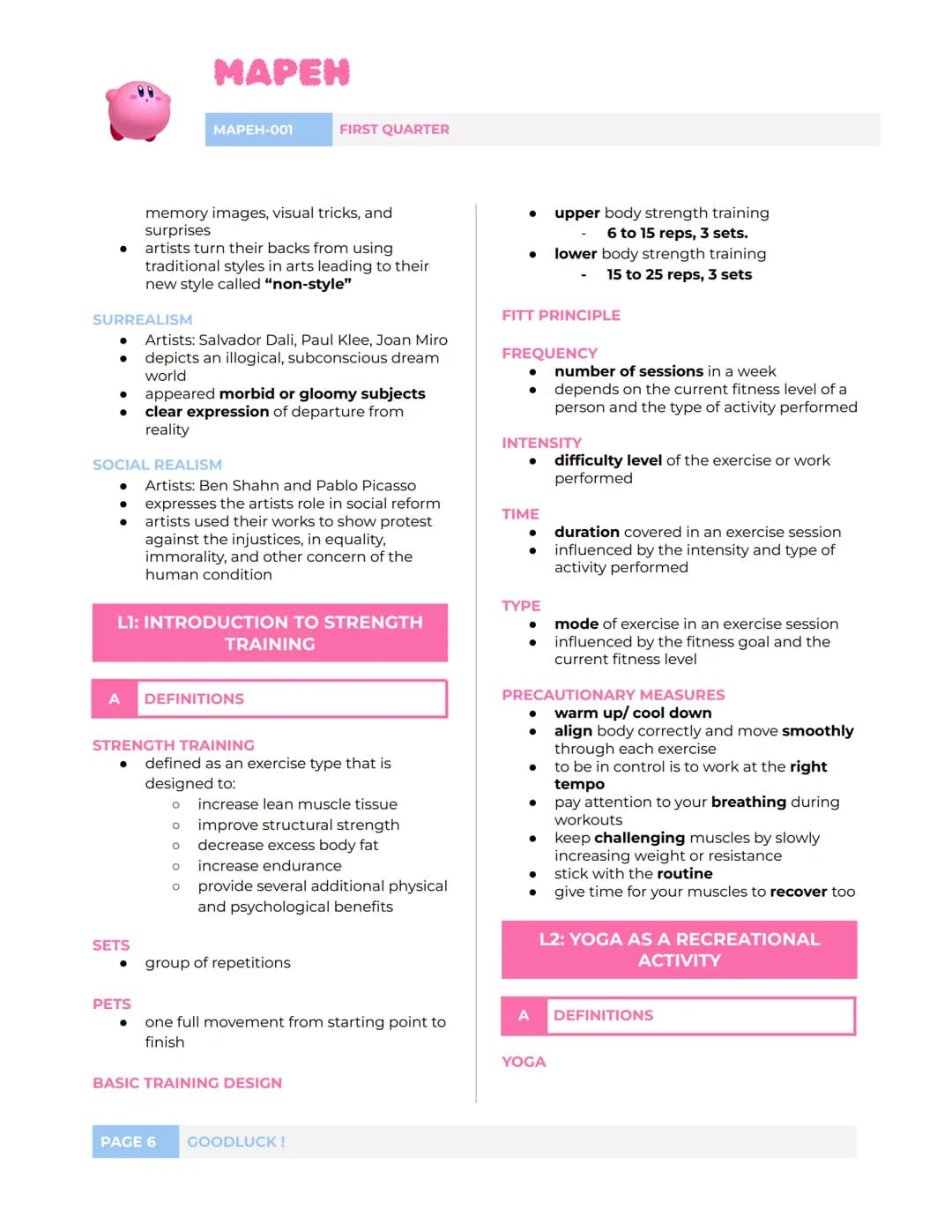
Consumer Health and Reliable Information
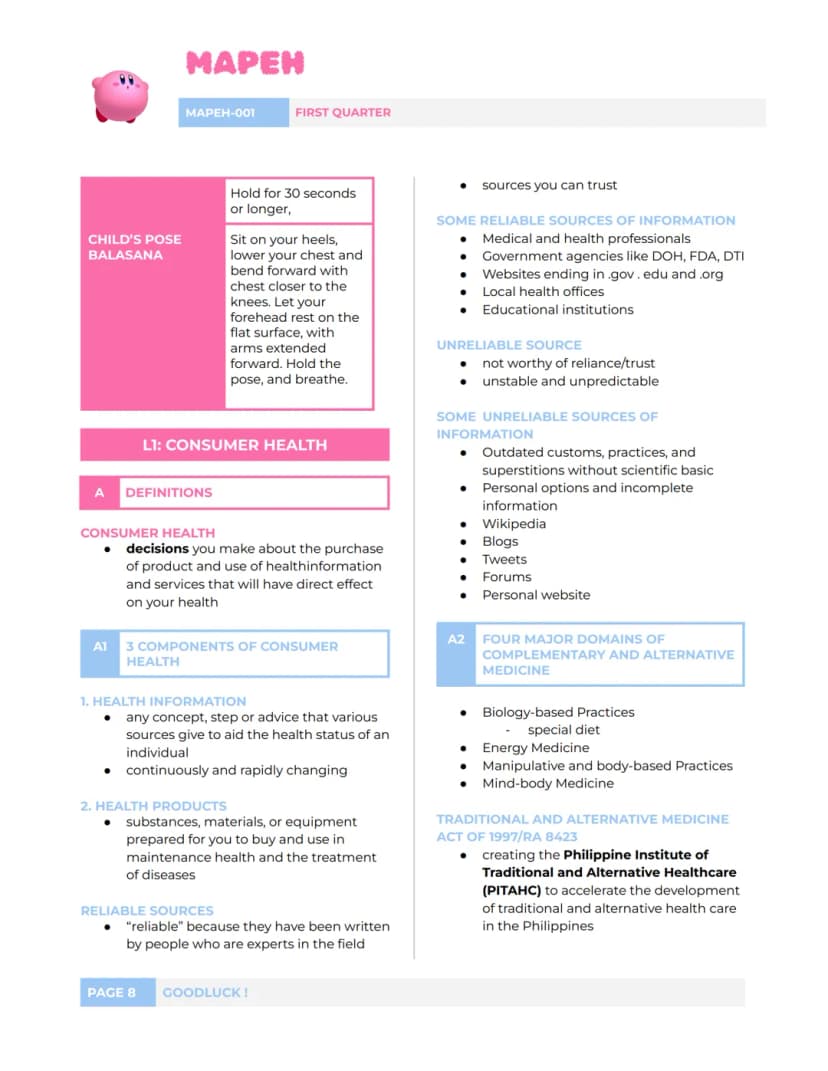
Making smart health decisions means knowing which sources to trust and which to avoid. Consumer health involves every choice you make about health products, information, and services that directly affect your wellbeing.
Reliable sources include medical professionals, government agencies like DOH (Department of Health) and FDA, websites ending in .gov, .edu, and .org, plus educational institutions. These sources are trustworthy because they're written by actual experts in their fields.
Unreliable sources to avoid include outdated customs without scientific basis, personal opinions, Wikipedia, random blogs, tweets, forums, and personal websites. Just because something is posted online doesn't make it true!
The Traditional and Alternative Medicine Act of 1997 (RA 8423) created PITAHC to develop alternative healthcare in the Philippines. This includes naturopathy (treating illness with diet, herbs, and exercise without standard drugs), acupuncture, acupressure, and various massage therapies.
Smart Move: Always ask "What? Who? What else?" when evaluating health information - what's the claim, who's making it, and what other evidence supports it?
7
of 10
DOH-Approved Herbal Medicines
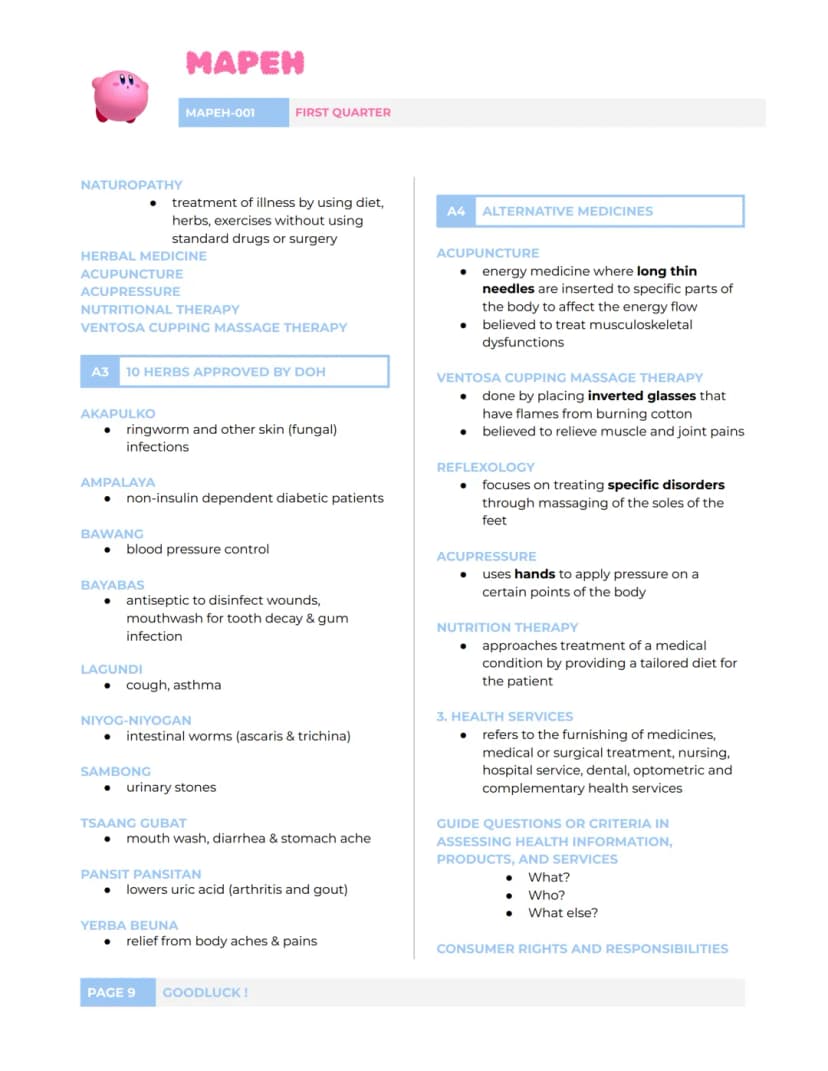
The Department of Health has officially approved 10 herbal medicines that you can safely use for specific conditions. Akapulko treats ringworm and fungal skin infections, while Ampalaya helps non-insulin dependent diabetic patients control blood sugar.
Bawang (garlic) works for blood pressure control, and Bayabas (guava) serves as an antiseptic for wounds and mouthwash for dental problems. Lagundi is your go-to for cough and asthma relief.
For digestive issues, Niyog-niyogan eliminates intestinal worms, Sambong helps with urinary stones, and Tsaang Gubat works as mouthwash and treats diarrhea. Pansit-pansitan lowers uric acid for arthritis and gout sufferers.
Yerba Buena provides natural relief from body aches and pains. These aren't just folk remedies - they've undergone scientific testing and received official government approval for safety and effectiveness.
Important: Even though these herbs are DOH-approved, always consult healthcare professionals before using them, especially if you're taking other medications!
8
of 10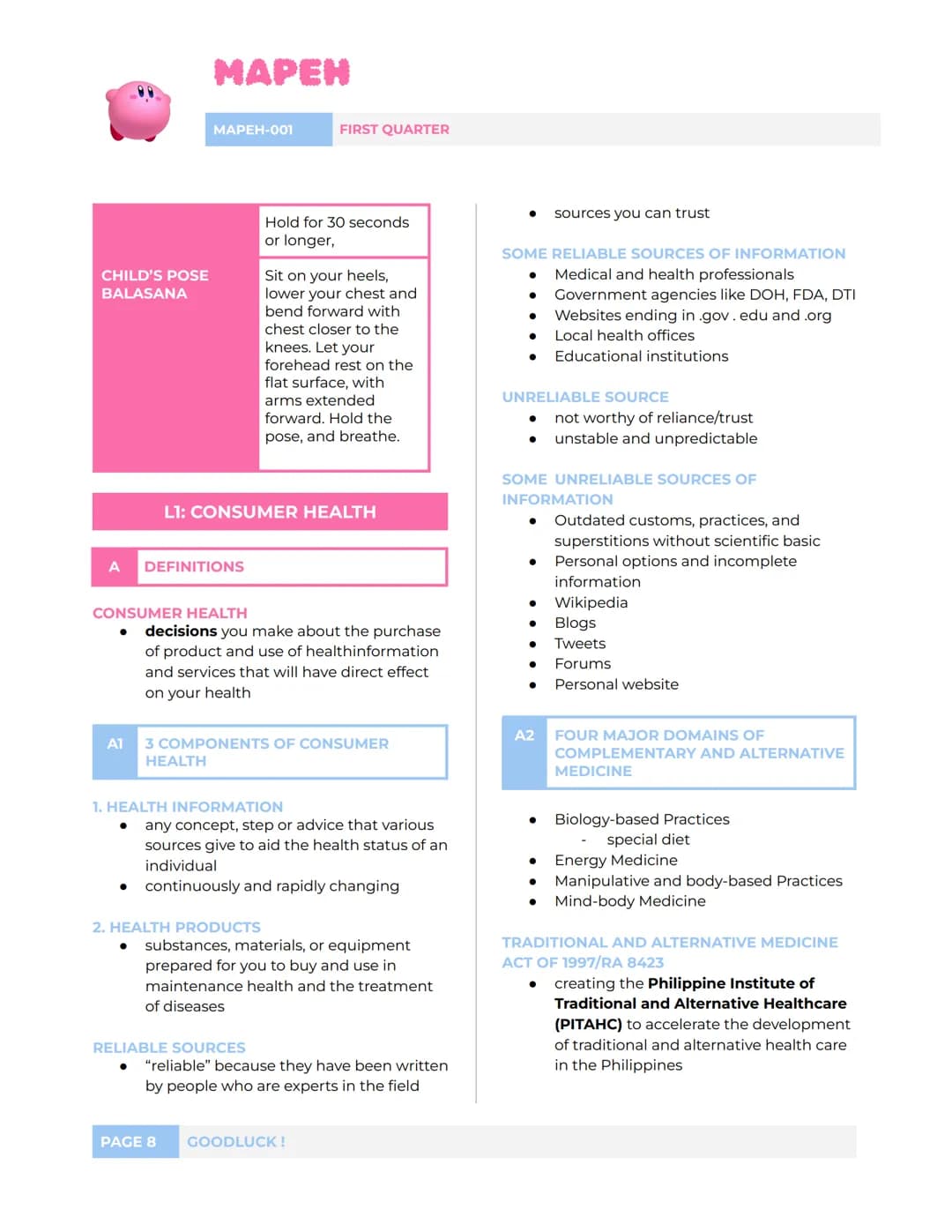
Alternative Medicine and Healthcare Facilities
Alternative medicine offers various approaches beyond conventional treatments. Acupuncture uses thin needles inserted at specific body points to affect energy flow and treat musculoskeletal problems. Ventosa cupping places inverted heated glasses on the skin to relieve muscle and joint pain.
Reflexology treats disorders by massaging specific points on the soles of your feet, while acupressure uses hand pressure instead of needles. Nutrition therapy creates tailored diets to treat medical conditions naturally.
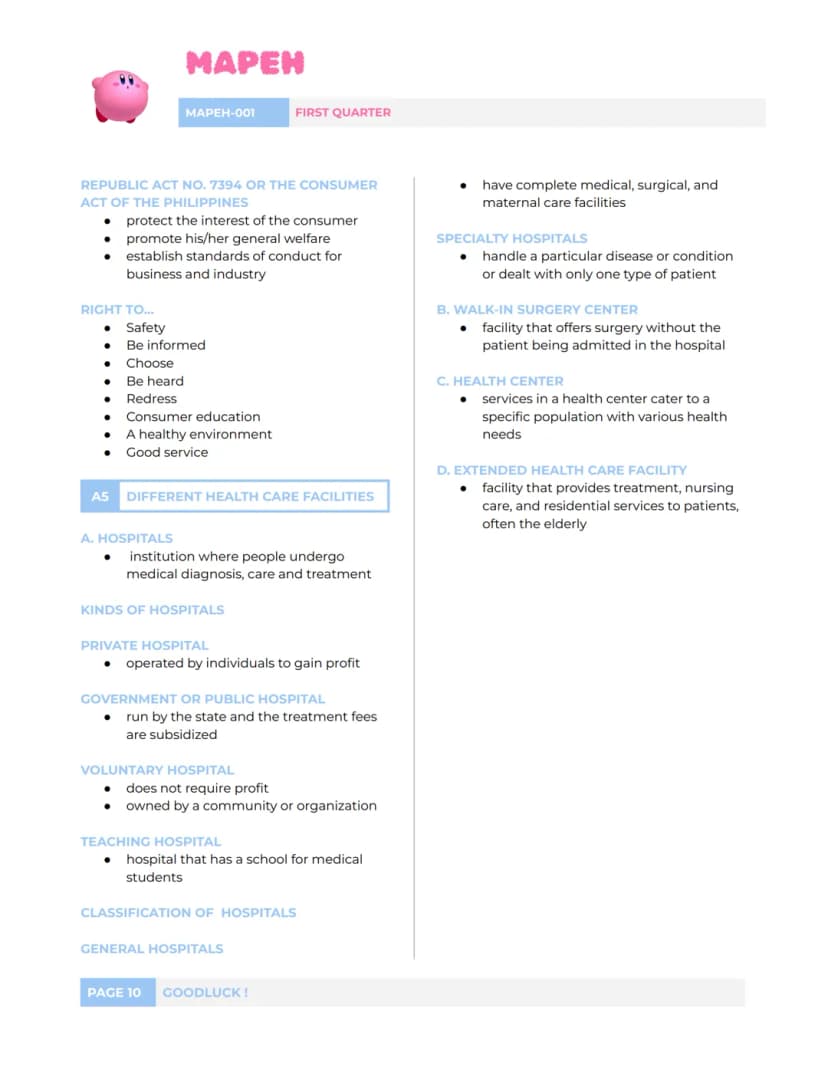
Healthcare facilities serve different needs and populations. General hospitals provide complete medical, surgical, and maternal care, while specialty hospitals focus on specific diseases or patient types. Walk-in surgery centers offer procedures without hospital admission.
The Consumer Act of the Philippines (RA 7394) protects your rights to safety, information, choice, and good service. You have the right to be heard, receive redress for problems, get consumer education, and enjoy a healthy environment.
Know Your Rights: Whether choosing alternative medicine or traditional healthcare, you always have the right to ask questions, get second opinions, and receive quality service!
9
of 10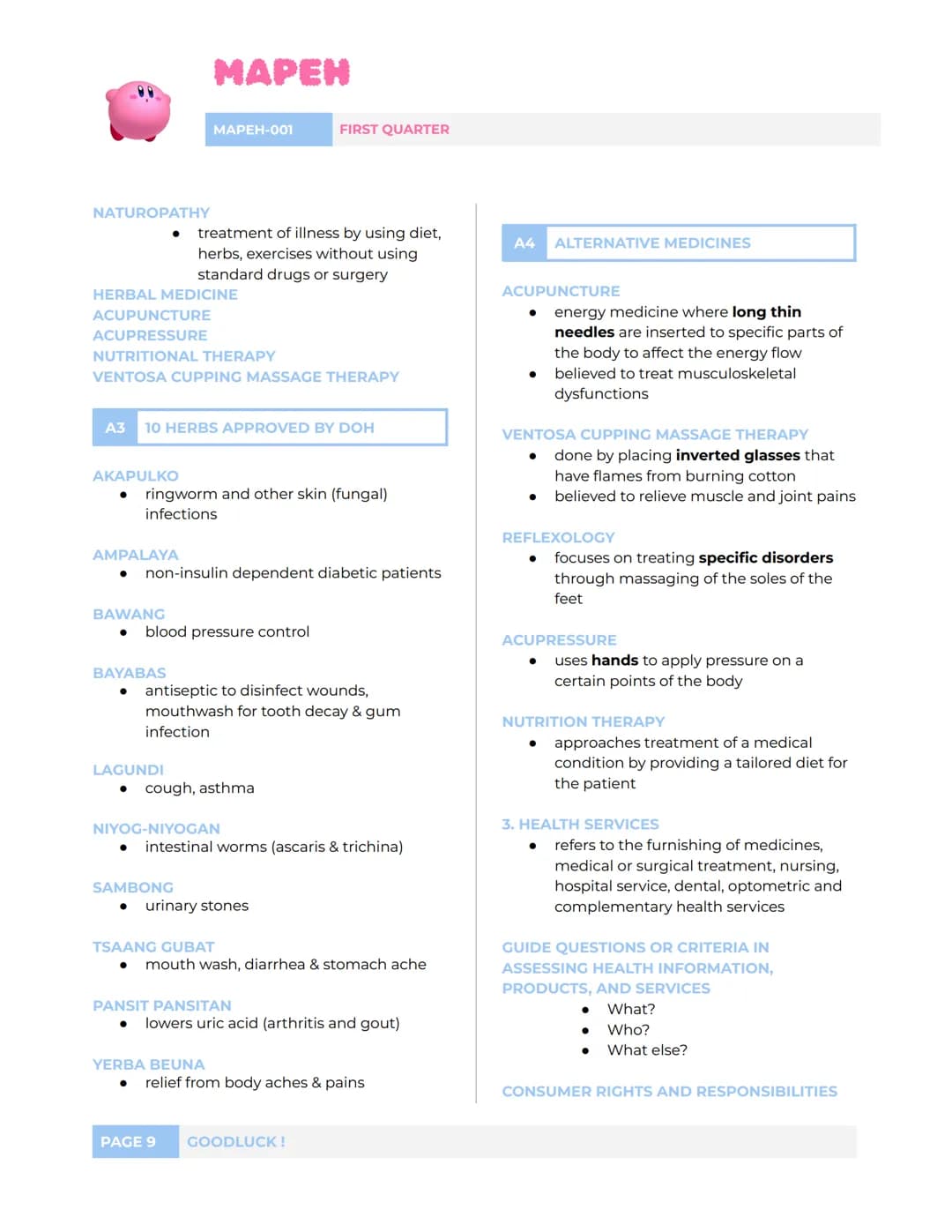
10
of 10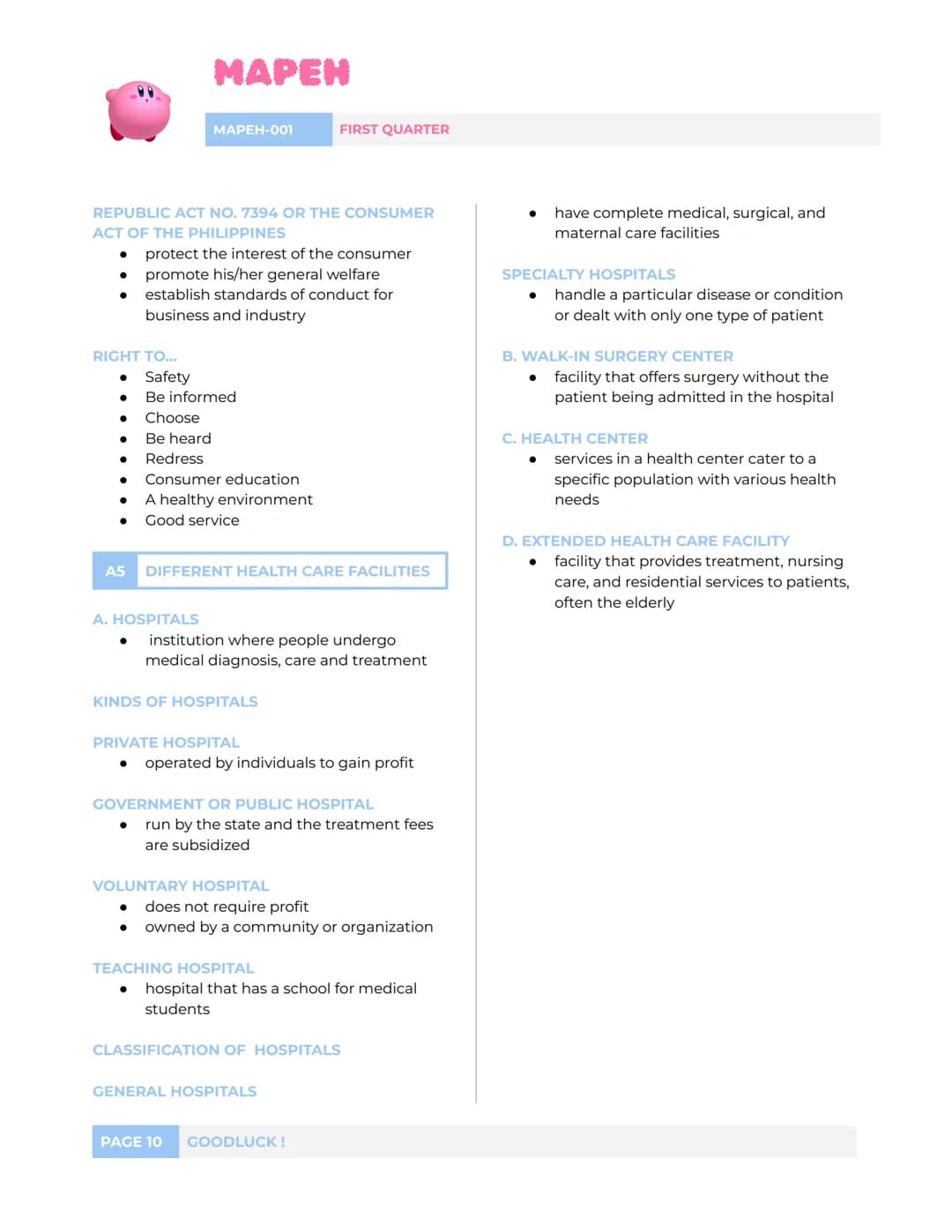
We thought you’d never ask...
What is the Knowunity AI companion?
Our AI companion is specifically built for the needs of students. Based on the millions of content pieces we have on the platform we can provide truly meaningful and relevant answers to students. But its not only about answers, the companion is even more about guiding students through their daily learning challenges, with personalised study plans, quizzes or content pieces in the chat and 100% personalisation based on the students skills and developments.
Where can I download the Knowunity app?
You can download the app in the Google Play Store and in the Apple App Store.
Is Knowunity really free of charge?
That's right! Enjoy free access to study content, connect with fellow students, and get instant help – all at your fingertips.
Most popular content in MAPEH
9MAPEHMAPEH Grade 9 Notes 💙🎶
1st Quarter Notes in Mapeh 9
G93,81182
MAPEHMAPEH Grade 9 Quarter 2 Reviewer
All about the lessons in Grade 9 Quarter 2 MAPEH, all complete, highlighted, printable, and has extra informations.
G96,137151
MAPEHMAPEH G10 2ND QUARTER Reviewer
MAPEH G10 2ND QUARTER Reviewer
G106,352160
MAPEHMUSIC Grade 9 Quarter 2 Reviewer
All about the lessons in Grade 9 Quarter 2 MUSIC, all complete, highlighted, printable, and has extra informations.
G91,34337
MAPEHMUSIC Grade 9 Quarter 3 Reviewer
All about the lessons in Grade 9 Quarter 3 MUSIC, all complete, highlighted, printable, and has extra informations.
G91,20025
MAPEHMAPEH Grade 10 Quarter 2
African Music, Afro-Latin Music, Media Based Arts, FITT Principle, Health related R.A.s
G102,96864
MAPEHMAPEH 9 LECTURE NOTES
2nd quarter notes in MAPEH 9
G103,13556
MAPEHMAPEH Grade 9 Quarter 3 Reviewer
All about the lessons in Grade 9 Quarter 3 MAPEH, all complete, highlighted, printable, and has extra informations.
G92,26733
MAPEHHEALTH Grade 9 Quarter 2 Reviewer
All about the lessons in Grade 9 Quarter 2 HEALTH, all complete, highlighted, printable, and has extra informations.
G967019
Most popular content
9 Math
MathMathematics Grade 10 Quarter 1
Grade 10 Math topics
G1010,223250
 Iba pa
El Filibusterismo (FILIPINO 10)
Kilalanin ang mga karakter at alamin ang mga pangyayari mula Kabanata 1 hanggang 39.
G1011,183240
 Science
Science 9 Quarter 1 Lesson 1
Topics: The Respiratory System and The Circulatory System
G911,075383
 Gen Physics
General Physics 1, First Sem
Units of Measurement, Vectors, and Kinematics. All with formulas
G116,255168
 Filipino
Filipino 8 Reviewer
Filipino Reviewer for 4th Quarter for Grade 8 students
G88,088127
ScienceSCIENCE Grade 9 Quarter 3 Reviewer
All about the lessons in Grade 9 Quarter 3 SCIENCE, all complete, highlighted, printable, and has extra informations.
G914,629303
 Pre-Cal
UPCAT Reviewer: Mathematics
general coverage of the mathematics section for UPCAT
G127,085397
OtherIntroduction to Philosophy - 1st Semester, Grade 12
A summarized notes for Grade 12 students. Easier learning for the 1st semester’s Philosophy subject.
G123,96856
ScienceThe Human Digestive System
Science Grade 8 1st Quarter Lesson
G84,78386
Can't find what you're looking for? Explore other subjects.
Students love us — and so will you.
4.6/5App Store
4.7/5Google Play
The app is very easy to use and well designed. I have found everything I was looking for so far and have been able to learn a lot from the presentations! I will definitely use the app for a class assignment! And of course it also helps a lot as an inspiration.
Stefan SiOS user
This app is really great. There are so many study notes and help [...]. My problem subject is French, for example, and the app has so many options for help. Thanks to this app, I have improved my French. I would recommend it to anyone.
Samantha KlichAndroid user
Wow, I am really amazed. I just tried the app because I've seen it advertised many times and was absolutely stunned. This app is THE HELP you want for school and above all, it offers so many things, such as workouts and fact sheets, which have been VERY helpful to me personally.
AnnaiOS user
MAPEH7,442 views·Updated Jun 23, 2026·10 pagesMAPEH G10 1st Quarter Study Guide
K
kish andres@kishandres
Get ready to dive into the fascinating world of 20th century music, art movements, and health practices! This comprehensive guide covers everything from Impressionism to yoga poses, giving you the essential knowledge you need for your MAPEH class.
1
of 10
Sign up to see the content. It's free!
- Access to all documents
- Improve your grades
- Join milions of students
20th Century Music Movements
Ever wondered why some classical music sounds so dreamy while others feel intense and dramatic? The 20th century brought revolutionary changes to music that completely broke traditional rules.
Impressionism creates hazy, emotional moods using the whole-tone scale and overlapping chords. Think of it like painting with sound - composers like Claude Debussy and Maurice Ravel wanted to capture feelings rather than tell specific stories.
Expressionism takes the opposite approach, revealing raw emotions through atonality and dissonance (basically, notes that clash on purpose). Arnold Schoenberg pioneered the twelve-tone scale, while these compositions often convey darker, more intense feelings.
Primitivism brought back the power of rhythm, with composers like Bela Bartok combining simple ideas to create entirely new sounds. Meanwhile, Neo-classicism was a reaction against all this weirdness - Sergei Prokofiev and others returned to more classical forms but with modern twists.
Quick Tip: Remember that each movement was a reaction to what came before - just like how fashion trends swing from one extreme to another!
2
of 10Sign up to see the content. It's free!
- Access to all documents
- Improve your grades
- Join milions of students
Famous Composers and Their Impact
These musical pioneers didn't just write pretty melodies - they completely changed how we think about music. Claude Debussy became known as the "father of modern composition" by dissolving traditional rules and using gamelan ensemble sounds in his work.
His masterpiece "La Mer" (The Sea) is an atmospheric orchestra work that literally sounds like ocean waves. "Claire de Lune" (Moonlight) remains one of the most recognizable pieces ever written - you've probably heard it in movies or commercials.
Maurice Ravel brought unique innovation with pieces like "Bolero" - a hypnotic work that builds from a whisper to a thunderous climax using the same melody over and over. Both composers performed in opera houses and concert halls for elite audiences.
Arnold Schoenberg established the twelve-tone system and invented Sprechstimme - a weird singing style that's half-speaking, half-singing. His music was so challenging that concerts sometimes caused scandals, but his mathematical approach to choosing notes influenced countless future composers.
Fun Fact: Schoenberg's "Skandal Konzert" literally means "Scandal Concert" - imagine music so revolutionary it caused riots!
3
of 10Sign up to see the content. It's free!
- Access to all documents
- Improve your grades
- Join milions of students
Art Movements That Changed Everything
Just like music, visual art exploded with new styles in the late 1800s and early 1900s. Modern art completely rejected traditional academic painting in favor of bold experimentation.
Impressionism in art works exactly like in music - it's all about capturing fleeting moments of light and color. Claude Monet painted the same garden scenes day after day to show how light changes throughout the day. Pierre-Auguste Renoir focused on people in candid, intimate scenes with soft, brushed touches of color.
Post-Impressionism took things further with artists like Paul Cézanne using geometric approaches and Vincent van Gogh creating those famous swirling, energetic brushstrokes in "Starry Night." These artists cared more about emotional impact than realistic representation.
Expressionism in art mirrors its musical counterpart - it's all about conveying raw emotion through distorted figures and shocking, vivid colors. Artists literally twisted and exaggerated their subjects to make you feel something intense.
Key Insight: Notice how both music and art movements happened simultaneously - artists across different mediums were all rebelling against the same old traditions!
4
of 10Sign up to see the content. It's free!
- Access to all documents
- Improve your grades
- Join milions of students
Avant-Garde and Modern Art Movements
The early 20th century got even weirder with movements that completely abandoned reality. Fauvism, led by Henri Matisse, used bold, non-naturalistic colors - imagine painting a person's face bright green just because it felt right emotionally.
Neo-Primitivism drew inspiration from African tribal art and South Sea Islander carvings. Amedeo Modigliani became famous for those elongated faces and oval shapes that looked nothing like traditional portraits.
Dadaism was basically the "anti-art" movement - Marc Chagall and Giorgio de Chirico created dream-like fantasies and visual tricks that made no logical sense. They deliberately turned their backs on traditional techniques.
Surrealism took this dream concept even further. Salvador Dalí's melting clocks and Joan Miró's abstract shapes depicted the subconscious mind in ways that were completely divorced from reality. Social Realism, on the other hand, used art to protest injustice and social problems.
Reality Check: These "weird" art movements actually reflect the chaos and rapid changes happening in early 20th century society - two world wars, industrialization, and social upheaval!
5
of 10Sign up to see the content. It's free!
- Access to all documents
- Improve your grades
- Join milions of students
Strength Training and Yoga Basics
Now let's shift gears to physical health! Strength training isn't just about building muscles - it increases lean muscle tissue, improves structural strength, decreases body fat, and boosts endurance. Think of it as a complete body makeover system.
Understanding the basics is simple: sets are groups of repetitions, and reps are single full movements from start to finish. The key is designing a program that gradually challenges your body without overdoing it.
Yoga comes from the Sanskrit word "yuj" meaning "to join" or "unite." This ancient Indian practice builds both strength and flexibility while serving as therapy for mind and body. The two main components are posture and breathing - master these and you're golden.
Essential poses include Mountain Pose (Tadasana) where you raise hands overhead like the number 11, Downward Dog (your body makes an inverted V), and Warrior III with one knee at 90 degrees and arms extended. Each pose should be held for specific time periods while focusing on proper breathing.
Pro Tip: Start with basic poses and hold them for shorter periods - yoga is about gradual progress, not showing off on day one!
6
of 10Sign up to see the content. It's free!
- Access to all documents
- Improve your grades
- Join milions of students
Consumer Health and Reliable Information
Making smart health decisions means knowing which sources to trust and which to avoid. Consumer health involves every choice you make about health products, information, and services that directly affect your wellbeing.
Reliable sources include medical professionals, government agencies like DOH (Department of Health) and FDA, websites ending in .gov, .edu, and .org, plus educational institutions. These sources are trustworthy because they're written by actual experts in their fields.
Unreliable sources to avoid include outdated customs without scientific basis, personal opinions, Wikipedia, random blogs, tweets, forums, and personal websites. Just because something is posted online doesn't make it true!
The Traditional and Alternative Medicine Act of 1997 (RA 8423) created PITAHC to develop alternative healthcare in the Philippines. This includes naturopathy (treating illness with diet, herbs, and exercise without standard drugs), acupuncture, acupressure, and various massage therapies.
Smart Move: Always ask "What? Who? What else?" when evaluating health information - what's the claim, who's making it, and what other evidence supports it?
7
of 10Sign up to see the content. It's free!
- Access to all documents
- Improve your grades
- Join milions of students
DOH-Approved Herbal Medicines
The Department of Health has officially approved 10 herbal medicines that you can safely use for specific conditions. Akapulko treats ringworm and fungal skin infections, while Ampalaya helps non-insulin dependent diabetic patients control blood sugar.
Bawang (garlic) works for blood pressure control, and Bayabas (guava) serves as an antiseptic for wounds and mouthwash for dental problems. Lagundi is your go-to for cough and asthma relief.
For digestive issues, Niyog-niyogan eliminates intestinal worms, Sambong helps with urinary stones, and Tsaang Gubat works as mouthwash and treats diarrhea. Pansit-pansitan lowers uric acid for arthritis and gout sufferers.
Yerba Buena provides natural relief from body aches and pains. These aren't just folk remedies - they've undergone scientific testing and received official government approval for safety and effectiveness.
Important: Even though these herbs are DOH-approved, always consult healthcare professionals before using them, especially if you're taking other medications!
8
of 10Sign up to see the content. It's free!
- Access to all documents
- Improve your grades
- Join milions of students
Alternative Medicine and Healthcare Facilities
Alternative medicine offers various approaches beyond conventional treatments. Acupuncture uses thin needles inserted at specific body points to affect energy flow and treat musculoskeletal problems. Ventosa cupping places inverted heated glasses on the skin to relieve muscle and joint pain.
Reflexology treats disorders by massaging specific points on the soles of your feet, while acupressure uses hand pressure instead of needles. Nutrition therapy creates tailored diets to treat medical conditions naturally.
Healthcare facilities serve different needs and populations. General hospitals provide complete medical, surgical, and maternal care, while specialty hospitals focus on specific diseases or patient types. Walk-in surgery centers offer procedures without hospital admission.
The Consumer Act of the Philippines (RA 7394) protects your rights to safety, information, choice, and good service. You have the right to be heard, receive redress for problems, get consumer education, and enjoy a healthy environment.
Know Your Rights: Whether choosing alternative medicine or traditional healthcare, you always have the right to ask questions, get second opinions, and receive quality service!
9
of 10Sign up to see the content. It's free!
- Access to all documents
- Improve your grades
- Join milions of students
10
of 10Sign up to see the content. It's free!
- Access to all documents
- Improve your grades
- Join milions of students
We thought you’d never ask...
What is the Knowunity AI companion?
Our AI companion is specifically built for the needs of students. Based on the millions of content pieces we have on the platform we can provide truly meaningful and relevant answers to students. But its not only about answers, the companion is even more about guiding students through their daily learning challenges, with personalised study plans, quizzes or content pieces in the chat and 100% personalisation based on the students skills and developments.
Where can I download the Knowunity app?
You can download the app in the Google Play Store and in the Apple App Store.
Is Knowunity really free of charge?
That's right! Enjoy free access to study content, connect with fellow students, and get instant help – all at your fingertips.
Most popular content in MAPEH
9MAPEHMAPEH Grade 9 Notes 💙🎶
1st Quarter Notes in Mapeh 9
G93,81182
MAPEHMAPEH Grade 9 Quarter 2 Reviewer
All about the lessons in Grade 9 Quarter 2 MAPEH, all complete, highlighted, printable, and has extra informations.
G96,137151
MAPEHMAPEH G10 2ND QUARTER Reviewer
MAPEH G10 2ND QUARTER Reviewer
G106,352160
MAPEHMUSIC Grade 9 Quarter 2 Reviewer
All about the lessons in Grade 9 Quarter 2 MUSIC, all complete, highlighted, printable, and has extra informations.
G91,34337
MAPEHMUSIC Grade 9 Quarter 3 Reviewer
All about the lessons in Grade 9 Quarter 3 MUSIC, all complete, highlighted, printable, and has extra informations.
G91,20025
MAPEHMAPEH Grade 10 Quarter 2
African Music, Afro-Latin Music, Media Based Arts, FITT Principle, Health related R.A.s
G102,96864
MAPEHMAPEH 9 LECTURE NOTES
2nd quarter notes in MAPEH 9
G103,13556
MAPEHMAPEH Grade 9 Quarter 3 Reviewer
All about the lessons in Grade 9 Quarter 3 MAPEH, all complete, highlighted, printable, and has extra informations.
G92,26733
MAPEHHEALTH Grade 9 Quarter 2 Reviewer
All about the lessons in Grade 9 Quarter 2 HEALTH, all complete, highlighted, printable, and has extra informations.
G967019
Most popular content
9MathMathematics Grade 10 Quarter 1
Grade 10 Math topics
G1010,223250
Iba paEl Filibusterismo (FILIPINO 10)
Kilalanin ang mga karakter at alamin ang mga pangyayari mula Kabanata 1 hanggang 39.
G1011,183240
ScienceScience 9 Quarter 1 Lesson 1
Topics: The Respiratory System and The Circulatory System
G911,075383
Gen PhysicsGeneral Physics 1, First Sem
Units of Measurement, Vectors, and Kinematics. All with formulas
G116,255168
FilipinoFilipino 8 Reviewer
Filipino Reviewer for 4th Quarter for Grade 8 students
G88,088127
ScienceSCIENCE Grade 9 Quarter 3 Reviewer
All about the lessons in Grade 9 Quarter 3 SCIENCE, all complete, highlighted, printable, and has extra informations.
G914,629303
Pre-CalUPCAT Reviewer: Mathematics
general coverage of the mathematics section for UPCAT
G127,085397
OtherIntroduction to Philosophy - 1st Semester, Grade 12
A summarized notes for Grade 12 students. Easier learning for the 1st semester’s Philosophy subject.
G123,96856
ScienceThe Human Digestive System
Science Grade 8 1st Quarter Lesson
G84,78386
Can't find what you're looking for? Explore other subjects.
Students love us — and so will you.
4.6/5App Store
4.7/5Google Play
The app is very easy to use and well designed. I have found everything I was looking for so far and have been able to learn a lot from the presentations! I will definitely use the app for a class assignment! And of course it also helps a lot as an inspiration.
Stefan SiOS user
This app is really great. There are so many study notes and help [...]. My problem subject is French, for example, and the app has so many options for help. Thanks to this app, I have improved my French. I would recommend it to anyone.
Samantha KlichAndroid user
Wow, I am really amazed. I just tried the app because I've seen it advertised many times and was absolutely stunned. This app is THE HELP you want for school and above all, it offers so many things, such as workouts and fact sheets, which have been VERY helpful to me personally.
AnnaiOS user