
¡Vamos a dominar las palabras! En este resumen, veremos las...
 Lengua Castellana y Literatura300 views·Updated Jun 17, 2026·2 pages
Morfología y Gramática: Guía Completa
R
Raquel Martín Pradoo@gly
1
of 2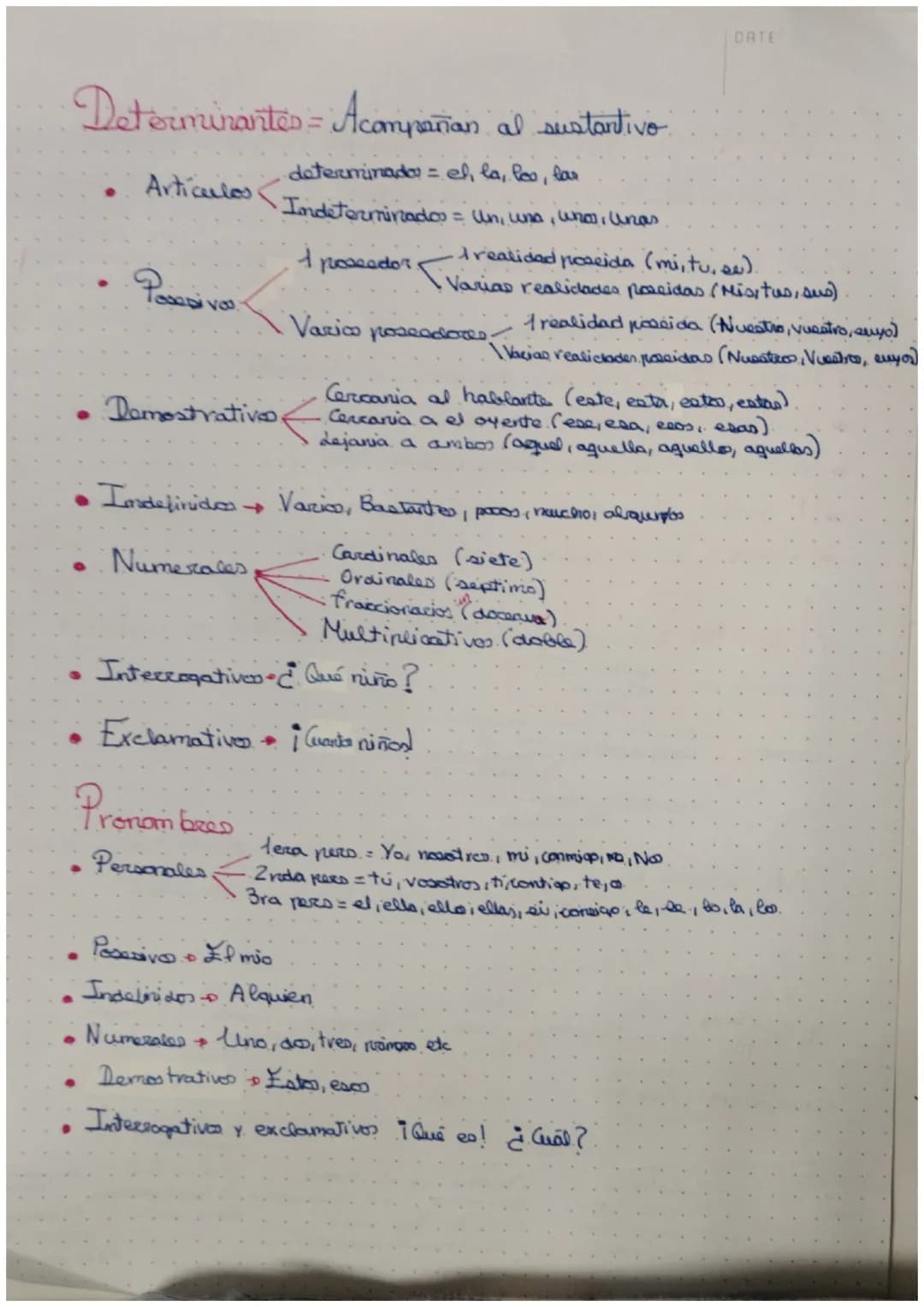
Determinantes y Pronombres
Los determinantes son palabras que acompañan al sustantivo y nos dan información sobre él. Existen varios tipos:
Los artículos pueden ser determinados (el, la, los, las) o indeterminados (un, una, unos, unas). Los posesivos indican pertenencia y varían según el número de poseedores . Los demostrativos señalan distancia (este, ese, aquel) y los indefinidos indican cantidad imprecisa (varios, bastantes).
Los numerales pueden ser cardinales (siete), ordinales (séptimo), fraccionarios (doceava) o multiplicativos (doble). También tenemos interrogativos (¿Qué niño?) y exclamativos (¡Cuánto niño!).
Los pronombres sustituyen al nombre y pueden ser: personales (yo, tú, él), posesivos (el mío), indefinidos (alguien), numerales (uno, dos), demostrativos (estos, esos) e interrogativos/exclamativos (¿qué?, ¿cuánto?).
💡 Truco para recordar: Los determinantes siempre van acompañados de un sustantivo, mientras que los pronombres van solos, sustituyendo al nombre.
2
of 2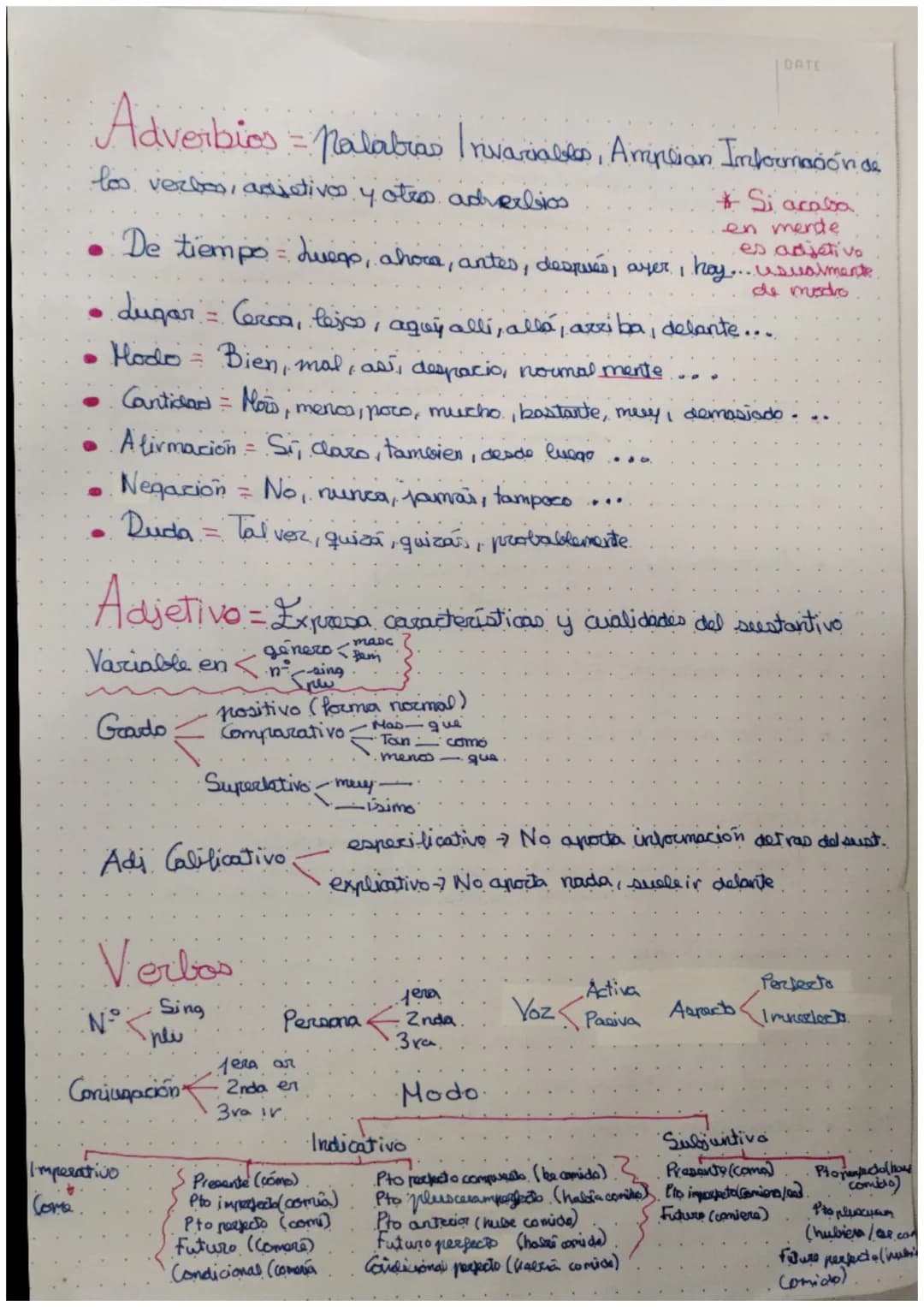
Adverbios, Adjetivos y Verbos
Los adverbios son palabras invariables que amplían información de verbos, adjetivos u otros adverbios. Pueden ser de tiempo (luego, ahora), lugar (cerca, lejos), modo (bien, mal), cantidad (más, menos), afirmación (sí, claro), negación (no, nunca) y duda (quizá, tal vez).
Los adjetivos expresan características del sustantivo y varían en género y número. Tienen diferentes grados: positivo (forma normal), comparativo y superlativo . Pueden ser especificativos (aportan información) o explicativos (suelen ir delante del sustantivo).
Los verbos son palabras que cambian según la persona (primera, segunda, tercera), el número (singular, plural), la voz (activa, pasiva) y el aspecto (perfecto, imperfecto). Se dividen en tres conjugaciones y tienen diferentes modos: indicativo (expresa realidad), subjuntivo (posibilidad) e imperativo (órdenes).
🔍 ¡Atención!: Si una palabra termina en "-mente", suele ser un adverbio de modo, como "normalmente" o "rápidamente".
We thought you’d never ask...
What is the Knowunity AI companion?
Our AI companion is specifically built for the needs of students. Based on the millions of content pieces we have on the platform we can provide truly meaningful and relevant answers to students. But its not only about answers, the companion is even more about guiding students through their daily learning challenges, with personalised study plans, quizzes or content pieces in the chat and 100% personalisation based on the students skills and developments.
Where can I download the Knowunity app?
You can download the app in the Google Play Store and in the Apple App Store.
Is Knowunity really free of charge?
That's right! Enjoy free access to study content, connect with fellow students, and get instant help – all at your fingertips.
Similar Content
 Spanish
 Espagnol
Most popular content: Comparativo
9Lengua Castellana y LiteraturaEl adverbio
Adverbio
6º primaria1,30868
Lengua Castellana y LiteraturaOraciones subordinadas adverbiales
De lugar, tiempo, modo, causal, final, condicional, concesiva, ilativa, consecutiva y comparativa
1° Bach1,68618
Lengua Castellana y LiteraturaAdjetivo
Esquema del Adjetivos +análisis
1° ESO1,54481
Lengua Castellana y LiteraturaRESUMEN CASTELLANO LUCES DE BOHEMIA
RESUMEN CASTELLANO LUCES DE BOHEMIA
1° Bach1,04025
Lengua Castellana y LiteraturaApuntes de los adverbios
Que son los Adverbios y sus tipos.
1° ESO1,02822
Lengua Castellana y LiteraturaTIPOS de SUBORDINADAS
Resumen subordinadas. Tipos: Sustantivas, Relativo y Adverbiales.
2° Bach93712
Lengua Castellana y LiteraturaEl adjetivo
Apuntes del adjetivo
3° ESO2,30467
Lengua Castellana y LiteraturaApuntes de castellano de textos narrativos, descripciones, adjetivos y determinantes
En estos apuntes puedes encontrar todo un tema entero resumido en el cual te explica los elementos de la narración, los tipos de descripciones que hay. También encontraras todas las clases de adjetivos resumidos y los tipos de determinantes que hay.
1° Bach1,99333
Lengua Castellana y LiteraturaLengua castellana 1ºBach
Propiedades de texto y morfología
1° Bach1,10010
Most popular content in Lengua Castellana y Literatura
9O
Lengua Castellana y LiteraturaOBRAS Y AUTORES II
Quiz donde tendrás que relacionar las siguientes obras con sus respectivos autores: edición Romanticismo.
4° ESO3,3610
G
Lengua Castellana y LiteraturaGÉNEROS LITERARIOS
quiz sobre los géneros literarios, ánimo!
2° ESO4,3051
Lengua Castellana y LiteraturaResumen CUENTOS EMILIA PARDO BAZÁN
Incluye un resumen, cuento a cuento, del contenido de los relatos. Temario de las PAU de la Comunidad Valenciana
2° Bach8,912155
Lengua Castellana y LiteraturaSintaxis
Sintexis de Lengua Castellana. Incluye las oraciones simples, los complementos y todas las oraciones compuestas
1° Bach8,168199
Lengua Castellana y LiteraturaApuntes sintaxis
apuntes de sintaxis lengua 1 de bachillerato
4° ESO42,2313,974
R
Lengua Castellana y LiteraturaRepaso 5 primaria.LENGUA CASTELLANA
Aquí repasarás todo lo que has aprendido en 5 de primaria sobre lengua castellana
5º primaria2,1542
Lengua Castellana y LiteraturaOraciones subordinadas, sustantivas, adjetivas y adverbiales
Mejorar en sintaxis
4° ESO5,516117
G
Lengua Castellana y LiteraturaGENERACIÓN DEL 98
Quiz de la Generación del 98, donde se harán diversas preguntas de sus principales representantes en cada uno de los géneros literarios.
4° ESO2,0290
Lengua Castellana y LiteraturaSintaxis
Contenidos: sujeto y predicado, sintagmas y complementos. Todo con ejemplos
4° ESO20,0893,390
Most popular content
9I
 Inglés
irregular verbs quiz
Domina el idioma inglés de manera sencilla y divertida con estos flashcards diseñados especialmente para estudiantes de sexto grado.
6º primaria2,8981
R
 Geografía e Historia
roma
a estudiar Roma!!
1° ESO2,3122
G
Geografía e HistoriaGrecia: Inicio de la democracia
Más o menos las preguntas que me pusieron a mí en el examen
1° ESO2,3622
D
InglésDominando la gramática inglesa: Flashcards desafiantes
Mejora tus habilidades gramaticales en inglés con estos flashcards desafiantes diseñados para estudiantes de grado 11. ¡Prepárate para dominar la gramática inglesa de manera divertida y efectiva!
3° ESO2,2480
M
Geografía e HistoriaMesopotamia y Egipto
Contenidos sobre la civilización mesopotámica y egipcia
1° ESO3,9381
O
Lengua Castellana y LiteraturaOBRAS Y AUTORES II
Quiz donde tendrás que relacionar las siguientes obras con sus respectivos autores: edición Romanticismo.
4° ESO3,3610
I
InglésIngles para repasar
quiz de ingles para entrar a clase preparados
2° ESO2,6290
F
 Filosofía
filosofía
repaso filosofía "el arje , la metafísica y la crítica de Nietszche a platon"
1° Bach2,8421
I
InglésIrregular verbs
Aprende nuevas palabras y expande tu vocabulario en inglés con esta colección de tarjetas de estudio interactivas.
3° ESO1,7442
Can't find what you're looking for? Explore other subjects.
Students love us — and so will you.
4.6/5App Store
4.7/5Google Play
The app is very easy to use and well designed. I have found everything I was looking for so far and have been able to learn a lot from the presentations! I will definitely use the app for a class assignment! And of course it also helps a lot as an inspiration.
Stefan SiOS user
This app is really great. There are so many study notes and help [...]. My problem subject is French, for example, and the app has so many options for help. Thanks to this app, I have improved my French. I would recommend it to anyone.
Samantha KlichAndroid user
Wow, I am really amazed. I just tried the app because I've seen it advertised many times and was absolutely stunned. This app is THE HELP you want for school and above all, it offers so many things, such as workouts and fact sheets, which have been VERY helpful to me personally.
AnnaiOS user
Lengua Castellana y Literatura300 views·Updated Jun 17, 2026·2 pagesMorfología y Gramática: Guía Completa
R
Raquel Martín Pradoo@gly
¡Vamos a dominar las palabras! En este resumen, veremos las diferentes categorías de palabras en español y sus características. Conocer estos elementos te ayudará a escribir y hablar con mayor precisión.
1
of 2
Sign up to see the content. It's free!
- Access to all documents
- Improve your grades
- Join milions of students
Determinantes y Pronombres
Los determinantes son palabras que acompañan al sustantivo y nos dan información sobre él. Existen varios tipos:
Los artículos pueden ser determinados (el, la, los, las) o indeterminados (un, una, unos, unas). Los posesivos indican pertenencia y varían según el número de poseedores . Los demostrativos señalan distancia (este, ese, aquel) y los indefinidos indican cantidad imprecisa (varios, bastantes).
Los numerales pueden ser cardinales (siete), ordinales (séptimo), fraccionarios (doceava) o multiplicativos (doble). También tenemos interrogativos (¿Qué niño?) y exclamativos (¡Cuánto niño!).
Los pronombres sustituyen al nombre y pueden ser: personales (yo, tú, él), posesivos (el mío), indefinidos (alguien), numerales (uno, dos), demostrativos (estos, esos) e interrogativos/exclamativos (¿qué?, ¿cuánto?).
💡 Truco para recordar: Los determinantes siempre van acompañados de un sustantivo, mientras que los pronombres van solos, sustituyendo al nombre.
2
of 2Sign up to see the content. It's free!
- Access to all documents
- Improve your grades
- Join milions of students
Adverbios, Adjetivos y Verbos
Los adverbios son palabras invariables que amplían información de verbos, adjetivos u otros adverbios. Pueden ser de tiempo (luego, ahora), lugar (cerca, lejos), modo (bien, mal), cantidad (más, menos), afirmación (sí, claro), negación (no, nunca) y duda (quizá, tal vez).
Los adjetivos expresan características del sustantivo y varían en género y número. Tienen diferentes grados: positivo (forma normal), comparativo y superlativo . Pueden ser especificativos (aportan información) o explicativos (suelen ir delante del sustantivo).
Los verbos son palabras que cambian según la persona (primera, segunda, tercera), el número (singular, plural), la voz (activa, pasiva) y el aspecto (perfecto, imperfecto). Se dividen en tres conjugaciones y tienen diferentes modos: indicativo (expresa realidad), subjuntivo (posibilidad) e imperativo (órdenes).
🔍 ¡Atención!: Si una palabra termina en "-mente", suele ser un adverbio de modo, como "normalmente" o "rápidamente".
We thought you’d never ask...
What is the Knowunity AI companion?
Our AI companion is specifically built for the needs of students. Based on the millions of content pieces we have on the platform we can provide truly meaningful and relevant answers to students. But its not only about answers, the companion is even more about guiding students through their daily learning challenges, with personalised study plans, quizzes or content pieces in the chat and 100% personalisation based on the students skills and developments.
Where can I download the Knowunity app?
You can download the app in the Google Play Store and in the Apple App Store.
Is Knowunity really free of charge?
That's right! Enjoy free access to study content, connect with fellow students, and get instant help – all at your fingertips.
Similar Content
Most popular content: Comparativo
9Lengua Castellana y LiteraturaEl adverbio
Adverbio
6º primaria1,30868
Lengua Castellana y LiteraturaOraciones subordinadas adverbiales
De lugar, tiempo, modo, causal, final, condicional, concesiva, ilativa, consecutiva y comparativa
1° Bach1,68618
Lengua Castellana y LiteraturaAdjetivo
Esquema del Adjetivos +análisis
1° ESO1,54481
Lengua Castellana y LiteraturaRESUMEN CASTELLANO LUCES DE BOHEMIA
RESUMEN CASTELLANO LUCES DE BOHEMIA
1° Bach1,04025
Lengua Castellana y LiteraturaApuntes de los adverbios
Que son los Adverbios y sus tipos.
1° ESO1,02822
Lengua Castellana y LiteraturaTIPOS de SUBORDINADAS
Resumen subordinadas. Tipos: Sustantivas, Relativo y Adverbiales.
2° Bach93712
Lengua Castellana y LiteraturaEl adjetivo
Apuntes del adjetivo
3° ESO2,30467
Lengua Castellana y LiteraturaApuntes de castellano de textos narrativos, descripciones, adjetivos y determinantes
En estos apuntes puedes encontrar todo un tema entero resumido en el cual te explica los elementos de la narración, los tipos de descripciones que hay. También encontraras todas las clases de adjetivos resumidos y los tipos de determinantes que hay.
1° Bach1,99333
Lengua Castellana y LiteraturaLengua castellana 1ºBach
Propiedades de texto y morfología
1° Bach1,10010
Most popular content in Lengua Castellana y Literatura
9O
Lengua Castellana y LiteraturaOBRAS Y AUTORES II
Quiz donde tendrás que relacionar las siguientes obras con sus respectivos autores: edición Romanticismo.
4° ESO3,3610
G
Lengua Castellana y LiteraturaGÉNEROS LITERARIOS
quiz sobre los géneros literarios, ánimo!
2° ESO4,3051
Lengua Castellana y LiteraturaResumen CUENTOS EMILIA PARDO BAZÁN
Incluye un resumen, cuento a cuento, del contenido de los relatos. Temario de las PAU de la Comunidad Valenciana
2° Bach8,912155
Lengua Castellana y LiteraturaSintaxis
Sintexis de Lengua Castellana. Incluye las oraciones simples, los complementos y todas las oraciones compuestas
1° Bach8,168199
Lengua Castellana y LiteraturaApuntes sintaxis
apuntes de sintaxis lengua 1 de bachillerato
4° ESO42,2313,974
R
Lengua Castellana y LiteraturaRepaso 5 primaria.LENGUA CASTELLANA
Aquí repasarás todo lo que has aprendido en 5 de primaria sobre lengua castellana
5º primaria2,1542
Lengua Castellana y LiteraturaOraciones subordinadas, sustantivas, adjetivas y adverbiales
Mejorar en sintaxis
4° ESO5,516117
G
Lengua Castellana y LiteraturaGENERACIÓN DEL 98
Quiz de la Generación del 98, donde se harán diversas preguntas de sus principales representantes en cada uno de los géneros literarios.
4° ESO2,0290
Lengua Castellana y LiteraturaSintaxis
Contenidos: sujeto y predicado, sintagmas y complementos. Todo con ejemplos
4° ESO20,0893,390
Most popular content
9I
Inglésirregular verbs quiz
Domina el idioma inglés de manera sencilla y divertida con estos flashcards diseñados especialmente para estudiantes de sexto grado.
6º primaria2,8981
R
Geografía e Historiaroma
a estudiar Roma!!
1° ESO2,3122
G
Geografía e HistoriaGrecia: Inicio de la democracia
Más o menos las preguntas que me pusieron a mí en el examen
1° ESO2,3622
D
InglésDominando la gramática inglesa: Flashcards desafiantes
Mejora tus habilidades gramaticales en inglés con estos flashcards desafiantes diseñados para estudiantes de grado 11. ¡Prepárate para dominar la gramática inglesa de manera divertida y efectiva!
3° ESO2,2480
M
Geografía e HistoriaMesopotamia y Egipto
Contenidos sobre la civilización mesopotámica y egipcia
1° ESO3,9381
O
Lengua Castellana y LiteraturaOBRAS Y AUTORES II
Quiz donde tendrás que relacionar las siguientes obras con sus respectivos autores: edición Romanticismo.
4° ESO3,3610
I
InglésIngles para repasar
quiz de ingles para entrar a clase preparados
2° ESO2,6290
F
Filosofíafilosofía
repaso filosofía "el arje , la metafísica y la crítica de Nietszche a platon"
1° Bach2,8421
I
InglésIrregular verbs
Aprende nuevas palabras y expande tu vocabulario en inglés con esta colección de tarjetas de estudio interactivas.
3° ESO1,7442
Can't find what you're looking for? Explore other subjects.
Students love us — and so will you.
4.6/5App Store
4.7/5Google Play
The app is very easy to use and well designed. I have found everything I was looking for so far and have been able to learn a lot from the presentations! I will definitely use the app for a class assignment! And of course it also helps a lot as an inspiration.
Stefan SiOS user
This app is really great. There are so many study notes and help [...]. My problem subject is French, for example, and the app has so many options for help. Thanks to this app, I have improved my French. I would recommend it to anyone.
Samantha KlichAndroid user
Wow, I am really amazed. I just tried the app because I've seen it advertised many times and was absolutely stunned. This app is THE HELP you want for school and above all, it offers so many things, such as workouts and fact sheets, which have been VERY helpful to me personally.
AnnaiOS user