
¿Te lías con los sintagmas y complementos del verbo? Tranquilo,...
 Lengua Castellana y Literatura2,731 views·Updated Jun 19, 2026·3 pages
Guía Básica de Análisis Sintáctico

Lola Vallejo@lolavallejo


1 / 3
1
of 3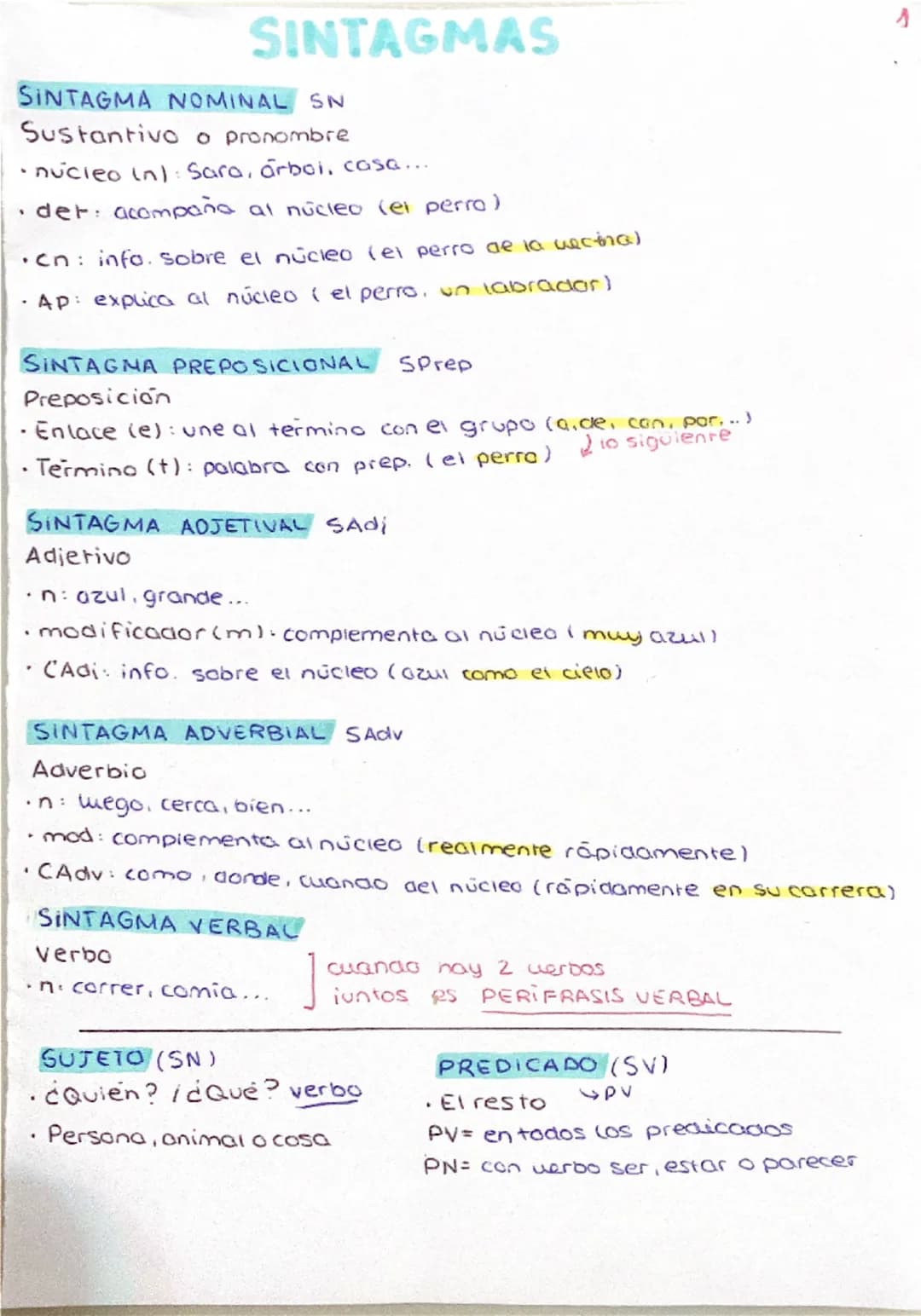
Tipos de Sintagmas
Los sintagmas son grupos de palabras que funcionan juntos en una oración. Cada uno tiene un núcleo principal y elementos que lo acompañan.
El sintagma nominal (SN) tiene como núcleo un sustantivo o pronombre (Sara, árbol, cosa). Le pueden acompañar determinantes como "el", complementos del nombre que dan más información, y aposiciones que explican mejor el núcleo.
El sintagma preposicional (SPrep) usa una preposición como enlace (a, de, con, por) que conecta con un término. El sintagma adjetival (SAdj) tiene un adjetivo como núcleo (azul, grande) que puede llevar modificadores como "muy".
Truco clave: El sintagma adverbial (SAdv) funciona igual pero con adverbios (lejos, bien), y el sintagma verbal (SV) siempre tiene un verbo como núcleo.
2
of 3
Complementos del Verbo
Cada complemento cumple una función específica y tiene trucos para identificarlo. El complemento directo (CD) se sustituye por lo, la, los, las y responde a "¿qué?" del verbo.
El complemento indirecto (CI) se cambia por le, les y lleva la preposición "a" - es quien recibe la acción. El atributo solo aparece con ser, estar o parecer y se sustituye por "lo".
El complemento predicativo describe cómo está el sujeto o CD durante la acción. El complemento de régimen siempre lleva una preposición fija del verbo (pensar EN, confiar EN).
Dato importante: Los complementos circunstanciales expresan dónde, cuándo, cómo, por qué... de la acción, y el complemento agente solo existe en oraciones pasivas con "por" o "de".
3
of 3
Clasificación de Oraciones
Las oraciones se clasifican según varios criterios que debes dominar. Personales tienen sujeto (aunque no se vea), mientras que impersonales no lo tienen.
Transitivas necesitan complemento directo para tener sentido completo, pero las intransitivas no lo necesitan. Las atributivas usan verbos copulativos (ser, estar, parecer) con atributo.
En las oraciones activas el sujeto hace la acción, pero en las pasivas la recibe. Por ejemplo: "Yo como pizza" (activa) frente a "La pizza es comida por mí" (pasiva).
Consejo práctico: Para identificar el tipo de oración, pregúntate siempre: ¿quién hace qué a quién? Esto te ayudará a distinguir entre activa y pasiva fácilmente.
We thought you’d never ask...
What is the Knowunity AI companion?
Our AI companion is specifically built for the needs of students. Based on the millions of content pieces we have on the platform we can provide truly meaningful and relevant answers to students. But its not only about answers, the companion is even more about guiding students through their daily learning challenges, with personalised study plans, quizzes or content pieces in the chat and 100% personalisation based on the students skills and developments.
Where can I download the Knowunity app?
You can download the app in the Google Play Store and in the Apple App Store.
Is Knowunity really free of charge?
That's right! Enjoy free access to study content, connect with fellow students, and get instant help – all at your fingertips.
Similar Content
 Matemáticas
 Lengua Castellana
Most popular content: ejercicios de sintaxis
9Lengua Castellana y LiteraturaApuntes sintaxis
apuntes de sintaxis lengua 1 de bachillerato
4° ESO42,2313,974
Lengua Castellana y LiteraturaSintaxis
Contenidos: sujeto y predicado, sintagmas y complementos. Todo con ejemplos
4° ESO20,0863,389
Lengua Castellana y LiteraturaApuntes sintaxis
Apuntes de sintaxis con ejemplos al final
4° ESO4,431118
Lengua Castellana y LiteraturaSintaxis
Apuntes de sintaxis
4° ESO6,027138
Lengua Castellana y LiteraturaEstructuras de oraciones subordinadas
Análisis sintáctico de oraciones subordinadas y ejercicios prácticos para comprender su función en la gramática española.
1° Bach3,45369
Lengua Castellana y LiteraturaSintaxis. La oración compuesta.
Sintaxis Bachillerato EBAU EVAU Selectividad Lengua
1° Bach9,820607
Lengua Castellana y LiteraturaSintaxis
oraciones compuestas ( yuxtapuestas, coordinadas y subordinadas)
1° Bach3,789120
Lengua Castellana y LiteraturaTemario sintaxis completo evau pau lengua castellana y literatura
Todo tipo de oraciones sintácticas para bachillerato, evau y pau. Oraciones compuestas, coordinadas, yuxtapuestas, subordinadas, adverbiales y sus subtipos. Ejemplos de sintaxis resueltos
1° Bach3,42745
Lengua Castellana y LiteraturaSINTAXIS DE LA ORACIÓN COMPUESTA, muchos ejemplos
EBAU lengua morfosintaxis, hecho con el iPad
2° Bach13,7551,603
Most popular content in Lengua Castellana y Literatura
9O
Lengua Castellana y LiteraturaOBRAS Y AUTORES II
Quiz donde tendrás que relacionar las siguientes obras con sus respectivos autores: edición Romanticismo.
4° ESO3,3610
G
Lengua Castellana y LiteraturaGÉNEROS LITERARIOS
quiz sobre los géneros literarios, ánimo!
2° ESO4,3051
Lengua Castellana y LiteraturaResumen CUENTOS EMILIA PARDO BAZÁN
Incluye un resumen, cuento a cuento, del contenido de los relatos. Temario de las PAU de la Comunidad Valenciana
2° Bach8,912155
Lengua Castellana y LiteraturaSintaxis
Sintexis de Lengua Castellana. Incluye las oraciones simples, los complementos y todas las oraciones compuestas
1° Bach8,168199
Lengua Castellana y LiteraturaApuntes sintaxis
apuntes de sintaxis lengua 1 de bachillerato
4° ESO42,2313,974
R
Lengua Castellana y LiteraturaRepaso 5 primaria.LENGUA CASTELLANA
Aquí repasarás todo lo que has aprendido en 5 de primaria sobre lengua castellana
5º primaria2,1542
Lengua Castellana y LiteraturaOraciones subordinadas, sustantivas, adjetivas y adverbiales
Mejorar en sintaxis
4° ESO5,516117
G
Lengua Castellana y LiteraturaGENERACIÓN DEL 98
Quiz de la Generación del 98, donde se harán diversas preguntas de sus principales representantes en cada uno de los géneros literarios.
4° ESO2,0290
Lengua Castellana y LiteraturaSintaxis
Contenidos: sujeto y predicado, sintagmas y complementos. Todo con ejemplos
4° ESO20,0863,389
Most popular content
9I
 Inglés
irregular verbs quiz
Domina el idioma inglés de manera sencilla y divertida con estos flashcards diseñados especialmente para estudiantes de sexto grado.
6º primaria2,8981
R
 Geografía e Historia
roma
a estudiar Roma!!
1° ESO2,3122
G
Geografía e HistoriaGrecia: Inicio de la democracia
Más o menos las preguntas que me pusieron a mí en el examen
1° ESO2,3622
D
InglésDominando la gramática inglesa: Flashcards desafiantes
Mejora tus habilidades gramaticales en inglés con estos flashcards desafiantes diseñados para estudiantes de grado 11. ¡Prepárate para dominar la gramática inglesa de manera divertida y efectiva!
3° ESO2,2450
M
Geografía e HistoriaMesopotamia y Egipto
Contenidos sobre la civilización mesopotámica y egipcia
1° ESO3,9381
O
Lengua Castellana y LiteraturaOBRAS Y AUTORES II
Quiz donde tendrás que relacionar las siguientes obras con sus respectivos autores: edición Romanticismo.
4° ESO3,3610
I
InglésIngles para repasar
quiz de ingles para entrar a clase preparados
2° ESO2,6290
F
 Filosofía
filosofía
repaso filosofía "el arje , la metafísica y la crítica de Nietszche a platon"
1° Bach2,8421
I
InglésIrregular verbs
Aprende nuevas palabras y expande tu vocabulario en inglés con esta colección de tarjetas de estudio interactivas.
3° ESO1,7442
Can't find what you're looking for? Explore other subjects.
Students love us — and so will you.
4.6/5App Store
4.7/5Google Play
The app is very easy to use and well designed. I have found everything I was looking for so far and have been able to learn a lot from the presentations! I will definitely use the app for a class assignment! And of course it also helps a lot as an inspiration.
Stefan SiOS user
This app is really great. There are so many study notes and help [...]. My problem subject is French, for example, and the app has so many options for help. Thanks to this app, I have improved my French. I would recommend it to anyone.
Samantha KlichAndroid user
Wow, I am really amazed. I just tried the app because I've seen it advertised many times and was absolutely stunned. This app is THE HELP you want for school and above all, it offers so many things, such as workouts and fact sheets, which have been VERY helpful to me personally.
AnnaiOS user
Lengua Castellana y Literatura2,731 views·Updated Jun 19, 2026·3 pagesGuía Básica de Análisis Sintáctico
Lola Vallejo@lolavallejo
¿Te lías con los sintagmas y complementos del verbo? Tranquilo, que es más fácil de lo que parece. Vamos a ver de forma clara cómo funciona la sintaxis española para que puedas analizar oraciones sin complicarte la vida.
1
of 3
Sign up to see the content. It's free!
- Access to all documents
- Improve your grades
- Join milions of students
Tipos de Sintagmas
Los sintagmas son grupos de palabras que funcionan juntos en una oración. Cada uno tiene un núcleo principal y elementos que lo acompañan.
El sintagma nominal (SN) tiene como núcleo un sustantivo o pronombre (Sara, árbol, cosa). Le pueden acompañar determinantes como "el", complementos del nombre que dan más información, y aposiciones que explican mejor el núcleo.
El sintagma preposicional (SPrep) usa una preposición como enlace (a, de, con, por) que conecta con un término. El sintagma adjetival (SAdj) tiene un adjetivo como núcleo (azul, grande) que puede llevar modificadores como "muy".
Truco clave: El sintagma adverbial (SAdv) funciona igual pero con adverbios (lejos, bien), y el sintagma verbal (SV) siempre tiene un verbo como núcleo.
2
of 3Sign up to see the content. It's free!
- Access to all documents
- Improve your grades
- Join milions of students
Complementos del Verbo
Cada complemento cumple una función específica y tiene trucos para identificarlo. El complemento directo (CD) se sustituye por lo, la, los, las y responde a "¿qué?" del verbo.
El complemento indirecto (CI) se cambia por le, les y lleva la preposición "a" - es quien recibe la acción. El atributo solo aparece con ser, estar o parecer y se sustituye por "lo".
El complemento predicativo describe cómo está el sujeto o CD durante la acción. El complemento de régimen siempre lleva una preposición fija del verbo (pensar EN, confiar EN).
Dato importante: Los complementos circunstanciales expresan dónde, cuándo, cómo, por qué... de la acción, y el complemento agente solo existe en oraciones pasivas con "por" o "de".
3
of 3Sign up to see the content. It's free!
- Access to all documents
- Improve your grades
- Join milions of students
Clasificación de Oraciones
Las oraciones se clasifican según varios criterios que debes dominar. Personales tienen sujeto (aunque no se vea), mientras que impersonales no lo tienen.
Transitivas necesitan complemento directo para tener sentido completo, pero las intransitivas no lo necesitan. Las atributivas usan verbos copulativos (ser, estar, parecer) con atributo.
En las oraciones activas el sujeto hace la acción, pero en las pasivas la recibe. Por ejemplo: "Yo como pizza" (activa) frente a "La pizza es comida por mí" (pasiva).
Consejo práctico: Para identificar el tipo de oración, pregúntate siempre: ¿quién hace qué a quién? Esto te ayudará a distinguir entre activa y pasiva fácilmente.
We thought you’d never ask...
What is the Knowunity AI companion?
Our AI companion is specifically built for the needs of students. Based on the millions of content pieces we have on the platform we can provide truly meaningful and relevant answers to students. But its not only about answers, the companion is even more about guiding students through their daily learning challenges, with personalised study plans, quizzes or content pieces in the chat and 100% personalisation based on the students skills and developments.
Where can I download the Knowunity app?
You can download the app in the Google Play Store and in the Apple App Store.
Is Knowunity really free of charge?
That's right! Enjoy free access to study content, connect with fellow students, and get instant help – all at your fingertips.
Similar Content
Most popular content: ejercicios de sintaxis
9Lengua Castellana y LiteraturaApuntes sintaxis
apuntes de sintaxis lengua 1 de bachillerato
4° ESO42,2313,974
Lengua Castellana y LiteraturaSintaxis
Contenidos: sujeto y predicado, sintagmas y complementos. Todo con ejemplos
4° ESO20,0863,389
Lengua Castellana y LiteraturaApuntes sintaxis
Apuntes de sintaxis con ejemplos al final
4° ESO4,431118
Lengua Castellana y LiteraturaSintaxis
Apuntes de sintaxis
4° ESO6,027138
Lengua Castellana y LiteraturaEstructuras de oraciones subordinadas
Análisis sintáctico de oraciones subordinadas y ejercicios prácticos para comprender su función en la gramática española.
1° Bach3,45369
Lengua Castellana y LiteraturaSintaxis. La oración compuesta.
Sintaxis Bachillerato EBAU EVAU Selectividad Lengua
1° Bach9,820607
Lengua Castellana y LiteraturaSintaxis
oraciones compuestas ( yuxtapuestas, coordinadas y subordinadas)
1° Bach3,789120
Lengua Castellana y LiteraturaTemario sintaxis completo evau pau lengua castellana y literatura
Todo tipo de oraciones sintácticas para bachillerato, evau y pau. Oraciones compuestas, coordinadas, yuxtapuestas, subordinadas, adverbiales y sus subtipos. Ejemplos de sintaxis resueltos
1° Bach3,42745
Lengua Castellana y LiteraturaSINTAXIS DE LA ORACIÓN COMPUESTA, muchos ejemplos
EBAU lengua morfosintaxis, hecho con el iPad
2° Bach13,7551,603
Most popular content in Lengua Castellana y Literatura
9O
Lengua Castellana y LiteraturaOBRAS Y AUTORES II
Quiz donde tendrás que relacionar las siguientes obras con sus respectivos autores: edición Romanticismo.
4° ESO3,3610
G
Lengua Castellana y LiteraturaGÉNEROS LITERARIOS
quiz sobre los géneros literarios, ánimo!
2° ESO4,3051
Lengua Castellana y LiteraturaResumen CUENTOS EMILIA PARDO BAZÁN
Incluye un resumen, cuento a cuento, del contenido de los relatos. Temario de las PAU de la Comunidad Valenciana
2° Bach8,912155
Lengua Castellana y LiteraturaSintaxis
Sintexis de Lengua Castellana. Incluye las oraciones simples, los complementos y todas las oraciones compuestas
1° Bach8,168199
Lengua Castellana y LiteraturaApuntes sintaxis
apuntes de sintaxis lengua 1 de bachillerato
4° ESO42,2313,974
R
Lengua Castellana y LiteraturaRepaso 5 primaria.LENGUA CASTELLANA
Aquí repasarás todo lo que has aprendido en 5 de primaria sobre lengua castellana
5º primaria2,1542
Lengua Castellana y LiteraturaOraciones subordinadas, sustantivas, adjetivas y adverbiales
Mejorar en sintaxis
4° ESO5,516117
G
Lengua Castellana y LiteraturaGENERACIÓN DEL 98
Quiz de la Generación del 98, donde se harán diversas preguntas de sus principales representantes en cada uno de los géneros literarios.
4° ESO2,0290
Lengua Castellana y LiteraturaSintaxis
Contenidos: sujeto y predicado, sintagmas y complementos. Todo con ejemplos
4° ESO20,0863,389
Most popular content
9I
Inglésirregular verbs quiz
Domina el idioma inglés de manera sencilla y divertida con estos flashcards diseñados especialmente para estudiantes de sexto grado.
6º primaria2,8981
R
Geografía e Historiaroma
a estudiar Roma!!
1° ESO2,3122
G
Geografía e HistoriaGrecia: Inicio de la democracia
Más o menos las preguntas que me pusieron a mí en el examen
1° ESO2,3622
D
InglésDominando la gramática inglesa: Flashcards desafiantes
Mejora tus habilidades gramaticales en inglés con estos flashcards desafiantes diseñados para estudiantes de grado 11. ¡Prepárate para dominar la gramática inglesa de manera divertida y efectiva!
3° ESO2,2450
M
Geografía e HistoriaMesopotamia y Egipto
Contenidos sobre la civilización mesopotámica y egipcia
1° ESO3,9381
O
Lengua Castellana y LiteraturaOBRAS Y AUTORES II
Quiz donde tendrás que relacionar las siguientes obras con sus respectivos autores: edición Romanticismo.
4° ESO3,3610
I
InglésIngles para repasar
quiz de ingles para entrar a clase preparados
2° ESO2,6290
F
Filosofíafilosofía
repaso filosofía "el arje , la metafísica y la crítica de Nietszche a platon"
1° Bach2,8421
I
InglésIrregular verbs
Aprende nuevas palabras y expande tu vocabulario en inglés con esta colección de tarjetas de estudio interactivas.
3° ESO1,7442
Can't find what you're looking for? Explore other subjects.
Students love us — and so will you.
4.6/5App Store
4.7/5Google Play
The app is very easy to use and well designed. I have found everything I was looking for so far and have been able to learn a lot from the presentations! I will definitely use the app for a class assignment! And of course it also helps a lot as an inspiration.
Stefan SiOS user
This app is really great. There are so many study notes and help [...]. My problem subject is French, for example, and the app has so many options for help. Thanks to this app, I have improved my French. I would recommend it to anyone.
Samantha KlichAndroid user
Wow, I am really amazed. I just tried the app because I've seen it advertised many times and was absolutely stunned. This app is THE HELP you want for school and above all, it offers so many things, such as workouts and fact sheets, which have been VERY helpful to me personally.
AnnaiOS user