
¿Te has preguntado por qué palabras como "yo", "aquí" o...
 Lengua Castellana186 views·Updated Jun 23, 2026·2 pages
Entendiendo los Deícticos: Temporales, Personales y Espaciales
A
adriana Chavarria@adrianachavarri
1
of 2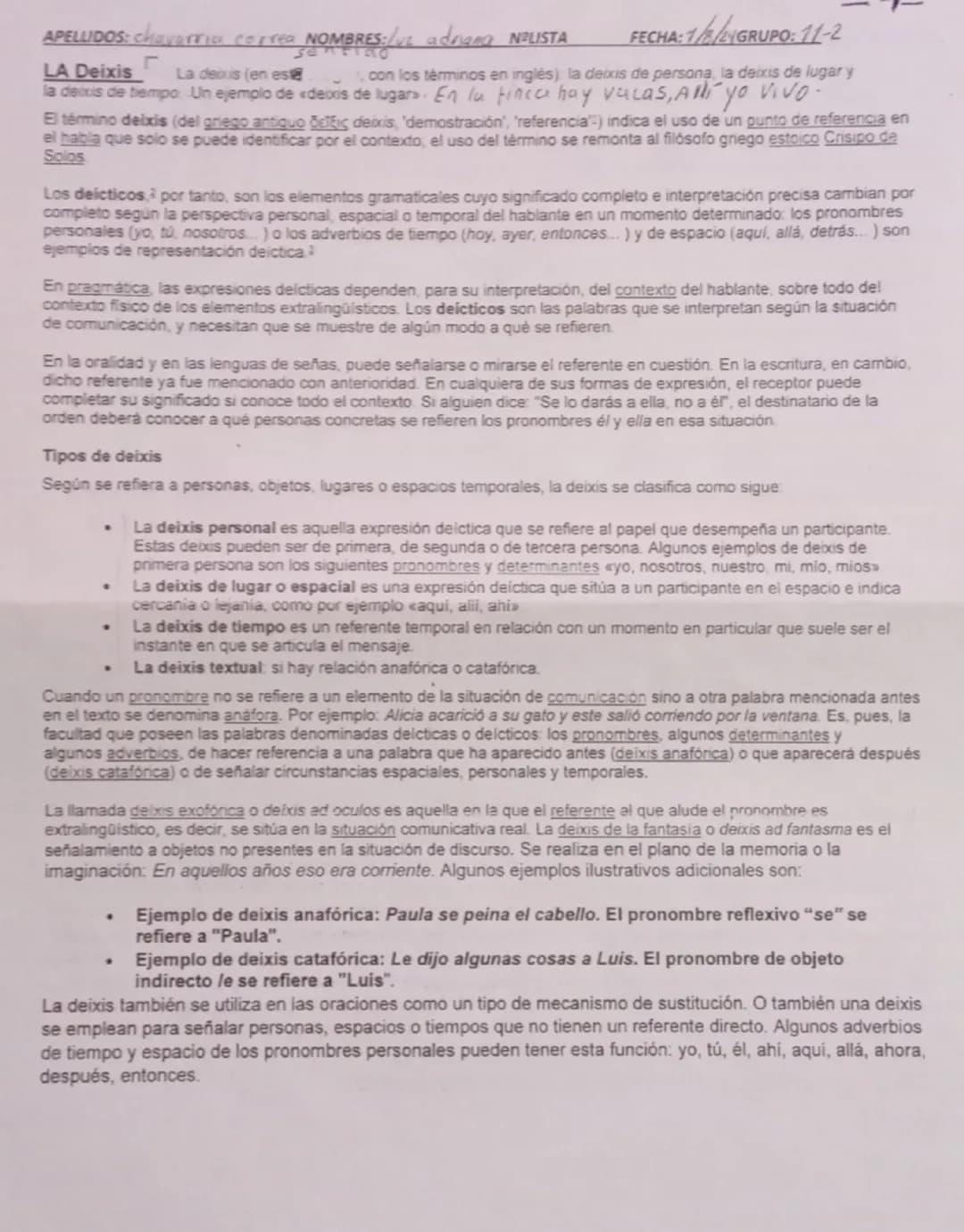
¿Qué es la deixis?
La deixis es como un GPS del lenguaje: nos ayuda a ubicarnos en el tiempo, el espacio y las personas cuando hablamos. Son palabras que solo tienen sentido completo si conocés el contexto de la conversación.
Imaginate que alguien te dice "Dame eso que está ahí". Sin ver la situación, no tenés idea de qué es "eso" ni dónde queda "ahí". Los elementos deícticos son justamente esas palabras: pronombres como "yo", "tú", adverbios como "aquí", "allá", "hoy", "mañana".
💡 Dato clave: La palabra deixis viene del griego y significa "demostración" o "referencia".
Tipos principales de deixis:
- Personal: se refiere a quién participa (yo, tú, nosotros, él)
- Espacial: indica dónde pasa algo (aquí, allí, acá)
- Temporal: marca cuándo ocurre (ahora, ayer, mañana)
- Textual: conecta ideas dentro del texto (anáfora y catáfora)
2
of 2
Deixis textual: anáfora y catáfora
Cuando un pronombre se refiere a algo ya mencionado en el texto, tenemos una anáfora. Por ejemplo: "María compró un auto. Él es rojo" . Es como una flecha que apunta hacia atrás en el texto.
La catáfora es lo contrario: el pronombre aparece antes que su referente. Ejemplo: "Le dije la verdad a Juan" . Es una flecha que apunta hacia adelante.
💡 Tip de estudio: Para identificar anáforas, buscá el pronombre y preguntate "¿a qué se refiere?" La respuesta estará antes en el texto.
También existe la deixis exofórica (cuando señalamos algo fuera del texto, como "ese libro" mientras lo señalás) y la deixis ad fantasma (cuando hablamos de cosas de la memoria: "En aquellos años todo era diferente").
We thought you’d never ask...
What is the Knowunity AI companion?
Our AI companion is specifically built for the needs of students. Based on the millions of content pieces we have on the platform we can provide truly meaningful and relevant answers to students. But its not only about answers, the companion is even more about guiding students through their daily learning challenges, with personalised study plans, quizzes or content pieces in the chat and 100% personalisation based on the students skills and developments.
Where can I download the Knowunity app?
You can download the app in the Google Play Store and in the Apple App Store.
Is Knowunity really free of charge?
That's right! Enjoy free access to study content, connect with fellow students, and get instant help – all at your fingertips.
Similar Content
 Espagnol
 Lengua Castellana y Literatura
Most popular content: Pronombres De Objeto
3Lengua CastellanaLos pronombres demostrativos
Se explica que son los pronombres demostrativos, como se utilizan , cuáles son y se muestran ejemplos en oraciones.
71204
Lengua CastellanaLengua Castellana grado 10 y 11 - Referencias Textuales
Referencias Textuales
2°M653
Lengua CastellanaLa Proposición Subordinada Adjetiva
En esta presentación se puede ver que es, donde se usa, y los tipos de la preposición subordinada adjetiva.
81640
Most popular content in Lengua Castellana
9Lengua CastellanaLa Metamorfosis
En este documento se encuentra un breve resumen o síntesis de "La Metamorfosis" libro escrito por Franz Kafka en 1915.
82,10123
Lengua CastellanaIcfes lectura crítica
Lectura crítica
113901
E
Lengua CastellanaElementos del Texto Narrativo
Conceptos clave sobre narrador, personajes, tiempo, espacio y acción en textos narrativos.
9700
 Sociales/Historia
Guerra de los Treinta Años
La Guerra de los Treinta Años
93384
F
Lengua Castellanafiguras literarias
símil, metáfora, hipérbole, alteracion, anafora, epíteto, personificación
71021
Lengua Castellanacomprensión lectora
esta presentación habla de como tener buena comprensión lectora
89483
Lengua CastellanaAnalisis Literario
Componentes de la litaraura
692911
G
Lengua CastellanaGéneros Literarios y Partes del Libro
Conceptos clave sobre géneros literarios y la estructura de un libro.
8340
Lengua CastellanaLey de los signos
Cuando se realizan operaciones de suma con números reales, se siguen las siguientes reglas: Si los dos números son positivos (mayor que cero): se suman y mantienen su signo «+». Si los dos números son negativos (menores que cero)se suman y se mantiene e
93794
Most popular content
9 ICFES: Matemáticas
Simulacro ICFES primera sesión calendario B filtrado 2025
Este simulacro te ayudará a sacar un buen puntaje en las pruebas ICFES este 2025. Vamos por ese 500/500. Y poder ser admitido en la universidad que quieras, estudiar la carrera que quieres y no la que te toque. Vamos con toda para sacar un buen puntaje.
1016,900174
 ICFES: Lectura Crítica
Simulacro icfes
Simulacro
111,82946
 ICFES: Inglés
Cuadernillo Preguntaa Saber 11 Inglés.
Aprovecha los cuadernillos de Inglés para practicar y mejorar tus habilidades en el ítem de Inglés de la Prueba Saber 11. 🫡
Universidad82212
ICFES: MatemáticasMaterial de estudio ICFES
Material de estudio, preguntas icfes de matemáticas resueltas
116,996109
 Química
Trucos para ganar icfes
Lo mejor
111,03212
S
 Otros
Otrossimulacro icfes
Este simulacro evalúa tus conocimientos en las áreas clave del examen ICFES, preparándote para obtener un excelente puntaje.
114540
 ICFES: Sociales y Ciudadanas
SIMULACRO ICFES
Simulacro icfes
111,06015
ICFES: Lectura CríticaICFES segunda sesión calendario B 2025
Segunda sesión simulacro ICFES 2025 calendario B filtrado, aprovecha y se el mejor ICFES de tu colegio y poder ingresar a universidad, y estudiar aquella carrera con la que tanto sueñas.
119,795123
ICFES: Lectura CríticaPrueba icfes 2024
Prueba icfes para practicar todas las asignaturas
118227
Can't find what you're looking for? Explore other subjects.
Students love us — and so will you.
4.6/5App Store
4.7/5Google Play
The app is very easy to use and well designed. I have found everything I was looking for so far and have been able to learn a lot from the presentations! I will definitely use the app for a class assignment! And of course it also helps a lot as an inspiration.
Stefan SiOS user
This app is really great. There are so many study notes and help [...]. My problem subject is French, for example, and the app has so many options for help. Thanks to this app, I have improved my French. I would recommend it to anyone.
Samantha KlichAndroid user
Wow, I am really amazed. I just tried the app because I've seen it advertised many times and was absolutely stunned. This app is THE HELP you want for school and above all, it offers so many things, such as workouts and fact sheets, which have been VERY helpful to me personally.
AnnaiOS user
Lengua Castellana186 views·Updated Jun 23, 2026·2 pagesEntendiendo los Deícticos: Temporales, Personales y Espaciales
A
adriana Chavarria@adrianachavarri
¿Te has preguntado por qué palabras como "yo", "aquí" o "ahora" cambian de significado según quién las dice y cuándo? La deixis es el fenómeno lingüístico que explica cómo estas palabras necesitan del contexto para ser entendidas completamente.
1
of 2
Sign up to see the content. It's free!
- Access to all documents
- Improve your grades
- Join milions of students
¿Qué es la deixis?
La deixis es como un GPS del lenguaje: nos ayuda a ubicarnos en el tiempo, el espacio y las personas cuando hablamos. Son palabras que solo tienen sentido completo si conocés el contexto de la conversación.
Imaginate que alguien te dice "Dame eso que está ahí". Sin ver la situación, no tenés idea de qué es "eso" ni dónde queda "ahí". Los elementos deícticos son justamente esas palabras: pronombres como "yo", "tú", adverbios como "aquí", "allá", "hoy", "mañana".
💡 Dato clave: La palabra deixis viene del griego y significa "demostración" o "referencia".
Tipos principales de deixis:
- Personal: se refiere a quién participa (yo, tú, nosotros, él)
- Espacial: indica dónde pasa algo (aquí, allí, acá)
- Temporal: marca cuándo ocurre (ahora, ayer, mañana)
- Textual: conecta ideas dentro del texto (anáfora y catáfora)
2
of 2Sign up to see the content. It's free!
- Access to all documents
- Improve your grades
- Join milions of students
Deixis textual: anáfora y catáfora
Cuando un pronombre se refiere a algo ya mencionado en el texto, tenemos una anáfora. Por ejemplo: "María compró un auto. Él es rojo" . Es como una flecha que apunta hacia atrás en el texto.
La catáfora es lo contrario: el pronombre aparece antes que su referente. Ejemplo: "Le dije la verdad a Juan" . Es una flecha que apunta hacia adelante.
💡 Tip de estudio: Para identificar anáforas, buscá el pronombre y preguntate "¿a qué se refiere?" La respuesta estará antes en el texto.
También existe la deixis exofórica (cuando señalamos algo fuera del texto, como "ese libro" mientras lo señalás) y la deixis ad fantasma (cuando hablamos de cosas de la memoria: "En aquellos años todo era diferente").
We thought you’d never ask...
What is the Knowunity AI companion?
Our AI companion is specifically built for the needs of students. Based on the millions of content pieces we have on the platform we can provide truly meaningful and relevant answers to students. But its not only about answers, the companion is even more about guiding students through their daily learning challenges, with personalised study plans, quizzes or content pieces in the chat and 100% personalisation based on the students skills and developments.
Where can I download the Knowunity app?
You can download the app in the Google Play Store and in the Apple App Store.
Is Knowunity really free of charge?
That's right! Enjoy free access to study content, connect with fellow students, and get instant help – all at your fingertips.
Similar Content
Most popular content: Pronombres De Objeto
3Lengua CastellanaLos pronombres demostrativos
Se explica que son los pronombres demostrativos, como se utilizan , cuáles son y se muestran ejemplos en oraciones.
71204
Lengua CastellanaLengua Castellana grado 10 y 11 - Referencias Textuales
Referencias Textuales
2°M653
Lengua CastellanaLa Proposición Subordinada Adjetiva
En esta presentación se puede ver que es, donde se usa, y los tipos de la preposición subordinada adjetiva.
81640
Most popular content in Lengua Castellana
9Lengua CastellanaLa Metamorfosis
En este documento se encuentra un breve resumen o síntesis de "La Metamorfosis" libro escrito por Franz Kafka en 1915.
82,10123
Lengua CastellanaIcfes lectura crítica
Lectura crítica
113901
E
Lengua CastellanaElementos del Texto Narrativo
Conceptos clave sobre narrador, personajes, tiempo, espacio y acción en textos narrativos.
9700
Sociales/HistoriaGuerra de los Treinta Años
La Guerra de los Treinta Años
93384
F
Lengua Castellanafiguras literarias
símil, metáfora, hipérbole, alteracion, anafora, epíteto, personificación
71021
Lengua Castellanacomprensión lectora
esta presentación habla de como tener buena comprensión lectora
89483
Lengua CastellanaAnalisis Literario
Componentes de la litaraura
692911
G
Lengua CastellanaGéneros Literarios y Partes del Libro
Conceptos clave sobre géneros literarios y la estructura de un libro.
8340
Lengua CastellanaLey de los signos
Cuando se realizan operaciones de suma con números reales, se siguen las siguientes reglas: Si los dos números son positivos (mayor que cero): se suman y mantienen su signo «+». Si los dos números son negativos (menores que cero)se suman y se mantiene e
93794
Most popular content
9ICFES: MatemáticasSimulacro ICFES primera sesión calendario B filtrado 2025
Este simulacro te ayudará a sacar un buen puntaje en las pruebas ICFES este 2025. Vamos por ese 500/500. Y poder ser admitido en la universidad que quieras, estudiar la carrera que quieres y no la que te toque. Vamos con toda para sacar un buen puntaje.
1016,900174
ICFES: Lectura CríticaSimulacro icfes
Simulacro
111,82946
ICFES: InglésCuadernillo Preguntaa Saber 11 Inglés.
Aprovecha los cuadernillos de Inglés para practicar y mejorar tus habilidades en el ítem de Inglés de la Prueba Saber 11. 🫡
Universidad82212
ICFES: MatemáticasMaterial de estudio ICFES
Material de estudio, preguntas icfes de matemáticas resueltas
116,996109
QuímicaTrucos para ganar icfes
Lo mejor
111,03212
S
Otrossimulacro icfes
Este simulacro evalúa tus conocimientos en las áreas clave del examen ICFES, preparándote para obtener un excelente puntaje.
114540
ICFES: Sociales y CiudadanasSIMULACRO ICFES
Simulacro icfes
111,06015
ICFES: Lectura CríticaICFES segunda sesión calendario B 2025
Segunda sesión simulacro ICFES 2025 calendario B filtrado, aprovecha y se el mejor ICFES de tu colegio y poder ingresar a universidad, y estudiar aquella carrera con la que tanto sueñas.
119,795123
ICFES: Lectura CríticaPrueba icfes 2024
Prueba icfes para practicar todas las asignaturas
118227
Can't find what you're looking for? Explore other subjects.
Students love us — and so will you.
4.6/5App Store
4.7/5Google Play
The app is very easy to use and well designed. I have found everything I was looking for so far and have been able to learn a lot from the presentations! I will definitely use the app for a class assignment! And of course it also helps a lot as an inspiration.
Stefan SiOS user
This app is really great. There are so many study notes and help [...]. My problem subject is French, for example, and the app has so many options for help. Thanks to this app, I have improved my French. I would recommend it to anyone.
Samantha KlichAndroid user
Wow, I am really amazed. I just tried the app because I've seen it advertised many times and was absolutely stunned. This app is THE HELP you want for school and above all, it offers so many things, such as workouts and fact sheets, which have been VERY helpful to me personally.
AnnaiOS user