
A comprehensive guide to Latin pronouns covering personal, demonstrative, and...
 Latín770 views·Updated Jun 26, 2026·3 pages
Guía Divertida de Pronombres Latín: ¿Sabes Quién es Qui, Quae, Quod?

Alexiaa❤️@alexiaa_19_06
1 / 3
1
of 3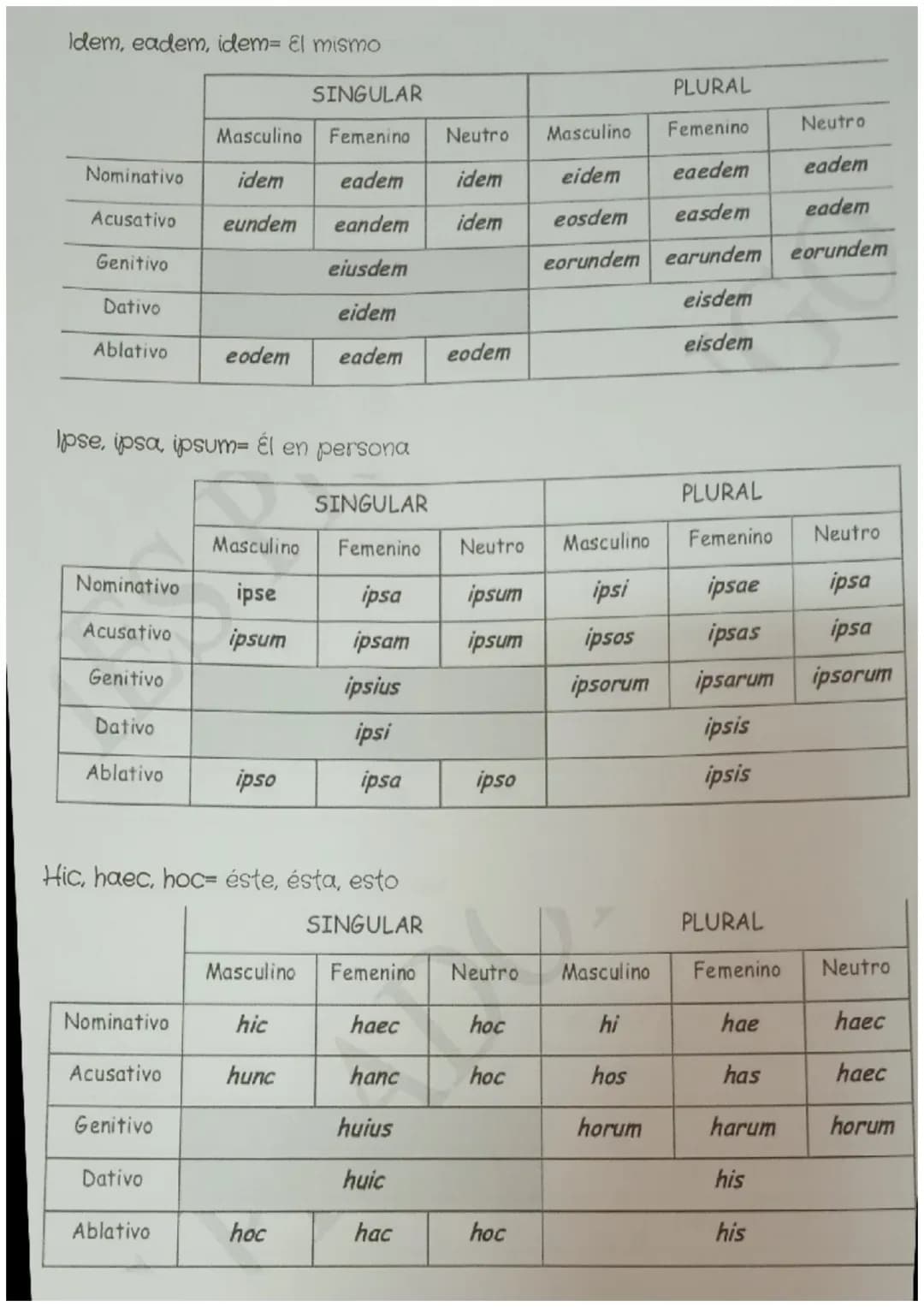
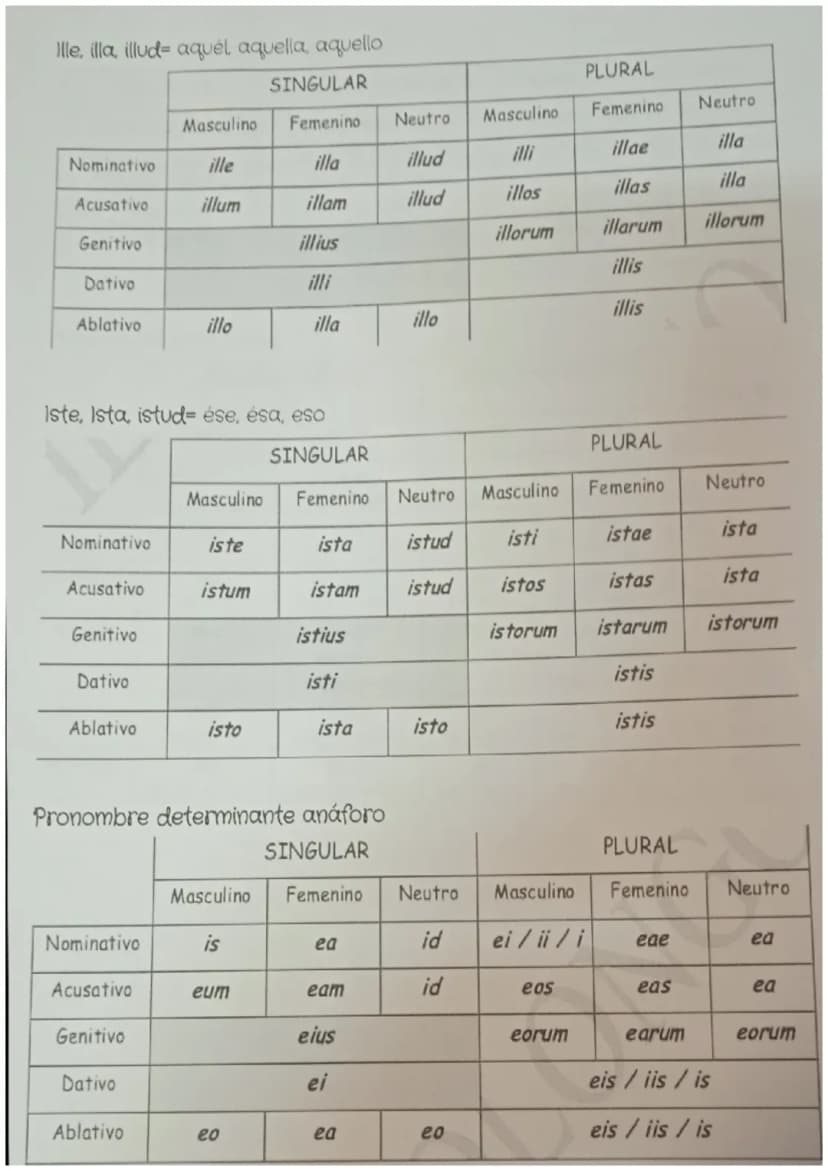
Page 2: Anaphoric and Additional Demonstrative Pronouns
This section details the demonstrative pronouns ille, illa, illud (that) and iste, ista, istud (that near you), along with the anaphoric pronoun is, ea, id. Each pronoun is presented with its complete declension pattern across all cases and numbers.
Vocabulary: The anaphoric pronoun is, ea, id is used to refer back to something previously mentioned in the text.
Definition: Ille, illa, illud indicates something distant from both speaker and listener, while iste, ista, istud refers to something near the person addressed.
Example: The masculine singular forms of ille decline as: nominative (ille), accusative (illum), genitive (illius), dative (illi), ablative (illo).
2
of 3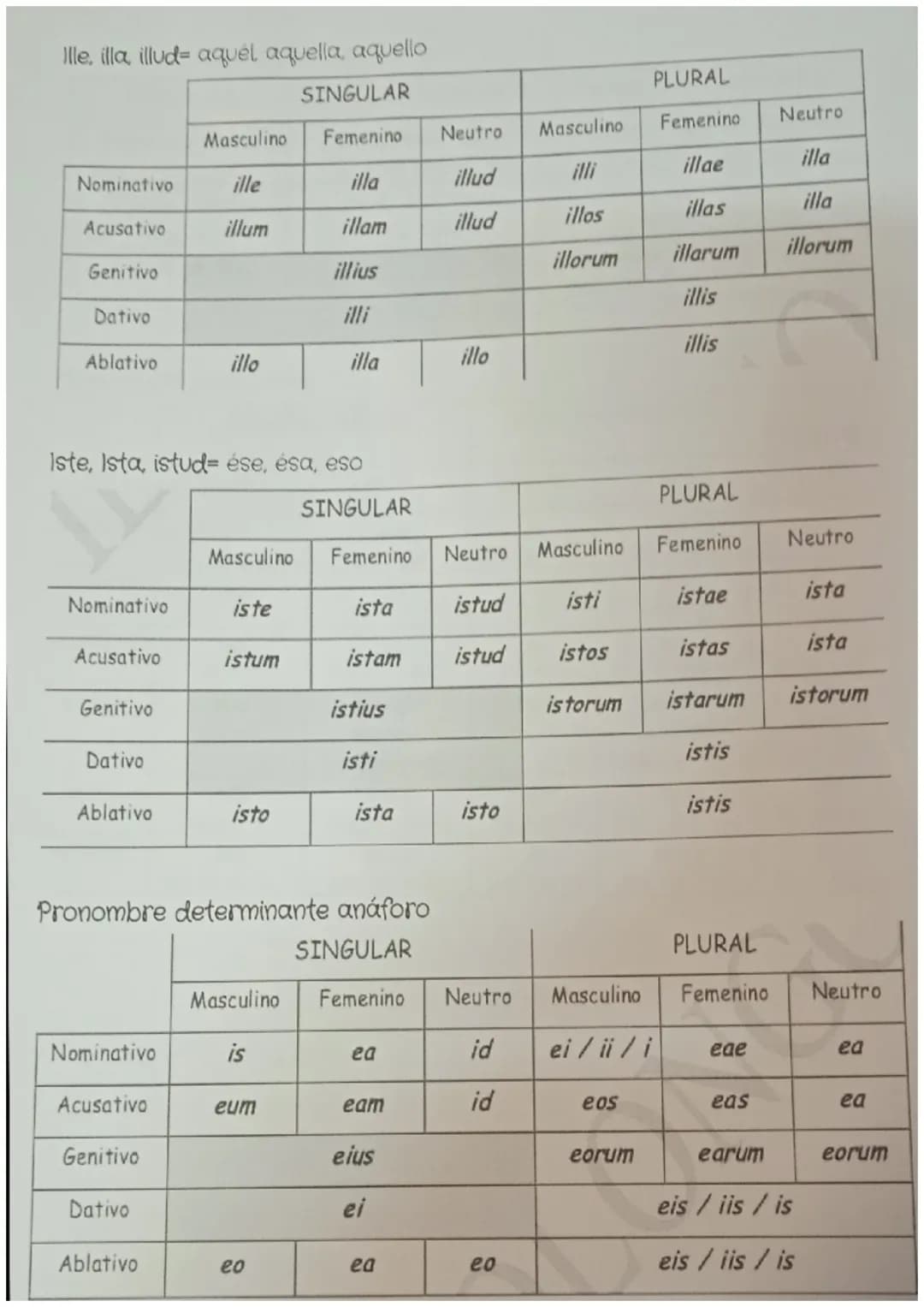
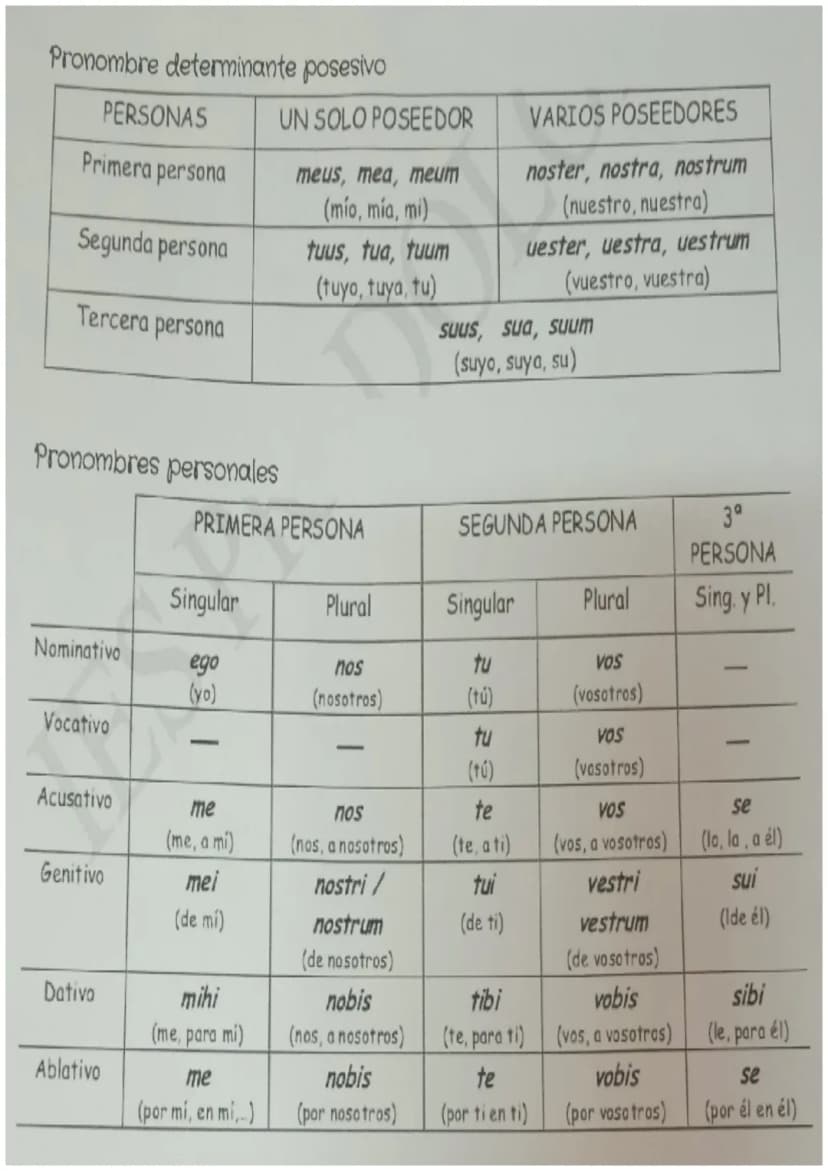
Page 3: Personal and Possessive Pronouns
The final page covers pronombres personales latín and pronombres posesivos latín, detailing first, second, and third person pronouns along with their corresponding possessive forms.
Definition: Personal pronouns indicate the person speaking (first person), being spoken to (second person), or being spoken about (third person).
Example: First person singular forms include: ego (nominative), me (accusative), mei (genitive), mihi (dative), me (ablative).
Highlight: Possessive pronouns are categorized by the number of possessors: single possessor (meus, tuus, suus) and multiple possessors (noster, vester).
Vocabulary: The third person reflexive pronoun "se" is used for both singular and plural subjects when referring back to the subject of the sentence.
3
of 3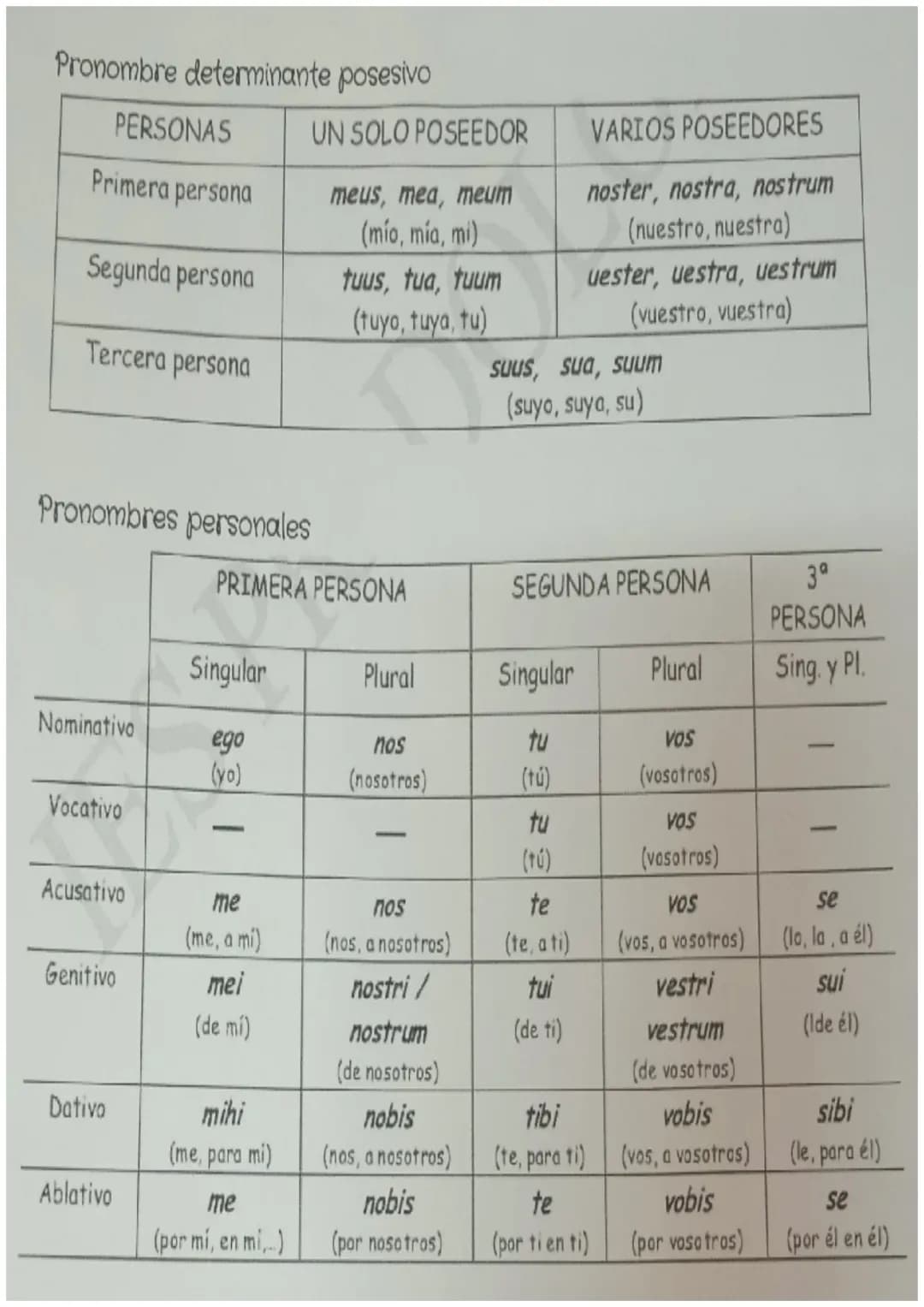
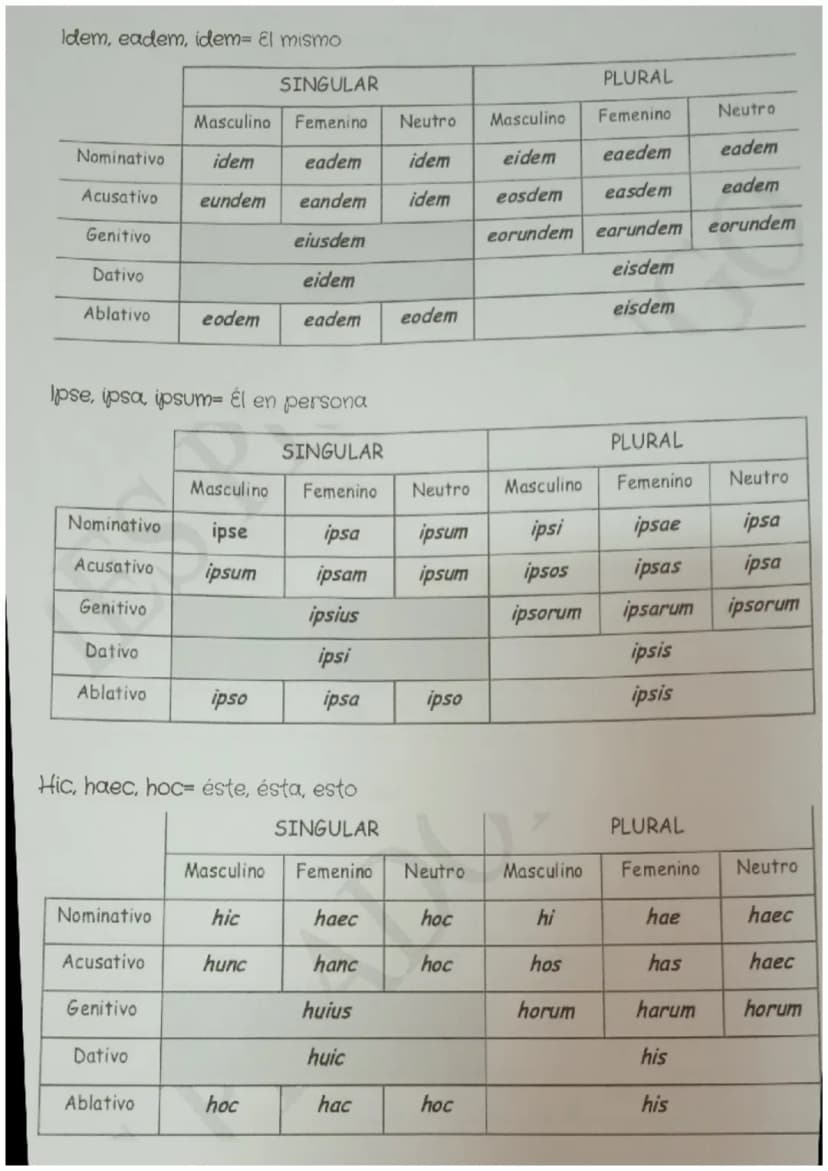
Page 1: Demonstrative and Intensive Pronouns
This page introduces the fundamental demonstrative and intensive pronouns in Latin. The content focuses on the declension patterns of idem, eadem, idem (meaning "the same") and ipse, ipsa, ipsum , along with hic, haec, hoc (meaning "this").
Definition: Idem, eadem, idem functions as an identical pronoun, used to refer to the same person or thing previously mentioned.
Example: The declension of ipse, ipsa, ipsum shows variations across all cases: nominative (ipse), accusative (ipsum), genitive (ipsius), dative (ipsi), and ablative (ipso).
Highlight: The demonstrative pronoun hic, haec, hoc follows a unique pattern with distinctive forms in each gender and case.
We thought you’d never ask...
What is the Knowunity AI companion?
Our AI companion is specifically built for the needs of students. Based on the millions of content pieces we have on the platform we can provide truly meaningful and relevant answers to students. But its not only about answers, the companion is even more about guiding students through their daily learning challenges, with personalised study plans, quizzes or content pieces in the chat and 100% personalisation based on the students skills and developments.
Where can I download the Knowunity app?
You can download the app in the Google Play Store and in the Apple App Store.
Is Knowunity really free of charge?
That's right! Enjoy free access to study content, connect with fellow students, and get instant help – all at your fingertips.
Similar Content
 Latein
Most popular content: pronombres latinos
2LatínAPUNTES LATÍN (GRAMÁTICA Y FONÉTICA)
En estos apuntes encontramos la gramática y la fonética de latín. Son los que yo he utilizado durante el curso y para selectividad.
1° Bach95120
LatínCasos latinos, pronombres personales, números romanos
Casos latinos, pronombres personales, números romanos
4° ESO46814
Most popular content in Latín
9LatínGramatica Latina
casos latinos, todas declinaciones, El verbo sum, los temas de presente, de perfecto y de la voz pasiva, Los adjetivos de primera y segunda clase, los pronombres personales, los posesivos, los pronombres determinativos y los pronombres demostrativos
1° Bach4,721140
LatínIntroducción al latín
-INTRODUCCIÓN AL LATÍN -LAS DECLINACIONES -PREPOSICIONES -LOS ADJETIVOS -LOS PRONOMBRES -LOS VERBOS -PASIVA
4° ESO12,890703
LatínDeclinaciones
Tabla de las cinco declinaciones de latín.
1° Bach4,719102
LatínLatín Gramática
La gramática más básica para poder hacer sintaxis, con ejemplos y subrayado
1° Bach96120
LatínLiteratura latín 2 bachillerato
Apuntes literatura con esquemas incluidos
2° Bach76516
LatínLatín 1o Bachillerato completo
hola, os dejo por aquí todo lo que he dado yo en 1o de bachiller en latín. Espero que os sirva 🤗
1° Bach55020
Latín1 y 2 declinación latín
Apuntes completos de la primera y segunda declinación en latín para sacar un 10 en primero de bachillerato.
4° ESO1,16017
LatínAPUNTES LATÍN (GRAMÁTICA Y FONÉTICA)
En estos apuntes encontramos la gramática y la fonética de latín. Son los que yo he utilizado durante el curso y para selectividad.
1° Bach95120
LatínLatín conjugaciones verbales
Todas las conjugaciones verbales en latín
1° Bach4396
Most popular content
9I
 Inglés
irregular verbs quiz
Domina el idioma inglés de manera sencilla y divertida con estos flashcards diseñados especialmente para estudiantes de sexto grado.
6º primaria2,8981
R
 Geografía e Historia
roma
a estudiar Roma!!
1° ESO2,3122
G
Geografía e HistoriaGrecia: Inicio de la democracia
Más o menos las preguntas que me pusieron a mí en el examen
1° ESO2,3622
D
InglésDominando la gramática inglesa: Flashcards desafiantes
Mejora tus habilidades gramaticales en inglés con estos flashcards desafiantes diseñados para estudiantes de grado 11. ¡Prepárate para dominar la gramática inglesa de manera divertida y efectiva!
3° ESO2,2480
M
Geografía e HistoriaMesopotamia y Egipto
Contenidos sobre la civilización mesopotámica y egipcia
1° ESO3,9381
O
 Lengua Castellana y Literatura
OBRAS Y AUTORES II
Quiz donde tendrás que relacionar las siguientes obras con sus respectivos autores: edición Romanticismo.
4° ESO3,3610
I
InglésIngles para repasar
quiz de ingles para entrar a clase preparados
2° ESO2,6290
F
 Filosofía
filosofía
repaso filosofía "el arje , la metafísica y la crítica de Nietszche a platon"
1° Bach2,8421
I
InglésIrregular verbs
Aprende nuevas palabras y expande tu vocabulario en inglés con esta colección de tarjetas de estudio interactivas.
3° ESO1,7442
Can't find what you're looking for? Explore other subjects.
Students love us — and so will you.
4.6/5App Store
4.7/5Google Play
The app is very easy to use and well designed. I have found everything I was looking for so far and have been able to learn a lot from the presentations! I will definitely use the app for a class assignment! And of course it also helps a lot as an inspiration.
Stefan SiOS user
This app is really great. There are so many study notes and help [...]. My problem subject is French, for example, and the app has so many options for help. Thanks to this app, I have improved my French. I would recommend it to anyone.
Samantha KlichAndroid user
Wow, I am really amazed. I just tried the app because I've seen it advertised many times and was absolutely stunned. This app is THE HELP you want for school and above all, it offers so many things, such as workouts and fact sheets, which have been VERY helpful to me personally.
AnnaiOS user
Latín770 views·Updated Jun 26, 2026·3 pagesGuía Divertida de Pronombres Latín: ¿Sabes Quién es Qui, Quae, Quod?
Alexiaa❤️@alexiaa_19_06
A comprehensive guide to Latin pronouns covering personal, demonstrative, and possessive forms. The guide details various pronoun declensions including pronombres personales latín, pronombres demostrativos latín, and pronombres posesivos latín with their complete conjugation patterns and usage.
• The...
1
of 3
Sign up to see the content. It's free!
- Access to all documents
- Improve your grades
- Join milions of students
Page 2: Anaphoric and Additional Demonstrative Pronouns
This section details the demonstrative pronouns ille, illa, illud (that) and iste, ista, istud (that near you), along with the anaphoric pronoun is, ea, id. Each pronoun is presented with its complete declension pattern across all cases and numbers.
Vocabulary: The anaphoric pronoun is, ea, id is used to refer back to something previously mentioned in the text.
Definition: Ille, illa, illud indicates something distant from both speaker and listener, while iste, ista, istud refers to something near the person addressed.
Example: The masculine singular forms of ille decline as: nominative (ille), accusative (illum), genitive (illius), dative (illi), ablative (illo).
2
of 3Sign up to see the content. It's free!
- Access to all documents
- Improve your grades
- Join milions of students
Page 3: Personal and Possessive Pronouns
The final page covers pronombres personales latín and pronombres posesivos latín, detailing first, second, and third person pronouns along with their corresponding possessive forms.
Definition: Personal pronouns indicate the person speaking (first person), being spoken to (second person), or being spoken about (third person).
Example: First person singular forms include: ego (nominative), me (accusative), mei (genitive), mihi (dative), me (ablative).
Highlight: Possessive pronouns are categorized by the number of possessors: single possessor (meus, tuus, suus) and multiple possessors (noster, vester).
Vocabulary: The third person reflexive pronoun "se" is used for both singular and plural subjects when referring back to the subject of the sentence.
3
of 3Sign up to see the content. It's free!
- Access to all documents
- Improve your grades
- Join milions of students
Page 1: Demonstrative and Intensive Pronouns
This page introduces the fundamental demonstrative and intensive pronouns in Latin. The content focuses on the declension patterns of idem, eadem, idem (meaning "the same") and ipse, ipsa, ipsum , along with hic, haec, hoc (meaning "this").
Definition: Idem, eadem, idem functions as an identical pronoun, used to refer to the same person or thing previously mentioned.
Example: The declension of ipse, ipsa, ipsum shows variations across all cases: nominative (ipse), accusative (ipsum), genitive (ipsius), dative (ipsi), and ablative (ipso).
Highlight: The demonstrative pronoun hic, haec, hoc follows a unique pattern with distinctive forms in each gender and case.
We thought you’d never ask...
What is the Knowunity AI companion?
Our AI companion is specifically built for the needs of students. Based on the millions of content pieces we have on the platform we can provide truly meaningful and relevant answers to students. But its not only about answers, the companion is even more about guiding students through their daily learning challenges, with personalised study plans, quizzes or content pieces in the chat and 100% personalisation based on the students skills and developments.
Where can I download the Knowunity app?
You can download the app in the Google Play Store and in the Apple App Store.
Is Knowunity really free of charge?
That's right! Enjoy free access to study content, connect with fellow students, and get instant help – all at your fingertips.
Similar Content
Most popular content: pronombres latinos
2LatínAPUNTES LATÍN (GRAMÁTICA Y FONÉTICA)
En estos apuntes encontramos la gramática y la fonética de latín. Son los que yo he utilizado durante el curso y para selectividad.
1° Bach95120
LatínCasos latinos, pronombres personales, números romanos
Casos latinos, pronombres personales, números romanos
4° ESO46814
Most popular content in Latín
9LatínGramatica Latina
casos latinos, todas declinaciones, El verbo sum, los temas de presente, de perfecto y de la voz pasiva, Los adjetivos de primera y segunda clase, los pronombres personales, los posesivos, los pronombres determinativos y los pronombres demostrativos
1° Bach4,721140
LatínIntroducción al latín
-INTRODUCCIÓN AL LATÍN -LAS DECLINACIONES -PREPOSICIONES -LOS ADJETIVOS -LOS PRONOMBRES -LOS VERBOS -PASIVA
4° ESO12,890703
LatínDeclinaciones
Tabla de las cinco declinaciones de latín.
1° Bach4,719102
LatínLatín Gramática
La gramática más básica para poder hacer sintaxis, con ejemplos y subrayado
1° Bach96120
LatínLiteratura latín 2 bachillerato
Apuntes literatura con esquemas incluidos
2° Bach76516
LatínLatín 1o Bachillerato completo
hola, os dejo por aquí todo lo que he dado yo en 1o de bachiller en latín. Espero que os sirva 🤗
1° Bach55020
Latín1 y 2 declinación latín
Apuntes completos de la primera y segunda declinación en latín para sacar un 10 en primero de bachillerato.
4° ESO1,16017
LatínAPUNTES LATÍN (GRAMÁTICA Y FONÉTICA)
En estos apuntes encontramos la gramática y la fonética de latín. Son los que yo he utilizado durante el curso y para selectividad.
1° Bach95120
LatínLatín conjugaciones verbales
Todas las conjugaciones verbales en latín
1° Bach4396
Most popular content
9I
Inglésirregular verbs quiz
Domina el idioma inglés de manera sencilla y divertida con estos flashcards diseñados especialmente para estudiantes de sexto grado.
6º primaria2,8981
R
Geografía e Historiaroma
a estudiar Roma!!
1° ESO2,3122
G
Geografía e HistoriaGrecia: Inicio de la democracia
Más o menos las preguntas que me pusieron a mí en el examen
1° ESO2,3622
D
InglésDominando la gramática inglesa: Flashcards desafiantes
Mejora tus habilidades gramaticales en inglés con estos flashcards desafiantes diseñados para estudiantes de grado 11. ¡Prepárate para dominar la gramática inglesa de manera divertida y efectiva!
3° ESO2,2480
M
Geografía e HistoriaMesopotamia y Egipto
Contenidos sobre la civilización mesopotámica y egipcia
1° ESO3,9381
O
Lengua Castellana y LiteraturaOBRAS Y AUTORES II
Quiz donde tendrás que relacionar las siguientes obras con sus respectivos autores: edición Romanticismo.
4° ESO3,3610
I
InglésIngles para repasar
quiz de ingles para entrar a clase preparados
2° ESO2,6290
F
Filosofíafilosofía
repaso filosofía "el arje , la metafísica y la crítica de Nietszche a platon"
1° Bach2,8421
I
InglésIrregular verbs
Aprende nuevas palabras y expande tu vocabulario en inglés con esta colección de tarjetas de estudio interactivas.
3° ESO1,7442
Can't find what you're looking for? Explore other subjects.
Students love us — and so will you.
4.6/5App Store
4.7/5Google Play
The app is very easy to use and well designed. I have found everything I was looking for so far and have been able to learn a lot from the presentations! I will definitely use the app for a class assignment! And of course it also helps a lot as an inspiration.
Stefan SiOS user
This app is really great. There are so many study notes and help [...]. My problem subject is French, for example, and the app has so many options for help. Thanks to this app, I have improved my French. I would recommend it to anyone.
Samantha KlichAndroid user
Wow, I am really amazed. I just tried the app because I've seen it advertised many times and was absolutely stunned. This app is THE HELP you want for school and above all, it offers so many things, such as workouts and fact sheets, which have been VERY helpful to me personally.
AnnaiOS user