
Studiare i verbi latini può sembrare complicato, ma una volta...
 Latino6,027 views·Updated Jun 26, 2026·3 pages
Guida ai Verbi Latini: Coniugazioni e Tempi Verbali

Ariel@rielorzettig_dfaa


1 / 3
1
of 3
I Tempi Principali dell'Indicativo
Il presente indicativo è il primo tempo che devi padroneggiare perfettamente. Ogni coniugazione ha le sue terminazioni specifiche: la prima finisce in -o/-as/-at, la seconda in -eo/-es/-et, e così via.
L'imperfetto esprime azioni del passato in corso di svolgimento (come il nostro "facevo"). Tutte le coniugazioni usano le stesse terminazioni aggiunte al tema del presente. È uno dei tempi più regolari del latino!
Il futuro semplice cambia a seconda della coniugazione. Le prime due usano -bo/-bis/-bit, mentre la terza e quarta usano -am/-es/-et. Questa differenza è fondamentale da ricordare per le verifiche.
Il perfetto racconta azioni compiute nel passato. La forma attiva usa il tema del perfetto (che devi imparare a memoria), mentre il passivo si forma con il participio passato + il verbo essere.
Trucco per ricordare: Le terminazioni del presente sono come una melodia - una volta memorizzate, le riconoscerai sempre!
2
of 3
Tempi Composti e Congiuntivo
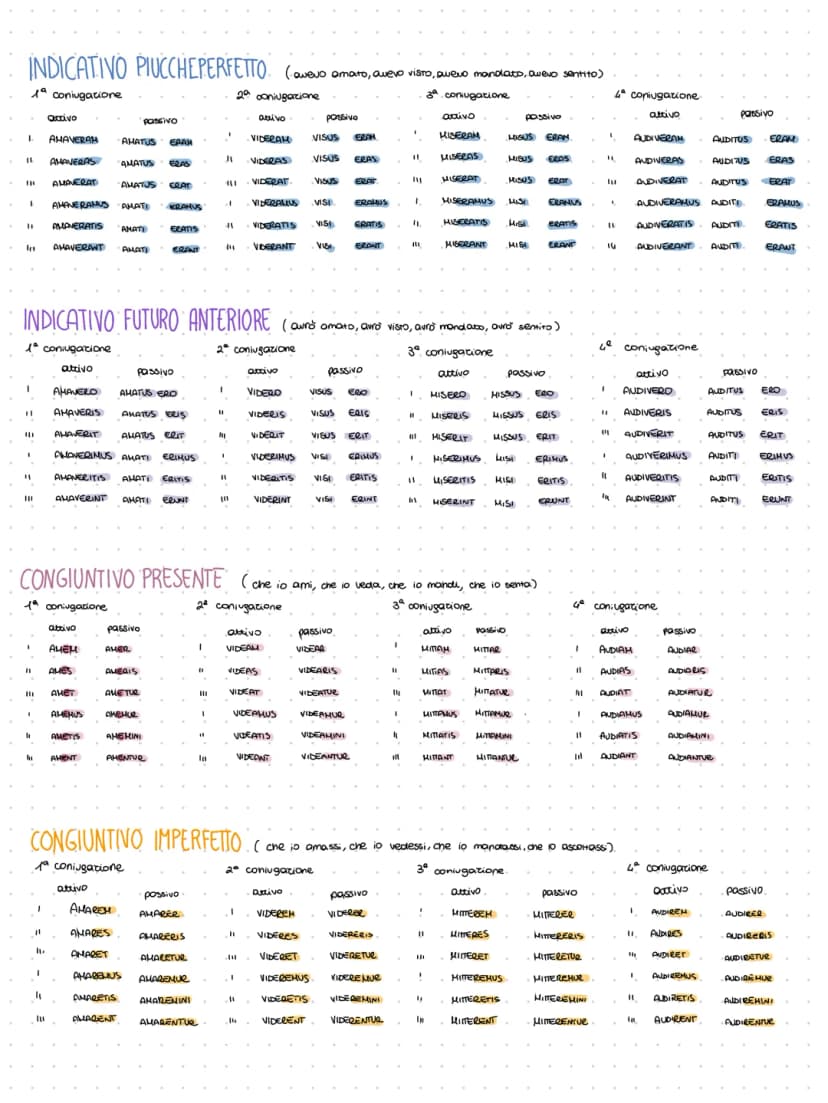
Il piuccheperfetto indica un'azione avvenuta prima di un'altra nel passato. Si forma aggiungendo le terminazioni dell'imperfetto di "sum" al tema del perfetto .
Il futuro anteriore esprime un'azione futura che si completerà prima di un'altra azione futura. La costruzione è simile al piuccheperfetto, ma usa il futuro di "sum" .
Il congiuntivo presente esprime dubbio, possibilità o desiderio. Le terminazioni sono diverse dall'indicativo: la prima coniugazione usa -em/-es/-et, mentre le altre usano -am/-as/-at. È l'opposto del presente indicativo!
Il congiuntivo imperfetto si forma dal tema dell'infinito presente. Tutte le coniugazioni seguono lo stesso schema, aggiungendo -m/-s/-t alle forme dell'infinito. Questo lo rende più prevedibile degli altri tempi del congiuntivo.
Attenzione: Il congiuntivo è essenziale per tradurre correttamente le proposizioni subordinate. Non sottovalutarlo!
3
of 3
Infiniti e Verbi Irregolari Essenziali
L'infinito ha tre tempi: presente, perfetto e futuro. Il presente è quello che conosci meglio (amare, videre, mittere, audire). Il perfetto usa il tema del perfetto + isse, mentre il futuro si forma con il participio futuro + esse.
Il verbo sum (essere) è irregolare ma fondamentale. Compare in tantissime costruzioni, dai tempi passivi ai tempi composti. Le sue forme sono completamente diverse dalle coniugazioni regolari, quindi vanno imparate come un blocco unico.
Il verbo possum (potere) deriva da "potis sum" e mantiene questa struttura. Quando il verbo "sum" inizia per consonante, "potis" diventa "pot-" , quando inizia per vocale resta "pos-" . È un meccanismo fonico da ricordare.
Questi verbi irregolari sono tra i più frequenti nei testi latini. Una volta memorizzati bene, ti accorgerai che compaiono ovunque e diventeranno i tuoi migliori alleati per capire le frasi complesse.
Suggerimento: Crea delle tabelle colorate per i verbi irregolari - la memoria visiva ti aiuterà moltissimo durante le traduzioni!
We thought you’d never ask...
What is the Knowunity AI companion?
Our AI companion is specifically built for the needs of students. Based on the millions of content pieces we have on the platform we can provide truly meaningful and relevant answers to students. But its not only about answers, the companion is even more about guiding students through their daily learning challenges, with personalised study plans, quizzes or content pieces in the chat and 100% personalisation based on the students skills and developments.
Where can I download the Knowunity app?
You can download the app in the Google Play Store and in the Apple App Store.
Is Knowunity really free of charge?
That's right! Enjoy free access to study content, connect with fellow students, and get instant help – all at your fingertips.
Similar Content
Most popular content: coniugazione dei verbi latini
9LatinoTabella verbi latino
Tabella con tutti i modi verbali attivi e passivi, coniugazione prima declinazione.
1ªl50,7152,621
LatinoCatullo
Appunti su Catullo (spiegazione + riassunto dal libro). Con questi ho preso 9 all’interrogazione 🫶🏻
3ªl1,18320
LatinoTutti i verbi Latini
Tutti modi tempi e verbi particolari in latino - Crediti a Pearson s.p.a.
1ªl1,20328
LatinoVerbi latini
I verbi latini e la loro coniugazione
3ªl3,74250
LatinoVERBI LATINO
Schemi verbi di latino dal presente fino all'infinito
2ªl2,61947
LatinoVerbi latini
verbo essere + verbi regolari tutte le declinazioni attive e passive
2ªl11,287240
LatinoVerbi latini
I verbi sono: INDICATIVO presente, imperfetto, futuro semplice, futuro anteriore, perfetto, piuccheperfetto Attivi e passivi. IMPERATIVO presente, futuro. VERBO ESSERE presente, imperfetto, futuro semplice, perfetto. 1º,2º,3º e. 4º coniugazione
1ªl2,57151
LatinoCongiuntivo Latino
Tabella congiuntivo prima coniugazione
1ªl9,243191
LatinoVerbi latini
I verbi studiati il primo anno di liceo (scientifico)
1ªl2,18229
Most popular content in Latino
9LatinoGrammatica latina
declinazioni, verbi, paradigmi, subordinate, aggettivi, pronomi, complementi
1ªl3,640124
LatinoLe declinazioni latine
tutte le declinazioni latine
2ªl4,03380
LatinoTabella verbi latino
Tabella con tutti i modi verbali attivi e passivi, coniugazione prima declinazione.
1ªl50,7152,621
LatinoGrammatica latina
declinazioni, dativo di possesso, pronomi dimostrativi, pronomi determinativi, verbi regolari, subordinata finale, ablativo assoluto, numeri cardinali e ordinali, calendario romano e tanto altro!
2ªl16,583734
 Italiano
Eneide
Presentazione
1ªl2,63950
LatinoLa III declinazione latina
Appunto su la terza declinazione latina,con esempi e metodi per la risalire al nominativo.
1ªl2,90863
Latinoletteratura latina- Orazio
Orazio vita e opere
4ªl7,099174
LatinoLe declinazioni latine
Pdf declinazioni latine + particolarità e aggettivi correlati
1ªl53,8334,356
ItalianoLa Divina Commedia
Teoria sulla divina commedia e Dante
2ªm3,41970
Most popular content
9ItalianoRiassunto patente B
Riassunto patente B - appunti presi a lezione
5ªl29,228943
 Altro
AltroTeoria patente b
Tutti gli argomenti per la patente
1ªl21,114685
 Ed. civ.
Teoria patente di guida B: Segnali stradali
Segnali stradali di pericolo, luminosi, di prescrizione, di indicazione, temporanei, complementari, pannelli integrativi, segnaletica orizzontale, segnalazioni agenti del traffico, distanza di visibilità per l‘arresto, minima di sicurezza.
5ªl40,0241,644
 Filosofia
Aristotele
Aristotele: vita, metafisica, fisica, etica e politica, retorica e poetica
3ªl7,623216
ItalianoI promessi sposi
Riassunti completi di tutti i 38 capitoli dei Promessi sposi.
2ªl14,090314
AltroPATENTE
schemi per esame teorico della patente
Università22,050755
S
ItalianoSintesi finale di Analisi logica
Esercitazione completa di analisi logica su frasi articolate per consolidare la conoscenza di tutti i complementi.
3ªm5,5290
P
 Inglese
Present Simple vs Present Continuous
Develop the ability to choose correctly between the Present Simple for habits and the Present Continuous for ongoing actions.
3ªm4,2110
G
ItalianoGabriele D'Annunzio e l'Estetismo
Domande sull'ideale del superuomo, il panismo e la concezione dell'arte come valore assoluto in D'Annunzio.
4ªl2,6740
Can't find what you're looking for? Explore other subjects.
Students love us — and so will you.
4.6/5App Store
4.7/5Google Play
The app is very easy to use and well designed. I have found everything I was looking for so far and have been able to learn a lot from the presentations! I will definitely use the app for a class assignment! And of course it also helps a lot as an inspiration.
Stefan SiOS user
This app is really great. There are so many study notes and help [...]. My problem subject is French, for example, and the app has so many options for help. Thanks to this app, I have improved my French. I would recommend it to anyone.
Samantha KlichAndroid user
Wow, I am really amazed. I just tried the app because I've seen it advertised many times and was absolutely stunned. This app is THE HELP you want for school and above all, it offers so many things, such as workouts and fact sheets, which have been VERY helpful to me personally.
AnnaiOS user
Latino6,027 views·Updated Jun 26, 2026·3 pagesGuida ai Verbi Latini: Coniugazioni e Tempi Verbali
Ariel@rielorzettig_dfaa
Studiare i verbi latini può sembrare complicato, ma una volta capito il sistema diventa molto più facile! Questo riassunto ti mostra tutte le coniugazioni principali dei verbi latini, dalle 4 coniugazioni base fino ai verbi irregolari più importanti.
1
of 3
Sign up to see the content. It's free!
- Access to all documents
- Improve your grades
- Join milions of students
I Tempi Principali dell'Indicativo
Il presente indicativo è il primo tempo che devi padroneggiare perfettamente. Ogni coniugazione ha le sue terminazioni specifiche: la prima finisce in -o/-as/-at, la seconda in -eo/-es/-et, e così via.
L'imperfetto esprime azioni del passato in corso di svolgimento (come il nostro "facevo"). Tutte le coniugazioni usano le stesse terminazioni aggiunte al tema del presente. È uno dei tempi più regolari del latino!
Il futuro semplice cambia a seconda della coniugazione. Le prime due usano -bo/-bis/-bit, mentre la terza e quarta usano -am/-es/-et. Questa differenza è fondamentale da ricordare per le verifiche.
Il perfetto racconta azioni compiute nel passato. La forma attiva usa il tema del perfetto (che devi imparare a memoria), mentre il passivo si forma con il participio passato + il verbo essere.
Trucco per ricordare: Le terminazioni del presente sono come una melodia - una volta memorizzate, le riconoscerai sempre!
2
of 3Sign up to see the content. It's free!
- Access to all documents
- Improve your grades
- Join milions of students
Tempi Composti e Congiuntivo
Il piuccheperfetto indica un'azione avvenuta prima di un'altra nel passato. Si forma aggiungendo le terminazioni dell'imperfetto di "sum" al tema del perfetto .
Il futuro anteriore esprime un'azione futura che si completerà prima di un'altra azione futura. La costruzione è simile al piuccheperfetto, ma usa il futuro di "sum" .
Il congiuntivo presente esprime dubbio, possibilità o desiderio. Le terminazioni sono diverse dall'indicativo: la prima coniugazione usa -em/-es/-et, mentre le altre usano -am/-as/-at. È l'opposto del presente indicativo!
Il congiuntivo imperfetto si forma dal tema dell'infinito presente. Tutte le coniugazioni seguono lo stesso schema, aggiungendo -m/-s/-t alle forme dell'infinito. Questo lo rende più prevedibile degli altri tempi del congiuntivo.
Attenzione: Il congiuntivo è essenziale per tradurre correttamente le proposizioni subordinate. Non sottovalutarlo!
3
of 3Sign up to see the content. It's free!
- Access to all documents
- Improve your grades
- Join milions of students
Infiniti e Verbi Irregolari Essenziali
L'infinito ha tre tempi: presente, perfetto e futuro. Il presente è quello che conosci meglio (amare, videre, mittere, audire). Il perfetto usa il tema del perfetto + isse, mentre il futuro si forma con il participio futuro + esse.
Il verbo sum (essere) è irregolare ma fondamentale. Compare in tantissime costruzioni, dai tempi passivi ai tempi composti. Le sue forme sono completamente diverse dalle coniugazioni regolari, quindi vanno imparate come un blocco unico.
Il verbo possum (potere) deriva da "potis sum" e mantiene questa struttura. Quando il verbo "sum" inizia per consonante, "potis" diventa "pot-" , quando inizia per vocale resta "pos-" . È un meccanismo fonico da ricordare.
Questi verbi irregolari sono tra i più frequenti nei testi latini. Una volta memorizzati bene, ti accorgerai che compaiono ovunque e diventeranno i tuoi migliori alleati per capire le frasi complesse.
Suggerimento: Crea delle tabelle colorate per i verbi irregolari - la memoria visiva ti aiuterà moltissimo durante le traduzioni!
We thought you’d never ask...
What is the Knowunity AI companion?
Our AI companion is specifically built for the needs of students. Based on the millions of content pieces we have on the platform we can provide truly meaningful and relevant answers to students. But its not only about answers, the companion is even more about guiding students through their daily learning challenges, with personalised study plans, quizzes or content pieces in the chat and 100% personalisation based on the students skills and developments.
Where can I download the Knowunity app?
You can download the app in the Google Play Store and in the Apple App Store.
Is Knowunity really free of charge?
That's right! Enjoy free access to study content, connect with fellow students, and get instant help – all at your fingertips.
Similar Content
Most popular content: coniugazione dei verbi latini
9LatinoTabella verbi latino
Tabella con tutti i modi verbali attivi e passivi, coniugazione prima declinazione.
1ªl50,7152,621
LatinoCatullo
Appunti su Catullo (spiegazione + riassunto dal libro). Con questi ho preso 9 all’interrogazione 🫶🏻
3ªl1,18320
LatinoTutti i verbi Latini
Tutti modi tempi e verbi particolari in latino - Crediti a Pearson s.p.a.
1ªl1,20328
LatinoVerbi latini
I verbi latini e la loro coniugazione
3ªl3,74250
LatinoVERBI LATINO
Schemi verbi di latino dal presente fino all'infinito
2ªl2,61947
LatinoVerbi latini
verbo essere + verbi regolari tutte le declinazioni attive e passive
2ªl11,287240
LatinoVerbi latini
I verbi sono: INDICATIVO presente, imperfetto, futuro semplice, futuro anteriore, perfetto, piuccheperfetto Attivi e passivi. IMPERATIVO presente, futuro. VERBO ESSERE presente, imperfetto, futuro semplice, perfetto. 1º,2º,3º e. 4º coniugazione
1ªl2,57151
LatinoCongiuntivo Latino
Tabella congiuntivo prima coniugazione
1ªl9,243191
LatinoVerbi latini
I verbi studiati il primo anno di liceo (scientifico)
1ªl2,18229
Most popular content in Latino
9LatinoGrammatica latina
declinazioni, verbi, paradigmi, subordinate, aggettivi, pronomi, complementi
1ªl3,640124
LatinoLe declinazioni latine
tutte le declinazioni latine
2ªl4,03380
LatinoTabella verbi latino
Tabella con tutti i modi verbali attivi e passivi, coniugazione prima declinazione.
1ªl50,7152,621
LatinoGrammatica latina
declinazioni, dativo di possesso, pronomi dimostrativi, pronomi determinativi, verbi regolari, subordinata finale, ablativo assoluto, numeri cardinali e ordinali, calendario romano e tanto altro!
2ªl16,583734
ItalianoEneide
Presentazione
1ªl2,63950
LatinoLa III declinazione latina
Appunto su la terza declinazione latina,con esempi e metodi per la risalire al nominativo.
1ªl2,90863
Latinoletteratura latina- Orazio
Orazio vita e opere
4ªl7,099174
LatinoLe declinazioni latine
Pdf declinazioni latine + particolarità e aggettivi correlati
1ªl53,8334,356
ItalianoLa Divina Commedia
Teoria sulla divina commedia e Dante
2ªm3,41970
Most popular content
9ItalianoRiassunto patente B
Riassunto patente B - appunti presi a lezione
5ªl29,228943
AltroTeoria patente b
Tutti gli argomenti per la patente
1ªl21,114685
Ed. civ.Teoria patente di guida B: Segnali stradali
Segnali stradali di pericolo, luminosi, di prescrizione, di indicazione, temporanei, complementari, pannelli integrativi, segnaletica orizzontale, segnalazioni agenti del traffico, distanza di visibilità per l‘arresto, minima di sicurezza.
5ªl40,0241,644
FilosofiaAristotele
Aristotele: vita, metafisica, fisica, etica e politica, retorica e poetica
3ªl7,623216
ItalianoI promessi sposi
Riassunti completi di tutti i 38 capitoli dei Promessi sposi.
2ªl14,090314
AltroPATENTE
schemi per esame teorico della patente
Università22,050755
S
ItalianoSintesi finale di Analisi logica
Esercitazione completa di analisi logica su frasi articolate per consolidare la conoscenza di tutti i complementi.
3ªm5,5290
P
InglesePresent Simple vs Present Continuous
Develop the ability to choose correctly between the Present Simple for habits and the Present Continuous for ongoing actions.
3ªm4,2110
G
ItalianoGabriele D'Annunzio e l'Estetismo
Domande sull'ideale del superuomo, il panismo e la concezione dell'arte come valore assoluto in D'Annunzio.
4ªl2,6740
Can't find what you're looking for? Explore other subjects.
Students love us — and so will you.
4.6/5App Store
4.7/5Google Play
The app is very easy to use and well designed. I have found everything I was looking for so far and have been able to learn a lot from the presentations! I will definitely use the app for a class assignment! And of course it also helps a lot as an inspiration.
Stefan SiOS user
This app is really great. There are so many study notes and help [...]. My problem subject is French, for example, and the app has so many options for help. Thanks to this app, I have improved my French. I would recommend it to anyone.
Samantha KlichAndroid user
Wow, I am really amazed. I just tried the app because I've seen it advertised many times and was absolutely stunned. This app is THE HELP you want for school and above all, it offers so many things, such as workouts and fact sheets, which have been VERY helpful to me personally.
AnnaiOS user