

Il latino ha delle forme grammaticali che sembrano complicate ma...
 Latino478 views·Updated Jun 29, 2026·2 pages
Approfondimento sul passivo impersonale e sugli aggettivi di seconda classe
1
of 2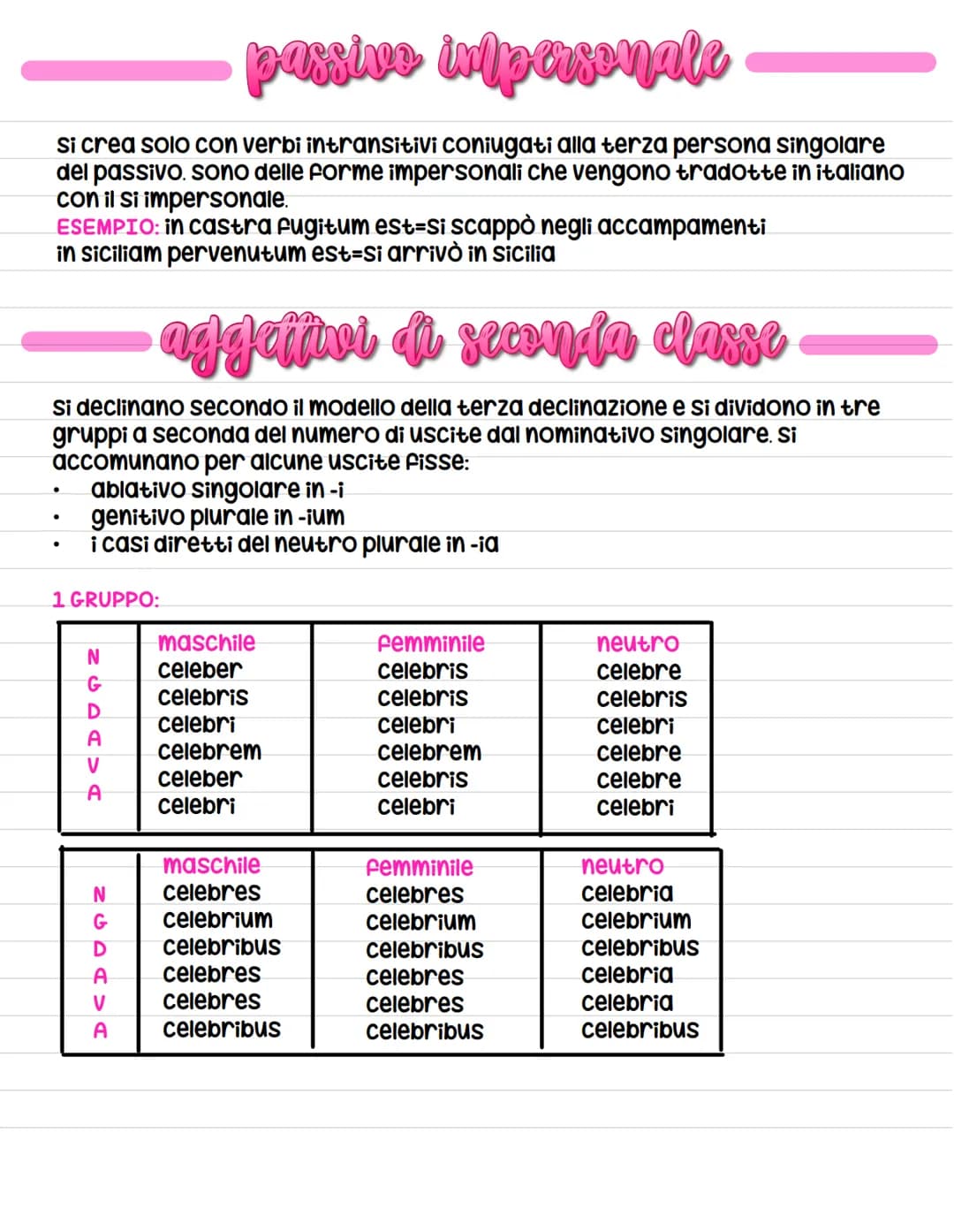
Passivo Impersonale
Hai mai visto frasi latine che sembrano non avere un soggetto preciso? Probabilmente stavi guardando il passivo impersonale! Questa forma si usa solo con verbi intransitivi coniugati alla terza persona singolare del passivo.
Il trucco per tradurre è semplice: usa il "si" impersonale in italiano. Per esempio, "in castra fugitum est" diventa "si scappò negli accampamenti", mentre "in Siciliam perventum est" si traduce "si arrivò in Sicilia".
Aggettivi di Seconda Classe - Introduzione
Gli aggettivi di seconda classe seguono la terza declinazione e si dividono in tre gruppi a seconda di quante forme diverse hanno al nominativo singolare. Tutti condividono alcune caratteristiche: ablativo singolare in -i, genitivo plurale in -ium e neutro plurale in -ia.
💡 Ricorda: Le terminazioni fisse ti aiutano a riconoscerli subito!
Il primo gruppo ha tre uscite diverse per ogni genere. Prendi "celeber": maschile -er, femminile -is, neutro -e. È il gruppo meno numeroso ma segue uno schema preciso che puoi imparare facilmente.
2
of 2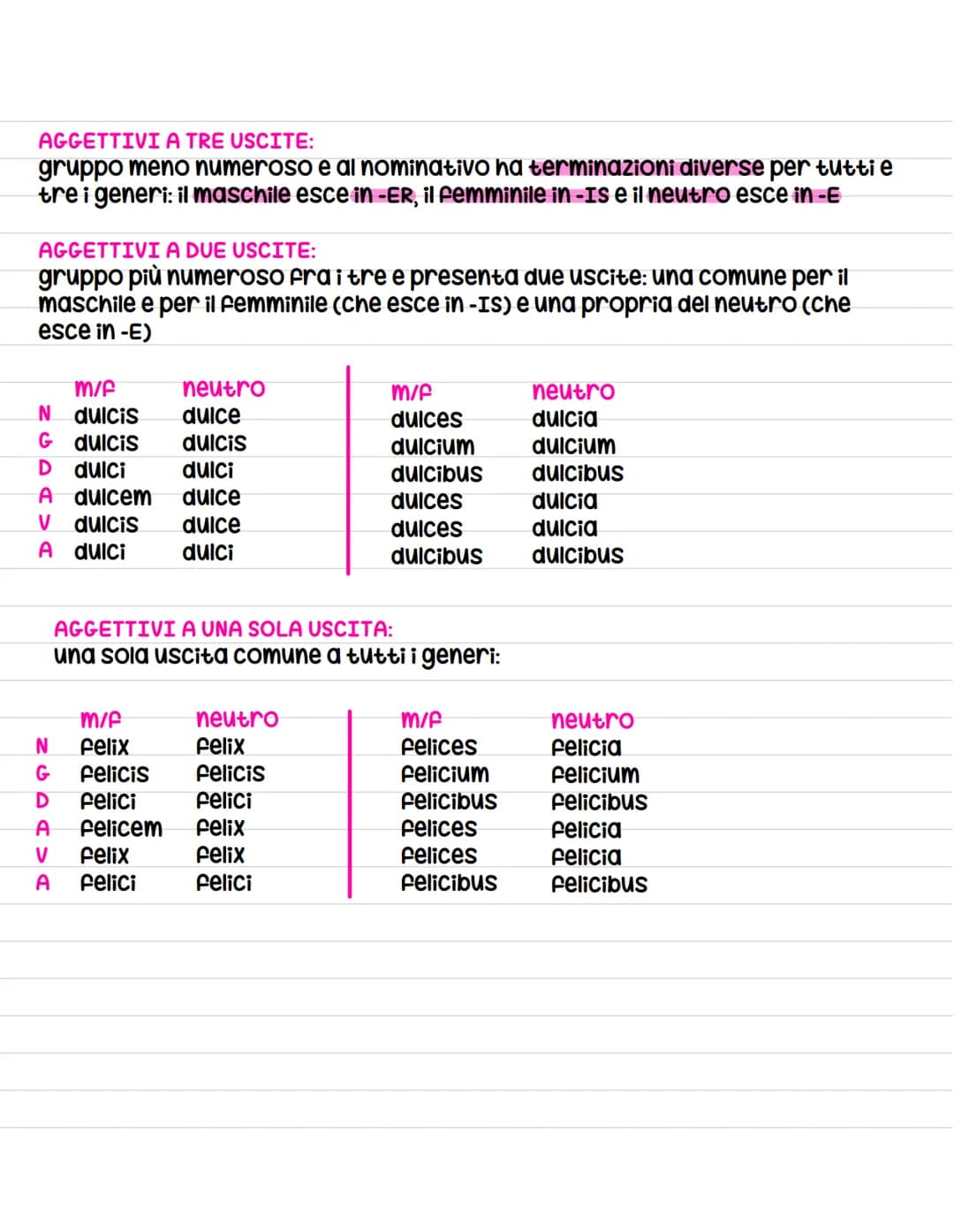
I Tre Gruppi di Aggettivi
Gli aggettivi a tre uscite sono i meno comuni ma i più regolari. Al nominativo il maschile finisce in -er, il femminile in -is e il neutro in -e. Una volta che conosci il nominativo, il resto della declinazione diventa automatico.
Gli aggettivi a due uscite sono il gruppo più numeroso che incontrerai nei testi. Hanno una forma comune per maschile e femminile (che finisce in -is) e una forma propria del neutro (in -e). "Dulcis/dulce" è l'esempio perfetto: facile da ricordare e da applicare.
Gli aggettivi a una sola uscita sono i più semplici: stessa forma per tutti i generi! "Felix" rimane "felix" sia che sia maschile, femminile o neutro al nominativo. Solo il contesto ti dice di che genere si tratta.
💡 Trucco per la memorizzazione: Inizia sempre dagli aggettivi a una uscita, sono i più facili da imparare!
We thought you’d never ask...
What is the Knowunity AI companion?
Our AI companion is specifically built for the needs of students. Based on the millions of content pieces we have on the platform we can provide truly meaningful and relevant answers to students. But its not only about answers, the companion is even more about guiding students through their daily learning challenges, with personalised study plans, quizzes or content pieces in the chat and 100% personalisation based on the students skills and developments.
Where can I download the Knowunity app?
You can download the app in the Google Play Store and in the Apple App Store.
Is Knowunity really free of charge?
That's right! Enjoy free access to study content, connect with fellow students, and get instant help – all at your fingertips.
Similar Content
 Yabancı Dil
 Český jazyk a literatura
 Limba și literatura română
 Türkçe
Most popular content: apprendimento linguistico
2LatinoAppunti e versioni
Sallustio - Cicerone - Lucrezio - Augusto - Virgilio - Orazio - Elegia - Gallo - Ovidio - Livio - età Giulio-Claudia - Seneca - Fedro - Petronio - Lucano - Persio - Giovenale - età Flavia - Quintiliano - Plinio il Vecchio - Marziale - Tacito
3ªl1,72023
 Russo
RussoIntroduzione alla lingua russa
Alfabeto e pronuncia, forme di saluto, numeri da zero a dieci e domande di presentazione generale
3ªl1,879115
Most popular content in Latino
9LatinoGrammatica latina
declinazioni, verbi, paradigmi, subordinate, aggettivi, pronomi, complementi
1ªl3,644124
LatinoLe declinazioni latine
tutte le declinazioni latine
2ªl4,03380
LatinoTabella verbi latino
Tabella con tutti i modi verbali attivi e passivi, coniugazione prima declinazione.
1ªl50,7182,621
LatinoGrammatica latina
declinazioni, dativo di possesso, pronomi dimostrativi, pronomi determinativi, verbi regolari, subordinata finale, ablativo assoluto, numeri cardinali e ordinali, calendario romano e tanto altro!
2ªl16,585734
LatinoVerbi latini
Tabella sulla coniugazione dei verbi in latino con i diversi tempi verbali
1ªl6,030131
 Italiano
Eneide
Presentazione
1ªl2,63950
LatinoLa III declinazione latina
Appunto su la terza declinazione latina,con esempi e metodi per la risalire al nominativo.
1ªl2,90863
Latinoletteratura latina- Orazio
Orazio vita e opere
4ªl7,099174
LatinoLe declinazioni latine
Pdf declinazioni latine + particolarità e aggettivi correlati
1ªl53,8344,356
Most popular content
9ItalianoRiassunto patente B
Riassunto patente B - appunti presi a lezione
5ªl29,242943
 Altro
AltroTeoria patente b
Tutti gli argomenti per la patente
1ªl21,138685
 Ed. civ.
Teoria patente di guida B: Segnali stradali
Segnali stradali di pericolo, luminosi, di prescrizione, di indicazione, temporanei, complementari, pannelli integrativi, segnaletica orizzontale, segnalazioni agenti del traffico, distanza di visibilità per l‘arresto, minima di sicurezza.
5ªl40,0421,645
 Filosofia
Aristotele
Aristotele: vita, metafisica, fisica, etica e politica, retorica e poetica
3ªl7,623216
ItalianoI promessi sposi
Riassunti completi di tutti i 38 capitoli dei Promessi sposi.
2ªl14,090314
AltroPATENTE
schemi per esame teorico della patente
Università22,067756
S
ItalianoSintesi finale di Analisi logica
Esercitazione completa di analisi logica su frasi articolate per consolidare la conoscenza di tutti i complementi.
3ªm5,5290
P
 Inglese
Present Simple vs Present Continuous
Develop the ability to choose correctly between the Present Simple for habits and the Present Continuous for ongoing actions.
3ªm4,2120
G
ItalianoGabriele D'Annunzio e l'Estetismo
Domande sull'ideale del superuomo, il panismo e la concezione dell'arte come valore assoluto in D'Annunzio.
4ªl2,6740
Can't find what you're looking for? Explore other subjects.
Students love us — and so will you.
4.6/5App Store
4.7/5Google Play
The app is very easy to use and well designed. I have found everything I was looking for so far and have been able to learn a lot from the presentations! I will definitely use the app for a class assignment! And of course it also helps a lot as an inspiration.
Stefan SiOS user
This app is really great. There are so many study notes and help [...]. My problem subject is French, for example, and the app has so many options for help. Thanks to this app, I have improved my French. I would recommend it to anyone.
Samantha KlichAndroid user
Wow, I am really amazed. I just tried the app because I've seen it advertised many times and was absolutely stunned. This app is THE HELP you want for school and above all, it offers so many things, such as workouts and fact sheets, which have been VERY helpful to me personally.
AnnaiOS user
Latino478 views·Updated Jun 29, 2026·2 pagesApprofondimento sul passivo impersonale e sugli aggettivi di seconda classe
Il latino ha delle forme grammaticali che sembrano complicate ma in realtà seguono schemi precisi. Oggi scoprirai come funziona il passivo impersonale e come si declinano gli aggettivi di seconda classe, strumenti fondamentali per tradurre correttamente i testi latini.
1
of 2
Sign up to see the content. It's free!
- Access to all documents
- Improve your grades
- Join milions of students
Passivo Impersonale
Hai mai visto frasi latine che sembrano non avere un soggetto preciso? Probabilmente stavi guardando il passivo impersonale! Questa forma si usa solo con verbi intransitivi coniugati alla terza persona singolare del passivo.
Il trucco per tradurre è semplice: usa il "si" impersonale in italiano. Per esempio, "in castra fugitum est" diventa "si scappò negli accampamenti", mentre "in Siciliam perventum est" si traduce "si arrivò in Sicilia".
Aggettivi di Seconda Classe - Introduzione
Gli aggettivi di seconda classe seguono la terza declinazione e si dividono in tre gruppi a seconda di quante forme diverse hanno al nominativo singolare. Tutti condividono alcune caratteristiche: ablativo singolare in -i, genitivo plurale in -ium e neutro plurale in -ia.
💡 Ricorda: Le terminazioni fisse ti aiutano a riconoscerli subito!
Il primo gruppo ha tre uscite diverse per ogni genere. Prendi "celeber": maschile -er, femminile -is, neutro -e. È il gruppo meno numeroso ma segue uno schema preciso che puoi imparare facilmente.
2
of 2Sign up to see the content. It's free!
- Access to all documents
- Improve your grades
- Join milions of students
I Tre Gruppi di Aggettivi
Gli aggettivi a tre uscite sono i meno comuni ma i più regolari. Al nominativo il maschile finisce in -er, il femminile in -is e il neutro in -e. Una volta che conosci il nominativo, il resto della declinazione diventa automatico.
Gli aggettivi a due uscite sono il gruppo più numeroso che incontrerai nei testi. Hanno una forma comune per maschile e femminile (che finisce in -is) e una forma propria del neutro (in -e). "Dulcis/dulce" è l'esempio perfetto: facile da ricordare e da applicare.
Gli aggettivi a una sola uscita sono i più semplici: stessa forma per tutti i generi! "Felix" rimane "felix" sia che sia maschile, femminile o neutro al nominativo. Solo il contesto ti dice di che genere si tratta.
💡 Trucco per la memorizzazione: Inizia sempre dagli aggettivi a una uscita, sono i più facili da imparare!
We thought you’d never ask...
What is the Knowunity AI companion?
Our AI companion is specifically built for the needs of students. Based on the millions of content pieces we have on the platform we can provide truly meaningful and relevant answers to students. But its not only about answers, the companion is even more about guiding students through their daily learning challenges, with personalised study plans, quizzes or content pieces in the chat and 100% personalisation based on the students skills and developments.
Where can I download the Knowunity app?
You can download the app in the Google Play Store and in the Apple App Store.
Is Knowunity really free of charge?
That's right! Enjoy free access to study content, connect with fellow students, and get instant help – all at your fingertips.
Similar Content
Most popular content: apprendimento linguistico
2LatinoAppunti e versioni
Sallustio - Cicerone - Lucrezio - Augusto - Virgilio - Orazio - Elegia - Gallo - Ovidio - Livio - età Giulio-Claudia - Seneca - Fedro - Petronio - Lucano - Persio - Giovenale - età Flavia - Quintiliano - Plinio il Vecchio - Marziale - Tacito
3ªl1,72023
RussoIntroduzione alla lingua russa
Alfabeto e pronuncia, forme di saluto, numeri da zero a dieci e domande di presentazione generale
3ªl1,879115
Most popular content in Latino
9LatinoGrammatica latina
declinazioni, verbi, paradigmi, subordinate, aggettivi, pronomi, complementi
1ªl3,644124
LatinoLe declinazioni latine
tutte le declinazioni latine
2ªl4,03380
LatinoTabella verbi latino
Tabella con tutti i modi verbali attivi e passivi, coniugazione prima declinazione.
1ªl50,7182,621
LatinoGrammatica latina
declinazioni, dativo di possesso, pronomi dimostrativi, pronomi determinativi, verbi regolari, subordinata finale, ablativo assoluto, numeri cardinali e ordinali, calendario romano e tanto altro!
2ªl16,585734
LatinoVerbi latini
Tabella sulla coniugazione dei verbi in latino con i diversi tempi verbali
1ªl6,030131
ItalianoEneide
Presentazione
1ªl2,63950
LatinoLa III declinazione latina
Appunto su la terza declinazione latina,con esempi e metodi per la risalire al nominativo.
1ªl2,90863
Latinoletteratura latina- Orazio
Orazio vita e opere
4ªl7,099174
LatinoLe declinazioni latine
Pdf declinazioni latine + particolarità e aggettivi correlati
1ªl53,8344,356
Most popular content
9ItalianoRiassunto patente B
Riassunto patente B - appunti presi a lezione
5ªl29,242943
AltroTeoria patente b
Tutti gli argomenti per la patente
1ªl21,138685
Ed. civ.Teoria patente di guida B: Segnali stradali
Segnali stradali di pericolo, luminosi, di prescrizione, di indicazione, temporanei, complementari, pannelli integrativi, segnaletica orizzontale, segnalazioni agenti del traffico, distanza di visibilità per l‘arresto, minima di sicurezza.
5ªl40,0421,645
FilosofiaAristotele
Aristotele: vita, metafisica, fisica, etica e politica, retorica e poetica
3ªl7,623216
ItalianoI promessi sposi
Riassunti completi di tutti i 38 capitoli dei Promessi sposi.
2ªl14,090314
AltroPATENTE
schemi per esame teorico della patente
Università22,067756
S
ItalianoSintesi finale di Analisi logica
Esercitazione completa di analisi logica su frasi articolate per consolidare la conoscenza di tutti i complementi.
3ªm5,5290
P
InglesePresent Simple vs Present Continuous
Develop the ability to choose correctly between the Present Simple for habits and the Present Continuous for ongoing actions.
3ªm4,2120
G
ItalianoGabriele D'Annunzio e l'Estetismo
Domande sull'ideale del superuomo, il panismo e la concezione dell'arte come valore assoluto in D'Annunzio.
4ªl2,6740
Can't find what you're looking for? Explore other subjects.
Students love us — and so will you.
4.6/5App Store
4.7/5Google Play
The app is very easy to use and well designed. I have found everything I was looking for so far and have been able to learn a lot from the presentations! I will definitely use the app for a class assignment! And of course it also helps a lot as an inspiration.
Stefan SiOS user
This app is really great. There are so many study notes and help [...]. My problem subject is French, for example, and the app has so many options for help. Thanks to this app, I have improved my French. I would recommend it to anyone.
Samantha KlichAndroid user
Wow, I am really amazed. I just tried the app because I've seen it advertised many times and was absolutely stunned. This app is THE HELP you want for school and above all, it offers so many things, such as workouts and fact sheets, which have been VERY helpful to me personally.
AnnaiOS user