
Latin declensionsform the foundational framework for understanding how nouns...
 Latino53,833 views·Updated Jun 21, 2026·9 pages
Impara le Declinações Latine e Aggettivi: Schemi e PDF

francesca@francescamontanari




1 / 9
1
of 9
Second Declension Patterns
The second declension includes both masculine and neuter nouns.
Example: Masculine pattern: servus, servi, servo, servum, serve, servo Example: Neuter pattern: verbum, verbi, verbo, verbum, verbum, verbo
Highlight: The word "deus" (god) has special forms: dei, dii, dis, diis, deis
2
of 9
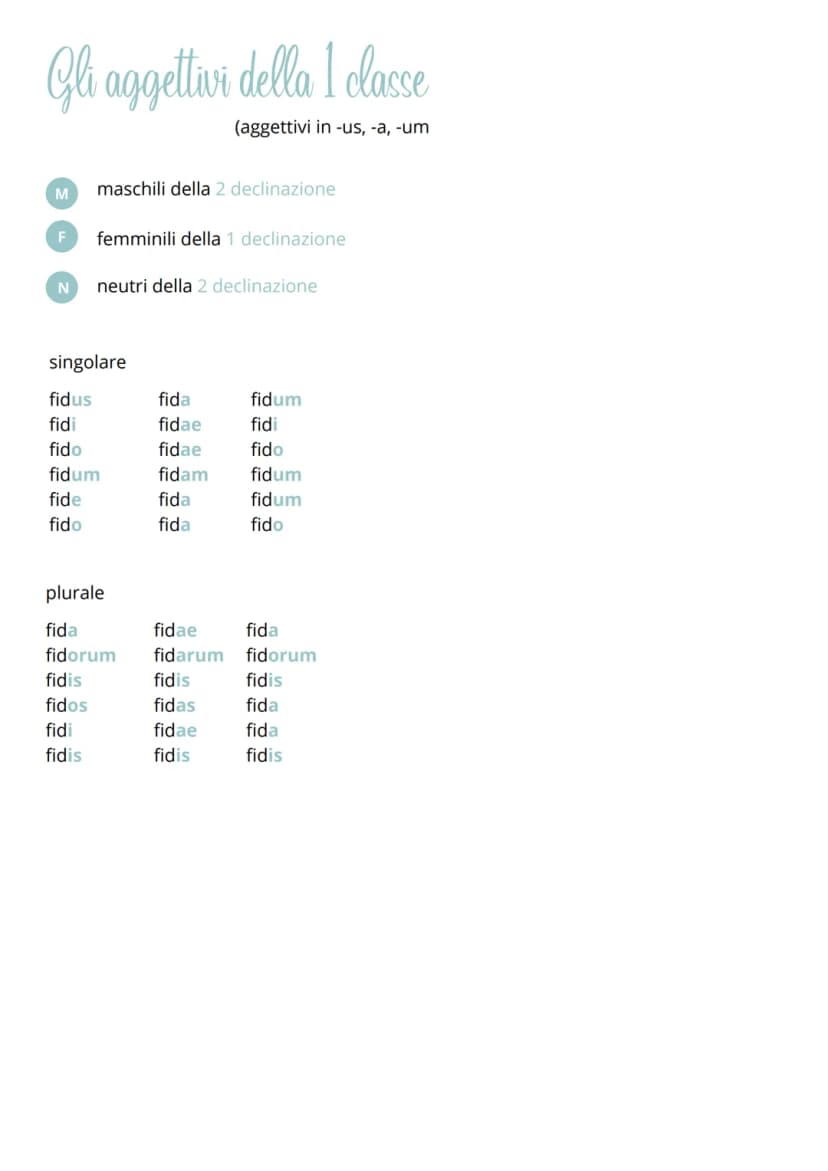
First Class Adjectives
Aggettivi prima classe latino follow the patterns of first and second declensions.
Definition: These adjectives have three endings: -us (masculine), -a (feminine), -um (neuter)
Example: The adjective "fidus" (faithful) declines as:
- Masculine: fidus, fidi, fido, fidum, fide, fido
- Feminine: fida, fidae, fidae, fidam, fida, fida
- Neuter: fidum, fidi, fido, fidum, fidum, fido
3
of 9
Names in -er and -ir
Special patterns exist for nouns ending in -er and -ir in the second declension.
Example: puer (boy) retains -e throughout: puer, pueri, puero Example: faber (craftsman) loses -e: faber, fabri, fabro
Vocabulary: "vir" (man) follows a unique pattern: vir, viri, viro
4
of 9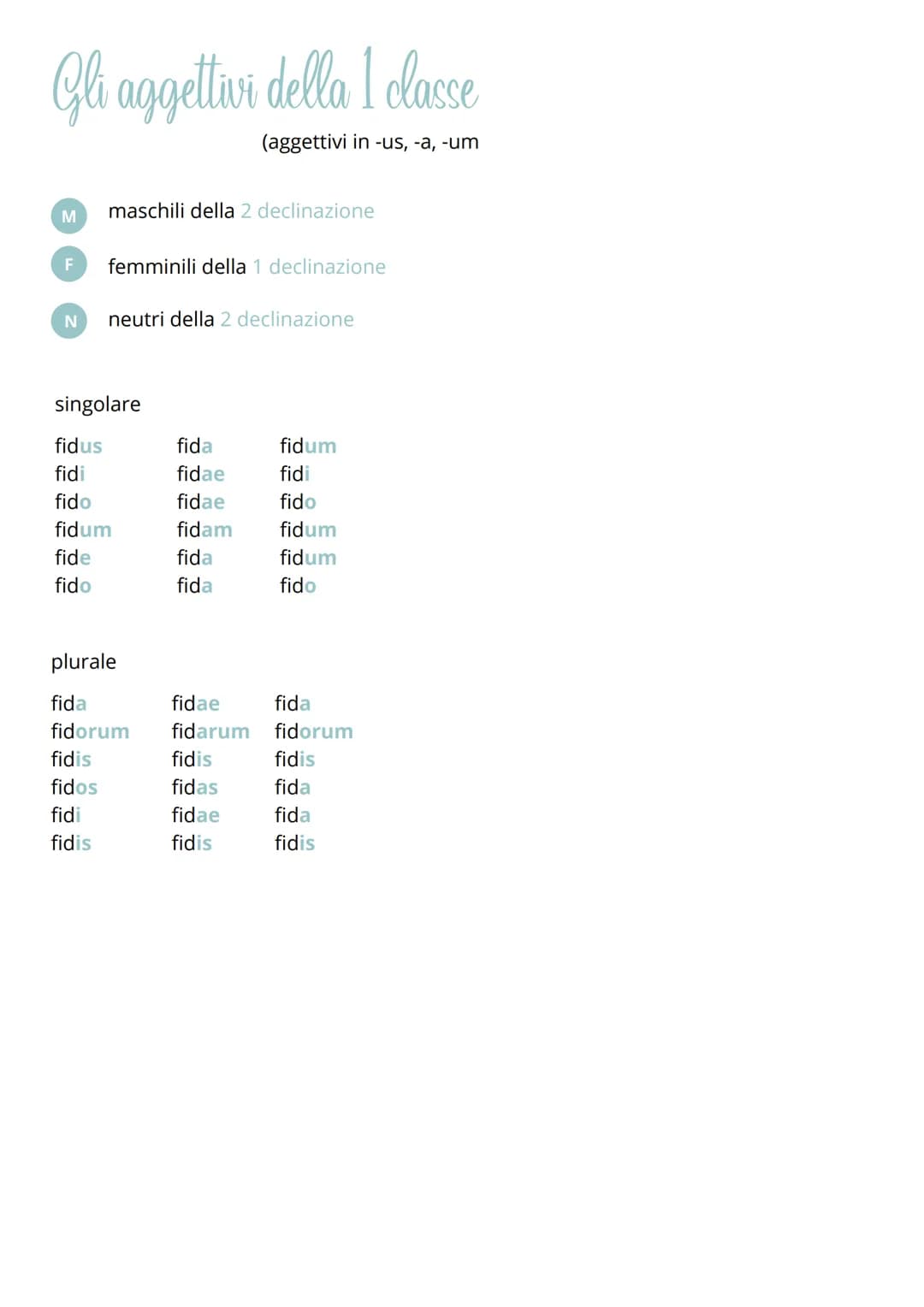
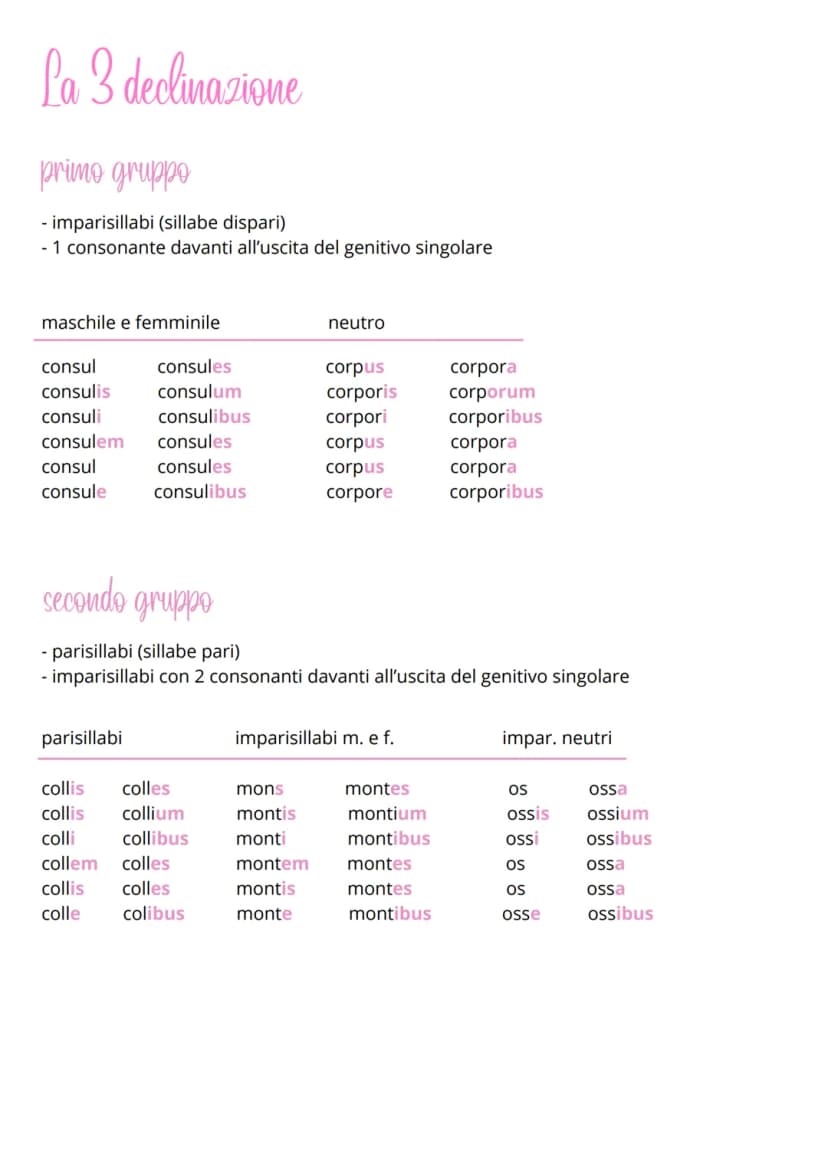
Third Declension Structure
The terza declinazione latino has three main groups:
- Imparisyllabic nouns (different number of syllables in nominative and genitive)
- Parisyllabic nouns (same number of syllables throughout)
- Special neuter nouns
Example: consul, consulis (imparisyllabic) Example: collis, collis (parisyllabic)
5
of 9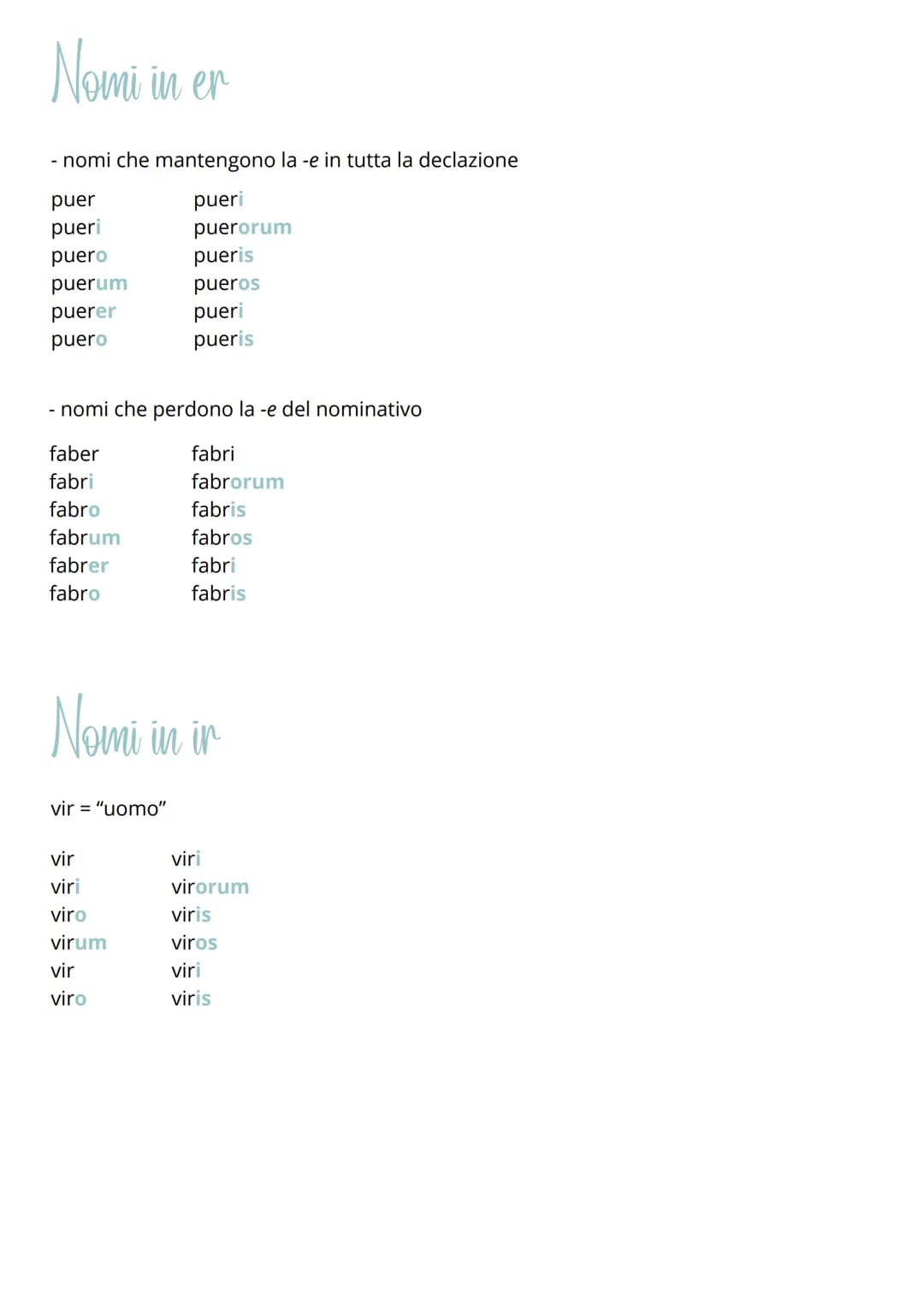
Third Declension Neuter Forms
Special patterns exist for neuter nouns ending in -al, -ar, and -e.
Example: animal, animalis Example: calcar, calcaris Example: mare, maris
6
of 9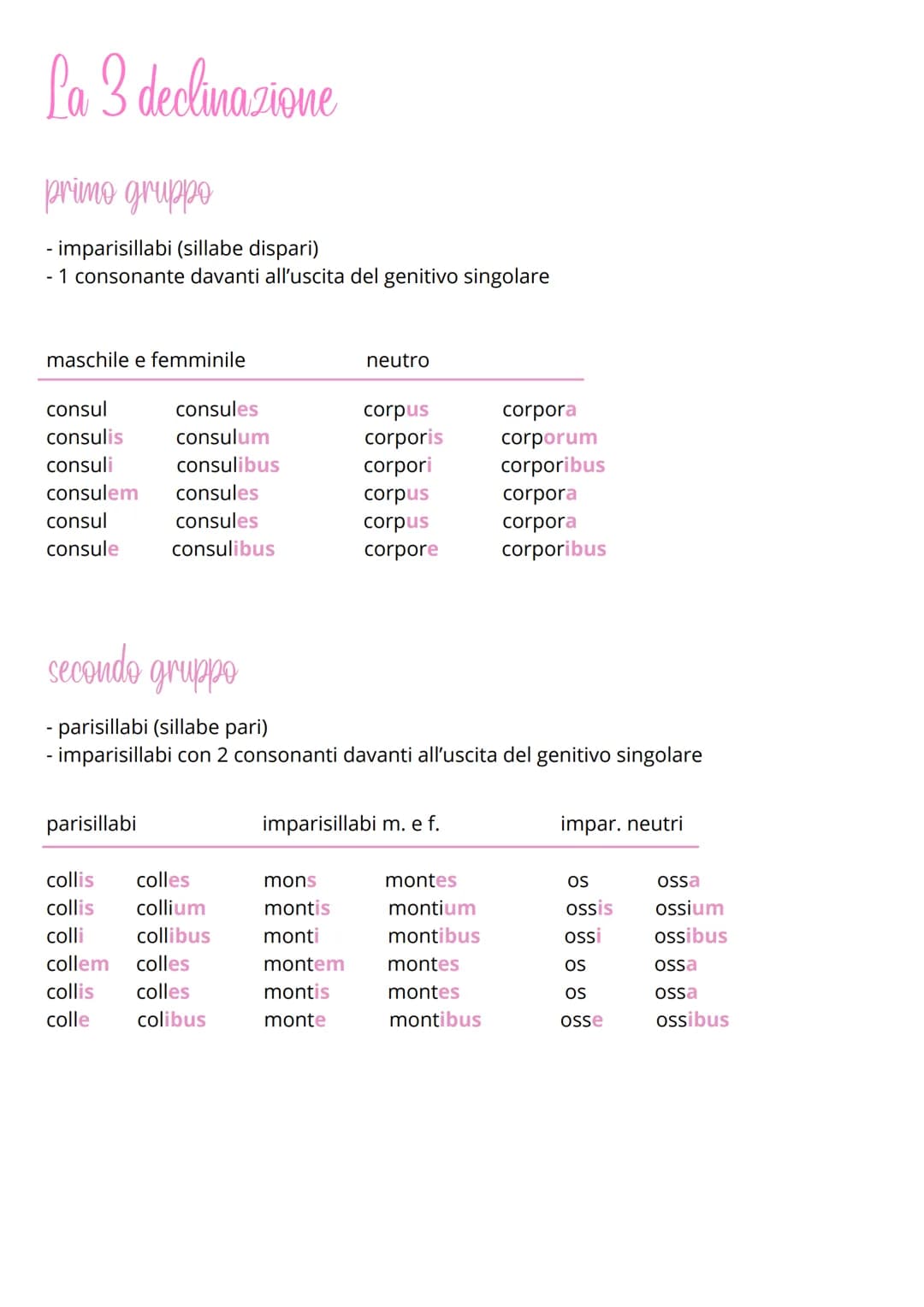
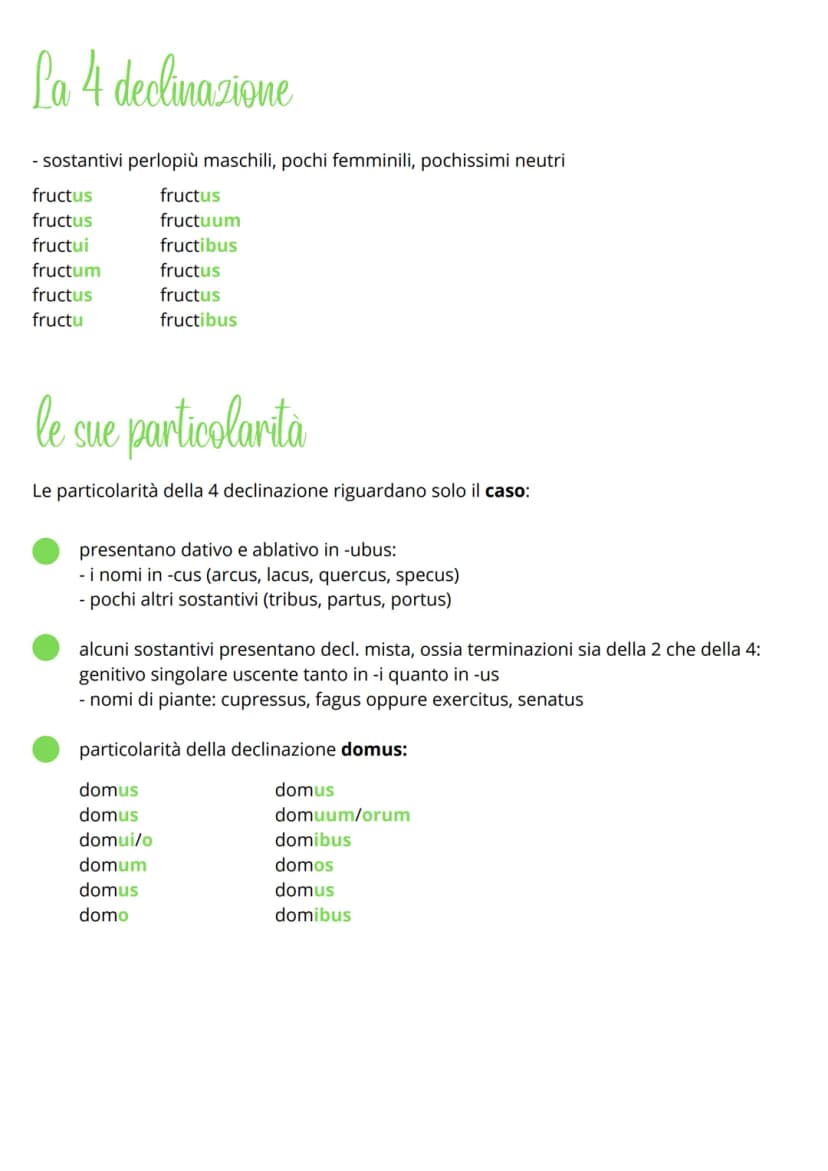
Fourth Declension Characteristics
The declinazioni latine 4 primarily contains masculine nouns with some feminine and neuter forms.
Example: fructus, fructus, fructui, fructum, fructus, fructu
Highlight: Special dative and ablative forms in -ubus for certain nouns
7
of 9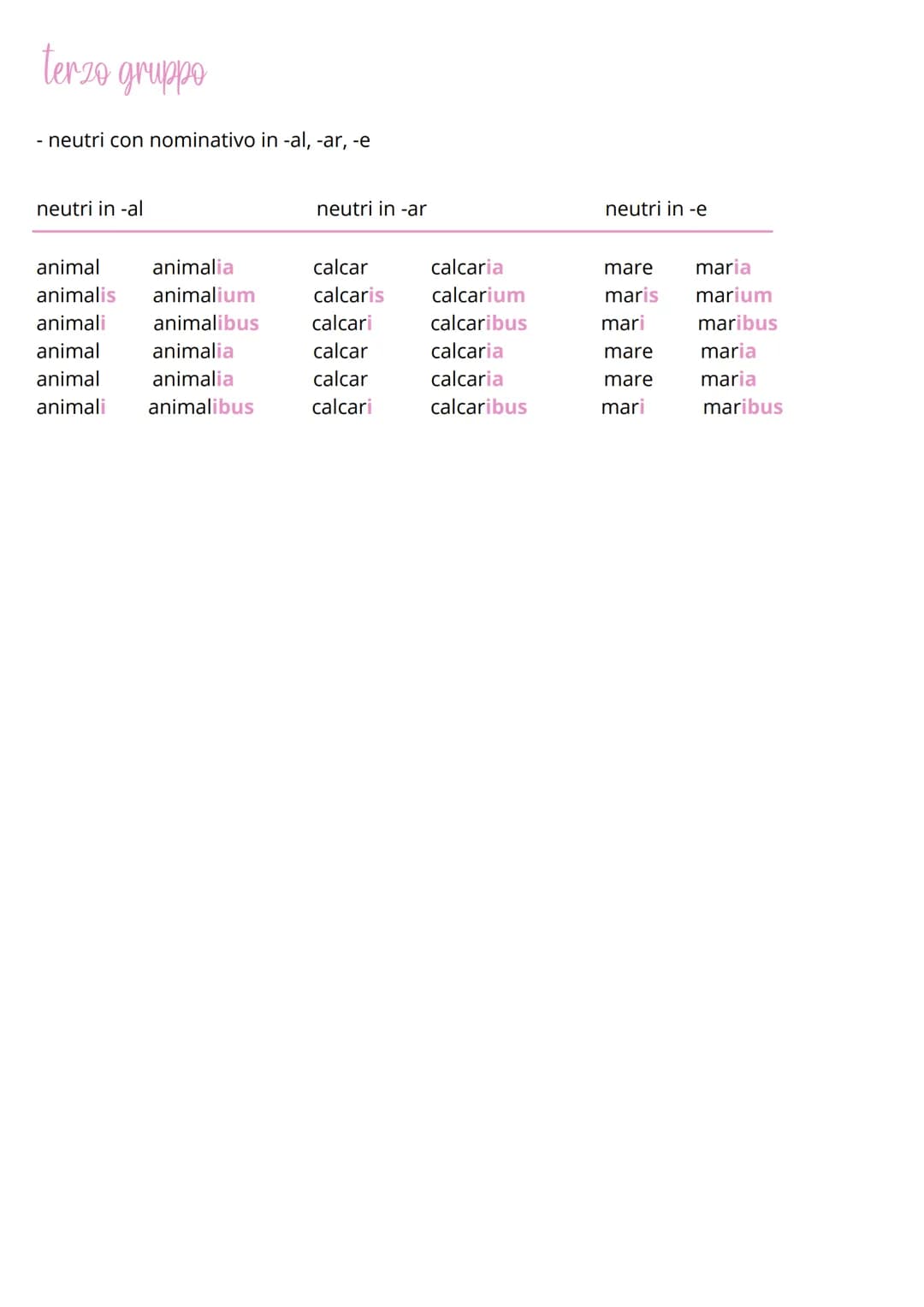
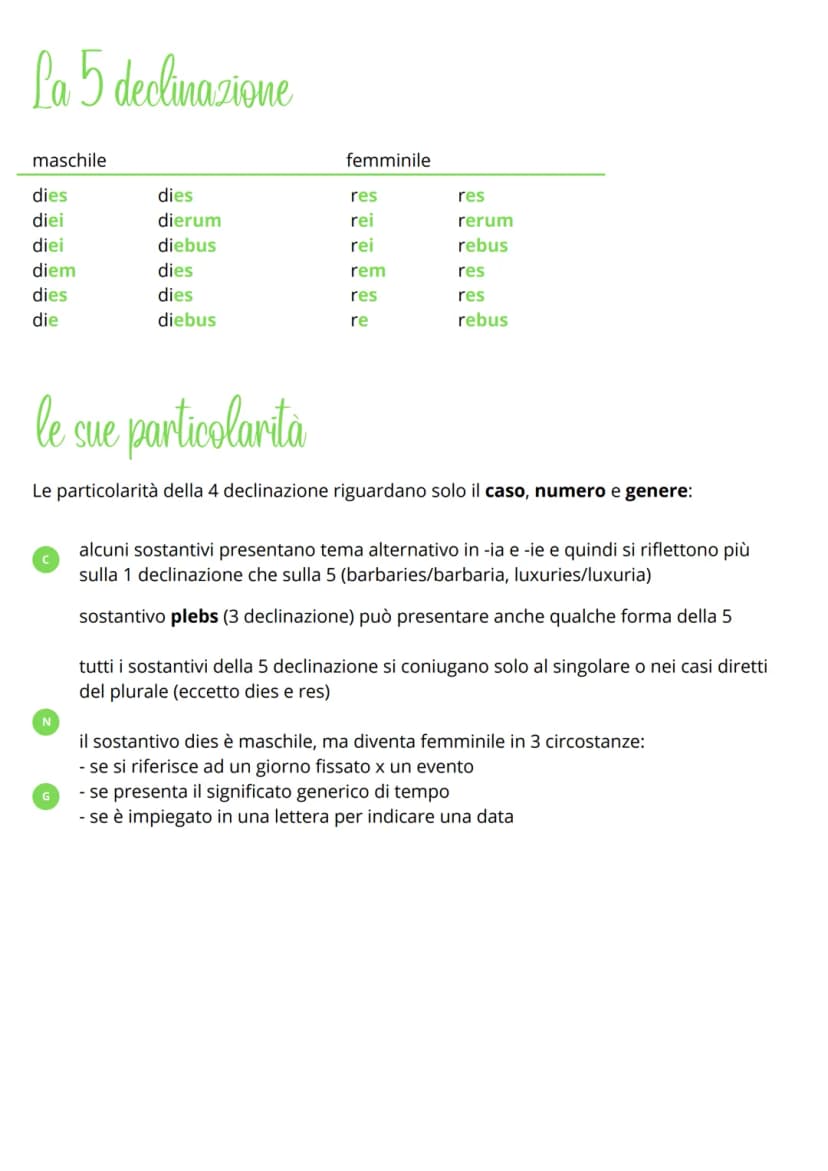
Fifth Declension Features
The declinazioni latine 5 consists mainly of feminine nouns with -es endings.
Example: dies (day), res (thing)
Highlight: Most fifth declension nouns only appear in singular or direct plural cases
8
of 9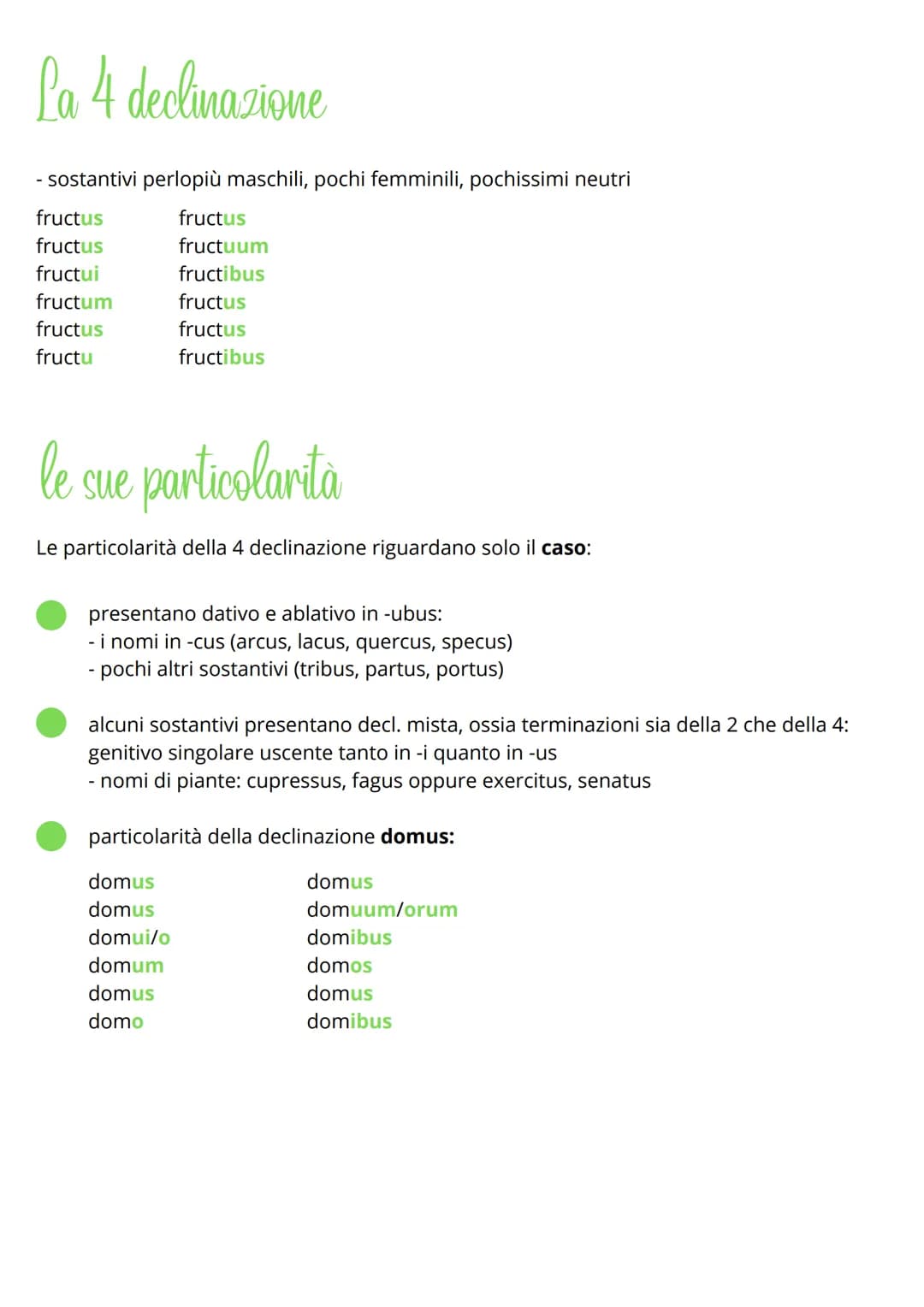
Fifth Declension (Quinta Declinazione)
The declinazioni latine quante sono culminates with the fifth declension, primarily containing feminine nouns.
Definition: Most nouns end in -es and are feminine
Example: "Dies" (day) and "res" (thing) are the most common fifth declension nouns
9
of 9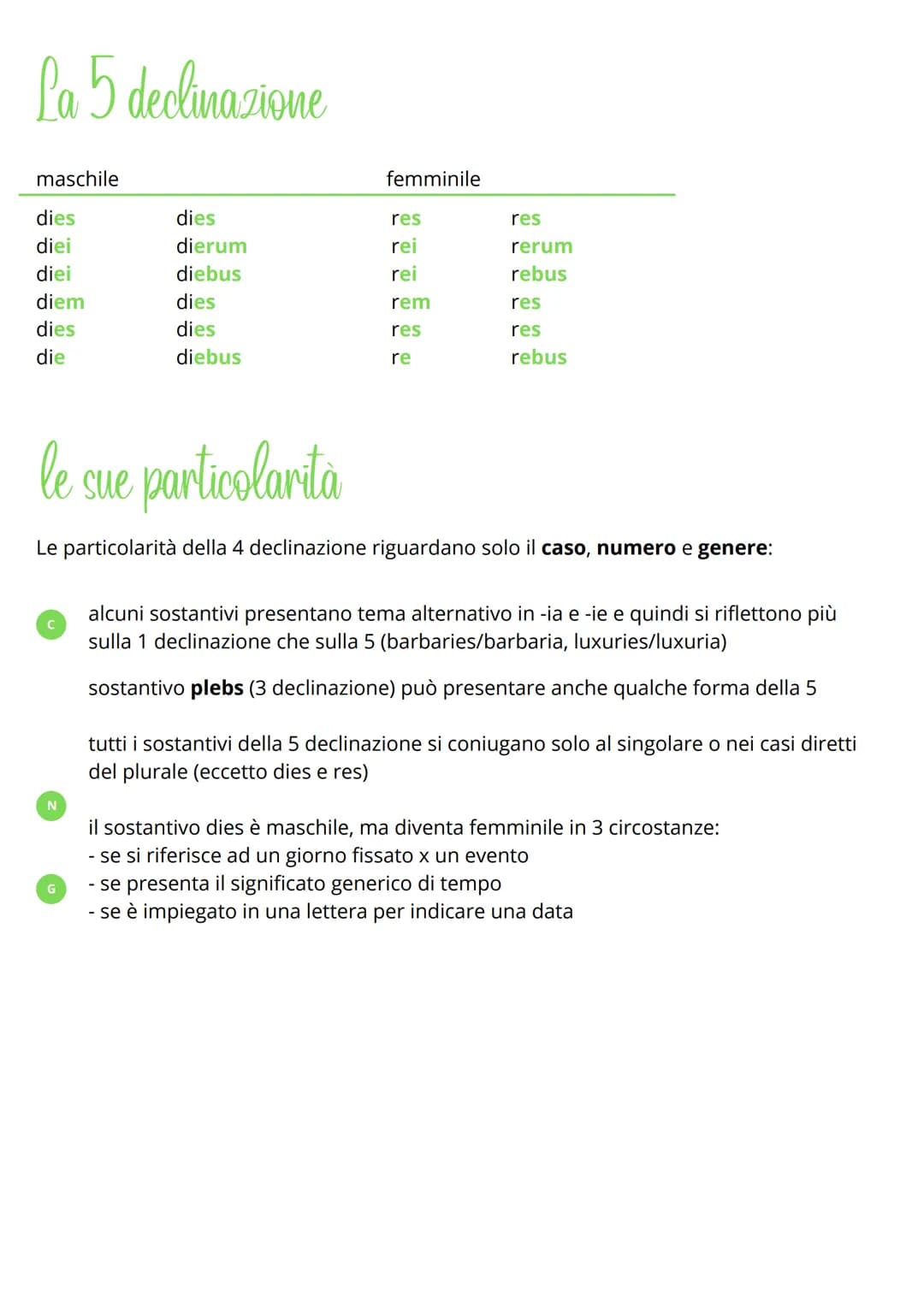
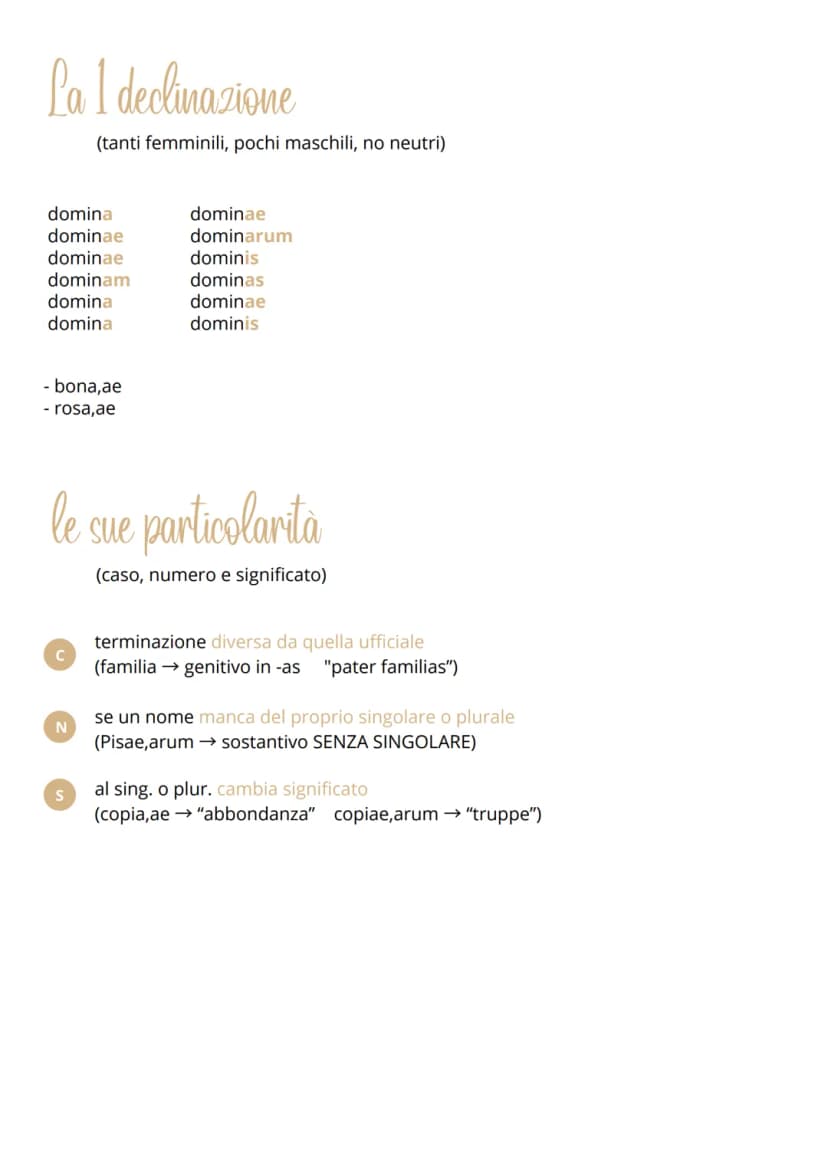
First Declension Overview
The prima declinazione latino primarily consists of feminine nouns ending in -a. This declension follows a consistent pattern with the nominative singular ending in -a.
Example: The word "domina" (lady) declines as: domina, dominae, dominae, dominam, domina, domina
Vocabulary: Common first declension nouns include bona (good things) and rosa (rose)
Definition: Peculiarities include special genitive forms like "pater familias" and pluralia tantum nouns like "Pisae" (Pisa)
We thought you’d never ask...
What is the Knowunity AI companion?
Our AI companion is specifically built for the needs of students. Based on the millions of content pieces we have on the platform we can provide truly meaningful and relevant answers to students. But its not only about answers, the companion is even more about guiding students through their daily learning challenges, with personalised study plans, quizzes or content pieces in the chat and 100% personalisation based on the students skills and developments.
Where can I download the Knowunity app?
You can download the app in the Google Play Store and in the Apple App Store.
Is Knowunity really free of charge?
That's right! Enjoy free access to study content, connect with fellow students, and get instant help – all at your fingertips.
Similar Content
Most popular content: Declinazioni Latine
9LatinoGrammatica latina
declinazioni, verbi, paradigmi, subordinate, aggettivi, pronomi, complementi
1ªl3,640124
LatinoLa III declinazione latina
Appunto su la terza declinazione latina,con esempi e metodi per la risalire al nominativo.
1ªl2,90863
LatinoLa terza declinazione
Uscite e Particolarità
1ªl20,737803
LatinoDeclinazioni latine con particolarità
Li appunti sono stati presi in classe e integrati dal libro
1ªl1,96054
Latinotutte le declinazioni, 1-2-3 gruppo, aggettivi 1-2 classe, i pronomi personali, il determinativo -is-ea-id, compl. argomento-materia, i determinativi IS-IDEM-IPSE, il pronome relativo QUI-QUAE-QUOD, le proposizioni relative, coniugazioni attive e passive
appunti su tutto il programma di latino 1 e 2 liceo
1ªl22,1871,215
LatinoRipasso latino 1° superiore
1ª declinazione; 2ª declinazione;3ª declinazione; aggettivi 1ª e 2ª classe; indicativo
1ªl2,88060
LatinoLe 5 declinazioni latine
Artomenti: prima, seconda, terza, quarta e quinta declinazione con le rispettive particolarità.
2ªl7,511179
LatinoLATINO: DECLINAZIONI
schema completo delle 5 declinazioni latine (con esempi)
1ªl7,514318
LatinoCOSTRUTTI IN LATINO
Sintesi sui vari costrutti in latino
3ªl59515
Most popular content in Latino
9LatinoGrammatica latina
declinazioni, verbi, paradigmi, subordinate, aggettivi, pronomi, complementi
1ªl3,640124
LatinoLe declinazioni latine
tutte le declinazioni latine
2ªl4,03380
LatinoTabella verbi latino
Tabella con tutti i modi verbali attivi e passivi, coniugazione prima declinazione.
1ªl50,7152,621
LatinoGrammatica latina
declinazioni, dativo di possesso, pronomi dimostrativi, pronomi determinativi, verbi regolari, subordinata finale, ablativo assoluto, numeri cardinali e ordinali, calendario romano e tanto altro!
2ªl16,583734
LatinoVerbi latini
Tabella sulla coniugazione dei verbi in latino con i diversi tempi verbali
1ªl6,027131
 Italiano
Eneide
Presentazione
1ªl2,63950
LatinoLa III declinazione latina
Appunto su la terza declinazione latina,con esempi e metodi per la risalire al nominativo.
1ªl2,90863
Latinoletteratura latina- Orazio
Orazio vita e opere
4ªl7,099174
ItalianoLa Divina Commedia
Teoria sulla divina commedia e Dante
2ªm3,41970
Most popular content
9ItalianoRiassunto patente B
Riassunto patente B - appunti presi a lezione
5ªl29,228943
 Altro
AltroTeoria patente b
Tutti gli argomenti per la patente
1ªl21,114685
 Ed. civ.
Teoria patente di guida B: Segnali stradali
Segnali stradali di pericolo, luminosi, di prescrizione, di indicazione, temporanei, complementari, pannelli integrativi, segnaletica orizzontale, segnalazioni agenti del traffico, distanza di visibilità per l‘arresto, minima di sicurezza.
5ªl40,0241,644
 Filosofia
Aristotele
Aristotele: vita, metafisica, fisica, etica e politica, retorica e poetica
3ªl7,623216
ItalianoI promessi sposi
Riassunti completi di tutti i 38 capitoli dei Promessi sposi.
2ªl14,090314
AltroPATENTE
schemi per esame teorico della patente
Università22,050755
S
ItalianoSintesi finale di Analisi logica
Esercitazione completa di analisi logica su frasi articolate per consolidare la conoscenza di tutti i complementi.
3ªm5,5290
P
 Inglese
Present Simple vs Present Continuous
Develop the ability to choose correctly between the Present Simple for habits and the Present Continuous for ongoing actions.
3ªm4,2110
G
ItalianoGabriele D'Annunzio e l'Estetismo
Domande sull'ideale del superuomo, il panismo e la concezione dell'arte come valore assoluto in D'Annunzio.
4ªl2,6740
Can't find what you're looking for? Explore other subjects.
Students love us — and so will you.
4.6/5App Store
4.7/5Google Play
The app is very easy to use and well designed. I have found everything I was looking for so far and have been able to learn a lot from the presentations! I will definitely use the app for a class assignment! And of course it also helps a lot as an inspiration.
Stefan SiOS user
This app is really great. There are so many study notes and help [...]. My problem subject is French, for example, and the app has so many options for help. Thanks to this app, I have improved my French. I would recommend it to anyone.
Samantha KlichAndroid user
Wow, I am really amazed. I just tried the app because I've seen it advertised many times and was absolutely stunned. This app is THE HELP you want for school and above all, it offers so many things, such as workouts and fact sheets, which have been VERY helpful to me personally.
AnnaiOS user
Latino53,833 views·Updated Jun 21, 2026·9 pagesImpara le Declinações Latine e Aggettivi: Schemi e PDF
francesca@francescamontanari
Latin declensions form the foundational framework for understanding how nouns and adjectives change their forms in Latin grammar. The system comprises five distinct declension patterns that determine case endings for nouns and adjectives.
- The first declensionprimarily contains feminine nouns...
1
of 9
Sign up to see the content. It's free!
- Access to all documents
- Improve your grades
- Join milions of students
Second Declension Patterns
The second declension includes both masculine and neuter nouns.
Example: Masculine pattern: servus, servi, servo, servum, serve, servo Example: Neuter pattern: verbum, verbi, verbo, verbum, verbum, verbo
Highlight: The word "deus" (god) has special forms: dei, dii, dis, diis, deis
2
of 9Sign up to see the content. It's free!
- Access to all documents
- Improve your grades
- Join milions of students
First Class Adjectives
Aggettivi prima classe latino follow the patterns of first and second declensions.
Definition: These adjectives have three endings: -us (masculine), -a (feminine), -um (neuter)
Example: The adjective "fidus" (faithful) declines as:
- Masculine: fidus, fidi, fido, fidum, fide, fido
- Feminine: fida, fidae, fidae, fidam, fida, fida
- Neuter: fidum, fidi, fido, fidum, fidum, fido
3
of 9Sign up to see the content. It's free!
- Access to all documents
- Improve your grades
- Join milions of students
Names in -er and -ir
Special patterns exist for nouns ending in -er and -ir in the second declension.
Example: puer (boy) retains -e throughout: puer, pueri, puero Example: faber (craftsman) loses -e: faber, fabri, fabro
Vocabulary: "vir" (man) follows a unique pattern: vir, viri, viro
4
of 9Sign up to see the content. It's free!
- Access to all documents
- Improve your grades
- Join milions of students
Third Declension Structure
The terza declinazione latino has three main groups:
- Imparisyllabic nouns (different number of syllables in nominative and genitive)
- Parisyllabic nouns (same number of syllables throughout)
- Special neuter nouns
Example: consul, consulis (imparisyllabic) Example: collis, collis (parisyllabic)
5
of 9Sign up to see the content. It's free!
- Access to all documents
- Improve your grades
- Join milions of students
Third Declension Neuter Forms
Special patterns exist for neuter nouns ending in -al, -ar, and -e.
Example: animal, animalis Example: calcar, calcaris Example: mare, maris
6
of 9Sign up to see the content. It's free!
- Access to all documents
- Improve your grades
- Join milions of students
Fourth Declension Characteristics
The declinazioni latine 4 primarily contains masculine nouns with some feminine and neuter forms.
Example: fructus, fructus, fructui, fructum, fructus, fructu
Highlight: Special dative and ablative forms in -ubus for certain nouns
7
of 9Sign up to see the content. It's free!
- Access to all documents
- Improve your grades
- Join milions of students
Fifth Declension Features
The declinazioni latine 5 consists mainly of feminine nouns with -es endings.
Example: dies (day), res (thing)
Highlight: Most fifth declension nouns only appear in singular or direct plural cases
8
of 9Sign up to see the content. It's free!
- Access to all documents
- Improve your grades
- Join milions of students
Fifth Declension (Quinta Declinazione)
The declinazioni latine quante sono culminates with the fifth declension, primarily containing feminine nouns.
Definition: Most nouns end in -es and are feminine
Example: "Dies" (day) and "res" (thing) are the most common fifth declension nouns
9
of 9Sign up to see the content. It's free!
- Access to all documents
- Improve your grades
- Join milions of students
First Declension Overview
The prima declinazione latino primarily consists of feminine nouns ending in -a. This declension follows a consistent pattern with the nominative singular ending in -a.
Example: The word "domina" (lady) declines as: domina, dominae, dominae, dominam, domina, domina
Vocabulary: Common first declension nouns include bona (good things) and rosa (rose)
Definition: Peculiarities include special genitive forms like "pater familias" and pluralia tantum nouns like "Pisae" (Pisa)
We thought you’d never ask...
What is the Knowunity AI companion?
Our AI companion is specifically built for the needs of students. Based on the millions of content pieces we have on the platform we can provide truly meaningful and relevant answers to students. But its not only about answers, the companion is even more about guiding students through their daily learning challenges, with personalised study plans, quizzes or content pieces in the chat and 100% personalisation based on the students skills and developments.
Where can I download the Knowunity app?
You can download the app in the Google Play Store and in the Apple App Store.
Is Knowunity really free of charge?
That's right! Enjoy free access to study content, connect with fellow students, and get instant help – all at your fingertips.
Similar Content
Most popular content: Declinazioni Latine
9LatinoGrammatica latina
declinazioni, verbi, paradigmi, subordinate, aggettivi, pronomi, complementi
1ªl3,640124
LatinoLa III declinazione latina
Appunto su la terza declinazione latina,con esempi e metodi per la risalire al nominativo.
1ªl2,90863
LatinoLa terza declinazione
Uscite e Particolarità
1ªl20,737803
LatinoDeclinazioni latine con particolarità
Li appunti sono stati presi in classe e integrati dal libro
1ªl1,96054
Latinotutte le declinazioni, 1-2-3 gruppo, aggettivi 1-2 classe, i pronomi personali, il determinativo -is-ea-id, compl. argomento-materia, i determinativi IS-IDEM-IPSE, il pronome relativo QUI-QUAE-QUOD, le proposizioni relative, coniugazioni attive e passive
appunti su tutto il programma di latino 1 e 2 liceo
1ªl22,1871,215
LatinoRipasso latino 1° superiore
1ª declinazione; 2ª declinazione;3ª declinazione; aggettivi 1ª e 2ª classe; indicativo
1ªl2,88060
LatinoLe 5 declinazioni latine
Artomenti: prima, seconda, terza, quarta e quinta declinazione con le rispettive particolarità.
2ªl7,511179
LatinoLATINO: DECLINAZIONI
schema completo delle 5 declinazioni latine (con esempi)
1ªl7,514318
LatinoCOSTRUTTI IN LATINO
Sintesi sui vari costrutti in latino
3ªl59515
Most popular content in Latino
9LatinoGrammatica latina
declinazioni, verbi, paradigmi, subordinate, aggettivi, pronomi, complementi
1ªl3,640124
LatinoLe declinazioni latine
tutte le declinazioni latine
2ªl4,03380
LatinoTabella verbi latino
Tabella con tutti i modi verbali attivi e passivi, coniugazione prima declinazione.
1ªl50,7152,621
LatinoGrammatica latina
declinazioni, dativo di possesso, pronomi dimostrativi, pronomi determinativi, verbi regolari, subordinata finale, ablativo assoluto, numeri cardinali e ordinali, calendario romano e tanto altro!
2ªl16,583734
LatinoVerbi latini
Tabella sulla coniugazione dei verbi in latino con i diversi tempi verbali
1ªl6,027131
ItalianoEneide
Presentazione
1ªl2,63950
LatinoLa III declinazione latina
Appunto su la terza declinazione latina,con esempi e metodi per la risalire al nominativo.
1ªl2,90863
Latinoletteratura latina- Orazio
Orazio vita e opere
4ªl7,099174
ItalianoLa Divina Commedia
Teoria sulla divina commedia e Dante
2ªm3,41970
Most popular content
9ItalianoRiassunto patente B
Riassunto patente B - appunti presi a lezione
5ªl29,228943
AltroTeoria patente b
Tutti gli argomenti per la patente
1ªl21,114685
Ed. civ.Teoria patente di guida B: Segnali stradali
Segnali stradali di pericolo, luminosi, di prescrizione, di indicazione, temporanei, complementari, pannelli integrativi, segnaletica orizzontale, segnalazioni agenti del traffico, distanza di visibilità per l‘arresto, minima di sicurezza.
5ªl40,0241,644
FilosofiaAristotele
Aristotele: vita, metafisica, fisica, etica e politica, retorica e poetica
3ªl7,623216
ItalianoI promessi sposi
Riassunti completi di tutti i 38 capitoli dei Promessi sposi.
2ªl14,090314
AltroPATENTE
schemi per esame teorico della patente
Università22,050755
S
ItalianoSintesi finale di Analisi logica
Esercitazione completa di analisi logica su frasi articolate per consolidare la conoscenza di tutti i complementi.
3ªm5,5290
P
InglesePresent Simple vs Present Continuous
Develop the ability to choose correctly between the Present Simple for habits and the Present Continuous for ongoing actions.
3ªm4,2110
G
ItalianoGabriele D'Annunzio e l'Estetismo
Domande sull'ideale del superuomo, il panismo e la concezione dell'arte come valore assoluto in D'Annunzio.
4ªl2,6740
Can't find what you're looking for? Explore other subjects.
Students love us — and so will you.
4.6/5App Store
4.7/5Google Play
The app is very easy to use and well designed. I have found everything I was looking for so far and have been able to learn a lot from the presentations! I will definitely use the app for a class assignment! And of course it also helps a lot as an inspiration.
Stefan SiOS user
This app is really great. There are so many study notes and help [...]. My problem subject is French, for example, and the app has so many options for help. Thanks to this app, I have improved my French. I would recommend it to anyone.
Samantha KlichAndroid user
Wow, I am really amazed. I just tried the app because I've seen it advertised many times and was absolutely stunned. This app is THE HELP you want for school and above all, it offers so many things, such as workouts and fact sheets, which have been VERY helpful to me personally.
AnnaiOS user