
Kimyanın Temel Kanunları, modern kimyanın dayandığı önemli prensipleri açıklayan kanunlardır....
 Kimya381 views·Updated Jun 18, 2026·2 pages
Kimyanın Temel Kanunları - Lise İçin Rehber

Sude Patan@sudepatan
1
of 2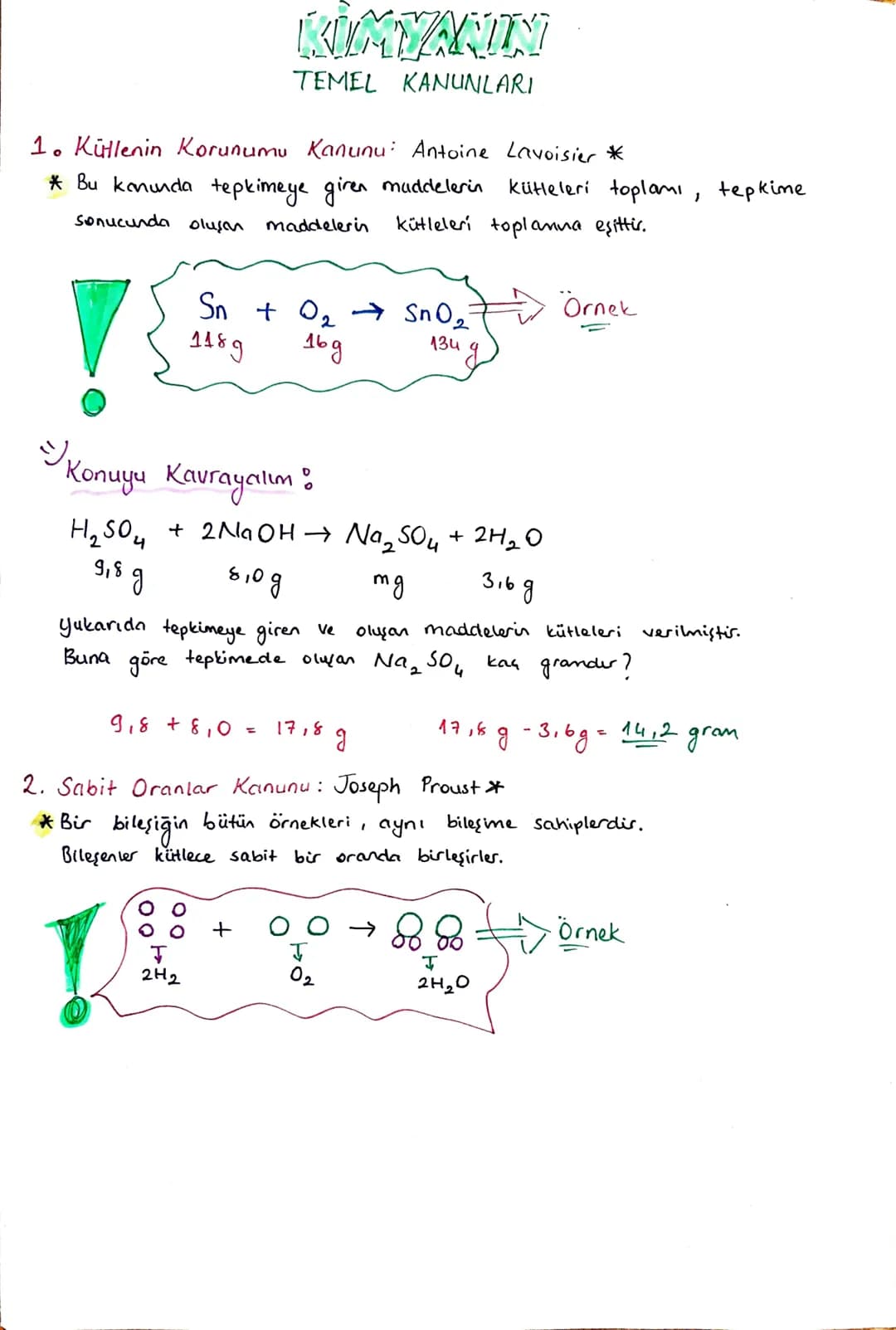
Kütlenin Korunumu ve Sabit Oranlar Kanunu
Kütlenin Korunumu Kanunu, Antoine Lavoisier tarafından ortaya konmuş ve kimyanın en temel kanunlarından biridir. Bu kanuna göre kimyasal tepkimelerde madde yok olmaz veya yoktan var olmaz - tepkimeye giren maddelerin toplam kütlesi, tepkime sonucunda oluşan maddelerin toplam kütlesine eşittir.
Örneğin, Sn + O₂ → SnO₂ tepkimesinde 118g kalay ve 16g oksijen birleşerek tam olarak 134g kalay oksit oluşturur. Benzer şekilde, H₂SO₄ + 2NaOH → Na₂SO₄ + 2H₂O tepkimesinde giren ve çıkan maddelerin kütle toplamları eşittir.
Sabit Oranlar Kanunu ise Joseph Proust tarafından geliştirilmiştir. Bu kanun, bir bileşiği oluşturan elementlerin her zaman sabit bir kütle oranında birleştiğini söyler. Örneğin, suyun (H₂O) her örneğinde hidrojen ve oksijen aynı oranda bulunur.
Not: Kimyasal tepkimeleri denkleştirirken atom sayıları eşitlenir - bu, kütlenin korunumu kanununun atomik düzeydeki yansımasıdır. Bu kavramı anlamak, kimya derslerinde başarılı olmanızın anahtarıdır!
2
of 2
Katlı Oranlar Kanunu
Sabit Oranlar Kanunu uygulamada oldukça kullanışlıdır. Örneğin, Fe₃O₄ bileşiğinde demir ve oksijenin kütle oranı her zaman 21/8'dir. Eğer 2,8 gram demirin kaç gram oksijenle birleştiğini bulmak istersek, orantı kurarak hesaplayabiliriz: 21 gram demire 8 gram oksijen karşılık geliyorsa, 2,8 gram demire 1,06 gram oksijen karşılık gelir.
Katlı Oranlar Kanunu ise John Dalton tarafından ortaya konmuştur. Bu kanun, iki element arasında oluşan farklı bileşiklerde, bir elementin sabit miktarına karşılık diğer elementin miktarları arasında tam sayılarla ifade edilen bir oran olduğunu belirtir.
Örneğin, karbon monoksit (CO) ve karbon dioksit (CO₂) bileşiklerinde, 1 gram karbonla birleşen oksijen miktarları arasındaki oran 1,333/2,667 = 1/2'dir. Bu durum, CO₂'de, CO'ya göre iki kat daha fazla oksijen bulunduğunu gösterir.
Bu kanun, N₂O₅ ile NₓO₄ bileşiklerinde olduğu gibi, bilinmeyen değişkenleri bulmakta da kullanılabilir. Azot katlı oranı 4/5 ise, x değerini 2 olarak hesaplayabiliriz.
Hatırlatma: Kimyanın temel kanunlarını anlamak, karmaşık kimyasal tepkimeleri çözmenize yardımcı olur. Bu kanunları formül ezberleme yerine mantıksal ilişkiler olarak düşünürseniz, kimya problemlerini çok daha kolay çözebilirsiniz!
We thought you’d never ask...
What is the Knowunity AI companion?
Our AI companion is specifically built for the needs of students. Based on the millions of content pieces we have on the platform we can provide truly meaningful and relevant answers to students. But its not only about answers, the companion is even more about guiding students through their daily learning challenges, with personalised study plans, quizzes or content pieces in the chat and 100% personalisation based on the students skills and developments.
Where can I download the Knowunity app?
You can download the app in the Google Play Store and in the Apple App Store.
Is Knowunity really free of charge?
That's right! Enjoy free access to study content, connect with fellow students, and get instant help – all at your fingertips.
Similar Content
 Chemistry
Most popular content: Laws of Chemistry
8Kimya10, sınıf kimya mol kavramı
Mol kavramı ders notu içerisinde sorularda bulunmaktadır.
107357
Kimya10.Sınıf Kimya 1.Ünite "Kimyanın Temel Kanunları" Ders Notu
10. Sınıf 1. Ünite Kimyanın Temel Kanunları konusu ile ilgili mutlaka bilmeniz gerekenler en verimli ve özet ders notu.
101,93918
KimyaKimyanın temel kanunları
Kimya
101661
KimyaKimyanın temel kanunları
Tyt kimya
127576
KimyaKimyanın Temel Kanunları
Bu ders notu Kimya dersinde Kimyanın temel kanunları konusunda örnekler ve konu anlatımı içerir.
101,91420
KimyaTYT Kimya
Kimyanın Temel Kanunları
121913
KimyaSimyadan Kimyaya
bu ders notu kimya dersinden "Simyadan Kimyaya" konusunu içermektedir. başarılar dilerim.
91973
KimyaKatlı oranlar kanunu
katlı oranlar kanunu konu anlatımı ve çözümlü örnekleri
104057
Most popular content in Kimya
9KimyaTyt kimya
Tyt kimya özet
125,271130
KimyaKimyaa
9.sınıf KİMYASAL BAĞLAR(metalik bağ,iyonik bağ,kovalent bağ) (☆▽☆)
91,68529
KimyaTYT Kimya her yıl çıkan konu notları
MEBİ TYT Kimya Özetleri
104,84294
Kimya11 sınıf kimya 4 ünite kimyasal tepkimelerde enerji
11 sınıf kimya 4 ünite kimyasal tepkimelerde enerji
111,01034
KimyaLewis Nokta Yapısı
Lewis Nokta yapısı
95222
KimyaKimyasal Türler Arası Etkileşimler
El Yazısı Özet Bilgiler
98,823394
KimyaTyt kimya
Tyt kimya ders notlari
124027
Kimya9. Sınıf Kimya 2. Dönem 2. Yazılı Notları (2024-2025)
9. Sınıf Kimya 2. Dönem 2. Yazılı Konu anlatımı (2024-2025)
91,06315
Kimya9. Sınıf Kimya 2. Dönem 1. Yazılı Notları
İyi çalışmalar🫶🏻
944318
Most popular content
9 Tarih
Tarih9. Sınıf Tarih Konu Anlatımı
9. sınıf tarih tüm ünite konu anlatımı
94,16066
 Matematik
8.sınıf matematik
Tüm üniteleri içermektedir!
85,207185
 Biyoloji
Tyt biyoloji
Bio
95,112132
Tarih9.sınıf tarih ders notları
Yeni maarif modele uygundur
92,20748
Biyoloji11. sınıf biyoloji dolaşım sistemi ders notları
11. sınıf biyoloji dolaşım sistemi ders notları
114,34185
TarihTYT AYT TARİH
Tarih
92,58762
T.C. İnkılâp Tarihi ve Atatürkçülükİnkılap tarihi
Beğenin
82,76154
 Fen Bilimleri
7. Sınıf Fen Bilimleri
Tüm üniteler
79,273188
 Felsefe
11.Sınıf Felsefe 2.Dönem 2.Yazılı sınavı ders notları
20.yüzyıl felsefesini hazırlayan düşünce ortamı, 20.yüzyıl felsefesi temel problemleri ve akımları konularını içermektedir
113,596113
Can't find what you're looking for? Explore other subjects.
Students love us — and so will you.
4.6/5App Store
4.7/5Google Play
The app is very easy to use and well designed. I have found everything I was looking for so far and have been able to learn a lot from the presentations! I will definitely use the app for a class assignment! And of course it also helps a lot as an inspiration.
Stefan SiOS user
This app is really great. There are so many study notes and help [...]. My problem subject is French, for example, and the app has so many options for help. Thanks to this app, I have improved my French. I would recommend it to anyone.
Samantha KlichAndroid user
Wow, I am really amazed. I just tried the app because I've seen it advertised many times and was absolutely stunned. This app is THE HELP you want for school and above all, it offers so many things, such as workouts and fact sheets, which have been VERY helpful to me personally.
AnnaiOS user
Kimya381 views·Updated Jun 18, 2026·2 pagesKimyanın Temel Kanunları - Lise İçin Rehber
Sude Patan@sudepatan
Kimyanın Temel Kanunları, modern kimyanın dayandığı önemli prensipleri açıklayan kanunlardır. Bu kanunlar kimyasal tepkimelerde maddelerin nasıl davrandığını anlamanıza yardımcı olur. Şimdi kimyasal tepkimelerin temelini oluşturan bu üç önemli kanunu inceleyelim.
1
of 2
Sign up to see the content. It's free!
- Access to all documents
- Improve your grades
- Join milions of students
Kütlenin Korunumu ve Sabit Oranlar Kanunu
Kütlenin Korunumu Kanunu, Antoine Lavoisier tarafından ortaya konmuş ve kimyanın en temel kanunlarından biridir. Bu kanuna göre kimyasal tepkimelerde madde yok olmaz veya yoktan var olmaz - tepkimeye giren maddelerin toplam kütlesi, tepkime sonucunda oluşan maddelerin toplam kütlesine eşittir.
Örneğin, Sn + O₂ → SnO₂ tepkimesinde 118g kalay ve 16g oksijen birleşerek tam olarak 134g kalay oksit oluşturur. Benzer şekilde, H₂SO₄ + 2NaOH → Na₂SO₄ + 2H₂O tepkimesinde giren ve çıkan maddelerin kütle toplamları eşittir.
Sabit Oranlar Kanunu ise Joseph Proust tarafından geliştirilmiştir. Bu kanun, bir bileşiği oluşturan elementlerin her zaman sabit bir kütle oranında birleştiğini söyler. Örneğin, suyun (H₂O) her örneğinde hidrojen ve oksijen aynı oranda bulunur.
Not: Kimyasal tepkimeleri denkleştirirken atom sayıları eşitlenir - bu, kütlenin korunumu kanununun atomik düzeydeki yansımasıdır. Bu kavramı anlamak, kimya derslerinde başarılı olmanızın anahtarıdır!
2
of 2Sign up to see the content. It's free!
- Access to all documents
- Improve your grades
- Join milions of students
Katlı Oranlar Kanunu
Sabit Oranlar Kanunu uygulamada oldukça kullanışlıdır. Örneğin, Fe₃O₄ bileşiğinde demir ve oksijenin kütle oranı her zaman 21/8'dir. Eğer 2,8 gram demirin kaç gram oksijenle birleştiğini bulmak istersek, orantı kurarak hesaplayabiliriz: 21 gram demire 8 gram oksijen karşılık geliyorsa, 2,8 gram demire 1,06 gram oksijen karşılık gelir.
Katlı Oranlar Kanunu ise John Dalton tarafından ortaya konmuştur. Bu kanun, iki element arasında oluşan farklı bileşiklerde, bir elementin sabit miktarına karşılık diğer elementin miktarları arasında tam sayılarla ifade edilen bir oran olduğunu belirtir.
Örneğin, karbon monoksit (CO) ve karbon dioksit (CO₂) bileşiklerinde, 1 gram karbonla birleşen oksijen miktarları arasındaki oran 1,333/2,667 = 1/2'dir. Bu durum, CO₂'de, CO'ya göre iki kat daha fazla oksijen bulunduğunu gösterir.
Bu kanun, N₂O₅ ile NₓO₄ bileşiklerinde olduğu gibi, bilinmeyen değişkenleri bulmakta da kullanılabilir. Azot katlı oranı 4/5 ise, x değerini 2 olarak hesaplayabiliriz.
Hatırlatma: Kimyanın temel kanunlarını anlamak, karmaşık kimyasal tepkimeleri çözmenize yardımcı olur. Bu kanunları formül ezberleme yerine mantıksal ilişkiler olarak düşünürseniz, kimya problemlerini çok daha kolay çözebilirsiniz!
We thought you’d never ask...
What is the Knowunity AI companion?
Our AI companion is specifically built for the needs of students. Based on the millions of content pieces we have on the platform we can provide truly meaningful and relevant answers to students. But its not only about answers, the companion is even more about guiding students through their daily learning challenges, with personalised study plans, quizzes or content pieces in the chat and 100% personalisation based on the students skills and developments.
Where can I download the Knowunity app?
You can download the app in the Google Play Store and in the Apple App Store.
Is Knowunity really free of charge?
That's right! Enjoy free access to study content, connect with fellow students, and get instant help – all at your fingertips.
Similar Content
Most popular content: Laws of Chemistry
8Kimya10, sınıf kimya mol kavramı
Mol kavramı ders notu içerisinde sorularda bulunmaktadır.
107357
Kimya10.Sınıf Kimya 1.Ünite "Kimyanın Temel Kanunları" Ders Notu
10. Sınıf 1. Ünite Kimyanın Temel Kanunları konusu ile ilgili mutlaka bilmeniz gerekenler en verimli ve özet ders notu.
101,93918
KimyaKimyanın temel kanunları
Kimya
101661
KimyaKimyanın temel kanunları
Tyt kimya
127576
KimyaKimyanın Temel Kanunları
Bu ders notu Kimya dersinde Kimyanın temel kanunları konusunda örnekler ve konu anlatımı içerir.
101,91420
KimyaTYT Kimya
Kimyanın Temel Kanunları
121913
KimyaSimyadan Kimyaya
bu ders notu kimya dersinden "Simyadan Kimyaya" konusunu içermektedir. başarılar dilerim.
91973
KimyaKatlı oranlar kanunu
katlı oranlar kanunu konu anlatımı ve çözümlü örnekleri
104057
Most popular content in Kimya
9KimyaTyt kimya
Tyt kimya özet
125,271130
KimyaKimyaa
9.sınıf KİMYASAL BAĞLAR(metalik bağ,iyonik bağ,kovalent bağ) (☆▽☆)
91,68529
KimyaTYT Kimya her yıl çıkan konu notları
MEBİ TYT Kimya Özetleri
104,84294
Kimya11 sınıf kimya 4 ünite kimyasal tepkimelerde enerji
11 sınıf kimya 4 ünite kimyasal tepkimelerde enerji
111,01034
KimyaLewis Nokta Yapısı
Lewis Nokta yapısı
95222
KimyaKimyasal Türler Arası Etkileşimler
El Yazısı Özet Bilgiler
98,823394
KimyaTyt kimya
Tyt kimya ders notlari
124027
Kimya9. Sınıf Kimya 2. Dönem 2. Yazılı Notları (2024-2025)
9. Sınıf Kimya 2. Dönem 2. Yazılı Konu anlatımı (2024-2025)
91,06315
Kimya9. Sınıf Kimya 2. Dönem 1. Yazılı Notları
İyi çalışmalar🫶🏻
944318
Most popular content
9Tarih9. Sınıf Tarih Konu Anlatımı
9. sınıf tarih tüm ünite konu anlatımı
94,16066
Matematik8.sınıf matematik
Tüm üniteleri içermektedir!
85,207185
BiyolojiTyt biyoloji
Bio
95,112132
Tarih9.sınıf tarih ders notları
Yeni maarif modele uygundur
92,20748
Biyoloji11. sınıf biyoloji dolaşım sistemi ders notları
11. sınıf biyoloji dolaşım sistemi ders notları
114,34185
TarihTYT AYT TARİH
Tarih
92,58762
T.C. İnkılâp Tarihi ve Atatürkçülükİnkılap tarihi
Beğenin
82,76154
Fen Bilimleri7. Sınıf Fen Bilimleri
Tüm üniteler
79,273188
Felsefe11.Sınıf Felsefe 2.Dönem 2.Yazılı sınavı ders notları
20.yüzyıl felsefesini hazırlayan düşünce ortamı, 20.yüzyıl felsefesi temel problemleri ve akımları konularını içermektedir
113,596113
Can't find what you're looking for? Explore other subjects.
Students love us — and so will you.
4.6/5App Store
4.7/5Google Play
The app is very easy to use and well designed. I have found everything I was looking for so far and have been able to learn a lot from the presentations! I will definitely use the app for a class assignment! And of course it also helps a lot as an inspiration.
Stefan SiOS user
This app is really great. There are so many study notes and help [...]. My problem subject is French, for example, and the app has so many options for help. Thanks to this app, I have improved my French. I would recommend it to anyone.
Samantha KlichAndroid user
Wow, I am really amazed. I just tried the app because I've seen it advertised many times and was absolutely stunned. This app is THE HELP you want for school and above all, it offers so many things, such as workouts and fact sheets, which have been VERY helpful to me personally.
AnnaiOS user