
Podstawowe zwroty i gramatyka języka hiszpańskiego dla początkujących uczniów. Obejmuje...
 Język hiszpański46,105 views·Updated Jun 27, 2026·5 pages
Fajne słowa i zwroty po hiszpańsku z PDF

Amy😺@_amyyy


1 / 5
1
of 5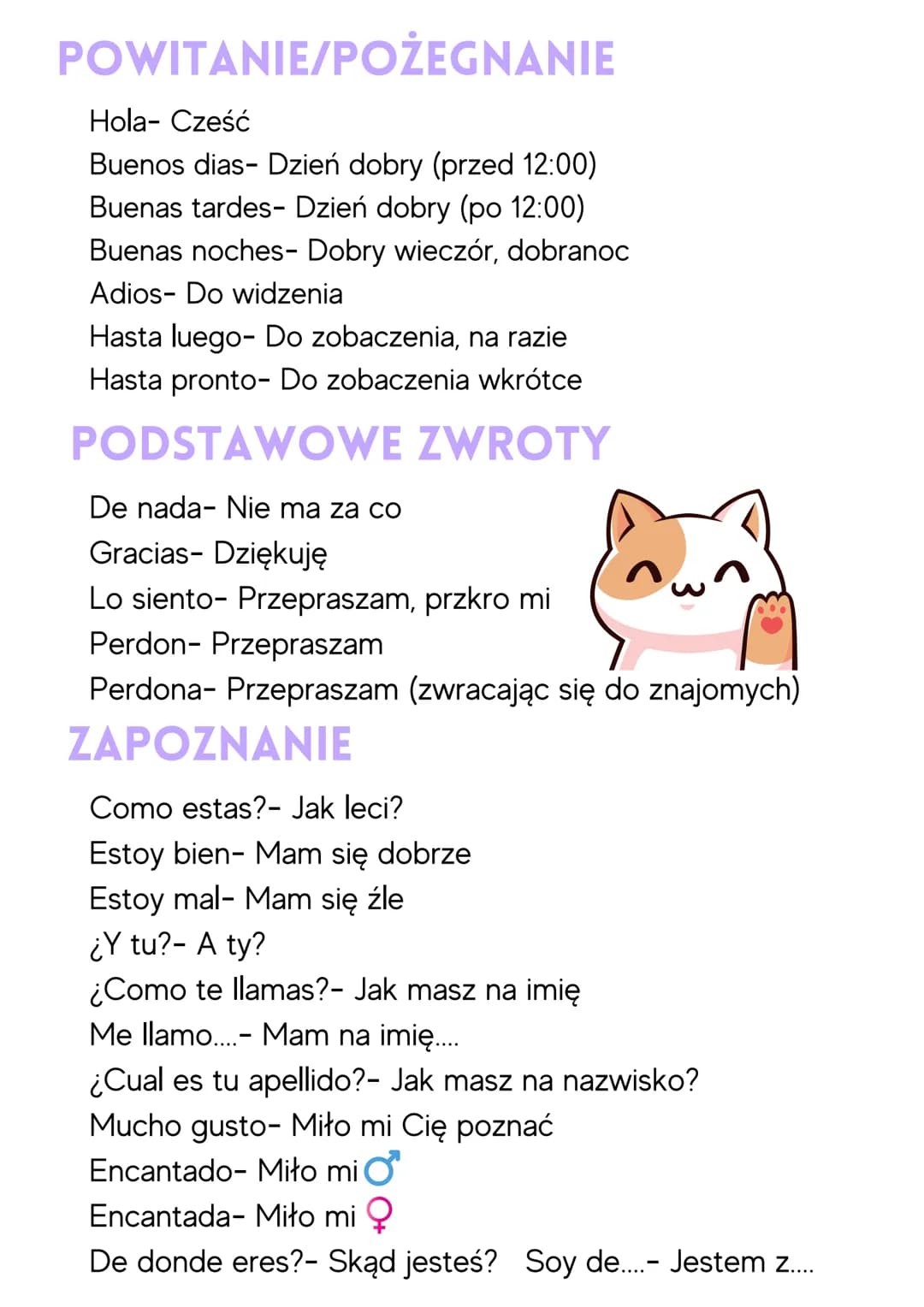
Spanish Numbers and Counting System
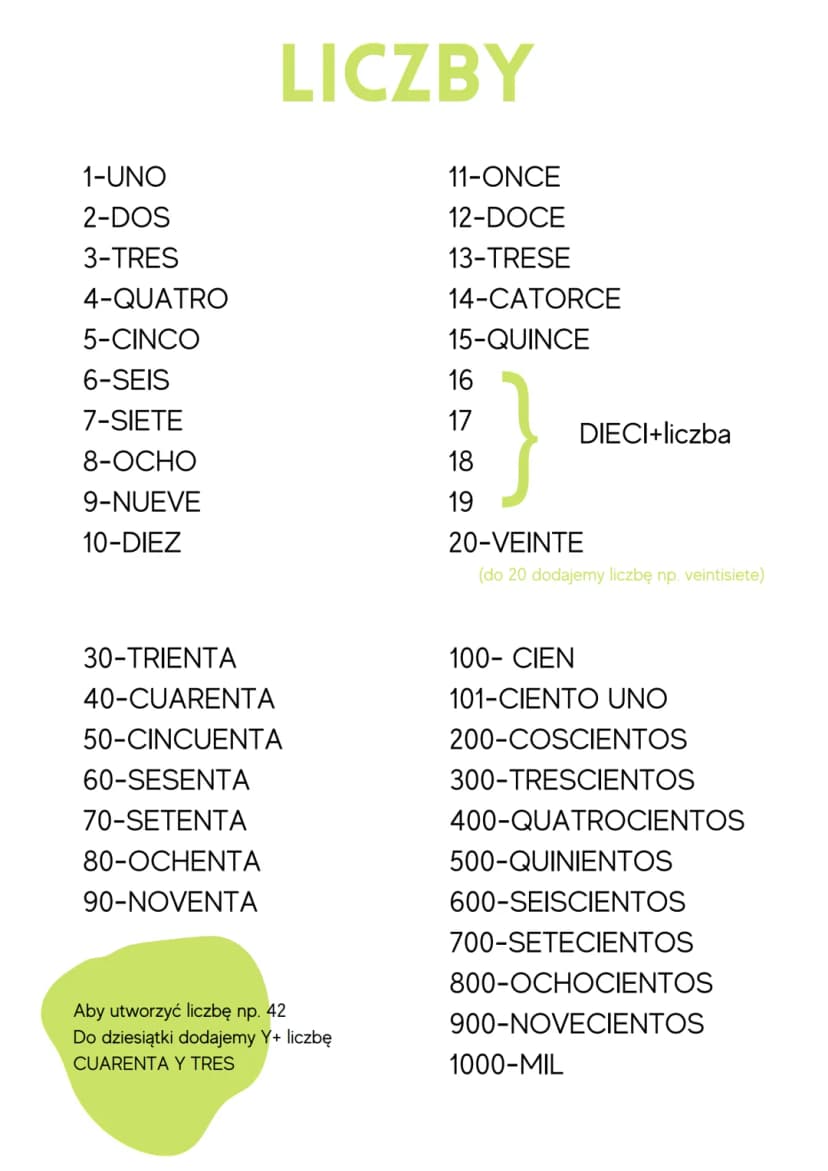
This page delves into the Spanish number system, providing a detailed guide on counting from 1 to 1000. It's an essential resource for learning podstawowe zwroty po hiszpańsku z wymową (basic Spanish phrases with pronunciation), particularly focusing on numerical expressions.
The page starts with numbers 1 to 10 in Spanish, followed by the tens up to 90. It then explains how to form compound numbers, such as 42, by combining tens and units with the conjunction "y" (and).
Example: To say 42 in Spanish, you would say "cuarenta y dos" (forty and two).
The guide also covers the unique formation of numbers 11 to 15, which have special names, and explains how numbers from 16 to 19 are formed by adding "dieci-" to the unit.
Highlight: Numbers from 21 to 29 have a special formation, where "veinti-" is added to the unit, such as "veintisiete" for 27.
The page concludes with hundreds up to 900 and introduces "mil" for 1000. This comprehensive overview of the Spanish number system provides learners with the tools to express any number up to 1000, which is crucial for various everyday situations, from shopping to telling time.
2
of 5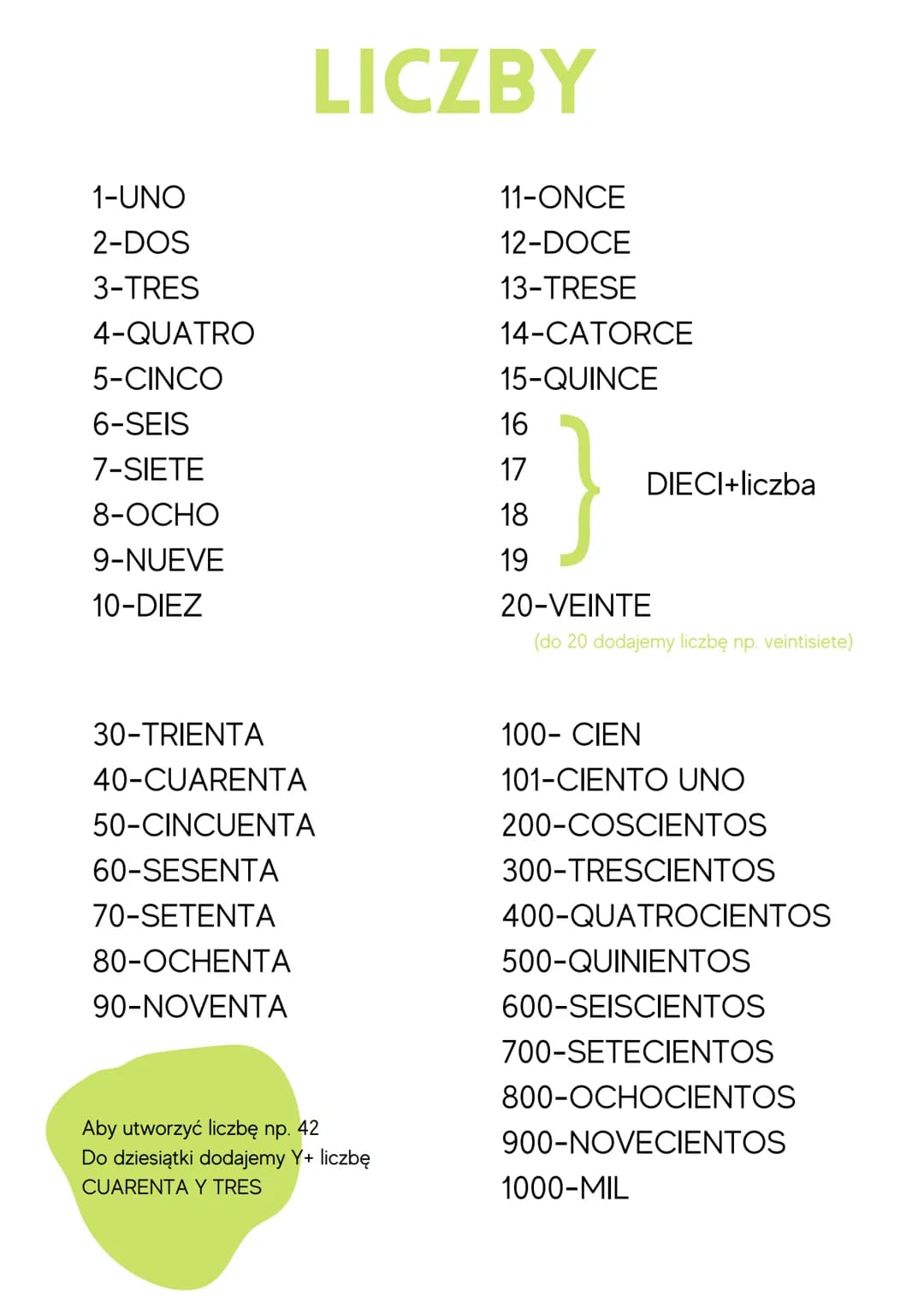
Spanish Pronouns and the Verbs "Ser" and "Estar"
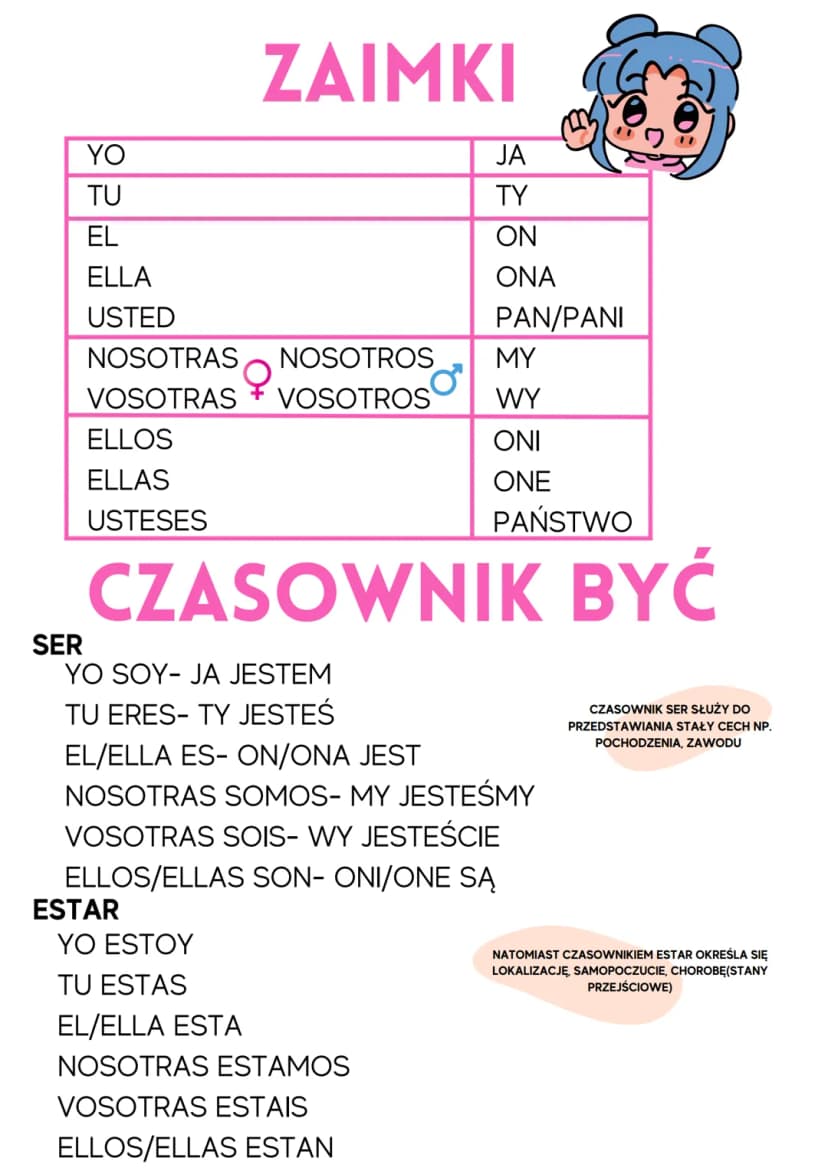
This page focuses on hiszpański zaimki osobowe (Spanish personal pronouns) and the crucial verbs "ser" and "estar," both of which mean "to be" in English but are used in different contexts.
The page begins by listing all personal pronouns in Spanish, including singular and plural forms, as well as formal and informal versions. This comprehensive list covers "yo" (I), "tú" (you informal), "él" (he), "ella" (she), "usted" (you formal), "nosotros/nosotras" (we), "vosotros/vosotras" (you plural informal), "ellos/ellas" (they), and "ustedes" (you plural formal).
Definition: "Usted" and "ustedes" are formal forms of address in Spanish, used to show respect or maintain a professional distance.
The page then introduces the conjugation of the verbs "ser" and "estar" for all these pronouns. This is a crucial aspect of Spanish grammar, as these two verbs, despite both meaning "to be," are used in different situations.
Highlight: The verb "ser" is used for permanent or inherent characteristics, such as nationality or profession, while "estar" is used for temporary states or locations.
The explanation includes examples of when to use each verb, helping learners understand the distinction between permanent traits (using "ser") and temporary states or locations (using "estar").
This page provides essential information for constructing basic sentences in Spanish and understanding the nuances of describing people, things, and situations.
3
of 5
Spanish Family Vocabulary
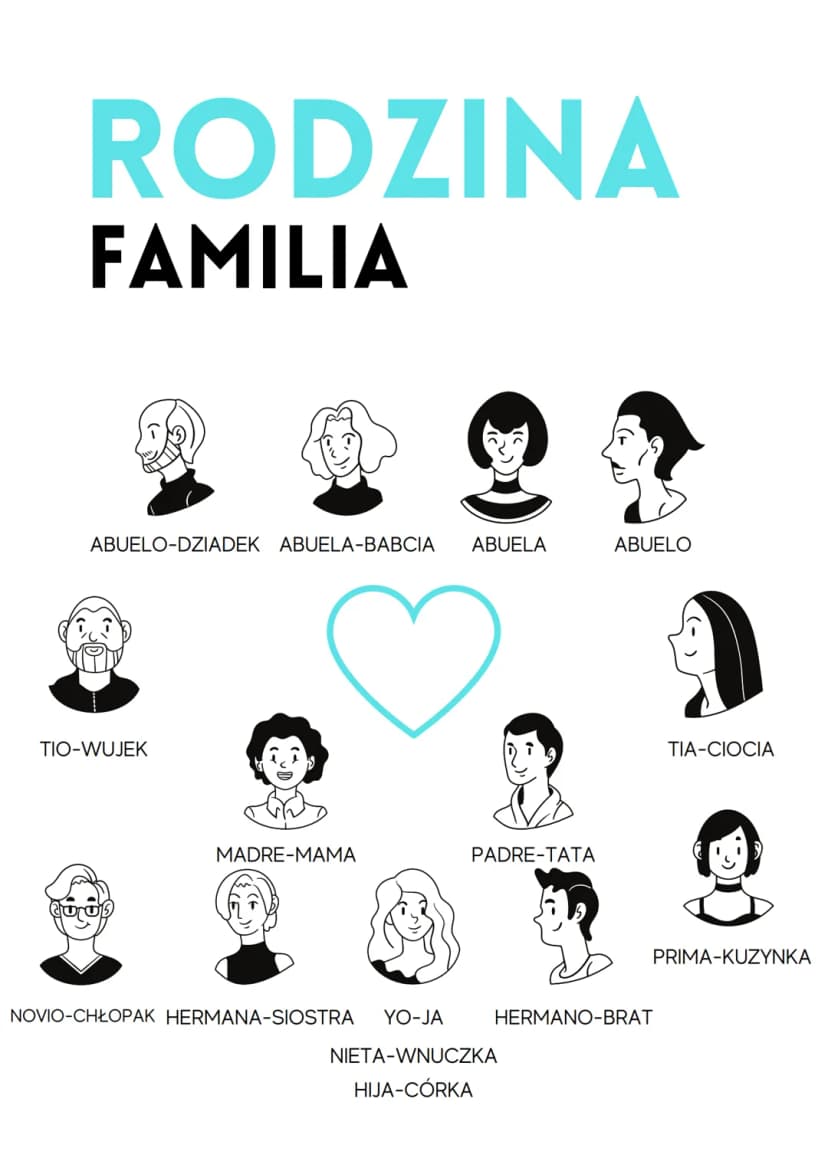
This page is dedicated to fajne słowa po hiszpańsku (cool Spanish words) related to family members. It presents a comprehensive list of family terms accompanied by a family tree diagram for visual learners.
The vocabulary list includes terms for immediate and extended family members, such as:
- "Abuelo" (grandfather) and "Abuela" (grandmother)
- "Padre" (father) and "Madre" (mother)
- "Hermano" (brother) and "Hermana" (sister)
- "Tío" (uncle) and "Tía" (aunt)
- "Primo" (male cousin) and "Prima" (female cousin)
- "Nieta" (granddaughter)
- "Hija" (daughter)
Vocabulary: "Novio" means boyfriend, which is included in the family tree, suggesting that the diagram represents a modern, inclusive view of family structures.
The family tree diagram visually represents how these terms relate to each other, making it easier for learners to understand and remember the relationships between different family members.
This page is particularly useful for learners who want to discuss their family in Spanish or understand when Spanish speakers talk about their relatives. It provides a solid foundation for vocabulary related to family relationships, which is essential for many everyday conversations and for describing personal life in Spanish.
4
of 5
Spanish Adjective Comparisons
This final page covers the topic of stopniowanie przymiotników hiszpański (Spanish adjective comparisons), explaining both regular and irregular forms of comparison.
For regular comparisons, the page introduces the use of "más" (more) and "menos" (less) to form comparative adjectives.
Example: "Más inteligente" means "more intelligent," while "menos inteligente" means "less intelligent."
The page also explains how to form comparisons using "que" (than), allowing learners to create sentences that compare two things or people.
Example: "Mi madre es más inteligente que mi padre" translates to "My mother is more intelligent than my father."
For irregular comparisons, the page lists some common adjectives that have special comparative forms:
- "Bueno" (good) becomes "mejor" (better)
- "Malo" (bad) becomes "peor" (worse)
- "Pequeño" (small) becomes "menor" (smaller)
- "Grande" (big) becomes "mayor" (bigger)
Highlight: These irregular forms are essential to learn as they are frequently used in everyday Spanish conversations.
This page provides learners with the tools to make comparisons in Spanish, an important skill for describing and contrasting people, objects, and situations. Understanding both regular and irregular comparisons allows for more nuanced and accurate expression in Spanish.
5
of 5
Greetings and Basic Phrases in Spanish
This page introduces essential codzienne zwroty po hiszpańsku (everyday Spanish phrases) that are crucial for beginners. It covers greetings for different times of the day, farewells, and basic expressions of gratitude and apology.
The section begins with common greetings such as "Hola" (Hello) and progresses to time-specific greetings like "Buenos días" (Good morning) and "Buenas noches" . It then moves on to farewell expressions, including "Adiós" (Goodbye) and "Hasta luego" (See you later).
Vocabulary: "Hasta pronto" means "See you soon," which is a friendly way to say goodbye when you expect to meet again in the near future.
The page also covers fundamental phrases like "Gracias" (Thank you) and "De nada" (You're welcome), as well as different ways to say sorry, such as "Lo siento" and "Perdón."
Lastly, it introduces proste zdania po hiszpańsku (simple Spanish sentences) for introductions and asking about someone's well-being. These include "¿Cómo estás?" (How are you?) and "Me llamo..." (My name is...).
Example: To introduce yourself, you can say "Me llamo Juan" (My name is Juan) and then ask "¿Y tú?" (And you?) to encourage the other person to introduce themselves.
This comprehensive list of greetings and basic phrases provides a solid foundation for beginners to start communicating in Spanish.
We thought you’d never ask...
What is the Knowunity AI companion?
Our AI companion is specifically built for the needs of students. Based on the millions of content pieces we have on the platform we can provide truly meaningful and relevant answers to students. But its not only about answers, the companion is even more about guiding students through their daily learning challenges, with personalised study plans, quizzes or content pieces in the chat and 100% personalisation based on the students skills and developments.
Where can I download the Knowunity app?
You can download the app in the Google Play Store and in the Apple App Store.
Is Knowunity really free of charge?
That's right! Enjoy free access to study content, connect with fellow students, and get instant help – all at your fingertips.
Similar Content
 Espagnol
 Spanish
Most popular content: Uso de ser y estar
9Język hiszpańskiSer, Estar, Hay: Kluczowe Zasady
Zrozumienie użycia czasowników 'ser', 'estar' oraz 'hay' w języku hiszpańskim. Dowiedz się, jak odmieniać te czasowniki oraz kiedy stosować rodzajniki nieokreślone. Idealne dla uczniów pragnących opanować podstawy gramatyki hiszpańskiej.
13,390197
Język hiszpańskiSer, Estar, Hay: Kluczowe Zasady
Zrozumienie użycia czasowników 'ser', 'estar' i 'hay' w języku hiszpańskim. Dowiedz się, kiedy stosować każdy z tych czasowników, ich różnice oraz przykłady użycia. Idealne dla uczniów uczących się gramatyki hiszpańskiej. Typ: Podsumowanie.
13,434123
Język hiszpańskiHaber, Estar, Ser: Użycie
Zrozum różnice między czasownikami Haber, Estar i Ser w języku hiszpańskim. Dowiedz się, kiedy stosować każdą formę oraz ich zastosowanie w różnych kontekstach, takich jak preterito perfecto, opisy cech, samopoczucie i zawody. Idealne dla uczniów pragnących poprawić swoje umiejętności językowe.
31,19636
Język hiszpańskiPogoda i Pory Roku
Zrozumienie terminologii pogodowej i pór roku w języku hiszpańskim. Dowiedz się, jak opisywać pogodę, zadawać pytania o warunki atmosferyczne oraz poznaj słownictwo związane z katastrofami naturalnymi. Idealne dla uczniów uczących się hiszpańskiego.
31,43170
Język hiszpańskiHiszpańskie Powitania i Pożegnania
Odkryj podstawowe zwroty i pytania w języku hiszpańskim dotyczące powitań i pożegnań. Zawiera odmianę czasowników oraz kluczowe słownictwo, które ułatwi komunikację. Idealne dla początkujących uczniów języka hiszpańskiego.
842020
Język hiszpańskiZaimki i Czasowniki w Hiszpańskim
Odkryj kluczowe zasady dotyczące zaimków osobowych oraz odmiany czasowników 'ser' i 'llamarse' w języku hiszpańskim. Materiał zawiera podstawowe zwroty, powitania i pytania, które pomogą w codziennej komunikacji. Idealne dla początkujących uczniów. Typ: Podsumowanie.
73,52993
Język hiszpańskiOdmiana czasownika 'ser'
Zrozumienie odmiany czasownika 'ser' w języku hiszpańskim. Dowiedz się, jak używać form: yo soy, tú eres, él/ella/usted es, nosotros/as somos, vosotros/as sois, ellos/ellas/ustedes son. Idealne dla uczniów pragnących opanować podstawy gramatyki hiszpańskiej.
163523
Język hiszpańskiCzasownik SER w Hiszpańskim
Zrozum odmianę czasownika 'ser' w języku hiszpańskim. Dowiedz się, jak używać go w liczbie pojedynczej i mnogiej, a także poznaj przykłady zastosowania w kontekście cech charakteru, wyglądu, narodowości, religii, zawodów i relacji rodzinnych. Idealne dla uczniów uczących się gramatyki hiszpańskiej.
14999
Język hiszpańskiSer vs. Estar: Kluczowe Różnice
Zrozumienie użycia czasowników 'ser' i 'estar' w języku hiszpańskim. Przewodnik po znaczeniach i zastosowaniach, z przykładami przymiotników i zwrotów. Idealne dla uczniów pragnących opanować subtelności hiszpańskiego.
885820
Most popular content in Język hiszpański
9P
Język hiszpańskiPowitania i zwroty po hiszpańsku!🇪🇸
Podstawowe powitania oraz zwroty w języku hiszpańskim🇪🇸! Pytania będą podane w języku polskim ,natomiast odpowiedzi będą w języku hiszpańskim . Twoim zadaniem będzie zaznaczenie prawidłowej odpowiedzi w języku hiszpańskim,🇪🇸
85192
Język hiszpańskiHiszpanski descubre 1
Caly podrecznik opracowany, wszystkie najważniejsze rzeczy
189131
Język hiszpańskiHiszpańskie Czasowniki: Czasowniki i Czas
Odkryj kluczowe zasady odmiany czasowników w języku hiszpańskim, w tym czasy przeszłe, teraźniejsze i przyszłe. Zawiera szczegółowe informacje o regularnych i nieregularnych czasownikach, a także przykłady użycia. Idealne dla uczniów pragnących zrozumieć hiszpańską gramatykę i poprawnie koniugować czasowniki.
85,258164
Język hiszpańskiLiczby, dni tygodnia i miesiące po hiszpańsku
.
894821
Język hiszpańskiHiszpański: Słownictwo i Zwroty
Odkryj podstawowe słownictwo hiszpańskie, zwroty do codziennych rozmów oraz zasady odmiany czasowników. Materiał obejmuje słownictwo dotyczące rodziny, kolory, liczby oraz przydatne pytania. Idealne dla początkujących uczniów języka hiszpańskiego.
83,782102
Język hiszpańskiCzas Perfecto: Przykłady i Zastosowanie
Zrozumienie czasu Preterito Perfecto w języku hiszpańskim. Obejmuje tworzenie konstrukcji, przykłady użycia, nieregularne czasowniki oraz kluczowe słownictwo. Idealne dla uczniów pragnących opanować czasy przeszłe.
42,98088
Język hiszpańskiHiszpański podstawy
Podstawowe zwroty
148110
Język hiszpańskiHiszpański podstawy
Podstawowa notatka z języka hiszpańskiego która zawiera:powitanie/pozegnanie, podstawowe zwroty, zaimki, liczby, zapoznanie.
71,45748
Język hiszpańskiPretérito Perfecto, Pretérito Indefinido, Pretérito Imperfecto i konektory
mam nadzieje, że pomogę:)
34449
Most popular content
9 Język polski
Przedwiośnie: Analiza Tematów
Zanurz się w analizę powieści 'Przedwiośnie' Stefana Żeromskiego. Odkryj kluczowe motywy, takie jak dojrzewanie, rewolucja i podróż, oraz ich znaczenie w kontekście niepodległej Polski. Notatka zawiera szczegółowe omówienie bohaterów, narracji oraz symboliki, co czyni ją idealnym materiałem do nauki i przygotowania do egzaminów.
1181,2427,271
Język polskiAnaliza Lalki Prusa
Szczegółowa analiza powieści 'Lalka' Bolesława Prusa, obejmująca kompozycję, problematykę, głównych bohaterów oraz kontekst społeczny Warszawy lat 70. i 80. XIX wieku. Zawiera omówienie miłości Wokulskiego do Izabeli Łęckiej, różnorodności narracji oraz otwartości zakończenia. Idealna dla studentów literatury i miłośników polskiej prozy.
4133,9114,302
Język polskiAnaliza 'Lalki' Prusa
Szczegółowa analiza powieści 'Lalka' Bolesława Prusa, obejmująca gatunek, czas i miejsce akcji, kluczowych bohaterów, oraz motywy literackie. Zawiera omówienie postaci Stanisława Wokulskiego jako romantyka i pozytywisty oraz realistyczny obraz Warszawy i Paryża. Idealne dla studentów literatury polskiej.
4130,4526,097
W
Język polskiWprowadzenie do lektury Zemsta
Sprawdź znajomość czasu i miejsca akcji oraz głównych wątków komedii Aleksandra Fredry.
85,9710
Język polskiMakbet: Analiza Tragedii Szekspira
Odkryj kluczowe cechy dramatu 'Makbet' Williama Szekspira, w tym złamanie zasady decorum, psychologię postaci oraz tematykę zbrodni i ambicji. Zrozum, jak Szekspir przekształca klasyczną tragedię, wprowadzając elementy fantastyki i psychologii. Idealne dla uczniów i studentów literatury. Typ: analiza literacka.
4104,1894,738
B
 Biologia
biologia- ryby klasa 6
Przed odpowiedzią ustnią idealny do powtórki ❤️
64,8014
Język polskiWesele: Analiza Symboli
Zanurz się w głęboką analizę dramatu 'Wesele' Stanisława Wyspiańskiego. Odkryj kluczowe symbole, takie jak chochoł i złoty róg, oraz ich znaczenie w kontekście polskiego społeczeństwa przełomu XIX i XX wieku. Notatka zawiera omówienie genezy, kompozycji, tematów oraz portretu społecznego, co czyni ją idealnym materiałem do nauki i przygotowań do egzaminów.
1183,6957,869
K
BiologiaKorzeń- organ podziemny rośliny
prawie wszystko w temacie "korzeń- organ podziemny rośliny "
54,3982
K
 Technika
Karta rowerowa
UwU
45,4003
Can't find what you're looking for? Explore other subjects.
Students love us — and so will you.
4.6/5App Store
4.7/5Google Play
The app is very easy to use and well designed. I have found everything I was looking for so far and have been able to learn a lot from the presentations! I will definitely use the app for a class assignment! And of course it also helps a lot as an inspiration.
Stefan SiOS user
This app is really great. There are so many study notes and help [...]. My problem subject is French, for example, and the app has so many options for help. Thanks to this app, I have improved my French. I would recommend it to anyone.
Samantha KlichAndroid user
Wow, I am really amazed. I just tried the app because I've seen it advertised many times and was absolutely stunned. This app is THE HELP you want for school and above all, it offers so many things, such as workouts and fact sheets, which have been VERY helpful to me personally.
AnnaiOS user
Język hiszpański46,105 views·Updated Jun 27, 2026·5 pagesFajne słowa i zwroty po hiszpańsku z PDF
Amy😺@_amyyy
Podstawowe zwroty i gramatyka języka hiszpańskiego dla początkujących uczniów. Obejmuje powitania, liczby, zaimki, czasowniki być, rodzinę i stopniowanie przymiotników.
- Codzienne zwroty po hiszpańsku od powitań po pożegnania
- Liczby od 1 do 1000 oraz zasady ich tworzenia
- Zaimki osobowe i odmiana...
1
of 5
Sign up to see the content. It's free!
- Access to all documents
- Improve your grades
- Join milions of students
Spanish Numbers and Counting System
This page delves into the Spanish number system, providing a detailed guide on counting from 1 to 1000. It's an essential resource for learning podstawowe zwroty po hiszpańsku z wymową (basic Spanish phrases with pronunciation), particularly focusing on numerical expressions.
The page starts with numbers 1 to 10 in Spanish, followed by the tens up to 90. It then explains how to form compound numbers, such as 42, by combining tens and units with the conjunction "y" (and).
Example: To say 42 in Spanish, you would say "cuarenta y dos" (forty and two).
The guide also covers the unique formation of numbers 11 to 15, which have special names, and explains how numbers from 16 to 19 are formed by adding "dieci-" to the unit.
Highlight: Numbers from 21 to 29 have a special formation, where "veinti-" is added to the unit, such as "veintisiete" for 27.
The page concludes with hundreds up to 900 and introduces "mil" for 1000. This comprehensive overview of the Spanish number system provides learners with the tools to express any number up to 1000, which is crucial for various everyday situations, from shopping to telling time.
2
of 5Sign up to see the content. It's free!
- Access to all documents
- Improve your grades
- Join milions of students
Spanish Pronouns and the Verbs "Ser" and "Estar"
This page focuses on hiszpański zaimki osobowe (Spanish personal pronouns) and the crucial verbs "ser" and "estar," both of which mean "to be" in English but are used in different contexts.
The page begins by listing all personal pronouns in Spanish, including singular and plural forms, as well as formal and informal versions. This comprehensive list covers "yo" (I), "tú" (you informal), "él" (he), "ella" (she), "usted" (you formal), "nosotros/nosotras" (we), "vosotros/vosotras" (you plural informal), "ellos/ellas" (they), and "ustedes" (you plural formal).
Definition: "Usted" and "ustedes" are formal forms of address in Spanish, used to show respect or maintain a professional distance.
The page then introduces the conjugation of the verbs "ser" and "estar" for all these pronouns. This is a crucial aspect of Spanish grammar, as these two verbs, despite both meaning "to be," are used in different situations.
Highlight: The verb "ser" is used for permanent or inherent characteristics, such as nationality or profession, while "estar" is used for temporary states or locations.
The explanation includes examples of when to use each verb, helping learners understand the distinction between permanent traits (using "ser") and temporary states or locations (using "estar").
This page provides essential information for constructing basic sentences in Spanish and understanding the nuances of describing people, things, and situations.
3
of 5Sign up to see the content. It's free!
- Access to all documents
- Improve your grades
- Join milions of students
Spanish Family Vocabulary
This page is dedicated to fajne słowa po hiszpańsku (cool Spanish words) related to family members. It presents a comprehensive list of family terms accompanied by a family tree diagram for visual learners.
The vocabulary list includes terms for immediate and extended family members, such as:
- "Abuelo" (grandfather) and "Abuela" (grandmother)
- "Padre" (father) and "Madre" (mother)
- "Hermano" (brother) and "Hermana" (sister)
- "Tío" (uncle) and "Tía" (aunt)
- "Primo" (male cousin) and "Prima" (female cousin)
- "Nieta" (granddaughter)
- "Hija" (daughter)
Vocabulary: "Novio" means boyfriend, which is included in the family tree, suggesting that the diagram represents a modern, inclusive view of family structures.
The family tree diagram visually represents how these terms relate to each other, making it easier for learners to understand and remember the relationships between different family members.
This page is particularly useful for learners who want to discuss their family in Spanish or understand when Spanish speakers talk about their relatives. It provides a solid foundation for vocabulary related to family relationships, which is essential for many everyday conversations and for describing personal life in Spanish.
4
of 5Sign up to see the content. It's free!
- Access to all documents
- Improve your grades
- Join milions of students
Spanish Adjective Comparisons
This final page covers the topic of stopniowanie przymiotników hiszpański (Spanish adjective comparisons), explaining both regular and irregular forms of comparison.
For regular comparisons, the page introduces the use of "más" (more) and "menos" (less) to form comparative adjectives.
Example: "Más inteligente" means "more intelligent," while "menos inteligente" means "less intelligent."
The page also explains how to form comparisons using "que" (than), allowing learners to create sentences that compare two things or people.
Example: "Mi madre es más inteligente que mi padre" translates to "My mother is more intelligent than my father."
For irregular comparisons, the page lists some common adjectives that have special comparative forms:
- "Bueno" (good) becomes "mejor" (better)
- "Malo" (bad) becomes "peor" (worse)
- "Pequeño" (small) becomes "menor" (smaller)
- "Grande" (big) becomes "mayor" (bigger)
Highlight: These irregular forms are essential to learn as they are frequently used in everyday Spanish conversations.
This page provides learners with the tools to make comparisons in Spanish, an important skill for describing and contrasting people, objects, and situations. Understanding both regular and irregular comparisons allows for more nuanced and accurate expression in Spanish.
5
of 5Sign up to see the content. It's free!
- Access to all documents
- Improve your grades
- Join milions of students
Greetings and Basic Phrases in Spanish
This page introduces essential codzienne zwroty po hiszpańsku (everyday Spanish phrases) that are crucial for beginners. It covers greetings for different times of the day, farewells, and basic expressions of gratitude and apology.
The section begins with common greetings such as "Hola" (Hello) and progresses to time-specific greetings like "Buenos días" (Good morning) and "Buenas noches" . It then moves on to farewell expressions, including "Adiós" (Goodbye) and "Hasta luego" (See you later).
Vocabulary: "Hasta pronto" means "See you soon," which is a friendly way to say goodbye when you expect to meet again in the near future.
The page also covers fundamental phrases like "Gracias" (Thank you) and "De nada" (You're welcome), as well as different ways to say sorry, such as "Lo siento" and "Perdón."
Lastly, it introduces proste zdania po hiszpańsku (simple Spanish sentences) for introductions and asking about someone's well-being. These include "¿Cómo estás?" (How are you?) and "Me llamo..." (My name is...).
Example: To introduce yourself, you can say "Me llamo Juan" (My name is Juan) and then ask "¿Y tú?" (And you?) to encourage the other person to introduce themselves.
This comprehensive list of greetings and basic phrases provides a solid foundation for beginners to start communicating in Spanish.
We thought you’d never ask...
What is the Knowunity AI companion?
Our AI companion is specifically built for the needs of students. Based on the millions of content pieces we have on the platform we can provide truly meaningful and relevant answers to students. But its not only about answers, the companion is even more about guiding students through their daily learning challenges, with personalised study plans, quizzes or content pieces in the chat and 100% personalisation based on the students skills and developments.
Where can I download the Knowunity app?
You can download the app in the Google Play Store and in the Apple App Store.
Is Knowunity really free of charge?
That's right! Enjoy free access to study content, connect with fellow students, and get instant help – all at your fingertips.
Similar Content
Most popular content: Uso de ser y estar
9Język hiszpańskiSer, Estar, Hay: Kluczowe Zasady
Zrozumienie użycia czasowników 'ser', 'estar' oraz 'hay' w języku hiszpańskim. Dowiedz się, jak odmieniać te czasowniki oraz kiedy stosować rodzajniki nieokreślone. Idealne dla uczniów pragnących opanować podstawy gramatyki hiszpańskiej.
13,390197
Język hiszpańskiSer, Estar, Hay: Kluczowe Zasady
Zrozumienie użycia czasowników 'ser', 'estar' i 'hay' w języku hiszpańskim. Dowiedz się, kiedy stosować każdy z tych czasowników, ich różnice oraz przykłady użycia. Idealne dla uczniów uczących się gramatyki hiszpańskiej. Typ: Podsumowanie.
13,434123
Język hiszpańskiHaber, Estar, Ser: Użycie
Zrozum różnice między czasownikami Haber, Estar i Ser w języku hiszpańskim. Dowiedz się, kiedy stosować każdą formę oraz ich zastosowanie w różnych kontekstach, takich jak preterito perfecto, opisy cech, samopoczucie i zawody. Idealne dla uczniów pragnących poprawić swoje umiejętności językowe.
31,19636
Język hiszpańskiPogoda i Pory Roku
Zrozumienie terminologii pogodowej i pór roku w języku hiszpańskim. Dowiedz się, jak opisywać pogodę, zadawać pytania o warunki atmosferyczne oraz poznaj słownictwo związane z katastrofami naturalnymi. Idealne dla uczniów uczących się hiszpańskiego.
31,43170
Język hiszpańskiHiszpańskie Powitania i Pożegnania
Odkryj podstawowe zwroty i pytania w języku hiszpańskim dotyczące powitań i pożegnań. Zawiera odmianę czasowników oraz kluczowe słownictwo, które ułatwi komunikację. Idealne dla początkujących uczniów języka hiszpańskiego.
842020
Język hiszpańskiZaimki i Czasowniki w Hiszpańskim
Odkryj kluczowe zasady dotyczące zaimków osobowych oraz odmiany czasowników 'ser' i 'llamarse' w języku hiszpańskim. Materiał zawiera podstawowe zwroty, powitania i pytania, które pomogą w codziennej komunikacji. Idealne dla początkujących uczniów. Typ: Podsumowanie.
73,52993
Język hiszpańskiOdmiana czasownika 'ser'
Zrozumienie odmiany czasownika 'ser' w języku hiszpańskim. Dowiedz się, jak używać form: yo soy, tú eres, él/ella/usted es, nosotros/as somos, vosotros/as sois, ellos/ellas/ustedes son. Idealne dla uczniów pragnących opanować podstawy gramatyki hiszpańskiej.
163523
Język hiszpańskiCzasownik SER w Hiszpańskim
Zrozum odmianę czasownika 'ser' w języku hiszpańskim. Dowiedz się, jak używać go w liczbie pojedynczej i mnogiej, a także poznaj przykłady zastosowania w kontekście cech charakteru, wyglądu, narodowości, religii, zawodów i relacji rodzinnych. Idealne dla uczniów uczących się gramatyki hiszpańskiej.
14999
Język hiszpańskiSer vs. Estar: Kluczowe Różnice
Zrozumienie użycia czasowników 'ser' i 'estar' w języku hiszpańskim. Przewodnik po znaczeniach i zastosowaniach, z przykładami przymiotników i zwrotów. Idealne dla uczniów pragnących opanować subtelności hiszpańskiego.
885820
Most popular content in Język hiszpański
9P
Język hiszpańskiPowitania i zwroty po hiszpańsku!🇪🇸
Podstawowe powitania oraz zwroty w języku hiszpańskim🇪🇸! Pytania będą podane w języku polskim ,natomiast odpowiedzi będą w języku hiszpańskim . Twoim zadaniem będzie zaznaczenie prawidłowej odpowiedzi w języku hiszpańskim,🇪🇸
85192
Język hiszpańskiHiszpanski descubre 1
Caly podrecznik opracowany, wszystkie najważniejsze rzeczy
189131
Język hiszpańskiHiszpańskie Czasowniki: Czasowniki i Czas
Odkryj kluczowe zasady odmiany czasowników w języku hiszpańskim, w tym czasy przeszłe, teraźniejsze i przyszłe. Zawiera szczegółowe informacje o regularnych i nieregularnych czasownikach, a także przykłady użycia. Idealne dla uczniów pragnących zrozumieć hiszpańską gramatykę i poprawnie koniugować czasowniki.
85,258164
Język hiszpańskiLiczby, dni tygodnia i miesiące po hiszpańsku
.
894821
Język hiszpańskiHiszpański: Słownictwo i Zwroty
Odkryj podstawowe słownictwo hiszpańskie, zwroty do codziennych rozmów oraz zasady odmiany czasowników. Materiał obejmuje słownictwo dotyczące rodziny, kolory, liczby oraz przydatne pytania. Idealne dla początkujących uczniów języka hiszpańskiego.
83,782102
Język hiszpańskiCzas Perfecto: Przykłady i Zastosowanie
Zrozumienie czasu Preterito Perfecto w języku hiszpańskim. Obejmuje tworzenie konstrukcji, przykłady użycia, nieregularne czasowniki oraz kluczowe słownictwo. Idealne dla uczniów pragnących opanować czasy przeszłe.
42,98088
Język hiszpańskiHiszpański podstawy
Podstawowe zwroty
148110
Język hiszpańskiHiszpański podstawy
Podstawowa notatka z języka hiszpańskiego która zawiera:powitanie/pozegnanie, podstawowe zwroty, zaimki, liczby, zapoznanie.
71,45748
Język hiszpańskiPretérito Perfecto, Pretérito Indefinido, Pretérito Imperfecto i konektory
mam nadzieje, że pomogę:)
34449
Most popular content
9Język polskiPrzedwiośnie: Analiza Tematów
Zanurz się w analizę powieści 'Przedwiośnie' Stefana Żeromskiego. Odkryj kluczowe motywy, takie jak dojrzewanie, rewolucja i podróż, oraz ich znaczenie w kontekście niepodległej Polski. Notatka zawiera szczegółowe omówienie bohaterów, narracji oraz symboliki, co czyni ją idealnym materiałem do nauki i przygotowania do egzaminów.
1181,2427,271
Język polskiAnaliza Lalki Prusa
Szczegółowa analiza powieści 'Lalka' Bolesława Prusa, obejmująca kompozycję, problematykę, głównych bohaterów oraz kontekst społeczny Warszawy lat 70. i 80. XIX wieku. Zawiera omówienie miłości Wokulskiego do Izabeli Łęckiej, różnorodności narracji oraz otwartości zakończenia. Idealna dla studentów literatury i miłośników polskiej prozy.
4133,9114,302
Język polskiAnaliza 'Lalki' Prusa
Szczegółowa analiza powieści 'Lalka' Bolesława Prusa, obejmująca gatunek, czas i miejsce akcji, kluczowych bohaterów, oraz motywy literackie. Zawiera omówienie postaci Stanisława Wokulskiego jako romantyka i pozytywisty oraz realistyczny obraz Warszawy i Paryża. Idealne dla studentów literatury polskiej.
4130,4526,097
W
Język polskiWprowadzenie do lektury Zemsta
Sprawdź znajomość czasu i miejsca akcji oraz głównych wątków komedii Aleksandra Fredry.
85,9710
Język polskiMakbet: Analiza Tragedii Szekspira
Odkryj kluczowe cechy dramatu 'Makbet' Williama Szekspira, w tym złamanie zasady decorum, psychologię postaci oraz tematykę zbrodni i ambicji. Zrozum, jak Szekspir przekształca klasyczną tragedię, wprowadzając elementy fantastyki i psychologii. Idealne dla uczniów i studentów literatury. Typ: analiza literacka.
4104,1894,738
B
Biologiabiologia- ryby klasa 6
Przed odpowiedzią ustnią idealny do powtórki ❤️
64,8014
Język polskiWesele: Analiza Symboli
Zanurz się w głęboką analizę dramatu 'Wesele' Stanisława Wyspiańskiego. Odkryj kluczowe symbole, takie jak chochoł i złoty róg, oraz ich znaczenie w kontekście polskiego społeczeństwa przełomu XIX i XX wieku. Notatka zawiera omówienie genezy, kompozycji, tematów oraz portretu społecznego, co czyni ją idealnym materiałem do nauki i przygotowań do egzaminów.
1183,6957,869
K
BiologiaKorzeń- organ podziemny rośliny
prawie wszystko w temacie "korzeń- organ podziemny rośliny "
54,3982
K
TechnikaKarta rowerowa
UwU
45,4003
Can't find what you're looking for? Explore other subjects.
Students love us — and so will you.
4.6/5App Store
4.7/5Google Play
The app is very easy to use and well designed. I have found everything I was looking for so far and have been able to learn a lot from the presentations! I will definitely use the app for a class assignment! And of course it also helps a lot as an inspiration.
Stefan SiOS user
This app is really great. There are so many study notes and help [...]. My problem subject is French, for example, and the app has so many options for help. Thanks to this app, I have improved my French. I would recommend it to anyone.
Samantha KlichAndroid user
Wow, I am really amazed. I just tried the app because I've seen it advertised many times and was absolutely stunned. This app is THE HELP you want for school and above all, it offers so many things, such as workouts and fact sheets, which have been VERY helpful to me personally.
AnnaiOS user