
The English language encompasses various tenses that allow speakers to...
 Język angielski24,723 views·Updated Jun 16, 2026·3 pages
Zabawa z czasami angielskimi: przeszłe, teraźniejsze i przyszłe!

notes_marysia@notes_marysia


1 / 3
1
of 3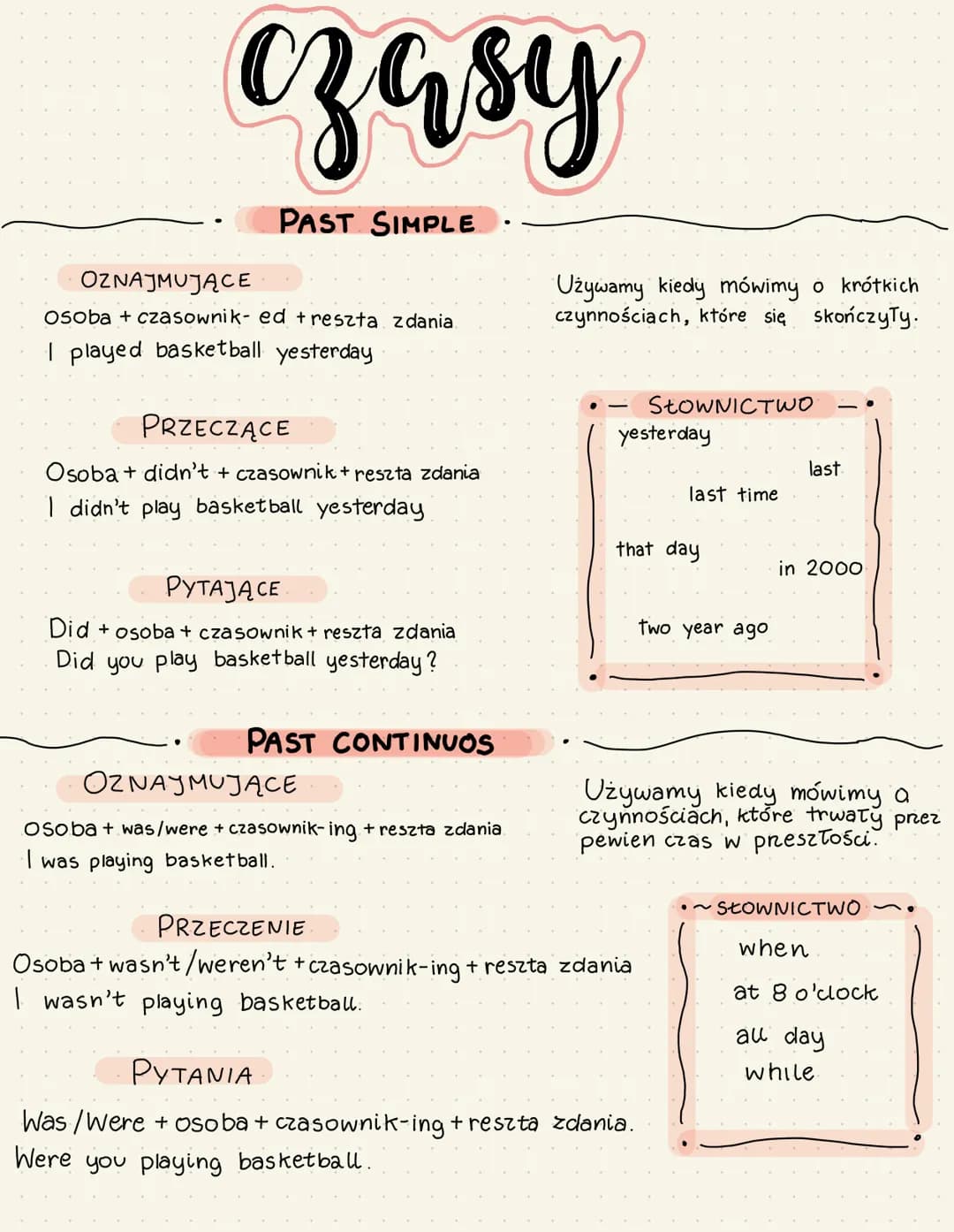
Present Tenses and Present Perfect
This page covers the Present Perfect tense and the Present Simple tense, two essential tenses for describing current and recent past actions.
Present Perfect
The Present Perfect tense is used for actions that started in the past and have current relevance or for ongoing actions.
Structure:
- Affirmative: Subject + have/has + past participle
- Negative: Subject + haven't/hasn't + past participle
- Interrogative: Have/Has + subject + past participle
Vocabulary: Key time expressions used with Present Perfect include "never", "since", "how long", "yet", "ever", "for", "just", "already".
Present Simple
The Present Simple tense is used for habitual actions or general truths.
Structure:
- Affirmative: Subject + verb + rest of sentence
- Negative: Subject + don't/doesn't + verb + rest of sentence
- Interrogative: Do/Does + subject + verb + rest of sentence
Example: I play basketball. (Affirmative) I don't play basketball. (Negative) Do you play basketball? (Interrogative)
Vocabulary: Frequency adverbs often used with Present Simple include "always", "often", "usually", "sometimes", "every day", "seldom", "occasionally", "on Monday", "hardly ever".
Highlight: The Present Simple is crucial for expressing routines, facts, and general statements in English.
2
of 3
Present Continuous and Future Simple
This page explains the Present Continuous tense for current actions and the Future Simple tense for future predictions and spontaneous decisions.
Present Continuous
The Present Continuous tense is used for actions happening at the moment of speaking or in the near future.
Structure:
- Affirmative: Subject + to be + verb-ing + rest of sentence
- Negative: Subject + to be + not + verb-ing + rest of sentence
- Interrogative: To be + subject + verb-ing + rest of sentence
Example: I am playing basketball. (Affirmative) I am not playing basketball. (Negative) Are you playing basketball? (Interrogative)
Vocabulary: Time expressions used with Present Continuous include "now", "at the moment", "at present", "right now", "today".
Future Simple
The Future Simple tense is used for spontaneous decisions made at the moment of speaking and predictions about the future.
Structure:
- Affirmative: Subject + will + verb + rest of sentence
- Negative: Subject + won't + verb + rest of sentence
- Interrogative: Will + subject + verb + rest of sentence
Example: I will play basketball. (Affirmative) I won't play basketball. (Negative) Will you play basketball? (Interrogative)
Vocabulary: Expressions often used with Future Simple include "I think", "I hope", "I believe", "probably", "sure".
Highlight: The Future Simple is particularly useful for making predictions and expressing spontaneous decisions or promises.
3
of 3
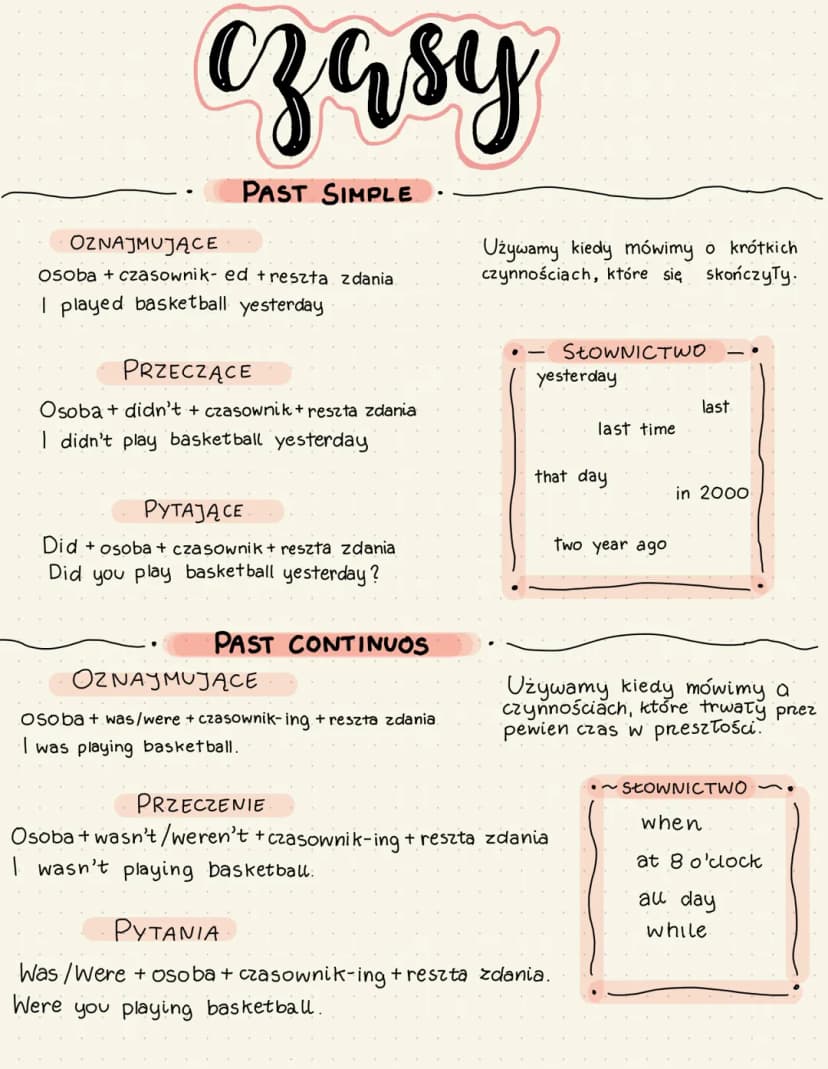
Past Tenses in English
This page focuses on two important past tenses in English: Past Simple and Past Continuous.
Past Simple
The Past Simple tense is used for actions that were completed in the past. Its structure varies for affirmative, negative, and interrogative sentences.
Example: I played basketball yesterday.
For negative sentences, "didn't" is used with the base form of the verb:
Example: I didn't play basketball yesterday.
Questions are formed using "Did" at the beginning:
Example: Did you play basketball yesterday?
Vocabulary: Common time expressions used with Past Simple include "yesterday", "that day", "last time", "two years ago", "last", "in 2000".
Past Continuous
The Past Continuous tense describes actions that were ongoing for a period in the past. It uses "was/were" with the -ing form of the verb.
Example: I was playing basketball.
Negative sentences use "wasn't/weren't":
Example: I wasn't playing basketball.
Questions invert the subject and "was/were":
Example: Were you playing basketball?
Vocabulary: Time expressions often used with Past Continuous include "when", "at 8 o'clock", "all day", "while".
Highlight: The Past Continuous is particularly useful for describing the context or background of a past event.
We thought you’d never ask...
What is the Knowunity AI companion?
Our AI companion is specifically built for the needs of students. Based on the millions of content pieces we have on the platform we can provide truly meaningful and relevant answers to students. But its not only about answers, the companion is even more about guiding students through their daily learning challenges, with personalised study plans, quizzes or content pieces in the chat and 100% personalisation based on the students skills and developments.
Where can I download the Knowunity app?
You can download the app in the Google Play Store and in the Apple App Store.
Is Knowunity really free of charge?
That's right! Enjoy free access to study content, connect with fellow students, and get instant help – all at your fingertips.
Similar Content
 Englisch
Most popular content: Future Tense
9Język angielskiCzas przyszły prosty
Zrozumienie czasu przyszłego prostego w języku angielskim. Dowiedz się, jak używać 'will' i 'be going to', aby wyrażać przyszłe zdarzenia, podejmować decyzje oraz oferować pomoc. Zawiera przykłady, budowę zdań oraz kluczowe słownictwo związane z przyszłością. Typ: podsumowanie.
123,837962
Język angielskiKonstrukcja 'Be Going To'
Zrozumienie konstrukcji 'be going to' w języku angielskim. Dowiedz się, jak używać tej formy do wyrażania planów i przewidywań dotyczących przyszłości. Przykłady zdań oraz zasady gramatyczne. Typ: Podsumowanie.
63,87552
Język angielskiCzasy w Języku Angielskim
Zrozumienie czasów w języku angielskim: od Present Simple po Future Simple. Dowiedz się, jak używać czasowników w różnych czasach, w tym Present Continuous, Past Simple, oraz konstrukcji 'be going to'. Idealne dla uczniów pragnących opanować gramatykę angielską. Typ: Podsumowanie.
125,7251,188
Język angielskiCzas Przyszły Ciągły
Zrozumienie czasu przyszłego ciągłego w języku angielskim. Dowiedz się, jak budować zdania twierdzące, przeczące i pytające, oraz poznaj zastosowanie 'will' i 'shall'. Odkryj kluczowe określenia czasu, które pomogą w codziennej komunikacji. Idealne dla uczniów pragnących poprawić swoje umiejętności językowe.
119,763919
Język angielskiCzas przyszły w angielskim
Zrozumienie czasów przyszłych w języku angielskim: 'will', 'going to', 'might' oraz Present Continuous. Dowiedz się, jak używać tych konstrukcji do wyrażania przewidywań, planów i obietnic. Idealne dla uczniów przygotowujących się do egzaminów z gramatyki angielskiej.
110,593419
Język angielskiBe going to
Be going to
81,38718
Język angielskiCzas Future Simple
Język Angielski Czas przyszły prosty future simple
665716
Język angielskiFuture forms
Future forms
82,00728
Język angielskiCzas przyszły prosty
Zrozumienie czasu przyszłego prostego w języku angielskim. Dowiedz się, jak tworzyć zdania oznajmujące, przeczenia i pytania w czasie przyszłym, oraz poznaj kluczowe słownictwo związane z prognozowaniem i obietnicami. Idealne dla uczniów przygotowujących się do egzaminów z gramatyki angielskiej.
81,58633
Most popular content in Język angielski
9C
Język angielskiCzasowniki nieregularne w Past Simple
Ćwicz odmianę popularnych czasowników nieregularnych i twórz zdania przeczące z operatorem didn't w czasie Past Simple.
64,9900
Język angielskiGramatyka angielski E8
Cala najważniejsza dokładnie opisana gramatyka potrzebna na egzamin ósmoklasisty! Polecam jako powtórkę nawet dla najlepszych!
814,1331,024
F
Język angielskiFormy Past Simple czasowników nieregularnych
Rozpoznawanie i dopasowywanie podstawowych form czasu przeszłego Past Simple dla najpopularniejszych czasowników nieregularnych.
73,3110
Język angielskiCzasy w języku angielskim na egzamin ósmoklasisty.
Wszystkie czasy na egzamin ósmoklasisty z języka angielskiego (2025)!<3
88,200221
Język angielskiGramatyka - czasy teraźniejsze, przeszłe i przyszłe.
Wszystkie czasy do matury z j.angielskiego (rozszerzonego).
46,371201
P
Język angielskiPisownia II i III formy czasownika
Ćwiczenie polega na samodzielnym uzupełnianiu tabeli z drugą i trzecią formą najczęściej używanych angielskich czasowników nieregularnych.
64,0950
P
Język angielskiPresent Simple: Questions and Negations
Learn to use do, does, don't, and doesn't to form questions and negative statements in Present Simple.
52,9470
A
Język angielskiAngielski słówka
słówka klasa 1 2 3 4 5 6 7 i 8
53,9322
Język angielskiCzasy- Język angielski- Egzamin ósmoklasisty
Wszystkie czasy po angielsku potrzebne na egzamin ósmoklasisty #E8 ##EgzaminÓsmoklasisty
811,288583
Most popular content
9 Język polski
Przedwiośnie: Analiza Tematów
Zanurz się w analizę powieści 'Przedwiośnie' Stefana Żeromskiego. Odkryj kluczowe motywy, takie jak dojrzewanie, rewolucja i podróż, oraz ich znaczenie w kontekście niepodległej Polski. Notatka zawiera szczegółowe omówienie bohaterów, narracji oraz symboliki, co czyni ją idealnym materiałem do nauki i przygotowania do egzaminów.
1181,2427,271
Język polskiAnaliza Lalki Prusa
Szczegółowa analiza powieści 'Lalka' Bolesława Prusa, obejmująca kompozycję, problematykę, głównych bohaterów oraz kontekst społeczny Warszawy lat 70. i 80. XIX wieku. Zawiera omówienie miłości Wokulskiego do Izabeli Łęckiej, różnorodności narracji oraz otwartości zakończenia. Idealna dla studentów literatury i miłośników polskiej prozy.
4133,9114,302
Język polskiAnaliza 'Lalki' Prusa
Szczegółowa analiza powieści 'Lalka' Bolesława Prusa, obejmująca gatunek, czas i miejsce akcji, kluczowych bohaterów, oraz motywy literackie. Zawiera omówienie postaci Stanisława Wokulskiego jako romantyka i pozytywisty oraz realistyczny obraz Warszawy i Paryża. Idealne dla studentów literatury polskiej.
4130,4526,097
W
Język polskiWprowadzenie do lektury Zemsta
Sprawdź znajomość czasu i miejsca akcji oraz głównych wątków komedii Aleksandra Fredry.
85,9710
Język polskiMakbet: Analiza Tragedii Szekspira
Odkryj kluczowe cechy dramatu 'Makbet' Williama Szekspira, w tym złamanie zasady decorum, psychologię postaci oraz tematykę zbrodni i ambicji. Zrozum, jak Szekspir przekształca klasyczną tragedię, wprowadzając elementy fantastyki i psychologii. Idealne dla uczniów i studentów literatury. Typ: analiza literacka.
4104,1894,738
B
 Biologia
biologia- ryby klasa 6
Przed odpowiedzią ustnią idealny do powtórki ❤️
64,8014
Język polskiWesele: Analiza Symboli
Zanurz się w głęboką analizę dramatu 'Wesele' Stanisława Wyspiańskiego. Odkryj kluczowe symbole, takie jak chochoł i złoty róg, oraz ich znaczenie w kontekście polskiego społeczeństwa przełomu XIX i XX wieku. Notatka zawiera omówienie genezy, kompozycji, tematów oraz portretu społecznego, co czyni ją idealnym materiałem do nauki i przygotowań do egzaminów.
1183,6957,869
K
BiologiaKorzeń- organ podziemny rośliny
prawie wszystko w temacie "korzeń- organ podziemny rośliny "
54,3982
K
 Technika
Karta rowerowa
UwU
45,4003
Can't find what you're looking for? Explore other subjects.
Students love us — and so will you.
4.6/5App Store
4.7/5Google Play
The app is very easy to use and well designed. I have found everything I was looking for so far and have been able to learn a lot from the presentations! I will definitely use the app for a class assignment! And of course it also helps a lot as an inspiration.
Stefan SiOS user
This app is really great. There are so many study notes and help [...]. My problem subject is French, for example, and the app has so many options for help. Thanks to this app, I have improved my French. I would recommend it to anyone.
Samantha KlichAndroid user
Wow, I am really amazed. I just tried the app because I've seen it advertised many times and was absolutely stunned. This app is THE HELP you want for school and above all, it offers so many things, such as workouts and fact sheets, which have been VERY helpful to me personally.
AnnaiOS user
Język angielski24,723 views·Updated Jun 16, 2026·3 pagesZabawa z czasami angielskimi: przeszłe, teraźniejsze i przyszłe!
notes_marysia@notes_marysia
The English language encompasses various tenses that allow speakers to express actions and states across different time frames. This summary provides an overview of key past, present, and future tenses, including their structures and usage.
- Past Simple and Past Continuous...
1
of 3
Sign up to see the content. It's free!
- Access to all documents
- Improve your grades
- Join milions of students
Present Tenses and Present Perfect
This page covers the Present Perfect tense and the Present Simple tense, two essential tenses for describing current and recent past actions.
Present Perfect
The Present Perfect tense is used for actions that started in the past and have current relevance or for ongoing actions.
Structure:
- Affirmative: Subject + have/has + past participle
- Negative: Subject + haven't/hasn't + past participle
- Interrogative: Have/Has + subject + past participle
Vocabulary: Key time expressions used with Present Perfect include "never", "since", "how long", "yet", "ever", "for", "just", "already".
Present Simple
The Present Simple tense is used for habitual actions or general truths.
Structure:
- Affirmative: Subject + verb + rest of sentence
- Negative: Subject + don't/doesn't + verb + rest of sentence
- Interrogative: Do/Does + subject + verb + rest of sentence
Example: I play basketball. (Affirmative) I don't play basketball. (Negative) Do you play basketball? (Interrogative)
Vocabulary: Frequency adverbs often used with Present Simple include "always", "often", "usually", "sometimes", "every day", "seldom", "occasionally", "on Monday", "hardly ever".
Highlight: The Present Simple is crucial for expressing routines, facts, and general statements in English.
2
of 3Sign up to see the content. It's free!
- Access to all documents
- Improve your grades
- Join milions of students
Present Continuous and Future Simple
This page explains the Present Continuous tense for current actions and the Future Simple tense for future predictions and spontaneous decisions.
Present Continuous
The Present Continuous tense is used for actions happening at the moment of speaking or in the near future.
Structure:
- Affirmative: Subject + to be + verb-ing + rest of sentence
- Negative: Subject + to be + not + verb-ing + rest of sentence
- Interrogative: To be + subject + verb-ing + rest of sentence
Example: I am playing basketball. (Affirmative) I am not playing basketball. (Negative) Are you playing basketball? (Interrogative)
Vocabulary: Time expressions used with Present Continuous include "now", "at the moment", "at present", "right now", "today".
Future Simple
The Future Simple tense is used for spontaneous decisions made at the moment of speaking and predictions about the future.
Structure:
- Affirmative: Subject + will + verb + rest of sentence
- Negative: Subject + won't + verb + rest of sentence
- Interrogative: Will + subject + verb + rest of sentence
Example: I will play basketball. (Affirmative) I won't play basketball. (Negative) Will you play basketball? (Interrogative)
Vocabulary: Expressions often used with Future Simple include "I think", "I hope", "I believe", "probably", "sure".
Highlight: The Future Simple is particularly useful for making predictions and expressing spontaneous decisions or promises.
3
of 3Sign up to see the content. It's free!
- Access to all documents
- Improve your grades
- Join milions of students
Past Tenses in English
This page focuses on two important past tenses in English: Past Simple and Past Continuous.
Past Simple
The Past Simple tense is used for actions that were completed in the past. Its structure varies for affirmative, negative, and interrogative sentences.
Example: I played basketball yesterday.
For negative sentences, "didn't" is used with the base form of the verb:
Example: I didn't play basketball yesterday.
Questions are formed using "Did" at the beginning:
Example: Did you play basketball yesterday?
Vocabulary: Common time expressions used with Past Simple include "yesterday", "that day", "last time", "two years ago", "last", "in 2000".
Past Continuous
The Past Continuous tense describes actions that were ongoing for a period in the past. It uses "was/were" with the -ing form of the verb.
Example: I was playing basketball.
Negative sentences use "wasn't/weren't":
Example: I wasn't playing basketball.
Questions invert the subject and "was/were":
Example: Were you playing basketball?
Vocabulary: Time expressions often used with Past Continuous include "when", "at 8 o'clock", "all day", "while".
Highlight: The Past Continuous is particularly useful for describing the context or background of a past event.
We thought you’d never ask...
What is the Knowunity AI companion?
Our AI companion is specifically built for the needs of students. Based on the millions of content pieces we have on the platform we can provide truly meaningful and relevant answers to students. But its not only about answers, the companion is even more about guiding students through their daily learning challenges, with personalised study plans, quizzes or content pieces in the chat and 100% personalisation based on the students skills and developments.
Where can I download the Knowunity app?
You can download the app in the Google Play Store and in the Apple App Store.
Is Knowunity really free of charge?
That's right! Enjoy free access to study content, connect with fellow students, and get instant help – all at your fingertips.
Similar Content
Most popular content: Future Tense
9Język angielskiCzas przyszły prosty
Zrozumienie czasu przyszłego prostego w języku angielskim. Dowiedz się, jak używać 'will' i 'be going to', aby wyrażać przyszłe zdarzenia, podejmować decyzje oraz oferować pomoc. Zawiera przykłady, budowę zdań oraz kluczowe słownictwo związane z przyszłością. Typ: podsumowanie.
123,837962
Język angielskiKonstrukcja 'Be Going To'
Zrozumienie konstrukcji 'be going to' w języku angielskim. Dowiedz się, jak używać tej formy do wyrażania planów i przewidywań dotyczących przyszłości. Przykłady zdań oraz zasady gramatyczne. Typ: Podsumowanie.
63,87552
Język angielskiCzasy w Języku Angielskim
Zrozumienie czasów w języku angielskim: od Present Simple po Future Simple. Dowiedz się, jak używać czasowników w różnych czasach, w tym Present Continuous, Past Simple, oraz konstrukcji 'be going to'. Idealne dla uczniów pragnących opanować gramatykę angielską. Typ: Podsumowanie.
125,7251,188
Język angielskiCzas Przyszły Ciągły
Zrozumienie czasu przyszłego ciągłego w języku angielskim. Dowiedz się, jak budować zdania twierdzące, przeczące i pytające, oraz poznaj zastosowanie 'will' i 'shall'. Odkryj kluczowe określenia czasu, które pomogą w codziennej komunikacji. Idealne dla uczniów pragnących poprawić swoje umiejętności językowe.
119,763919
Język angielskiCzas przyszły w angielskim
Zrozumienie czasów przyszłych w języku angielskim: 'will', 'going to', 'might' oraz Present Continuous. Dowiedz się, jak używać tych konstrukcji do wyrażania przewidywań, planów i obietnic. Idealne dla uczniów przygotowujących się do egzaminów z gramatyki angielskiej.
110,593419
Język angielskiBe going to
Be going to
81,38718
Język angielskiCzas Future Simple
Język Angielski Czas przyszły prosty future simple
665716
Język angielskiFuture forms
Future forms
82,00728
Język angielskiCzas przyszły prosty
Zrozumienie czasu przyszłego prostego w języku angielskim. Dowiedz się, jak tworzyć zdania oznajmujące, przeczenia i pytania w czasie przyszłym, oraz poznaj kluczowe słownictwo związane z prognozowaniem i obietnicami. Idealne dla uczniów przygotowujących się do egzaminów z gramatyki angielskiej.
81,58633
Most popular content in Język angielski
9C
Język angielskiCzasowniki nieregularne w Past Simple
Ćwicz odmianę popularnych czasowników nieregularnych i twórz zdania przeczące z operatorem didn't w czasie Past Simple.
64,9900
Język angielskiGramatyka angielski E8
Cala najważniejsza dokładnie opisana gramatyka potrzebna na egzamin ósmoklasisty! Polecam jako powtórkę nawet dla najlepszych!
814,1331,024
F
Język angielskiFormy Past Simple czasowników nieregularnych
Rozpoznawanie i dopasowywanie podstawowych form czasu przeszłego Past Simple dla najpopularniejszych czasowników nieregularnych.
73,3110
Język angielskiCzasy w języku angielskim na egzamin ósmoklasisty.
Wszystkie czasy na egzamin ósmoklasisty z języka angielskiego (2025)!<3
88,200221
Język angielskiGramatyka - czasy teraźniejsze, przeszłe i przyszłe.
Wszystkie czasy do matury z j.angielskiego (rozszerzonego).
46,371201
P
Język angielskiPisownia II i III formy czasownika
Ćwiczenie polega na samodzielnym uzupełnianiu tabeli z drugą i trzecią formą najczęściej używanych angielskich czasowników nieregularnych.
64,0950
P
Język angielskiPresent Simple: Questions and Negations
Learn to use do, does, don't, and doesn't to form questions and negative statements in Present Simple.
52,9470
A
Język angielskiAngielski słówka
słówka klasa 1 2 3 4 5 6 7 i 8
53,9322
Język angielskiCzasy- Język angielski- Egzamin ósmoklasisty
Wszystkie czasy po angielsku potrzebne na egzamin ósmoklasisty #E8 ##EgzaminÓsmoklasisty
811,288583
Most popular content
9Język polskiPrzedwiośnie: Analiza Tematów
Zanurz się w analizę powieści 'Przedwiośnie' Stefana Żeromskiego. Odkryj kluczowe motywy, takie jak dojrzewanie, rewolucja i podróż, oraz ich znaczenie w kontekście niepodległej Polski. Notatka zawiera szczegółowe omówienie bohaterów, narracji oraz symboliki, co czyni ją idealnym materiałem do nauki i przygotowania do egzaminów.
1181,2427,271
Język polskiAnaliza Lalki Prusa
Szczegółowa analiza powieści 'Lalka' Bolesława Prusa, obejmująca kompozycję, problematykę, głównych bohaterów oraz kontekst społeczny Warszawy lat 70. i 80. XIX wieku. Zawiera omówienie miłości Wokulskiego do Izabeli Łęckiej, różnorodności narracji oraz otwartości zakończenia. Idealna dla studentów literatury i miłośników polskiej prozy.
4133,9114,302
Język polskiAnaliza 'Lalki' Prusa
Szczegółowa analiza powieści 'Lalka' Bolesława Prusa, obejmująca gatunek, czas i miejsce akcji, kluczowych bohaterów, oraz motywy literackie. Zawiera omówienie postaci Stanisława Wokulskiego jako romantyka i pozytywisty oraz realistyczny obraz Warszawy i Paryża. Idealne dla studentów literatury polskiej.
4130,4526,097
W
Język polskiWprowadzenie do lektury Zemsta
Sprawdź znajomość czasu i miejsca akcji oraz głównych wątków komedii Aleksandra Fredry.
85,9710
Język polskiMakbet: Analiza Tragedii Szekspira
Odkryj kluczowe cechy dramatu 'Makbet' Williama Szekspira, w tym złamanie zasady decorum, psychologię postaci oraz tematykę zbrodni i ambicji. Zrozum, jak Szekspir przekształca klasyczną tragedię, wprowadzając elementy fantastyki i psychologii. Idealne dla uczniów i studentów literatury. Typ: analiza literacka.
4104,1894,738
B
Biologiabiologia- ryby klasa 6
Przed odpowiedzią ustnią idealny do powtórki ❤️
64,8014
Język polskiWesele: Analiza Symboli
Zanurz się w głęboką analizę dramatu 'Wesele' Stanisława Wyspiańskiego. Odkryj kluczowe symbole, takie jak chochoł i złoty róg, oraz ich znaczenie w kontekście polskiego społeczeństwa przełomu XIX i XX wieku. Notatka zawiera omówienie genezy, kompozycji, tematów oraz portretu społecznego, co czyni ją idealnym materiałem do nauki i przygotowań do egzaminów.
1183,6957,869
K
BiologiaKorzeń- organ podziemny rośliny
prawie wszystko w temacie "korzeń- organ podziemny rośliny "
54,3982
K
TechnikaKarta rowerowa
UwU
45,4003
Can't find what you're looking for? Explore other subjects.
Students love us — and so will you.
4.6/5App Store
4.7/5Google Play
The app is very easy to use and well designed. I have found everything I was looking for so far and have been able to learn a lot from the presentations! I will definitely use the app for a class assignment! And of course it also helps a lot as an inspiration.
Stefan SiOS user
This app is really great. There are so many study notes and help [...]. My problem subject is French, for example, and the app has so many options for help. Thanks to this app, I have improved my French. I would recommend it to anyone.
Samantha KlichAndroid user
Wow, I am really amazed. I just tried the app because I've seen it advertised many times and was absolutely stunned. This app is THE HELP you want for school and above all, it offers so many things, such as workouts and fact sheets, which have been VERY helpful to me personally.
AnnaiOS user