
The Victorian Age Historical backgroundmarks a transformative period in...
 Inglese8,342 views·Updated Jun 17, 2026·7 pages
The Victorian Age: Cool Facts, Queen Victoria, and Life Back Then

Margherita Frassinetti@marghe28




1 / 7
1
of 7
The Victorian Compromise
The term "Victorian compromise" refers to the complex and often contradictory nature of the Victorian era. This period was characterized by unprecedented change and progress, but also significant social and economic disparities.
Key aspects of the Victorian compromise include:
- Coexistence of progress and poverty
- Importance of religion alongside belief in science and progress
- Emphasis on public morality and respectability
Definition: Respectability was a concept shared by both middle and working classes, emphasizing proper public behavior and maintaining appearances.
The Victorian era saw a growing emphasis on education, hygiene, and the protection of women. Women were viewed as physically weaker but morally superior, and they played crucial roles in managing family budgets and raising children.
Highlight: The concept of respectability often masked unpleasant aspects of society, leading to a mixture of morality and hypocrisy.
Religious movements, such as Evangelicalism, encouraged public and political action. Philanthropy also played a significant role, with societies addressing various forms of poverty, often relying on the efforts of women.
Vocabulary: Philanthropy - The desire to promote the welfare of others, expressed especially by the generous donation of money to good causes.
The Victorian age was marked by a complex interplay of social, moral, and economic factors, reflecting the rapid changes and challenges faced by British society during this transformative period.
2
of 7
Politics and Reform in Late Victorian Britain
The late Victorian period saw significant political and social reforms that shaped modern British society. This era was characterized by the expansion of voting rights, improvements in working conditions, and the growth of trade unions.
Key political developments included:
- The Third Reform Act of 1884, which further extended voting rights to rural workers.
- The rise of the Labour Party, representing the interests of the working class.
- The introduction of free, compulsory education for children up to the age of 10 in 1880.
Highlight: The expansion of voting rights during the Victorian era laid the foundation for modern British democracy.
Social reforms were also a prominent feature of this period:
- Improvements in public health and sanitation.
- The establishment of public libraries and museums.
- Reforms in the treatment of the mentally ill and the poor.
Example: The Public Health Act of 1875 required local authorities to provide clean water, proper drainage, and waste disposal.
The late Victorian era also saw the growth of trade unions and workers' rights movements:
- The formation of the Trades Union Congress in 1868.
- The legalization of peaceful picketing in 1875.
- The emergence of the "New Unionism" movement in the 1880s, which sought to organize unskilled workers.
Vocabulary: New Unionism - A movement that aimed to organize unskilled workers into trade unions, in contrast to the earlier focus on skilled craftsmen.
3
of 7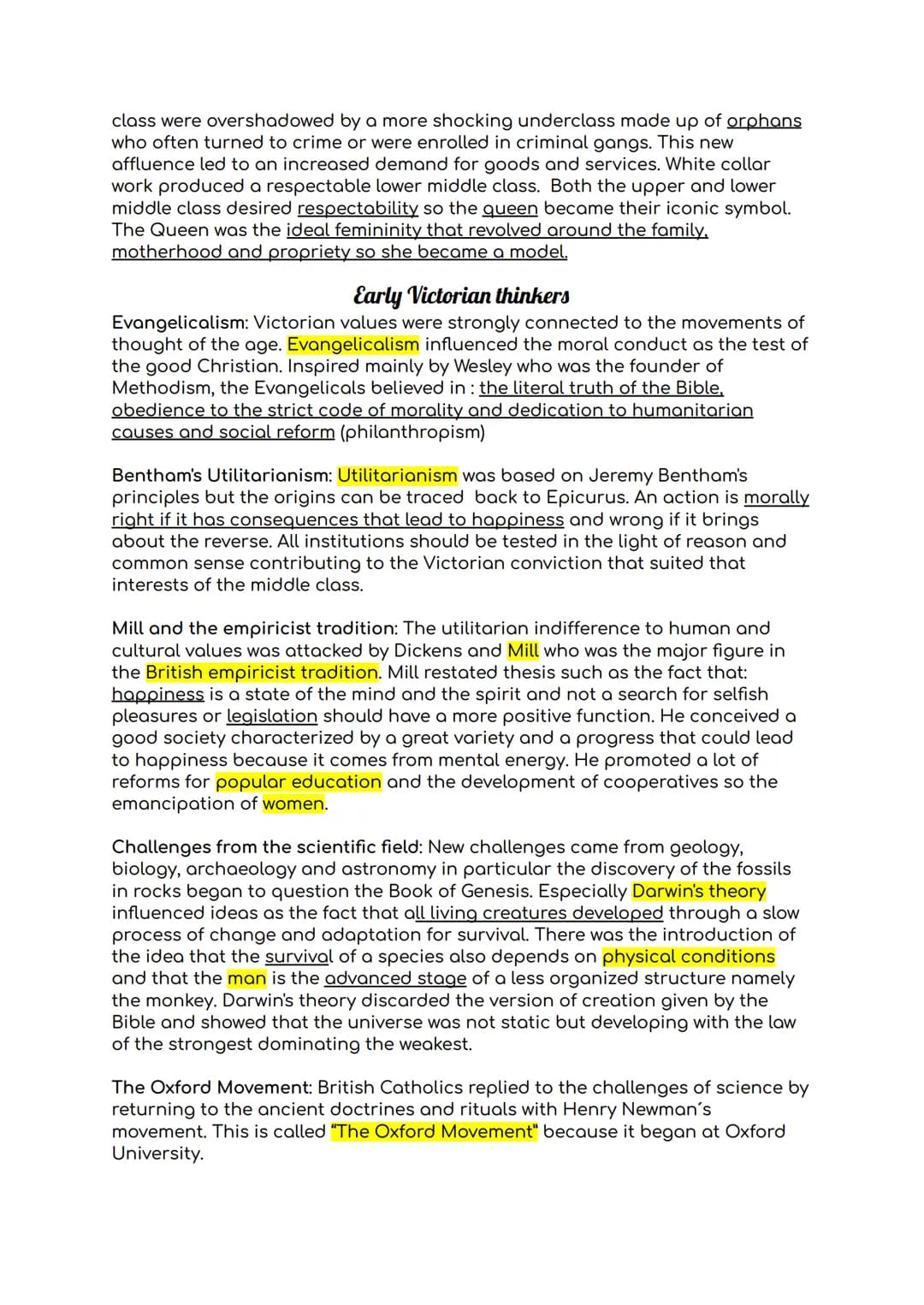
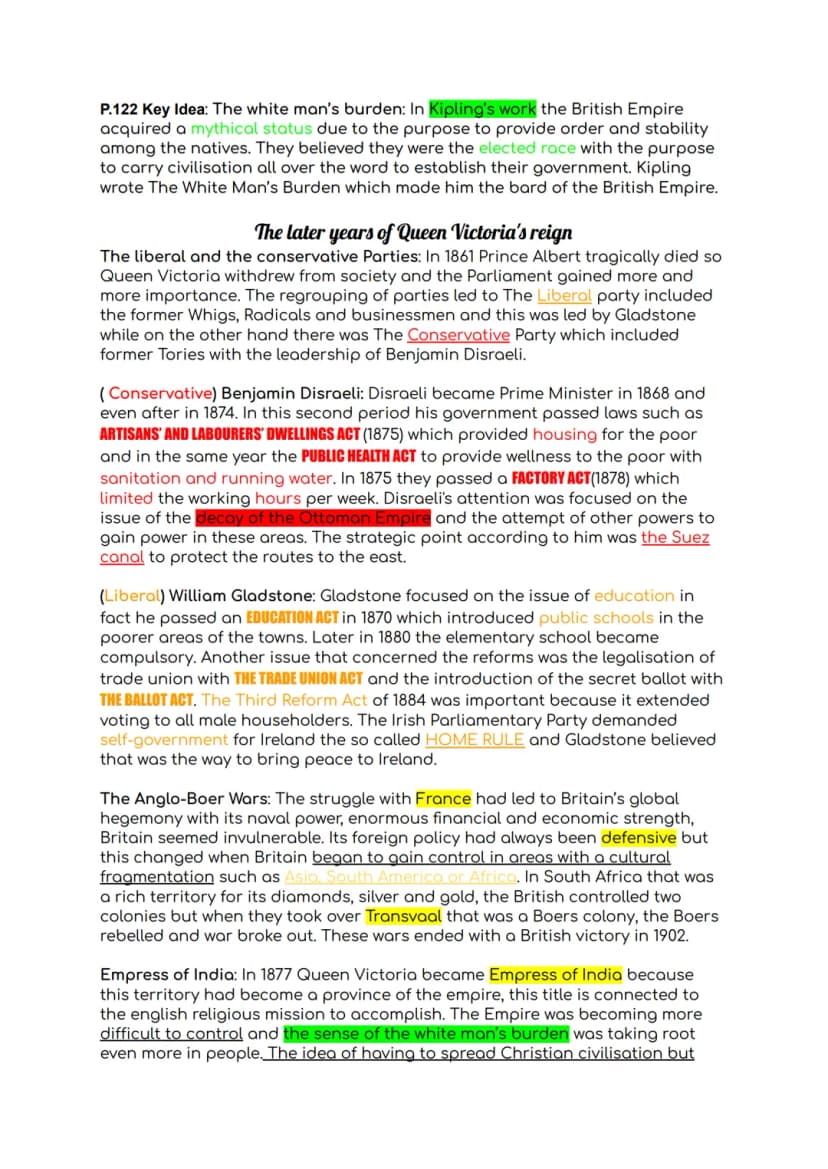
The British Empire during the Victorian Era
The Victorian era saw the British Empire reach its zenith, with Queen Victoria ruling over a quarter of the world's population and landmass. This period of imperial expansion had profound effects on both Britain and its colonies.
Key aspects of British imperialism during this period include:
- The expansion of colonial territories in Africa, Asia, and the Pacific.
- The establishment of British cultural and administrative systems in colonies.
- The exploitation of colonial resources to fuel Britain's industrial growth.
Highlight: The phrase "the empire on which the sun never sets" was coined during this period to describe the vast extent of British territories.
The Victorian Age saw several significant events and policies related to the empire:
- The Indian Rebellion of 1857, leading to direct British rule in India.
- The Scramble for Africa, resulting in the acquisition of new territories.
- The development of the concept of the "white man's burden" to justify colonialism.
Vocabulary: White man's burden - The supposed or presumed responsibility of white people to govern and impart their culture to nonwhite people.
The empire also had a significant impact on British society and culture:
- The influx of exotic goods and materials from colonies.
- The development of new scientific and anthropological theories.
- The influence of colonial experiences on literature and art.
Example: Rudyard Kipling's works, such as "The Jungle Book," were heavily influenced by his experiences in colonial India.
4
of 7
Life in Victorian Britain
Life in Victorian Britain was characterized by rapid social and economic changes, urbanization, and the emergence of distinct class structures. This period saw significant improvements in living standards for many, but also persistent poverty and inequality.
Key aspects of Victorian society include:
- The growth of cities and the emergence of urban working-class neighborhoods.
- The development of a strong middle class with its own set of values and aspirations.
- The persistence of a wealthy aristocracy alongside new industrial elites.
Highlight: The Victorian era saw a significant increase in literacy rates and the popularity of reading as a pastime.
Daily life in Victorian Britain varied greatly depending on social class:
- Working-class life was often characterized by long working hours, poor living conditions, and limited opportunities for education.
- Middle-class families emphasized respectability, education, and moral values.
- Upper-class life revolved around social events, country estates, and political influence.
Example: A typical working-class family might live in a small, crowded tenement, while a middle-class family would occupy a larger house with servants.
The Victorian era also saw significant changes in family life and gender roles:
- The ideal of the "angel in the house" promoted women as moral guardians of the home.
- The emergence of the women's suffrage movement in the late 19th century.
- Changes in marriage laws, including the Married Women's Property Act of 1882.
Vocabulary: Angel in the house - A popular Victorian image of the ideal wife and mother, who was devoted and submissive to her husband.
5
of 7
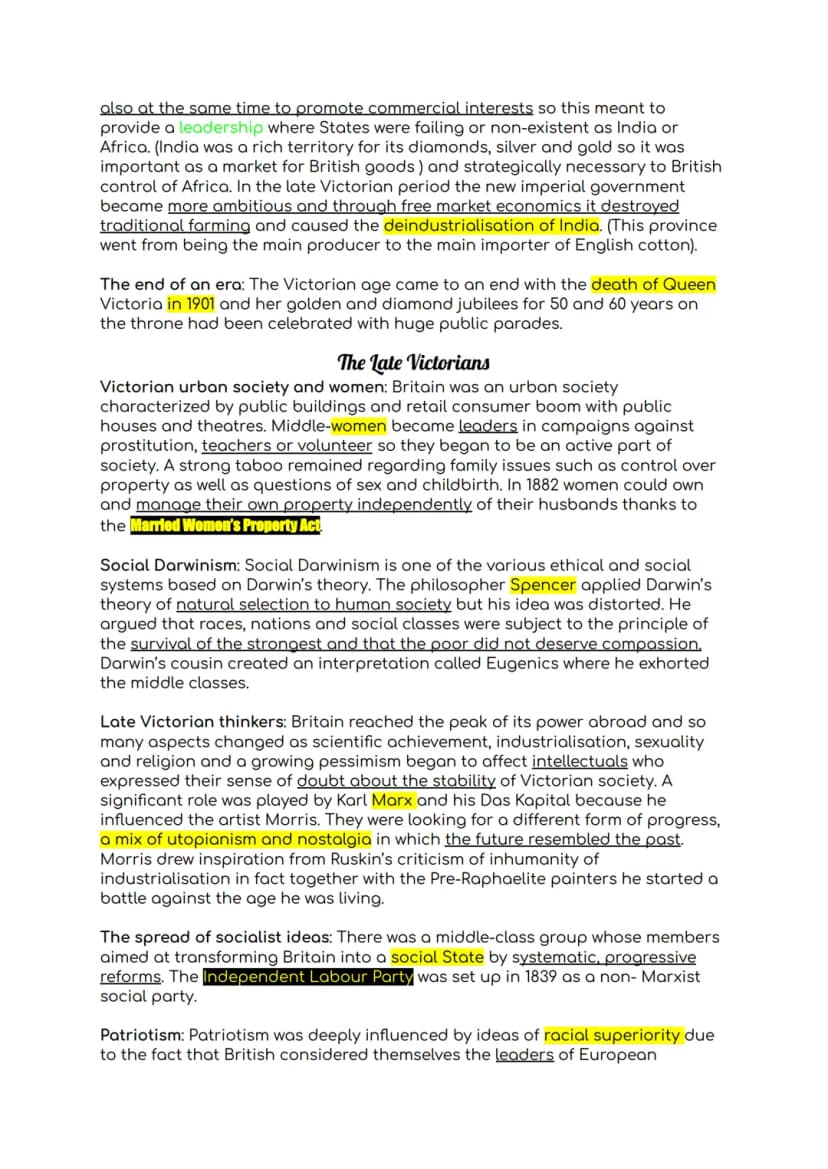
Victorian Age Innovations and Scientific Advancements
The Victorian Age was a period of remarkable scientific and technological progress, with numerous innovations that transformed society and laid the groundwork for modern life. This era saw advancements in various fields, including transportation, communication, and medicine.
Key innovations of the Victorian era include:
- The development of the railway network, revolutionizing travel and commerce.
- The invention of the telegraph, enabling rapid long-distance communication.
- Advancements in industrial machinery and manufacturing processes.
Highlight: The Great Exhibition of 1851 showcased many of these innovations, symbolizing Britain's industrial and technological prowess.
Scientific advancements during this period were equally significant:
- Charles Darwin's theory of evolution, published in "On the Origin of Species" in 1859.
- Improvements in medical knowledge and practices, including the development of antiseptics.
- Advancements in physics and chemistry, laying the foundation for modern scientific understanding.
Example: Joseph Lister's introduction of antiseptic techniques in surgery dramatically reduced mortality rates from infections.
The Victorian era also saw important developments in energy and lighting:
- The widespread adoption of gas lighting in cities.
- The development of electric lighting and power generation.
- Improvements in steam engine technology.
Vocabulary: Dynamo - A machine for converting mechanical energy into electrical energy; a key invention of the Victorian era.
These innovations had a profound impact on society, transforming work, leisure, and daily life for people across all social classes. The rapid pace of change during this period contributed to both excitement about progress and anxiety about the future, themes that are reflected in much of Victorian literature and art.
6
of 7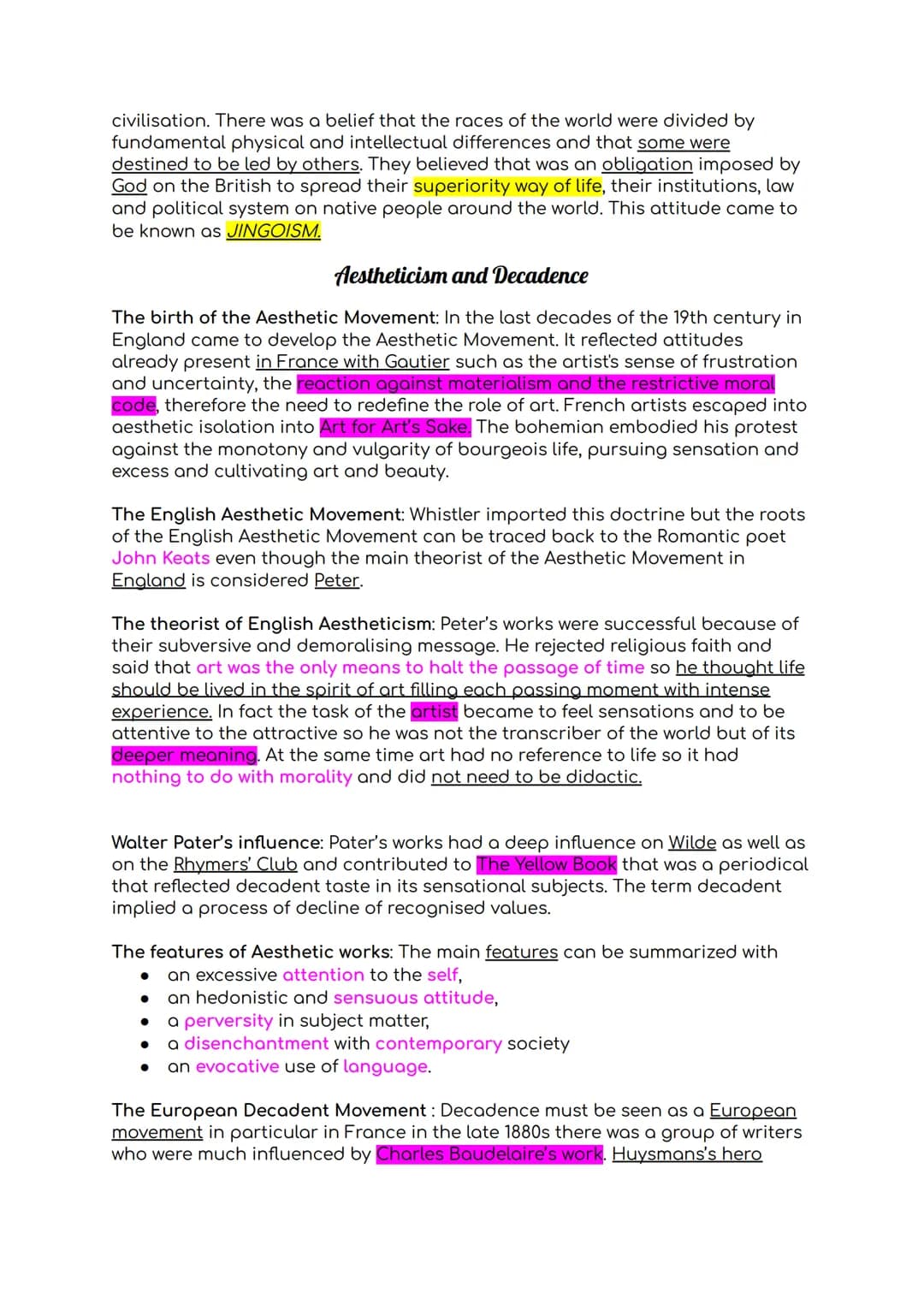
Cultural and Philosophical Developments
The late Victorian period saw the emergence of new philosophical and cultural movements, including Aestheticism and Decadence.
Definition: Jingoism - The belief in British superiority and divine obligation to spread their way of life globally.
Example: The Aesthetic Movement developed as a reaction against materialism and Victorian values.
7
of 7
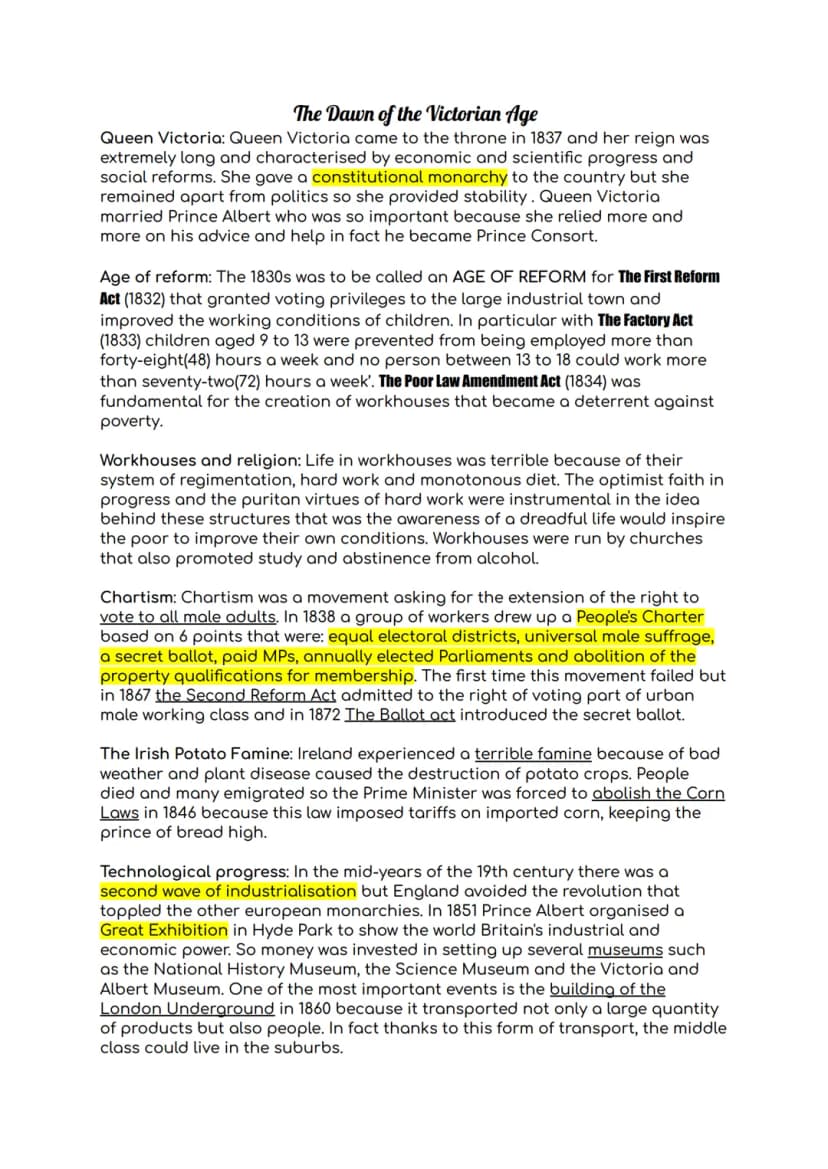
The Dawn of the Victorian Age
The Victorian Age began with Queen Victoria's ascension to the throne in 1837, ushering in a period of significant economic, scientific, and social progress. This era was characterized by a constitutional monarchy that provided stability while remaining separate from politics.
Highlight: Queen Victoria married Prince Albert, who became Prince Consort and played a crucial role in advising and supporting the Queen.
The 1830s were known as an "Age of Reform," with several important acts passed:
- The First Reform Act (1832): Expanded voting privileges to large industrial towns.
- The Factory Act (1833): Improved working conditions for children.
- The Poor Law Amendment Act (1834): Established workhouses to deter poverty.
Definition: Workhouses were institutions that provided accommodation and employment for the poor, often under harsh conditions.
Chartism, a movement advocating for universal male suffrage and other democratic reforms, emerged during this period. Although initially unsuccessful, some of its demands were eventually met through later reforms.
Example: The Second Reform Act of 1867 extended voting rights to part of the urban male working class, while the Ballot Act of 1872 introduced secret ballots.
The mid-19th century saw a second wave of industrialization and technological progress. Notable events include:
- The Great Exhibition of 1851, organized by Prince Albert to showcase Britain's industrial and economic power.
- The establishment of several museums, including the National History Museum and the Victoria and Albert Museum.
- The construction of the London Underground in 1860, revolutionizing transportation.
Vocabulary: Jingoism - Extreme patriotism, especially in the form of aggressive or warlike foreign policy.
In foreign policy, Britain engaged in several conflicts, including:
- The Opium Wars against China, resulting in British control of Hong Kong.
- The Indian Mutiny of 1857, a rebellion against British rule in India.
- The Crimean War, fought alongside France against Russia.
Quote: "The Lady with the Lamp" refers to Florence Nightingale, who became famous for her voluntary action in developing the nursing profession during the Crimean War.
We thought you’d never ask...
What is the Knowunity AI companion?
Our AI companion is specifically built for the needs of students. Based on the millions of content pieces we have on the platform we can provide truly meaningful and relevant answers to students. But its not only about answers, the companion is even more about guiding students through their daily learning challenges, with personalised study plans, quizzes or content pieces in the chat and 100% personalisation based on the students skills and developments.
Where can I download the Knowunity app?
You can download the app in the Google Play Store and in the Apple App Store.
Is Knowunity really free of charge?
That's right! Enjoy free access to study content, connect with fellow students, and get instant help – all at your fingertips.
Similar Content
 LLCE Ang
Most popular content: Charles Dickens
9IngleseRiassunti di inglese, Victorian age, Charles Dickens
Riassunto di testi del libro: The Victorian city life, The Victorian compromise, The age of fiction, all about Charles Dickens, all about Oliver Twist, All about Hard Times
5ªl1,25336
IngleseCharles Dickens
Charles Dickens: vita, analisi, Oliver Twist e Hard Times
5ªl73818
IngleseCharles Dickens
Charles Dickens, Oliver Twist, Hard Times. In solo 4 pagine. Buono studio!
4ªl2,91155
IngleseTHE EARLY YEARS OF QUEEN VICTORIA'S REIGN (1837-1861) E CHARLES DICKENS (E OLIVER TWIST)
THE EARLY YEARS OF QUEEN VICTORIA'S REIGN (1837-1861),EARLY VICTORIAN CITY LIFE, THE VICTORIAN FRAME OF MIND – The Victorian Compromise, THE AGE OF FICTION, CHARLES DICKENS, OLIVER TWIST
5ªl2,33145
Ingleseprogramma english
programma su victorian age, modernismo e post modernismo
5ªl4,140119
IngleseHARD TIMES-Dickens
Spiegazione opera + testi “Coketown” e “Mr Gradgrind”
5ªl4,60290
IngleseCharles Dickens
Biografia, tematiche, stile. Oliver Twist: analisi e commento con testo allegato.
4ªl1,88066
IngleseCharles Dickens
Appunti su "Charles Dickens", contenenti "Oliver Twist", "Hard Times" + traduzione
5ªl17,679509
IngleseCharles Dickens
Charles Dickens vita, temi, stile. Opere: Hard Times, Oliver Twist.
5ªl3,05570
Most popular content in Inglese
9P
InglesePresent Simple vs Present Continuous
Develop the ability to choose correctly between the Present Simple for habits and the Present Continuous for ongoing actions.
3ªm4,2110
F
IngleseFormazione dei Verbi al Past Simple
Impara a trasformare i verbi dalla forma base al Past Simple, distinguendo tra verbi regolari e irregolari.
2ªm2,5550
B
IngleseBasics of Present Simple vs Continuous
Identify core differences between regular habits and temporary actions happening right now.
3ªm9990
I
IngleseIntroduzione ai Verbi Irregolari Inglesi
Impara a distinguere tra verbi regolari e irregolari e familiarizza con i paradigmi più comuni della lingua inglese.
2ªm4,9610
I
IngleseI conditionals
Un quiz su come formare i condizionali in inglese. Spero possa esservi utile♥️
3ªl2,1082
Inglesepresent simple, continuous, past simple, continuous, present perfect simple e continuous
Tempi verbali
2ªl11,642259
IngleseRipasso tempi verbali inglese
Ecco i tempi verbali inglesi spiegati in maniera riassuntiva e schematica
3ªl2,14049
F
IngleseFrasi e Domande al Past Simple
Crea frasi complete e domande utilizzando l'ausiliare 'did' per descrivere eventi avvenuti nel passato.
2ªm9310
InglesePROGRAMMA COMPLETO DI INGLESE
The Romantic Age (Blake, Wordsworth, Coleridge, Shelley, Keats and Jane Austen), The Victorian Age (Dickens, Oscar Wilde, Stevenson) and The Modern Age (War Poets, Eliot, Joyce and Orwell)
5ªl98629
Most popular content
9 Italiano
Riassunto patente B
Riassunto patente B - appunti presi a lezione
5ªl29,228943
 Altro
AltroTeoria patente b
Tutti gli argomenti per la patente
1ªl21,114685
 Ed. civ.
Teoria patente di guida B: Segnali stradali
Segnali stradali di pericolo, luminosi, di prescrizione, di indicazione, temporanei, complementari, pannelli integrativi, segnaletica orizzontale, segnalazioni agenti del traffico, distanza di visibilità per l‘arresto, minima di sicurezza.
5ªl40,0421,645
 Filosofia
Aristotele
Aristotele: vita, metafisica, fisica, etica e politica, retorica e poetica
3ªl7,623216
ItalianoI promessi sposi
Riassunti completi di tutti i 38 capitoli dei Promessi sposi.
2ªl14,090314
AltroPATENTE
schemi per esame teorico della patente
Università22,067756
S
ItalianoSintesi finale di Analisi logica
Esercitazione completa di analisi logica su frasi articolate per consolidare la conoscenza di tutti i complementi.
3ªm5,5290
P
InglesePresent Simple vs Present Continuous
Develop the ability to choose correctly between the Present Simple for habits and the Present Continuous for ongoing actions.
3ªm4,2110
G
ItalianoGabriele D'Annunzio e l'Estetismo
Domande sull'ideale del superuomo, il panismo e la concezione dell'arte come valore assoluto in D'Annunzio.
4ªl2,6740
Can't find what you're looking for? Explore other subjects.
Students love us — and so will you.
4.6/5App Store
4.7/5Google Play
The app is very easy to use and well designed. I have found everything I was looking for so far and have been able to learn a lot from the presentations! I will definitely use the app for a class assignment! And of course it also helps a lot as an inspiration.
Stefan SiOS user
This app is really great. There are so many study notes and help [...]. My problem subject is French, for example, and the app has so many options for help. Thanks to this app, I have improved my French. I would recommend it to anyone.
Samantha KlichAndroid user
Wow, I am really amazed. I just tried the app because I've seen it advertised many times and was absolutely stunned. This app is THE HELP you want for school and above all, it offers so many things, such as workouts and fact sheets, which have been VERY helpful to me personally.
AnnaiOS user
Inglese8,342 views·Updated Jun 17, 2026·7 pagesThe Victorian Age: Cool Facts, Queen Victoria, and Life Back Then
Margherita Frassinetti@marghe28
The Victorian Age Historical background marks a transformative period in British history, defined by Queen Victoria's 64-year reign from 1837 to 1901, characterized by unprecedented industrial growth, social reforms, and imperial expansion.
- Queen Victoria and Albert relationshipformed the cornerstone...
1
of 7
Sign up to see the content. It's free!
- Access to all documents
- Improve your grades
- Join milions of students
The Victorian Compromise
The term "Victorian compromise" refers to the complex and often contradictory nature of the Victorian era. This period was characterized by unprecedented change and progress, but also significant social and economic disparities.
Key aspects of the Victorian compromise include:
- Coexistence of progress and poverty
- Importance of religion alongside belief in science and progress
- Emphasis on public morality and respectability
Definition: Respectability was a concept shared by both middle and working classes, emphasizing proper public behavior and maintaining appearances.
The Victorian era saw a growing emphasis on education, hygiene, and the protection of women. Women were viewed as physically weaker but morally superior, and they played crucial roles in managing family budgets and raising children.
Highlight: The concept of respectability often masked unpleasant aspects of society, leading to a mixture of morality and hypocrisy.
Religious movements, such as Evangelicalism, encouraged public and political action. Philanthropy also played a significant role, with societies addressing various forms of poverty, often relying on the efforts of women.
Vocabulary: Philanthropy - The desire to promote the welfare of others, expressed especially by the generous donation of money to good causes.
The Victorian age was marked by a complex interplay of social, moral, and economic factors, reflecting the rapid changes and challenges faced by British society during this transformative period.
2
of 7Sign up to see the content. It's free!
- Access to all documents
- Improve your grades
- Join milions of students
Politics and Reform in Late Victorian Britain
The late Victorian period saw significant political and social reforms that shaped modern British society. This era was characterized by the expansion of voting rights, improvements in working conditions, and the growth of trade unions.
Key political developments included:
- The Third Reform Act of 1884, which further extended voting rights to rural workers.
- The rise of the Labour Party, representing the interests of the working class.
- The introduction of free, compulsory education for children up to the age of 10 in 1880.
Highlight: The expansion of voting rights during the Victorian era laid the foundation for modern British democracy.
Social reforms were also a prominent feature of this period:
- Improvements in public health and sanitation.
- The establishment of public libraries and museums.
- Reforms in the treatment of the mentally ill and the poor.
Example: The Public Health Act of 1875 required local authorities to provide clean water, proper drainage, and waste disposal.
The late Victorian era also saw the growth of trade unions and workers' rights movements:
- The formation of the Trades Union Congress in 1868.
- The legalization of peaceful picketing in 1875.
- The emergence of the "New Unionism" movement in the 1880s, which sought to organize unskilled workers.
Vocabulary: New Unionism - A movement that aimed to organize unskilled workers into trade unions, in contrast to the earlier focus on skilled craftsmen.
3
of 7Sign up to see the content. It's free!
- Access to all documents
- Improve your grades
- Join milions of students
The British Empire during the Victorian Era
The Victorian era saw the British Empire reach its zenith, with Queen Victoria ruling over a quarter of the world's population and landmass. This period of imperial expansion had profound effects on both Britain and its colonies.
Key aspects of British imperialism during this period include:
- The expansion of colonial territories in Africa, Asia, and the Pacific.
- The establishment of British cultural and administrative systems in colonies.
- The exploitation of colonial resources to fuel Britain's industrial growth.
Highlight: The phrase "the empire on which the sun never sets" was coined during this period to describe the vast extent of British territories.
The Victorian Age saw several significant events and policies related to the empire:
- The Indian Rebellion of 1857, leading to direct British rule in India.
- The Scramble for Africa, resulting in the acquisition of new territories.
- The development of the concept of the "white man's burden" to justify colonialism.
Vocabulary: White man's burden - The supposed or presumed responsibility of white people to govern and impart their culture to nonwhite people.
The empire also had a significant impact on British society and culture:
- The influx of exotic goods and materials from colonies.
- The development of new scientific and anthropological theories.
- The influence of colonial experiences on literature and art.
Example: Rudyard Kipling's works, such as "The Jungle Book," were heavily influenced by his experiences in colonial India.
4
of 7Sign up to see the content. It's free!
- Access to all documents
- Improve your grades
- Join milions of students
Life in Victorian Britain
Life in Victorian Britain was characterized by rapid social and economic changes, urbanization, and the emergence of distinct class structures. This period saw significant improvements in living standards for many, but also persistent poverty and inequality.
Key aspects of Victorian society include:
- The growth of cities and the emergence of urban working-class neighborhoods.
- The development of a strong middle class with its own set of values and aspirations.
- The persistence of a wealthy aristocracy alongside new industrial elites.
Highlight: The Victorian era saw a significant increase in literacy rates and the popularity of reading as a pastime.
Daily life in Victorian Britain varied greatly depending on social class:
- Working-class life was often characterized by long working hours, poor living conditions, and limited opportunities for education.
- Middle-class families emphasized respectability, education, and moral values.
- Upper-class life revolved around social events, country estates, and political influence.
Example: A typical working-class family might live in a small, crowded tenement, while a middle-class family would occupy a larger house with servants.
The Victorian era also saw significant changes in family life and gender roles:
- The ideal of the "angel in the house" promoted women as moral guardians of the home.
- The emergence of the women's suffrage movement in the late 19th century.
- Changes in marriage laws, including the Married Women's Property Act of 1882.
Vocabulary: Angel in the house - A popular Victorian image of the ideal wife and mother, who was devoted and submissive to her husband.
5
of 7Sign up to see the content. It's free!
- Access to all documents
- Improve your grades
- Join milions of students
Victorian Age Innovations and Scientific Advancements
The Victorian Age was a period of remarkable scientific and technological progress, with numerous innovations that transformed society and laid the groundwork for modern life. This era saw advancements in various fields, including transportation, communication, and medicine.
Key innovations of the Victorian era include:
- The development of the railway network, revolutionizing travel and commerce.
- The invention of the telegraph, enabling rapid long-distance communication.
- Advancements in industrial machinery and manufacturing processes.
Highlight: The Great Exhibition of 1851 showcased many of these innovations, symbolizing Britain's industrial and technological prowess.
Scientific advancements during this period were equally significant:
- Charles Darwin's theory of evolution, published in "On the Origin of Species" in 1859.
- Improvements in medical knowledge and practices, including the development of antiseptics.
- Advancements in physics and chemistry, laying the foundation for modern scientific understanding.
Example: Joseph Lister's introduction of antiseptic techniques in surgery dramatically reduced mortality rates from infections.
The Victorian era also saw important developments in energy and lighting:
- The widespread adoption of gas lighting in cities.
- The development of electric lighting and power generation.
- Improvements in steam engine technology.
Vocabulary: Dynamo - A machine for converting mechanical energy into electrical energy; a key invention of the Victorian era.
These innovations had a profound impact on society, transforming work, leisure, and daily life for people across all social classes. The rapid pace of change during this period contributed to both excitement about progress and anxiety about the future, themes that are reflected in much of Victorian literature and art.
6
of 7Sign up to see the content. It's free!
- Access to all documents
- Improve your grades
- Join milions of students
Cultural and Philosophical Developments
The late Victorian period saw the emergence of new philosophical and cultural movements, including Aestheticism and Decadence.
Definition: Jingoism - The belief in British superiority and divine obligation to spread their way of life globally.
Example: The Aesthetic Movement developed as a reaction against materialism and Victorian values.
7
of 7Sign up to see the content. It's free!
- Access to all documents
- Improve your grades
- Join milions of students
The Dawn of the Victorian Age
The Victorian Age began with Queen Victoria's ascension to the throne in 1837, ushering in a period of significant economic, scientific, and social progress. This era was characterized by a constitutional monarchy that provided stability while remaining separate from politics.
Highlight: Queen Victoria married Prince Albert, who became Prince Consort and played a crucial role in advising and supporting the Queen.
The 1830s were known as an "Age of Reform," with several important acts passed:
- The First Reform Act (1832): Expanded voting privileges to large industrial towns.
- The Factory Act (1833): Improved working conditions for children.
- The Poor Law Amendment Act (1834): Established workhouses to deter poverty.
Definition: Workhouses were institutions that provided accommodation and employment for the poor, often under harsh conditions.
Chartism, a movement advocating for universal male suffrage and other democratic reforms, emerged during this period. Although initially unsuccessful, some of its demands were eventually met through later reforms.
Example: The Second Reform Act of 1867 extended voting rights to part of the urban male working class, while the Ballot Act of 1872 introduced secret ballots.
The mid-19th century saw a second wave of industrialization and technological progress. Notable events include:
- The Great Exhibition of 1851, organized by Prince Albert to showcase Britain's industrial and economic power.
- The establishment of several museums, including the National History Museum and the Victoria and Albert Museum.
- The construction of the London Underground in 1860, revolutionizing transportation.
Vocabulary: Jingoism - Extreme patriotism, especially in the form of aggressive or warlike foreign policy.
In foreign policy, Britain engaged in several conflicts, including:
- The Opium Wars against China, resulting in British control of Hong Kong.
- The Indian Mutiny of 1857, a rebellion against British rule in India.
- The Crimean War, fought alongside France against Russia.
Quote: "The Lady with the Lamp" refers to Florence Nightingale, who became famous for her voluntary action in developing the nursing profession during the Crimean War.
We thought you’d never ask...
What is the Knowunity AI companion?
Our AI companion is specifically built for the needs of students. Based on the millions of content pieces we have on the platform we can provide truly meaningful and relevant answers to students. But its not only about answers, the companion is even more about guiding students through their daily learning challenges, with personalised study plans, quizzes or content pieces in the chat and 100% personalisation based on the students skills and developments.
Where can I download the Knowunity app?
You can download the app in the Google Play Store and in the Apple App Store.
Is Knowunity really free of charge?
That's right! Enjoy free access to study content, connect with fellow students, and get instant help – all at your fingertips.
Similar Content
Most popular content: Charles Dickens
9IngleseRiassunti di inglese, Victorian age, Charles Dickens
Riassunto di testi del libro: The Victorian city life, The Victorian compromise, The age of fiction, all about Charles Dickens, all about Oliver Twist, All about Hard Times
5ªl1,25336
IngleseCharles Dickens
Charles Dickens: vita, analisi, Oliver Twist e Hard Times
5ªl73818
IngleseCharles Dickens
Charles Dickens, Oliver Twist, Hard Times. In solo 4 pagine. Buono studio!
4ªl2,91155
IngleseTHE EARLY YEARS OF QUEEN VICTORIA'S REIGN (1837-1861) E CHARLES DICKENS (E OLIVER TWIST)
THE EARLY YEARS OF QUEEN VICTORIA'S REIGN (1837-1861),EARLY VICTORIAN CITY LIFE, THE VICTORIAN FRAME OF MIND – The Victorian Compromise, THE AGE OF FICTION, CHARLES DICKENS, OLIVER TWIST
5ªl2,33145
Ingleseprogramma english
programma su victorian age, modernismo e post modernismo
5ªl4,140119
IngleseHARD TIMES-Dickens
Spiegazione opera + testi “Coketown” e “Mr Gradgrind”
5ªl4,60290
IngleseCharles Dickens
Biografia, tematiche, stile. Oliver Twist: analisi e commento con testo allegato.
4ªl1,88066
IngleseCharles Dickens
Appunti su "Charles Dickens", contenenti "Oliver Twist", "Hard Times" + traduzione
5ªl17,679509
IngleseCharles Dickens
Charles Dickens vita, temi, stile. Opere: Hard Times, Oliver Twist.
5ªl3,05570
Most popular content in Inglese
9P
InglesePresent Simple vs Present Continuous
Develop the ability to choose correctly between the Present Simple for habits and the Present Continuous for ongoing actions.
3ªm4,2110
F
IngleseFormazione dei Verbi al Past Simple
Impara a trasformare i verbi dalla forma base al Past Simple, distinguendo tra verbi regolari e irregolari.
2ªm2,5550
B
IngleseBasics of Present Simple vs Continuous
Identify core differences between regular habits and temporary actions happening right now.
3ªm9990
I
IngleseIntroduzione ai Verbi Irregolari Inglesi
Impara a distinguere tra verbi regolari e irregolari e familiarizza con i paradigmi più comuni della lingua inglese.
2ªm4,9610
I
IngleseI conditionals
Un quiz su come formare i condizionali in inglese. Spero possa esservi utile♥️
3ªl2,1082
Inglesepresent simple, continuous, past simple, continuous, present perfect simple e continuous
Tempi verbali
2ªl11,642259
IngleseRipasso tempi verbali inglese
Ecco i tempi verbali inglesi spiegati in maniera riassuntiva e schematica
3ªl2,14049
F
IngleseFrasi e Domande al Past Simple
Crea frasi complete e domande utilizzando l'ausiliare 'did' per descrivere eventi avvenuti nel passato.
2ªm9310
InglesePROGRAMMA COMPLETO DI INGLESE
The Romantic Age (Blake, Wordsworth, Coleridge, Shelley, Keats and Jane Austen), The Victorian Age (Dickens, Oscar Wilde, Stevenson) and The Modern Age (War Poets, Eliot, Joyce and Orwell)
5ªl98629
Most popular content
9ItalianoRiassunto patente B
Riassunto patente B - appunti presi a lezione
5ªl29,228943
AltroTeoria patente b
Tutti gli argomenti per la patente
1ªl21,114685
Ed. civ.Teoria patente di guida B: Segnali stradali
Segnali stradali di pericolo, luminosi, di prescrizione, di indicazione, temporanei, complementari, pannelli integrativi, segnaletica orizzontale, segnalazioni agenti del traffico, distanza di visibilità per l‘arresto, minima di sicurezza.
5ªl40,0421,645
FilosofiaAristotele
Aristotele: vita, metafisica, fisica, etica e politica, retorica e poetica
3ªl7,623216
ItalianoI promessi sposi
Riassunti completi di tutti i 38 capitoli dei Promessi sposi.
2ªl14,090314
AltroPATENTE
schemi per esame teorico della patente
Università22,067756
S
ItalianoSintesi finale di Analisi logica
Esercitazione completa di analisi logica su frasi articolate per consolidare la conoscenza di tutti i complementi.
3ªm5,5290
P
InglesePresent Simple vs Present Continuous
Develop the ability to choose correctly between the Present Simple for habits and the Present Continuous for ongoing actions.
3ªm4,2110
G
ItalianoGabriele D'Annunzio e l'Estetismo
Domande sull'ideale del superuomo, il panismo e la concezione dell'arte come valore assoluto in D'Annunzio.
4ªl2,6740
Can't find what you're looking for? Explore other subjects.
Students love us — and so will you.
4.6/5App Store
4.7/5Google Play
The app is very easy to use and well designed. I have found everything I was looking for so far and have been able to learn a lot from the presentations! I will definitely use the app for a class assignment! And of course it also helps a lot as an inspiration.
Stefan SiOS user
This app is really great. There are so many study notes and help [...]. My problem subject is French, for example, and the app has so many options for help. Thanks to this app, I have improved my French. I would recommend it to anyone.
Samantha KlichAndroid user
Wow, I am really amazed. I just tried the app because I've seen it advertised many times and was absolutely stunned. This app is THE HELP you want for school and above all, it offers so many things, such as workouts and fact sheets, which have been VERY helpful to me personally.
AnnaiOS user