
The Past Simpletense in English is a fundamental aspect...
 Inglese756 views·Updated Jun 24, 2026·2 pages
Learn Past Simple: Regular and Irregular Verbs - Easy Guide with Exercises

astuccioblu💙@astuccioblu_ktrz
1
of 2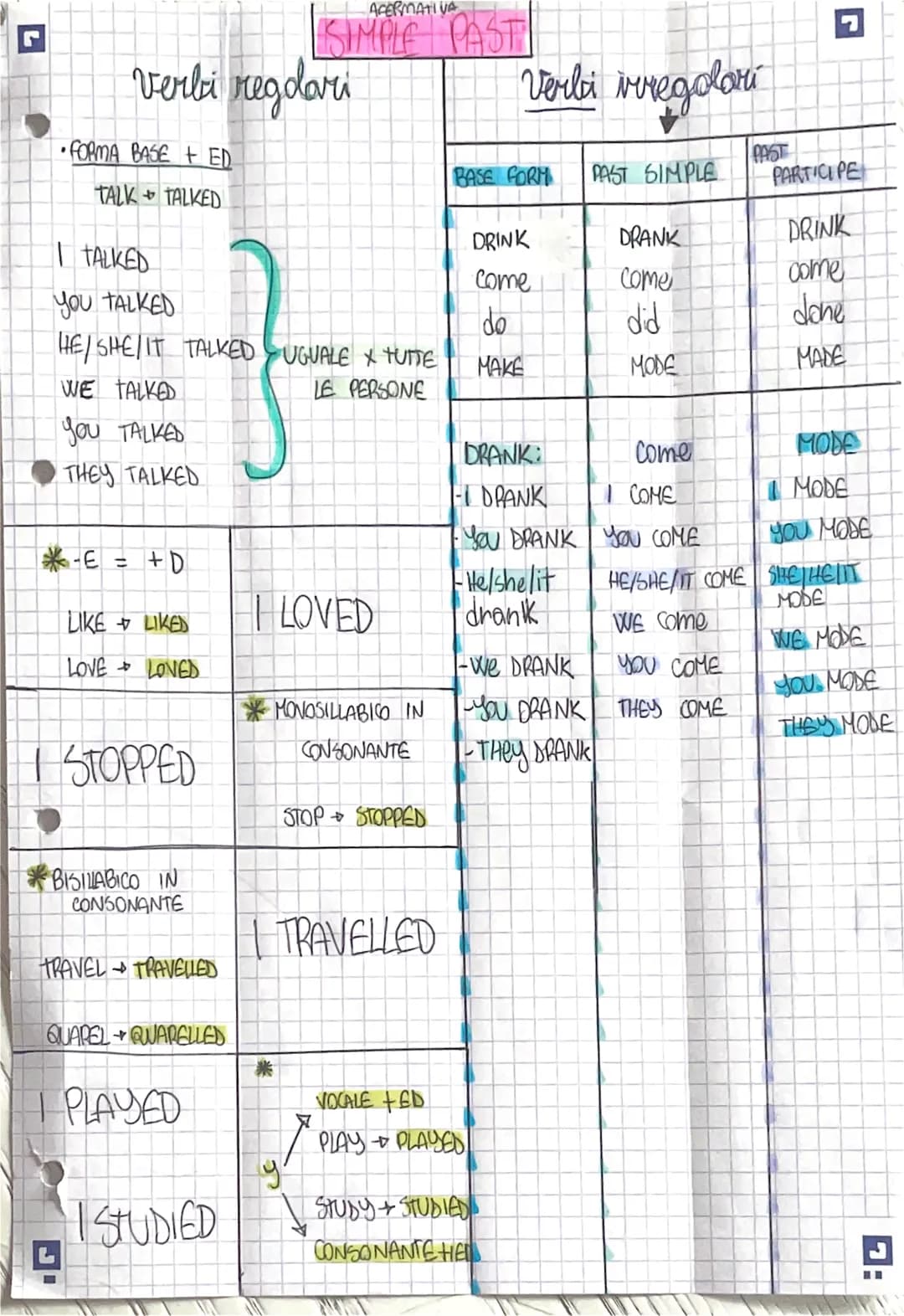
Past Simple: Negative and Interrogative Forms
This page covers the formation of negative and interrogative sentences in the Past Simple for both regular and irregular verbs.
For the negative form of regular and irregular verbs:
- Use the structure: Subject + DIDN'T + base form of the verb
Example:
- I DIDN'T STUDY
- I DIDN'T WALK
- I DIDN'T DRINK
- I DIDN'T EAT
For the interrogative form of regular and irregular verbs:
- Use the structure: DID + Subject + base form of the verb + ?
Example:
- DID YOU STUDY?
- DID YOU WALK?
- DID YOU DRINK?
- DID YOU EAT?
Highlight: The base form of the verb is used in both negative and interrogative structures, regardless of whether the verb is regular or irregular.
Short answers to Past Simple questions:
- Affirmative: Yes, I did.
- Negative: No, I didn't.
Definition: DIDN'T is the contracted form of DID NOT, commonly used in spoken and informal written English.
This consistent structure for negatives and interrogatives simplifies the use of the Past Simple, as it applies to both regular and irregular verbs.
2
of 2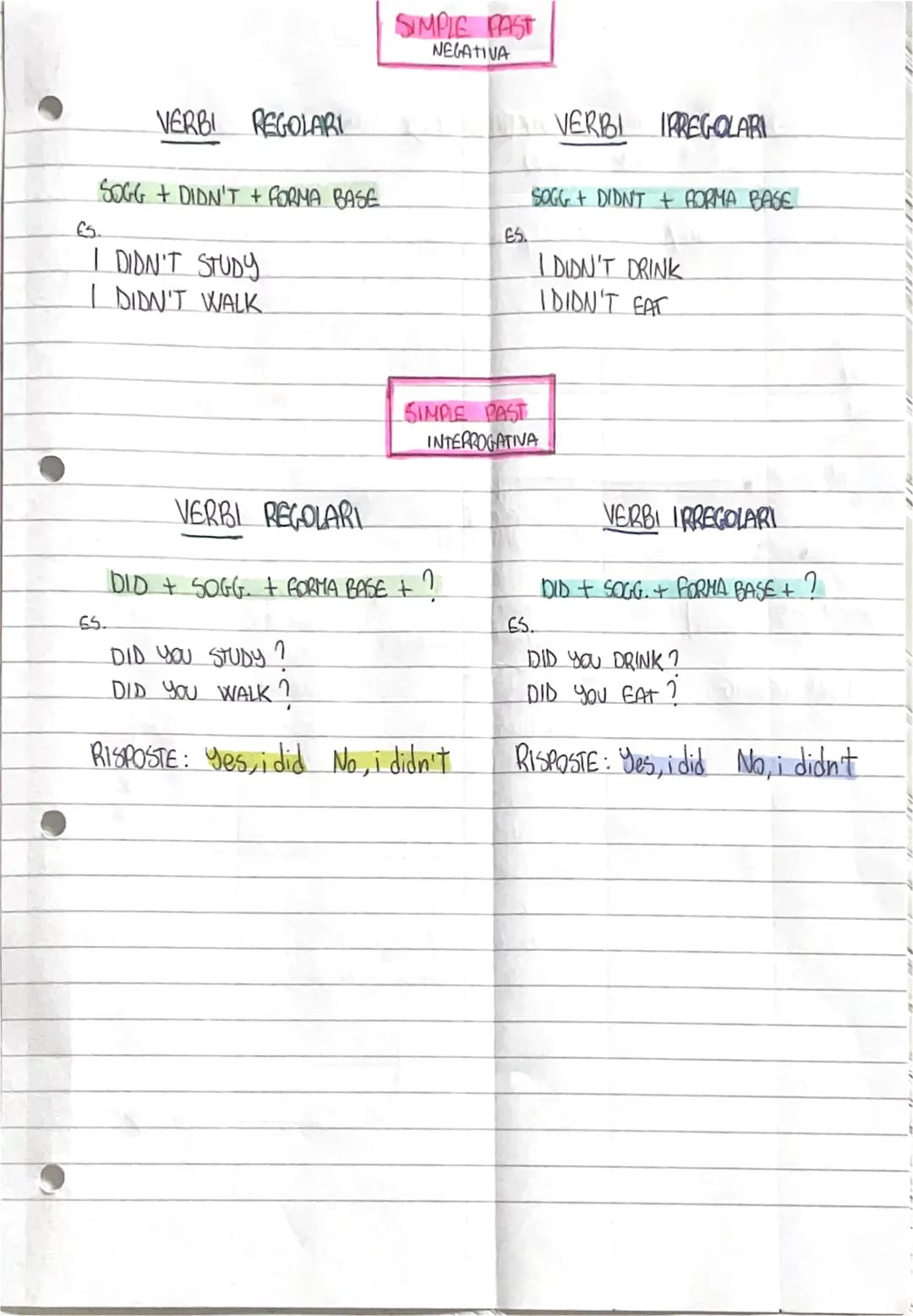
Past Simple: Regular and Irregular Verbs
This page introduces the formation of the Past Simple for both regular and irregular verbs in English.
For regular verbs, the Past Simple is formed by adding -ed to the base form of the verb. This rule applies to all persons .
Example: TALK → TALKED
There are some spelling variations for regular verbs:
- Verbs ending in -e: add only -d (LIKE → LIKED, LOVE → LOVED)
- Monosyllabic verbs ending in consonant-vowel-consonant: double the final consonant (STOP → STOPPED)
- Verbs ending in consonant + y: change y to i and add -ed (STUDY → STUDIED)
- Two-syllable verbs ending in a consonant: may double the final consonant (TRAVEL → TRAVELLED, QUARREL → QUARRELLED)
Highlight: The Past Simple form remains the same for all persons in affirmative sentences.
For irregular verbs, the Past Simple form does not follow a specific pattern and must be memorized.
Example:
- DRINK → DRANK
- COME → CAME
- DO → DID
- MAKE → MADE
Vocabulary: Base form - The infinitive form of the verb without 'to'
We thought you’d never ask...
What is the Knowunity AI companion?
Our AI companion is specifically built for the needs of students. Based on the millions of content pieces we have on the platform we can provide truly meaningful and relevant answers to students. But its not only about answers, the companion is even more about guiding students through their daily learning challenges, with personalised study plans, quizzes or content pieces in the chat and 100% personalisation based on the students skills and developments.
Where can I download the Knowunity app?
You can download the app in the Google Play Store and in the Apple App Store.
Is Knowunity really free of charge?
That's right! Enjoy free access to study content, connect with fellow students, and get instant help – all at your fingertips.
Similar Content
 Anglais
Most popular content in Inglese
9P
InglesePresent Simple vs Present Continuous
Develop the ability to choose correctly between the Present Simple for habits and the Present Continuous for ongoing actions.
3ªm4,2110
F
IngleseFormazione dei Verbi al Past Simple
Impara a trasformare i verbi dalla forma base al Past Simple, distinguendo tra verbi regolari e irregolari.
2ªm2,5550
B
IngleseBasics of Present Simple vs Continuous
Identify core differences between regular habits and temporary actions happening right now.
3ªm9990
I
IngleseIntroduzione ai Verbi Irregolari Inglesi
Impara a distinguere tra verbi regolari e irregolari e familiarizza con i paradigmi più comuni della lingua inglese.
2ªm4,9610
I
IngleseI conditionals
Un quiz su come formare i condizionali in inglese. Spero possa esservi utile♥️
3ªl2,1082
Inglesepresent simple, continuous, past simple, continuous, present perfect simple e continuous
Tempi verbali
2ªl11,642259
IngleseRipasso tempi verbali inglese
Ecco i tempi verbali inglesi spiegati in maniera riassuntiva e schematica
3ªl2,14049
F
IngleseFrasi e Domande al Past Simple
Crea frasi complete e domande utilizzando l'ausiliare 'did' per descrivere eventi avvenuti nel passato.
2ªm9310
InglesePROGRAMMA COMPLETO DI INGLESE
The Romantic Age (Blake, Wordsworth, Coleridge, Shelley, Keats and Jane Austen), The Victorian Age (Dickens, Oscar Wilde, Stevenson) and The Modern Age (War Poets, Eliot, Joyce and Orwell)
5ªl98629
Most popular content
9 Italiano
Riassunto patente B
Riassunto patente B - appunti presi a lezione
5ªl29,228943
 Altro
AltroTeoria patente b
Tutti gli argomenti per la patente
1ªl21,114685
 Ed. civ.
Teoria patente di guida B: Segnali stradali
Segnali stradali di pericolo, luminosi, di prescrizione, di indicazione, temporanei, complementari, pannelli integrativi, segnaletica orizzontale, segnalazioni agenti del traffico, distanza di visibilità per l‘arresto, minima di sicurezza.
5ªl40,0241,644
 Filosofia
Aristotele
Aristotele: vita, metafisica, fisica, etica e politica, retorica e poetica
3ªl7,623216
ItalianoI promessi sposi
Riassunti completi di tutti i 38 capitoli dei Promessi sposi.
2ªl14,090314
AltroPATENTE
schemi per esame teorico della patente
Università22,050755
S
ItalianoSintesi finale di Analisi logica
Esercitazione completa di analisi logica su frasi articolate per consolidare la conoscenza di tutti i complementi.
3ªm5,5290
P
InglesePresent Simple vs Present Continuous
Develop the ability to choose correctly between the Present Simple for habits and the Present Continuous for ongoing actions.
3ªm4,2110
G
ItalianoGabriele D'Annunzio e l'Estetismo
Domande sull'ideale del superuomo, il panismo e la concezione dell'arte come valore assoluto in D'Annunzio.
4ªl2,6740
Can't find what you're looking for? Explore other subjects.
Students love us — and so will you.
4.6/5App Store
4.7/5Google Play
The app is very easy to use and well designed. I have found everything I was looking for so far and have been able to learn a lot from the presentations! I will definitely use the app for a class assignment! And of course it also helps a lot as an inspiration.
Stefan SiOS user
This app is really great. There are so many study notes and help [...]. My problem subject is French, for example, and the app has so many options for help. Thanks to this app, I have improved my French. I would recommend it to anyone.
Samantha KlichAndroid user
Wow, I am really amazed. I just tried the app because I've seen it advertised many times and was absolutely stunned. This app is THE HELP you want for school and above all, it offers so many things, such as workouts and fact sheets, which have been VERY helpful to me personally.
AnnaiOS user
Inglese756 views·Updated Jun 24, 2026·2 pagesLearn Past Simple: Regular and Irregular Verbs - Easy Guide with Exercises
astuccioblu💙@astuccioblu_ktrz
The Past Simple tense in English is a fundamental aspect of grammar, used to describe completed actions in the past. This summary covers both regular and irregular verbs in the Past Simple, including their affirmative, negative, and interrogative forms.
Key...
1
of 2
Sign up to see the content. It's free!
- Access to all documents
- Improve your grades
- Join milions of students
Past Simple: Negative and Interrogative Forms
This page covers the formation of negative and interrogative sentences in the Past Simple for both regular and irregular verbs.
For the negative form of regular and irregular verbs:
- Use the structure: Subject + DIDN'T + base form of the verb
Example:
- I DIDN'T STUDY
- I DIDN'T WALK
- I DIDN'T DRINK
- I DIDN'T EAT
For the interrogative form of regular and irregular verbs:
- Use the structure: DID + Subject + base form of the verb + ?
Example:
- DID YOU STUDY?
- DID YOU WALK?
- DID YOU DRINK?
- DID YOU EAT?
Highlight: The base form of the verb is used in both negative and interrogative structures, regardless of whether the verb is regular or irregular.
Short answers to Past Simple questions:
- Affirmative: Yes, I did.
- Negative: No, I didn't.
Definition: DIDN'T is the contracted form of DID NOT, commonly used in spoken and informal written English.
This consistent structure for negatives and interrogatives simplifies the use of the Past Simple, as it applies to both regular and irregular verbs.
2
of 2Sign up to see the content. It's free!
- Access to all documents
- Improve your grades
- Join milions of students
Past Simple: Regular and Irregular Verbs
This page introduces the formation of the Past Simple for both regular and irregular verbs in English.
For regular verbs, the Past Simple is formed by adding -ed to the base form of the verb. This rule applies to all persons .
Example: TALK → TALKED
There are some spelling variations for regular verbs:
- Verbs ending in -e: add only -d (LIKE → LIKED, LOVE → LOVED)
- Monosyllabic verbs ending in consonant-vowel-consonant: double the final consonant (STOP → STOPPED)
- Verbs ending in consonant + y: change y to i and add -ed (STUDY → STUDIED)
- Two-syllable verbs ending in a consonant: may double the final consonant (TRAVEL → TRAVELLED, QUARREL → QUARRELLED)
Highlight: The Past Simple form remains the same for all persons in affirmative sentences.
For irregular verbs, the Past Simple form does not follow a specific pattern and must be memorized.
Example:
- DRINK → DRANK
- COME → CAME
- DO → DID
- MAKE → MADE
Vocabulary: Base form - The infinitive form of the verb without 'to'
We thought you’d never ask...
What is the Knowunity AI companion?
Our AI companion is specifically built for the needs of students. Based on the millions of content pieces we have on the platform we can provide truly meaningful and relevant answers to students. But its not only about answers, the companion is even more about guiding students through their daily learning challenges, with personalised study plans, quizzes or content pieces in the chat and 100% personalisation based on the students skills and developments.
Where can I download the Knowunity app?
You can download the app in the Google Play Store and in the Apple App Store.
Is Knowunity really free of charge?
That's right! Enjoy free access to study content, connect with fellow students, and get instant help – all at your fingertips.
Similar Content
Most popular content in Inglese
9P
InglesePresent Simple vs Present Continuous
Develop the ability to choose correctly between the Present Simple for habits and the Present Continuous for ongoing actions.
3ªm4,2110
F
IngleseFormazione dei Verbi al Past Simple
Impara a trasformare i verbi dalla forma base al Past Simple, distinguendo tra verbi regolari e irregolari.
2ªm2,5550
B
IngleseBasics of Present Simple vs Continuous
Identify core differences between regular habits and temporary actions happening right now.
3ªm9990
I
IngleseIntroduzione ai Verbi Irregolari Inglesi
Impara a distinguere tra verbi regolari e irregolari e familiarizza con i paradigmi più comuni della lingua inglese.
2ªm4,9610
I
IngleseI conditionals
Un quiz su come formare i condizionali in inglese. Spero possa esservi utile♥️
3ªl2,1082
Inglesepresent simple, continuous, past simple, continuous, present perfect simple e continuous
Tempi verbali
2ªl11,642259
IngleseRipasso tempi verbali inglese
Ecco i tempi verbali inglesi spiegati in maniera riassuntiva e schematica
3ªl2,14049
F
IngleseFrasi e Domande al Past Simple
Crea frasi complete e domande utilizzando l'ausiliare 'did' per descrivere eventi avvenuti nel passato.
2ªm9310
InglesePROGRAMMA COMPLETO DI INGLESE
The Romantic Age (Blake, Wordsworth, Coleridge, Shelley, Keats and Jane Austen), The Victorian Age (Dickens, Oscar Wilde, Stevenson) and The Modern Age (War Poets, Eliot, Joyce and Orwell)
5ªl98629
Most popular content
9ItalianoRiassunto patente B
Riassunto patente B - appunti presi a lezione
5ªl29,228943
AltroTeoria patente b
Tutti gli argomenti per la patente
1ªl21,114685
Ed. civ.Teoria patente di guida B: Segnali stradali
Segnali stradali di pericolo, luminosi, di prescrizione, di indicazione, temporanei, complementari, pannelli integrativi, segnaletica orizzontale, segnalazioni agenti del traffico, distanza di visibilità per l‘arresto, minima di sicurezza.
5ªl40,0241,644
FilosofiaAristotele
Aristotele: vita, metafisica, fisica, etica e politica, retorica e poetica
3ªl7,623216
ItalianoI promessi sposi
Riassunti completi di tutti i 38 capitoli dei Promessi sposi.
2ªl14,090314
AltroPATENTE
schemi per esame teorico della patente
Università22,050755
S
ItalianoSintesi finale di Analisi logica
Esercitazione completa di analisi logica su frasi articolate per consolidare la conoscenza di tutti i complementi.
3ªm5,5290
P
InglesePresent Simple vs Present Continuous
Develop the ability to choose correctly between the Present Simple for habits and the Present Continuous for ongoing actions.
3ªm4,2110
G
ItalianoGabriele D'Annunzio e l'Estetismo
Domande sull'ideale del superuomo, il panismo e la concezione dell'arte come valore assoluto in D'Annunzio.
4ªl2,6740
Can't find what you're looking for? Explore other subjects.
Students love us — and so will you.
4.6/5App Store
4.7/5Google Play
The app is very easy to use and well designed. I have found everything I was looking for so far and have been able to learn a lot from the presentations! I will definitely use the app for a class assignment! And of course it also helps a lot as an inspiration.
Stefan SiOS user
This app is really great. There are so many study notes and help [...]. My problem subject is French, for example, and the app has so many options for help. Thanks to this app, I have improved my French. I would recommend it to anyone.
Samantha KlichAndroid user
Wow, I am really amazed. I just tried the app because I've seen it advertised many times and was absolutely stunned. This app is THE HELP you want for school and above all, it offers so many things, such as workouts and fact sheets, which have been VERY helpful to me personally.
AnnaiOS user