
I tempi verbali inglesi possono sembrare complicati, ma una volta...
 Inglese11,642 views·Updated Jun 24, 2026·6 pages
I tempi verbali: Present Simple, Continuous, Past Simple e Perfect
A
Anna Franceschini@annafranceschini_rmhg
1 / 6
1
of 6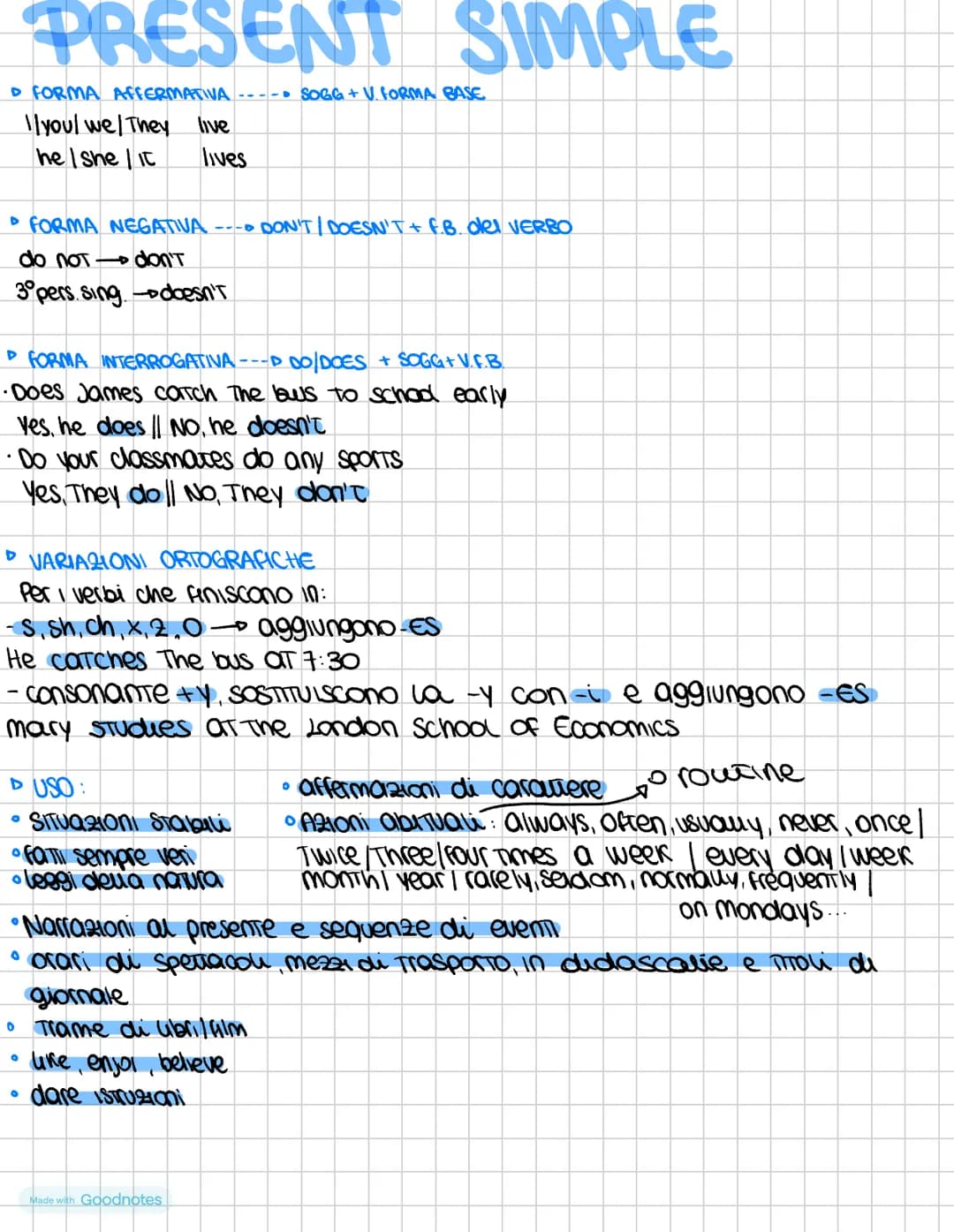
Present Simple
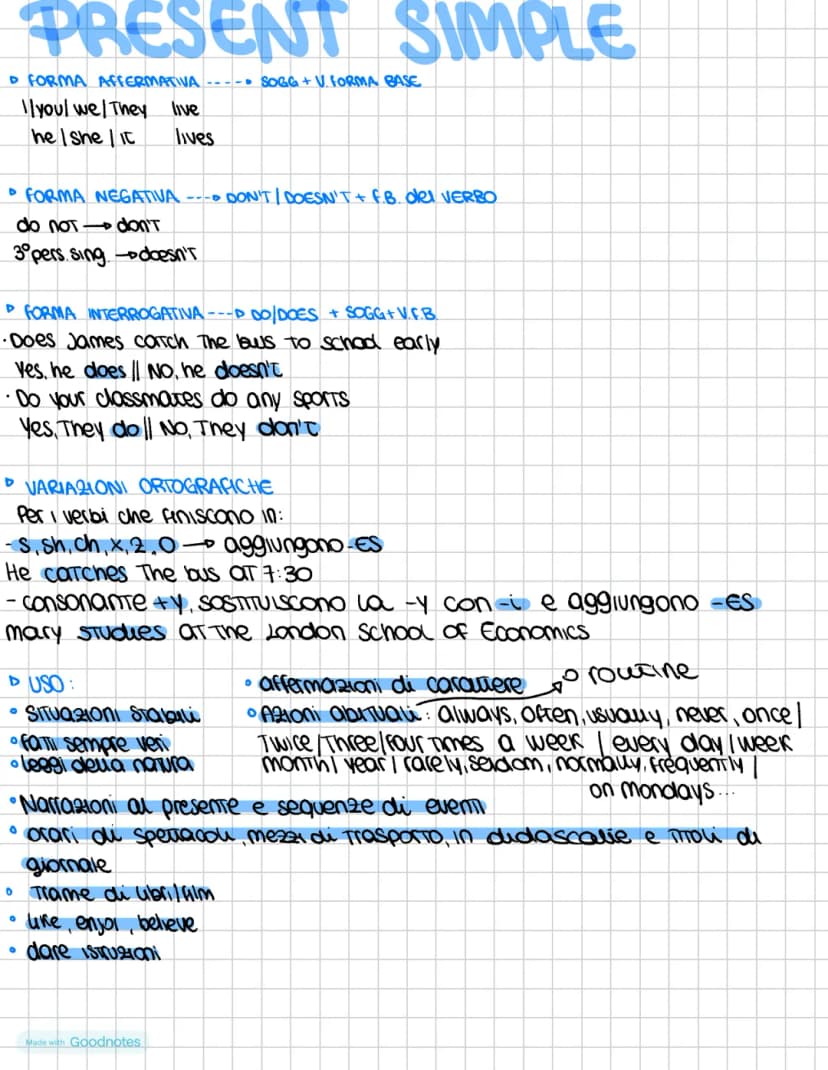
Il present simple è il tuo migliore amico per parlare di cose che succedono sempre! Si forma con il verbo base, ma attenzione: alla terza persona singolare aggiungi sempre la -s.
Per le forme negative usi don't e doesn't + verbo base. Per le domande metti do/does all'inizio: "Do you like pizza?" oppure "Does she study English?"
Trucchi ortografici: se il verbo finisce in -s, -sh, -ch, -x, -z, -o aggiungi -es (he catches). Se finisce in consonante + y, cambia la y in i e aggiungi -es (she studies).
💡 Ricorda: Usa il present simple per abitudini, fatti sempre veri e con parole come always, often, usually, never!
2
of 6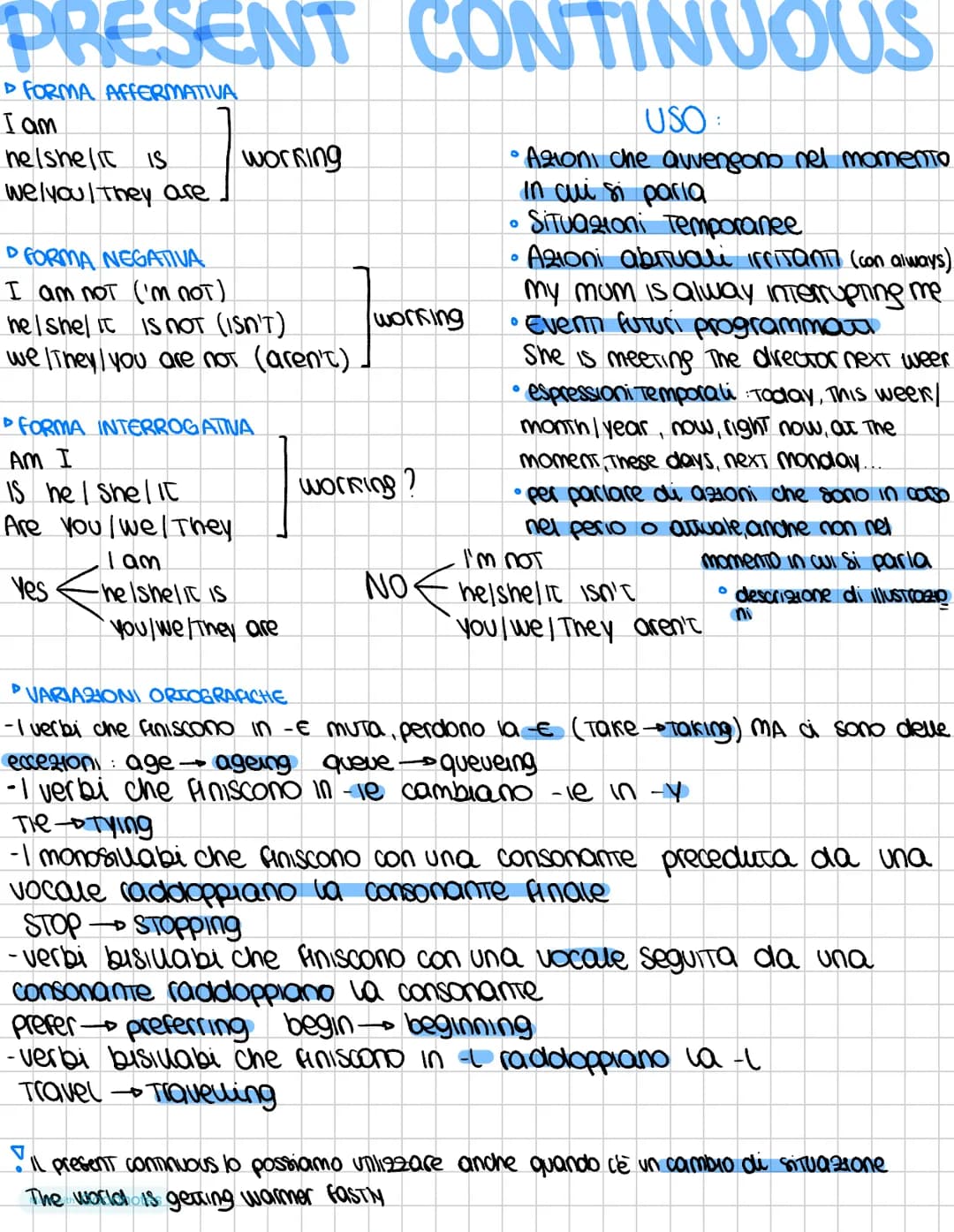
Present Continuous
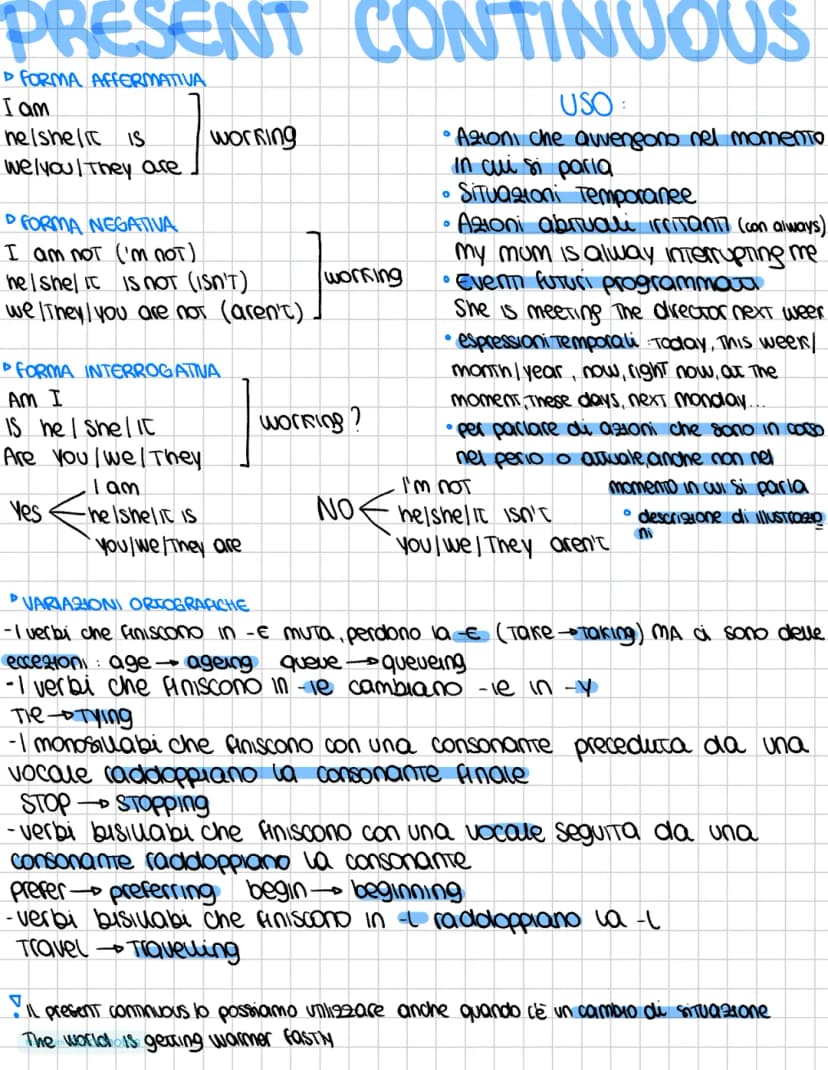
Il present continuous descrive quello che sta succedendo proprio adesso! Si forma con am/is/are + verbo-ing. È perfetto quando vuoi dire "sto facendo qualcosa in questo momento".
Per formare il gerundio : i verbi che finiscono in -e muta la perdono (take → taking), quelli che finiscono in -ie cambiano in -y (tie → tying). I monosillabi con vocale + consonante raddoppiano la consonante (stop → stopping).
Lo usi anche per azioni future programmate ("I'm meeting Tom tomorrow") e per abitudini irritanti con always ("My brother is always interrupting me!").
⚠️ Attenzione: Non puoi usarlo con verbi di stato come be, have, know, like, want!
3
of 6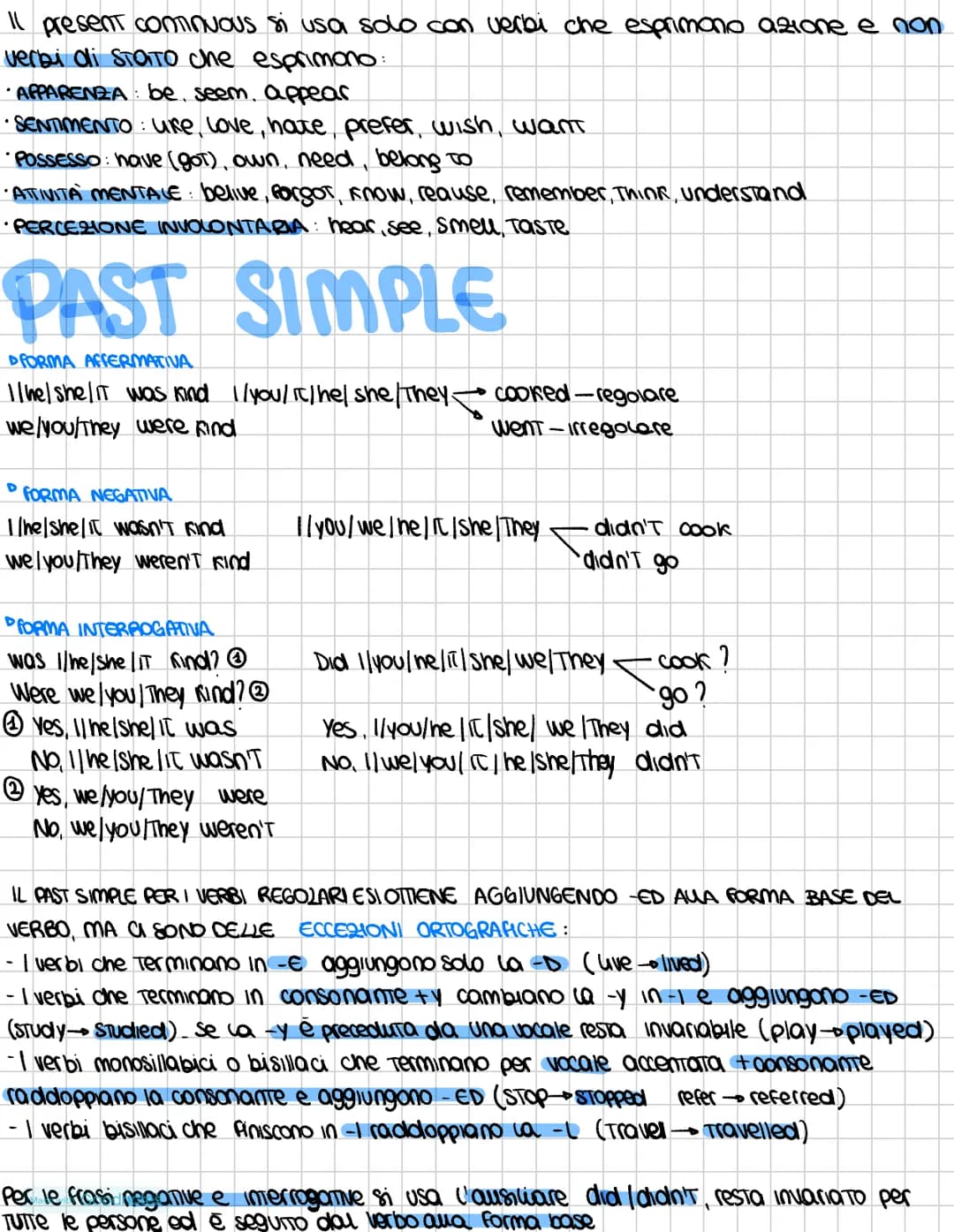
Past Simple
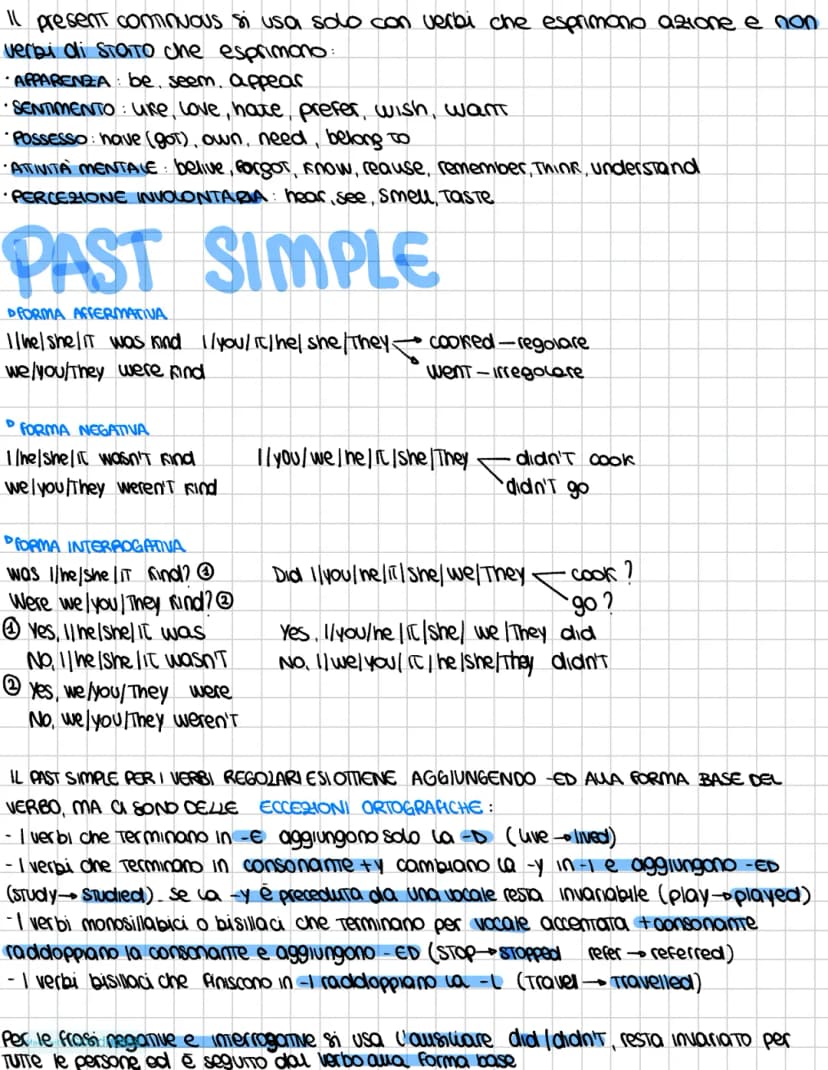
Il past simple è il tempo del "c'era una volta"! Per i verbi regolari aggiungi -ed alla forma base, ma i verbi irregolari hanno forme speciali che devi imparare a memoria (go → went, see → saw).
Con was/were per il verbo essere: was per I/he/she/it, were per you/we/they. Per tutti gli altri verbi usi did/didn't nelle domande e negazioni, sempre con il verbo alla forma base.
Regole ortografiche: verbi che finiscono in -e aggiungono solo -d (live → lived), quelli in consonante + y cambiano y in i (study → studied).
Lo usi per azioni finite nel passato con parole come yesterday, last week, two days ago, in 2010.
🎯 Trucco: Se puoi dire "quando" è successo qualcosa, usa il past simple!
4
of 6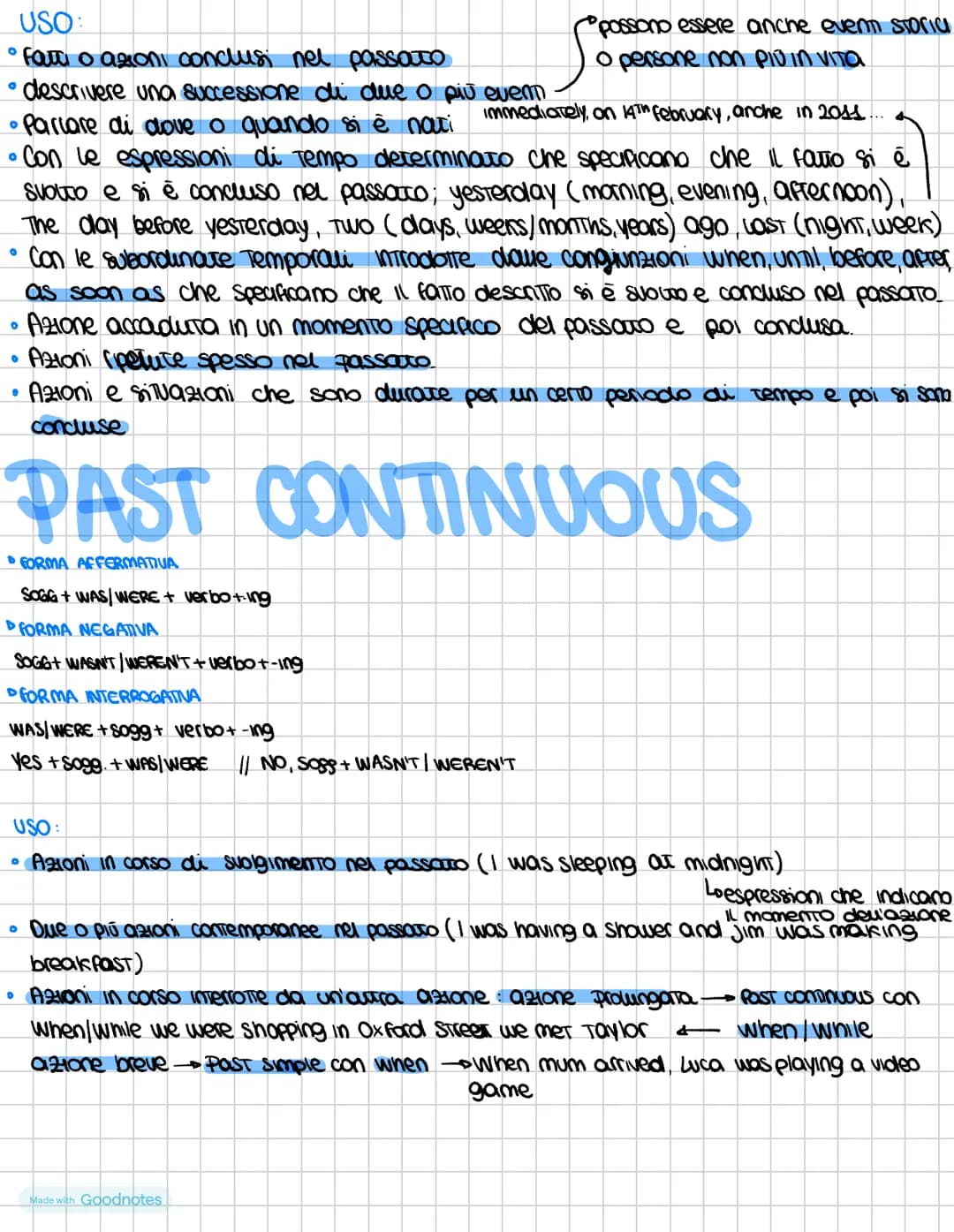
Past Continuous e Altri Usi del Past Simple
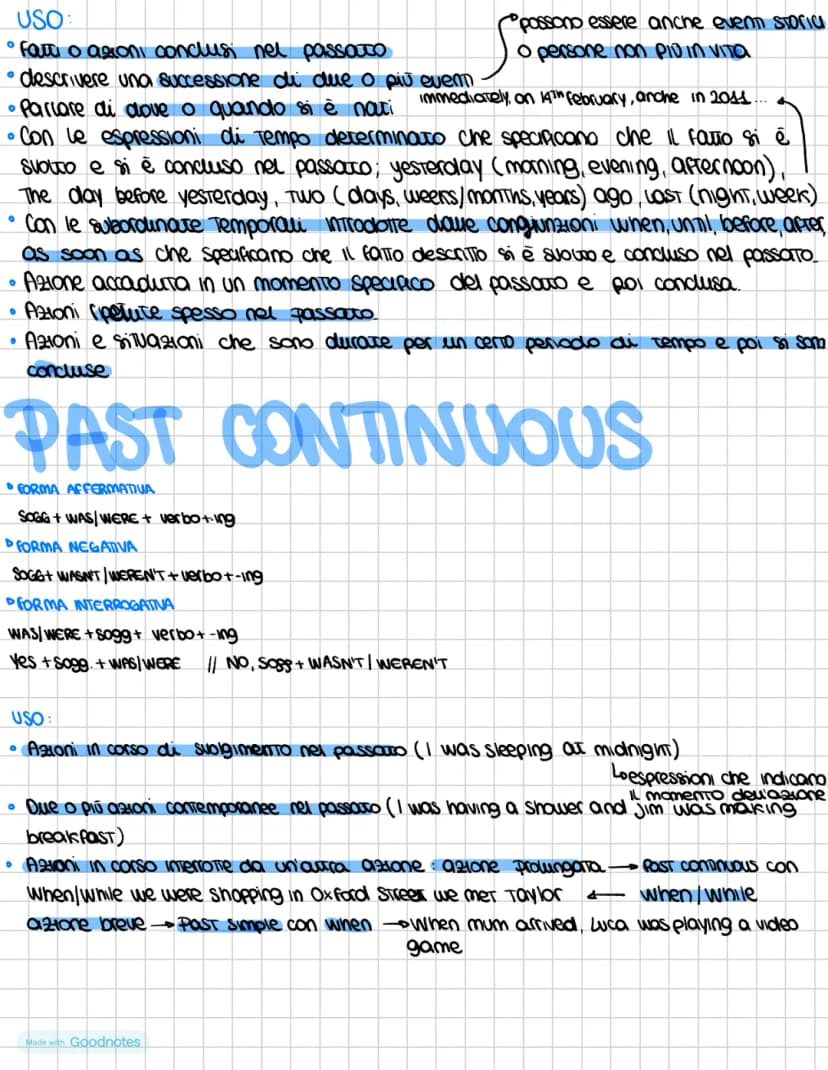
Il past continuous si forma con was/were + verbo-ing e descrive azioni in corso nel passato. Immagina di guardare una foto del passato: quello che stava succedendo in quel momento!
Lo usi per azioni interrotte: "I was studying when my friend called" . Anche per azioni contemporanee: "While I was cooking, dad was watching TV".
Il past simple è perfetto anche per sequenze di eventi ("I woke up, had breakfast and went to school"), per dire dove/quando sei nato, e con congiunzioni temporali come when, after, before.
💭 Pensa così: Past continuous = stavo facendo, Past simple = ho fatto e basta!
5
of 6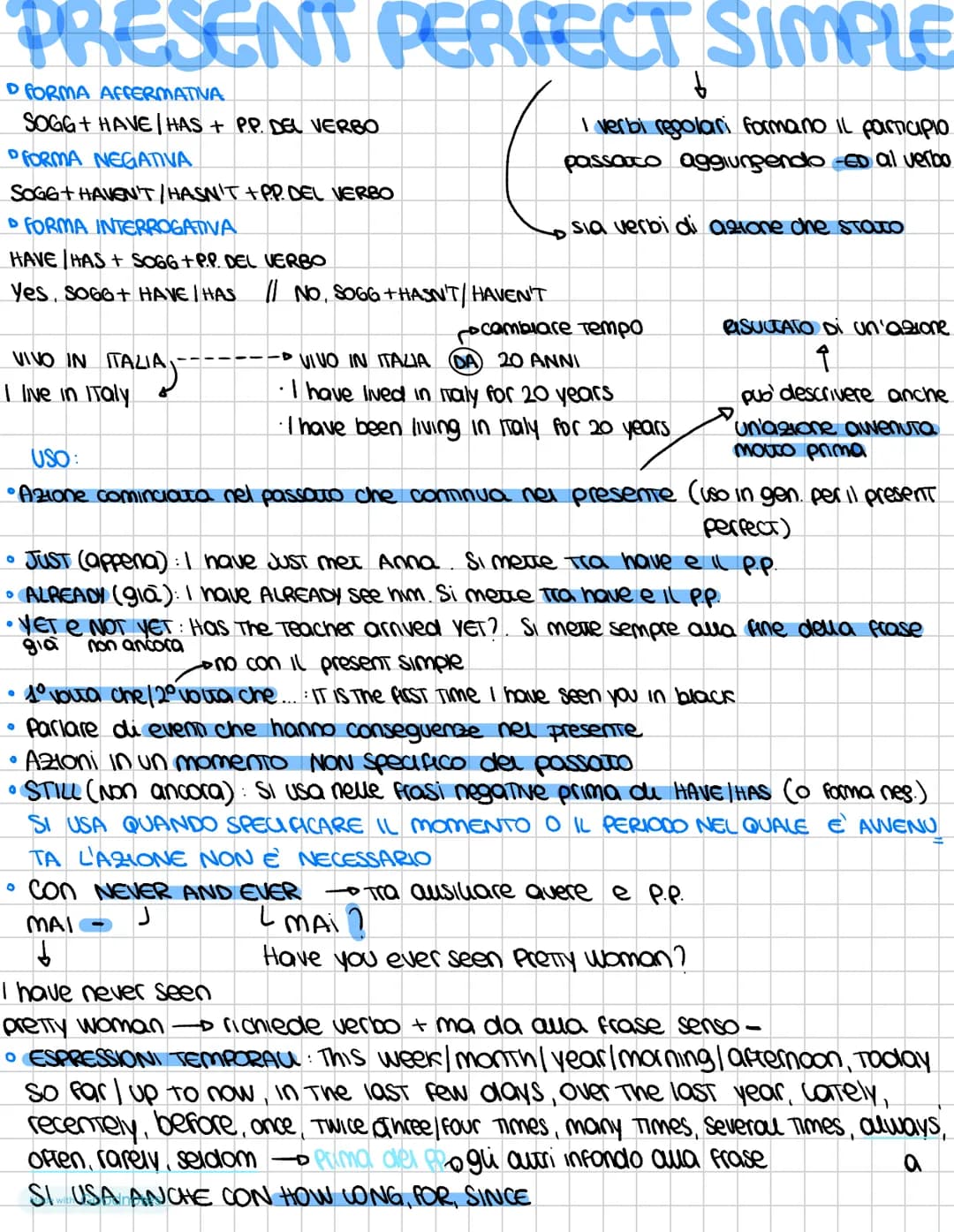
Present Perfect Simple
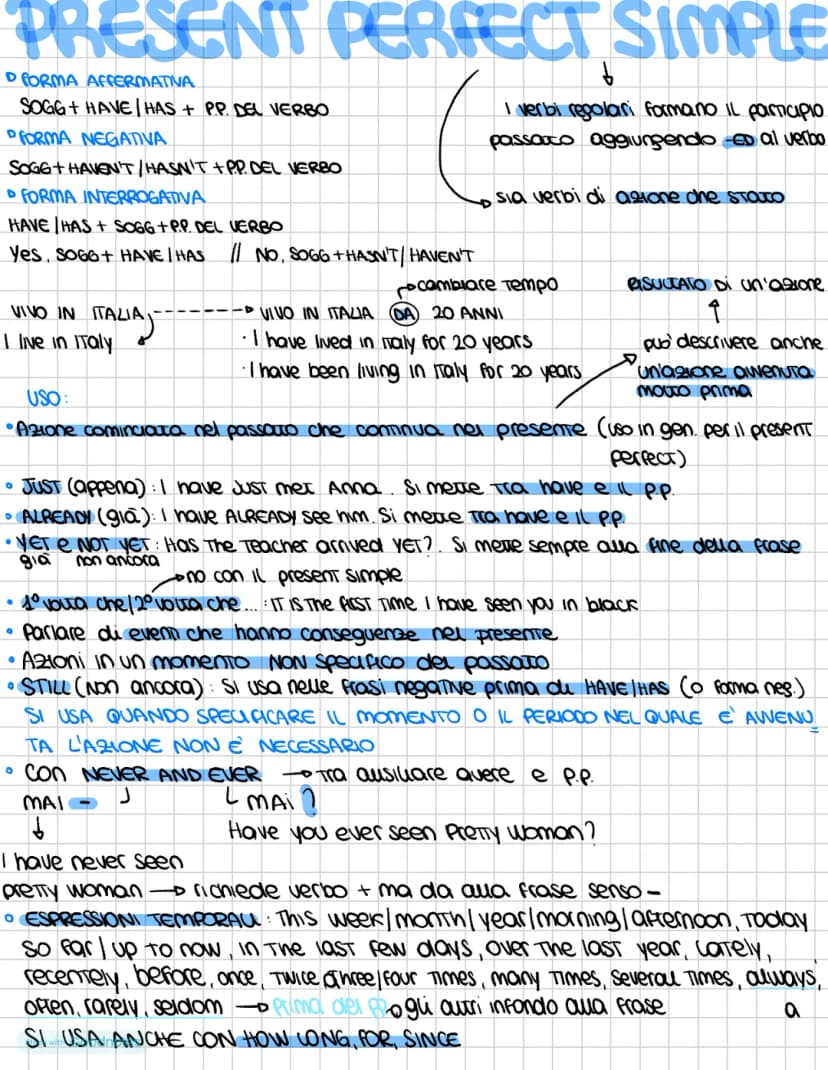
Il present perfect è il ponte tra passato e presente! Si forma con have/has + participio passato e collega sempre qualcosa del passato con ora.
Le parole magiche sono: just (appena), already (già), yet , never/ever (mai). "I have just finished" significa "ho appena finito" con effetti sul presente.
Lo usi per esperienze di vita ("Have you ever been to Rome?"), azioni iniziate nel passato che continuano ("I have lived here for 5 years"), e con this week/month/year, today, recently.
Con since indichi il momento di inizio ("since 2020"), con for la durata ("for 3 years").
🔑 La chiave: Se l'azione ha conseguenze ADESSO, usa il present perfect!
6
of 6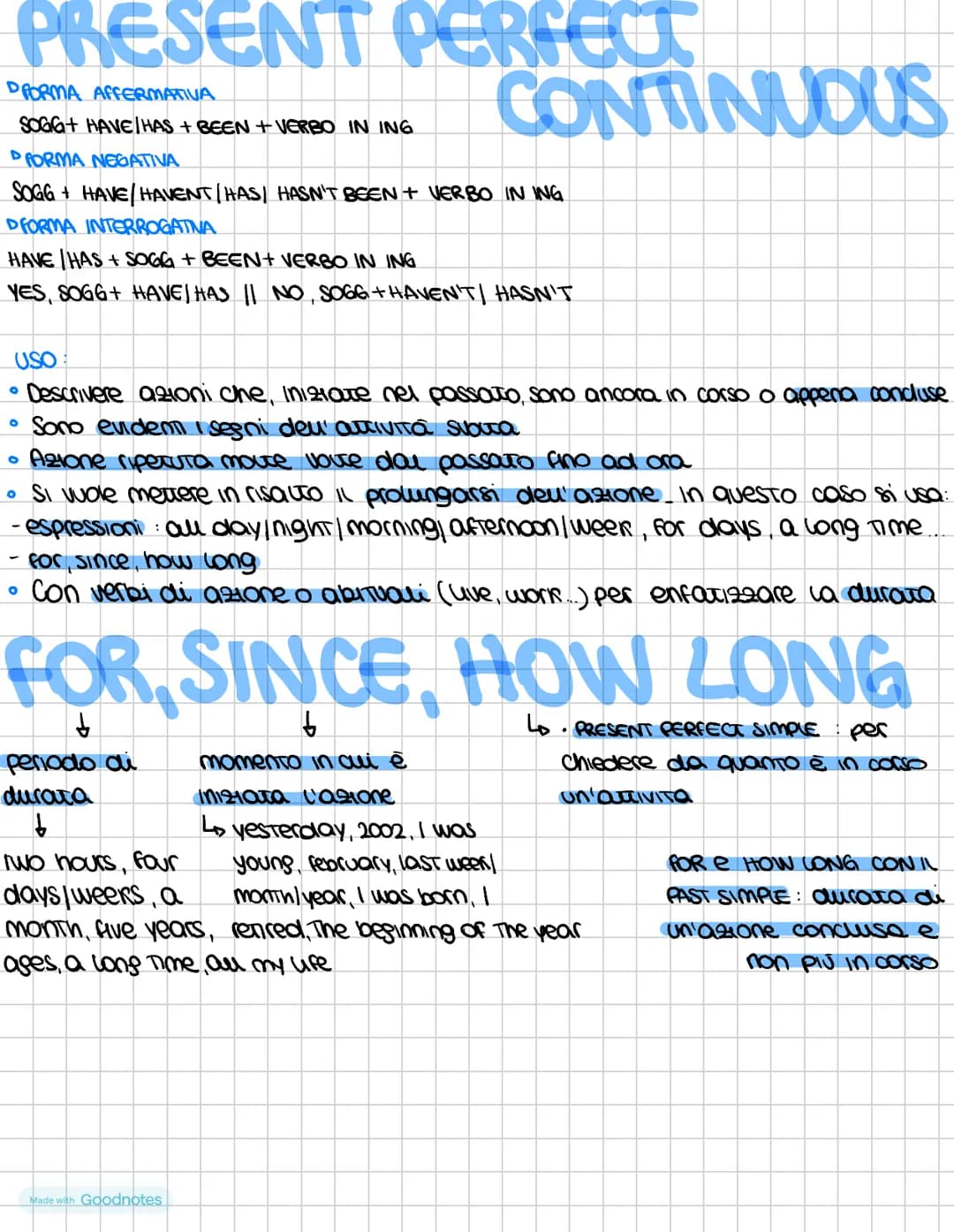
Present Perfect Continuous
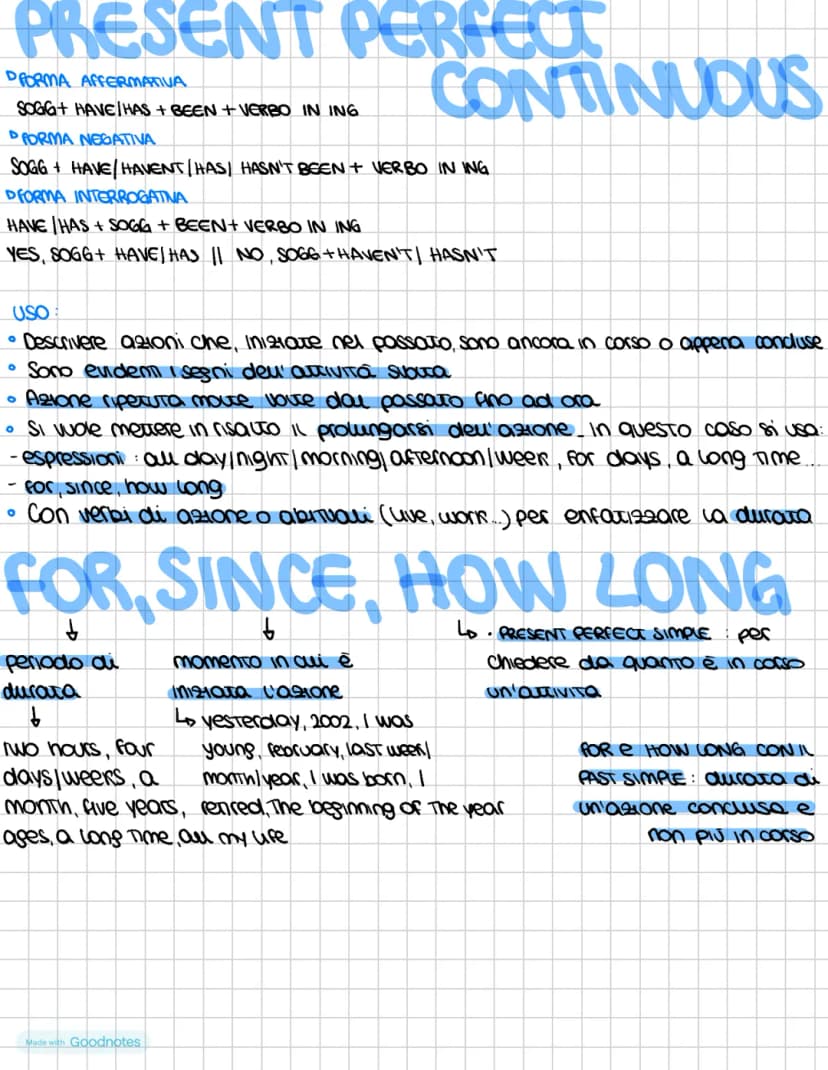
Il present perfect continuous (have/has been + verbo-ing) è la versione "marathon" del present perfect! Enfatizza la durata di un'azione che continua o è appena finita.
Lo usi quando vuoi sottolineare quanto tempo hai passato a fare qualcosa: "I've been studying for 3 hours" (e sono stanco!). Spesso ci sono segni evidenti dell'attività: "You've been running!" (sei tutto sudato).
FOR vs SINCE vs HOW LONG: FOR = durata ("for 2 hours"), SINCE = punto di inizio ("since Monday"), HOW LONG = domanda sulla durata ("How long have you been waiting?").
La differenza con il present perfect simple? Il continuous enfatizza l'azione continua, il simple il risultato.
⏰ Ricorda: Usa "been + -ing" quando vuoi far capire che l'azione è durata a lungo!
We thought you’d never ask...
What is the Knowunity AI companion?
Our AI companion is specifically built for the needs of students. Based on the millions of content pieces we have on the platform we can provide truly meaningful and relevant answers to students. But its not only about answers, the companion is even more about guiding students through their daily learning challenges, with personalised study plans, quizzes or content pieces in the chat and 100% personalisation based on the students skills and developments.
Where can I download the Knowunity app?
You can download the app in the Google Play Store and in the Apple App Store.
Is Knowunity really free of charge?
That's right! Enjoy free access to study content, connect with fellow students, and get instant help – all at your fingertips.
Similar Content
 Anglais
Most popular content: verb tenses
9IngleseVerbi Modali
Verbi Modali
1ªl1,54432
IngleseTempi verbali inglesi (Past, Present, Future)
Tempi verbali (Verb Tenses), usi ed esempi: - Past simple, continuous, perfect, perfect continuous - Present simple, continuous, perfect, perfect continuous - Future simple, continuous, perfect, perfect continuous
3ªl13,865418
IngleseRiassunto tempi verbali in inglese
appunti
2ªl12,097485
IngleseMateriale per la preparazione ad un esame B2 Cambridge
Materiale di studio
4ªl1,69764
Inglesetempi verbali inglese
tabella riassuntiva
5ªl10,066324
Ingleseregole verbi inglese
tutte le regole dei verbi in inglese
18,7852,678
Inglesetempi verbali inglese
un riassunto con i principali temi verbali inglesi
2ªl12,459618
Ingleseschede tempi verbali inglese
schede tempi verbali inglese
3ªm1,75843
IngleseGRAMMATICA INGLESE LIVELLO B2
Schema di inglese coon i principali argomenti di grammatica inglese - livello B2 (past tenses, future tenses, conditionals, wish, advice & obligation, past modals, have/get something done, passive, reported speech).
3ªl4,67697
Most popular content in Inglese
9P
InglesePresent Simple vs Present Continuous
Develop the ability to choose correctly between the Present Simple for habits and the Present Continuous for ongoing actions.
3ªm4,2110
F
IngleseFormazione dei Verbi al Past Simple
Impara a trasformare i verbi dalla forma base al Past Simple, distinguendo tra verbi regolari e irregolari.
2ªm2,5550
B
IngleseBasics of Present Simple vs Continuous
Identify core differences between regular habits and temporary actions happening right now.
3ªm9990
I
IngleseIntroduzione ai Verbi Irregolari Inglesi
Impara a distinguere tra verbi regolari e irregolari e familiarizza con i paradigmi più comuni della lingua inglese.
2ªm4,9610
I
IngleseI conditionals
Un quiz su come formare i condizionali in inglese. Spero possa esservi utile♥️
3ªl2,1082
IngleseRipasso tempi verbali inglese
Ecco i tempi verbali inglesi spiegati in maniera riassuntiva e schematica
3ªl2,14049
F
IngleseFrasi e Domande al Past Simple
Crea frasi complete e domande utilizzando l'ausiliare 'did' per descrivere eventi avvenuti nel passato.
2ªm9310
InglesePROGRAMMA COMPLETO DI INGLESE
The Romantic Age (Blake, Wordsworth, Coleridge, Shelley, Keats and Jane Austen), The Victorian Age (Dickens, Oscar Wilde, Stevenson) and The Modern Age (War Poets, Eliot, Joyce and Orwell)
5ªl98629
IngleseRipasso Grammatica Inglese
Grammatica BASE Inglese
1ªm2,57189
Most popular content
9 Italiano
Riassunto patente B
Riassunto patente B - appunti presi a lezione
5ªl29,228943
 Altro
AltroTeoria patente b
Tutti gli argomenti per la patente
1ªl21,114685
 Ed. civ.
Teoria patente di guida B: Segnali stradali
Segnali stradali di pericolo, luminosi, di prescrizione, di indicazione, temporanei, complementari, pannelli integrativi, segnaletica orizzontale, segnalazioni agenti del traffico, distanza di visibilità per l‘arresto, minima di sicurezza.
5ªl40,0241,644
 Filosofia
Aristotele
Aristotele: vita, metafisica, fisica, etica e politica, retorica e poetica
3ªl7,623216
ItalianoI promessi sposi
Riassunti completi di tutti i 38 capitoli dei Promessi sposi.
2ªl14,088314
AltroPATENTE
schemi per esame teorico della patente
Università22,050755
S
ItalianoSintesi finale di Analisi logica
Esercitazione completa di analisi logica su frasi articolate per consolidare la conoscenza di tutti i complementi.
3ªm5,5290
P
InglesePresent Simple vs Present Continuous
Develop the ability to choose correctly between the Present Simple for habits and the Present Continuous for ongoing actions.
3ªm4,2110
G
ItalianoGabriele D'Annunzio e l'Estetismo
Domande sull'ideale del superuomo, il panismo e la concezione dell'arte come valore assoluto in D'Annunzio.
4ªl2,6740
Can't find what you're looking for? Explore other subjects.
Students love us — and so will you.
4.6/5App Store
4.7/5Google Play
The app is very easy to use and well designed. I have found everything I was looking for so far and have been able to learn a lot from the presentations! I will definitely use the app for a class assignment! And of course it also helps a lot as an inspiration.
Stefan SiOS user
This app is really great. There are so many study notes and help [...]. My problem subject is French, for example, and the app has so many options for help. Thanks to this app, I have improved my French. I would recommend it to anyone.
Samantha KlichAndroid user
Wow, I am really amazed. I just tried the app because I've seen it advertised many times and was absolutely stunned. This app is THE HELP you want for school and above all, it offers so many things, such as workouts and fact sheets, which have been VERY helpful to me personally.
AnnaiOS user
Inglese11,642 views·Updated Jun 24, 2026·6 pagesI tempi verbali: Present Simple, Continuous, Past Simple e Perfect
A
Anna Franceschini@annafranceschini_rmhg
I tempi verbali inglesi possono sembrare complicati, ma una volta capiti i trucchi diventano facilissimi! Qui trovi una guida completa ai tempi più importanti: dal present simple per le azioni quotidiane fino al present perfect per collegare passato e presente.
1
of 6
Sign up to see the content. It's free!
- Access to all documents
- Improve your grades
- Join milions of students
Present Simple
Il present simple è il tuo migliore amico per parlare di cose che succedono sempre! Si forma con il verbo base, ma attenzione: alla terza persona singolare aggiungi sempre la -s.
Per le forme negative usi don't e doesn't + verbo base. Per le domande metti do/does all'inizio: "Do you like pizza?" oppure "Does she study English?"
Trucchi ortografici: se il verbo finisce in -s, -sh, -ch, -x, -z, -o aggiungi -es (he catches). Se finisce in consonante + y, cambia la y in i e aggiungi -es (she studies).
💡 Ricorda: Usa il present simple per abitudini, fatti sempre veri e con parole come always, often, usually, never!
2
of 6Sign up to see the content. It's free!
- Access to all documents
- Improve your grades
- Join milions of students
Present Continuous
Il present continuous descrive quello che sta succedendo proprio adesso! Si forma con am/is/are + verbo-ing. È perfetto quando vuoi dire "sto facendo qualcosa in questo momento".
Per formare il gerundio : i verbi che finiscono in -e muta la perdono (take → taking), quelli che finiscono in -ie cambiano in -y (tie → tying). I monosillabi con vocale + consonante raddoppiano la consonante (stop → stopping).
Lo usi anche per azioni future programmate ("I'm meeting Tom tomorrow") e per abitudini irritanti con always ("My brother is always interrupting me!").
⚠️ Attenzione: Non puoi usarlo con verbi di stato come be, have, know, like, want!
3
of 6Sign up to see the content. It's free!
- Access to all documents
- Improve your grades
- Join milions of students
Past Simple
Il past simple è il tempo del "c'era una volta"! Per i verbi regolari aggiungi -ed alla forma base, ma i verbi irregolari hanno forme speciali che devi imparare a memoria (go → went, see → saw).
Con was/were per il verbo essere: was per I/he/she/it, were per you/we/they. Per tutti gli altri verbi usi did/didn't nelle domande e negazioni, sempre con il verbo alla forma base.
Regole ortografiche: verbi che finiscono in -e aggiungono solo -d (live → lived), quelli in consonante + y cambiano y in i (study → studied).
Lo usi per azioni finite nel passato con parole come yesterday, last week, two days ago, in 2010.
🎯 Trucco: Se puoi dire "quando" è successo qualcosa, usa il past simple!
4
of 6Sign up to see the content. It's free!
- Access to all documents
- Improve your grades
- Join milions of students
Past Continuous e Altri Usi del Past Simple
Il past continuous si forma con was/were + verbo-ing e descrive azioni in corso nel passato. Immagina di guardare una foto del passato: quello che stava succedendo in quel momento!
Lo usi per azioni interrotte: "I was studying when my friend called" . Anche per azioni contemporanee: "While I was cooking, dad was watching TV".
Il past simple è perfetto anche per sequenze di eventi ("I woke up, had breakfast and went to school"), per dire dove/quando sei nato, e con congiunzioni temporali come when, after, before.
💭 Pensa così: Past continuous = stavo facendo, Past simple = ho fatto e basta!
5
of 6Sign up to see the content. It's free!
- Access to all documents
- Improve your grades
- Join milions of students
Present Perfect Simple
Il present perfect è il ponte tra passato e presente! Si forma con have/has + participio passato e collega sempre qualcosa del passato con ora.
Le parole magiche sono: just (appena), already (già), yet , never/ever (mai). "I have just finished" significa "ho appena finito" con effetti sul presente.
Lo usi per esperienze di vita ("Have you ever been to Rome?"), azioni iniziate nel passato che continuano ("I have lived here for 5 years"), e con this week/month/year, today, recently.
Con since indichi il momento di inizio ("since 2020"), con for la durata ("for 3 years").
🔑 La chiave: Se l'azione ha conseguenze ADESSO, usa il present perfect!
6
of 6Sign up to see the content. It's free!
- Access to all documents
- Improve your grades
- Join milions of students
Present Perfect Continuous
Il present perfect continuous (have/has been + verbo-ing) è la versione "marathon" del present perfect! Enfatizza la durata di un'azione che continua o è appena finita.
Lo usi quando vuoi sottolineare quanto tempo hai passato a fare qualcosa: "I've been studying for 3 hours" (e sono stanco!). Spesso ci sono segni evidenti dell'attività: "You've been running!" (sei tutto sudato).
FOR vs SINCE vs HOW LONG: FOR = durata ("for 2 hours"), SINCE = punto di inizio ("since Monday"), HOW LONG = domanda sulla durata ("How long have you been waiting?").
La differenza con il present perfect simple? Il continuous enfatizza l'azione continua, il simple il risultato.
⏰ Ricorda: Usa "been + -ing" quando vuoi far capire che l'azione è durata a lungo!
We thought you’d never ask...
What is the Knowunity AI companion?
Our AI companion is specifically built for the needs of students. Based on the millions of content pieces we have on the platform we can provide truly meaningful and relevant answers to students. But its not only about answers, the companion is even more about guiding students through their daily learning challenges, with personalised study plans, quizzes or content pieces in the chat and 100% personalisation based on the students skills and developments.
Where can I download the Knowunity app?
You can download the app in the Google Play Store and in the Apple App Store.
Is Knowunity really free of charge?
That's right! Enjoy free access to study content, connect with fellow students, and get instant help – all at your fingertips.
Similar Content
Most popular content: verb tenses
9IngleseVerbi Modali
Verbi Modali
1ªl1,54432
IngleseTempi verbali inglesi (Past, Present, Future)
Tempi verbali (Verb Tenses), usi ed esempi: - Past simple, continuous, perfect, perfect continuous - Present simple, continuous, perfect, perfect continuous - Future simple, continuous, perfect, perfect continuous
3ªl13,865418
IngleseRiassunto tempi verbali in inglese
appunti
2ªl12,097485
IngleseMateriale per la preparazione ad un esame B2 Cambridge
Materiale di studio
4ªl1,69764
Inglesetempi verbali inglese
tabella riassuntiva
5ªl10,066324
Ingleseregole verbi inglese
tutte le regole dei verbi in inglese
18,7852,678
Inglesetempi verbali inglese
un riassunto con i principali temi verbali inglesi
2ªl12,459618
Ingleseschede tempi verbali inglese
schede tempi verbali inglese
3ªm1,75843
IngleseGRAMMATICA INGLESE LIVELLO B2
Schema di inglese coon i principali argomenti di grammatica inglese - livello B2 (past tenses, future tenses, conditionals, wish, advice & obligation, past modals, have/get something done, passive, reported speech).
3ªl4,67697
Most popular content in Inglese
9P
InglesePresent Simple vs Present Continuous
Develop the ability to choose correctly between the Present Simple for habits and the Present Continuous for ongoing actions.
3ªm4,2110
F
IngleseFormazione dei Verbi al Past Simple
Impara a trasformare i verbi dalla forma base al Past Simple, distinguendo tra verbi regolari e irregolari.
2ªm2,5550
B
IngleseBasics of Present Simple vs Continuous
Identify core differences between regular habits and temporary actions happening right now.
3ªm9990
I
IngleseIntroduzione ai Verbi Irregolari Inglesi
Impara a distinguere tra verbi regolari e irregolari e familiarizza con i paradigmi più comuni della lingua inglese.
2ªm4,9610
I
IngleseI conditionals
Un quiz su come formare i condizionali in inglese. Spero possa esservi utile♥️
3ªl2,1082
IngleseRipasso tempi verbali inglese
Ecco i tempi verbali inglesi spiegati in maniera riassuntiva e schematica
3ªl2,14049
F
IngleseFrasi e Domande al Past Simple
Crea frasi complete e domande utilizzando l'ausiliare 'did' per descrivere eventi avvenuti nel passato.
2ªm9310
InglesePROGRAMMA COMPLETO DI INGLESE
The Romantic Age (Blake, Wordsworth, Coleridge, Shelley, Keats and Jane Austen), The Victorian Age (Dickens, Oscar Wilde, Stevenson) and The Modern Age (War Poets, Eliot, Joyce and Orwell)
5ªl98629
IngleseRipasso Grammatica Inglese
Grammatica BASE Inglese
1ªm2,57189
Most popular content
9ItalianoRiassunto patente B
Riassunto patente B - appunti presi a lezione
5ªl29,228943
AltroTeoria patente b
Tutti gli argomenti per la patente
1ªl21,114685
Ed. civ.Teoria patente di guida B: Segnali stradali
Segnali stradali di pericolo, luminosi, di prescrizione, di indicazione, temporanei, complementari, pannelli integrativi, segnaletica orizzontale, segnalazioni agenti del traffico, distanza di visibilità per l‘arresto, minima di sicurezza.
5ªl40,0241,644
FilosofiaAristotele
Aristotele: vita, metafisica, fisica, etica e politica, retorica e poetica
3ªl7,623216
ItalianoI promessi sposi
Riassunti completi di tutti i 38 capitoli dei Promessi sposi.
2ªl14,088314
AltroPATENTE
schemi per esame teorico della patente
Università22,050755
S
ItalianoSintesi finale di Analisi logica
Esercitazione completa di analisi logica su frasi articolate per consolidare la conoscenza di tutti i complementi.
3ªm5,5290
P
InglesePresent Simple vs Present Continuous
Develop the ability to choose correctly between the Present Simple for habits and the Present Continuous for ongoing actions.
3ªm4,2110
G
ItalianoGabriele D'Annunzio e l'Estetismo
Domande sull'ideale del superuomo, il panismo e la concezione dell'arte come valore assoluto in D'Annunzio.
4ªl2,6740
Can't find what you're looking for? Explore other subjects.
Students love us — and so will you.
4.6/5App Store
4.7/5Google Play
The app is very easy to use and well designed. I have found everything I was looking for so far and have been able to learn a lot from the presentations! I will definitely use the app for a class assignment! And of course it also helps a lot as an inspiration.
Stefan SiOS user
This app is really great. There are so many study notes and help [...]. My problem subject is French, for example, and the app has so many options for help. Thanks to this app, I have improved my French. I would recommend it to anyone.
Samantha KlichAndroid user
Wow, I am really amazed. I just tried the app because I've seen it advertised many times and was absolutely stunned. This app is THE HELP you want for school and above all, it offers so many things, such as workouts and fact sheets, which have been VERY helpful to me personally.
AnnaiOS user