
Ti è mai capitato di dire "Se avessi studiato di...
 Inglese2,576 views·Updated Jun 19, 2026·4 pages
I 4 Tipi di Condizionali: Regole ed Esempi Facili

Veronica Tosi@veronicaa.tosi
1 / 4
1
of 4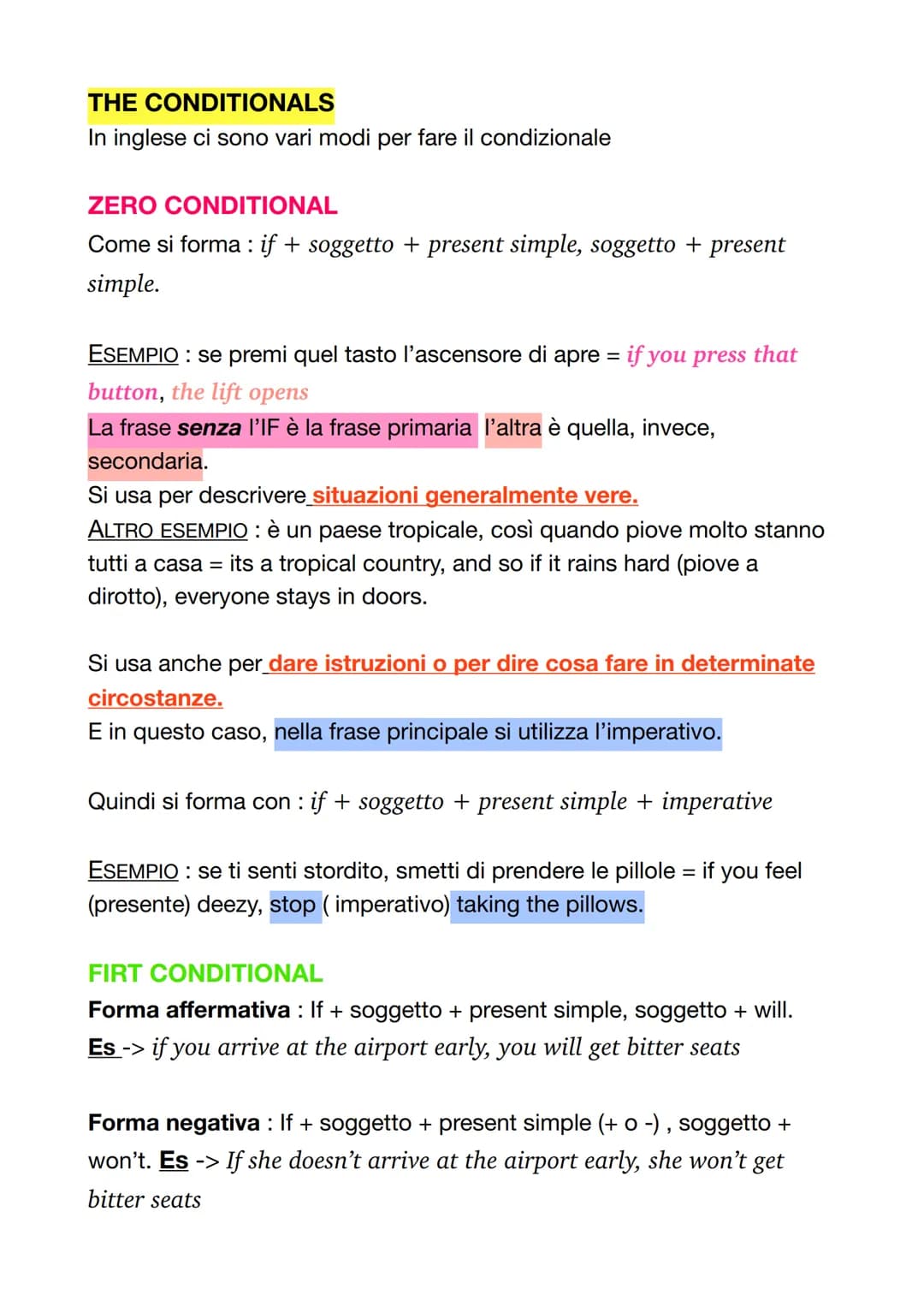
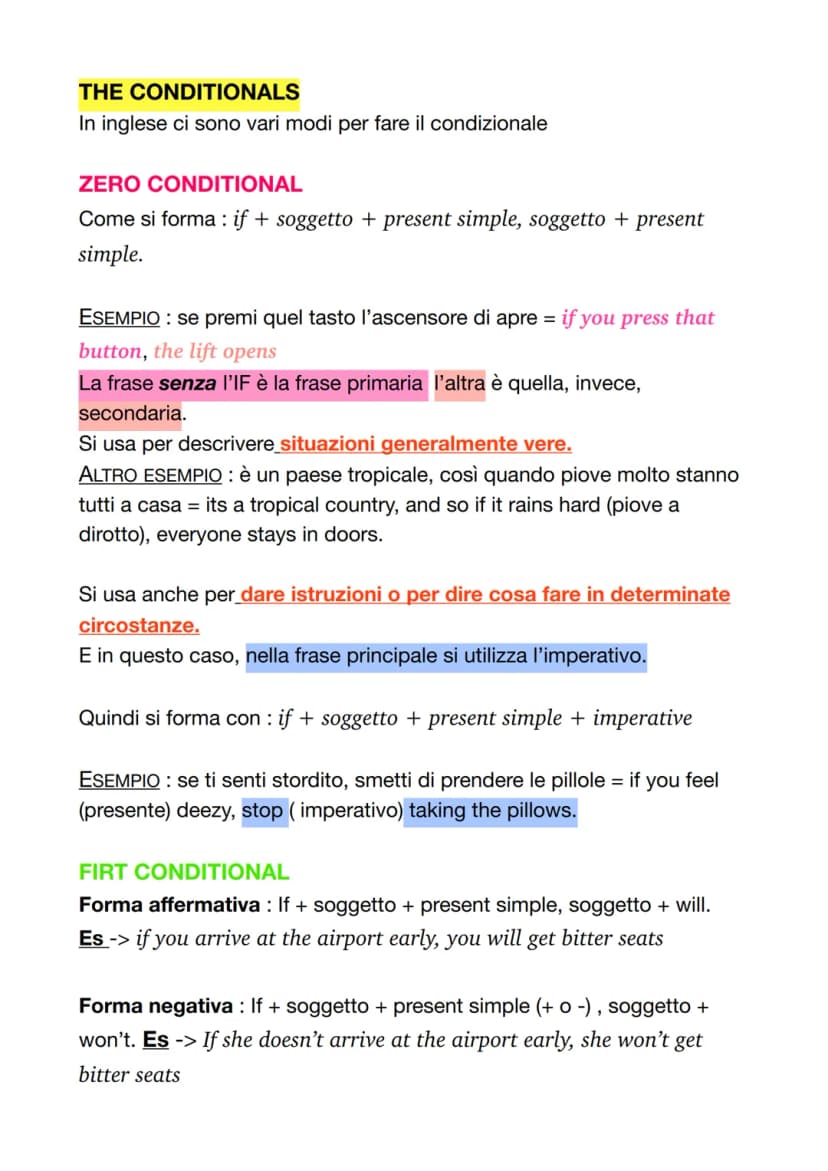
Zero e First Conditional
Lo zero conditional è il più semplice da capire perché parla di cose che succedono sempre! Si forma con if + present simple, present simple e lo usi per descrivere fatti generali o dare istruzioni.
Per esempio: "If you press that button, the lift opens" (se premi quel pulsante, l'ascensore si apre). È perfetto anche per dare consigli: "If you feel dizzy, stop taking the pills" (se ti senti stordito, smetti di prendere le pillole).
Il first conditional invece parla di cose che potrebbero succedere nel futuro ed è molto probabile che accadano. La formula è if + present simple, will + verbo. Esempio: "If you arrive at the airport early, you will get better seats".
Trucco: Nella frase con "if" usi sempre il presente, anche se parli del futuro!
Puoi anche usare might o could al posto di "will" per rendere la situazione meno sicura: "If it stops raining, we might go for a walk".
2
of 4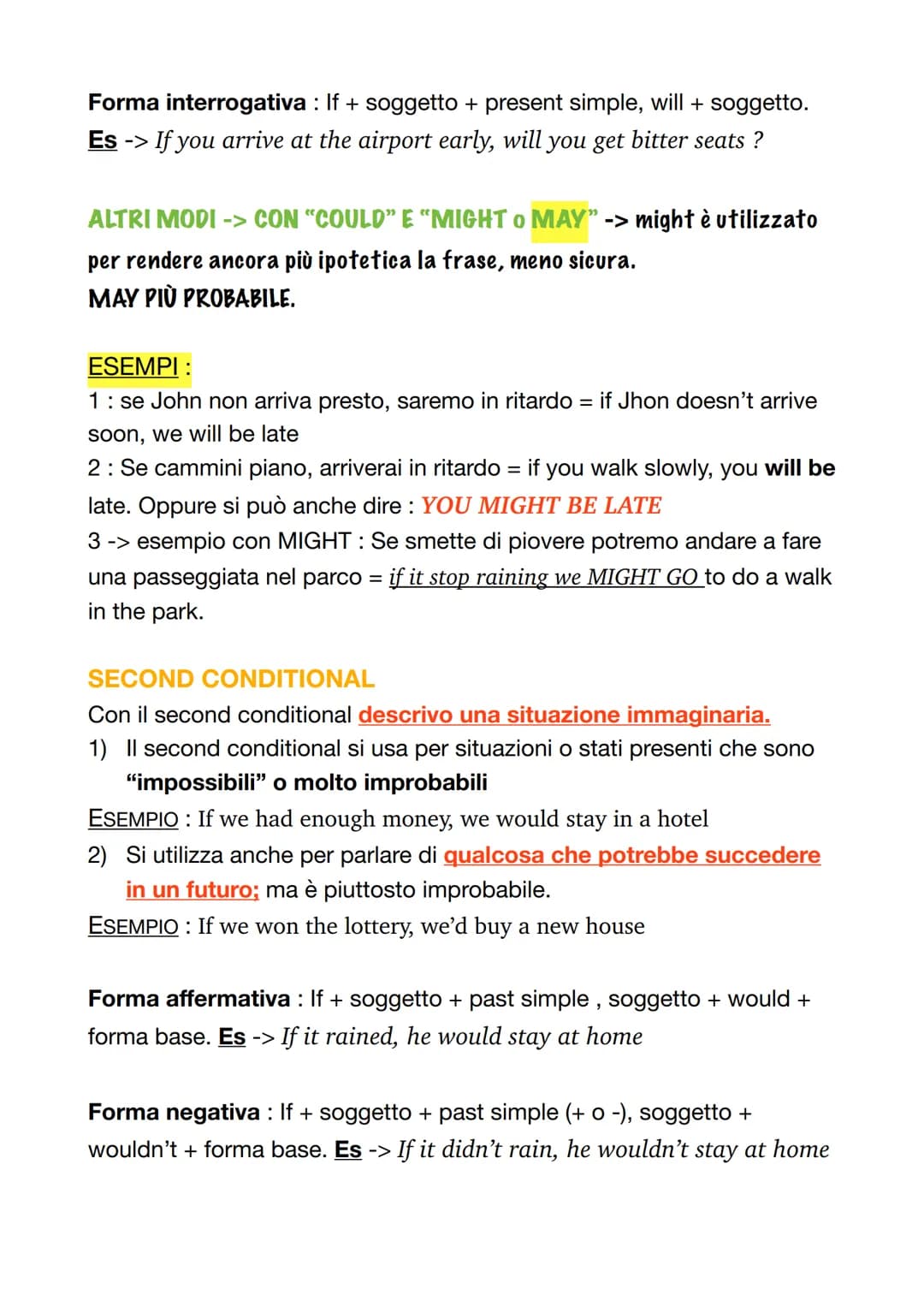
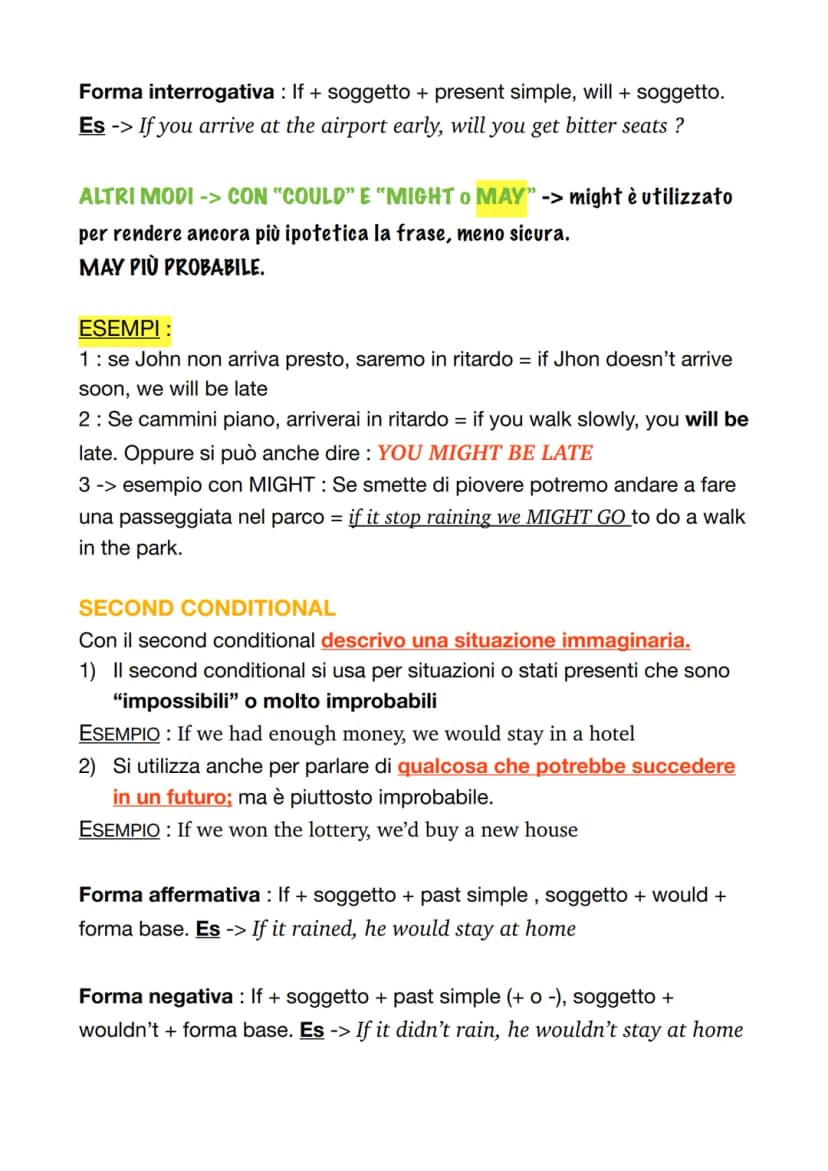
Second Conditional
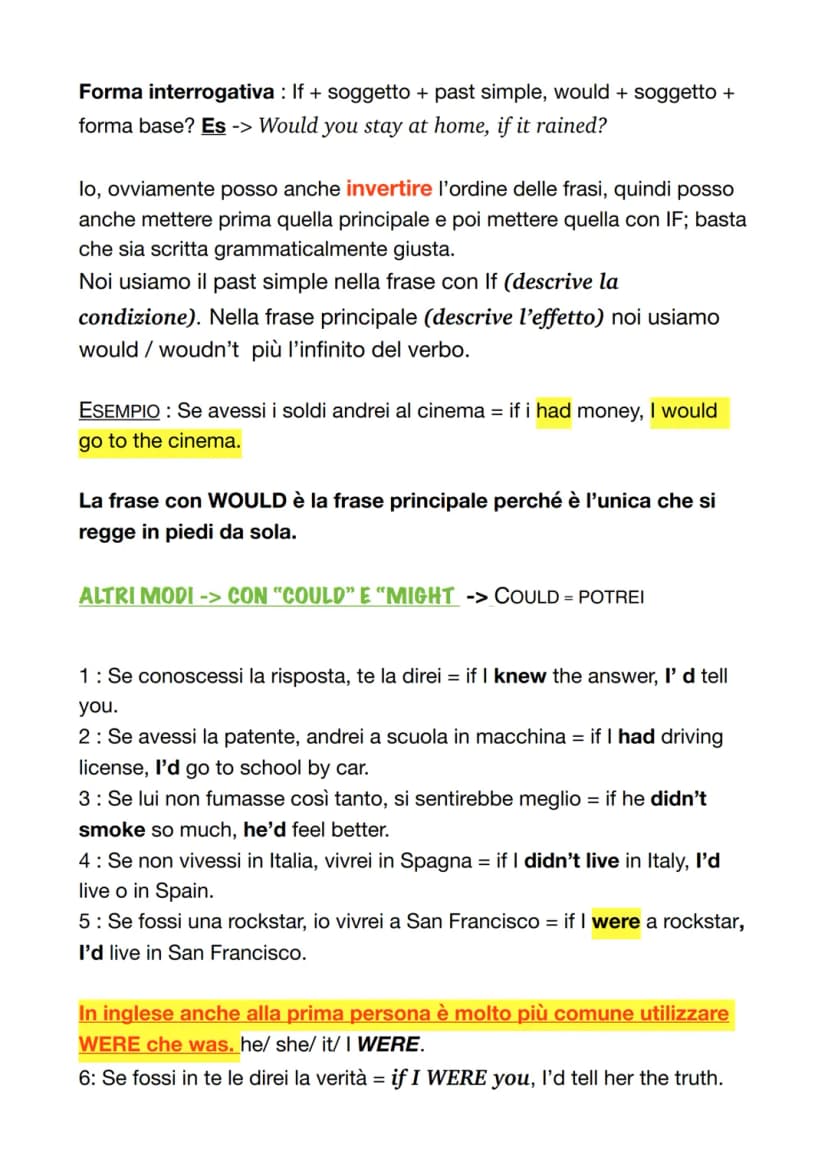
Il second conditional è perfetto per sognare ad occhi aperti! Lo usi quando parli di situazioni immaginarie o molto improbabili. La struttura è if + past simple, would + verbo.
Pensa a frasi come "If we won the lottery, we'd buy a new house" (se vincessi alla lotteria, comprerei una casa nuova). Stai parlando di qualcosa che probabilmente non succederà mai, ma è bello immaginarlo!
La cosa più importante da ricordare è che usi il past simple nella parte con "if", anche se parli del presente o futuro. Per esempio: "If I had money, I would go to the cinema" (se avessi soldi, andrei al cinema).
Attenzione: Con il verbo "be" si usa sempre "were" per tutte le persone: "If I were you, I'd tell her the truth"!
Puoi sostituire "would" con could (potrei) o might (forse) per variare: "If you played the lottery, you might win".
3
of 4
Third Conditional
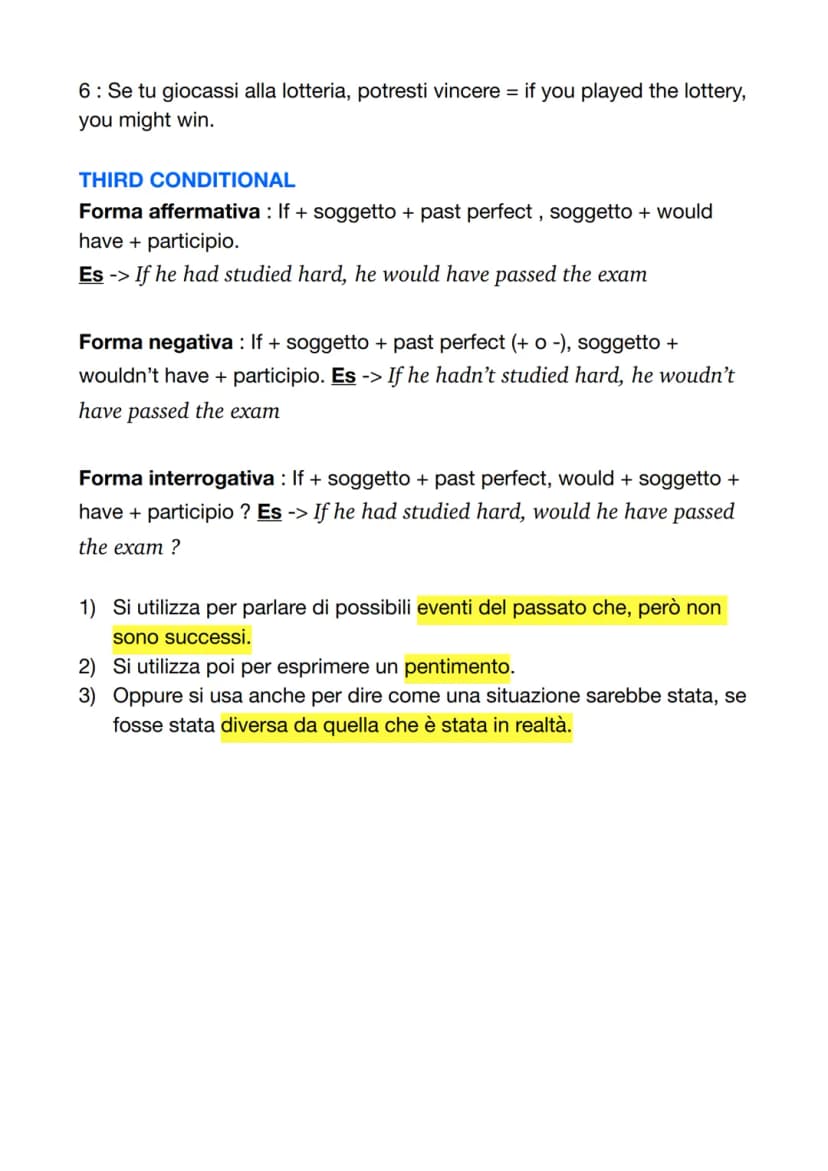
Il third conditional è quello dei rimpianti! Lo usi per parlare di cose che non sono successe nel passato e per esprimere pentimenti. È formato da if + past perfect, would have + participio passato.
Immagina di aver preso un brutto voto: "If I had studied harder, I would have passed the exam" (se avessi studiato di più, avrei superato l'esame). Stai parlando di qualcosa che ormai non puoi più cambiare.
Questo conditional è perfetto per i "what if" della vita - quelle situazioni in cui pensi "e se fosse andata diversamente?". Puoi usarlo per immaginare come le cose sarebbero potute andare se avessi fatto scelte diverse.
Ricorda: Il third conditional parla sempre del passato, ma di un passato che non è mai esistito davvero!
La forma negativa funziona allo stesso modo: "If he hadn't studied hard, he wouldn't have passed the exam". Anche qui puoi variare con "could have" o "might have" per sfumature diverse.
4
of 4
We thought you’d never ask...
What is the Knowunity AI companion?
Our AI companion is specifically built for the needs of students. Based on the millions of content pieces we have on the platform we can provide truly meaningful and relevant answers to students. But its not only about answers, the companion is even more about guiding students through their daily learning challenges, with personalised study plans, quizzes or content pieces in the chat and 100% personalisation based on the students skills and developments.
Where can I download the Knowunity app?
You can download the app in the Google Play Store and in the Apple App Store.
Is Knowunity really free of charge?
That's right! Enjoy free access to study content, connect with fellow students, and get instant help – all at your fingertips.
Similar Content
 Język angielski
Most popular content: type 1 conditional
9Inglesetempi verbali inglesi
tempi verbali inglesi
1ªl13,039486
IngleseZero, First and Second Conditional
Zero, First and Second Conditional, Condizionale in inglese
1ªl16,244503
Inglesecondizionali inglese
schemi su tutti e 4 i condizionali
2ªl5,233142
IngleseCondizionali inglese
Condizionali inglese
3ªm9,122240
Inglesei periodi ipotetici (Inglese)
I periodi ipotetici in inglese, come si formano? Quando di usano? Il condizionale in inglese.
1ªl1,16428
IngleseI periodi ipotetici
Zero, First, Second and Third conditional
3ªl7,818231
IngleseZero and first conditional
Tabella su zero e first conditional
1ªl1,98217
IngleseLe if clauses: zero, first, second, third conditional e wish
Appunti riguardanti le if clauses e su come e quando usarle
1ªl2,84734
Inglesecondizionale inglese
zero, first, second, third conditional rules
1ªl2,61621
Most popular content in Inglese
9P
InglesePresent Simple vs Present Continuous
Develop the ability to choose correctly between the Present Simple for habits and the Present Continuous for ongoing actions.
3ªm4,2110
F
IngleseFormazione dei Verbi al Past Simple
Impara a trasformare i verbi dalla forma base al Past Simple, distinguendo tra verbi regolari e irregolari.
2ªm2,5550
B
IngleseBasics of Present Simple vs Continuous
Identify core differences between regular habits and temporary actions happening right now.
3ªm9990
I
IngleseIntroduzione ai Verbi Irregolari Inglesi
Impara a distinguere tra verbi regolari e irregolari e familiarizza con i paradigmi più comuni della lingua inglese.
2ªm4,9610
I
IngleseI conditionals
Un quiz su come formare i condizionali in inglese. Spero possa esservi utile♥️
3ªl2,1082
Inglesepresent simple, continuous, past simple, continuous, present perfect simple e continuous
Tempi verbali
2ªl11,642259
IngleseRipasso tempi verbali inglese
Ecco i tempi verbali inglesi spiegati in maniera riassuntiva e schematica
3ªl2,14049
F
IngleseFrasi e Domande al Past Simple
Crea frasi complete e domande utilizzando l'ausiliare 'did' per descrivere eventi avvenuti nel passato.
2ªm9310
InglesePROGRAMMA COMPLETO DI INGLESE
The Romantic Age (Blake, Wordsworth, Coleridge, Shelley, Keats and Jane Austen), The Victorian Age (Dickens, Oscar Wilde, Stevenson) and The Modern Age (War Poets, Eliot, Joyce and Orwell)
5ªl98629
Most popular content
9 Italiano
Riassunto patente B
Riassunto patente B - appunti presi a lezione
5ªl29,228943
 Altro
AltroTeoria patente b
Tutti gli argomenti per la patente
1ªl21,114685
 Ed. civ.
Teoria patente di guida B: Segnali stradali
Segnali stradali di pericolo, luminosi, di prescrizione, di indicazione, temporanei, complementari, pannelli integrativi, segnaletica orizzontale, segnalazioni agenti del traffico, distanza di visibilità per l‘arresto, minima di sicurezza.
5ªl40,0241,644
 Filosofia
Aristotele
Aristotele: vita, metafisica, fisica, etica e politica, retorica e poetica
3ªl7,623216
ItalianoI promessi sposi
Riassunti completi di tutti i 38 capitoli dei Promessi sposi.
2ªl14,090314
AltroPATENTE
schemi per esame teorico della patente
Università22,050755
S
ItalianoSintesi finale di Analisi logica
Esercitazione completa di analisi logica su frasi articolate per consolidare la conoscenza di tutti i complementi.
3ªm5,5290
P
InglesePresent Simple vs Present Continuous
Develop the ability to choose correctly between the Present Simple for habits and the Present Continuous for ongoing actions.
3ªm4,2110
G
ItalianoGabriele D'Annunzio e l'Estetismo
Domande sull'ideale del superuomo, il panismo e la concezione dell'arte come valore assoluto in D'Annunzio.
4ªl2,6740
Can't find what you're looking for? Explore other subjects.
Students love us — and so will you.
4.6/5App Store
4.7/5Google Play
The app is very easy to use and well designed. I have found everything I was looking for so far and have been able to learn a lot from the presentations! I will definitely use the app for a class assignment! And of course it also helps a lot as an inspiration.
Stefan SiOS user
This app is really great. There are so many study notes and help [...]. My problem subject is French, for example, and the app has so many options for help. Thanks to this app, I have improved my French. I would recommend it to anyone.
Samantha KlichAndroid user
Wow, I am really amazed. I just tried the app because I've seen it advertised many times and was absolutely stunned. This app is THE HELP you want for school and above all, it offers so many things, such as workouts and fact sheets, which have been VERY helpful to me personally.
AnnaiOS user
Inglese2,576 views·Updated Jun 19, 2026·4 pagesI 4 Tipi di Condizionali: Regole ed Esempi Facili
Veronica Tosi@veronicaa.tosi
Ti è mai capitato di dire "Se avessi studiato di più, avrei preso un voto migliore"? Ecco, in inglese esistono diversi modi per esprimere queste situazioni ipotetiche chiamati conditionals. Sono super utili per parlare di cosa succede sempre, cosa...
1
of 4
Sign up to see the content. It's free!
- Access to all documents
- Improve your grades
- Join milions of students
Zero e First Conditional
Lo zero conditional è il più semplice da capire perché parla di cose che succedono sempre! Si forma con if + present simple, present simple e lo usi per descrivere fatti generali o dare istruzioni.
Per esempio: "If you press that button, the lift opens" (se premi quel pulsante, l'ascensore si apre). È perfetto anche per dare consigli: "If you feel dizzy, stop taking the pills" (se ti senti stordito, smetti di prendere le pillole).
Il first conditional invece parla di cose che potrebbero succedere nel futuro ed è molto probabile che accadano. La formula è if + present simple, will + verbo. Esempio: "If you arrive at the airport early, you will get better seats".
Trucco: Nella frase con "if" usi sempre il presente, anche se parli del futuro!
Puoi anche usare might o could al posto di "will" per rendere la situazione meno sicura: "If it stops raining, we might go for a walk".
2
of 4Sign up to see the content. It's free!
- Access to all documents
- Improve your grades
- Join milions of students
Second Conditional
Il second conditional è perfetto per sognare ad occhi aperti! Lo usi quando parli di situazioni immaginarie o molto improbabili. La struttura è if + past simple, would + verbo.
Pensa a frasi come "If we won the lottery, we'd buy a new house" (se vincessi alla lotteria, comprerei una casa nuova). Stai parlando di qualcosa che probabilmente non succederà mai, ma è bello immaginarlo!
La cosa più importante da ricordare è che usi il past simple nella parte con "if", anche se parli del presente o futuro. Per esempio: "If I had money, I would go to the cinema" (se avessi soldi, andrei al cinema).
Attenzione: Con il verbo "be" si usa sempre "were" per tutte le persone: "If I were you, I'd tell her the truth"!
Puoi sostituire "would" con could (potrei) o might (forse) per variare: "If you played the lottery, you might win".
3
of 4Sign up to see the content. It's free!
- Access to all documents
- Improve your grades
- Join milions of students
Third Conditional
Il third conditional è quello dei rimpianti! Lo usi per parlare di cose che non sono successe nel passato e per esprimere pentimenti. È formato da if + past perfect, would have + participio passato.
Immagina di aver preso un brutto voto: "If I had studied harder, I would have passed the exam" (se avessi studiato di più, avrei superato l'esame). Stai parlando di qualcosa che ormai non puoi più cambiare.
Questo conditional è perfetto per i "what if" della vita - quelle situazioni in cui pensi "e se fosse andata diversamente?". Puoi usarlo per immaginare come le cose sarebbero potute andare se avessi fatto scelte diverse.
Ricorda: Il third conditional parla sempre del passato, ma di un passato che non è mai esistito davvero!
La forma negativa funziona allo stesso modo: "If he hadn't studied hard, he wouldn't have passed the exam". Anche qui puoi variare con "could have" o "might have" per sfumature diverse.
4
of 4Sign up to see the content. It's free!
- Access to all documents
- Improve your grades
- Join milions of students
We thought you’d never ask...
What is the Knowunity AI companion?
Our AI companion is specifically built for the needs of students. Based on the millions of content pieces we have on the platform we can provide truly meaningful and relevant answers to students. But its not only about answers, the companion is even more about guiding students through their daily learning challenges, with personalised study plans, quizzes or content pieces in the chat and 100% personalisation based on the students skills and developments.
Where can I download the Knowunity app?
You can download the app in the Google Play Store and in the Apple App Store.
Is Knowunity really free of charge?
That's right! Enjoy free access to study content, connect with fellow students, and get instant help – all at your fingertips.
Similar Content
Most popular content: type 1 conditional
9Inglesetempi verbali inglesi
tempi verbali inglesi
1ªl13,039486
IngleseZero, First and Second Conditional
Zero, First and Second Conditional, Condizionale in inglese
1ªl16,244503
Inglesecondizionali inglese
schemi su tutti e 4 i condizionali
2ªl5,233142
IngleseCondizionali inglese
Condizionali inglese
3ªm9,122240
Inglesei periodi ipotetici (Inglese)
I periodi ipotetici in inglese, come si formano? Quando di usano? Il condizionale in inglese.
1ªl1,16428
IngleseI periodi ipotetici
Zero, First, Second and Third conditional
3ªl7,818231
IngleseZero and first conditional
Tabella su zero e first conditional
1ªl1,98217
IngleseLe if clauses: zero, first, second, third conditional e wish
Appunti riguardanti le if clauses e su come e quando usarle
1ªl2,84734
Inglesecondizionale inglese
zero, first, second, third conditional rules
1ªl2,61621
Most popular content in Inglese
9P
InglesePresent Simple vs Present Continuous
Develop the ability to choose correctly between the Present Simple for habits and the Present Continuous for ongoing actions.
3ªm4,2110
F
IngleseFormazione dei Verbi al Past Simple
Impara a trasformare i verbi dalla forma base al Past Simple, distinguendo tra verbi regolari e irregolari.
2ªm2,5550
B
IngleseBasics of Present Simple vs Continuous
Identify core differences between regular habits and temporary actions happening right now.
3ªm9990
I
IngleseIntroduzione ai Verbi Irregolari Inglesi
Impara a distinguere tra verbi regolari e irregolari e familiarizza con i paradigmi più comuni della lingua inglese.
2ªm4,9610
I
IngleseI conditionals
Un quiz su come formare i condizionali in inglese. Spero possa esservi utile♥️
3ªl2,1082
Inglesepresent simple, continuous, past simple, continuous, present perfect simple e continuous
Tempi verbali
2ªl11,642259
IngleseRipasso tempi verbali inglese
Ecco i tempi verbali inglesi spiegati in maniera riassuntiva e schematica
3ªl2,14049
F
IngleseFrasi e Domande al Past Simple
Crea frasi complete e domande utilizzando l'ausiliare 'did' per descrivere eventi avvenuti nel passato.
2ªm9310
InglesePROGRAMMA COMPLETO DI INGLESE
The Romantic Age (Blake, Wordsworth, Coleridge, Shelley, Keats and Jane Austen), The Victorian Age (Dickens, Oscar Wilde, Stevenson) and The Modern Age (War Poets, Eliot, Joyce and Orwell)
5ªl98629
Most popular content
9ItalianoRiassunto patente B
Riassunto patente B - appunti presi a lezione
5ªl29,228943
AltroTeoria patente b
Tutti gli argomenti per la patente
1ªl21,114685
Ed. civ.Teoria patente di guida B: Segnali stradali
Segnali stradali di pericolo, luminosi, di prescrizione, di indicazione, temporanei, complementari, pannelli integrativi, segnaletica orizzontale, segnalazioni agenti del traffico, distanza di visibilità per l‘arresto, minima di sicurezza.
5ªl40,0241,644
FilosofiaAristotele
Aristotele: vita, metafisica, fisica, etica e politica, retorica e poetica
3ªl7,623216
ItalianoI promessi sposi
Riassunti completi di tutti i 38 capitoli dei Promessi sposi.
2ªl14,090314
AltroPATENTE
schemi per esame teorico della patente
Università22,050755
S
ItalianoSintesi finale di Analisi logica
Esercitazione completa di analisi logica su frasi articolate per consolidare la conoscenza di tutti i complementi.
3ªm5,5290
P
InglesePresent Simple vs Present Continuous
Develop the ability to choose correctly between the Present Simple for habits and the Present Continuous for ongoing actions.
3ªm4,2110
G
ItalianoGabriele D'Annunzio e l'Estetismo
Domande sull'ideale del superuomo, il panismo e la concezione dell'arte come valore assoluto in D'Annunzio.
4ªl2,6740
Can't find what you're looking for? Explore other subjects.
Students love us — and so will you.
4.6/5App Store
4.7/5Google Play
The app is very easy to use and well designed. I have found everything I was looking for so far and have been able to learn a lot from the presentations! I will definitely use the app for a class assignment! And of course it also helps a lot as an inspiration.
Stefan SiOS user
This app is really great. There are so many study notes and help [...]. My problem subject is French, for example, and the app has so many options for help. Thanks to this app, I have improved my French. I would recommend it to anyone.
Samantha KlichAndroid user
Wow, I am really amazed. I just tried the app because I've seen it advertised many times and was absolutely stunned. This app is THE HELP you want for school and above all, it offers so many things, such as workouts and fact sheets, which have been VERY helpful to me personally.
AnnaiOS user