
George Orwell'sprofound impact on literature and political thought shaped...
 Inglese2,976 views·Updated Jun 26, 2026·4 pages
George Orwell: Key Works & Summary of 1984 - Understanding Political Thoughts and Big Brother

Alessandra Fiorillo@alessandrafyorillo


1 / 4
1
of 4
George Orwell's Influential Voice and Artistic Development
George Orwell's experiences during the Spanish Civil War and World War II significantly shaped his political views and literary career, cementing his position as one of the most influential voices of the 20th century.
In 1936, Orwell traveled to Catalonia with his wife to report on the Spanish Civil War. This experience was transformative, as he joined the POUM (Workers' Party of Marxist Unification) militia and fought on the Aragon front. His firsthand experience of the conflict deepened his political convictions and provided material for his future works.
Highlight: Orwell's participation in the Spanish Civil War was a crucial moment in his political development, reinforcing his socialist beliefs while also making him wary of totalitarian tendencies within leftist movements.
During World War II, Orwell worked for the BBC, broadcasting cultural and political programs to India. This period coincided with the writing of "Animal Farm," published in 1945, which catapulted him to international fame and financial security.
Definition: Animal Farm - An allegorical novella by George Orwell that uses a farm setting and anthropomorphized animals to critique the Russian Revolution and the rise of Stalinism.
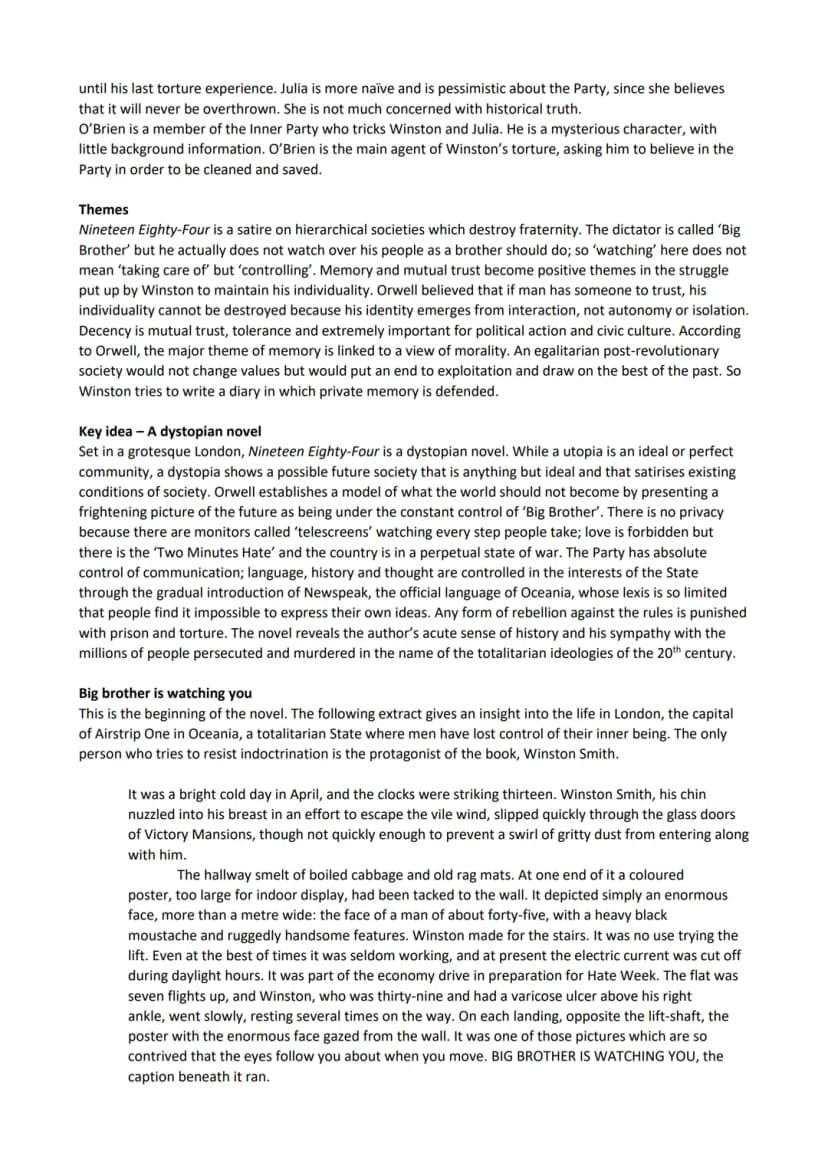
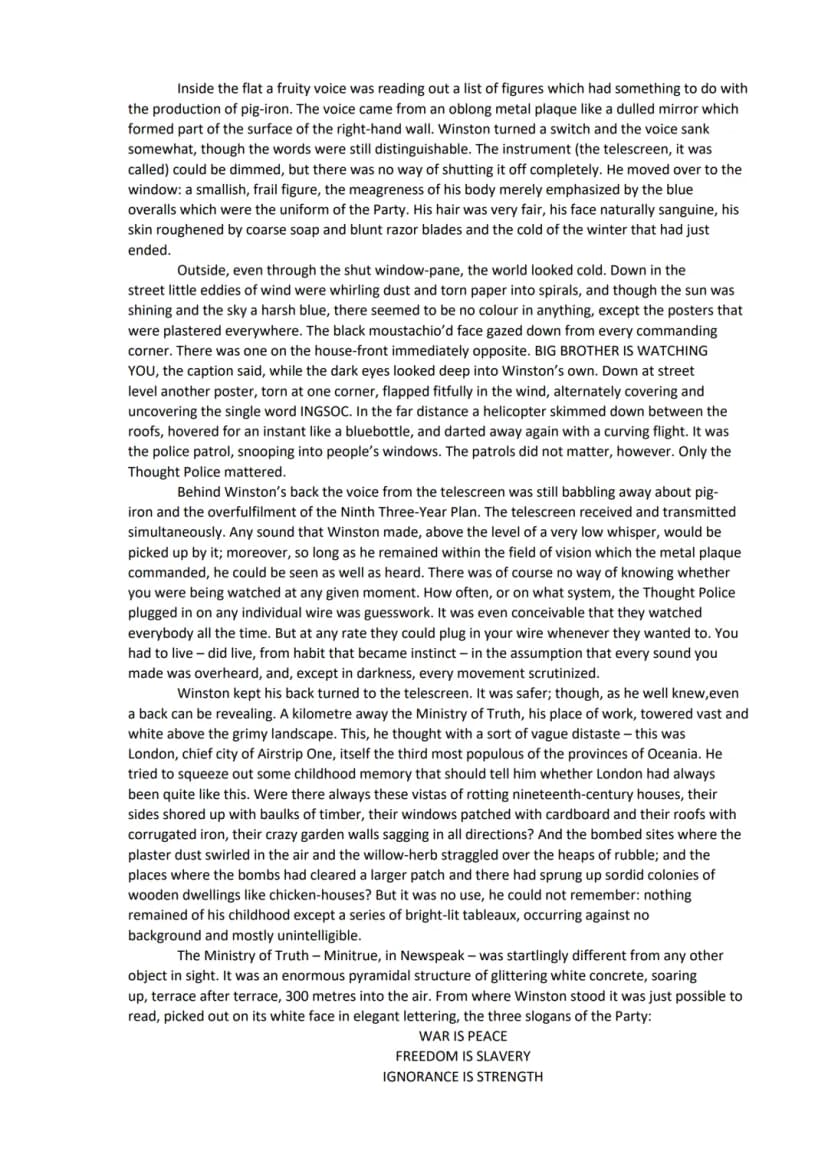
Orwell's final novel, "1984," published in 1949, is considered his most original and impactful work. This dystopian novel presents a chilling vision of a totalitarian future, introducing concepts like "Big Brother," "thoughtcrime," and "Newspeak" that have become part of our cultural lexicon.
Quote: "Big Brother is Watching You" - A famous phrase from "1984" that encapsulates the novel's themes of constant surveillance and control.
Orwell's artistic development was characterized by a deep understanding of the English character, combined with his ability to view his country from an outsider's perspective due to his experiences abroad. This unique viewpoint allowed him to critically examine both the strengths and weaknesses of English society.
Example: In his essay "The Lion and the Unicorn," Orwell analyzes the English national character, praising its tolerance while criticizing its class system.
The conflict between Orwell's middle-class background and his emotional identification with the working class was a recurring theme in his work. This tension contributed to his openness to new ideas and his ability to empathize with different social classes.
Vocabulary: Totalitarianism - A system of government that is centralized and dictatorial and requires complete subservience to the state.
2
of 4
George Orwell's Social Themes and Literary Legacy
George Orwell's literary works are characterized by their strong focus on social themes and their critique of totalitarianism. His writing style, influenced by Charles Dickens, combined realistic language with a deep concern for human suffering and social injustice.
Orwell's career was multifaceted, encompassing roles as a book reviewer, critic, political journalist, and pamphleteer. This diverse experience contributed to his keen observational skills and his ability to convey complex ideas in accessible language.
Highlight: Orwell's versatility as a writer allowed him to address social and political issues through various literary forms, from essays and journalism to novels and allegorical fiction.
One of the central themes in Orwell's work is the misery caused by poverty. Drawing inspiration from Dickens, he used vivid, realistic language to depict the harsh realities of life for the working class and the poor. This focus on social inequality is evident in works like "Down and Out in Paris and London" and "The Road to Wigan Pier."
Example: In "The Road to Wigan Pier," Orwell provides a detailed account of the living conditions of miners in northern England, bringing attention to their struggles and the broader issues of class inequality.
Orwell consistently advocated for tolerance, justice, and decency in human relationships. These values form the moral core of his writing, whether he was addressing political issues or social dynamics.
Quote: "If liberty means anything at all, it means the right to tell people what they do not want to hear." - This quote from Orwell encapsulates his commitment to speaking truth to power.
Perhaps Orwell's most significant contribution to literature and political thought was his fierce criticism of totalitarianism. His two most famous novels, "Animal Farm" and "1984," serve as powerful warnings against the dangers of authoritarian regimes and the manipulation of truth.
Vocabulary: Dystopia - An imagined state or society in which there is great suffering or injustice, typically one that is totalitarian or post-apocalyptic.
"1984," Orwell's final novel, presents a nightmarish vision of a future world divided into three superstates: Oceania, Eurasia, and Eastasia. The story focuses on Oceania, a totalitarian society ruled by the omnipresent figure of Big Brother and the all-powerful Party.
Definition: Newspeak - The official language of Oceania in "1984," designed to limit freedom of thought and personal identity.
The novel introduces concepts like "thoughtcrime" (illegal thoughts) and the "Thought Police," which have become synonymous with government overreach and the suppression of individual freedom. Through the protagonist Winston Smith's struggle against the Party, Orwell explores themes of surveillance, historical revisionism, and the power of language to shape thought.
Quote: "Big Brother is watching you" - This iconic phrase from "1984" has become a cultural shorthand for oppressive government surveillance.
Orwell's legacy extends far beyond his lifetime. His works continue to be widely read and studied, and terms he coined or popularized, such as "Orwellian," "thoughtcrime," and "Big Brother," have entered common usage. His insights into the nature of power, truth, and human freedom remain as relevant today as they were when first published, cementing his place as one of the most important political writers of the 20th century.
3
of 4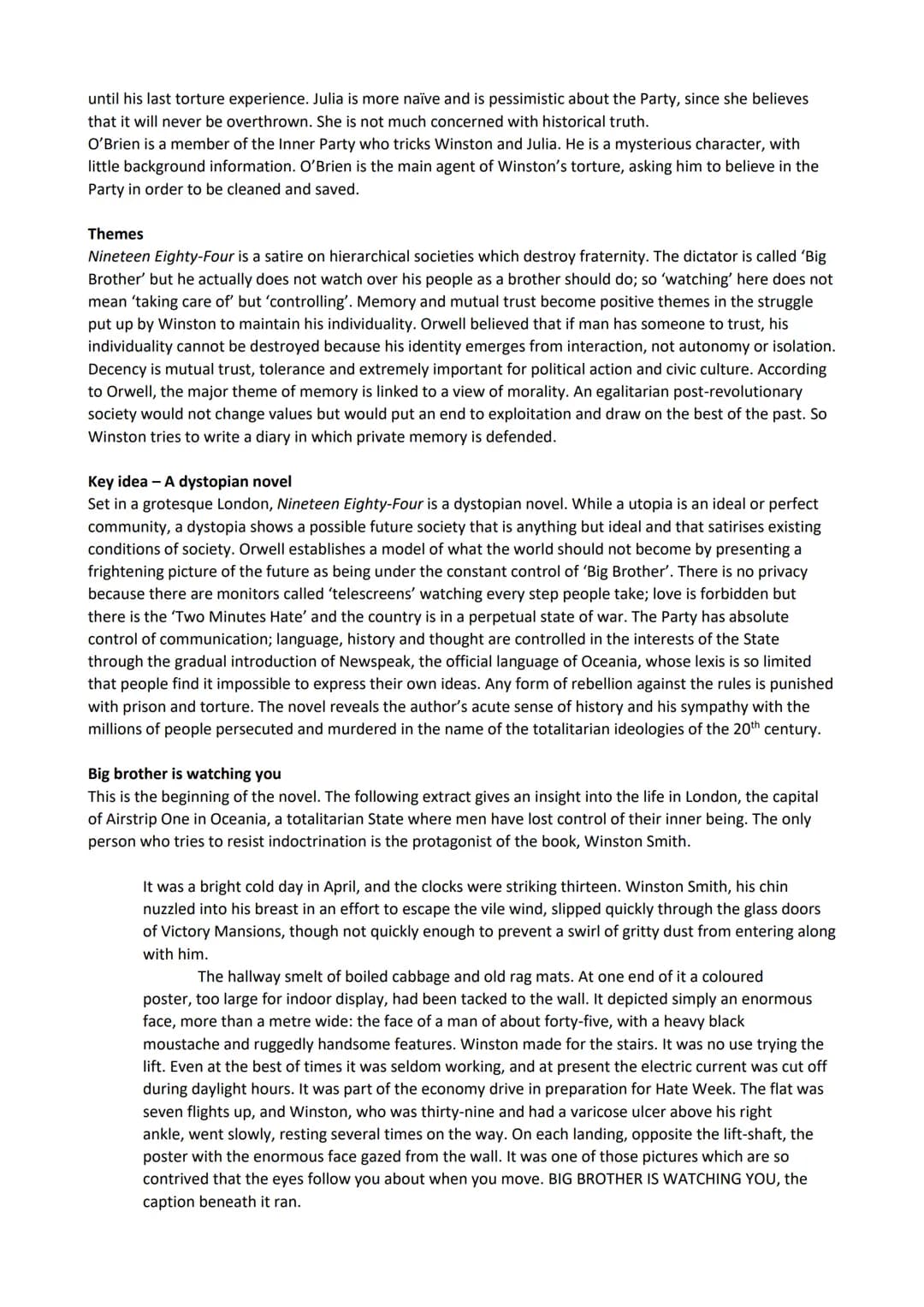
Page 3: Character Analysis and Themes
The novel delves deep into the psychological complexity of its characters and explores fundamental themes about human nature and society.
Highlight: The concept of Big Brother represents not protective oversight but oppressive control.
Quote: "Memory and mutual trust become positive themes in the struggle put up by Winston to maintain his individuality."
4
of 4
George Orwell's Early Life and Experiences
George Orwell, born as Eric Blair in 1903 in India, had a life that profoundly shaped his literary works and political thinking. His early years were marked by a rejection of the English public school tradition, which led to the development of his independent-minded personality and socialist leanings.
Orwell's decision to serve in the Indian Imperial Police in Burma from 1922 to 1927 was a pivotal moment in his life. This experience exposed him to the realities of British imperialism, which he later came to despise. In 1927, he made the significant decision to break away from this system, marking the beginning of his journey to escape from all forms of man's dominion over man.
Highlight: Orwell's early experiences in Burma played a crucial role in shaping his anti-imperialist views, which would later influence his writing.
Upon returning to London, Orwell immersed himself in the world of the poor, living in common lodging houses and experiencing poverty firsthand. This period of his life provided him with invaluable insights into the workings of institutions for the poor, which he would later incorporate into his writings.
Example: Orwell's experiences living among the poor in London directly influenced his first non-fiction work, "Down and Out in Paris and London" (1933).
It was during this time that Eric Blair adopted the pseudonym George Orwell. The choice of name was deliberate: 'George' for its Englishness and connotations of plain speaking and common sense, and 'Orwell' after a river in Suffolk that he was fond of.
Quote: "He chose 'George' because it had an Englishness about it, suggesting plain speaking and common sense, and 'Orwell' because it was the name of a river in the county of Suffolk (England) he was fond of."
Orwell's early works, such as "Burmese Days" (1934) and "The Road to Wigan Pier" (1937), were directly influenced by his experiences in Burma and among the working class in England. These books established him as a writer committed to exposing social injustices and the realities of poverty.
Vocabulary: Imperialism - A policy of extending a country's power and influence through colonization, use of military force, or other means.
We thought you’d never ask...
What is the Knowunity AI companion?
Our AI companion is specifically built for the needs of students. Based on the millions of content pieces we have on the platform we can provide truly meaningful and relevant answers to students. But its not only about answers, the companion is even more about guiding students through their daily learning challenges, with personalised study plans, quizzes or content pieces in the chat and 100% personalisation based on the students skills and developments.
Where can I download the Knowunity app?
You can download the app in the Google Play Store and in the Apple App Store.
Is Knowunity really free of charge?
That's right! Enjoy free access to study content, connect with fellow students, and get instant help – all at your fingertips.
Similar Content
Most popular content: George Orwell
7IngleseGeorge Orwell - 1984
George Orwell and 1984
3ªl7478
IngleseGEORGE ORWELL: ANIMAL FARM - NINETEEN EIGHTY FOUR
appunti con traduzioni in italiano, libro L&L (literature and language)
5ªl7,838259
IngleseOrwell e animal farm
Vita di orwell e analisi di animal farm
5ªl2,06347
IngleseAnimal Farm - George Orwell
Riassunto del libro + descrizione dei personaggi + breve riassunto dell'autore
3ªl1,48227
IngleseAnimal Farm
Riassunto+ personaggi
3ªl3589
Ingleseletteratura inglese
programma quinto anno
5ªl5,361175
IngleseAnimal farm
Spiegazione del libro di george orwell "animal farm"
5ªl64529
Most popular content in Inglese
9P
InglesePresent Simple vs Present Continuous
Develop the ability to choose correctly between the Present Simple for habits and the Present Continuous for ongoing actions.
3ªm4,2110
F
IngleseFormazione dei Verbi al Past Simple
Impara a trasformare i verbi dalla forma base al Past Simple, distinguendo tra verbi regolari e irregolari.
2ªm2,5550
B
IngleseBasics of Present Simple vs Continuous
Identify core differences between regular habits and temporary actions happening right now.
3ªm9990
I
IngleseIntroduzione ai Verbi Irregolari Inglesi
Impara a distinguere tra verbi regolari e irregolari e familiarizza con i paradigmi più comuni della lingua inglese.
2ªm4,9610
I
IngleseI conditionals
Un quiz su come formare i condizionali in inglese. Spero possa esservi utile♥️
3ªl2,1082
Inglesepresent simple, continuous, past simple, continuous, present perfect simple e continuous
Tempi verbali
2ªl11,642259
IngleseRipasso tempi verbali inglese
Ecco i tempi verbali inglesi spiegati in maniera riassuntiva e schematica
3ªl2,14049
F
IngleseFrasi e Domande al Past Simple
Crea frasi complete e domande utilizzando l'ausiliare 'did' per descrivere eventi avvenuti nel passato.
2ªm9310
InglesePROGRAMMA COMPLETO DI INGLESE
The Romantic Age (Blake, Wordsworth, Coleridge, Shelley, Keats and Jane Austen), The Victorian Age (Dickens, Oscar Wilde, Stevenson) and The Modern Age (War Poets, Eliot, Joyce and Orwell)
5ªl98629
Most popular content
9 Italiano
Riassunto patente B
Riassunto patente B - appunti presi a lezione
5ªl29,228943
 Altro
AltroTeoria patente b
Tutti gli argomenti per la patente
1ªl21,114685
 Ed. civ.
Teoria patente di guida B: Segnali stradali
Segnali stradali di pericolo, luminosi, di prescrizione, di indicazione, temporanei, complementari, pannelli integrativi, segnaletica orizzontale, segnalazioni agenti del traffico, distanza di visibilità per l‘arresto, minima di sicurezza.
5ªl40,0421,645
 Filosofia
Aristotele
Aristotele: vita, metafisica, fisica, etica e politica, retorica e poetica
3ªl7,623216
ItalianoI promessi sposi
Riassunti completi di tutti i 38 capitoli dei Promessi sposi.
2ªl14,090314
AltroPATENTE
schemi per esame teorico della patente
Università22,067756
S
ItalianoSintesi finale di Analisi logica
Esercitazione completa di analisi logica su frasi articolate per consolidare la conoscenza di tutti i complementi.
3ªm5,5290
P
InglesePresent Simple vs Present Continuous
Develop the ability to choose correctly between the Present Simple for habits and the Present Continuous for ongoing actions.
3ªm4,2110
G
ItalianoGabriele D'Annunzio e l'Estetismo
Domande sull'ideale del superuomo, il panismo e la concezione dell'arte come valore assoluto in D'Annunzio.
4ªl2,6740
Can't find what you're looking for? Explore other subjects.
Students love us — and so will you.
4.6/5App Store
4.7/5Google Play
The app is very easy to use and well designed. I have found everything I was looking for so far and have been able to learn a lot from the presentations! I will definitely use the app for a class assignment! And of course it also helps a lot as an inspiration.
Stefan SiOS user
This app is really great. There are so many study notes and help [...]. My problem subject is French, for example, and the app has so many options for help. Thanks to this app, I have improved my French. I would recommend it to anyone.
Samantha KlichAndroid user
Wow, I am really amazed. I just tried the app because I've seen it advertised many times and was absolutely stunned. This app is THE HELP you want for school and above all, it offers so many things, such as workouts and fact sheets, which have been VERY helpful to me personally.
AnnaiOS user
Inglese2,976 views·Updated Jun 26, 2026·4 pagesGeorge Orwell: Key Works & Summary of 1984 - Understanding Political Thoughts and Big Brother
Alessandra Fiorillo@alessandrafyorillo
George Orwell's profound impact on literature and political thought shaped the 20th century through his masterpiece "1984".
Key aspects:
- Born as Eric Blair in India, his experiences shaped his pensiero politico
- His journey from Burma to London influenced...
1
of 4
Sign up to see the content. It's free!
- Access to all documents
- Improve your grades
- Join milions of students
George Orwell's Influential Voice and Artistic Development
George Orwell's experiences during the Spanish Civil War and World War II significantly shaped his political views and literary career, cementing his position as one of the most influential voices of the 20th century.
In 1936, Orwell traveled to Catalonia with his wife to report on the Spanish Civil War. This experience was transformative, as he joined the POUM (Workers' Party of Marxist Unification) militia and fought on the Aragon front. His firsthand experience of the conflict deepened his political convictions and provided material for his future works.
Highlight: Orwell's participation in the Spanish Civil War was a crucial moment in his political development, reinforcing his socialist beliefs while also making him wary of totalitarian tendencies within leftist movements.
During World War II, Orwell worked for the BBC, broadcasting cultural and political programs to India. This period coincided with the writing of "Animal Farm," published in 1945, which catapulted him to international fame and financial security.
Definition: Animal Farm - An allegorical novella by George Orwell that uses a farm setting and anthropomorphized animals to critique the Russian Revolution and the rise of Stalinism.
Orwell's final novel, "1984," published in 1949, is considered his most original and impactful work. This dystopian novel presents a chilling vision of a totalitarian future, introducing concepts like "Big Brother," "thoughtcrime," and "Newspeak" that have become part of our cultural lexicon.
Quote: "Big Brother is Watching You" - A famous phrase from "1984" that encapsulates the novel's themes of constant surveillance and control.
Orwell's artistic development was characterized by a deep understanding of the English character, combined with his ability to view his country from an outsider's perspective due to his experiences abroad. This unique viewpoint allowed him to critically examine both the strengths and weaknesses of English society.
Example: In his essay "The Lion and the Unicorn," Orwell analyzes the English national character, praising its tolerance while criticizing its class system.
The conflict between Orwell's middle-class background and his emotional identification with the working class was a recurring theme in his work. This tension contributed to his openness to new ideas and his ability to empathize with different social classes.
Vocabulary: Totalitarianism - A system of government that is centralized and dictatorial and requires complete subservience to the state.
2
of 4Sign up to see the content. It's free!
- Access to all documents
- Improve your grades
- Join milions of students
George Orwell's Social Themes and Literary Legacy
George Orwell's literary works are characterized by their strong focus on social themes and their critique of totalitarianism. His writing style, influenced by Charles Dickens, combined realistic language with a deep concern for human suffering and social injustice.
Orwell's career was multifaceted, encompassing roles as a book reviewer, critic, political journalist, and pamphleteer. This diverse experience contributed to his keen observational skills and his ability to convey complex ideas in accessible language.
Highlight: Orwell's versatility as a writer allowed him to address social and political issues through various literary forms, from essays and journalism to novels and allegorical fiction.
One of the central themes in Orwell's work is the misery caused by poverty. Drawing inspiration from Dickens, he used vivid, realistic language to depict the harsh realities of life for the working class and the poor. This focus on social inequality is evident in works like "Down and Out in Paris and London" and "The Road to Wigan Pier."
Example: In "The Road to Wigan Pier," Orwell provides a detailed account of the living conditions of miners in northern England, bringing attention to their struggles and the broader issues of class inequality.
Orwell consistently advocated for tolerance, justice, and decency in human relationships. These values form the moral core of his writing, whether he was addressing political issues or social dynamics.
Quote: "If liberty means anything at all, it means the right to tell people what they do not want to hear." - This quote from Orwell encapsulates his commitment to speaking truth to power.
Perhaps Orwell's most significant contribution to literature and political thought was his fierce criticism of totalitarianism. His two most famous novels, "Animal Farm" and "1984," serve as powerful warnings against the dangers of authoritarian regimes and the manipulation of truth.
Vocabulary: Dystopia - An imagined state or society in which there is great suffering or injustice, typically one that is totalitarian or post-apocalyptic.
"1984," Orwell's final novel, presents a nightmarish vision of a future world divided into three superstates: Oceania, Eurasia, and Eastasia. The story focuses on Oceania, a totalitarian society ruled by the omnipresent figure of Big Brother and the all-powerful Party.
Definition: Newspeak - The official language of Oceania in "1984," designed to limit freedom of thought and personal identity.
The novel introduces concepts like "thoughtcrime" (illegal thoughts) and the "Thought Police," which have become synonymous with government overreach and the suppression of individual freedom. Through the protagonist Winston Smith's struggle against the Party, Orwell explores themes of surveillance, historical revisionism, and the power of language to shape thought.
Quote: "Big Brother is watching you" - This iconic phrase from "1984" has become a cultural shorthand for oppressive government surveillance.
Orwell's legacy extends far beyond his lifetime. His works continue to be widely read and studied, and terms he coined or popularized, such as "Orwellian," "thoughtcrime," and "Big Brother," have entered common usage. His insights into the nature of power, truth, and human freedom remain as relevant today as they were when first published, cementing his place as one of the most important political writers of the 20th century.
3
of 4Sign up to see the content. It's free!
- Access to all documents
- Improve your grades
- Join milions of students
Page 3: Character Analysis and Themes
The novel delves deep into the psychological complexity of its characters and explores fundamental themes about human nature and society.
Highlight: The concept of Big Brother represents not protective oversight but oppressive control.
Quote: "Memory and mutual trust become positive themes in the struggle put up by Winston to maintain his individuality."
4
of 4Sign up to see the content. It's free!
- Access to all documents
- Improve your grades
- Join milions of students
George Orwell's Early Life and Experiences
George Orwell, born as Eric Blair in 1903 in India, had a life that profoundly shaped his literary works and political thinking. His early years were marked by a rejection of the English public school tradition, which led to the development of his independent-minded personality and socialist leanings.
Orwell's decision to serve in the Indian Imperial Police in Burma from 1922 to 1927 was a pivotal moment in his life. This experience exposed him to the realities of British imperialism, which he later came to despise. In 1927, he made the significant decision to break away from this system, marking the beginning of his journey to escape from all forms of man's dominion over man.
Highlight: Orwell's early experiences in Burma played a crucial role in shaping his anti-imperialist views, which would later influence his writing.
Upon returning to London, Orwell immersed himself in the world of the poor, living in common lodging houses and experiencing poverty firsthand. This period of his life provided him with invaluable insights into the workings of institutions for the poor, which he would later incorporate into his writings.
Example: Orwell's experiences living among the poor in London directly influenced his first non-fiction work, "Down and Out in Paris and London" (1933).
It was during this time that Eric Blair adopted the pseudonym George Orwell. The choice of name was deliberate: 'George' for its Englishness and connotations of plain speaking and common sense, and 'Orwell' after a river in Suffolk that he was fond of.
Quote: "He chose 'George' because it had an Englishness about it, suggesting plain speaking and common sense, and 'Orwell' because it was the name of a river in the county of Suffolk (England) he was fond of."
Orwell's early works, such as "Burmese Days" (1934) and "The Road to Wigan Pier" (1937), were directly influenced by his experiences in Burma and among the working class in England. These books established him as a writer committed to exposing social injustices and the realities of poverty.
Vocabulary: Imperialism - A policy of extending a country's power and influence through colonization, use of military force, or other means.
We thought you’d never ask...
What is the Knowunity AI companion?
Our AI companion is specifically built for the needs of students. Based on the millions of content pieces we have on the platform we can provide truly meaningful and relevant answers to students. But its not only about answers, the companion is even more about guiding students through their daily learning challenges, with personalised study plans, quizzes or content pieces in the chat and 100% personalisation based on the students skills and developments.
Where can I download the Knowunity app?
You can download the app in the Google Play Store and in the Apple App Store.
Is Knowunity really free of charge?
That's right! Enjoy free access to study content, connect with fellow students, and get instant help – all at your fingertips.
Similar Content
Most popular content: George Orwell
7IngleseGeorge Orwell - 1984
George Orwell and 1984
3ªl7478
IngleseGEORGE ORWELL: ANIMAL FARM - NINETEEN EIGHTY FOUR
appunti con traduzioni in italiano, libro L&L (literature and language)
5ªl7,838259
IngleseOrwell e animal farm
Vita di orwell e analisi di animal farm
5ªl2,06347
IngleseAnimal Farm - George Orwell
Riassunto del libro + descrizione dei personaggi + breve riassunto dell'autore
3ªl1,48227
IngleseAnimal Farm
Riassunto+ personaggi
3ªl3589
Ingleseletteratura inglese
programma quinto anno
5ªl5,361175
IngleseAnimal farm
Spiegazione del libro di george orwell "animal farm"
5ªl64529
Most popular content in Inglese
9P
InglesePresent Simple vs Present Continuous
Develop the ability to choose correctly between the Present Simple for habits and the Present Continuous for ongoing actions.
3ªm4,2110
F
IngleseFormazione dei Verbi al Past Simple
Impara a trasformare i verbi dalla forma base al Past Simple, distinguendo tra verbi regolari e irregolari.
2ªm2,5550
B
IngleseBasics of Present Simple vs Continuous
Identify core differences between regular habits and temporary actions happening right now.
3ªm9990
I
IngleseIntroduzione ai Verbi Irregolari Inglesi
Impara a distinguere tra verbi regolari e irregolari e familiarizza con i paradigmi più comuni della lingua inglese.
2ªm4,9610
I
IngleseI conditionals
Un quiz su come formare i condizionali in inglese. Spero possa esservi utile♥️
3ªl2,1082
Inglesepresent simple, continuous, past simple, continuous, present perfect simple e continuous
Tempi verbali
2ªl11,642259
IngleseRipasso tempi verbali inglese
Ecco i tempi verbali inglesi spiegati in maniera riassuntiva e schematica
3ªl2,14049
F
IngleseFrasi e Domande al Past Simple
Crea frasi complete e domande utilizzando l'ausiliare 'did' per descrivere eventi avvenuti nel passato.
2ªm9310
InglesePROGRAMMA COMPLETO DI INGLESE
The Romantic Age (Blake, Wordsworth, Coleridge, Shelley, Keats and Jane Austen), The Victorian Age (Dickens, Oscar Wilde, Stevenson) and The Modern Age (War Poets, Eliot, Joyce and Orwell)
5ªl98629
Most popular content
9ItalianoRiassunto patente B
Riassunto patente B - appunti presi a lezione
5ªl29,228943
AltroTeoria patente b
Tutti gli argomenti per la patente
1ªl21,114685
Ed. civ.Teoria patente di guida B: Segnali stradali
Segnali stradali di pericolo, luminosi, di prescrizione, di indicazione, temporanei, complementari, pannelli integrativi, segnaletica orizzontale, segnalazioni agenti del traffico, distanza di visibilità per l‘arresto, minima di sicurezza.
5ªl40,0421,645
FilosofiaAristotele
Aristotele: vita, metafisica, fisica, etica e politica, retorica e poetica
3ªl7,623216
ItalianoI promessi sposi
Riassunti completi di tutti i 38 capitoli dei Promessi sposi.
2ªl14,090314
AltroPATENTE
schemi per esame teorico della patente
Università22,067756
S
ItalianoSintesi finale di Analisi logica
Esercitazione completa di analisi logica su frasi articolate per consolidare la conoscenza di tutti i complementi.
3ªm5,5290
P
InglesePresent Simple vs Present Continuous
Develop the ability to choose correctly between the Present Simple for habits and the Present Continuous for ongoing actions.
3ªm4,2110
G
ItalianoGabriele D'Annunzio e l'Estetismo
Domande sull'ideale del superuomo, il panismo e la concezione dell'arte come valore assoluto in D'Annunzio.
4ªl2,6740
Can't find what you're looking for? Explore other subjects.
Students love us — and so will you.
4.6/5App Store
4.7/5Google Play
The app is very easy to use and well designed. I have found everything I was looking for so far and have been able to learn a lot from the presentations! I will definitely use the app for a class assignment! And of course it also helps a lot as an inspiration.
Stefan SiOS user
This app is really great. There are so many study notes and help [...]. My problem subject is French, for example, and the app has so many options for help. Thanks to this app, I have improved my French. I would recommend it to anyone.
Samantha KlichAndroid user
Wow, I am really amazed. I just tried the app because I've seen it advertised many times and was absolutely stunned. This app is THE HELP you want for school and above all, it offers so many things, such as workouts and fact sheets, which have been VERY helpful to me personally.
AnnaiOS user