
This guide provides an overview of key verbal tenses in...
 Inglés2,918 views·Updated Jun 28, 2026·2 pages
Present Simple vs Continuous, Past Simple, Future with Will and Going to – Easy Guide with Examples and Exercises

Knowunity Apuntes@knowunity.es2
1
of 2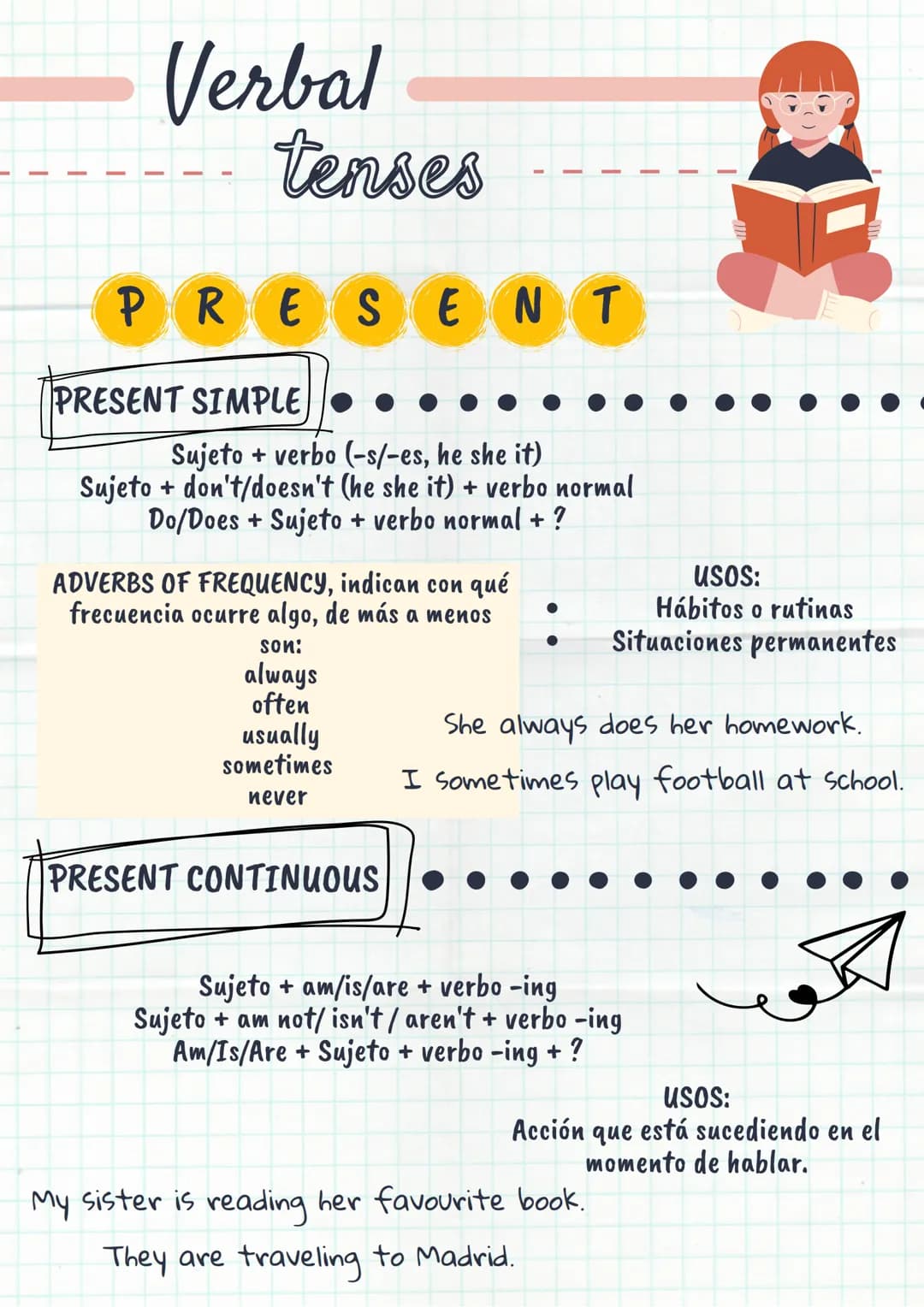
Past and Future Tenses
This page covers the Past Simple tense and two forms of expressing future actions: Will and Going to.
Past Simple
The Past Simple is used to talk about events that happened in the past.
Structure:
- Affirmative: Subject + verb
- Negative: Subject + didn't + base verb
- Interrogative: Did + Subject + base verb + ?
Example: Yesterday we went to the countryside.
Highlight: The Past Simple often uses time expressions like 'yesterday', 'last week', or 'two days ago' to indicate when the action occurred.
Future Expressions
Will
Will is used for spontaneous decisions and predictions.
Structure:
- Affirmative: Subject + will + base verb
- Negative: Subject + won't + base verb
- Interrogative: Will + Subject + base verb + ?
Example: I don't like this meal, I won't eat it.
Going to
Going to is used for plans or intentions.
Structure:
- Affirmative: Subject + am/is/are going to + base verb
- Negative: Subject + am/is/are not going to + base verb
- Interrogative: Am/Is/Are + Subject + going to + base verb + ?
Example: We are going to travel to NY next weekend.
Highlight: The choice between 'will' and 'going to' often depends on how certain or planned the future action is.
2
of 2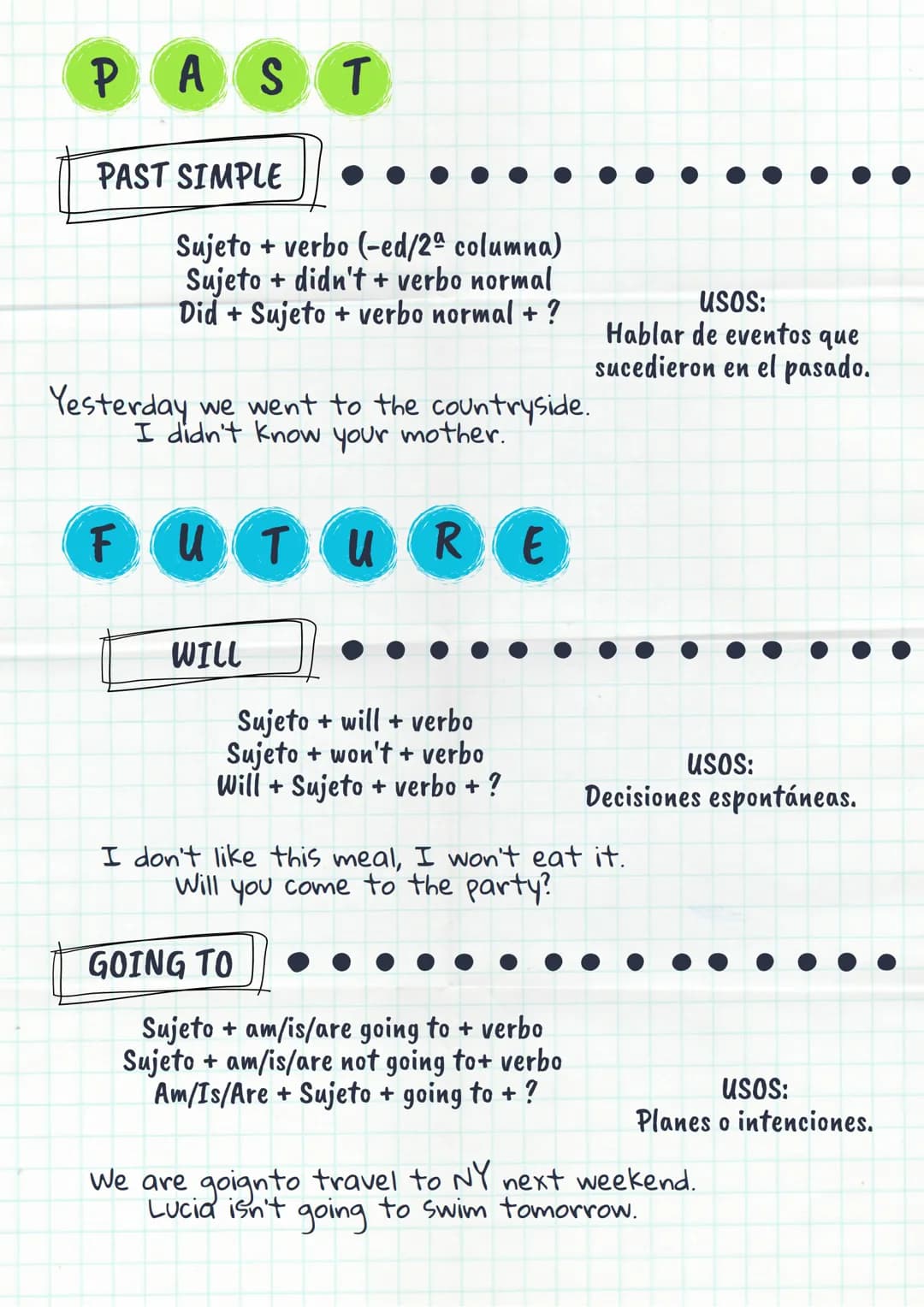
Present Tense Overview
The present tense in English is divided into two main forms: Present Simple and Present Continuous. Each has distinct structures and uses.
Present Simple
The Present Simple is used for habitual actions, routines, and permanent situations.
Structure:
- Affirmative: Subject + verb
- Negative: Subject + don't/doesn't + base verb
- Interrogative: Do/Does + Subject + base verb + ?
Example: She always does her homework.
Highlight: Adverbs of frequency are often used with Present Simple to indicate how often an action occurs. These include: always, often, usually, sometimes, and never.
Present Continuous
The Present Continuous is primarily used for actions happening at the moment of speaking.
Structure:
- Affirmative: Subject + am/is/are + verb-ing
- Negative: Subject + am not/isn't/aren't + verb-ing
- Interrogative: Am/Is/Are + Subject + verb-ing + ?
Example: My sister is reading her favourite book.
Vocabulary: Present Continuous is also known as Present Progressive.
We thought you’d never ask...
What is the Knowunity AI companion?
Our AI companion is specifically built for the needs of students. Based on the millions of content pieces we have on the platform we can provide truly meaningful and relevant answers to students. But its not only about answers, the companion is even more about guiding students through their daily learning challenges, with personalised study plans, quizzes or content pieces in the chat and 100% personalisation based on the students skills and developments.
Where can I download the Knowunity app?
You can download the app in the Google Play Store and in the Apple App Store.
Is Knowunity really free of charge?
That's right! Enjoy free access to study content, connect with fellow students, and get instant help – all at your fingertips.
Similar Content
 Anglais
Most popular content: verb tenses
9Inglésverb tenses present/past/future
los verbos del presente pasado y futuro, nomas me queda añadir el presente simple y los future perfect en future tenses pero ya los subiré a parte :3
4° ESO3,861455
InglésGramatica de 2 Bachillerato
Gramatica de 2 Bachillerato
4° ESO4,066167
InglésContenido de Inglés.
Esto son un resumen de todo lo que se ve en inglés desde primero de la ESO.
3° ESO72233
InglésVerbal tenses
Tiempos verbales en Inglés
1° ESO12,392855
InglésTiempos Verbales de Inglés
1°ESO / 2°ESO / 3°ESO / 4°ESO / 1° Bach
3° ESO2,621110
InglésTiempos verbales
Los tiempos verbales muy bien explicados
1° ESO57314
Inglésgramática Inglés 4ESO
Inglés
3° ESO66016
InglésVERB TENSES
Apuntes sobre las verb tenses en inglés
4° ESO2,47173
Ingléstiempos verbales ingles
todos los tiempos verbales explicados y con ejemplos
4° ESO5,743174
Most popular content in Inglés
9I
Inglésirregular verbs quiz
Domina el idioma inglés de manera sencilla y divertida con estos flashcards diseñados especialmente para estudiantes de sexto grado.
6º primaria2,8981
D
InglésDominando la gramática inglesa: Flashcards desafiantes
Mejora tus habilidades gramaticales en inglés con estos flashcards desafiantes diseñados para estudiantes de grado 11. ¡Prepárate para dominar la gramática inglesa de manera divertida y efectiva!
3° ESO2,2480
I
InglésIngles para repasar
quiz de ingles para entrar a clase preparados
2° ESO2,6290
I
InglésIrregular verbs
Aprende nuevas palabras y expande tu vocabulario en inglés con esta colección de tarjetas de estudio interactivas.
3° ESO1,7442
I
InglésIrregular verbs 1-30
Aprende los primeros 30 verbos irregulares esenciales en inglés, incluyendo sus formas de pasado simple y participio.
2° ESO1,1590
C
InglésConjugación de Verbos Irregulares en Pasado
Practica la transformación de verbos en presente a su forma correspondiente en Past Simple para ampliar tu vocabulario básico.
1° ESO1,0940
I
InglésIrregular verbs part 21
Here's a quiz to learn irregular verbs.
2° ESO7921
C
Ingléscomparativos y superlativos inglés 2
quizzz
1° ESO1,7743
D
InglésDomina el inglés fácilmente
Aprende de manera sencilla y efectiva el idioma inglés con estos flashcards diseñados especialmente para ti.
1° Bach3,3734
Most popular content
9I
Inglésirregular verbs quiz
Domina el idioma inglés de manera sencilla y divertida con estos flashcards diseñados especialmente para estudiantes de sexto grado.
6º primaria2,8981
R
 Geografía e Historia
roma
a estudiar Roma!!
1° ESO2,3122
G
Geografía e HistoriaGrecia: Inicio de la democracia
Más o menos las preguntas que me pusieron a mí en el examen
1° ESO2,3622
D
InglésDominando la gramática inglesa: Flashcards desafiantes
Mejora tus habilidades gramaticales en inglés con estos flashcards desafiantes diseñados para estudiantes de grado 11. ¡Prepárate para dominar la gramática inglesa de manera divertida y efectiva!
3° ESO2,2480
M
Geografía e HistoriaMesopotamia y Egipto
Contenidos sobre la civilización mesopotámica y egipcia
1° ESO3,9381
O
 Lengua Castellana y Literatura
OBRAS Y AUTORES II
Quiz donde tendrás que relacionar las siguientes obras con sus respectivos autores: edición Romanticismo.
4° ESO3,3610
I
InglésIngles para repasar
quiz de ingles para entrar a clase preparados
2° ESO2,6290
F
 Filosofía
filosofía
repaso filosofía "el arje , la metafísica y la crítica de Nietszche a platon"
1° Bach2,8421
I
InglésIrregular verbs
Aprende nuevas palabras y expande tu vocabulario en inglés con esta colección de tarjetas de estudio interactivas.
3° ESO1,7442
Can't find what you're looking for? Explore other subjects.
Students love us — and so will you.
4.6/5App Store
4.7/5Google Play
The app is very easy to use and well designed. I have found everything I was looking for so far and have been able to learn a lot from the presentations! I will definitely use the app for a class assignment! And of course it also helps a lot as an inspiration.
Stefan SiOS user
This app is really great. There are so many study notes and help [...]. My problem subject is French, for example, and the app has so many options for help. Thanks to this app, I have improved my French. I would recommend it to anyone.
Samantha KlichAndroid user
Wow, I am really amazed. I just tried the app because I've seen it advertised many times and was absolutely stunned. This app is THE HELP you want for school and above all, it offers so many things, such as workouts and fact sheets, which have been VERY helpful to me personally.
AnnaiOS user
Inglés2,918 views·Updated Jun 28, 2026·2 pagesPresent Simple vs Continuous, Past Simple, Future with Will and Going to – Easy Guide with Examples and Exercises
Knowunity Apuntes@knowunity.es2
This guide provides an overview of key verbal tenses in English, focusing on present, past, and future forms. It covers the structure and usage of each tense, helping students understand when and how to apply them correctly.
1
of 2
Sign up to see the content. It's free!
- Access to all documents
- Improve your grades
- Join milions of students
Past and Future Tenses
This page covers the Past Simple tense and two forms of expressing future actions: Will and Going to.
Past Simple
The Past Simple is used to talk about events that happened in the past.
Structure:
- Affirmative: Subject + verb
- Negative: Subject + didn't + base verb
- Interrogative: Did + Subject + base verb + ?
Example: Yesterday we went to the countryside.
Highlight: The Past Simple often uses time expressions like 'yesterday', 'last week', or 'two days ago' to indicate when the action occurred.
Future Expressions
Will
Will is used for spontaneous decisions and predictions.
Structure:
- Affirmative: Subject + will + base verb
- Negative: Subject + won't + base verb
- Interrogative: Will + Subject + base verb + ?
Example: I don't like this meal, I won't eat it.
Going to
Going to is used for plans or intentions.
Structure:
- Affirmative: Subject + am/is/are going to + base verb
- Negative: Subject + am/is/are not going to + base verb
- Interrogative: Am/Is/Are + Subject + going to + base verb + ?
Example: We are going to travel to NY next weekend.
Highlight: The choice between 'will' and 'going to' often depends on how certain or planned the future action is.
2
of 2Sign up to see the content. It's free!
- Access to all documents
- Improve your grades
- Join milions of students
Present Tense Overview
The present tense in English is divided into two main forms: Present Simple and Present Continuous. Each has distinct structures and uses.
Present Simple
The Present Simple is used for habitual actions, routines, and permanent situations.
Structure:
- Affirmative: Subject + verb
- Negative: Subject + don't/doesn't + base verb
- Interrogative: Do/Does + Subject + base verb + ?
Example: She always does her homework.
Highlight: Adverbs of frequency are often used with Present Simple to indicate how often an action occurs. These include: always, often, usually, sometimes, and never.
Present Continuous
The Present Continuous is primarily used for actions happening at the moment of speaking.
Structure:
- Affirmative: Subject + am/is/are + verb-ing
- Negative: Subject + am not/isn't/aren't + verb-ing
- Interrogative: Am/Is/Are + Subject + verb-ing + ?
Example: My sister is reading her favourite book.
Vocabulary: Present Continuous is also known as Present Progressive.
We thought you’d never ask...
What is the Knowunity AI companion?
Our AI companion is specifically built for the needs of students. Based on the millions of content pieces we have on the platform we can provide truly meaningful and relevant answers to students. But its not only about answers, the companion is even more about guiding students through their daily learning challenges, with personalised study plans, quizzes or content pieces in the chat and 100% personalisation based on the students skills and developments.
Where can I download the Knowunity app?
You can download the app in the Google Play Store and in the Apple App Store.
Is Knowunity really free of charge?
That's right! Enjoy free access to study content, connect with fellow students, and get instant help – all at your fingertips.
Similar Content
Most popular content: verb tenses
9Inglésverb tenses present/past/future
los verbos del presente pasado y futuro, nomas me queda añadir el presente simple y los future perfect en future tenses pero ya los subiré a parte :3
4° ESO3,861455
InglésGramatica de 2 Bachillerato
Gramatica de 2 Bachillerato
4° ESO4,066167
InglésContenido de Inglés.
Esto son un resumen de todo lo que se ve en inglés desde primero de la ESO.
3° ESO72233
InglésVerbal tenses
Tiempos verbales en Inglés
1° ESO12,392855
InglésTiempos Verbales de Inglés
1°ESO / 2°ESO / 3°ESO / 4°ESO / 1° Bach
3° ESO2,621110
InglésTiempos verbales
Los tiempos verbales muy bien explicados
1° ESO57314
Inglésgramática Inglés 4ESO
Inglés
3° ESO66016
InglésVERB TENSES
Apuntes sobre las verb tenses en inglés
4° ESO2,47173
Ingléstiempos verbales ingles
todos los tiempos verbales explicados y con ejemplos
4° ESO5,743174
Most popular content in Inglés
9I
Inglésirregular verbs quiz
Domina el idioma inglés de manera sencilla y divertida con estos flashcards diseñados especialmente para estudiantes de sexto grado.
6º primaria2,8981
D
InglésDominando la gramática inglesa: Flashcards desafiantes
Mejora tus habilidades gramaticales en inglés con estos flashcards desafiantes diseñados para estudiantes de grado 11. ¡Prepárate para dominar la gramática inglesa de manera divertida y efectiva!
3° ESO2,2480
I
InglésIngles para repasar
quiz de ingles para entrar a clase preparados
2° ESO2,6290
I
InglésIrregular verbs
Aprende nuevas palabras y expande tu vocabulario en inglés con esta colección de tarjetas de estudio interactivas.
3° ESO1,7442
I
InglésIrregular verbs 1-30
Aprende los primeros 30 verbos irregulares esenciales en inglés, incluyendo sus formas de pasado simple y participio.
2° ESO1,1590
C
InglésConjugación de Verbos Irregulares en Pasado
Practica la transformación de verbos en presente a su forma correspondiente en Past Simple para ampliar tu vocabulario básico.
1° ESO1,0940
I
InglésIrregular verbs part 21
Here's a quiz to learn irregular verbs.
2° ESO7921
C
Ingléscomparativos y superlativos inglés 2
quizzz
1° ESO1,7743
D
InglésDomina el inglés fácilmente
Aprende de manera sencilla y efectiva el idioma inglés con estos flashcards diseñados especialmente para ti.
1° Bach3,3734
Most popular content
9I
Inglésirregular verbs quiz
Domina el idioma inglés de manera sencilla y divertida con estos flashcards diseñados especialmente para estudiantes de sexto grado.
6º primaria2,8981
R
Geografía e Historiaroma
a estudiar Roma!!
1° ESO2,3122
G
Geografía e HistoriaGrecia: Inicio de la democracia
Más o menos las preguntas que me pusieron a mí en el examen
1° ESO2,3622
D
InglésDominando la gramática inglesa: Flashcards desafiantes
Mejora tus habilidades gramaticales en inglés con estos flashcards desafiantes diseñados para estudiantes de grado 11. ¡Prepárate para dominar la gramática inglesa de manera divertida y efectiva!
3° ESO2,2480
M
Geografía e HistoriaMesopotamia y Egipto
Contenidos sobre la civilización mesopotámica y egipcia
1° ESO3,9381
O
Lengua Castellana y LiteraturaOBRAS Y AUTORES II
Quiz donde tendrás que relacionar las siguientes obras con sus respectivos autores: edición Romanticismo.
4° ESO3,3610
I
InglésIngles para repasar
quiz de ingles para entrar a clase preparados
2° ESO2,6290
F
Filosofíafilosofía
repaso filosofía "el arje , la metafísica y la crítica de Nietszche a platon"
1° Bach2,8421
I
InglésIrregular verbs
Aprende nuevas palabras y expande tu vocabulario en inglés con esta colección de tarjetas de estudio interactivas.
3° ESO1,7442
Can't find what you're looking for? Explore other subjects.
Students love us — and so will you.
4.6/5App Store
4.7/5Google Play
The app is very easy to use and well designed. I have found everything I was looking for so far and have been able to learn a lot from the presentations! I will definitely use the app for a class assignment! And of course it also helps a lot as an inspiration.
Stefan SiOS user
This app is really great. There are so many study notes and help [...]. My problem subject is French, for example, and the app has so many options for help. Thanks to this app, I have improved my French. I would recommend it to anyone.
Samantha KlichAndroid user
Wow, I am really amazed. I just tried the app because I've seen it advertised many times and was absolutely stunned. This app is THE HELP you want for school and above all, it offers so many things, such as workouts and fact sheets, which have been VERY helpful to me personally.
AnnaiOS user