
¿Te agobia el inglés de 2º de Bach? No te...
 Inglés686 views·Updated Jun 18, 2026·4 pages
Guía Esencial de Inglés para Segundo de Bachillerato

Alexis@aaalexisss
1 / 4
1
of 4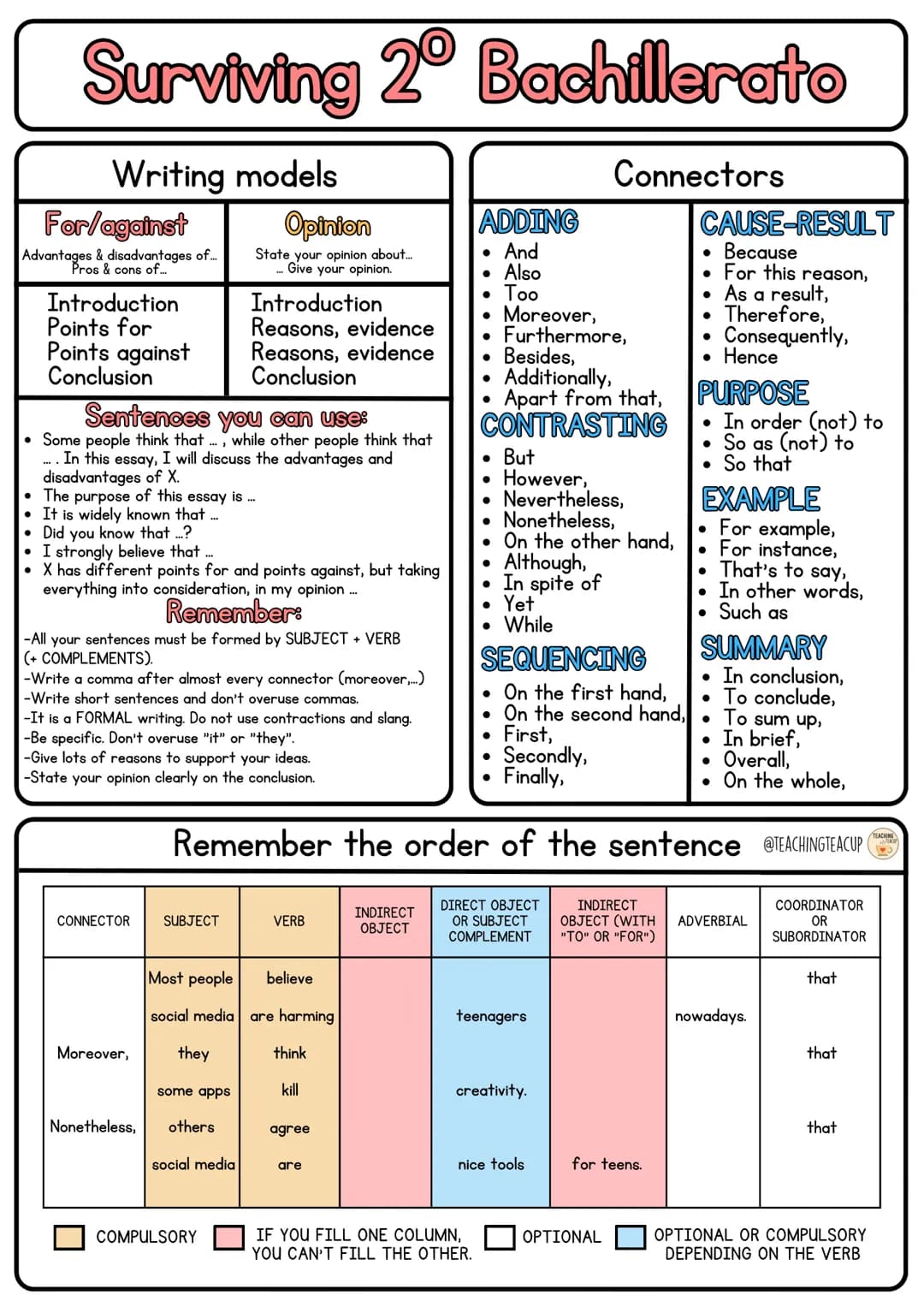
Modelos de Writing y Conectores
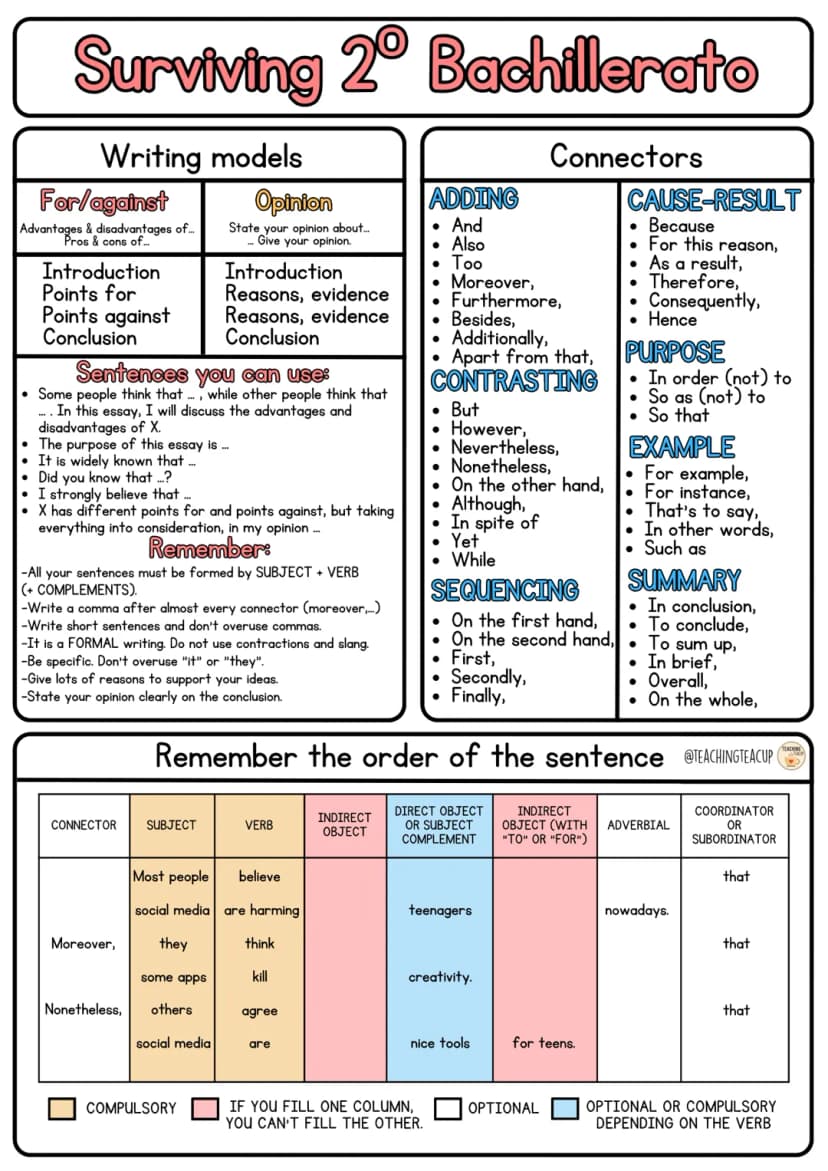
Los writings de opinión y for/against siguen estructuras súper claras que una vez las domines, te facilitarán muchísimo la vida. Para ambos tipos necesitas introducción, desarrollo de ideas y conclusión potente.
En los for/against presentas ventajas y desventajas de un tema. En los de opinión defiendes tu punto de vista con razones sólidas. Frases como "I strongly believe that" o "Taking everything into consideration" te darán un toque más formal.
Los conectores son tu mejor aliado para estructurar las ideas. Para añadir información usa "moreover" y "furthermore". Para contrastar, "however" y "on the other hand" funcionan genial. Y para concluir, siempre "in conclusion" o "to sum up".
Consejo clave: Recuerda la estructura SUJETO + VERBO + COMPLEMENTOS. Escribe oraciones cortas, usa comas después de conectores y mantén un registro formal sin contracciones.
2
of 4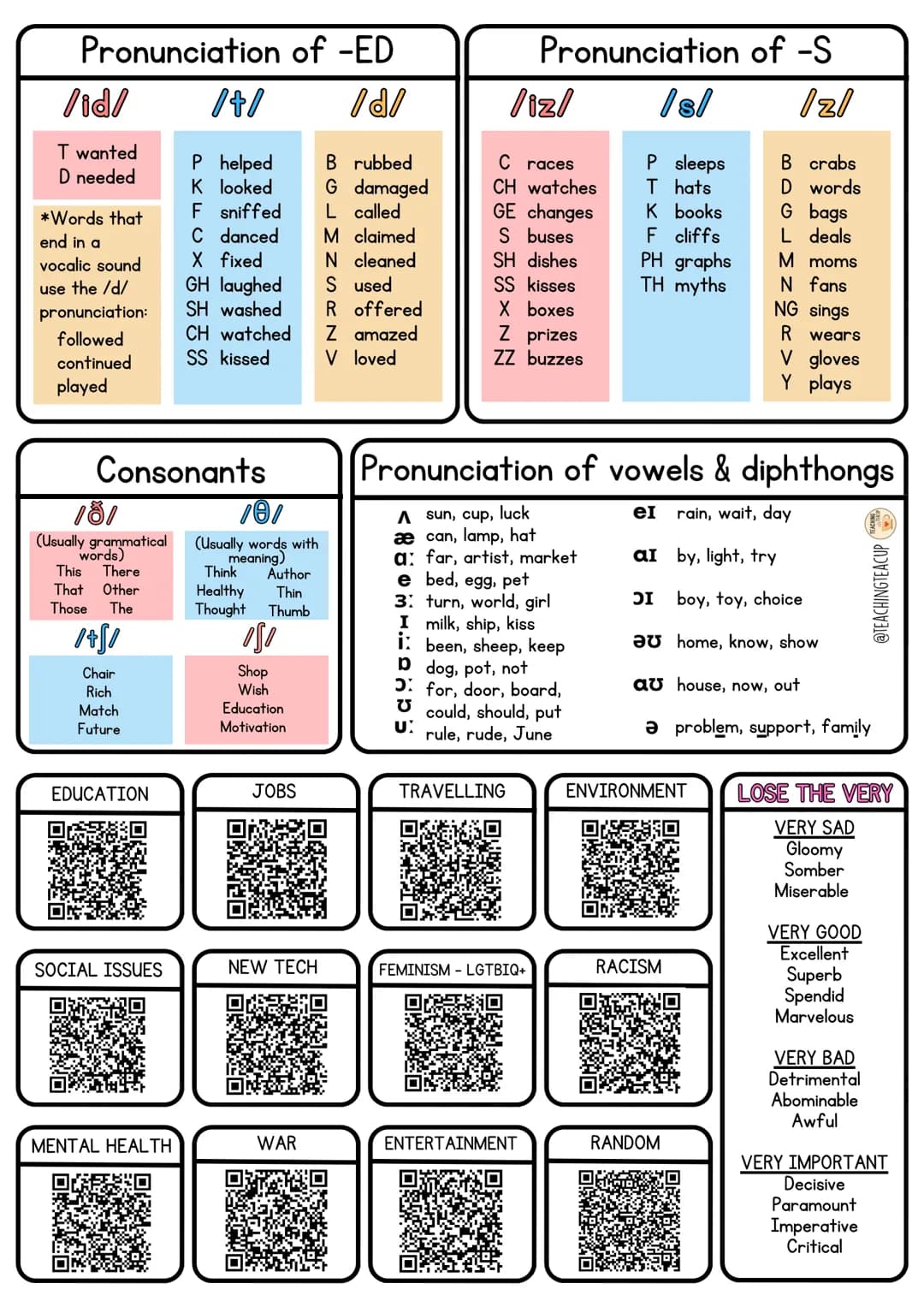
Pronunciación del Inglés
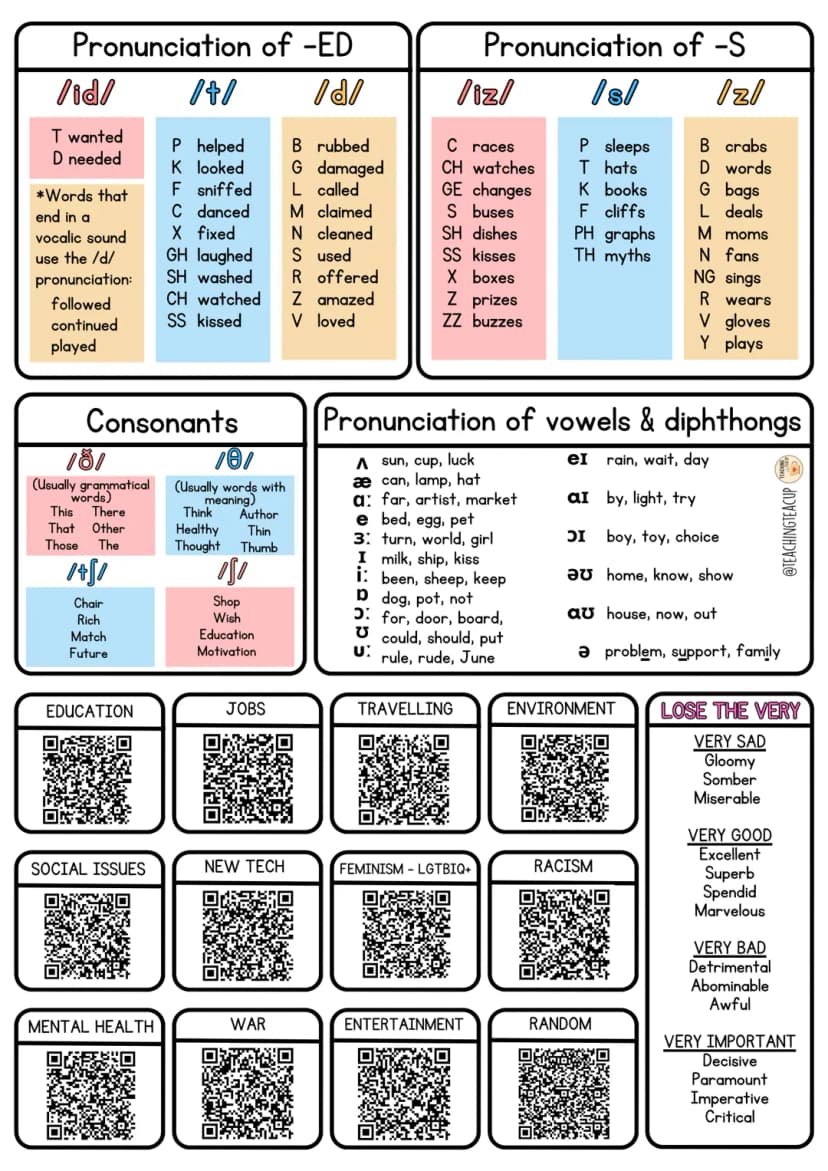
La pronunciación de -ED tiene tres sonidos que debes dominar: /t/, /d/ e /id/. Las palabras que terminan en sonidos sordos como P, K, F usan /t/ (helped, looked). Las que terminan en sonidos sonoros usan /d/ (rubbed, called). Solo las que terminan en T o D usan /id/ (wanted, needed).
Para la pronunciación de -S pasa algo parecillo. Usas /s/ después de sonidos sordos (sleeps, hats), /z/ después de sonoros (crabs, deals), y /iz/ después de sonidos sibilantes como S, CH, X (races, watches, boxes).
Los sonidos consonánticos más chungo son el /θ/ y /ð/. El primero aparece en palabras con significado (think, author) y el segundo en palabras gramaticales (this, that). También está la diferencia entre /ʃ/ (shop, wish) y /ʧ/ (chair, match).
Truco genial: Practica con las palabras que habéis trabajado en clase. Si no las encuentras, busca palabras con patrones similares de escritura.
3
of 4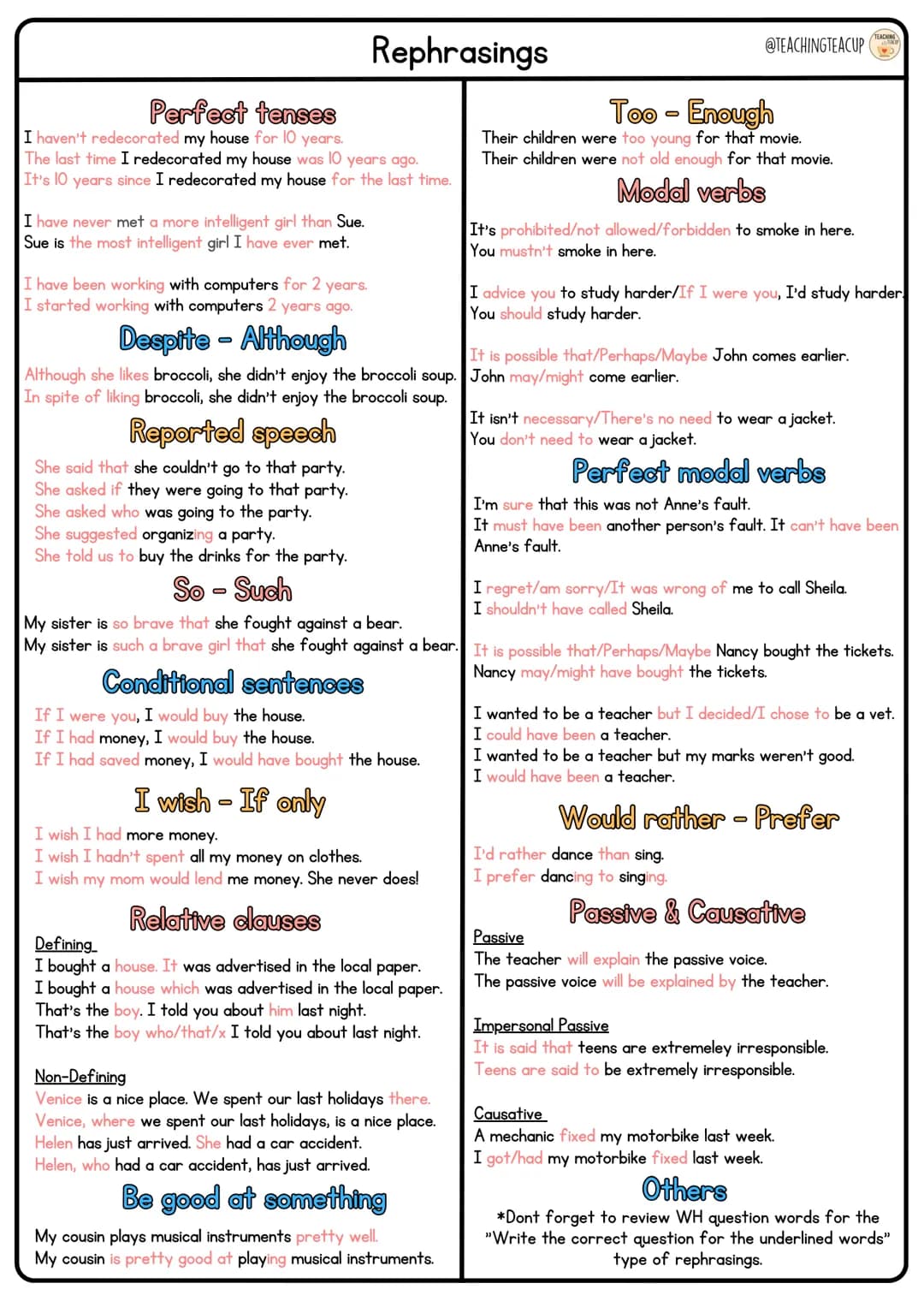
Transformaciones (Rephrasings)
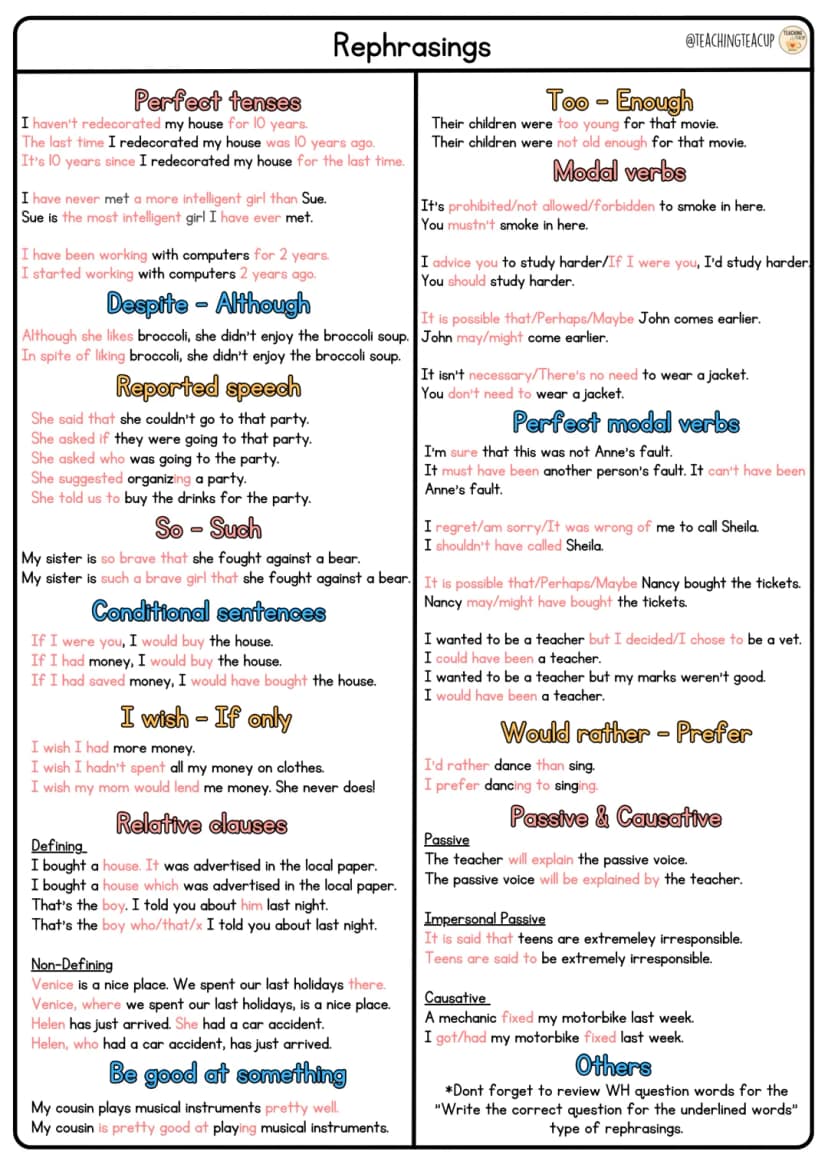
Los tiempos perfectos se transforman cambiando la estructura temporal. "I haven't done X for 10 years" se convierte en "The last time I did X was 10 years ago" o "It's 10 years since I last did X".
Las oraciones condicionales y los modales tienen patrones fijos. "If I were you, I would..." para consejos, "I wish I had..." para lamentos sobre el pasado. Los modales perfectos expresan deducciones: "It can't have been Anne's fault" (seguridad de que no fue ella).
Para reported speech, cambia tiempos verbales, pronombres y expresiones temporales. "She said that she couldn't go" en lugar de "I can't go". Las oraciones de relativo unen frases: usa "who" para personas, "which" para cosas, "where" para lugares.
Estrategia ganadora: Elige 6 transformaciones que domines bien y táchale las que te den problemas. Son 3 puntos del examen, así que tómatelas en serio.
4
of 4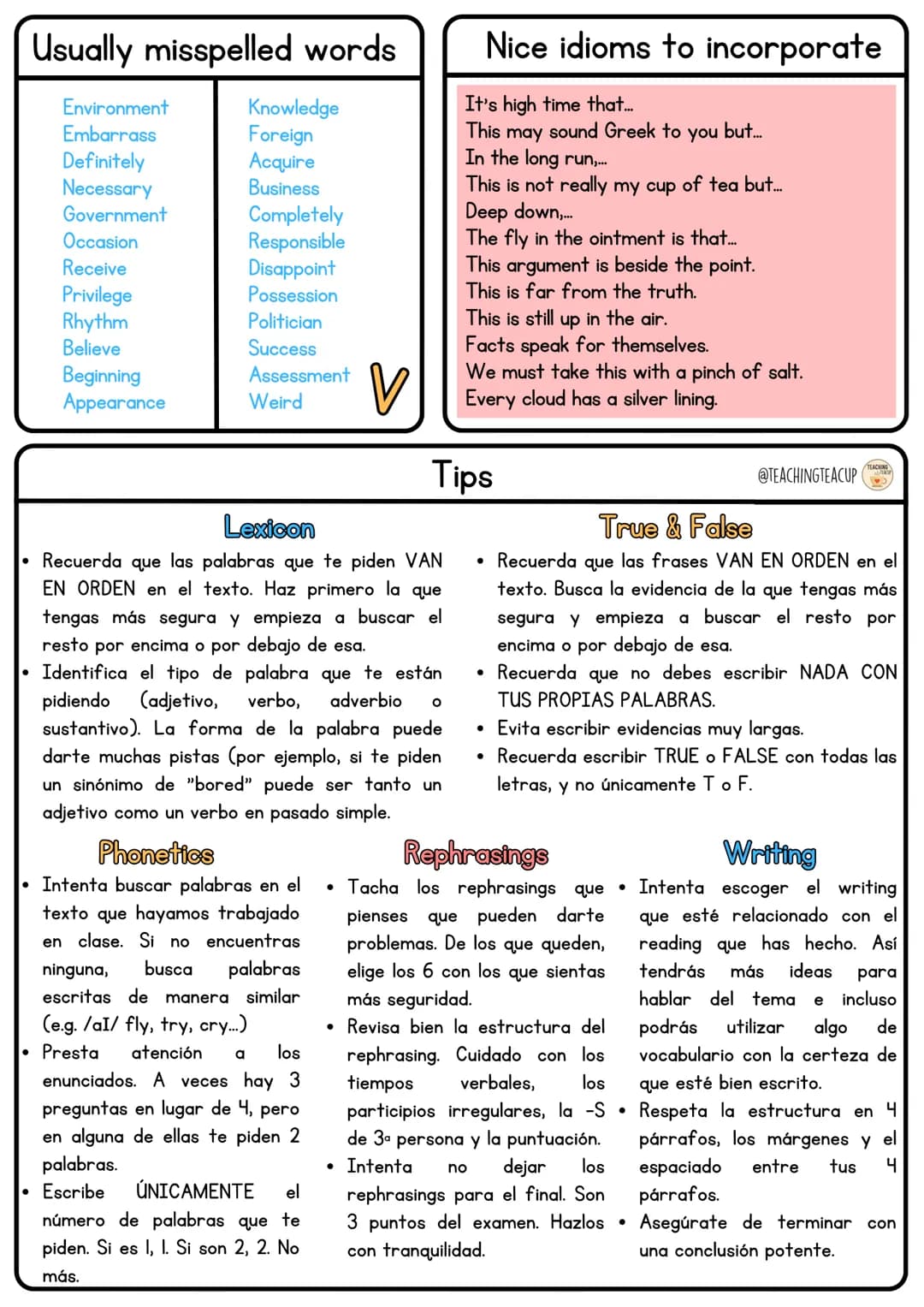
Consejos de Examen y Palabras Clave
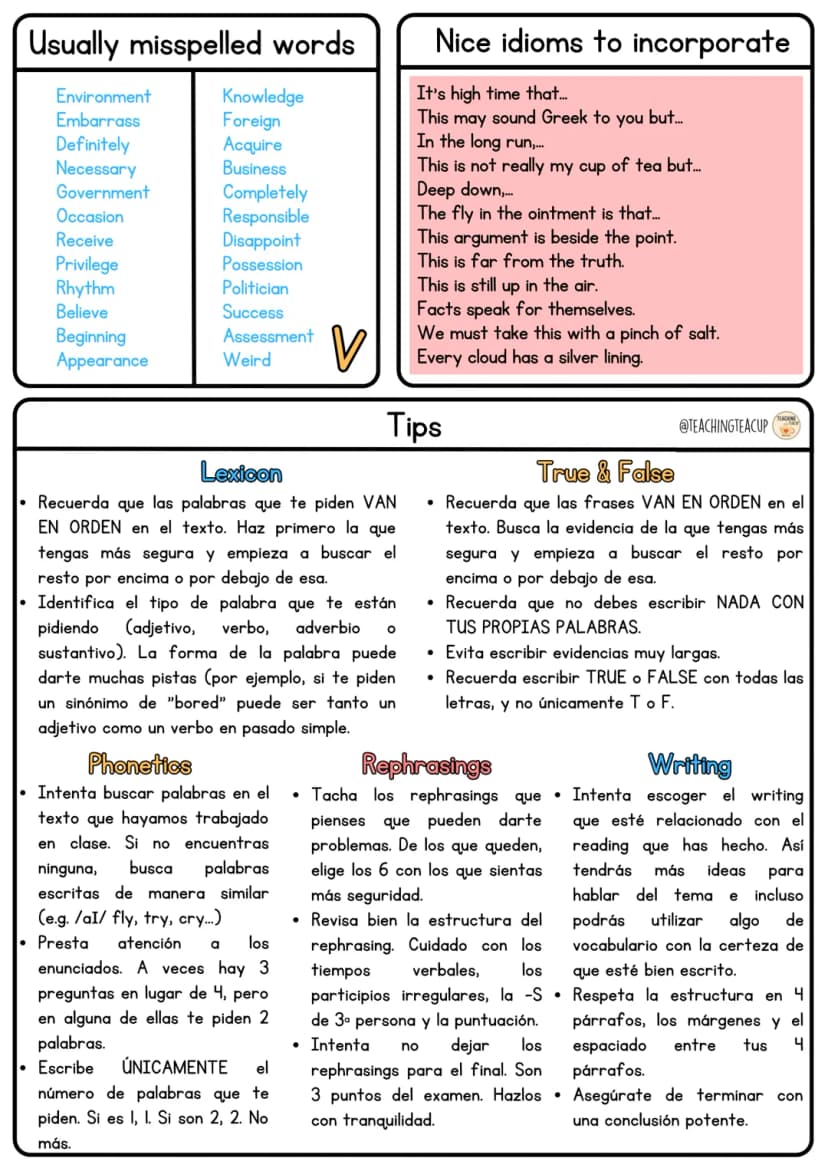
En el lexicon, las palabras van en orden en el texto. Identifica qué tipo de palabra necesitas (sustantivo, adjetivo, verbo) y busca a partir de la que tengas más clara. En phonetics, busca palabras que hayáis trabajado en clase o con patrones de escritura similares.
Para True & False, las frases también van en orden. Busca evidencias directas del texto, nada de tus propias palabras. Escribe "TRUE" o "FALSE" completo, no solo la inicial.
El writing hazlo relacionado con el reading si puedes, así tendrás más ideas y vocabulario. Mantén la estructura de 4 párrafos con márgenes claros y una conclusión potente que cierre bien tu argumento.
Palabras que siempre se escriben mal: environment, knowledge, definitely, necessary, embarrass. Apréndelas de memoria porque suelen aparecer. Los idioms como "It's high time that..." o "In the long run..." te darán puntos extra por naturalidad.
Tip definitivo: No dejes los rephrasings para el final. Valen 3 puntos y necesitas tiempo para revisar la estructura, tiempos verbales y puntuación.
We thought you’d never ask...
What is the Knowunity AI companion?
Our AI companion is specifically built for the needs of students. Based on the millions of content pieces we have on the platform we can provide truly meaningful and relevant answers to students. But its not only about answers, the companion is even more about guiding students through their daily learning challenges, with personalised study plans, quizzes or content pieces in the chat and 100% personalisation based on the students skills and developments.
Where can I download the Knowunity app?
You can download the app in the Google Play Store and in the Apple App Store.
Is Knowunity really free of charge?
That's right! Enjoy free access to study content, connect with fellow students, and get instant help – all at your fingertips.
Similar Content
Most popular content: english phonetics
2Most popular content in Inglés
9I
Inglésirregular verbs quiz
Domina el idioma inglés de manera sencilla y divertida con estos flashcards diseñados especialmente para estudiantes de sexto grado.
6º primaria2,8981
D
InglésDominando la gramática inglesa: Flashcards desafiantes
Mejora tus habilidades gramaticales en inglés con estos flashcards desafiantes diseñados para estudiantes de grado 11. ¡Prepárate para dominar la gramática inglesa de manera divertida y efectiva!
3° ESO2,2450
I
InglésIngles para repasar
quiz de ingles para entrar a clase preparados
2° ESO2,6290
I
InglésIrregular verbs
Aprende nuevas palabras y expande tu vocabulario en inglés con esta colección de tarjetas de estudio interactivas.
3° ESO1,7442
I
InglésIrregular verbs 1-30
Aprende los primeros 30 verbos irregulares esenciales en inglés, incluyendo sus formas de pasado simple y participio.
2° ESO1,1590
C
InglésConjugación de Verbos Irregulares en Pasado
Practica la transformación de verbos en presente a su forma correspondiente en Past Simple para ampliar tu vocabulario básico.
1° ESO1,0940
I
InglésIrregular verbs part 21
Here's a quiz to learn irregular verbs.
2° ESO7921
C
Ingléscomparativos y superlativos inglés 2
quizzz
1° ESO1,7743
D
InglésDomina el inglés fácilmente
Aprende de manera sencilla y efectiva el idioma inglés con estos flashcards diseñados especialmente para ti.
1° Bach3,3734
Most popular content
9I
Inglésirregular verbs quiz
Domina el idioma inglés de manera sencilla y divertida con estos flashcards diseñados especialmente para estudiantes de sexto grado.
6º primaria2,8981
R
 Geografía e Historia
roma
a estudiar Roma!!
1° ESO2,3122
G
Geografía e HistoriaGrecia: Inicio de la democracia
Más o menos las preguntas que me pusieron a mí en el examen
1° ESO2,3622
D
InglésDominando la gramática inglesa: Flashcards desafiantes
Mejora tus habilidades gramaticales en inglés con estos flashcards desafiantes diseñados para estudiantes de grado 11. ¡Prepárate para dominar la gramática inglesa de manera divertida y efectiva!
3° ESO2,2450
M
Geografía e HistoriaMesopotamia y Egipto
Contenidos sobre la civilización mesopotámica y egipcia
1° ESO3,9381
O
 Lengua Castellana y Literatura
OBRAS Y AUTORES II
Quiz donde tendrás que relacionar las siguientes obras con sus respectivos autores: edición Romanticismo.
4° ESO3,3610
I
InglésIngles para repasar
quiz de ingles para entrar a clase preparados
2° ESO2,6290
F
 Filosofía
filosofía
repaso filosofía "el arje , la metafísica y la crítica de Nietszche a platon"
1° Bach2,8421
I
InglésIrregular verbs
Aprende nuevas palabras y expande tu vocabulario en inglés con esta colección de tarjetas de estudio interactivas.
3° ESO1,7442
Can't find what you're looking for? Explore other subjects.
Students love us — and so will you.
4.6/5App Store
4.7/5Google Play
The app is very easy to use and well designed. I have found everything I was looking for so far and have been able to learn a lot from the presentations! I will definitely use the app for a class assignment! And of course it also helps a lot as an inspiration.
Stefan SiOS user
This app is really great. There are so many study notes and help [...]. My problem subject is French, for example, and the app has so many options for help. Thanks to this app, I have improved my French. I would recommend it to anyone.
Samantha KlichAndroid user
Wow, I am really amazed. I just tried the app because I've seen it advertised many times and was absolutely stunned. This app is THE HELP you want for school and above all, it offers so many things, such as workouts and fact sheets, which have been VERY helpful to me personally.
AnnaiOS user
Inglés686 views·Updated Jun 18, 2026·4 pagesGuía Esencial de Inglés para Segundo de Bachillerato
Alexis@aaalexisss
¿Te agobia el inglés de 2º de Bach? No te preocupes, que dominar los writings, la pronunciación y las transformaciones no es tan complicado como parece. Esta guía te ayudará a entender todo lo que necesitas para aprobar con nota.
1
of 4
Sign up to see the content. It's free!
- Access to all documents
- Improve your grades
- Join milions of students
Modelos de Writing y Conectores
Los writings de opinión y for/against siguen estructuras súper claras que una vez las domines, te facilitarán muchísimo la vida. Para ambos tipos necesitas introducción, desarrollo de ideas y conclusión potente.
En los for/against presentas ventajas y desventajas de un tema. En los de opinión defiendes tu punto de vista con razones sólidas. Frases como "I strongly believe that" o "Taking everything into consideration" te darán un toque más formal.
Los conectores son tu mejor aliado para estructurar las ideas. Para añadir información usa "moreover" y "furthermore". Para contrastar, "however" y "on the other hand" funcionan genial. Y para concluir, siempre "in conclusion" o "to sum up".
Consejo clave: Recuerda la estructura SUJETO + VERBO + COMPLEMENTOS. Escribe oraciones cortas, usa comas después de conectores y mantén un registro formal sin contracciones.
2
of 4Sign up to see the content. It's free!
- Access to all documents
- Improve your grades
- Join milions of students
Pronunciación del Inglés
La pronunciación de -ED tiene tres sonidos que debes dominar: /t/, /d/ e /id/. Las palabras que terminan en sonidos sordos como P, K, F usan /t/ (helped, looked). Las que terminan en sonidos sonoros usan /d/ (rubbed, called). Solo las que terminan en T o D usan /id/ (wanted, needed).
Para la pronunciación de -S pasa algo parecillo. Usas /s/ después de sonidos sordos (sleeps, hats), /z/ después de sonoros (crabs, deals), y /iz/ después de sonidos sibilantes como S, CH, X (races, watches, boxes).
Los sonidos consonánticos más chungo son el /θ/ y /ð/. El primero aparece en palabras con significado (think, author) y el segundo en palabras gramaticales (this, that). También está la diferencia entre /ʃ/ (shop, wish) y /ʧ/ (chair, match).
Truco genial: Practica con las palabras que habéis trabajado en clase. Si no las encuentras, busca palabras con patrones similares de escritura.
3
of 4Sign up to see the content. It's free!
- Access to all documents
- Improve your grades
- Join milions of students
Transformaciones (Rephrasings)
Los tiempos perfectos se transforman cambiando la estructura temporal. "I haven't done X for 10 years" se convierte en "The last time I did X was 10 years ago" o "It's 10 years since I last did X".
Las oraciones condicionales y los modales tienen patrones fijos. "If I were you, I would..." para consejos, "I wish I had..." para lamentos sobre el pasado. Los modales perfectos expresan deducciones: "It can't have been Anne's fault" (seguridad de que no fue ella).
Para reported speech, cambia tiempos verbales, pronombres y expresiones temporales. "She said that she couldn't go" en lugar de "I can't go". Las oraciones de relativo unen frases: usa "who" para personas, "which" para cosas, "where" para lugares.
Estrategia ganadora: Elige 6 transformaciones que domines bien y táchale las que te den problemas. Son 3 puntos del examen, así que tómatelas en serio.
4
of 4Sign up to see the content. It's free!
- Access to all documents
- Improve your grades
- Join milions of students
Consejos de Examen y Palabras Clave
En el lexicon, las palabras van en orden en el texto. Identifica qué tipo de palabra necesitas (sustantivo, adjetivo, verbo) y busca a partir de la que tengas más clara. En phonetics, busca palabras que hayáis trabajado en clase o con patrones de escritura similares.
Para True & False, las frases también van en orden. Busca evidencias directas del texto, nada de tus propias palabras. Escribe "TRUE" o "FALSE" completo, no solo la inicial.
El writing hazlo relacionado con el reading si puedes, así tendrás más ideas y vocabulario. Mantén la estructura de 4 párrafos con márgenes claros y una conclusión potente que cierre bien tu argumento.
Palabras que siempre se escriben mal: environment, knowledge, definitely, necessary, embarrass. Apréndelas de memoria porque suelen aparecer. Los idioms como "It's high time that..." o "In the long run..." te darán puntos extra por naturalidad.
Tip definitivo: No dejes los rephrasings para el final. Valen 3 puntos y necesitas tiempo para revisar la estructura, tiempos verbales y puntuación.
We thought you’d never ask...
What is the Knowunity AI companion?
Our AI companion is specifically built for the needs of students. Based on the millions of content pieces we have on the platform we can provide truly meaningful and relevant answers to students. But its not only about answers, the companion is even more about guiding students through their daily learning challenges, with personalised study plans, quizzes or content pieces in the chat and 100% personalisation based on the students skills and developments.
Where can I download the Knowunity app?
You can download the app in the Google Play Store and in the Apple App Store.
Is Knowunity really free of charge?
That's right! Enjoy free access to study content, connect with fellow students, and get instant help – all at your fingertips.
Similar Content
Most popular content: english phonetics
2Most popular content in Inglés
9I
Inglésirregular verbs quiz
Domina el idioma inglés de manera sencilla y divertida con estos flashcards diseñados especialmente para estudiantes de sexto grado.
6º primaria2,8981
D
InglésDominando la gramática inglesa: Flashcards desafiantes
Mejora tus habilidades gramaticales en inglés con estos flashcards desafiantes diseñados para estudiantes de grado 11. ¡Prepárate para dominar la gramática inglesa de manera divertida y efectiva!
3° ESO2,2450
I
InglésIngles para repasar
quiz de ingles para entrar a clase preparados
2° ESO2,6290
I
InglésIrregular verbs
Aprende nuevas palabras y expande tu vocabulario en inglés con esta colección de tarjetas de estudio interactivas.
3° ESO1,7442
I
InglésIrregular verbs 1-30
Aprende los primeros 30 verbos irregulares esenciales en inglés, incluyendo sus formas de pasado simple y participio.
2° ESO1,1590
C
InglésConjugación de Verbos Irregulares en Pasado
Practica la transformación de verbos en presente a su forma correspondiente en Past Simple para ampliar tu vocabulario básico.
1° ESO1,0940
I
InglésIrregular verbs part 21
Here's a quiz to learn irregular verbs.
2° ESO7921
C
Ingléscomparativos y superlativos inglés 2
quizzz
1° ESO1,7743
D
InglésDomina el inglés fácilmente
Aprende de manera sencilla y efectiva el idioma inglés con estos flashcards diseñados especialmente para ti.
1° Bach3,3734
Most popular content
9I
Inglésirregular verbs quiz
Domina el idioma inglés de manera sencilla y divertida con estos flashcards diseñados especialmente para estudiantes de sexto grado.
6º primaria2,8981
R
Geografía e Historiaroma
a estudiar Roma!!
1° ESO2,3122
G
Geografía e HistoriaGrecia: Inicio de la democracia
Más o menos las preguntas que me pusieron a mí en el examen
1° ESO2,3622
D
InglésDominando la gramática inglesa: Flashcards desafiantes
Mejora tus habilidades gramaticales en inglés con estos flashcards desafiantes diseñados para estudiantes de grado 11. ¡Prepárate para dominar la gramática inglesa de manera divertida y efectiva!
3° ESO2,2450
M
Geografía e HistoriaMesopotamia y Egipto
Contenidos sobre la civilización mesopotámica y egipcia
1° ESO3,9381
O
Lengua Castellana y LiteraturaOBRAS Y AUTORES II
Quiz donde tendrás que relacionar las siguientes obras con sus respectivos autores: edición Romanticismo.
4° ESO3,3610
I
InglésIngles para repasar
quiz de ingles para entrar a clase preparados
2° ESO2,6290
F
Filosofíafilosofía
repaso filosofía "el arje , la metafísica y la crítica de Nietszche a platon"
1° Bach2,8421
I
InglésIrregular verbs
Aprende nuevas palabras y expande tu vocabulario en inglés con esta colección de tarjetas de estudio interactivas.
3° ESO1,7442
Can't find what you're looking for? Explore other subjects.
Students love us — and so will you.
4.6/5App Store
4.7/5Google Play
The app is very easy to use and well designed. I have found everything I was looking for so far and have been able to learn a lot from the presentations! I will definitely use the app for a class assignment! And of course it also helps a lot as an inspiration.
Stefan SiOS user
This app is really great. There are so many study notes and help [...]. My problem subject is French, for example, and the app has so many options for help. Thanks to this app, I have improved my French. I would recommend it to anyone.
Samantha KlichAndroid user
Wow, I am really amazed. I just tried the app because I've seen it advertised many times and was absolutely stunned. This app is THE HELP you want for school and above all, it offers so many things, such as workouts and fact sheets, which have been VERY helpful to me personally.
AnnaiOS user