
¡Aprende inglés básico de forma fácil y divertida! Este resumen...
 Inglés1,120 views·Updated Jun 23, 2026·13 pages
Guía de inglés nivel fácil para principiantes

LUCAS 👑@lucas_nose




1 / 10
1
of 10
Vocabulario Esencial y el Verbo TO BE
¿Sabías que con estas palabras ya puedes describir tu aula y presentarte? El vocabulario básico incluye objetos de clase como chair (silla), desk (escritorio) y book (libro), además de nacionalidades como Spanish (español) y British (británico).
El verbo TO BE es tu mejor amigo en inglés. Se conjuga como: I am, you are, he/she/it is. Para hacer negaciones, añades not: I am not, he isn't. ¡Las contracciones como I'm y he's suenan mucho más naturales!
Las preguntas son súper fáciles: solo cambias el orden. Are you Spanish? - Yes, I am! Con las profesiones como doctor, teacher o chef, puedes decir I am a student y ya estás hablando inglés como un campeón.
¡Truco! Practica las contracciones desde el principio - así hablarás inglés más fluido desde el primer día.
2
of 10
Plurales y Demostrativos
Los plurales en inglés tienen sus trucos, pero son más fáciles de lo que piensas. La mayoría solo necesitan una -s: book → books. Si termina en consonante + y, cambias la y por -ies: secretary → secretaries.
Algunos plurales son especiales como man → men, woman → women y child → children. ¡Memorízalos porque los usarás constantemente!
Los demostrativos te ayudan a señalar cosas. This y that van con singular (this book, that car), mientras que these y those van con plural (these books, those cars). This/these para cosas cerca, that/those para cosas lejos.
¡Importante! Los plurales irregulares como children o people aparecen en todos los exámenes, así que repásalos bien.
3
of 10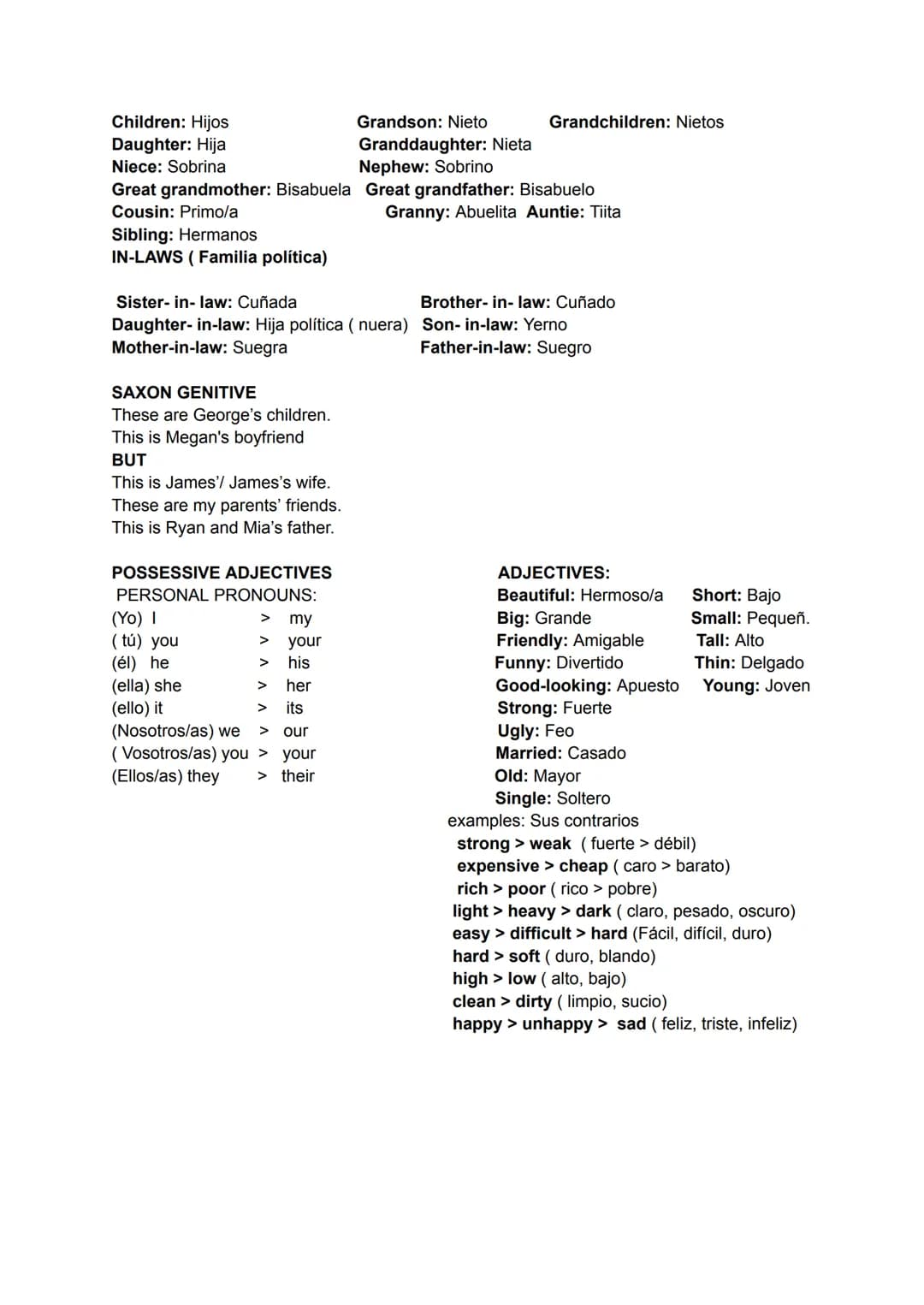
La Familia y Posesivos
Tu familia es el tema perfecto para practicar inglés. Desde parents (padres) hasta grandchildren (nietos), este vocabulario lo usarás toda la vida. Los in-laws (familia política) también son importantes: mother-in-law (suegra), brother-in-law (cuñado).
El genitivo sajón es genial para mostrar posesión. Añades 's: George's children (los hijos de George). Si el nombre termina en s, solo añades el apóstrofe: James' wife (la esposa de James).
Los adjetivos posesivos (my, your, his, her) siempre van antes del sustantivo: my sister, his car. Los adjetivos descriptivos como tall (alto), funny (divertido) o beautiful (hermoso) hacen tus conversaciones más interesantes.
¡Consejo! Dibuja tu árbol genealógico en inglés - es la mejor manera de recordar el vocabulario familiar.
4
of 10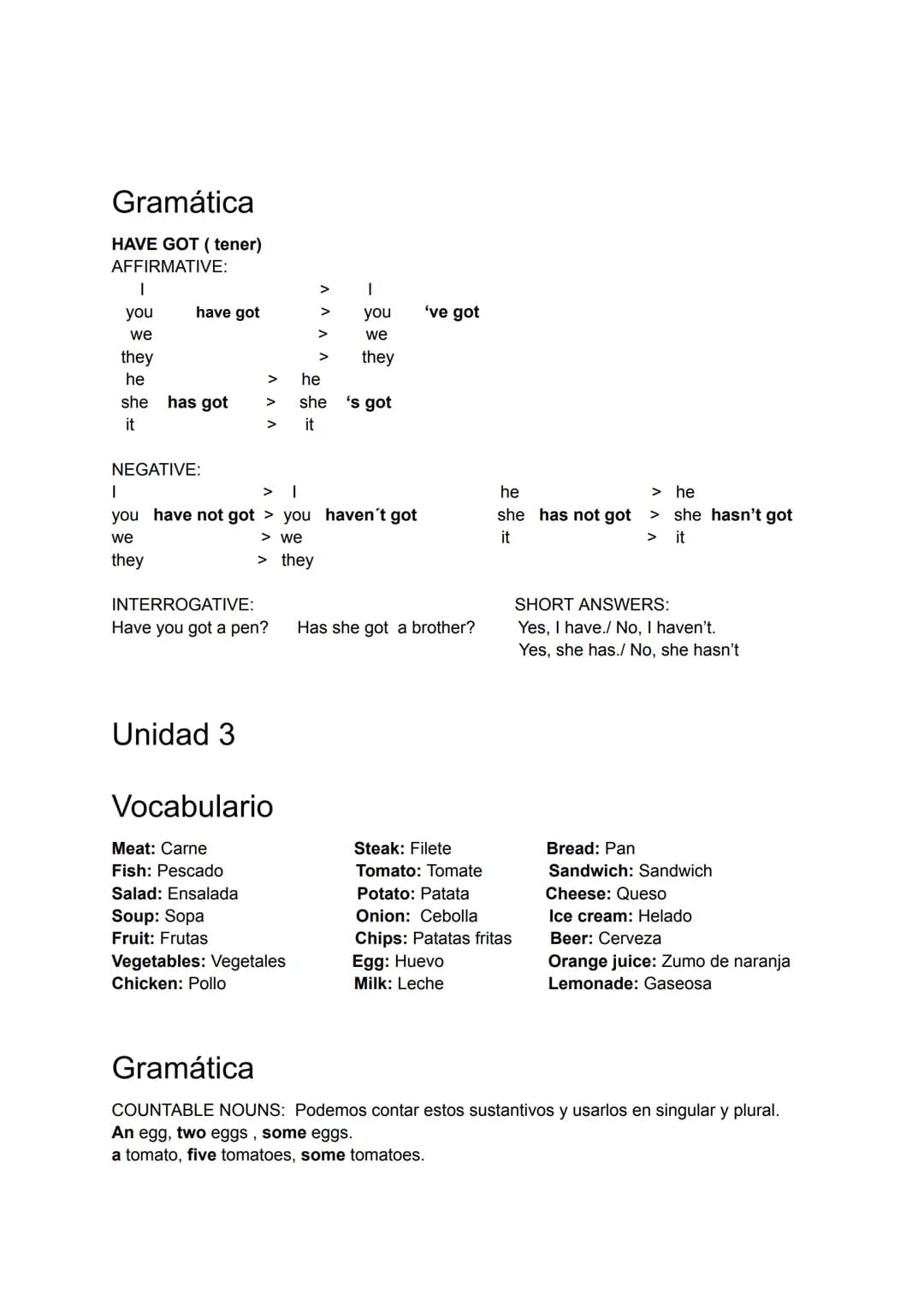
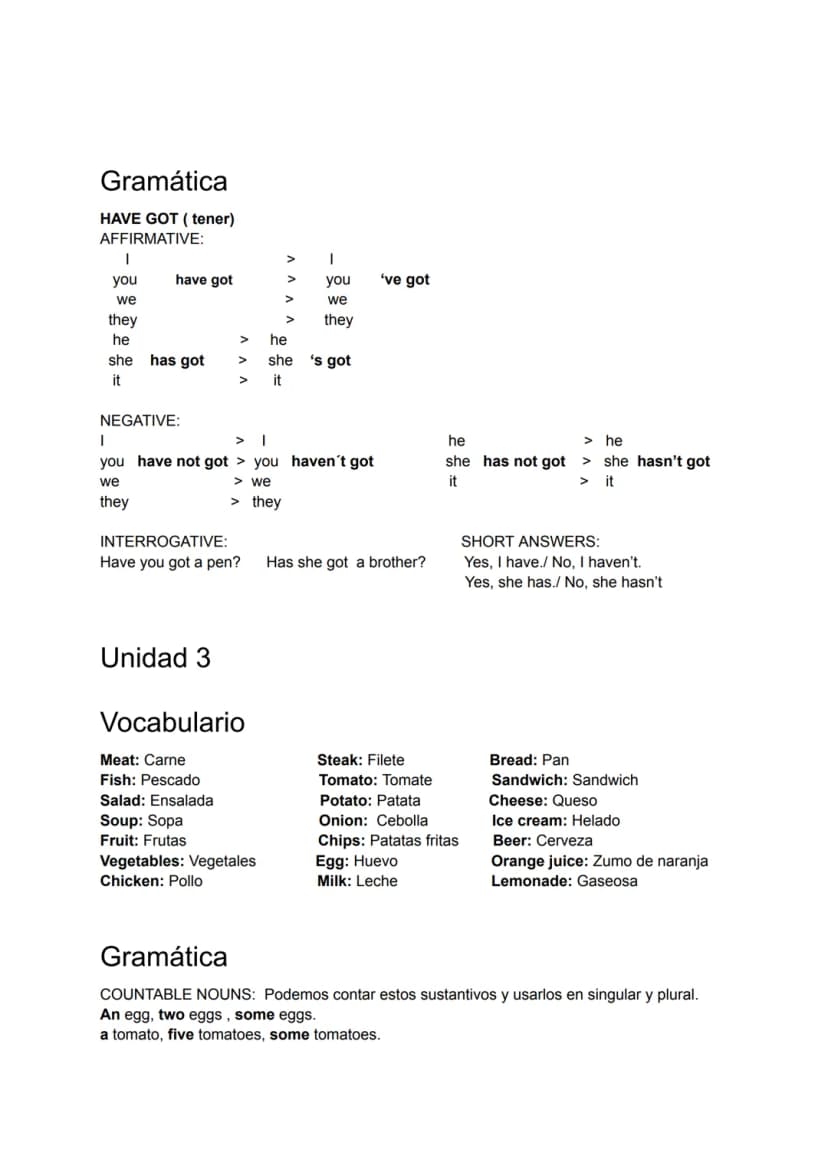
Have Got y Comida
Have got significa "tener" y es súper útil. Se conjuga: I/you/we/they have got, he/she/it has got. Las contracciones I've got y he's got suenan mucho mejor. Para preguntar: Have you got a pen? - Yes, I have!
La comida es vocabulario esencial: meat (carne), fish (pescado), vegetables (verduras), fruit (fruta). Con chicken (pollo), cheese (queso) y bread (pan) ya puedes pedir en cualquier restaurante.
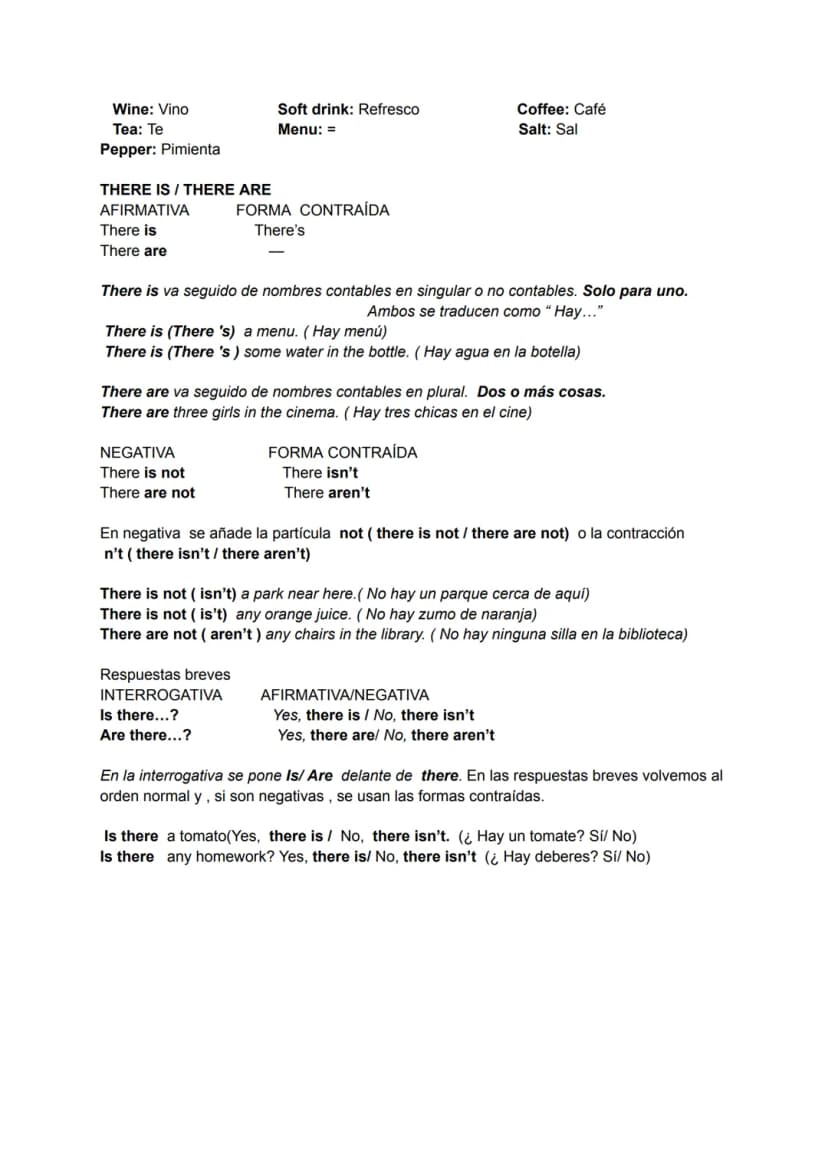
Las comidas del día también son importantes: breakfast (desayuno), lunch (comida), dinner (cena). El menu (menú) incluye starter (entrantes), main course (plato principal) y dessert (postre).
¡Truco! Practica have got describiendo lo que tienes en tu mochila - es divertido y muy útil.
5
of 10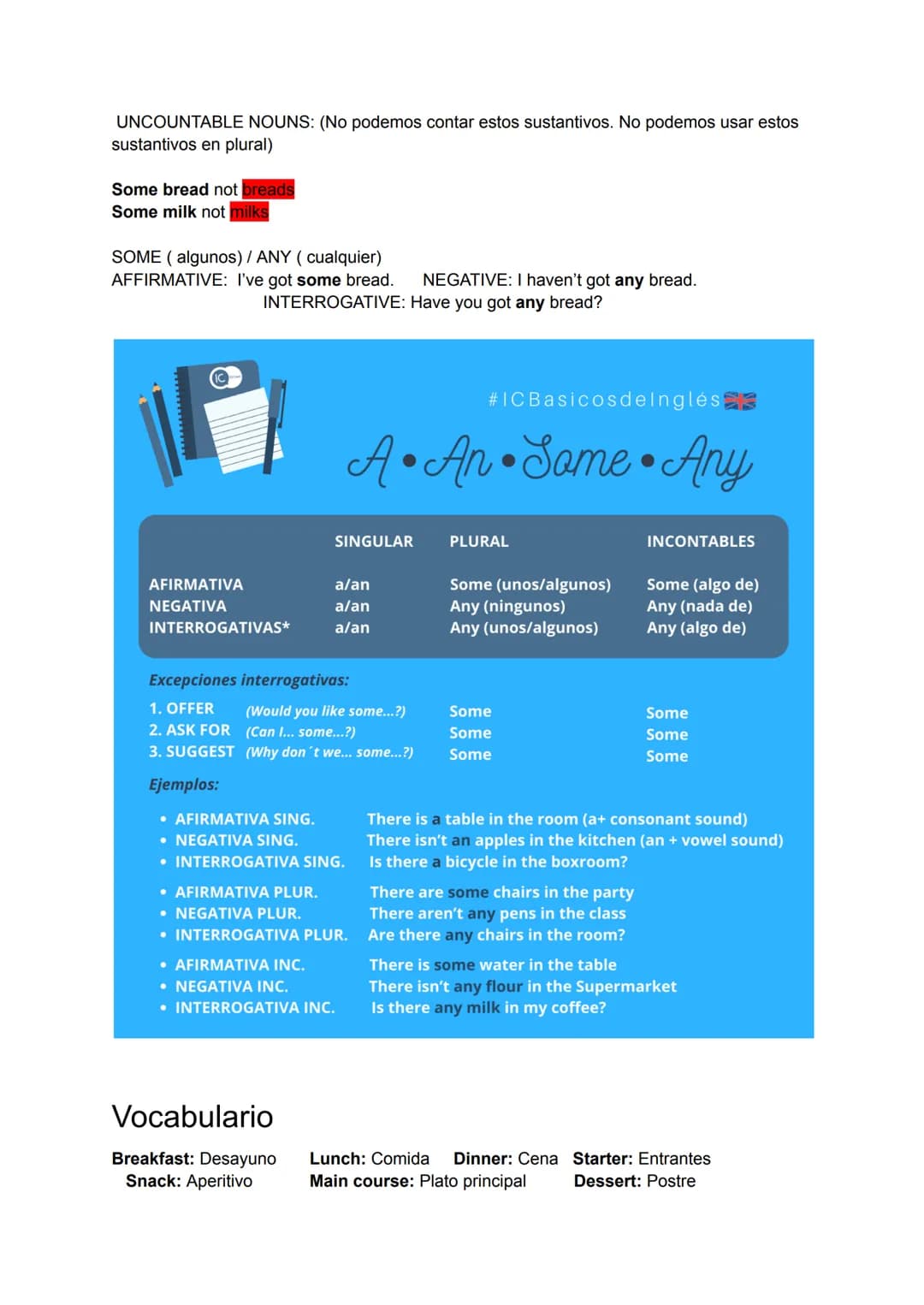
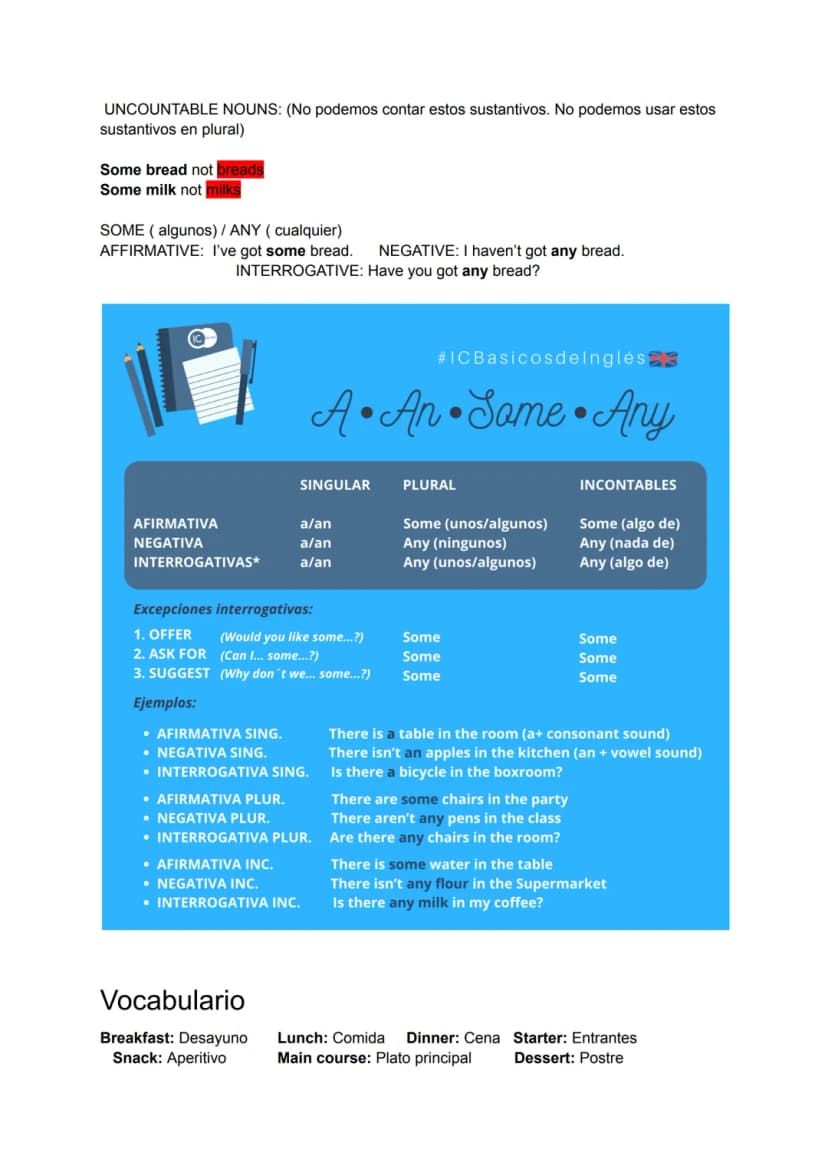
Contables vs Incontables y There Is/There Are
Los sustantivos contables como egg (huevo) pueden ir en plural: two eggs, some eggs. Los incontables como milk (leche) o bread (pan) no tienen plural - nunca digas milks o breads.
Some y any son clave. Usa some en afirmativo (I have some bread), any en negativo (I don't have any milk) y preguntas (Do you have any cheese?). Hay excepciones cuando ofreces algo: Would you like some tea?
There is/There are significa "hay". There is con singular o incontables (There is a table, There is some water). There are con plurales (There are three chairs). Para preguntar: Is there any milk? - Yes, there is!
¡Importante! La diferencia entre contables e incontables es fundamental - practícala con la comida de tu cocina.
6
of 10
Cantidades y la Hora
How much (¿cuánto?) se usa con incontables: How much milk is there? También pregunta precios: How much is the sandwich? How many (¿cuántos?) va con contables: How many apples do you have?
La hora en inglés tiene su sistema. It's five o'clock (son las cinco en punto). It's quarter past two (dos y cuarto), it's half past three (tres y media), it's quarter to four (cuatro menos cuarto).
Para minutos usa past (y) hasta la media hora, y to (menos) después de la media hora. It's ten past five (cinco y diez), it's twenty to six (seis menos veinte).
¡Consejo! Practica la hora mirando relojes durante el día - pronto será automático.
7
of 10
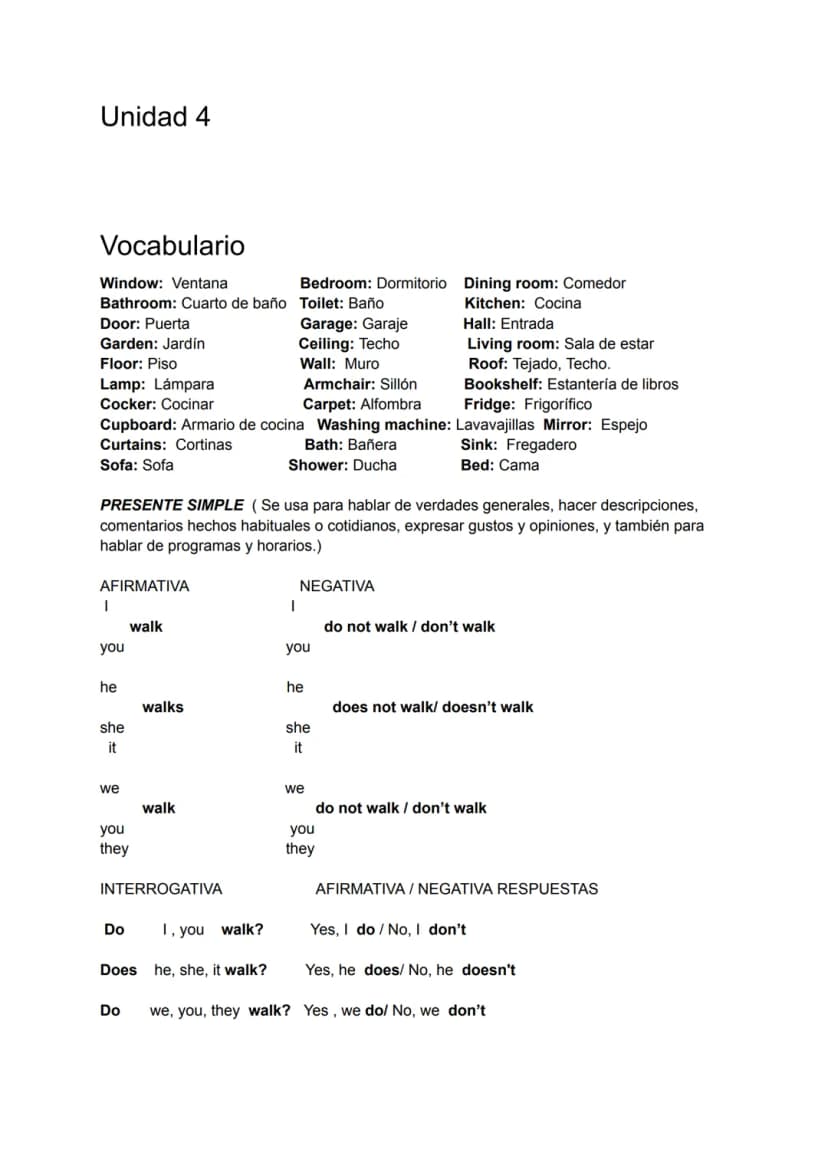
La Casa y Presente Simple
Tu casa está llena de vocabulario útil. Desde bedroom (dormitorio) y kitchen (cocina) hasta garden (jardín) y garage (garaje). Los muebles como sofa, bed (cama) y fridge (frigorífico) completan el vocabulario.
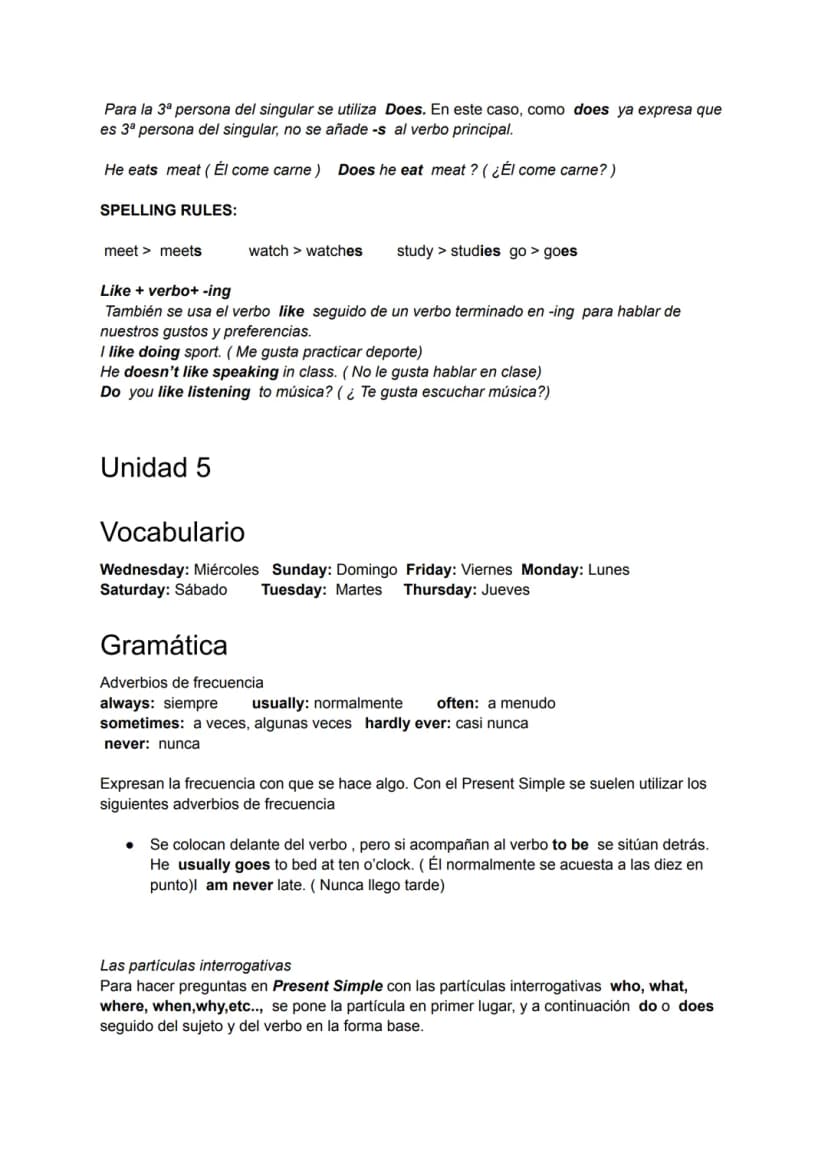
El presente simple describe rutinas y verdades generales. Se conjuga: I/you/we/they walk, he/she/it walks. En negativo: I don't walk, he doesn't walk. Para preguntar: Do you walk?, Does he walk?
Recuerda las reglas de la tercera persona: añade -s (meets), -es después de ch/sh/x (watches), y cambia y por -ies (studies). Para gustos usa like + -ing: I like swimming (me gusta nadar).
¡Truco! Describe tu rutina diaria en presente simple - es práctica perfecta para este tiempo verbal.
8
of 10
Días de la Semana y Frecuencia
Los días de la semana van siempre con mayúscula: Monday, Tuesday, Wednesday, Thursday, Friday, Saturday, Sunday. Son vocabulario básico que usarás constantemente para hacer planes.
Los adverbios de frecuencia expresan qué tan a menudo haces algo: always (siempre), usually (normalmente), often (a menudo), sometimes (a veces), hardly ever (casi nunca), never (nunca).
Van antes del verbo principal (I usually study) pero después del verbo be (I am never late). Las palabras interrogativas (what, where, when, why, how) van al principio: What do you do?, Where does she live?
¡Importante! Los adverbios de frecuencia te ayudan a hablar de tus rutinas - úsalos para sonar más natural.
9
of 10
Colores y Ropa
Los colores básicos son esenciales: red (rojo), blue (azul), green (verde), yellow (amarillo), black (negro), white (blanco), brown (marrón), pink (rosa), purple (morado), orange (naranja), grey (gris).
La ropa incluye prendas básicas como shirt (camisa), trousers (pantalones), dress (vestido), shoes (zapatos), jacket (chaqueta), jeans (vaqueros). Para el tiempo frío: coat (abrigo), scarf (bufanda), sweater (sudadera).
Los pronombres objeto (me, you, him, her, us, them) reciben la acción: She calls me (ella me llama), I see them (los veo). El presente continuo describe acciones ahora: I am working (estoy trabajando).
¡Consejo! Combina colores y ropa para describir outfits - es divertido y muy práctico para ir de compras.
10
of 10
We thought you’d never ask...
What is the Knowunity AI companion?
Our AI companion is specifically built for the needs of students. Based on the millions of content pieces we have on the platform we can provide truly meaningful and relevant answers to students. But its not only about answers, the companion is even more about guiding students through their daily learning challenges, with personalised study plans, quizzes or content pieces in the chat and 100% personalisation based on the students skills and developments.
Where can I download the Knowunity app?
You can download the app in the Google Play Store and in the Apple App Store.
Is Knowunity really free of charge?
That's right! Enjoy free access to study content, connect with fellow students, and get instant help – all at your fingertips.
Similar Content
 Anglais
Most popular content: english vocabulary
9InglésINGLÉS B1 (Cambridge)
Apuntes para preparación B1 (completo)
4° ESO10,9291,461
InglésInglés B2 (Parte 1)
Estos apuntes, cuenta con parte de grammar, vocabulary, writing. Estos apuntes te preparan muy bien para los exámenes y además te responden a cualquier duda que tengas ya que son bastante extensos en la mayoría de contenidos.
4° ESO4,751379
InglésPhrasal Verbs
Phrasal Verbs
1° Bach3,875106
InglésGRAMÁTICA Y VOCABULARIO INGLÉS 1 BACH
PDF con toda la gramática en la asignatura de inglés en primero de bachillerato, explicado con estructura, colores y ejemplos. Tiempos verbales, condicionales, reported speech, voz pasiva, etc.
4° ESO4,249207
InglésVocabulary Burlington books
Todo el vocabulario de las unidades 1 a 4
2° Bach1,12834
InglésGlosario completo
vocabulario super completo de inglés de 2 bachillerato
4° ESO1,41238
InglésVocabulario
Vocabulario en inglés(Estaciones, Meses, Días de semana) ¡Espero que es sirva!
2° ESO83614
InglésVocabulario y gramática de inglés
Está dividido por secciones: vocabulario, writing y gramática (la gramática está toda explicada)
1° Bach3227
InglésVocabulario de inglés
Vocabulario sobre viajes, calles, false friends, turismo...
4° ESO2998
Most popular content in Inglés
9I
Inglésirregular verbs quiz
Domina el idioma inglés de manera sencilla y divertida con estos flashcards diseñados especialmente para estudiantes de sexto grado.
6º primaria2,8981
D
InglésDominando la gramática inglesa: Flashcards desafiantes
Mejora tus habilidades gramaticales en inglés con estos flashcards desafiantes diseñados para estudiantes de grado 11. ¡Prepárate para dominar la gramática inglesa de manera divertida y efectiva!
3° ESO2,2450
I
InglésIngles para repasar
quiz de ingles para entrar a clase preparados
2° ESO2,6290
I
InglésIrregular verbs
Aprende nuevas palabras y expande tu vocabulario en inglés con esta colección de tarjetas de estudio interactivas.
3° ESO1,7442
I
InglésIrregular verbs 1-30
Aprende los primeros 30 verbos irregulares esenciales en inglés, incluyendo sus formas de pasado simple y participio.
2° ESO1,1590
C
InglésConjugación de Verbos Irregulares en Pasado
Practica la transformación de verbos en presente a su forma correspondiente en Past Simple para ampliar tu vocabulario básico.
1° ESO1,0940
I
InglésIrregular verbs part 21
Here's a quiz to learn irregular verbs.
2° ESO7921
C
Ingléscomparativos y superlativos inglés 2
quizzz
1° ESO1,7743
D
InglésDomina el inglés fácilmente
Aprende de manera sencilla y efectiva el idioma inglés con estos flashcards diseñados especialmente para ti.
1° Bach3,3734
Most popular content
9I
Inglésirregular verbs quiz
Domina el idioma inglés de manera sencilla y divertida con estos flashcards diseñados especialmente para estudiantes de sexto grado.
6º primaria2,8981
R
 Geografía e Historia
roma
a estudiar Roma!!
1° ESO2,3122
G
Geografía e HistoriaGrecia: Inicio de la democracia
Más o menos las preguntas que me pusieron a mí en el examen
1° ESO2,3622
D
InglésDominando la gramática inglesa: Flashcards desafiantes
Mejora tus habilidades gramaticales en inglés con estos flashcards desafiantes diseñados para estudiantes de grado 11. ¡Prepárate para dominar la gramática inglesa de manera divertida y efectiva!
3° ESO2,2450
M
Geografía e HistoriaMesopotamia y Egipto
Contenidos sobre la civilización mesopotámica y egipcia
1° ESO3,9381
O
 Lengua Castellana y Literatura
OBRAS Y AUTORES II
Quiz donde tendrás que relacionar las siguientes obras con sus respectivos autores: edición Romanticismo.
4° ESO3,3610
I
InglésIngles para repasar
quiz de ingles para entrar a clase preparados
2° ESO2,6290
F
 Filosofía
filosofía
repaso filosofía "el arje , la metafísica y la crítica de Nietszche a platon"
1° Bach2,8421
I
InglésIrregular verbs
Aprende nuevas palabras y expande tu vocabulario en inglés con esta colección de tarjetas de estudio interactivas.
3° ESO1,7442
Can't find what you're looking for? Explore other subjects.
Students love us — and so will you.
4.6/5App Store
4.7/5Google Play
The app is very easy to use and well designed. I have found everything I was looking for so far and have been able to learn a lot from the presentations! I will definitely use the app for a class assignment! And of course it also helps a lot as an inspiration.
Stefan SiOS user
This app is really great. There are so many study notes and help [...]. My problem subject is French, for example, and the app has so many options for help. Thanks to this app, I have improved my French. I would recommend it to anyone.
Samantha KlichAndroid user
Wow, I am really amazed. I just tried the app because I've seen it advertised many times and was absolutely stunned. This app is THE HELP you want for school and above all, it offers so many things, such as workouts and fact sheets, which have been VERY helpful to me personally.
AnnaiOS user
Inglés1,120 views·Updated Jun 23, 2026·13 pagesGuía de inglés nivel fácil para principiantes
LUCAS 👑@lucas_nose
¡Aprende inglés básico de forma fácil y divertida! Este resumen cubre vocabulario esencial, gramática fundamental y expresiones útiles que necesitas dominar para tus primeros años de inglés.
1
of 10
Sign up to see the content. It's free!
- Access to all documents
- Improve your grades
- Join milions of students
Vocabulario Esencial y el Verbo TO BE
¿Sabías que con estas palabras ya puedes describir tu aula y presentarte? El vocabulario básico incluye objetos de clase como chair (silla), desk (escritorio) y book (libro), además de nacionalidades como Spanish (español) y British (británico).
El verbo TO BE es tu mejor amigo en inglés. Se conjuga como: I am, you are, he/she/it is. Para hacer negaciones, añades not: I am not, he isn't. ¡Las contracciones como I'm y he's suenan mucho más naturales!
Las preguntas son súper fáciles: solo cambias el orden. Are you Spanish? - Yes, I am! Con las profesiones como doctor, teacher o chef, puedes decir I am a student y ya estás hablando inglés como un campeón.
¡Truco! Practica las contracciones desde el principio - así hablarás inglés más fluido desde el primer día.
2
of 10Sign up to see the content. It's free!
- Access to all documents
- Improve your grades
- Join milions of students
Plurales y Demostrativos
Los plurales en inglés tienen sus trucos, pero son más fáciles de lo que piensas. La mayoría solo necesitan una -s: book → books. Si termina en consonante + y, cambias la y por -ies: secretary → secretaries.
Algunos plurales son especiales como man → men, woman → women y child → children. ¡Memorízalos porque los usarás constantemente!
Los demostrativos te ayudan a señalar cosas. This y that van con singular (this book, that car), mientras que these y those van con plural (these books, those cars). This/these para cosas cerca, that/those para cosas lejos.
¡Importante! Los plurales irregulares como children o people aparecen en todos los exámenes, así que repásalos bien.
3
of 10Sign up to see the content. It's free!
- Access to all documents
- Improve your grades
- Join milions of students
La Familia y Posesivos
Tu familia es el tema perfecto para practicar inglés. Desde parents (padres) hasta grandchildren (nietos), este vocabulario lo usarás toda la vida. Los in-laws (familia política) también son importantes: mother-in-law (suegra), brother-in-law (cuñado).
El genitivo sajón es genial para mostrar posesión. Añades 's: George's children (los hijos de George). Si el nombre termina en s, solo añades el apóstrofe: James' wife (la esposa de James).
Los adjetivos posesivos (my, your, his, her) siempre van antes del sustantivo: my sister, his car. Los adjetivos descriptivos como tall (alto), funny (divertido) o beautiful (hermoso) hacen tus conversaciones más interesantes.
¡Consejo! Dibuja tu árbol genealógico en inglés - es la mejor manera de recordar el vocabulario familiar.
4
of 10Sign up to see the content. It's free!
- Access to all documents
- Improve your grades
- Join milions of students
Have Got y Comida
Have got significa "tener" y es súper útil. Se conjuga: I/you/we/they have got, he/she/it has got. Las contracciones I've got y he's got suenan mucho mejor. Para preguntar: Have you got a pen? - Yes, I have!
La comida es vocabulario esencial: meat (carne), fish (pescado), vegetables (verduras), fruit (fruta). Con chicken (pollo), cheese (queso) y bread (pan) ya puedes pedir en cualquier restaurante.
Las comidas del día también son importantes: breakfast (desayuno), lunch (comida), dinner (cena). El menu (menú) incluye starter (entrantes), main course (plato principal) y dessert (postre).
¡Truco! Practica have got describiendo lo que tienes en tu mochila - es divertido y muy útil.
5
of 10Sign up to see the content. It's free!
- Access to all documents
- Improve your grades
- Join milions of students
Contables vs Incontables y There Is/There Are
Los sustantivos contables como egg (huevo) pueden ir en plural: two eggs, some eggs. Los incontables como milk (leche) o bread (pan) no tienen plural - nunca digas milks o breads.
Some y any son clave. Usa some en afirmativo (I have some bread), any en negativo (I don't have any milk) y preguntas (Do you have any cheese?). Hay excepciones cuando ofreces algo: Would you like some tea?
There is/There are significa "hay". There is con singular o incontables (There is a table, There is some water). There are con plurales (There are three chairs). Para preguntar: Is there any milk? - Yes, there is!
¡Importante! La diferencia entre contables e incontables es fundamental - practícala con la comida de tu cocina.
6
of 10Sign up to see the content. It's free!
- Access to all documents
- Improve your grades
- Join milions of students
Cantidades y la Hora
How much (¿cuánto?) se usa con incontables: How much milk is there? También pregunta precios: How much is the sandwich? How many (¿cuántos?) va con contables: How many apples do you have?
La hora en inglés tiene su sistema. It's five o'clock (son las cinco en punto). It's quarter past two (dos y cuarto), it's half past three (tres y media), it's quarter to four (cuatro menos cuarto).
Para minutos usa past (y) hasta la media hora, y to (menos) después de la media hora. It's ten past five (cinco y diez), it's twenty to six (seis menos veinte).
¡Consejo! Practica la hora mirando relojes durante el día - pronto será automático.
7
of 10Sign up to see the content. It's free!
- Access to all documents
- Improve your grades
- Join milions of students
La Casa y Presente Simple
Tu casa está llena de vocabulario útil. Desde bedroom (dormitorio) y kitchen (cocina) hasta garden (jardín) y garage (garaje). Los muebles como sofa, bed (cama) y fridge (frigorífico) completan el vocabulario.
El presente simple describe rutinas y verdades generales. Se conjuga: I/you/we/they walk, he/she/it walks. En negativo: I don't walk, he doesn't walk. Para preguntar: Do you walk?, Does he walk?
Recuerda las reglas de la tercera persona: añade -s (meets), -es después de ch/sh/x (watches), y cambia y por -ies (studies). Para gustos usa like + -ing: I like swimming (me gusta nadar).
¡Truco! Describe tu rutina diaria en presente simple - es práctica perfecta para este tiempo verbal.
8
of 10Sign up to see the content. It's free!
- Access to all documents
- Improve your grades
- Join milions of students
Días de la Semana y Frecuencia
Los días de la semana van siempre con mayúscula: Monday, Tuesday, Wednesday, Thursday, Friday, Saturday, Sunday. Son vocabulario básico que usarás constantemente para hacer planes.
Los adverbios de frecuencia expresan qué tan a menudo haces algo: always (siempre), usually (normalmente), often (a menudo), sometimes (a veces), hardly ever (casi nunca), never (nunca).
Van antes del verbo principal (I usually study) pero después del verbo be (I am never late). Las palabras interrogativas (what, where, when, why, how) van al principio: What do you do?, Where does she live?
¡Importante! Los adverbios de frecuencia te ayudan a hablar de tus rutinas - úsalos para sonar más natural.
9
of 10Sign up to see the content. It's free!
- Access to all documents
- Improve your grades
- Join milions of students
Colores y Ropa
Los colores básicos son esenciales: red (rojo), blue (azul), green (verde), yellow (amarillo), black (negro), white (blanco), brown (marrón), pink (rosa), purple (morado), orange (naranja), grey (gris).
La ropa incluye prendas básicas como shirt (camisa), trousers (pantalones), dress (vestido), shoes (zapatos), jacket (chaqueta), jeans (vaqueros). Para el tiempo frío: coat (abrigo), scarf (bufanda), sweater (sudadera).
Los pronombres objeto (me, you, him, her, us, them) reciben la acción: She calls me (ella me llama), I see them (los veo). El presente continuo describe acciones ahora: I am working (estoy trabajando).
¡Consejo! Combina colores y ropa para describir outfits - es divertido y muy práctico para ir de compras.
10
of 10Sign up to see the content. It's free!
- Access to all documents
- Improve your grades
- Join milions of students
We thought you’d never ask...
What is the Knowunity AI companion?
Our AI companion is specifically built for the needs of students. Based on the millions of content pieces we have on the platform we can provide truly meaningful and relevant answers to students. But its not only about answers, the companion is even more about guiding students through their daily learning challenges, with personalised study plans, quizzes or content pieces in the chat and 100% personalisation based on the students skills and developments.
Where can I download the Knowunity app?
You can download the app in the Google Play Store and in the Apple App Store.
Is Knowunity really free of charge?
That's right! Enjoy free access to study content, connect with fellow students, and get instant help – all at your fingertips.
Similar Content
Most popular content: english vocabulary
9InglésINGLÉS B1 (Cambridge)
Apuntes para preparación B1 (completo)
4° ESO10,9291,461
InglésInglés B2 (Parte 1)
Estos apuntes, cuenta con parte de grammar, vocabulary, writing. Estos apuntes te preparan muy bien para los exámenes y además te responden a cualquier duda que tengas ya que son bastante extensos en la mayoría de contenidos.
4° ESO4,751379
InglésPhrasal Verbs
Phrasal Verbs
1° Bach3,875106
InglésGRAMÁTICA Y VOCABULARIO INGLÉS 1 BACH
PDF con toda la gramática en la asignatura de inglés en primero de bachillerato, explicado con estructura, colores y ejemplos. Tiempos verbales, condicionales, reported speech, voz pasiva, etc.
4° ESO4,249207
InglésVocabulary Burlington books
Todo el vocabulario de las unidades 1 a 4
2° Bach1,12834
InglésGlosario completo
vocabulario super completo de inglés de 2 bachillerato
4° ESO1,41238
InglésVocabulario
Vocabulario en inglés(Estaciones, Meses, Días de semana) ¡Espero que es sirva!
2° ESO83614
InglésVocabulario y gramática de inglés
Está dividido por secciones: vocabulario, writing y gramática (la gramática está toda explicada)
1° Bach3227
InglésVocabulario de inglés
Vocabulario sobre viajes, calles, false friends, turismo...
4° ESO2998
Most popular content in Inglés
9I
Inglésirregular verbs quiz
Domina el idioma inglés de manera sencilla y divertida con estos flashcards diseñados especialmente para estudiantes de sexto grado.
6º primaria2,8981
D
InglésDominando la gramática inglesa: Flashcards desafiantes
Mejora tus habilidades gramaticales en inglés con estos flashcards desafiantes diseñados para estudiantes de grado 11. ¡Prepárate para dominar la gramática inglesa de manera divertida y efectiva!
3° ESO2,2450
I
InglésIngles para repasar
quiz de ingles para entrar a clase preparados
2° ESO2,6290
I
InglésIrregular verbs
Aprende nuevas palabras y expande tu vocabulario en inglés con esta colección de tarjetas de estudio interactivas.
3° ESO1,7442
I
InglésIrregular verbs 1-30
Aprende los primeros 30 verbos irregulares esenciales en inglés, incluyendo sus formas de pasado simple y participio.
2° ESO1,1590
C
InglésConjugación de Verbos Irregulares en Pasado
Practica la transformación de verbos en presente a su forma correspondiente en Past Simple para ampliar tu vocabulario básico.
1° ESO1,0940
I
InglésIrregular verbs part 21
Here's a quiz to learn irregular verbs.
2° ESO7921
C
Ingléscomparativos y superlativos inglés 2
quizzz
1° ESO1,7743
D
InglésDomina el inglés fácilmente
Aprende de manera sencilla y efectiva el idioma inglés con estos flashcards diseñados especialmente para ti.
1° Bach3,3734
Most popular content
9I
Inglésirregular verbs quiz
Domina el idioma inglés de manera sencilla y divertida con estos flashcards diseñados especialmente para estudiantes de sexto grado.
6º primaria2,8981
R
Geografía e Historiaroma
a estudiar Roma!!
1° ESO2,3122
G
Geografía e HistoriaGrecia: Inicio de la democracia
Más o menos las preguntas que me pusieron a mí en el examen
1° ESO2,3622
D
InglésDominando la gramática inglesa: Flashcards desafiantes
Mejora tus habilidades gramaticales en inglés con estos flashcards desafiantes diseñados para estudiantes de grado 11. ¡Prepárate para dominar la gramática inglesa de manera divertida y efectiva!
3° ESO2,2450
M
Geografía e HistoriaMesopotamia y Egipto
Contenidos sobre la civilización mesopotámica y egipcia
1° ESO3,9381
O
Lengua Castellana y LiteraturaOBRAS Y AUTORES II
Quiz donde tendrás que relacionar las siguientes obras con sus respectivos autores: edición Romanticismo.
4° ESO3,3610
I
InglésIngles para repasar
quiz de ingles para entrar a clase preparados
2° ESO2,6290
F
Filosofíafilosofía
repaso filosofía "el arje , la metafísica y la crítica de Nietszche a platon"
1° Bach2,8421
I
InglésIrregular verbs
Aprende nuevas palabras y expande tu vocabulario en inglés con esta colección de tarjetas de estudio interactivas.
3° ESO1,7442
Can't find what you're looking for? Explore other subjects.
Students love us — and so will you.
4.6/5App Store
4.7/5Google Play
The app is very easy to use and well designed. I have found everything I was looking for so far and have been able to learn a lot from the presentations! I will definitely use the app for a class assignment! And of course it also helps a lot as an inspiration.
Stefan SiOS user
This app is really great. There are so many study notes and help [...]. My problem subject is French, for example, and the app has so many options for help. Thanks to this app, I have improved my French. I would recommend it to anyone.
Samantha KlichAndroid user
Wow, I am really amazed. I just tried the app because I've seen it advertised many times and was absolutely stunned. This app is THE HELP you want for school and above all, it offers so many things, such as workouts and fact sheets, which have been VERY helpful to me personally.
AnnaiOS user