
¿Te cuesta recordar todos los verbos en inglés cuando haces...
 Inglés3,510 views·Updated Jun 17, 2026·5 pages
Lista Completa de Verbos Regulares e Irregulares en Inglés

Alba Domínguez Cardoso@betapeta
1 / 5
1
of 5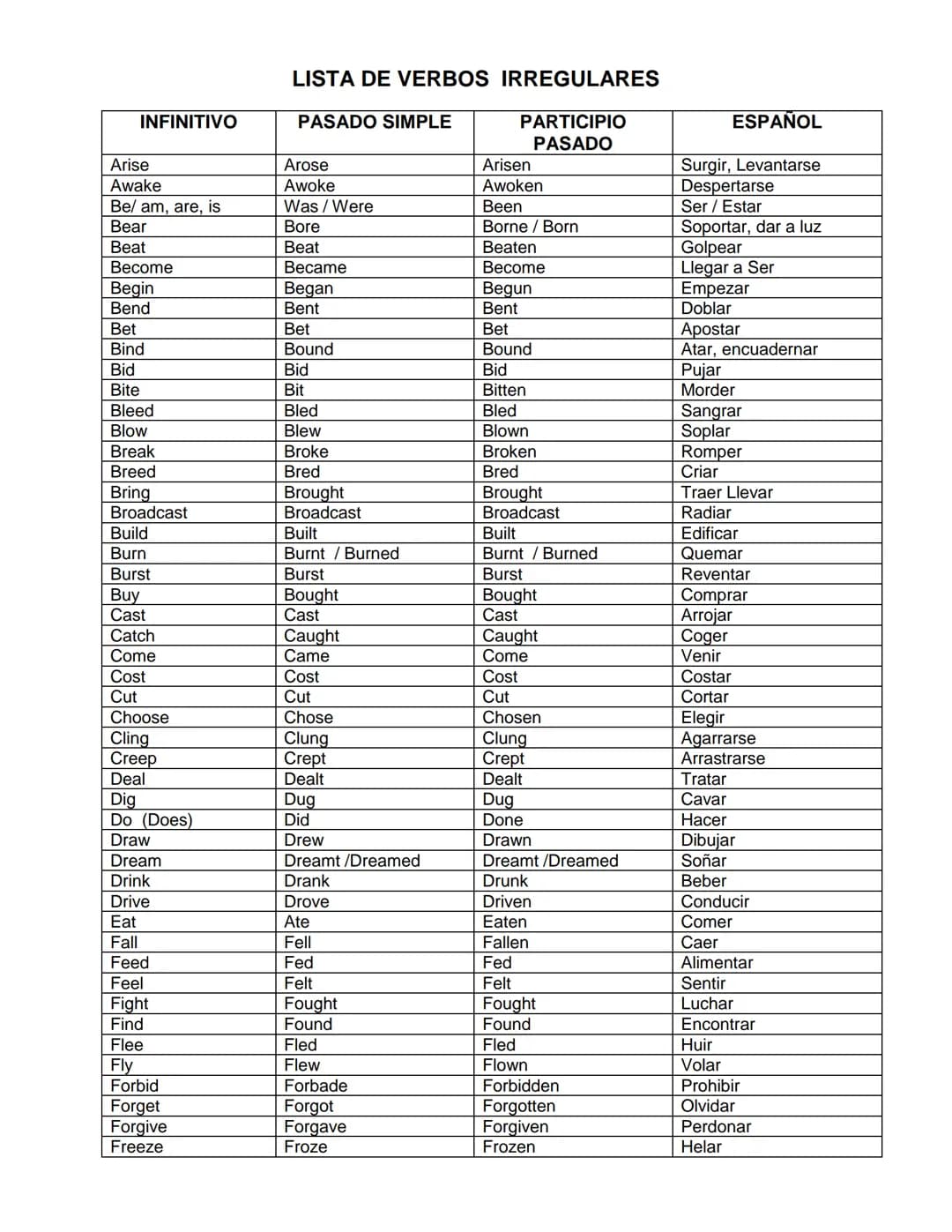
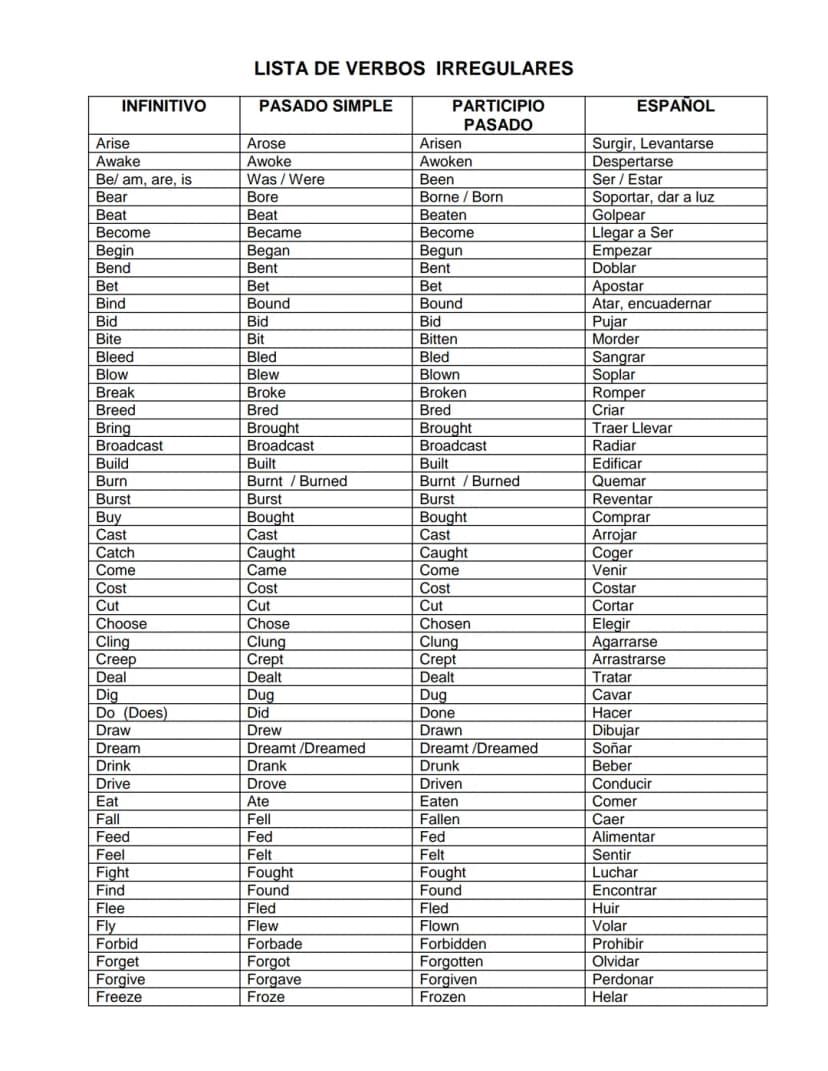
Verbos Irregulares: La Base
Los verbos irregulares son esos que no siguen las reglas normales cuando los pones en pasado. No puedes simplemente añadir "-ed" como con los verbos regulares, sino que cambian completamente su forma.
Esta primera parte incluye verbos súper comunes como "be", "do", "go" y "have" que usas constantemente. Fíjate en cómo algunos cambian completamente mientras otros se mantienen igual en las tres formas .
Los verbos como "begin", "break" y "bring" aparecen mucho en los exámenes, así que memorízalos bien. Muchos siguen patrones parecidos: por ejemplo, "sing-sang-sung" funciona igual que "ring-rang-rung".
💡 Truco: Agrupa los verbos por patrones de sonido. Es mucho más fácil recordar "drink-drank-drunk" si lo asocias con "sing-sang-sung".
2
of 5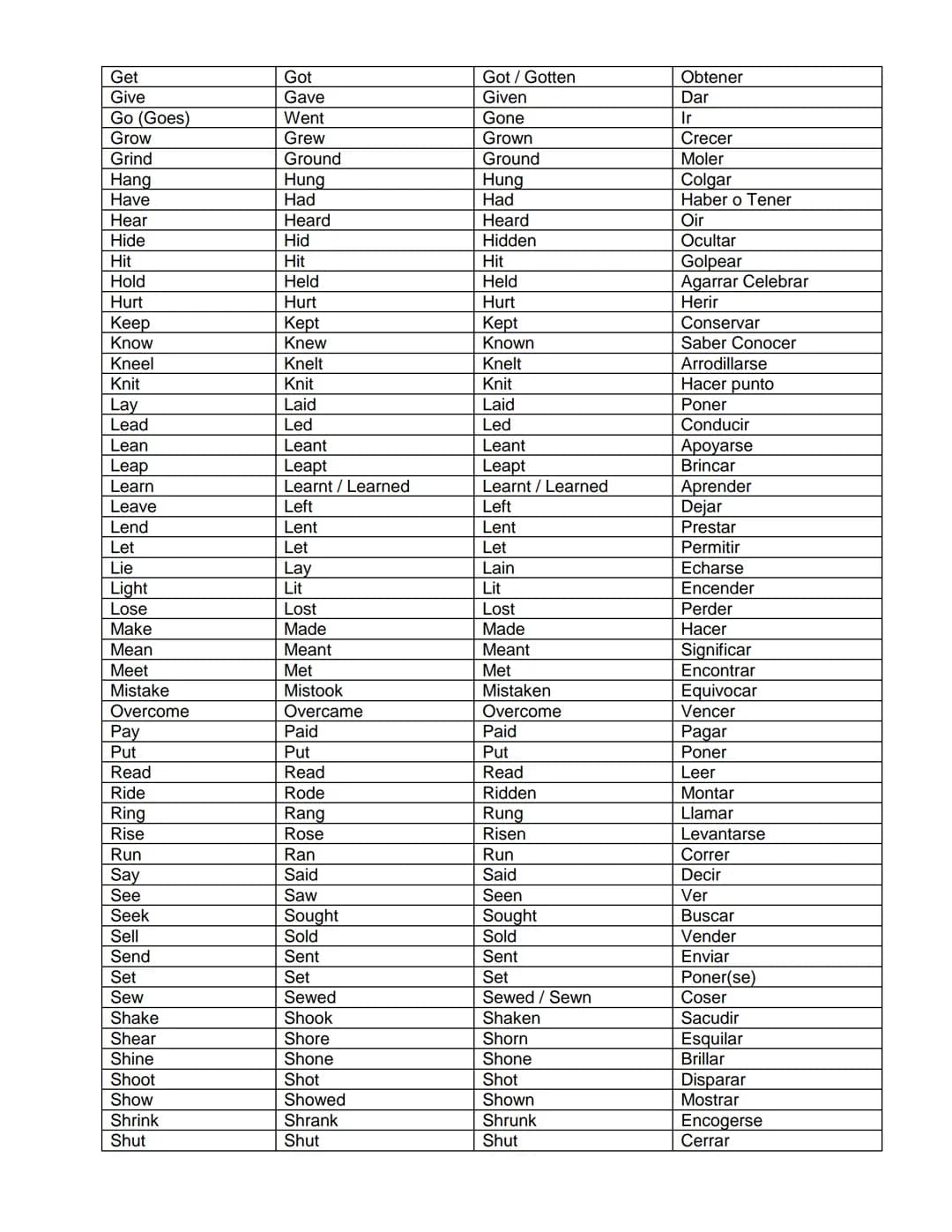
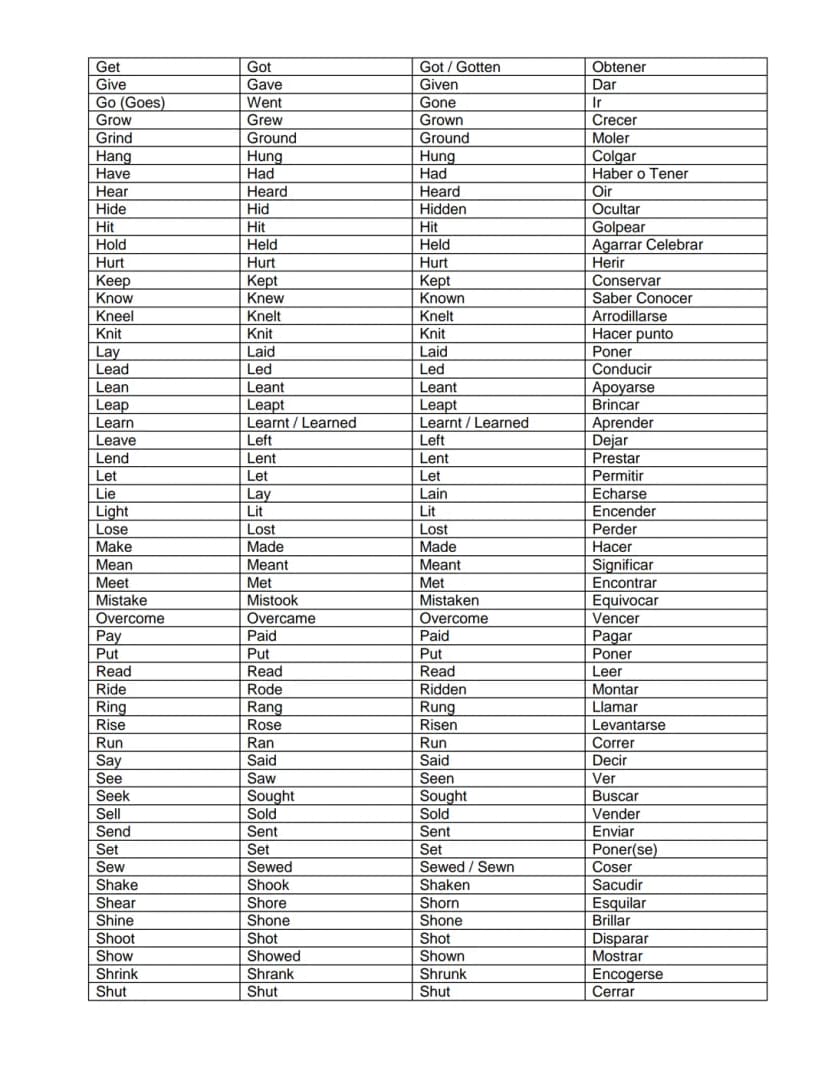
Verbos Irregulares: Continuación
Aquí tienes más verbos irregulares esenciales que necesitas dominar. Verbos como "get", "give" y "know" son básicos para cualquier conversación en inglés.
Presta atención especial a "read" - se escribe igual pero se pronuncia diferente en pasado. También fíjate en verbos como "put" y "set" que no cambian nada.
Los verbos de movimiento como "run", "ride" y "rise" suelen ser complicados, pero una vez que los practiques un par de veces, los tendrás dominados. "See" y "say" los usarás todos los días.
💡 Consejo: Practica haciendo frases con estos verbos en los tres tiempos. Por ejemplo: "I see the problem / I saw it yesterday / I have seen it before".
3
of 5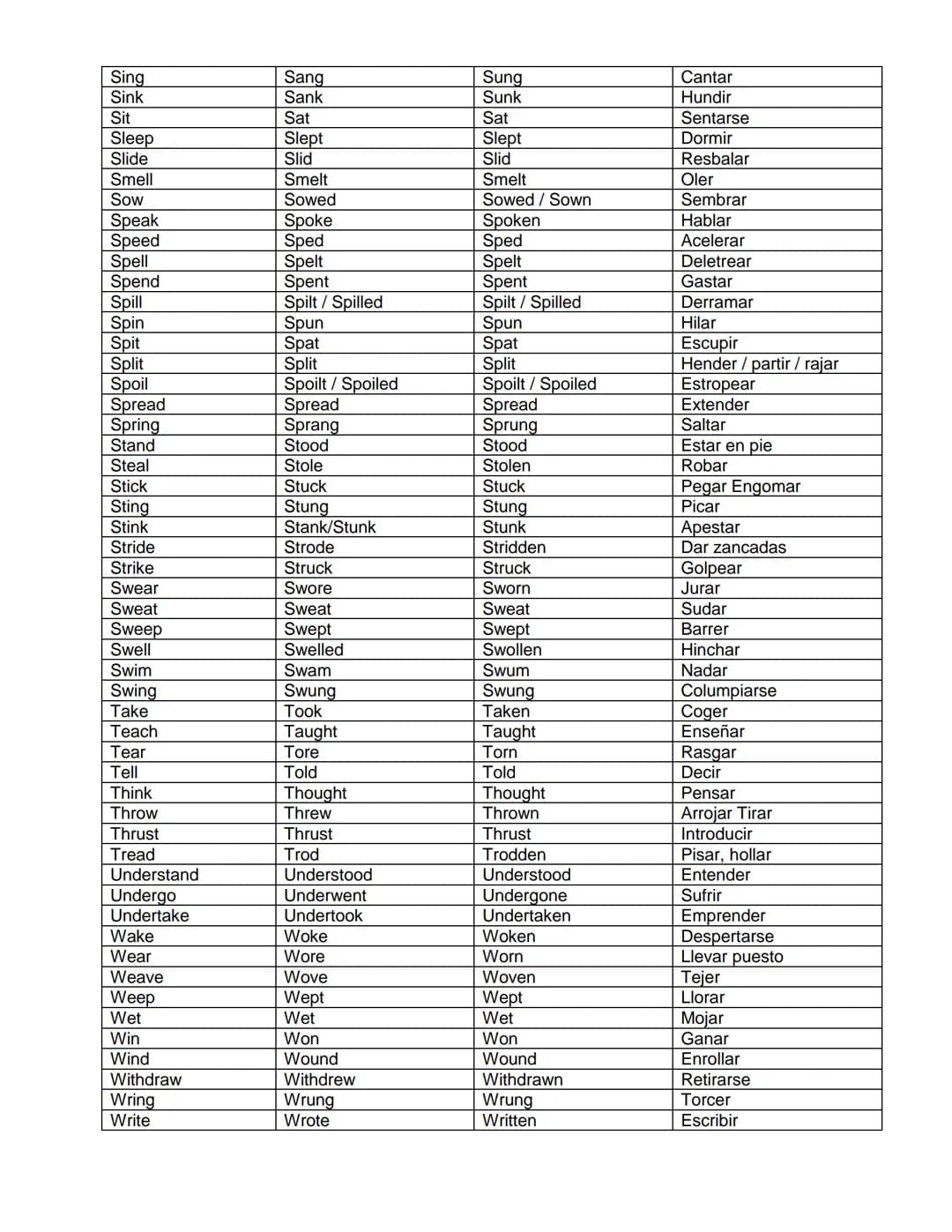
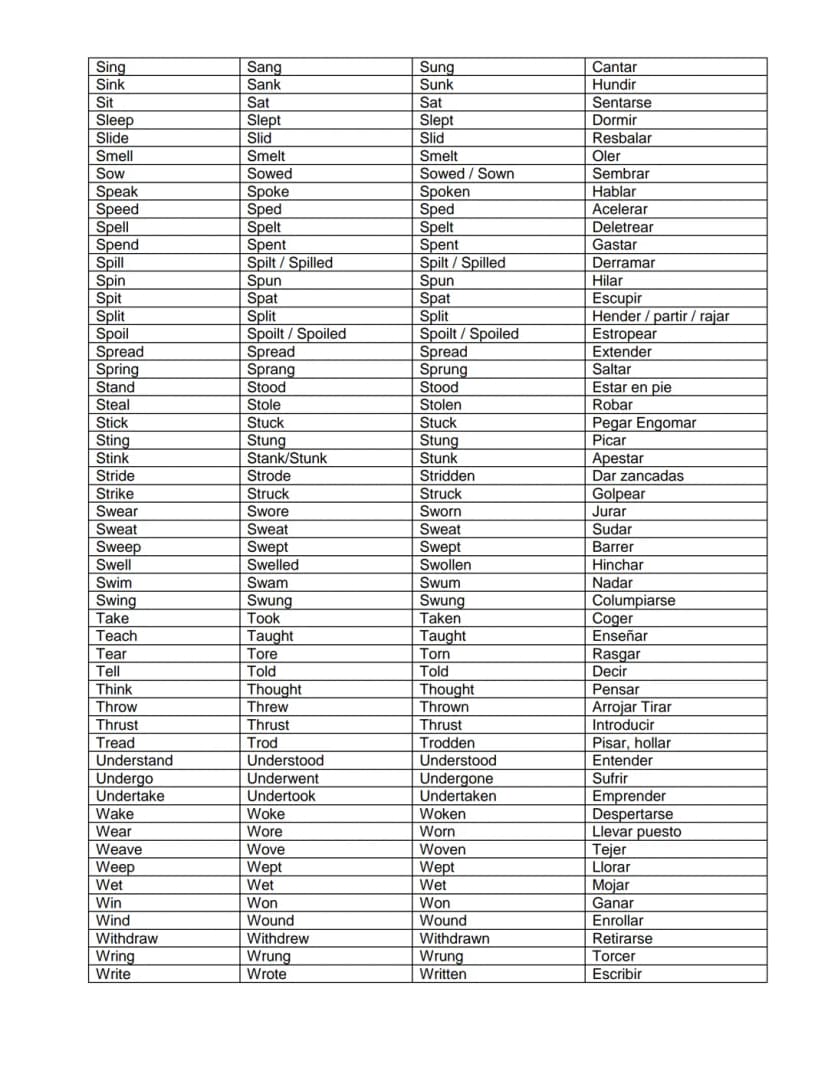
Verbos Irregulares: Final
Esta última sección completa tu arsenal de verbos irregulares con algunos de los más útiles. "Think" , "tell" y "write" aparecen constantemente en textos y conversaciones.
Los verbos como "swim", "sing" y "win" siguen patrones que ya conoces, así que no te agobies. "Understand" es simplemente "stand" con un prefijo, lo que hace que sea más fácil de recordar.
Verbos como "wear" y "wake" son perfectos para describir rutinas diarias. Con esta lista completa ya tienes todos los verbos irregulares importantes que necesitas para el instituto.
💡 Estrategia: Crea historias cortas usando varios de estos verbos juntos. Tu cerebro recordará mejor las formas verbales cuando las asocie con una narrativa.
4
of 5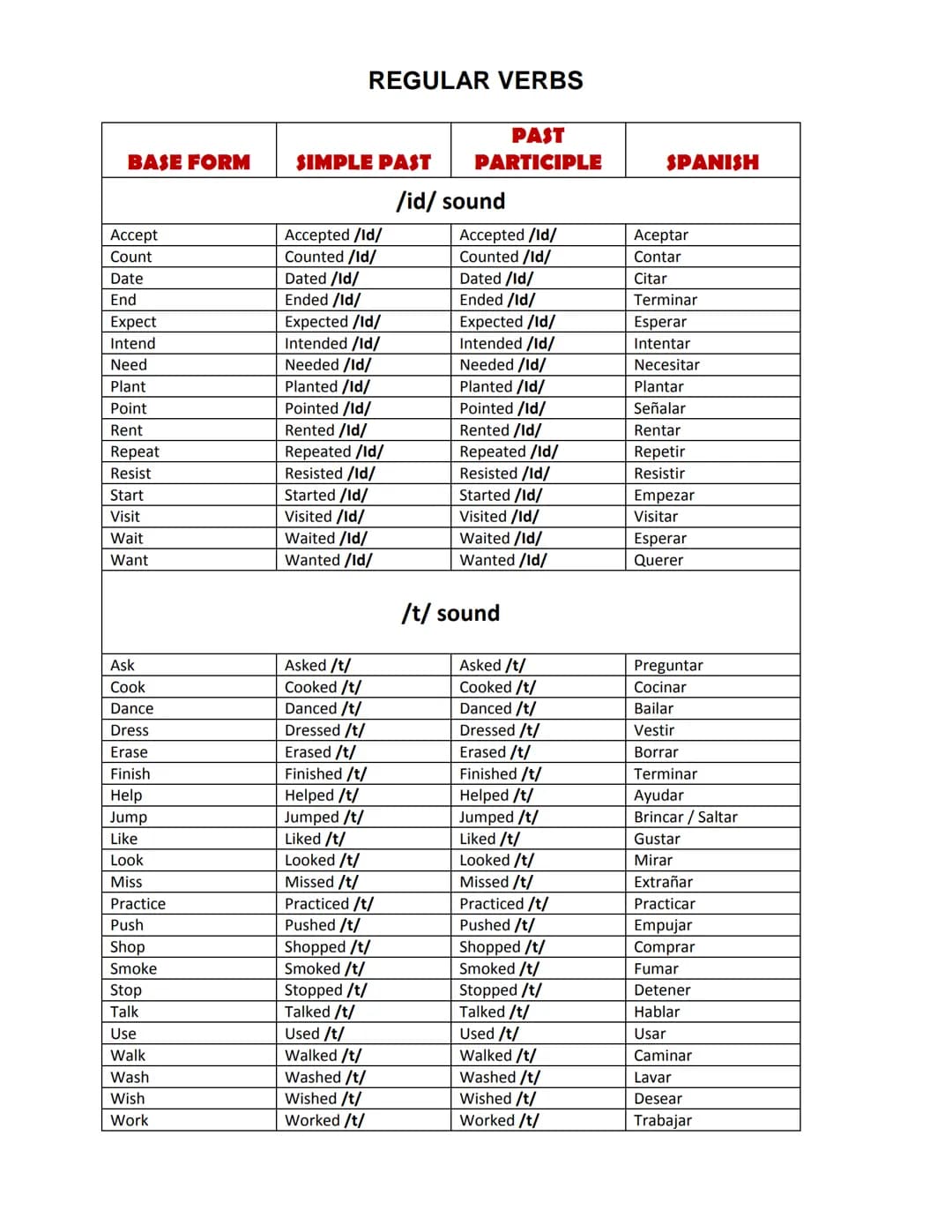
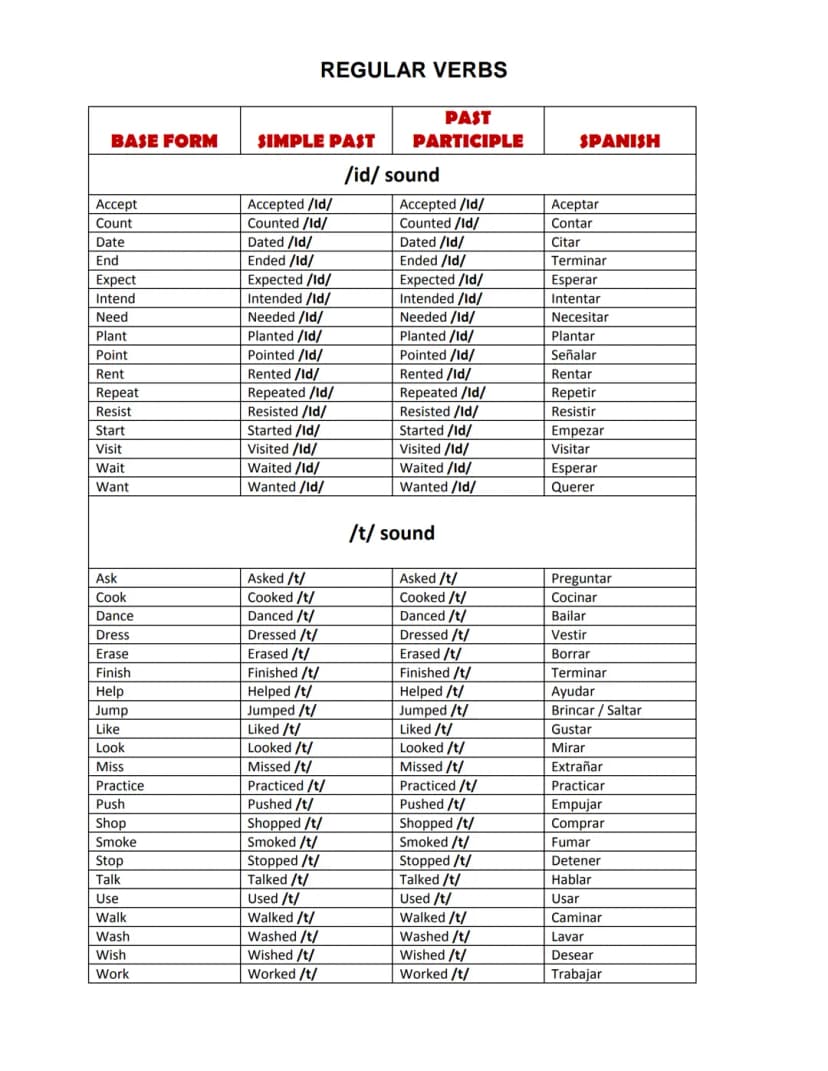
Verbos Regulares: Sonidos /id/ y /t/
Los verbos regulares son mucho más fáciles porque siguen reglas fijas. Todos terminan en "-ed" en pasado, pero la pronunciación cambia según la última letra del verbo base.
Con el sonido /id/, como en "wanted" o "needed", pronuncias la "ed" como una sílaba extra. Esto pasa cuando el verbo termina en "t" o "d". Es como si el inglés necesitara esa sílaba extra para que suene bien.
El sonido /t/ aparece después de consonantes sordas como "k", "p", "s". Verbos como "cooked", "helped" o "missed" suenan como si terminaran en "t" en vez de "ed". Es más rápido de pronunciar y suena más natural.
💡 Regla de oro: Si no puedes pronunciar el "-ed" sin añadir una sílaba extra, probablemente sea sonido /id/. Si suena como "t", es sonido /t/.
5
of 5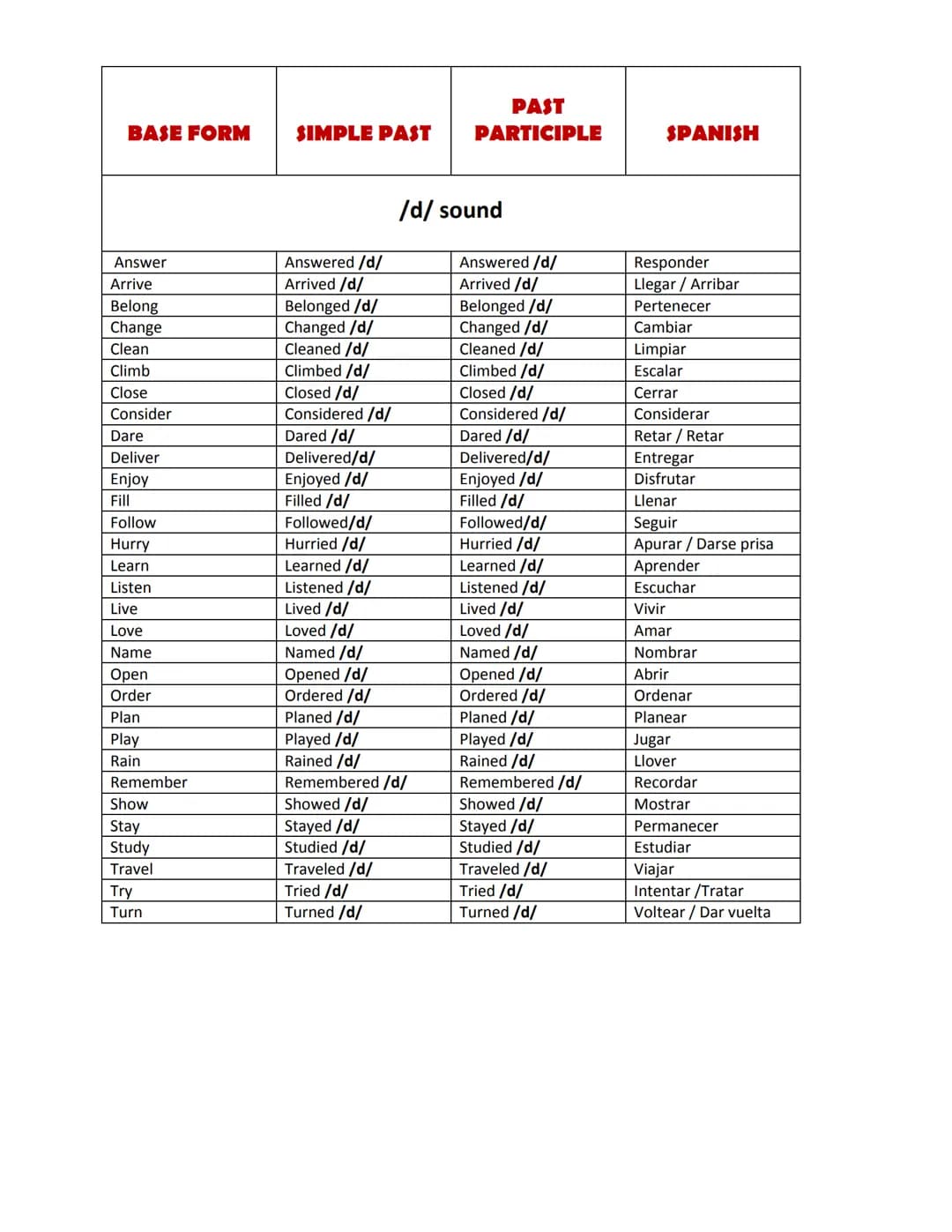
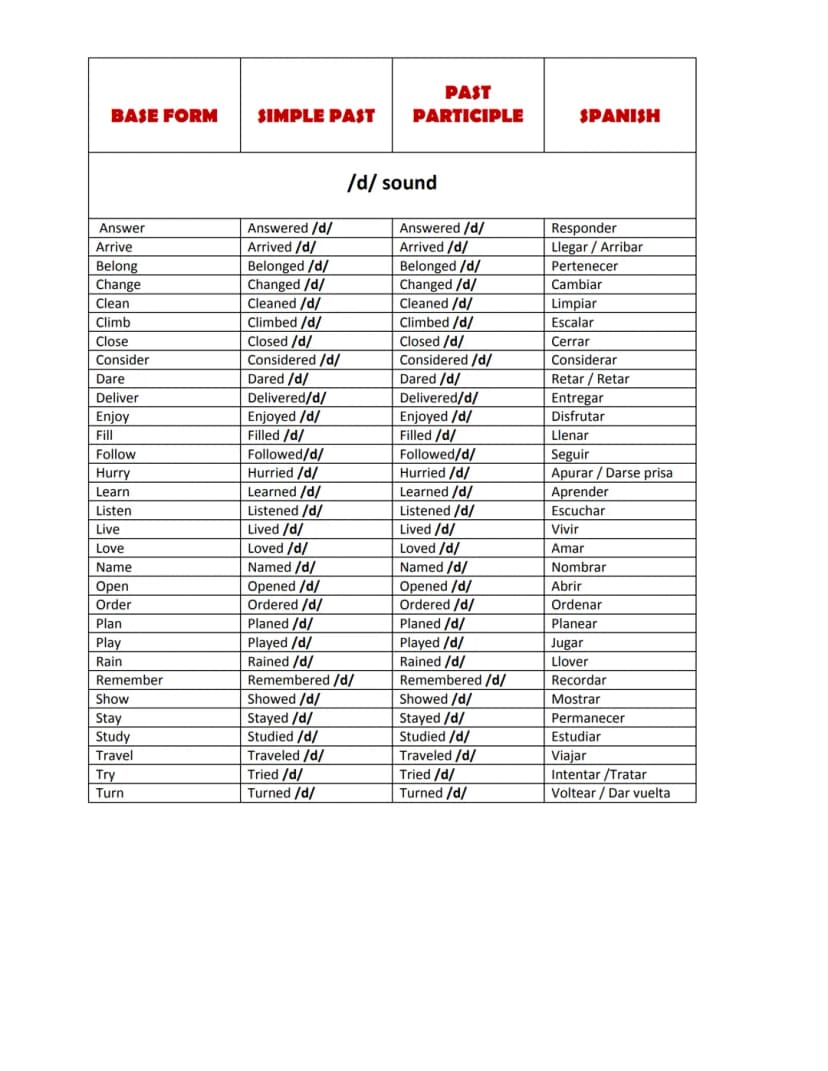
Verbos Regulares: Sonido /d/
El sonido /d/ es el tercer tipo de pronunciación para verbos regulares. Aparece después de vocales y consonantes sonoras, y es súper común en verbos como "played", "lived" o "studied".
Estos verbos suenan exactamente como esperarías - el "-ed" se pronuncia como una "d" suave. Son los más fáciles de pronunciar porque fluyen naturalmente después de sonidos sonoros.
Verbos como "answer", "change" y "enjoy" los usas constantemente para contar experiencias pasadas. La buena noticia es que una vez que domines estos patrones de sonido, podrás pronunciar cualquier verbo regular correctamente sin pensarlo.
💡 Práctica final: Lee en voz alta frases con estos verbos. Tu oído se acostumbrará a los sonidos y automáticamente sabrás cómo pronunciar nuevos verbos regulares.
We thought you’d never ask...
What is the Knowunity AI companion?
Our AI companion is specifically built for the needs of students. Based on the millions of content pieces we have on the platform we can provide truly meaningful and relevant answers to students. But its not only about answers, the companion is even more about guiding students through their daily learning challenges, with personalised study plans, quizzes or content pieces in the chat and 100% personalisation based on the students skills and developments.
Where can I download the Knowunity app?
You can download the app in the Google Play Store and in the Apple App Store.
Is Knowunity really free of charge?
That's right! Enjoy free access to study content, connect with fellow students, and get instant help – all at your fingertips.
Similar Content
 Anglais
Most popular content: irregular verbs
9InglésIRREGULAR VERBS
Aquí tienes la lista de verbos irregulares con su infinitivo, el pasado simple, el pasado participio y su traducción.
2° ESO1,42326
InglésIrregular verbs
Verbos irregulares completos
4° ESO1,88724
InglésIrregulars verbs
50 verbos irregulares en inglés
2° ESO11,3833,100
InglésVerbos irregulares inglés
Verbos irregulares inglés
1° ESO2,51028
InglésVerbos en inglés
Verbos regulares e irregulares
4° ESO4,544115
InglésRegular and Irregular verbs
Tablas con los verbos regulares e irregulares para estudiar y hacer ejercicios.
2° ESO1,24217
InglésIrregular verbs
Verbos irregulares en ingles
1° Bach1,35125
InglésIRREGULAR VERBS
Los verbos irregulares en ingles la forma más sencilla y facil de aprenderselos en 2 hora
2° ESO66416
InglésEnglish Irregular Verbs Complete List
Lista completa de los verbos irregulares en inglés.
4° ESO5,420296
Most popular content in Inglés
9I
Inglésirregular verbs quiz
Domina el idioma inglés de manera sencilla y divertida con estos flashcards diseñados especialmente para estudiantes de sexto grado.
6º primaria2,8981
D
InglésDominando la gramática inglesa: Flashcards desafiantes
Mejora tus habilidades gramaticales en inglés con estos flashcards desafiantes diseñados para estudiantes de grado 11. ¡Prepárate para dominar la gramática inglesa de manera divertida y efectiva!
3° ESO2,2480
I
InglésIngles para repasar
quiz de ingles para entrar a clase preparados
2° ESO2,6290
I
InglésIrregular verbs
Aprende nuevas palabras y expande tu vocabulario en inglés con esta colección de tarjetas de estudio interactivas.
3° ESO1,7442
I
InglésIrregular verbs 1-30
Aprende los primeros 30 verbos irregulares esenciales en inglés, incluyendo sus formas de pasado simple y participio.
2° ESO1,1590
C
InglésConjugación de Verbos Irregulares en Pasado
Practica la transformación de verbos en presente a su forma correspondiente en Past Simple para ampliar tu vocabulario básico.
1° ESO1,0940
I
InglésIrregular verbs part 21
Here's a quiz to learn irregular verbs.
2° ESO7921
C
Ingléscomparativos y superlativos inglés 2
quizzz
1° ESO1,7743
D
InglésDomina el inglés fácilmente
Aprende de manera sencilla y efectiva el idioma inglés con estos flashcards diseñados especialmente para ti.
1° Bach3,3734
Most popular content
9I
Inglésirregular verbs quiz
Domina el idioma inglés de manera sencilla y divertida con estos flashcards diseñados especialmente para estudiantes de sexto grado.
6º primaria2,8981
R
 Geografía e Historia
roma
a estudiar Roma!!
1° ESO2,3122
G
Geografía e HistoriaGrecia: Inicio de la democracia
Más o menos las preguntas que me pusieron a mí en el examen
1° ESO2,3622
D
InglésDominando la gramática inglesa: Flashcards desafiantes
Mejora tus habilidades gramaticales en inglés con estos flashcards desafiantes diseñados para estudiantes de grado 11. ¡Prepárate para dominar la gramática inglesa de manera divertida y efectiva!
3° ESO2,2480
M
Geografía e HistoriaMesopotamia y Egipto
Contenidos sobre la civilización mesopotámica y egipcia
1° ESO3,9381
O
 Lengua Castellana y Literatura
OBRAS Y AUTORES II
Quiz donde tendrás que relacionar las siguientes obras con sus respectivos autores: edición Romanticismo.
4° ESO3,3610
I
InglésIngles para repasar
quiz de ingles para entrar a clase preparados
2° ESO2,6290
F
 Filosofía
filosofía
repaso filosofía "el arje , la metafísica y la crítica de Nietszche a platon"
1° Bach2,8421
I
InglésIrregular verbs
Aprende nuevas palabras y expande tu vocabulario en inglés con esta colección de tarjetas de estudio interactivas.
3° ESO1,7442
Can't find what you're looking for? Explore other subjects.
Students love us — and so will you.
4.6/5App Store
4.7/5Google Play
The app is very easy to use and well designed. I have found everything I was looking for so far and have been able to learn a lot from the presentations! I will definitely use the app for a class assignment! And of course it also helps a lot as an inspiration.
Stefan SiOS user
This app is really great. There are so many study notes and help [...]. My problem subject is French, for example, and the app has so many options for help. Thanks to this app, I have improved my French. I would recommend it to anyone.
Samantha KlichAndroid user
Wow, I am really amazed. I just tried the app because I've seen it advertised many times and was absolutely stunned. This app is THE HELP you want for school and above all, it offers so many things, such as workouts and fact sheets, which have been VERY helpful to me personally.
AnnaiOS user
Inglés3,510 views·Updated Jun 17, 2026·5 pagesLista Completa de Verbos Regulares e Irregulares en Inglés
Alba Domínguez Cardoso@betapeta
¿Te cuesta recordar todos los verbos en inglés cuando haces exámenes? Esta lista completa de verbos irregulares y regulares va a ser tu mejor aliada para dominar los tiempos verbales en inglés de una vez por todas.
1
of 5
Sign up to see the content. It's free!
- Access to all documents
- Improve your grades
- Join milions of students
Verbos Irregulares: La Base
Los verbos irregulares son esos que no siguen las reglas normales cuando los pones en pasado. No puedes simplemente añadir "-ed" como con los verbos regulares, sino que cambian completamente su forma.
Esta primera parte incluye verbos súper comunes como "be", "do", "go" y "have" que usas constantemente. Fíjate en cómo algunos cambian completamente mientras otros se mantienen igual en las tres formas .
Los verbos como "begin", "break" y "bring" aparecen mucho en los exámenes, así que memorízalos bien. Muchos siguen patrones parecidos: por ejemplo, "sing-sang-sung" funciona igual que "ring-rang-rung".
💡 Truco: Agrupa los verbos por patrones de sonido. Es mucho más fácil recordar "drink-drank-drunk" si lo asocias con "sing-sang-sung".
2
of 5Sign up to see the content. It's free!
- Access to all documents
- Improve your grades
- Join milions of students
Verbos Irregulares: Continuación
Aquí tienes más verbos irregulares esenciales que necesitas dominar. Verbos como "get", "give" y "know" son básicos para cualquier conversación en inglés.
Presta atención especial a "read" - se escribe igual pero se pronuncia diferente en pasado. También fíjate en verbos como "put" y "set" que no cambian nada.
Los verbos de movimiento como "run", "ride" y "rise" suelen ser complicados, pero una vez que los practiques un par de veces, los tendrás dominados. "See" y "say" los usarás todos los días.
💡 Consejo: Practica haciendo frases con estos verbos en los tres tiempos. Por ejemplo: "I see the problem / I saw it yesterday / I have seen it before".
3
of 5Sign up to see the content. It's free!
- Access to all documents
- Improve your grades
- Join milions of students
Verbos Irregulares: Final
Esta última sección completa tu arsenal de verbos irregulares con algunos de los más útiles. "Think" , "tell" y "write" aparecen constantemente en textos y conversaciones.
Los verbos como "swim", "sing" y "win" siguen patrones que ya conoces, así que no te agobies. "Understand" es simplemente "stand" con un prefijo, lo que hace que sea más fácil de recordar.
Verbos como "wear" y "wake" son perfectos para describir rutinas diarias. Con esta lista completa ya tienes todos los verbos irregulares importantes que necesitas para el instituto.
💡 Estrategia: Crea historias cortas usando varios de estos verbos juntos. Tu cerebro recordará mejor las formas verbales cuando las asocie con una narrativa.
4
of 5Sign up to see the content. It's free!
- Access to all documents
- Improve your grades
- Join milions of students
Verbos Regulares: Sonidos /id/ y /t/
Los verbos regulares son mucho más fáciles porque siguen reglas fijas. Todos terminan en "-ed" en pasado, pero la pronunciación cambia según la última letra del verbo base.
Con el sonido /id/, como en "wanted" o "needed", pronuncias la "ed" como una sílaba extra. Esto pasa cuando el verbo termina en "t" o "d". Es como si el inglés necesitara esa sílaba extra para que suene bien.
El sonido /t/ aparece después de consonantes sordas como "k", "p", "s". Verbos como "cooked", "helped" o "missed" suenan como si terminaran en "t" en vez de "ed". Es más rápido de pronunciar y suena más natural.
💡 Regla de oro: Si no puedes pronunciar el "-ed" sin añadir una sílaba extra, probablemente sea sonido /id/. Si suena como "t", es sonido /t/.
5
of 5Sign up to see the content. It's free!
- Access to all documents
- Improve your grades
- Join milions of students
Verbos Regulares: Sonido /d/
El sonido /d/ es el tercer tipo de pronunciación para verbos regulares. Aparece después de vocales y consonantes sonoras, y es súper común en verbos como "played", "lived" o "studied".
Estos verbos suenan exactamente como esperarías - el "-ed" se pronuncia como una "d" suave. Son los más fáciles de pronunciar porque fluyen naturalmente después de sonidos sonoros.
Verbos como "answer", "change" y "enjoy" los usas constantemente para contar experiencias pasadas. La buena noticia es que una vez que domines estos patrones de sonido, podrás pronunciar cualquier verbo regular correctamente sin pensarlo.
💡 Práctica final: Lee en voz alta frases con estos verbos. Tu oído se acostumbrará a los sonidos y automáticamente sabrás cómo pronunciar nuevos verbos regulares.
We thought you’d never ask...
What is the Knowunity AI companion?
Our AI companion is specifically built for the needs of students. Based on the millions of content pieces we have on the platform we can provide truly meaningful and relevant answers to students. But its not only about answers, the companion is even more about guiding students through their daily learning challenges, with personalised study plans, quizzes or content pieces in the chat and 100% personalisation based on the students skills and developments.
Where can I download the Knowunity app?
You can download the app in the Google Play Store and in the Apple App Store.
Is Knowunity really free of charge?
That's right! Enjoy free access to study content, connect with fellow students, and get instant help – all at your fingertips.
Similar Content
Most popular content: irregular verbs
9InglésIRREGULAR VERBS
Aquí tienes la lista de verbos irregulares con su infinitivo, el pasado simple, el pasado participio y su traducción.
2° ESO1,42326
InglésIrregular verbs
Verbos irregulares completos
4° ESO1,88724
InglésIrregulars verbs
50 verbos irregulares en inglés
2° ESO11,3833,100
InglésVerbos irregulares inglés
Verbos irregulares inglés
1° ESO2,51028
InglésVerbos en inglés
Verbos regulares e irregulares
4° ESO4,544115
InglésRegular and Irregular verbs
Tablas con los verbos regulares e irregulares para estudiar y hacer ejercicios.
2° ESO1,24217
InglésIrregular verbs
Verbos irregulares en ingles
1° Bach1,35125
InglésIRREGULAR VERBS
Los verbos irregulares en ingles la forma más sencilla y facil de aprenderselos en 2 hora
2° ESO66416
InglésEnglish Irregular Verbs Complete List
Lista completa de los verbos irregulares en inglés.
4° ESO5,420296
Most popular content in Inglés
9I
Inglésirregular verbs quiz
Domina el idioma inglés de manera sencilla y divertida con estos flashcards diseñados especialmente para estudiantes de sexto grado.
6º primaria2,8981
D
InglésDominando la gramática inglesa: Flashcards desafiantes
Mejora tus habilidades gramaticales en inglés con estos flashcards desafiantes diseñados para estudiantes de grado 11. ¡Prepárate para dominar la gramática inglesa de manera divertida y efectiva!
3° ESO2,2480
I
InglésIngles para repasar
quiz de ingles para entrar a clase preparados
2° ESO2,6290
I
InglésIrregular verbs
Aprende nuevas palabras y expande tu vocabulario en inglés con esta colección de tarjetas de estudio interactivas.
3° ESO1,7442
I
InglésIrregular verbs 1-30
Aprende los primeros 30 verbos irregulares esenciales en inglés, incluyendo sus formas de pasado simple y participio.
2° ESO1,1590
C
InglésConjugación de Verbos Irregulares en Pasado
Practica la transformación de verbos en presente a su forma correspondiente en Past Simple para ampliar tu vocabulario básico.
1° ESO1,0940
I
InglésIrregular verbs part 21
Here's a quiz to learn irregular verbs.
2° ESO7921
C
Ingléscomparativos y superlativos inglés 2
quizzz
1° ESO1,7743
D
InglésDomina el inglés fácilmente
Aprende de manera sencilla y efectiva el idioma inglés con estos flashcards diseñados especialmente para ti.
1° Bach3,3734
Most popular content
9I
Inglésirregular verbs quiz
Domina el idioma inglés de manera sencilla y divertida con estos flashcards diseñados especialmente para estudiantes de sexto grado.
6º primaria2,8981
R
Geografía e Historiaroma
a estudiar Roma!!
1° ESO2,3122
G
Geografía e HistoriaGrecia: Inicio de la democracia
Más o menos las preguntas que me pusieron a mí en el examen
1° ESO2,3622
D
InglésDominando la gramática inglesa: Flashcards desafiantes
Mejora tus habilidades gramaticales en inglés con estos flashcards desafiantes diseñados para estudiantes de grado 11. ¡Prepárate para dominar la gramática inglesa de manera divertida y efectiva!
3° ESO2,2480
M
Geografía e HistoriaMesopotamia y Egipto
Contenidos sobre la civilización mesopotámica y egipcia
1° ESO3,9381
O
Lengua Castellana y LiteraturaOBRAS Y AUTORES II
Quiz donde tendrás que relacionar las siguientes obras con sus respectivos autores: edición Romanticismo.
4° ESO3,3610
I
InglésIngles para repasar
quiz de ingles para entrar a clase preparados
2° ESO2,6290
F
Filosofíafilosofía
repaso filosofía "el arje , la metafísica y la crítica de Nietszche a platon"
1° Bach2,8421
I
InglésIrregular verbs
Aprende nuevas palabras y expande tu vocabulario en inglés con esta colección de tarjetas de estudio interactivas.
3° ESO1,7442
Can't find what you're looking for? Explore other subjects.
Students love us — and so will you.
4.6/5App Store
4.7/5Google Play
The app is very easy to use and well designed. I have found everything I was looking for so far and have been able to learn a lot from the presentations! I will definitely use the app for a class assignment! And of course it also helps a lot as an inspiration.
Stefan SiOS user
This app is really great. There are so many study notes and help [...]. My problem subject is French, for example, and the app has so many options for help. Thanks to this app, I have improved my French. I would recommend it to anyone.
Samantha KlichAndroid user
Wow, I am really amazed. I just tried the app because I've seen it advertised many times and was absolutely stunned. This app is THE HELP you want for school and above all, it offers so many things, such as workouts and fact sheets, which have been VERY helpful to me personally.
AnnaiOS user