
¿Confundido con las reglas gramaticales del inglés? Tranquilo, aquí tienes...
 Inglés25 views·Updated Jun 22, 2026·6 pages
Guía Completa de Reglas Gramaticales
C
Constanza Valenzuela@constanza_el4cc


1 / 6
1
of 6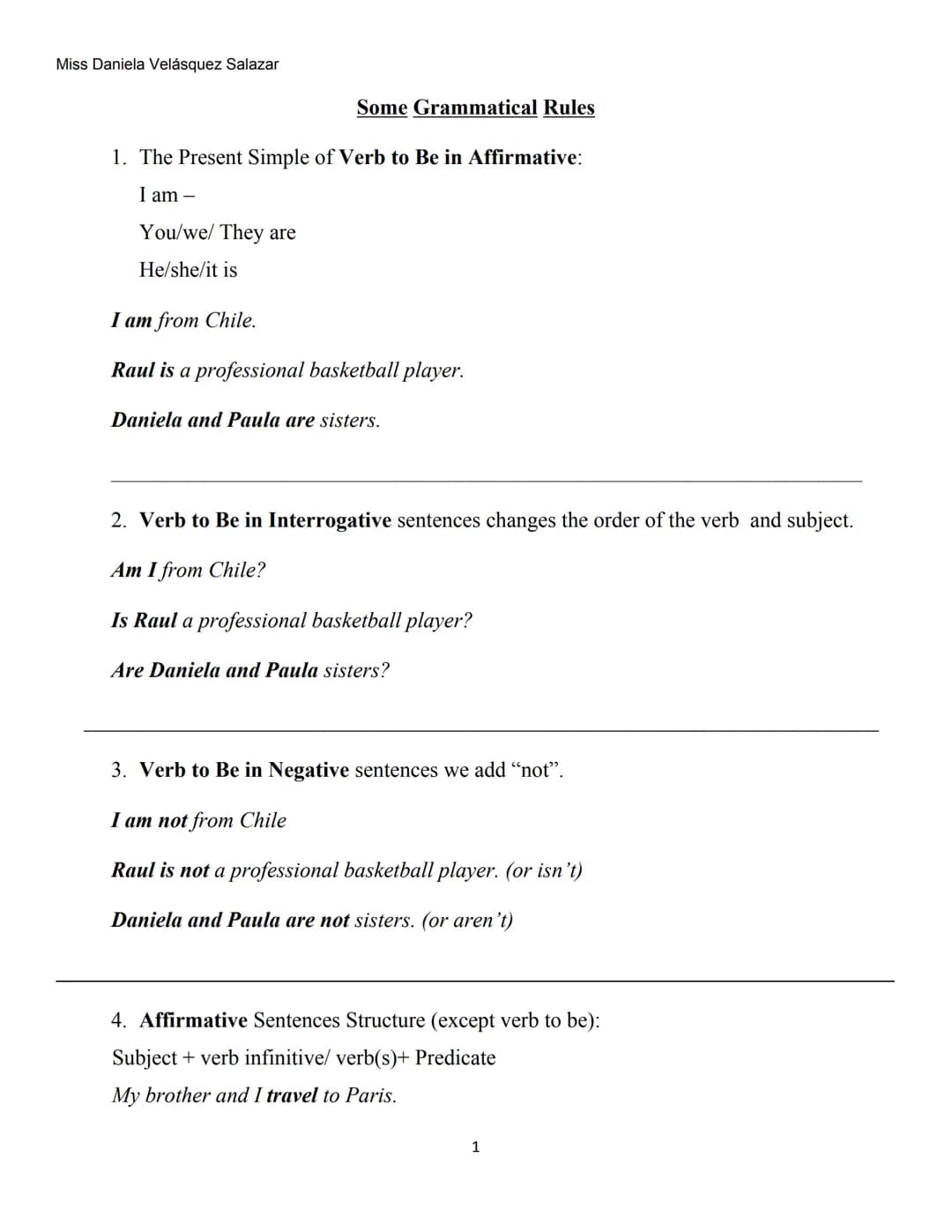
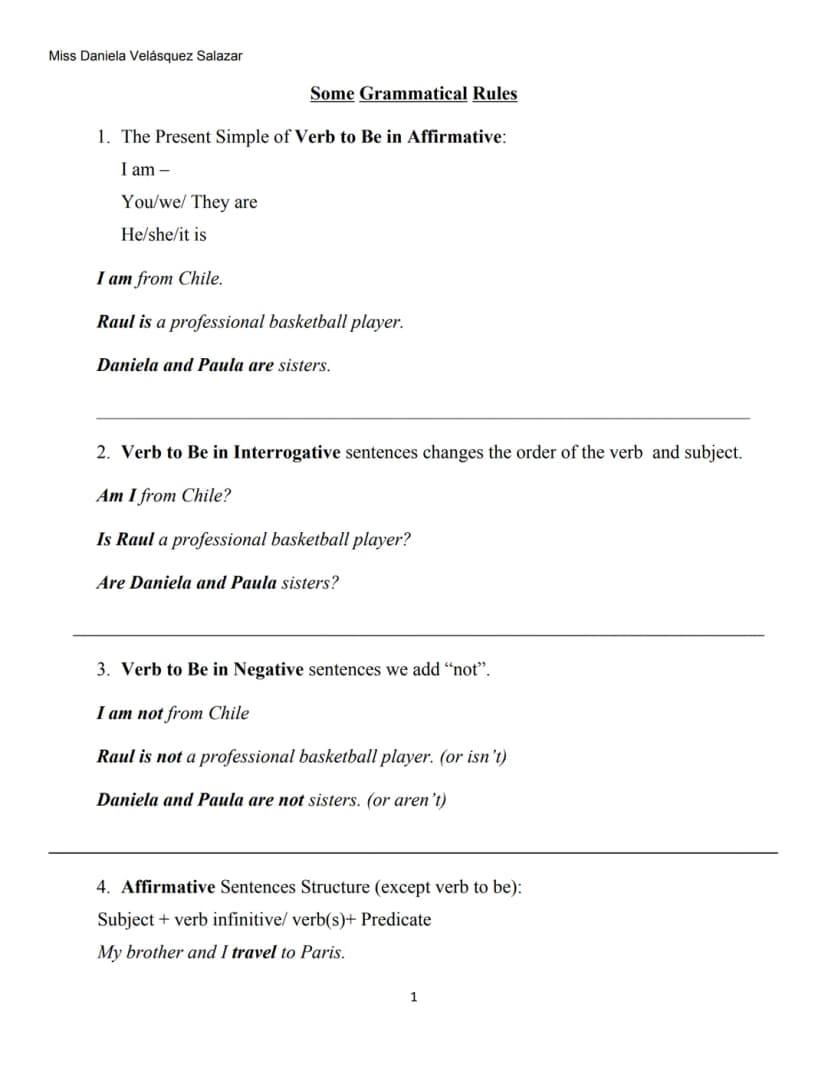
Presente Simple del Verbo "to Be"
El verbo "to be" cambia según el sujeto que uses. En afirmativo usamos: I am, You/We/They are, He/She/It is. Por ejemplo: I am from Chile o Raul is a professional basketball player.
Para formar preguntas con "to be", simplemente invertimos el orden: Am I from Chile? o Is Raul a professional basketball player?
Para hacer oraciones negativas, agregamos "not" después del verbo: I am not from Chile (o I'm not) y Raul is not a professional basketball player (o isn't).
💡 Recuerda que el verbo "to be" es especial y no sigue las mismas reglas que los demás verbos en inglés. ¡No necesita auxiliares como "do" o "does"!
La estructura básica para oraciones afirmativas con otros verbos es: Sujeto + verbo + complemento. Por ejemplo: My brother and I travel to Paris.
2
of 6
Presente Simple de Otros Verbos
En presente simple añadimos -s al verbo cuando el sujeto es he, she, it (o cualquier sustantivo singular). Por ejemplo: Juanita likes playing basketball o The plant needs water.
Para hacer preguntas, usamos los auxiliares "do" (para I, you, we, they) o "does" (para he, she, it): Do you speak English? o Does Jaime read a book?
En oraciones negativas usamos "don't" o "doesn't" seguido del verbo en infinitivo: Ana and Pedro don't live in Ancud o Javier doesn't read a book.
🔑 Cuando uses "does" en preguntas o "doesn't" en negativas, el verbo principal siempre va en infinitivo .
El verbo "to be" en pasado tiene solo dos formas: "was" (para I, he, she, it) y "were" (para we, you, they). Por ejemplo: I was a student 20 years ago o Juan and Pepe were in class last week.
3
of 6
Pasado Simple
El pasado simple en oraciones afirmativas (excepto "to be") se forma con el sujeto + verbo en pasado + complemento. Para verbos regulares añadimos -ed: Ana listened to rock music. Para irregulares cambia la forma: Gala wrote notes last class.
Para hacer oraciones negativas en pasado, usamos "didn't" + verbo en infinitivo: Feña didn't study for the test o Carla didn't come to class.
Las preguntas en pasado se forman con "did" + sujeto + verbo en infinitivo: Where did you buy your phone? o Did Dani eat lunch?
⚠️ ¡Atención! En preguntas y negativas de pasado simple, el verbo principal siempre va en infinitivo después de "did" o "didn't".
Cuando usamos dos verbos juntos, el segundo puede llevar -ing o "to" + infinitivo: Alan hates to eat beans / Alan hates eating beans o Amir likes playing football / Amir likes to play football.
4
of 6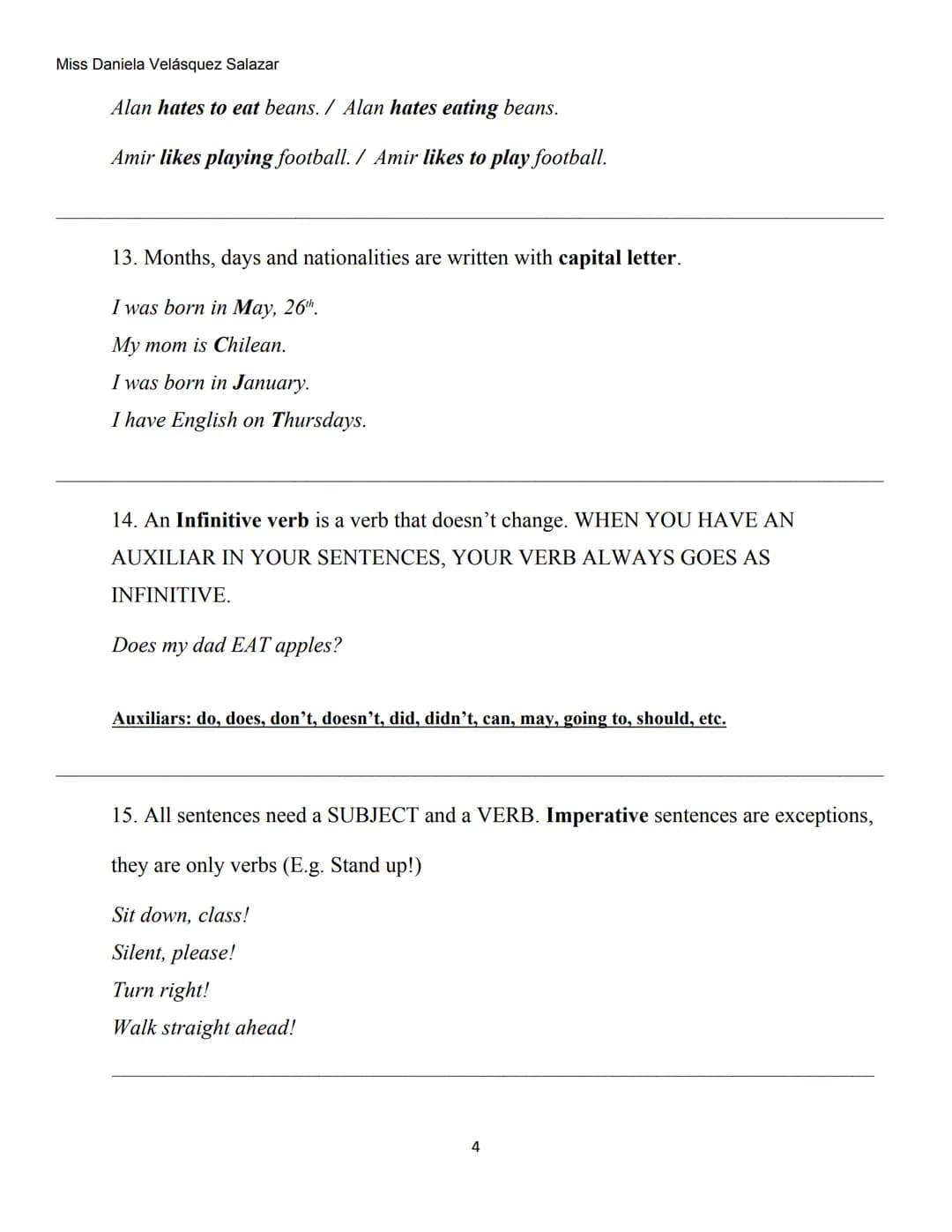
Reglas Importantes de Escritura
Los meses, días y nacionalidades se escriben siempre con letra mayúscula en inglés: I was born in May, I have English on Thursdays o My mom is Chilean.
Un verbo infinitivo es la forma base del verbo sin cambios. Recuerda que cuando usas auxiliares, el verbo principal siempre va en infinitivo: Does my dad eat apples?
Todas las oraciones necesitan un sujeto y un verbo. Las oraciones imperativas son la excepción, ya que solo llevan el verbo: Sit down, class! o Turn right!
💡 Los auxiliares como do, does, don't, doesn't, did, didn't, can, may, going to, should, siempre van seguidos de un verbo en infinitivo.
Puedes formar imperativos directos simplemente usando el verbo en infinitivo al inicio de la oración. Son perfectos para dar instrucciones o órdenes.
5
of 6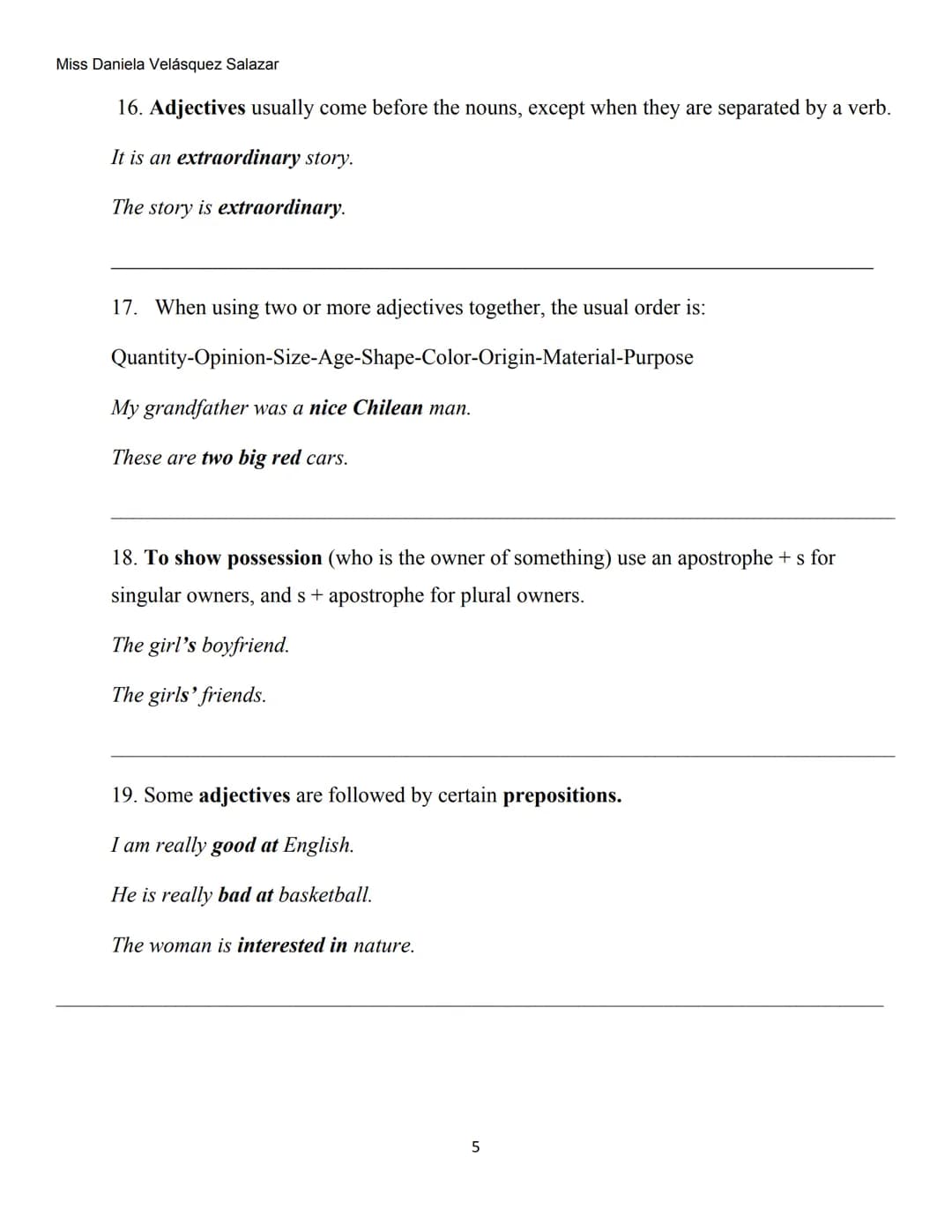
Adjetivos y Posesivos
Los adjetivos generalmente van antes del sustantivo: It is an extraordinary story. Pero también pueden ir después de un verbo: The story is extraordinary.
Cuando usamos varios adjetivos juntos, seguimos este orden: Cantidad-Opinión-Tamaño-Edad-Forma-Color-Origen-Material-Propósito. Por ejemplo: My grandfather was a nice Chilean man o These are two big red cars.
Para mostrar posesión usamos apóstrofe + s ('s) para dueños singulares y s + apóstrofe (s') para dueños plurales: The girl's boyfriend o The girls' friends.
🔍 ¡Ojo con los adjetivos! A diferencia del español, en inglés los adjetivos no cambian según el género o número del sustantivo.
Algunos adjetivos van seguidos de preposiciones específicas: I am really good at English, He is really bad at basketball o The woman is interested in nature.
6
of 6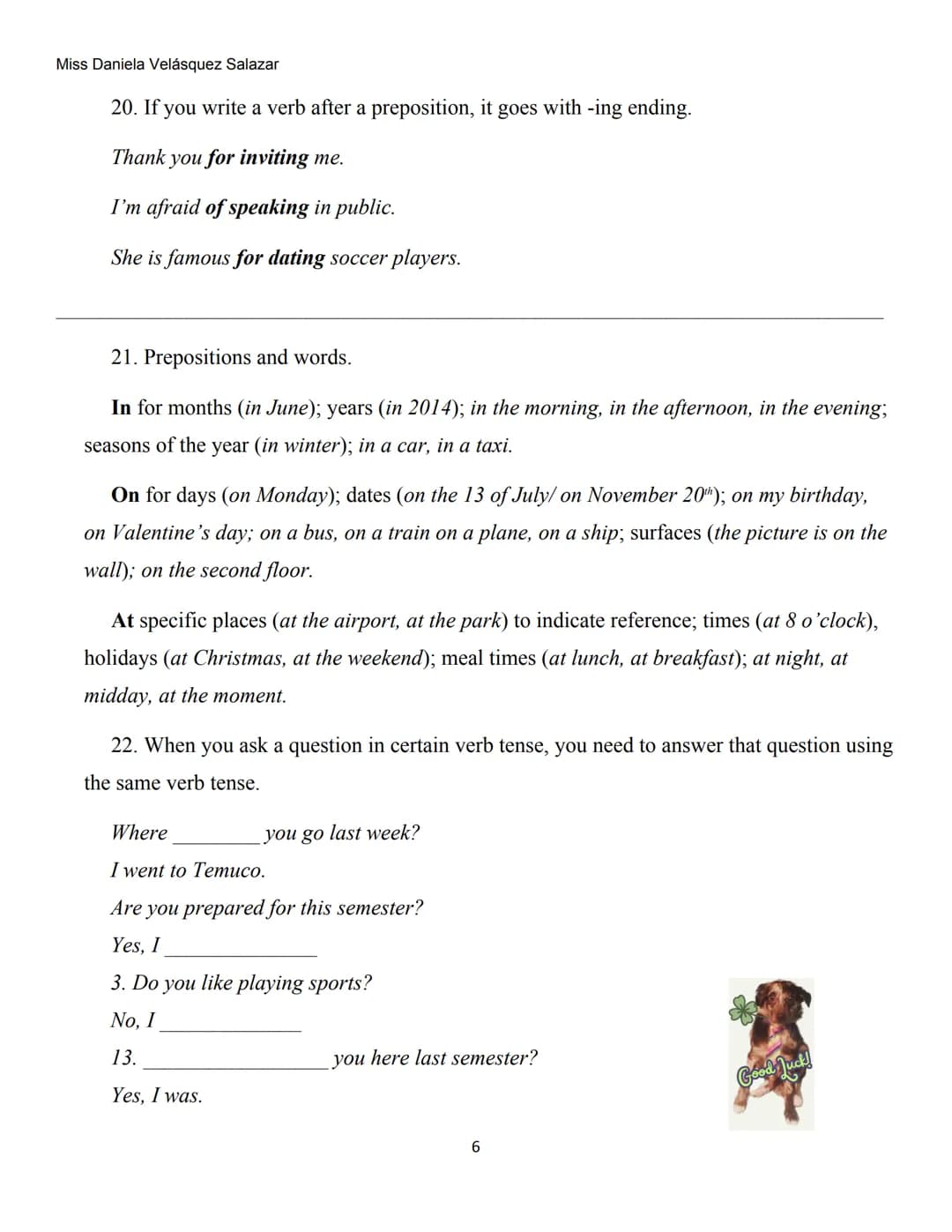
Preposiciones y Tiempos Verbales
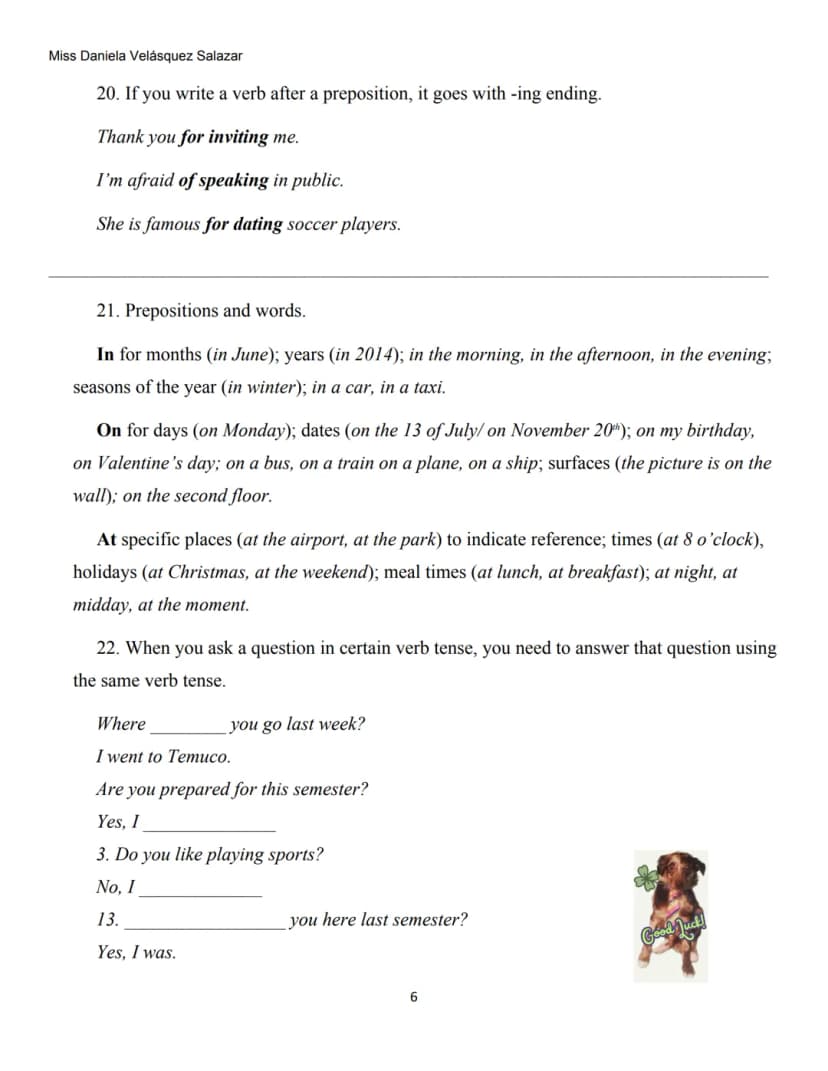
Si escribes un verbo después de una preposición, debe terminar en -ing: Thank you for inviting me o I'm afraid of speaking in public.
Usamos diferentes preposiciones de tiempo y lugar:
- In: para meses, años, partes del día, estaciones, vehículos cerrados (in June, in 2014, in the morning)
- On: para días, fechas, superficies, transporte público (on Monday, on November 20th, on the wall)
- At: para lugares específicos, horas exactas, festividades (at the airport, at 8 o'clock, at Christmas)
💪 Cuando respondas una pregunta, asegúrate de usar el mismo tiempo verbal que te preguntaron. Esto muestra que dominas realmente el idioma.
Recuerda que la consistencia en los tiempos verbales es crucial. Si alguien te pregunta "Where did you go last week?", debes responder usando pasado simple: "I went to Temuco".
We thought you’d never ask...
What is the Knowunity AI companion?
Our AI companion is specifically built for the needs of students. Based on the millions of content pieces we have on the platform we can provide truly meaningful and relevant answers to students. But its not only about answers, the companion is even more about guiding students through their daily learning challenges, with personalised study plans, quizzes or content pieces in the chat and 100% personalisation based on the students skills and developments.
Where can I download the Knowunity app?
You can download the app in the Google Play Store and in the Apple App Store.
Is Knowunity really free of charge?
That's right! Enjoy free access to study content, connect with fellow students, and get instant help – all at your fingertips.
Similar Content
 Anglais
Most popular content: Auxiliary Verb
1Most popular content in Inglés
9Q
InglésQuiz: Present Simple vs. Present Continuous
Quiz: Present Simple vs. Present Continuous
2°M990
P
InglésPhrasal Verbs Comunes en Inglés
Aprende phrasal verbs esenciales con ejemplos cotidianos para mejorar tu inglés.
1°M950
I
Inglésingles
Aprende las formas del verbo "To Be" en presente y su uso con los pronombres personales en inglés.
4°M760
Ingléshazme un cuestionario sobre el verbo to be, el presente simple y el person singular
Pon a prueba tus conocimientos de gramática inglesa con este cuestionario sobre el verbo "to be", el presente simple y la tercera persona del singular.
1°M1310
V
Inglésverbo to be
Pon a prueba tus conocimientos sobre el verbo "to be" en inglés con este cuestionario.
1°M1010
InglésModal verbs
Resumen de modal verbs
2°M1002
I
Inglésinglés
Números en inglés
2°M1710
InglésEstructura del pasado simple (inglés) + el pasado simple positivo
Contiene en que orden hay que colocar palabras (subject, verb y complement) también dice como armar las frases en positivo, negativo y en pregunta. Tiene unas reglas de cuando poner "ed" que en mi opinión sirven mucho cuando las memorizas.
7°B811
Ingléspast simple tense
Pon a prueba tus conocimientos del pasado simple en inglés con este quiz de gramática. ¡Domina la conjugación de verbos regulares e irregulares!
1°M910
Most popular content
9Q
 Física
Quiz sobre las Ondas
Quiz sobre las Ondas
1°M1840
C
 Lengua y Comunicación
Conceptos Literarios Esenciales
Define términos clave de la narrativa para entender mejor los textos literarios.
1°M2460
FísicaOndas
Clasificación y características de las ondas
1°M71710
O
 Biología
Organelos Celulares Eucariotas: Funciones Esenciales
Explora las funciones clave de los organelos celulares eucariotas, incluyendo ribosomas, Golgi, lisosomas y vacuolas.
2°M1920
 Historia
Construcción del Estado nación en Chile
Organización de la republica de Chile: Perspectivas, proyectos e ideas. Triunfo del ideario y orden conservador. Constitución de 1833. "Era Portaliana"
1°M1,49943
A
BiologíaArco Reflejo y SNA
Explora la ruta completa del arco reflejo y la respuesta del Sistema Nervioso Autónomo (SNA) ante estímulos sensoriales.
1°M2410
 Matemáticas
Potencias
Significado de potencias y ejemplos
8°B5364
C
 Historia, Geografía y Ciencias Sociales
Conceptos Clave: Teocentrismo y Renacimiento
Explora ideas fundamentales como el teocentrismo, antropocentrismo y figuras importantes del Renacimiento.
7°B1570
MatemáticasPara estudiar para la M1
De 7 básico a segundo medio
1°M43714
Can't find what you're looking for? Explore other subjects.
Students love us — and so will you.
4.6/5App Store
4.7/5Google Play
The app is very easy to use and well designed. I have found everything I was looking for so far and have been able to learn a lot from the presentations! I will definitely use the app for a class assignment! And of course it also helps a lot as an inspiration.
Stefan SiOS user
This app is really great. There are so many study notes and help [...]. My problem subject is French, for example, and the app has so many options for help. Thanks to this app, I have improved my French. I would recommend it to anyone.
Samantha KlichAndroid user
Wow, I am really amazed. I just tried the app because I've seen it advertised many times and was absolutely stunned. This app is THE HELP you want for school and above all, it offers so many things, such as workouts and fact sheets, which have been VERY helpful to me personally.
AnnaiOS user
Inglés25 views·Updated Jun 22, 2026·6 pagesGuía Completa de Reglas Gramaticales
C
Constanza Valenzuela@constanza_el4cc
¿Confundido con las reglas gramaticales del inglés? Tranquilo, aquí tienes un resumen práctico con las reglas más importantes que necesitas dominar. Entender estas estructuras te ayudará a construir oraciones correctas y comunicarte con confianza en inglés.
1
of 6
Sign up to see the content. It's free!
- Access to all documents
- Improve your grades
- Join milions of students
Presente Simple del Verbo "to Be"
El verbo "to be" cambia según el sujeto que uses. En afirmativo usamos: I am, You/We/They are, He/She/It is. Por ejemplo: I am from Chile o Raul is a professional basketball player.
Para formar preguntas con "to be", simplemente invertimos el orden: Am I from Chile? o Is Raul a professional basketball player?
Para hacer oraciones negativas, agregamos "not" después del verbo: I am not from Chile (o I'm not) y Raul is not a professional basketball player (o isn't).
💡 Recuerda que el verbo "to be" es especial y no sigue las mismas reglas que los demás verbos en inglés. ¡No necesita auxiliares como "do" o "does"!
La estructura básica para oraciones afirmativas con otros verbos es: Sujeto + verbo + complemento. Por ejemplo: My brother and I travel to Paris.
2
of 6Sign up to see the content. It's free!
- Access to all documents
- Improve your grades
- Join milions of students
Presente Simple de Otros Verbos
En presente simple añadimos -s al verbo cuando el sujeto es he, she, it (o cualquier sustantivo singular). Por ejemplo: Juanita likes playing basketball o The plant needs water.
Para hacer preguntas, usamos los auxiliares "do" (para I, you, we, they) o "does" (para he, she, it): Do you speak English? o Does Jaime read a book?
En oraciones negativas usamos "don't" o "doesn't" seguido del verbo en infinitivo: Ana and Pedro don't live in Ancud o Javier doesn't read a book.
🔑 Cuando uses "does" en preguntas o "doesn't" en negativas, el verbo principal siempre va en infinitivo .
El verbo "to be" en pasado tiene solo dos formas: "was" (para I, he, she, it) y "were" (para we, you, they). Por ejemplo: I was a student 20 years ago o Juan and Pepe were in class last week.
3
of 6Sign up to see the content. It's free!
- Access to all documents
- Improve your grades
- Join milions of students
Pasado Simple
El pasado simple en oraciones afirmativas (excepto "to be") se forma con el sujeto + verbo en pasado + complemento. Para verbos regulares añadimos -ed: Ana listened to rock music. Para irregulares cambia la forma: Gala wrote notes last class.
Para hacer oraciones negativas en pasado, usamos "didn't" + verbo en infinitivo: Feña didn't study for the test o Carla didn't come to class.
Las preguntas en pasado se forman con "did" + sujeto + verbo en infinitivo: Where did you buy your phone? o Did Dani eat lunch?
⚠️ ¡Atención! En preguntas y negativas de pasado simple, el verbo principal siempre va en infinitivo después de "did" o "didn't".
Cuando usamos dos verbos juntos, el segundo puede llevar -ing o "to" + infinitivo: Alan hates to eat beans / Alan hates eating beans o Amir likes playing football / Amir likes to play football.
4
of 6Sign up to see the content. It's free!
- Access to all documents
- Improve your grades
- Join milions of students
Reglas Importantes de Escritura
Los meses, días y nacionalidades se escriben siempre con letra mayúscula en inglés: I was born in May, I have English on Thursdays o My mom is Chilean.
Un verbo infinitivo es la forma base del verbo sin cambios. Recuerda que cuando usas auxiliares, el verbo principal siempre va en infinitivo: Does my dad eat apples?
Todas las oraciones necesitan un sujeto y un verbo. Las oraciones imperativas son la excepción, ya que solo llevan el verbo: Sit down, class! o Turn right!
💡 Los auxiliares como do, does, don't, doesn't, did, didn't, can, may, going to, should, siempre van seguidos de un verbo en infinitivo.
Puedes formar imperativos directos simplemente usando el verbo en infinitivo al inicio de la oración. Son perfectos para dar instrucciones o órdenes.
5
of 6Sign up to see the content. It's free!
- Access to all documents
- Improve your grades
- Join milions of students
Adjetivos y Posesivos
Los adjetivos generalmente van antes del sustantivo: It is an extraordinary story. Pero también pueden ir después de un verbo: The story is extraordinary.
Cuando usamos varios adjetivos juntos, seguimos este orden: Cantidad-Opinión-Tamaño-Edad-Forma-Color-Origen-Material-Propósito. Por ejemplo: My grandfather was a nice Chilean man o These are two big red cars.
Para mostrar posesión usamos apóstrofe + s ('s) para dueños singulares y s + apóstrofe (s') para dueños plurales: The girl's boyfriend o The girls' friends.
🔍 ¡Ojo con los adjetivos! A diferencia del español, en inglés los adjetivos no cambian según el género o número del sustantivo.
Algunos adjetivos van seguidos de preposiciones específicas: I am really good at English, He is really bad at basketball o The woman is interested in nature.
6
of 6Sign up to see the content. It's free!
- Access to all documents
- Improve your grades
- Join milions of students
Preposiciones y Tiempos Verbales
Si escribes un verbo después de una preposición, debe terminar en -ing: Thank you for inviting me o I'm afraid of speaking in public.
Usamos diferentes preposiciones de tiempo y lugar:
- In: para meses, años, partes del día, estaciones, vehículos cerrados (in June, in 2014, in the morning)
- On: para días, fechas, superficies, transporte público (on Monday, on November 20th, on the wall)
- At: para lugares específicos, horas exactas, festividades (at the airport, at 8 o'clock, at Christmas)
💪 Cuando respondas una pregunta, asegúrate de usar el mismo tiempo verbal que te preguntaron. Esto muestra que dominas realmente el idioma.
Recuerda que la consistencia en los tiempos verbales es crucial. Si alguien te pregunta "Where did you go last week?", debes responder usando pasado simple: "I went to Temuco".
We thought you’d never ask...
What is the Knowunity AI companion?
Our AI companion is specifically built for the needs of students. Based on the millions of content pieces we have on the platform we can provide truly meaningful and relevant answers to students. But its not only about answers, the companion is even more about guiding students through their daily learning challenges, with personalised study plans, quizzes or content pieces in the chat and 100% personalisation based on the students skills and developments.
Where can I download the Knowunity app?
You can download the app in the Google Play Store and in the Apple App Store.
Is Knowunity really free of charge?
That's right! Enjoy free access to study content, connect with fellow students, and get instant help – all at your fingertips.
Similar Content
Most popular content: Auxiliary Verb
1Most popular content in Inglés
9Q
InglésQuiz: Present Simple vs. Present Continuous
Quiz: Present Simple vs. Present Continuous
2°M990
P
InglésPhrasal Verbs Comunes en Inglés
Aprende phrasal verbs esenciales con ejemplos cotidianos para mejorar tu inglés.
1°M950
I
Inglésingles
Aprende las formas del verbo "To Be" en presente y su uso con los pronombres personales en inglés.
4°M760
Ingléshazme un cuestionario sobre el verbo to be, el presente simple y el person singular
Pon a prueba tus conocimientos de gramática inglesa con este cuestionario sobre el verbo "to be", el presente simple y la tercera persona del singular.
1°M1310
V
Inglésverbo to be
Pon a prueba tus conocimientos sobre el verbo "to be" en inglés con este cuestionario.
1°M1010
InglésModal verbs
Resumen de modal verbs
2°M1002
I
Inglésinglés
Números en inglés
2°M1710
InglésEstructura del pasado simple (inglés) + el pasado simple positivo
Contiene en que orden hay que colocar palabras (subject, verb y complement) también dice como armar las frases en positivo, negativo y en pregunta. Tiene unas reglas de cuando poner "ed" que en mi opinión sirven mucho cuando las memorizas.
7°B811
Ingléspast simple tense
Pon a prueba tus conocimientos del pasado simple en inglés con este quiz de gramática. ¡Domina la conjugación de verbos regulares e irregulares!
1°M910
Most popular content
9Q
FísicaQuiz sobre las Ondas
Quiz sobre las Ondas
1°M1840
C
Lengua y ComunicaciónConceptos Literarios Esenciales
Define términos clave de la narrativa para entender mejor los textos literarios.
1°M2460
FísicaOndas
Clasificación y características de las ondas
1°M71710
O
BiologíaOrganelos Celulares Eucariotas: Funciones Esenciales
Explora las funciones clave de los organelos celulares eucariotas, incluyendo ribosomas, Golgi, lisosomas y vacuolas.
2°M1920
HistoriaConstrucción del Estado nación en Chile
Organización de la republica de Chile: Perspectivas, proyectos e ideas. Triunfo del ideario y orden conservador. Constitución de 1833. "Era Portaliana"
1°M1,49943
A
BiologíaArco Reflejo y SNA
Explora la ruta completa del arco reflejo y la respuesta del Sistema Nervioso Autónomo (SNA) ante estímulos sensoriales.
1°M2410
MatemáticasPotencias
Significado de potencias y ejemplos
8°B5364
C
Historia, Geografía y Ciencias SocialesConceptos Clave: Teocentrismo y Renacimiento
Explora ideas fundamentales como el teocentrismo, antropocentrismo y figuras importantes del Renacimiento.
7°B1570
MatemáticasPara estudiar para la M1
De 7 básico a segundo medio
1°M43714
Can't find what you're looking for? Explore other subjects.
Students love us — and so will you.
4.6/5App Store
4.7/5Google Play
The app is very easy to use and well designed. I have found everything I was looking for so far and have been able to learn a lot from the presentations! I will definitely use the app for a class assignment! And of course it also helps a lot as an inspiration.
Stefan SiOS user
This app is really great. There are so many study notes and help [...]. My problem subject is French, for example, and the app has so many options for help. Thanks to this app, I have improved my French. I would recommend it to anyone.
Samantha KlichAndroid user
Wow, I am really amazed. I just tried the app because I've seen it advertised many times and was absolutely stunned. This app is THE HELP you want for school and above all, it offers so many things, such as workouts and fact sheets, which have been VERY helpful to me personally.
AnnaiOS user