
El presente en inglés tiene diferentes formas que nos permiten...
 Inglés164 views·Updated Jun 23, 2026·1 page
Presente Simple y Continuo: Aprende Fácilmente

Karol💫@tatianaforero268_hjmo
1
of 1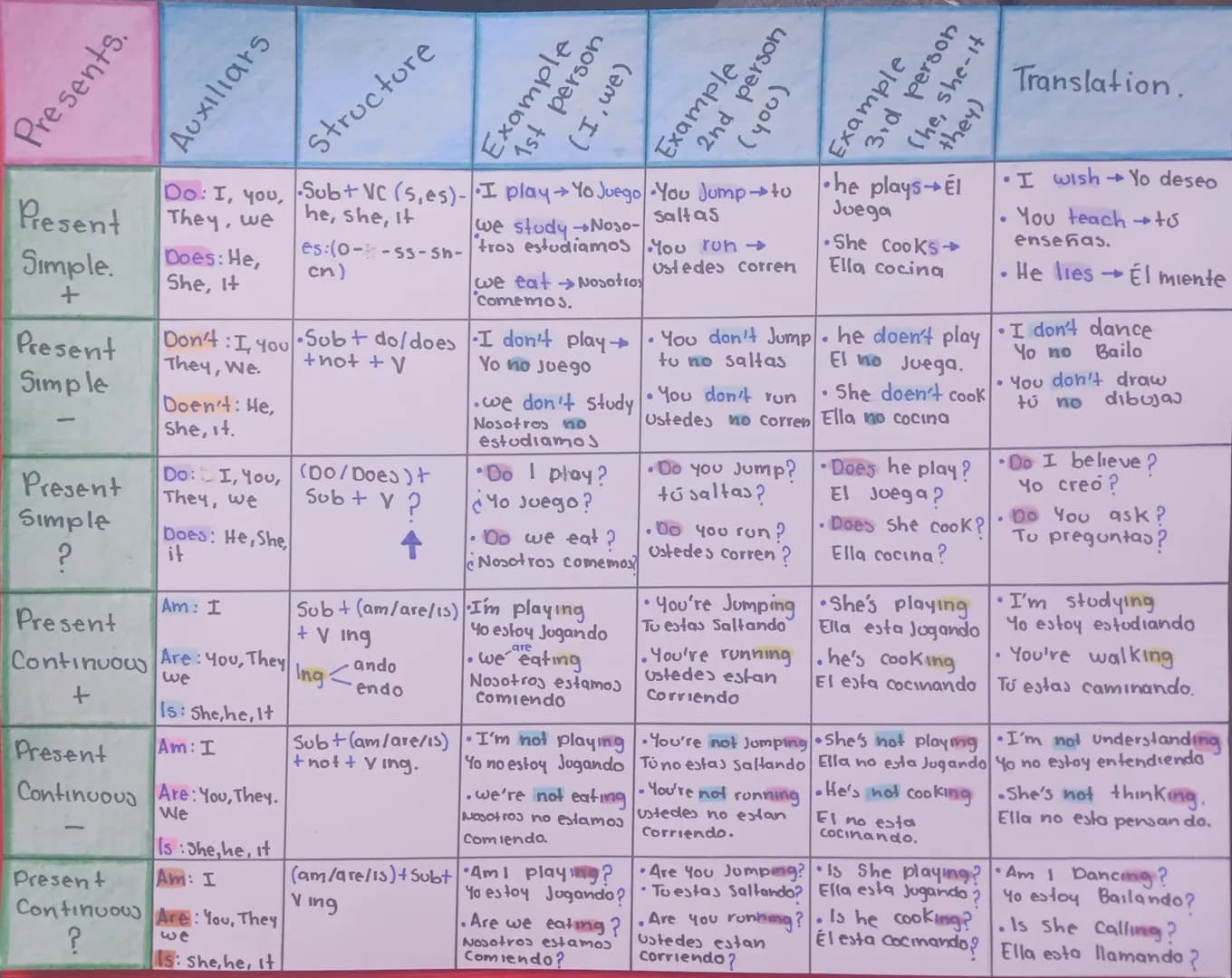
Tiempos Verbales del Presente en Inglés
El presente simple se usa para hablar de hábitos o verdades generales. Su estructura cambia según la persona: para "yo", "tú", "nosotros" y "ellos" simplemente usamos el verbo base (I play, you jump, we study). Pero ojo, para tercera persona singular (he, she, it) añadimos una "s" al final (he plays, she cooks).
Para formar oraciones negativas en presente simple necesitamos los auxiliares "do/does" + "not". Usamos "don't" para la mayoría de personas (I don't dance, you don't draw) y "doesn't" para tercera persona singular (he doesn't play, she doesn't cook). ¡Es más fácil de lo que parece!
El presente continuo expresa acciones que están ocurriendo ahora mismo. Se forma con el verbo "to be" + el verbo principal con terminación "-ing". Por ejemplo: I'm playing, you're walking, she's cooking. Las negaciones simplemente añaden "not" después del verbo "to be": I'm not playing, we're not eating.
¡Consejo útil! 🌟 Para formar preguntas, solo debes invertir el orden: pon el auxiliar primero, luego el sujeto y después el verbo. Ejemplo: "You are running" → "Are you running?". Este truco funciona tanto para presente simple como para continuo.
Las preguntas en presente simple necesitan "do" o "does" (Do I play? Does she cook?) mientras que en presente continuo invertimos el orden del auxiliar "to be" (Am I playing? Are they running?). Practica estas estructuras y pronto las dominarás sin darte cuenta.
We thought you’d never ask...
What is the Knowunity AI companion?
Our AI companion is specifically built for the needs of students. Based on the millions of content pieces we have on the platform we can provide truly meaningful and relevant answers to students. But its not only about answers, the companion is even more about guiding students through their daily learning challenges, with personalised study plans, quizzes or content pieces in the chat and 100% personalisation based on the students skills and developments.
Where can I download the Knowunity app?
You can download the app in the Google Play Store and in the Apple App Store.
Is Knowunity really free of charge?
That's right! Enjoy free access to study content, connect with fellow students, and get instant help – all at your fingertips.
Similar Content
 Język angielski
Most popular content: Present Tense
5InglésZERO CONDITIONAL
CONCEPTO CUÁNDO USARLO? EJEMPLOS ESTRUCTURA
111041
InglésPRESENT SIMPLE OR ING
usos del presente simple en ingles, estructura, y ejemplos
9471
InglésSimple Tenses
Los tiempos simples en ingles y sus principales reglas gramaticales y condiciones
8610
InglésSimple presente and present continuous
Learn to use present simple and present continuous in affirmative, negative and interrogative
9982
InglésSimple present
Cuando se usa, como se usa, ejemplos
10770
Most popular content in Inglés
9InglésVocabulario
Palabras en inglés y su significado
92,45627
Ingléspresente simple
como usar los pronombres en el presente simple y ejemplos
74699
InglésVerbos modales
Verbos modales (modal verbs)
113813
V
InglésVerbos: Presente, Pasado y Futuro
Conceptos clave sobre verbos en inglés: conjugación, tiempos y verbos irregulares.
10740
V
InglésVerbos en Presente Simple
Aprende a conjugar verbos en presente simple, incluyendo reglas y excepciones.
8530
P
InglésPronombres Personales en Inglés
Aprende los pronombres personales básicos en inglés y su significado en español.
6290
P
InglésPresente Simple: Frases Cotidianas
Aprende frases comunes en inglés usando el Presente Simple para el día a día.
7320
InglésZero conditional
Condicional cero y su uso
93101
V
InglésVerbos Irregulares en Inglés: Fundamentos Clave
Aprende los verbos irregulares esenciales para grado 8. ¡Mejora tu inglés!
8310
Most popular content
9 ICFES: Matemáticas
Simulacro ICFES primera sesión calendario B filtrado 2025
Este simulacro te ayudará a sacar un buen puntaje en las pruebas ICFES este 2025. Vamos por ese 500/500. Y poder ser admitido en la universidad que quieras, estudiar la carrera que quieres y no la que te toque. Vamos con toda para sacar un buen puntaje.
1016,900174
 ICFES: Lectura Crítica
Simulacro icfes
Simulacro
111,82946
ICFES: InglésCuadernillo Preguntaa Saber 11 Inglés.
Aprovecha los cuadernillos de Inglés para practicar y mejorar tus habilidades en el ítem de Inglés de la Prueba Saber 11. 🫡
Universidad82212
ICFES: MatemáticasMaterial de estudio ICFES
Material de estudio, preguntas icfes de matemáticas resueltas
116,996109
 Química
Trucos para ganar icfes
Lo mejor
111,03212
S
 Otros
Otrossimulacro icfes
Este simulacro evalúa tus conocimientos en las áreas clave del examen ICFES, preparándote para obtener un excelente puntaje.
114540
 ICFES: Sociales y Ciudadanas
SIMULACRO ICFES
Simulacro icfes
111,06015
ICFES: Lectura CríticaICFES segunda sesión calendario B 2025
Segunda sesión simulacro ICFES 2025 calendario B filtrado, aprovecha y se el mejor ICFES de tu colegio y poder ingresar a universidad, y estudiar aquella carrera con la que tanto sueñas.
119,795123
ICFES: Lectura CríticaPrueba icfes 2024
Prueba icfes para practicar todas las asignaturas
118227
Can't find what you're looking for? Explore other subjects.
Students love us — and so will you.
4.6/5App Store
4.7/5Google Play
The app is very easy to use and well designed. I have found everything I was looking for so far and have been able to learn a lot from the presentations! I will definitely use the app for a class assignment! And of course it also helps a lot as an inspiration.
Stefan SiOS user
This app is really great. There are so many study notes and help [...]. My problem subject is French, for example, and the app has so many options for help. Thanks to this app, I have improved my French. I would recommend it to anyone.
Samantha KlichAndroid user
Wow, I am really amazed. I just tried the app because I've seen it advertised many times and was absolutely stunned. This app is THE HELP you want for school and above all, it offers so many things, such as workouts and fact sheets, which have been VERY helpful to me personally.
AnnaiOS user
Inglés164 views·Updated Jun 23, 2026·1 pagePresente Simple y Continuo: Aprende Fácilmente
Karol💫@tatianaforero268_hjmo
El presente en inglés tiene diferentes formas que nos permiten expresar acciones habituales o que están ocurriendo en este momento. Estas estructuras son fundamentales para comunicarnos correctamente en situaciones cotidianas.
1
of 1
Sign up to see the content. It's free!
- Access to all documents
- Improve your grades
- Join milions of students
Tiempos Verbales del Presente en Inglés
El presente simple se usa para hablar de hábitos o verdades generales. Su estructura cambia según la persona: para "yo", "tú", "nosotros" y "ellos" simplemente usamos el verbo base (I play, you jump, we study). Pero ojo, para tercera persona singular (he, she, it) añadimos una "s" al final (he plays, she cooks).
Para formar oraciones negativas en presente simple necesitamos los auxiliares "do/does" + "not". Usamos "don't" para la mayoría de personas (I don't dance, you don't draw) y "doesn't" para tercera persona singular (he doesn't play, she doesn't cook). ¡Es más fácil de lo que parece!
El presente continuo expresa acciones que están ocurriendo ahora mismo. Se forma con el verbo "to be" + el verbo principal con terminación "-ing". Por ejemplo: I'm playing, you're walking, she's cooking. Las negaciones simplemente añaden "not" después del verbo "to be": I'm not playing, we're not eating.
¡Consejo útil! 🌟 Para formar preguntas, solo debes invertir el orden: pon el auxiliar primero, luego el sujeto y después el verbo. Ejemplo: "You are running" → "Are you running?". Este truco funciona tanto para presente simple como para continuo.
Las preguntas en presente simple necesitan "do" o "does" (Do I play? Does she cook?) mientras que en presente continuo invertimos el orden del auxiliar "to be" (Am I playing? Are they running?). Practica estas estructuras y pronto las dominarás sin darte cuenta.
We thought you’d never ask...
What is the Knowunity AI companion?
Our AI companion is specifically built for the needs of students. Based on the millions of content pieces we have on the platform we can provide truly meaningful and relevant answers to students. But its not only about answers, the companion is even more about guiding students through their daily learning challenges, with personalised study plans, quizzes or content pieces in the chat and 100% personalisation based on the students skills and developments.
Where can I download the Knowunity app?
You can download the app in the Google Play Store and in the Apple App Store.
Is Knowunity really free of charge?
That's right! Enjoy free access to study content, connect with fellow students, and get instant help – all at your fingertips.
Similar Content
Most popular content: Present Tense
5InglésZERO CONDITIONAL
CONCEPTO CUÁNDO USARLO? EJEMPLOS ESTRUCTURA
111041
InglésPRESENT SIMPLE OR ING
usos del presente simple en ingles, estructura, y ejemplos
9471
InglésSimple Tenses
Los tiempos simples en ingles y sus principales reglas gramaticales y condiciones
8610
InglésSimple presente and present continuous
Learn to use present simple and present continuous in affirmative, negative and interrogative
9982
InglésSimple present
Cuando se usa, como se usa, ejemplos
10770
Most popular content in Inglés
9InglésVocabulario
Palabras en inglés y su significado
92,45627
Ingléspresente simple
como usar los pronombres en el presente simple y ejemplos
74699
InglésVerbos modales
Verbos modales (modal verbs)
113813
V
InglésVerbos: Presente, Pasado y Futuro
Conceptos clave sobre verbos en inglés: conjugación, tiempos y verbos irregulares.
10740
V
InglésVerbos en Presente Simple
Aprende a conjugar verbos en presente simple, incluyendo reglas y excepciones.
8530
P
InglésPronombres Personales en Inglés
Aprende los pronombres personales básicos en inglés y su significado en español.
6290
P
InglésPresente Simple: Frases Cotidianas
Aprende frases comunes en inglés usando el Presente Simple para el día a día.
7320
InglésZero conditional
Condicional cero y su uso
93101
V
InglésVerbos Irregulares en Inglés: Fundamentos Clave
Aprende los verbos irregulares esenciales para grado 8. ¡Mejora tu inglés!
8310
Most popular content
9ICFES: MatemáticasSimulacro ICFES primera sesión calendario B filtrado 2025
Este simulacro te ayudará a sacar un buen puntaje en las pruebas ICFES este 2025. Vamos por ese 500/500. Y poder ser admitido en la universidad que quieras, estudiar la carrera que quieres y no la que te toque. Vamos con toda para sacar un buen puntaje.
1016,900174
ICFES: Lectura CríticaSimulacro icfes
Simulacro
111,82946
ICFES: InglésCuadernillo Preguntaa Saber 11 Inglés.
Aprovecha los cuadernillos de Inglés para practicar y mejorar tus habilidades en el ítem de Inglés de la Prueba Saber 11. 🫡
Universidad82212
ICFES: MatemáticasMaterial de estudio ICFES
Material de estudio, preguntas icfes de matemáticas resueltas
116,996109
QuímicaTrucos para ganar icfes
Lo mejor
111,03212
S
Otrossimulacro icfes
Este simulacro evalúa tus conocimientos en las áreas clave del examen ICFES, preparándote para obtener un excelente puntaje.
114540
ICFES: Sociales y CiudadanasSIMULACRO ICFES
Simulacro icfes
111,06015
ICFES: Lectura CríticaICFES segunda sesión calendario B 2025
Segunda sesión simulacro ICFES 2025 calendario B filtrado, aprovecha y se el mejor ICFES de tu colegio y poder ingresar a universidad, y estudiar aquella carrera con la que tanto sueñas.
119,795123
ICFES: Lectura CríticaPrueba icfes 2024
Prueba icfes para practicar todas las asignaturas
118227
Can't find what you're looking for? Explore other subjects.
Students love us — and so will you.
4.6/5App Store
4.7/5Google Play
The app is very easy to use and well designed. I have found everything I was looking for so far and have been able to learn a lot from the presentations! I will definitely use the app for a class assignment! And of course it also helps a lot as an inspiration.
Stefan SiOS user
This app is really great. There are so many study notes and help [...]. My problem subject is French, for example, and the app has so many options for help. Thanks to this app, I have improved my French. I would recommend it to anyone.
Samantha KlichAndroid user
Wow, I am really amazed. I just tried the app because I've seen it advertised many times and was absolutely stunned. This app is THE HELP you want for school and above all, it offers so many things, such as workouts and fact sheets, which have been VERY helpful to me personally.
AnnaiOS user