

El present simple es tu mejor amigo para hablar de...
 Inglés1,391 views·Updated Jun 14, 2026·2 pages
El Present Simple: Guía Rápida
1
of 2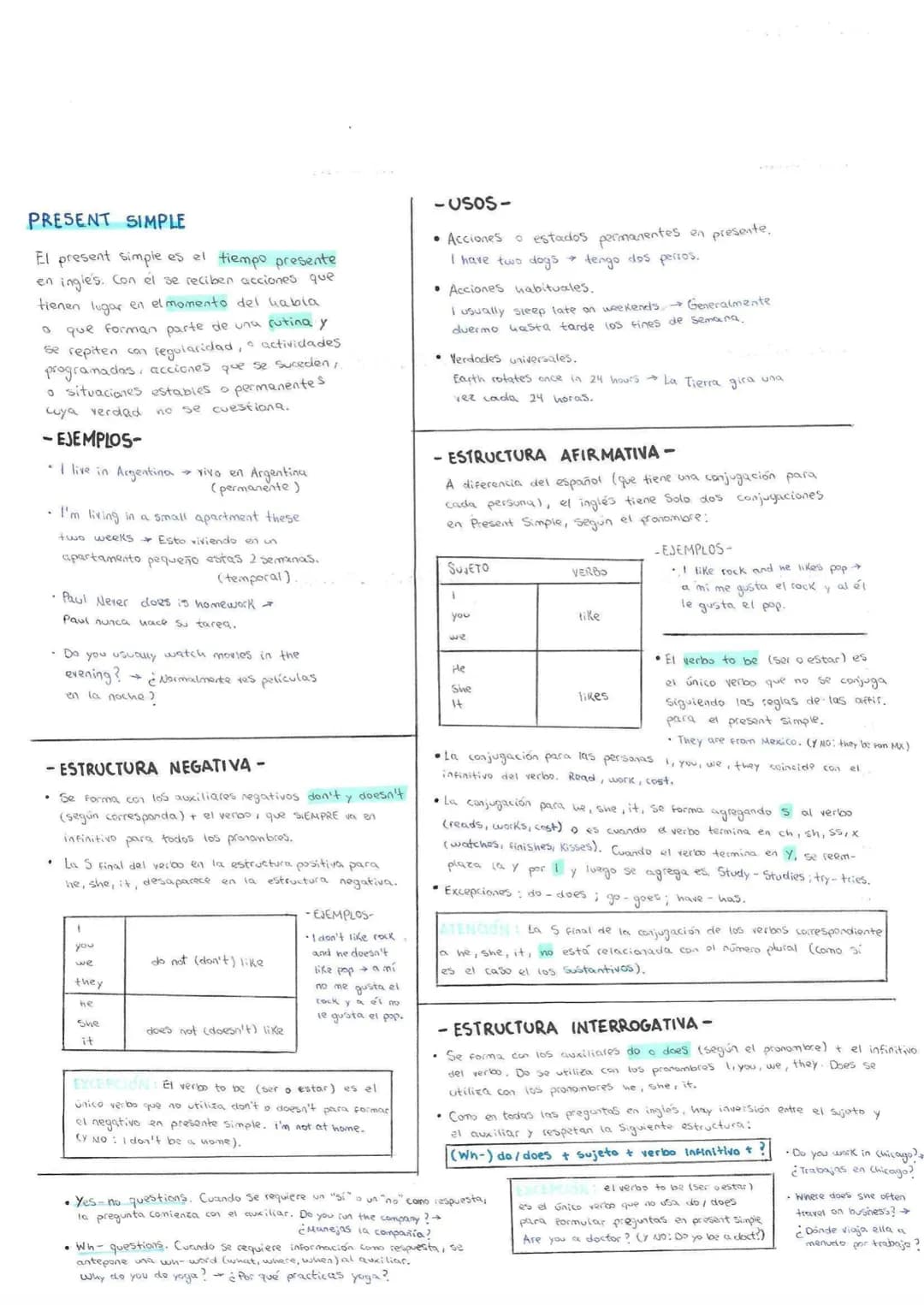
Present Simple: La Base de Todo
¿Sabías que usas el present simple cada vez que hablas de tu rutina diaria? Este tiempo verbal es perfecto para describir acciones habituales, verdades universales y situaciones permanentes. Por ejemplo, "I live in Spain" (situación permanente) vs "I'm living in a hotel" (situación temporal).
La estructura afirmativa es súper sencilla: solo tienes dos formas. Para I, you, we, they usas el verbo tal como está (work, play, study). Para he, she, it añades una -s al final (works, plays, studies). ¡Ojo! Algunos verbos irregulares como "have" se convierten en "has", y "do" en "does".
Para formar oraciones negativas, necesitas los auxiliares don't y doesn't + el verbo en infinitivo. La clave está en recordar que la -s desaparece del verbo principal: "He doesn't like pizza" (no "He doesn't likes pizza"). El único rebelde es el verbo to be, que hace su propia cosa: "I'm not ready" (nunca "I don't be ready").
Las preguntas siguen la fórmula mágica: Do/Does + sujeto + verbo infinitivo. "Do you speak English?" para yes/no questions, o añade palabras como what, where, when al principio para pedir información específica: "Where does she work?"
💡 Truco: El verbo "to be" siempre va por libre - no usa do/does en preguntas ni negativas.
2
of 2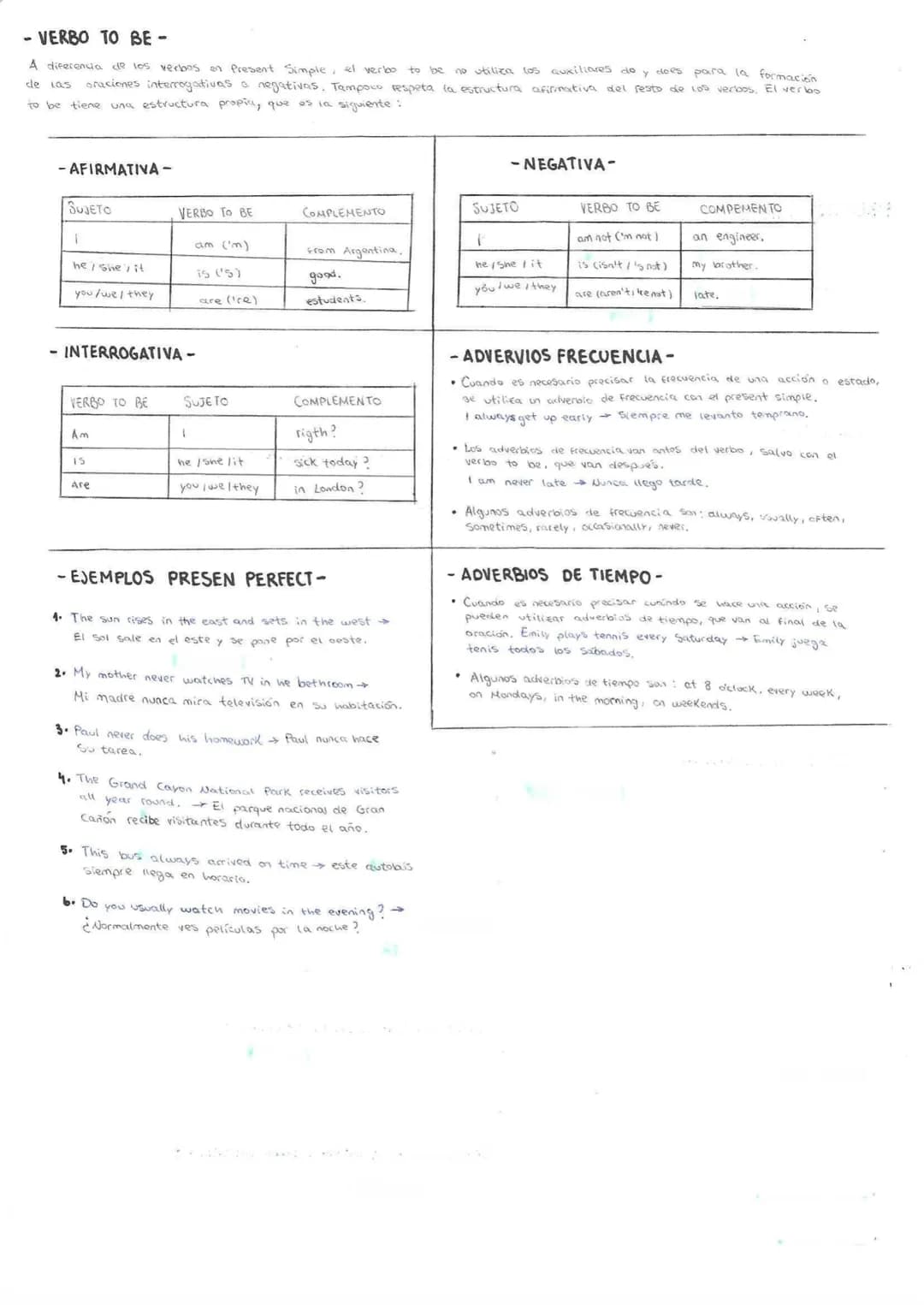
Verbo To Be y Adverbios de Frecuencia
El verbo to be es el rebelde del inglés - tiene sus propias reglas y no sigue el patrón del present simple normal. En afirmativa es am/is/are, en negativa añades "not" directamente (am not, isn't, aren't), y en interrogativa simplemente inviertes: "Are you ready?"
Los adverbios de frecuencia son tus aliados para expresar qué tan seguido haces algo. Van antes del verbo principal: "I always study English" o "She never eats breakfast". Pero cuidado con to be - con este verbo van después: "I am usually late" (no "I usually am late").
Los más comunes son always, usually, often, sometimes, rarely y never. También puedes usar adverbios de tiempo como every day, on Mondays, in the morning - estos van al final de la oración: "We play football on Saturdays".
Este tiempo verbal te permite hablar de verdades universales como "The sun rises in the east" o rutinas como "I get up at 7 AM every day". Una vez que domines estas estructuras, podrás expresar la mayoría de tus ideas básicas en inglés.
💡 Recuerda: Los adverbios de frecuencia van ANTES del verbo, excepto con "to be" que van DESPUÉS.
We thought you’d never ask...
What is the Knowunity AI companion?
Our AI companion is specifically built for the needs of students. Based on the millions of content pieces we have on the platform we can provide truly meaningful and relevant answers to students. But its not only about answers, the companion is even more about guiding students through their daily learning challenges, with personalised study plans, quizzes or content pieces in the chat and 100% personalisation based on the students skills and developments.
Where can I download the Knowunity app?
You can download the app in the Google Play Store and in the Apple App Store.
Is Knowunity really free of charge?
That's right! Enjoy free access to study content, connect with fellow students, and get instant help – all at your fingertips.
Similar Content
 Język angielski
Most popular content: Present Tense
9InglésTiempos verbales en inglés 🤓
Apuntes sobre los tiempos verbales en inglés
4° ESO1,28131
InglésPresent Simple and Continuous.
Present Simple y Continuous. Cuándo usarlo, palabras clave, y forma.
3° ESO2,29347
InglésPresent forms b1
Los diferentes tipos de presentes en inglés, y cómo escribirlos.
1° ESO3378
InglésLos tipos verbales en inglés
Varios tipos verbales
3° ESO1,71341
InglésPresent simple positive negativa interrogative
Es la teoría del positivo, negativo e interrogativo del presente simple de ingles
1° ESO1,09374
InglésPresent simple vs. Present continuous
Present tenses
3° ESO5,331576
InglésPRESENT SIMPLE, PRESENT CONTINUOUS, ADVERBS OF FREQUENCY
Apuntes fáciles para entender el presente simple, presente continuo y los adverbios de frequencia, en inglés!
2° ESO3536
InglésPresent simple and present continuous
2n ESO
2° ESO2393
InglésUso del Presente Simple y Continuo y vocabulario de peliculas
Aprende a usar el presente simple y continuo en inglés con ejemplos y expresiones de tiempo. Aprende también vocabulario sobre las peliculas.
1° ESO2,22730
Most popular content in Inglés
9I
Inglésirregular verbs quiz
Domina el idioma inglés de manera sencilla y divertida con estos flashcards diseñados especialmente para estudiantes de sexto grado.
6º primaria2,8981
D
InglésDominando la gramática inglesa: Flashcards desafiantes
Mejora tus habilidades gramaticales en inglés con estos flashcards desafiantes diseñados para estudiantes de grado 11. ¡Prepárate para dominar la gramática inglesa de manera divertida y efectiva!
3° ESO2,2450
I
InglésIngles para repasar
quiz de ingles para entrar a clase preparados
2° ESO2,6290
I
InglésIrregular verbs
Aprende nuevas palabras y expande tu vocabulario en inglés con esta colección de tarjetas de estudio interactivas.
3° ESO1,7442
I
InglésIrregular verbs 1-30
Aprende los primeros 30 verbos irregulares esenciales en inglés, incluyendo sus formas de pasado simple y participio.
2° ESO1,1590
C
InglésConjugación de Verbos Irregulares en Pasado
Practica la transformación de verbos en presente a su forma correspondiente en Past Simple para ampliar tu vocabulario básico.
1° ESO1,0940
I
InglésIrregular verbs part 21
Here's a quiz to learn irregular verbs.
2° ESO7921
C
Ingléscomparativos y superlativos inglés 2
quizzz
1° ESO1,7743
D
InglésDomina el inglés fácilmente
Aprende de manera sencilla y efectiva el idioma inglés con estos flashcards diseñados especialmente para ti.
1° Bach3,3734
Most popular content
9I
Inglésirregular verbs quiz
Domina el idioma inglés de manera sencilla y divertida con estos flashcards diseñados especialmente para estudiantes de sexto grado.
6º primaria2,8981
R
 Geografía e Historia
roma
a estudiar Roma!!
1° ESO2,3122
G
Geografía e HistoriaGrecia: Inicio de la democracia
Más o menos las preguntas que me pusieron a mí en el examen
1° ESO2,3622
D
InglésDominando la gramática inglesa: Flashcards desafiantes
Mejora tus habilidades gramaticales en inglés con estos flashcards desafiantes diseñados para estudiantes de grado 11. ¡Prepárate para dominar la gramática inglesa de manera divertida y efectiva!
3° ESO2,2450
M
Geografía e HistoriaMesopotamia y Egipto
Contenidos sobre la civilización mesopotámica y egipcia
1° ESO3,9381
O
 Lengua Castellana y Literatura
OBRAS Y AUTORES II
Quiz donde tendrás que relacionar las siguientes obras con sus respectivos autores: edición Romanticismo.
4° ESO3,3610
I
InglésIngles para repasar
quiz de ingles para entrar a clase preparados
2° ESO2,6290
F
 Filosofía
filosofía
repaso filosofía "el arje , la metafísica y la crítica de Nietszche a platon"
1° Bach2,8421
I
InglésIrregular verbs
Aprende nuevas palabras y expande tu vocabulario en inglés con esta colección de tarjetas de estudio interactivas.
3° ESO1,7442
Can't find what you're looking for? Explore other subjects.
Students love us — and so will you.
4.6/5App Store
4.7/5Google Play
The app is very easy to use and well designed. I have found everything I was looking for so far and have been able to learn a lot from the presentations! I will definitely use the app for a class assignment! And of course it also helps a lot as an inspiration.
Stefan SiOS user
This app is really great. There are so many study notes and help [...]. My problem subject is French, for example, and the app has so many options for help. Thanks to this app, I have improved my French. I would recommend it to anyone.
Samantha KlichAndroid user
Wow, I am really amazed. I just tried the app because I've seen it advertised many times and was absolutely stunned. This app is THE HELP you want for school and above all, it offers so many things, such as workouts and fact sheets, which have been VERY helpful to me personally.
AnnaiOS user
Inglés1,391 views·Updated Jun 14, 2026·2 pagesEl Present Simple: Guía Rápida
El present simple es tu mejor amigo para hablar de rutinas, hechos y situaciones permanentes en inglés. Es súper útil y lo vas a usar constantemente, así que dominarlo te dará mucha confianza al hablar.
1
of 2
Sign up to see the content. It's free!
- Access to all documents
- Improve your grades
- Join milions of students
Present Simple: La Base de Todo
¿Sabías que usas el present simple cada vez que hablas de tu rutina diaria? Este tiempo verbal es perfecto para describir acciones habituales, verdades universales y situaciones permanentes. Por ejemplo, "I live in Spain" (situación permanente) vs "I'm living in a hotel" (situación temporal).
La estructura afirmativa es súper sencilla: solo tienes dos formas. Para I, you, we, they usas el verbo tal como está (work, play, study). Para he, she, it añades una -s al final (works, plays, studies). ¡Ojo! Algunos verbos irregulares como "have" se convierten en "has", y "do" en "does".
Para formar oraciones negativas, necesitas los auxiliares don't y doesn't + el verbo en infinitivo. La clave está en recordar que la -s desaparece del verbo principal: "He doesn't like pizza" (no "He doesn't likes pizza"). El único rebelde es el verbo to be, que hace su propia cosa: "I'm not ready" (nunca "I don't be ready").
Las preguntas siguen la fórmula mágica: Do/Does + sujeto + verbo infinitivo. "Do you speak English?" para yes/no questions, o añade palabras como what, where, when al principio para pedir información específica: "Where does she work?"
💡 Truco: El verbo "to be" siempre va por libre - no usa do/does en preguntas ni negativas.
2
of 2Sign up to see the content. It's free!
- Access to all documents
- Improve your grades
- Join milions of students
Verbo To Be y Adverbios de Frecuencia
El verbo to be es el rebelde del inglés - tiene sus propias reglas y no sigue el patrón del present simple normal. En afirmativa es am/is/are, en negativa añades "not" directamente (am not, isn't, aren't), y en interrogativa simplemente inviertes: "Are you ready?"
Los adverbios de frecuencia son tus aliados para expresar qué tan seguido haces algo. Van antes del verbo principal: "I always study English" o "She never eats breakfast". Pero cuidado con to be - con este verbo van después: "I am usually late" (no "I usually am late").
Los más comunes son always, usually, often, sometimes, rarely y never. También puedes usar adverbios de tiempo como every day, on Mondays, in the morning - estos van al final de la oración: "We play football on Saturdays".
Este tiempo verbal te permite hablar de verdades universales como "The sun rises in the east" o rutinas como "I get up at 7 AM every day". Una vez que domines estas estructuras, podrás expresar la mayoría de tus ideas básicas en inglés.
💡 Recuerda: Los adverbios de frecuencia van ANTES del verbo, excepto con "to be" que van DESPUÉS.
We thought you’d never ask...
What is the Knowunity AI companion?
Our AI companion is specifically built for the needs of students. Based on the millions of content pieces we have on the platform we can provide truly meaningful and relevant answers to students. But its not only about answers, the companion is even more about guiding students through their daily learning challenges, with personalised study plans, quizzes or content pieces in the chat and 100% personalisation based on the students skills and developments.
Where can I download the Knowunity app?
You can download the app in the Google Play Store and in the Apple App Store.
Is Knowunity really free of charge?
That's right! Enjoy free access to study content, connect with fellow students, and get instant help – all at your fingertips.
Similar Content
Most popular content: Present Tense
9InglésTiempos verbales en inglés 🤓
Apuntes sobre los tiempos verbales en inglés
4° ESO1,28131
InglésPresent Simple and Continuous.
Present Simple y Continuous. Cuándo usarlo, palabras clave, y forma.
3° ESO2,29347
InglésPresent forms b1
Los diferentes tipos de presentes en inglés, y cómo escribirlos.
1° ESO3378
InglésLos tipos verbales en inglés
Varios tipos verbales
3° ESO1,71341
InglésPresent simple positive negativa interrogative
Es la teoría del positivo, negativo e interrogativo del presente simple de ingles
1° ESO1,09374
InglésPresent simple vs. Present continuous
Present tenses
3° ESO5,331576
InglésPRESENT SIMPLE, PRESENT CONTINUOUS, ADVERBS OF FREQUENCY
Apuntes fáciles para entender el presente simple, presente continuo y los adverbios de frequencia, en inglés!
2° ESO3536
InglésPresent simple and present continuous
2n ESO
2° ESO2393
InglésUso del Presente Simple y Continuo y vocabulario de peliculas
Aprende a usar el presente simple y continuo en inglés con ejemplos y expresiones de tiempo. Aprende también vocabulario sobre las peliculas.
1° ESO2,22730
Most popular content in Inglés
9I
Inglésirregular verbs quiz
Domina el idioma inglés de manera sencilla y divertida con estos flashcards diseñados especialmente para estudiantes de sexto grado.
6º primaria2,8981
D
InglésDominando la gramática inglesa: Flashcards desafiantes
Mejora tus habilidades gramaticales en inglés con estos flashcards desafiantes diseñados para estudiantes de grado 11. ¡Prepárate para dominar la gramática inglesa de manera divertida y efectiva!
3° ESO2,2450
I
InglésIngles para repasar
quiz de ingles para entrar a clase preparados
2° ESO2,6290
I
InglésIrregular verbs
Aprende nuevas palabras y expande tu vocabulario en inglés con esta colección de tarjetas de estudio interactivas.
3° ESO1,7442
I
InglésIrregular verbs 1-30
Aprende los primeros 30 verbos irregulares esenciales en inglés, incluyendo sus formas de pasado simple y participio.
2° ESO1,1590
C
InglésConjugación de Verbos Irregulares en Pasado
Practica la transformación de verbos en presente a su forma correspondiente en Past Simple para ampliar tu vocabulario básico.
1° ESO1,0940
I
InglésIrregular verbs part 21
Here's a quiz to learn irregular verbs.
2° ESO7921
C
Ingléscomparativos y superlativos inglés 2
quizzz
1° ESO1,7743
D
InglésDomina el inglés fácilmente
Aprende de manera sencilla y efectiva el idioma inglés con estos flashcards diseñados especialmente para ti.
1° Bach3,3734
Most popular content
9I
Inglésirregular verbs quiz
Domina el idioma inglés de manera sencilla y divertida con estos flashcards diseñados especialmente para estudiantes de sexto grado.
6º primaria2,8981
R
Geografía e Historiaroma
a estudiar Roma!!
1° ESO2,3122
G
Geografía e HistoriaGrecia: Inicio de la democracia
Más o menos las preguntas que me pusieron a mí en el examen
1° ESO2,3622
D
InglésDominando la gramática inglesa: Flashcards desafiantes
Mejora tus habilidades gramaticales en inglés con estos flashcards desafiantes diseñados para estudiantes de grado 11. ¡Prepárate para dominar la gramática inglesa de manera divertida y efectiva!
3° ESO2,2450
M
Geografía e HistoriaMesopotamia y Egipto
Contenidos sobre la civilización mesopotámica y egipcia
1° ESO3,9381
O
Lengua Castellana y LiteraturaOBRAS Y AUTORES II
Quiz donde tendrás que relacionar las siguientes obras con sus respectivos autores: edición Romanticismo.
4° ESO3,3610
I
InglésIngles para repasar
quiz de ingles para entrar a clase preparados
2° ESO2,6290
F
Filosofíafilosofía
repaso filosofía "el arje , la metafísica y la crítica de Nietszche a platon"
1° Bach2,8421
I
InglésIrregular verbs
Aprende nuevas palabras y expande tu vocabulario en inglés con esta colección de tarjetas de estudio interactivas.
3° ESO1,7442
Can't find what you're looking for? Explore other subjects.
Students love us — and so will you.
4.6/5App Store
4.7/5Google Play
The app is very easy to use and well designed. I have found everything I was looking for so far and have been able to learn a lot from the presentations! I will definitely use the app for a class assignment! And of course it also helps a lot as an inspiration.
Stefan SiOS user
This app is really great. There are so many study notes and help [...]. My problem subject is French, for example, and the app has so many options for help. Thanks to this app, I have improved my French. I would recommend it to anyone.
Samantha KlichAndroid user
Wow, I am really amazed. I just tried the app because I've seen it advertised many times and was absolutely stunned. This app is THE HELP you want for school and above all, it offers so many things, such as workouts and fact sheets, which have been VERY helpful to me personally.
AnnaiOS user