
Los verbos modales son herramientas poderosas que expresan obligación, recomendación,...
 Inglés100 views·Updated Jun 16, 2026·4 pages
Modal Verbs explicados claramente

Flo@floreyes


1 / 4
1
of 4
Verbos modales: Must y Should
El verbo must expresa una obligación fuerte en presente o futuro. La estructura es simple: sujeto + must + verbo base. Por ejemplo: "I must finish my work" (Debo terminar mi trabajo).
Para formar la negativa usamos mustn't, que significa prohibición: "You mustn't park here" (No debes estacionar aquí). La forma interrogativa se crea invirtiendo el orden: "Must I submit the report today?" (¿Debo entregar el informe hoy?).
Should indica recomendación, no obligación. Cuando dices "You should study for the exam" (Deberías estudiar para el examen), estás dando un consejo. La forma negativa shouldn't sugiere que algo no es recomendable: "He shouldn't eat so late at night" (No debería comer tan tarde en la noche).
💡 Tip importante: Usa "must" cuando algo es absolutamente necesario, y "should" cuando solo quieres recomendar algo. ¡La diferencia de intensidad es clave!
2
of 4
Should interrogativo y Ought to
Para preguntar con should, simplemente invertimos el orden: "Should we call her now?" (¿Deberíamos llamarla ahora?). Es una forma común de pedir opiniones o consejos.
El modal ought to expresa consejos moralmente correctos o suposiciones lógicas. Su estructura es: sujeto + ought to + verbo base. Por ejemplo: "You ought to apologize for your mistake" (Deberías pedir disculpas por tu error).
La forma negativa es ought not to: "They ought not to ignore important details" (No deberían ignorar detalles importantes). La forma interrogativa "Ought I to explain myself further?" es poco común en conversaciones diarias, generalmente se prefiere usar "Should I...".
Have to expresa necesidad u obligación impuesta externamente: "I have to finish this project" (Tengo que terminar este proyecto). Recuerda usar has to para la tercera persona singular: "She has to attend the meeting" (Ella tiene que asistir a la reunión).
🔍 Recuerda: "Ought to" suena más formal que "should", pero ambos expresan recomendaciones. ¡Usa "ought to" cuando quieras sonar más serio!
3
of 4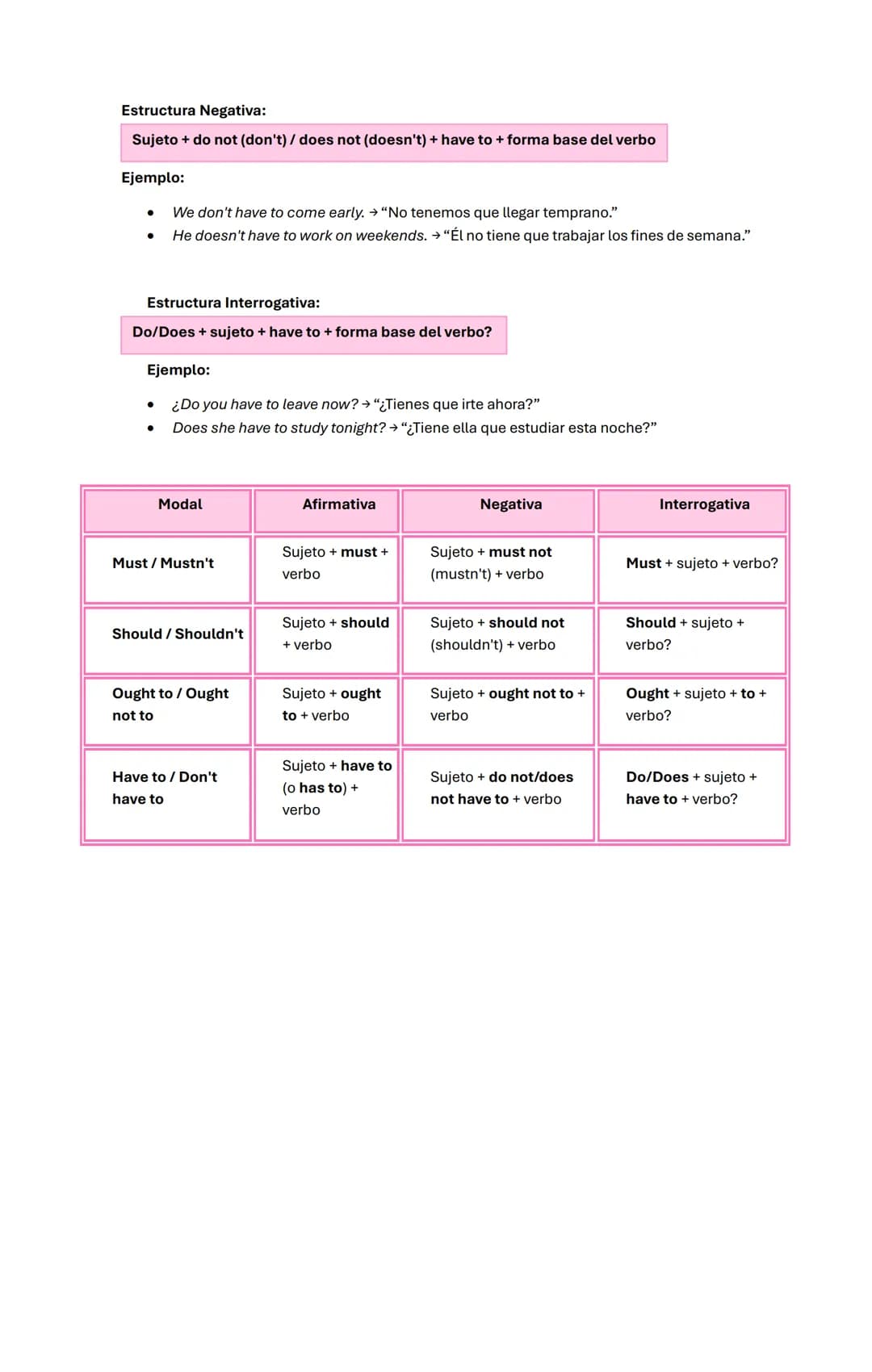
Have to y tabla comparativa
Para negar con have to, usamos el auxiliar don't/doesn't: "We don't have to come early" (No tenemos que llegar temprano) o "He doesn't have to work on weekends" (Él no tiene que trabajar los fines de semana).
Las preguntas se forman con Do/Does: "Do you have to leave now?" (¿Tienes que irte ahora?) o "Does she have to study tonight?" (¿Tiene ella que estudiar esta noche?).
Esta tabla te ayudará a recordar las estructuras de los verbos modales:
| Modal | Afirmativa | Negativa | Interrogativa |
|---|---|---|---|
| Must | Sujeto + must + verbo | Sujeto + mustn't + verbo | Must + sujeto + verbo? |
| Should | Sujeto + should + verbo | Sujeto + shouldn't + verbo | Should + sujeto + verbo? |
| Ought to | Sujeto + ought to + verbo | Sujeto + ought not to + verbo | Ought + sujeto + to + verbo? |
| Have to | Sujeto + have to/has to + verbo | Sujeto + don't/doesn't have to + verbo | Do/Does + sujeto + have to + verbo? |
🌟 Consejo útil: "Have to" suele expresar obligaciones externas, mientras que "must" expresa obligaciones que tú mismo te impones. ¡Un pequeño matiz que marca la diferencia!
4
of 4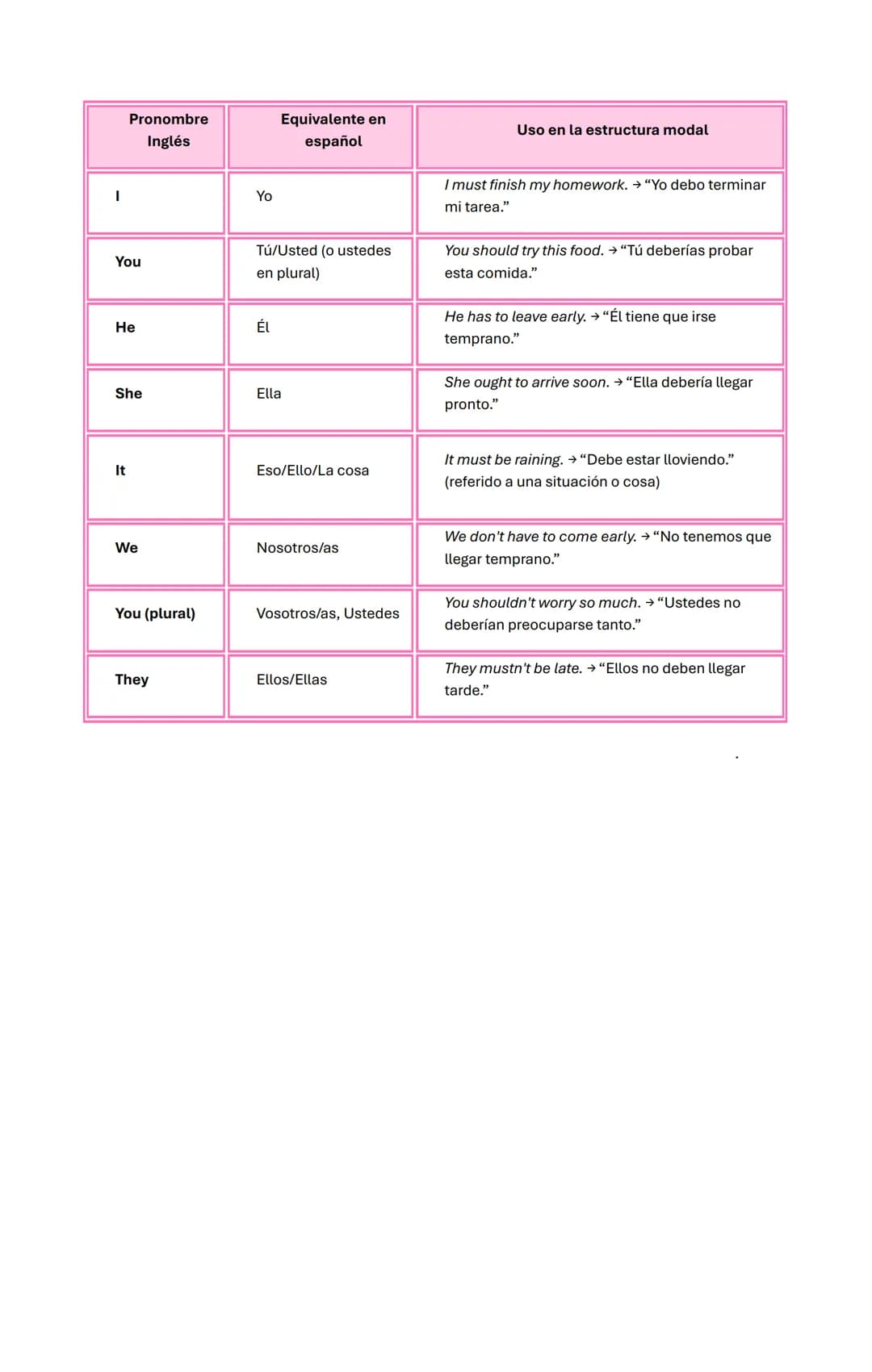
Pronombres con verbos modales
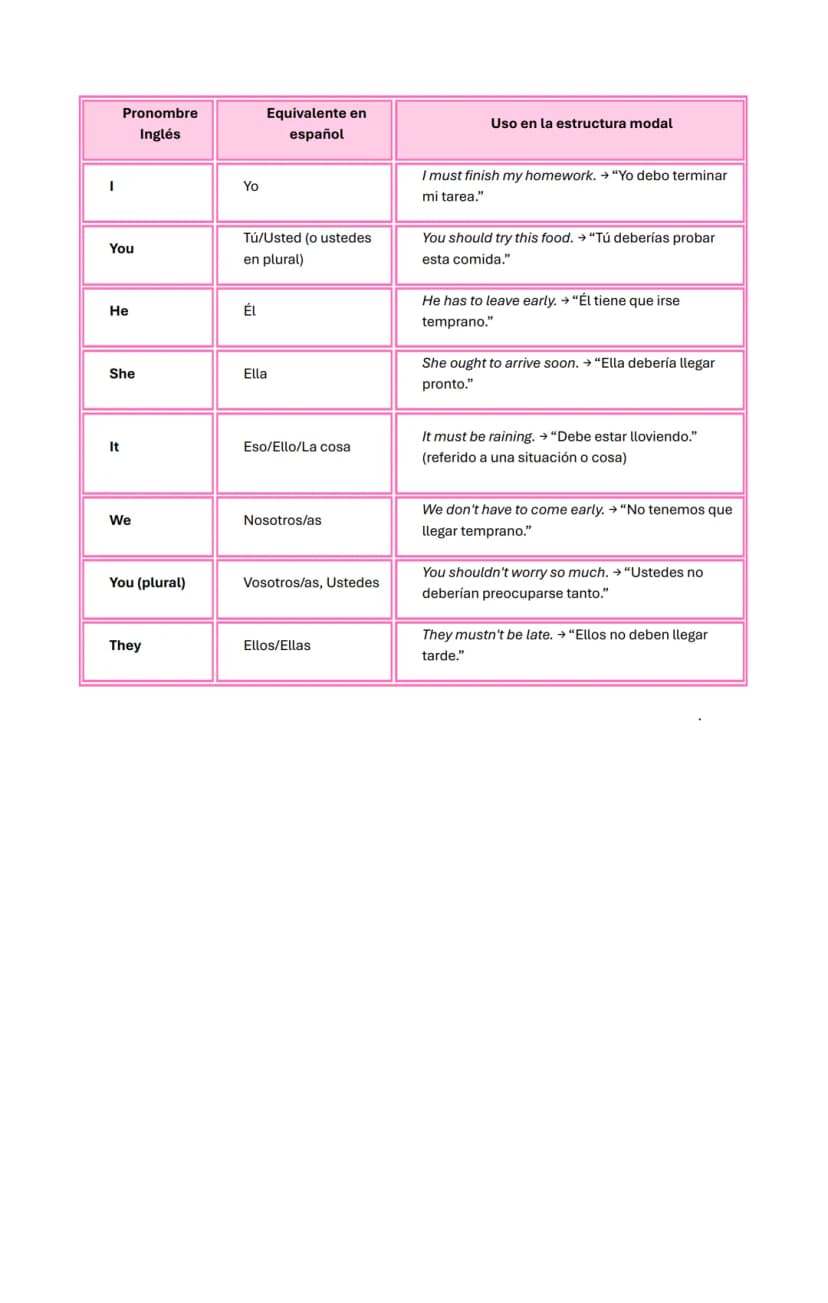
Usar correctamente los pronombres con verbos modales es esencial para comunicarte bien en inglés. Cada pronombre tiene su equivalente en español y se usa de manera específica en estructuras modales:
I (Yo): "I must finish my homework" (Yo debo terminar mi tarea) You : "You should try this food" (Tú deberías probar esta comida) He (Él): "He has to leave early" (Él tiene que irse temprano) She (Ella): "She ought to arrive soon" (Ella debería llegar pronto)
También tenemos It para situaciones o cosas: "It must be raining" (Debe estar lloviendo), We : "We don't have to come early" (No tenemos que llegar temprano), You plural (Ustedes): "You shouldn't worry so much" (Ustedes no deberían preocuparse tanto) y They : "They mustn't be late" (Ellos no deben llegar tarde).
💪 ¡Tú puedes! Practica usando estos pronombres con diferentes verbos modales. Verás que rápidamente formarás oraciones correctas y naturales en inglés.
We thought you’d never ask...
What is the Knowunity AI companion?
Our AI companion is specifically built for the needs of students. Based on the millions of content pieces we have on the platform we can provide truly meaningful and relevant answers to students. But its not only about answers, the companion is even more about guiding students through their daily learning challenges, with personalised study plans, quizzes or content pieces in the chat and 100% personalisation based on the students skills and developments.
Where can I download the Knowunity app?
You can download the app in the Google Play Store and in the Apple App Store.
Is Knowunity really free of charge?
That's right! Enjoy free access to study content, connect with fellow students, and get instant help – all at your fingertips.
Similar Content
 Anglais
Most popular content in Inglés
9Q
InglésQuiz: Present Simple vs. Present Continuous
Quiz: Present Simple vs. Present Continuous
2°M990
P
InglésPhrasal Verbs Comunes en Inglés
Aprende phrasal verbs esenciales con ejemplos cotidianos para mejorar tu inglés.
1°M950
I
Inglésingles
Aprende las formas del verbo "To Be" en presente y su uso con los pronombres personales en inglés.
4°M760
Ingléshazme un cuestionario sobre el verbo to be, el presente simple y el person singular
Pon a prueba tus conocimientos de gramática inglesa con este cuestionario sobre el verbo "to be", el presente simple y la tercera persona del singular.
1°M1310
V
Inglésverbo to be
Pon a prueba tus conocimientos sobre el verbo "to be" en inglés con este cuestionario.
1°M1010
I
Inglésinglés
Números en inglés
2°M1710
InglésEstructura del pasado simple (inglés) + el pasado simple positivo
Contiene en que orden hay que colocar palabras (subject, verb y complement) también dice como armar las frases en positivo, negativo y en pregunta. Tiene unas reglas de cuando poner "ed" que en mi opinión sirven mucho cuando las memorizas.
7°B811
Ingléspast simple tense
Pon a prueba tus conocimientos del pasado simple en inglés con este quiz de gramática. ¡Domina la conjugación de verbos regulares e irregulares!
1°M910
InglésPrueba de inglés
Jsksjjdudkdidkisjdukd7dnd7dnutjejdhgj6gdke6jeydhfuxnekdksldyfjusjysjysjhf6fjfjffjslitdylhxhdylzlzzlhyoylylyyodydoydyxoyxyldyoyxydlydydlydylxylxlyxyooydylxlydyllydldydoydyxljuldlydlydlydlydlhdlhdlhdlydkhdlylydlydlydylñydyldoydoydlydyoydyodlyyfyflydodo
7°B680
Most popular content
9Q
 Física
Quiz sobre las Ondas
Quiz sobre las Ondas
1°M1840
C
 Lengua y Comunicación
Conceptos Literarios Esenciales
Define términos clave de la narrativa para entender mejor los textos literarios.
1°M2460
FísicaOndas
Clasificación y características de las ondas
1°M71710
O
 Biología
Organelos Celulares Eucariotas: Funciones Esenciales
Explora las funciones clave de los organelos celulares eucariotas, incluyendo ribosomas, Golgi, lisosomas y vacuolas.
2°M1920
 Historia
Construcción del Estado nación en Chile
Organización de la republica de Chile: Perspectivas, proyectos e ideas. Triunfo del ideario y orden conservador. Constitución de 1833. "Era Portaliana"
1°M1,49943
A
BiologíaArco Reflejo y SNA
Explora la ruta completa del arco reflejo y la respuesta del Sistema Nervioso Autónomo (SNA) ante estímulos sensoriales.
1°M2410
 Matemáticas
Potencias
Significado de potencias y ejemplos
8°B5364
C
 Historia, Geografía y Ciencias Sociales
Conceptos Clave: Teocentrismo y Renacimiento
Explora ideas fundamentales como el teocentrismo, antropocentrismo y figuras importantes del Renacimiento.
7°B1570
MatemáticasPara estudiar para la M1
De 7 básico a segundo medio
1°M43714
Can't find what you're looking for? Explore other subjects.
Students love us — and so will you.
4.6/5App Store
4.7/5Google Play
The app is very easy to use and well designed. I have found everything I was looking for so far and have been able to learn a lot from the presentations! I will definitely use the app for a class assignment! And of course it also helps a lot as an inspiration.
Stefan SiOS user
This app is really great. There are so many study notes and help [...]. My problem subject is French, for example, and the app has so many options for help. Thanks to this app, I have improved my French. I would recommend it to anyone.
Samantha KlichAndroid user
Wow, I am really amazed. I just tried the app because I've seen it advertised many times and was absolutely stunned. This app is THE HELP you want for school and above all, it offers so many things, such as workouts and fact sheets, which have been VERY helpful to me personally.
AnnaiOS user
Inglés100 views·Updated Jun 16, 2026·4 pagesModal Verbs explicados claramente
Flo@floreyes
Los verbos modales son herramientas poderosas que expresan obligación, recomendación, consejo y necesidad en inglés. Estas palabras especiales modifican el significado del verbo principal y te ayudarán a comunicarte con mayor precisión y naturalidad.
1
of 4
Sign up to see the content. It's free!
- Access to all documents
- Improve your grades
- Join milions of students
Verbos modales: Must y Should
El verbo must expresa una obligación fuerte en presente o futuro. La estructura es simple: sujeto + must + verbo base. Por ejemplo: "I must finish my work" (Debo terminar mi trabajo).
Para formar la negativa usamos mustn't, que significa prohibición: "You mustn't park here" (No debes estacionar aquí). La forma interrogativa se crea invirtiendo el orden: "Must I submit the report today?" (¿Debo entregar el informe hoy?).
Should indica recomendación, no obligación. Cuando dices "You should study for the exam" (Deberías estudiar para el examen), estás dando un consejo. La forma negativa shouldn't sugiere que algo no es recomendable: "He shouldn't eat so late at night" (No debería comer tan tarde en la noche).
💡 Tip importante: Usa "must" cuando algo es absolutamente necesario, y "should" cuando solo quieres recomendar algo. ¡La diferencia de intensidad es clave!
2
of 4Sign up to see the content. It's free!
- Access to all documents
- Improve your grades
- Join milions of students
Should interrogativo y Ought to
Para preguntar con should, simplemente invertimos el orden: "Should we call her now?" (¿Deberíamos llamarla ahora?). Es una forma común de pedir opiniones o consejos.
El modal ought to expresa consejos moralmente correctos o suposiciones lógicas. Su estructura es: sujeto + ought to + verbo base. Por ejemplo: "You ought to apologize for your mistake" (Deberías pedir disculpas por tu error).
La forma negativa es ought not to: "They ought not to ignore important details" (No deberían ignorar detalles importantes). La forma interrogativa "Ought I to explain myself further?" es poco común en conversaciones diarias, generalmente se prefiere usar "Should I...".
Have to expresa necesidad u obligación impuesta externamente: "I have to finish this project" (Tengo que terminar este proyecto). Recuerda usar has to para la tercera persona singular: "She has to attend the meeting" (Ella tiene que asistir a la reunión).
🔍 Recuerda: "Ought to" suena más formal que "should", pero ambos expresan recomendaciones. ¡Usa "ought to" cuando quieras sonar más serio!
3
of 4Sign up to see the content. It's free!
- Access to all documents
- Improve your grades
- Join milions of students
Have to y tabla comparativa
Para negar con have to, usamos el auxiliar don't/doesn't: "We don't have to come early" (No tenemos que llegar temprano) o "He doesn't have to work on weekends" (Él no tiene que trabajar los fines de semana).
Las preguntas se forman con Do/Does: "Do you have to leave now?" (¿Tienes que irte ahora?) o "Does she have to study tonight?" (¿Tiene ella que estudiar esta noche?).
Esta tabla te ayudará a recordar las estructuras de los verbos modales:
| Modal | Afirmativa | Negativa | Interrogativa |
|---|---|---|---|
| Must | Sujeto + must + verbo | Sujeto + mustn't + verbo | Must + sujeto + verbo? |
| Should | Sujeto + should + verbo | Sujeto + shouldn't + verbo | Should + sujeto + verbo? |
| Ought to | Sujeto + ought to + verbo | Sujeto + ought not to + verbo | Ought + sujeto + to + verbo? |
| Have to | Sujeto + have to/has to + verbo | Sujeto + don't/doesn't have to + verbo | Do/Does + sujeto + have to + verbo? |
🌟 Consejo útil: "Have to" suele expresar obligaciones externas, mientras que "must" expresa obligaciones que tú mismo te impones. ¡Un pequeño matiz que marca la diferencia!
4
of 4Sign up to see the content. It's free!
- Access to all documents
- Improve your grades
- Join milions of students
Pronombres con verbos modales
Usar correctamente los pronombres con verbos modales es esencial para comunicarte bien en inglés. Cada pronombre tiene su equivalente en español y se usa de manera específica en estructuras modales:
I (Yo): "I must finish my homework" (Yo debo terminar mi tarea) You : "You should try this food" (Tú deberías probar esta comida) He (Él): "He has to leave early" (Él tiene que irse temprano) She (Ella): "She ought to arrive soon" (Ella debería llegar pronto)
También tenemos It para situaciones o cosas: "It must be raining" (Debe estar lloviendo), We : "We don't have to come early" (No tenemos que llegar temprano), You plural (Ustedes): "You shouldn't worry so much" (Ustedes no deberían preocuparse tanto) y They : "They mustn't be late" (Ellos no deben llegar tarde).
💪 ¡Tú puedes! Practica usando estos pronombres con diferentes verbos modales. Verás que rápidamente formarás oraciones correctas y naturales en inglés.
We thought you’d never ask...
What is the Knowunity AI companion?
Our AI companion is specifically built for the needs of students. Based on the millions of content pieces we have on the platform we can provide truly meaningful and relevant answers to students. But its not only about answers, the companion is even more about guiding students through their daily learning challenges, with personalised study plans, quizzes or content pieces in the chat and 100% personalisation based on the students skills and developments.
Where can I download the Knowunity app?
You can download the app in the Google Play Store and in the Apple App Store.
Is Knowunity really free of charge?
That's right! Enjoy free access to study content, connect with fellow students, and get instant help – all at your fingertips.
Similar Content
Most popular content in Inglés
9Q
InglésQuiz: Present Simple vs. Present Continuous
Quiz: Present Simple vs. Present Continuous
2°M990
P
InglésPhrasal Verbs Comunes en Inglés
Aprende phrasal verbs esenciales con ejemplos cotidianos para mejorar tu inglés.
1°M950
I
Inglésingles
Aprende las formas del verbo "To Be" en presente y su uso con los pronombres personales en inglés.
4°M760
Ingléshazme un cuestionario sobre el verbo to be, el presente simple y el person singular
Pon a prueba tus conocimientos de gramática inglesa con este cuestionario sobre el verbo "to be", el presente simple y la tercera persona del singular.
1°M1310
V
Inglésverbo to be
Pon a prueba tus conocimientos sobre el verbo "to be" en inglés con este cuestionario.
1°M1010
I
Inglésinglés
Números en inglés
2°M1710
InglésEstructura del pasado simple (inglés) + el pasado simple positivo
Contiene en que orden hay que colocar palabras (subject, verb y complement) también dice como armar las frases en positivo, negativo y en pregunta. Tiene unas reglas de cuando poner "ed" que en mi opinión sirven mucho cuando las memorizas.
7°B811
Ingléspast simple tense
Pon a prueba tus conocimientos del pasado simple en inglés con este quiz de gramática. ¡Domina la conjugación de verbos regulares e irregulares!
1°M910
InglésPrueba de inglés
Jsksjjdudkdidkisjdukd7dnd7dnutjejdhgj6gdke6jeydhfuxnekdksldyfjusjysjysjhf6fjfjffjslitdylhxhdylzlzzlhyoylylyyodydoydyxoyxyldyoyxydlydydlydylxylxlyxyooydylxlydyllydldydoydyxljuldlydlydlydlydlhdlhdlhdlydkhdlylydlydlydylñydyldoydoydlydyoydyodlyyfyflydodo
7°B680
Most popular content
9Q
FísicaQuiz sobre las Ondas
Quiz sobre las Ondas
1°M1840
C
Lengua y ComunicaciónConceptos Literarios Esenciales
Define términos clave de la narrativa para entender mejor los textos literarios.
1°M2460
FísicaOndas
Clasificación y características de las ondas
1°M71710
O
BiologíaOrganelos Celulares Eucariotas: Funciones Esenciales
Explora las funciones clave de los organelos celulares eucariotas, incluyendo ribosomas, Golgi, lisosomas y vacuolas.
2°M1920
HistoriaConstrucción del Estado nación en Chile
Organización de la republica de Chile: Perspectivas, proyectos e ideas. Triunfo del ideario y orden conservador. Constitución de 1833. "Era Portaliana"
1°M1,49943
A
BiologíaArco Reflejo y SNA
Explora la ruta completa del arco reflejo y la respuesta del Sistema Nervioso Autónomo (SNA) ante estímulos sensoriales.
1°M2410
MatemáticasPotencias
Significado de potencias y ejemplos
8°B5364
C
Historia, Geografía y Ciencias SocialesConceptos Clave: Teocentrismo y Renacimiento
Explora ideas fundamentales como el teocentrismo, antropocentrismo y figuras importantes del Renacimiento.
7°B1570
MatemáticasPara estudiar para la M1
De 7 básico a segundo medio
1°M43714
Can't find what you're looking for? Explore other subjects.
Students love us — and so will you.
4.6/5App Store
4.7/5Google Play
The app is very easy to use and well designed. I have found everything I was looking for so far and have been able to learn a lot from the presentations! I will definitely use the app for a class assignment! And of course it also helps a lot as an inspiration.
Stefan SiOS user
This app is really great. There are so many study notes and help [...]. My problem subject is French, for example, and the app has so many options for help. Thanks to this app, I have improved my French. I would recommend it to anyone.
Samantha KlichAndroid user
Wow, I am really amazed. I just tried the app because I've seen it advertised many times and was absolutely stunned. This app is THE HELP you want for school and above all, it offers so many things, such as workouts and fact sheets, which have been VERY helpful to me personally.
AnnaiOS user