
¡Vamos a repasar los puntos clave de la gramática inglesa!...
 Inglés219 views·Updated Jun 27, 2026·5 pages
Mastering English Grammar Made Easy
A
Anna Thau@annathau
1 / 5
1
of 5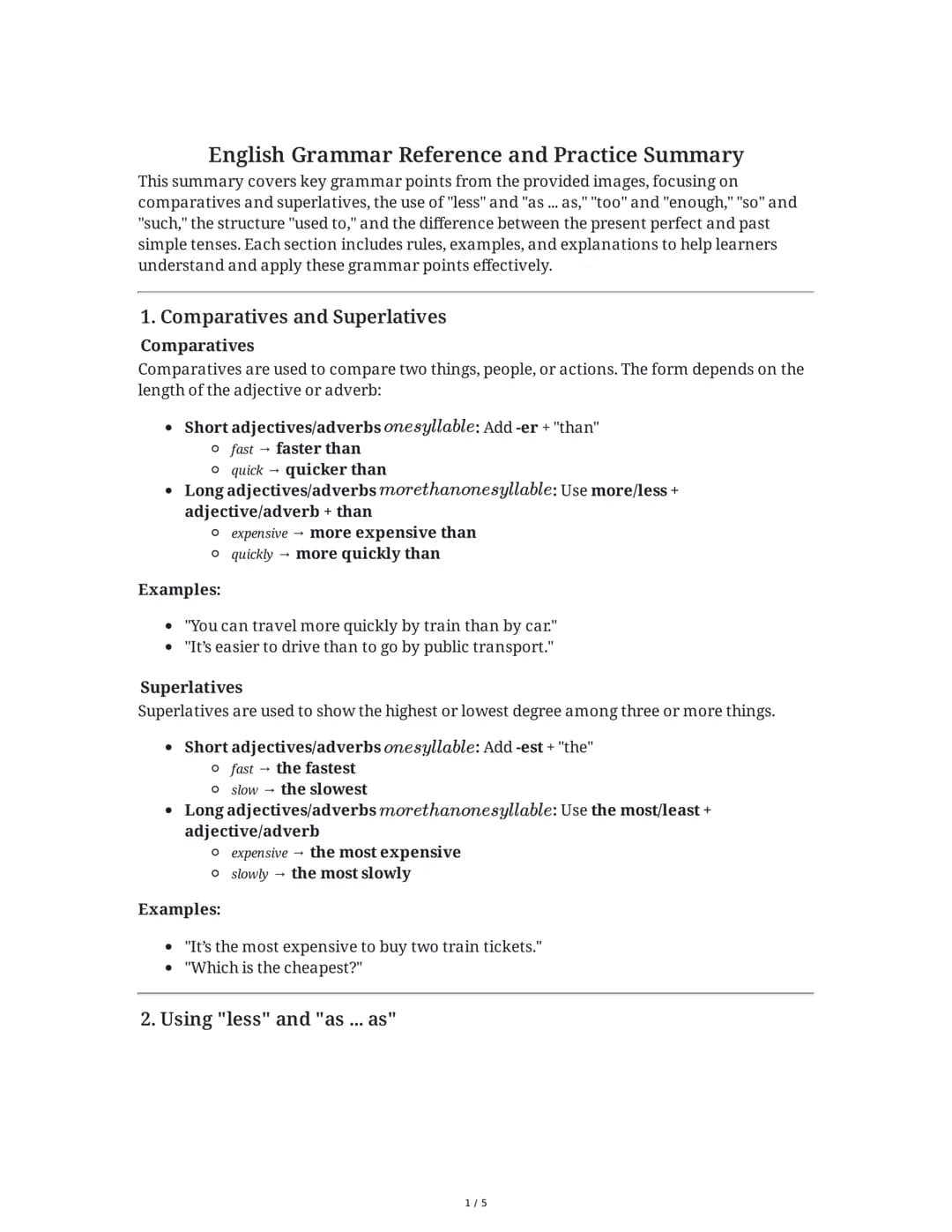
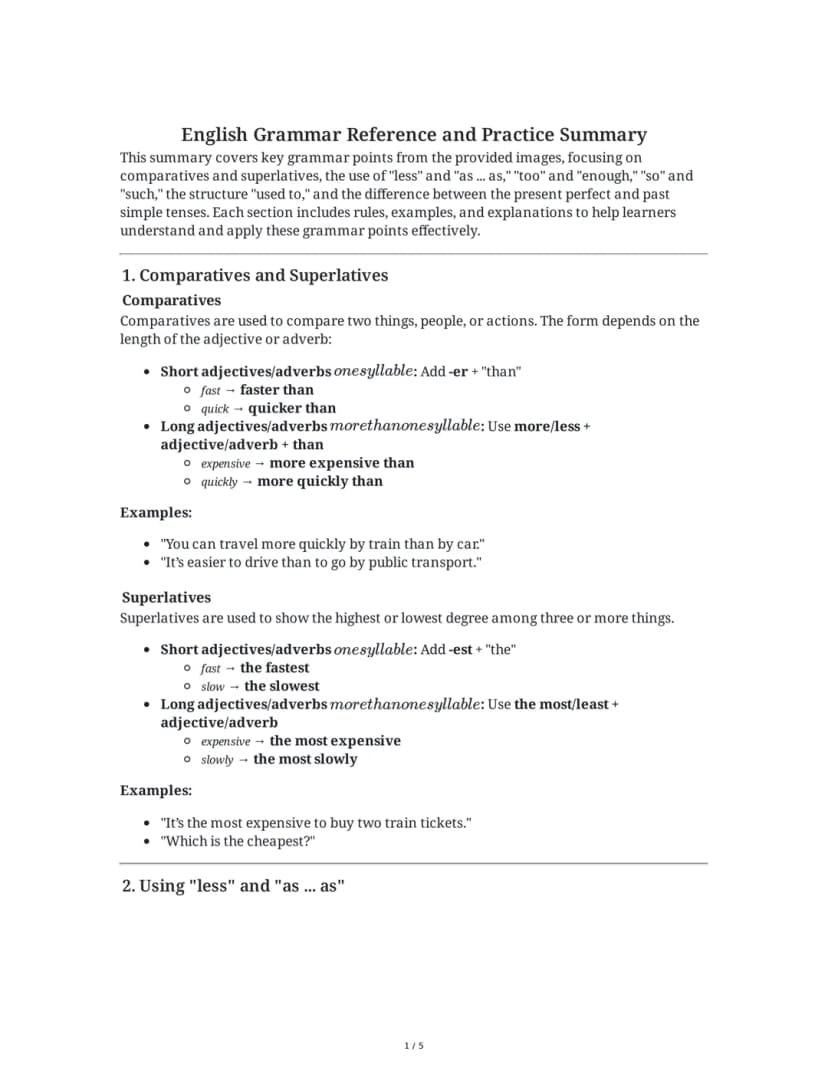
Comparativos y Superlativos
Los comparativos nos ayudan a comparar dos cosas. Su forma depende de la longitud del adjetivo:
- Adjetivos cortos (una sílaba): añade -er + "than" (fast → faster than)
- Adjetivos largos (más de una sílaba): usa more/less + adjetivo + than (expensive → more expensive than)
Los superlativos comparan tres o más cosas, mostrando el mayor o menor grado:
- Adjetivos cortos: añade -est con "the" (fast → the fastest)
- Adjetivos largos: usa the most/least + adjetivo (expensive → the most expensive)
¿Viajas mucho? Puedes decir: "Viajar en tren es más rápido que en auto" o "El avión es el medio más caro para viajar".
💡 ¡Consejo útil! Para recordar cuándo usar -er/-est y cuándo usar more/most, piensa en el número de sílabas: ¡una sílaba va con terminación, más sílabas va con palabras adicionales!
2
of 5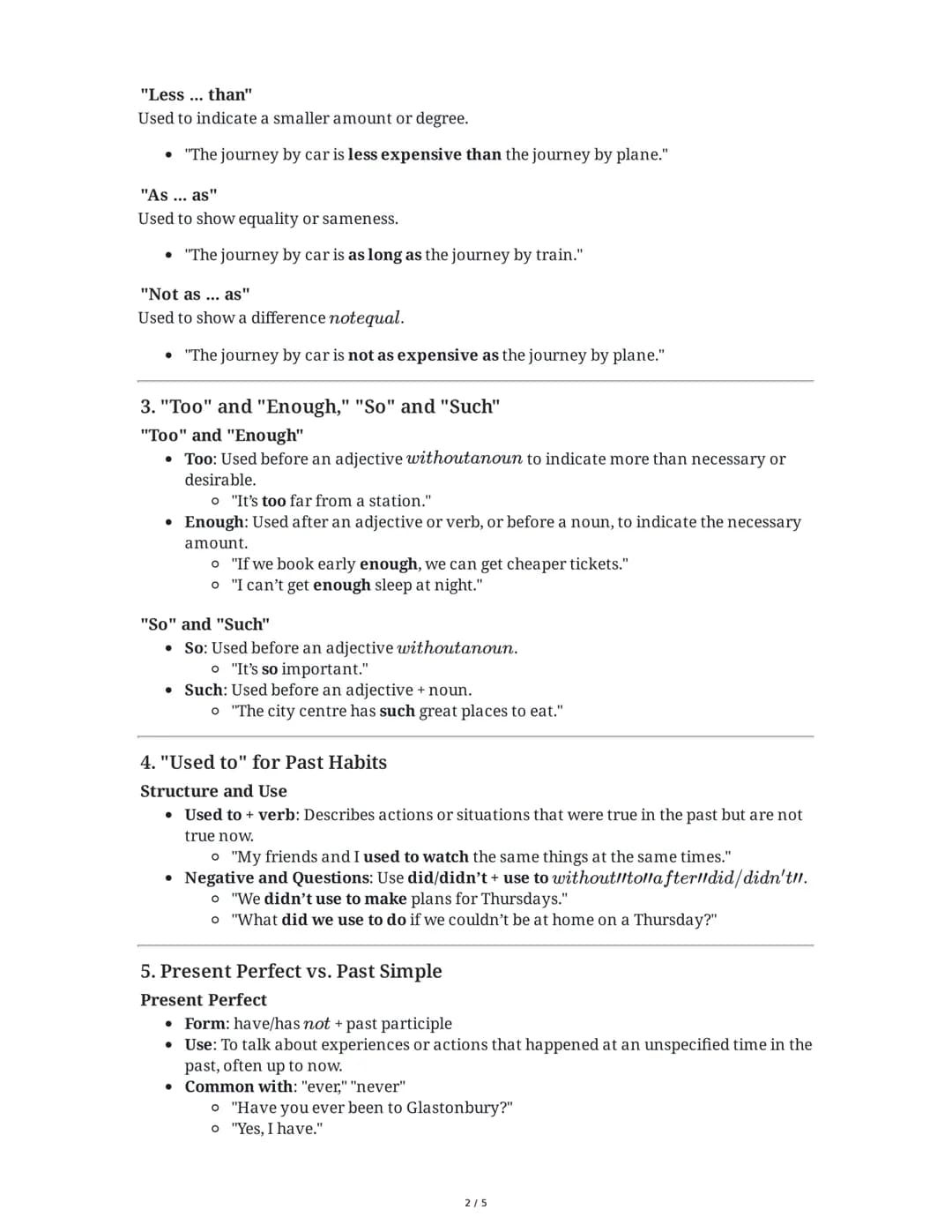
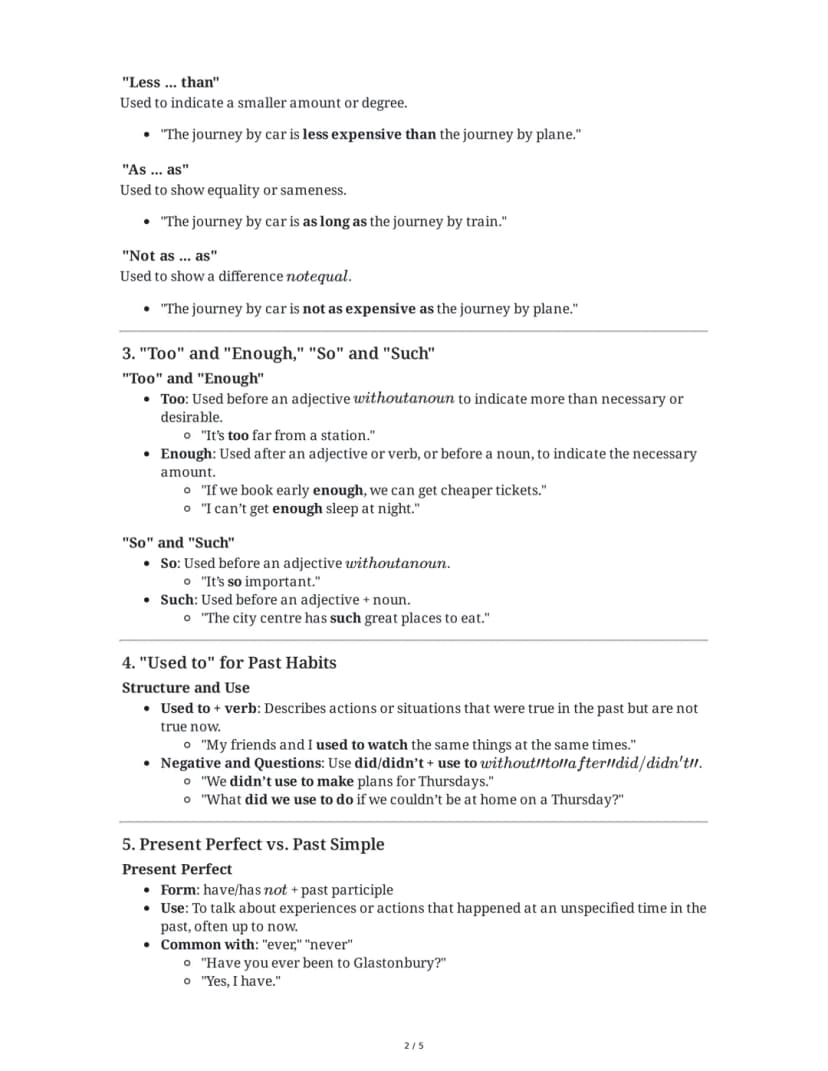
Less, As...As, Too y Enough
Cuando queremos mostrar diferencias usamos:
- Less... than: indica una cantidad menor. "El viaje en auto es menos caro que el viaje en avión."
- As... as: muestra igualdad. "El viaje en auto es tan largo como el viaje en tren."
- Not as... as: indica diferencia. "El viaje en auto no es tan caro como el viaje en avión."
Para hablar de exceso o suficiencia:
- Too: va antes del adjetivo para indicar exceso. "Está demasiado lejos de la estación."
- Enough: va después del adjetivo o verbo, o antes del sustantivo. "Si reservamos con suficiente anticipación, podemos conseguir boletos más baratos."
So y such son para enfatizar:
- So + adjetivo (sin sustantivo): "Es tan importante."
- Such + adjetivo + sustantivo: "El centro tiene unos lugares tan buenos para comer."
¡Estas expresiones te ayudarán a describir situaciones cotidianas con más precisión!
3
of 5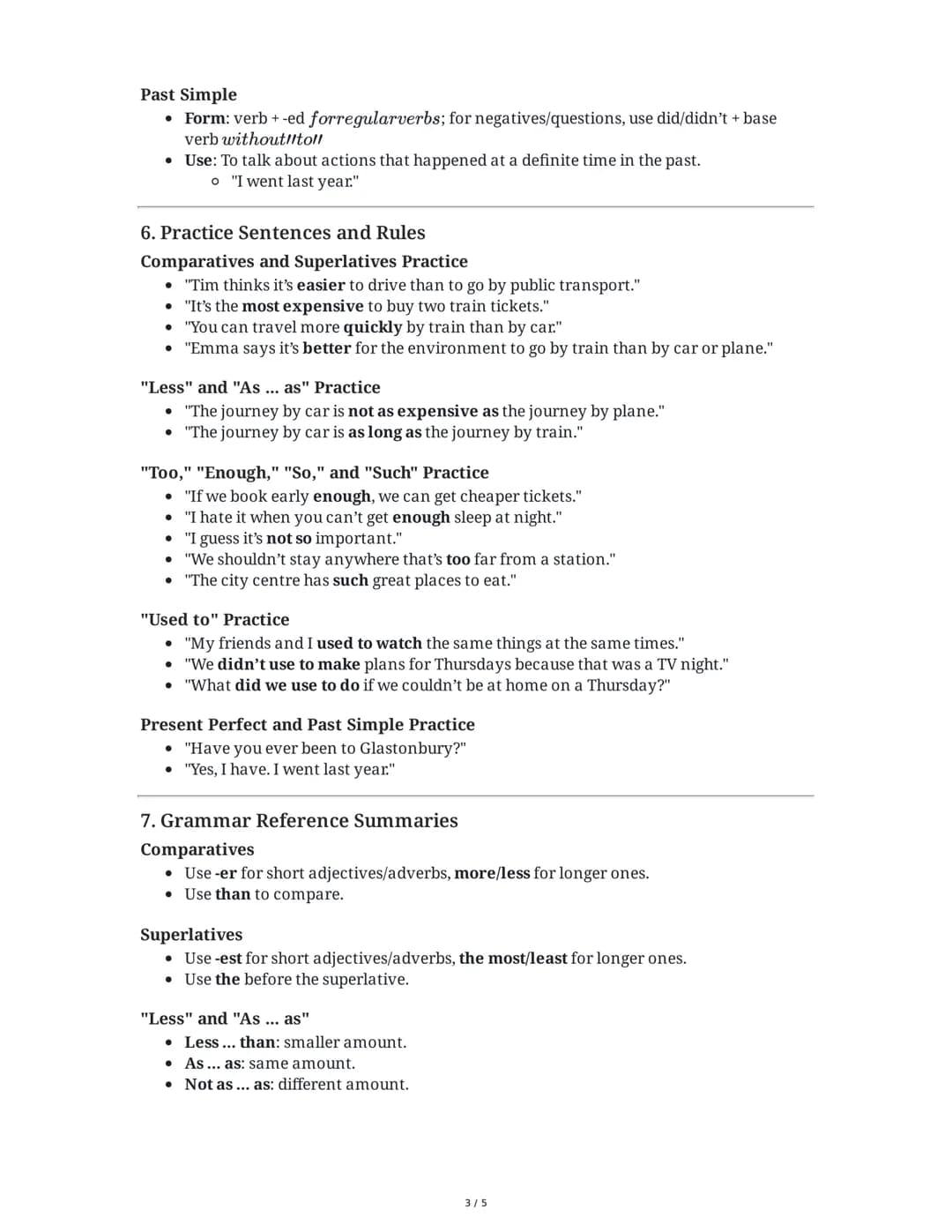
Used to y los Tiempos Pasados
Used to + verbo describe hábitos o situaciones que eran verdad en el pasado pero ya no lo son.
Por ejemplo: "Mis amigos y yo solíamos ver las mismas cosas a la misma hora." Para formar preguntas o negaciones, usamos did/didn't + use to (¡sin "d"!): "No solíamos hacer planes los jueves."
La diferencia entre Present Perfect y Past Simple es crucial:
Present Perfect :
- Habla sobre experiencias en un tiempo no especificado
- Se usa con "ever", "never"
- "¿Has estado alguna vez en Glastonbury?"
Past Simple :
- Habla sobre acciones en un tiempo definido
- "Fui el año pasado."
🔑 Recuerda: Si mencionas cuándo ocurrió algo (ayer, la semana pasada, en 2020), debes usar Past Simple, no Present Perfect.
4
of 5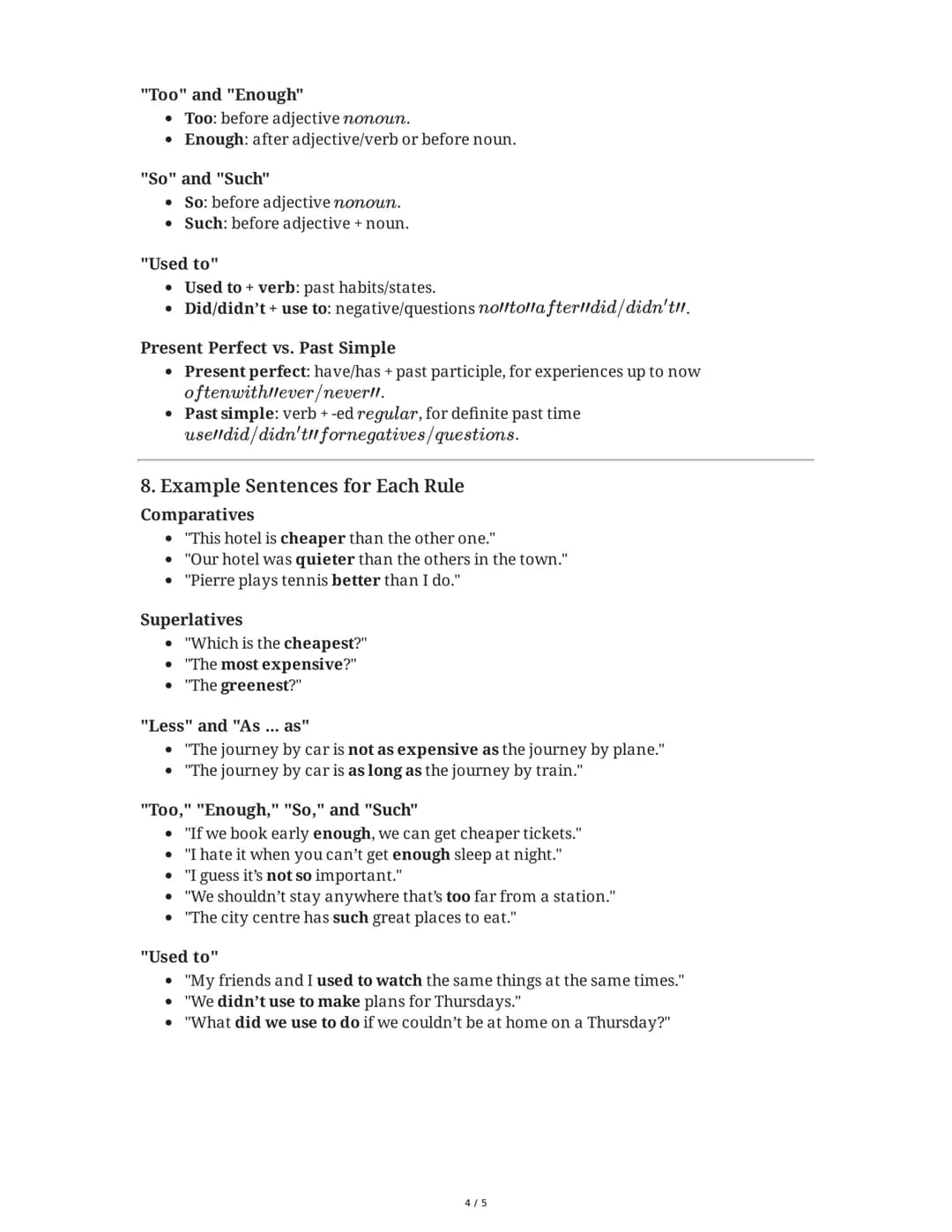
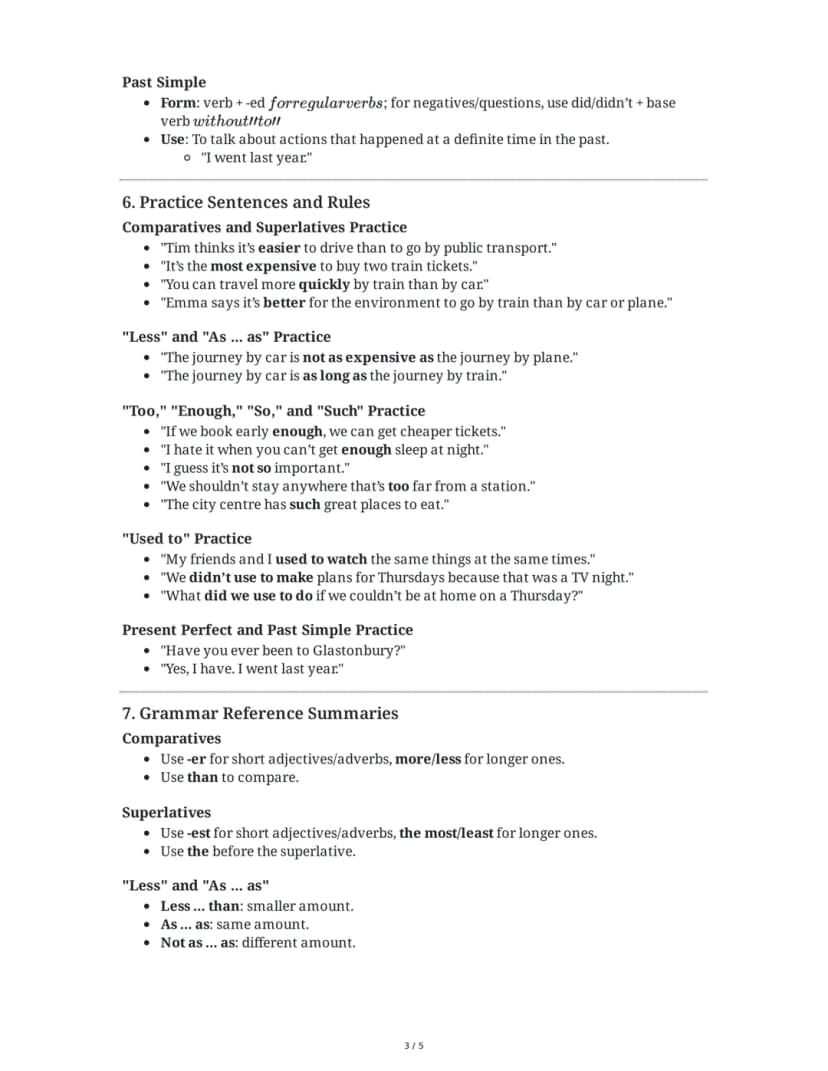
Reglas Prácticas y Ejemplos
Para los comparativos y superlativos, recuerda:
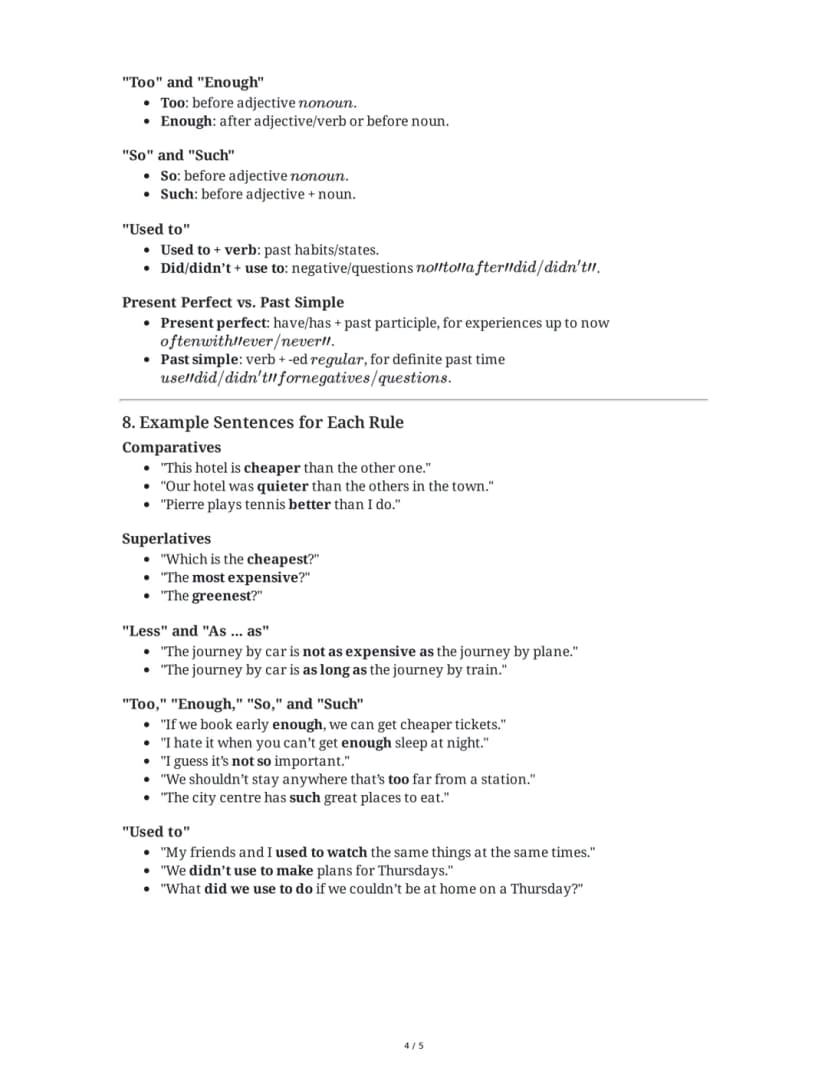
- "Este hotel es más barato que el otro." (comparativo)
- "¿Cuál es el más barato?" (superlativo)
Con less y as...as:
- "El viaje en auto no es tan caro como el viaje en avión."
- "El viaje en auto es tan largo como el viaje en tren."
Para too, enough, so y such:
- "Si reservamos con suficiente anticipación, podemos conseguir boletos más baratos."
- "No deberíamos hospedarnos en un lugar que esté demasiado lejos de la estación."
- "El centro tiene unos lugares tan buenos para comer."
Con used to:
- "Mis amigos y yo solíamos ver las mismas cosas a la misma hora."
- "¿Qué solíamos hacer si no podíamos estar en casa un jueves?"
¡Estas estructuras te permitirán comunicarte con más precisión en inglés! Practica formando tus propias oraciones con cada una de estas reglas.
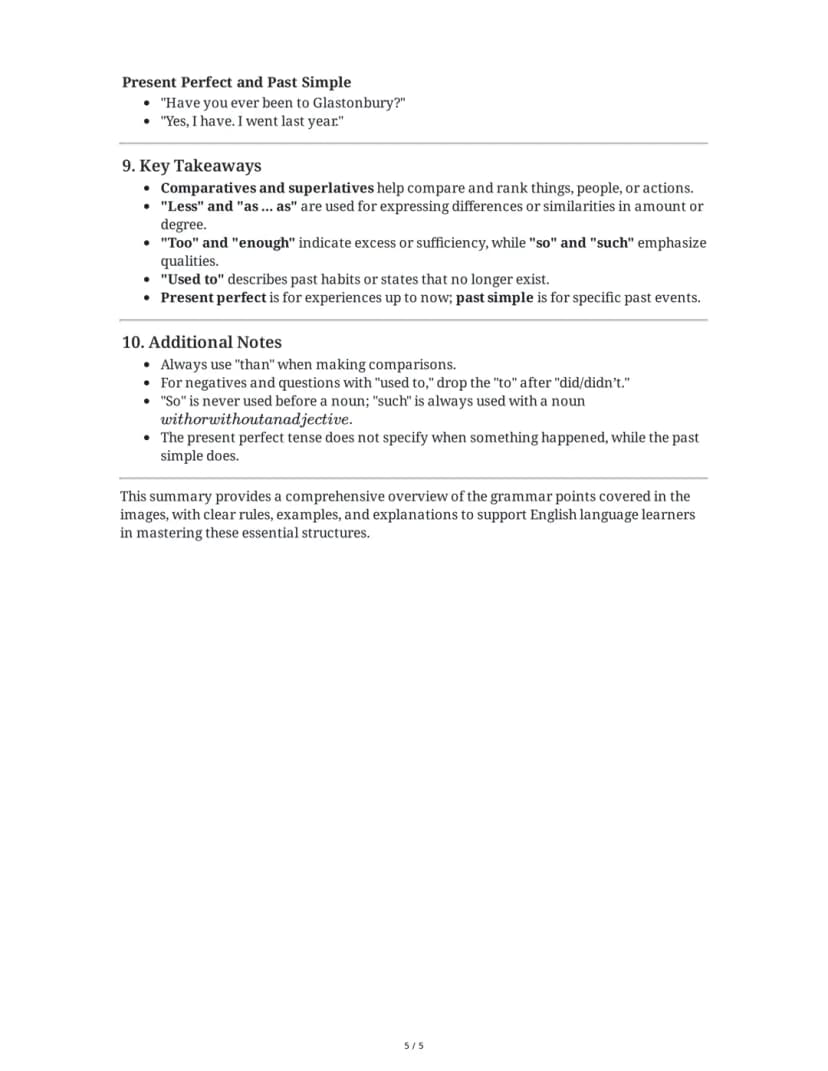
5
of 5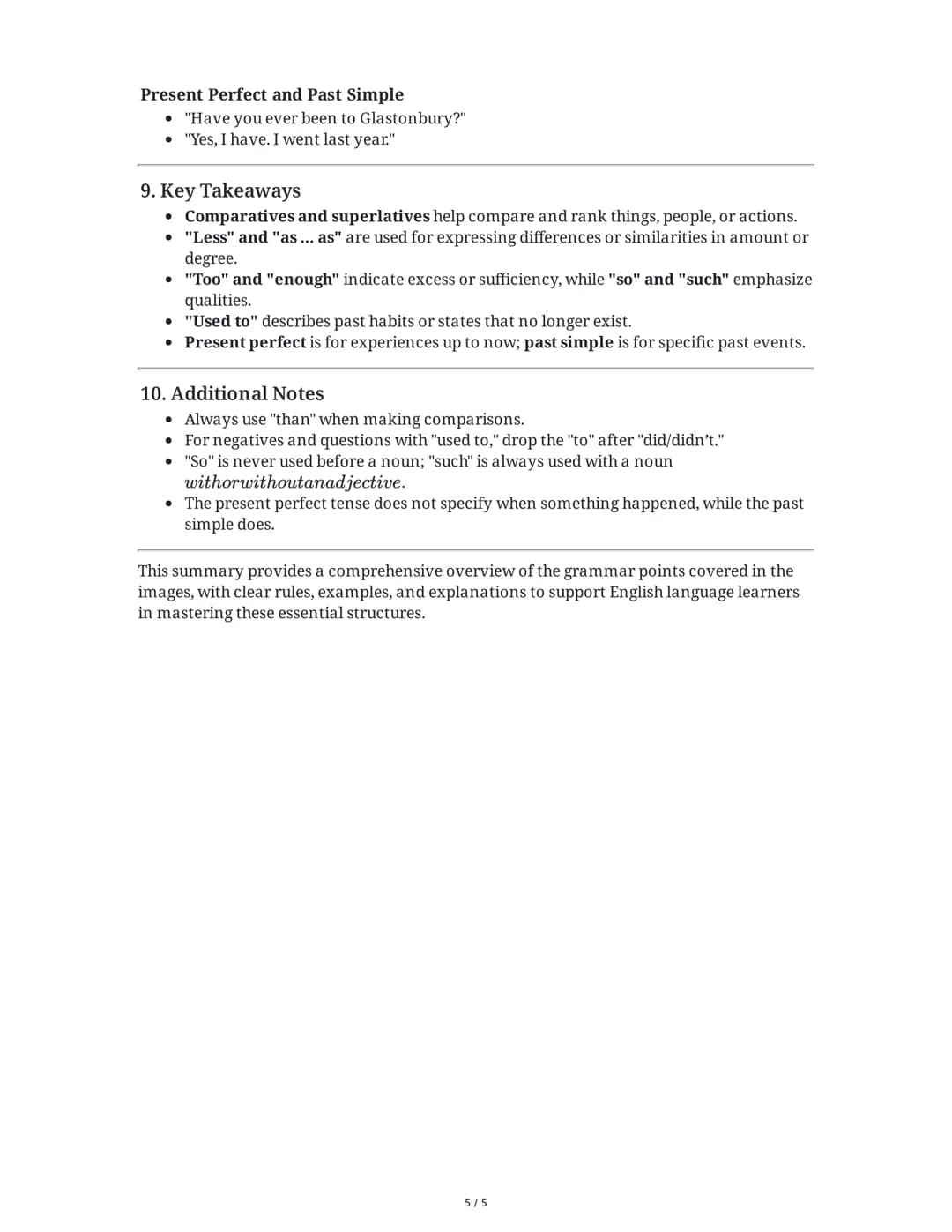
Consejos Clave y Aplicaciones
Para mejorar tu uso de comparativos y superlativos:
- Siempre usa "than" al hacer comparaciones
- No olvides "the" antes de los superlativos
Con used to, recuerda estas reglas:
- En negaciones: "We didn't use to..." (sin "d" después de didn't)
- En preguntas: "Did you use to...?" (sin "d" después de did)
Diferencias importantes:
- "So" nunca se usa antes de un sustantivo solo
- "Such" siempre va con un sustantivo (con o sin adjetivo)
- Present Perfect no especifica cuándo ocurrió algo
- Past Simple sí especifica el momento
Estos puntos gramaticales son esenciales para expresarte correctamente en inglés. ¡Cada vez que los practiques, tu fluidez mejorará!
💪 ¡Tú puedes! Aprender estas reglas te ayudará a hablar inglés con más confianza. Prueba usarlas en tus conversaciones diarias o cuando escribas en inglés.
We thought you’d never ask...
What is the Knowunity AI companion?
Our AI companion is specifically built for the needs of students. Based on the millions of content pieces we have on the platform we can provide truly meaningful and relevant answers to students. But its not only about answers, the companion is even more about guiding students through their daily learning challenges, with personalised study plans, quizzes or content pieces in the chat and 100% personalisation based on the students skills and developments.
Where can I download the Knowunity app?
You can download the app in the Google Play Store and in the Apple App Store.
Is Knowunity really free of charge?
That's right! Enjoy free access to study content, connect with fellow students, and get instant help – all at your fingertips.
Similar Content
 Anglais
Most popular content: Auxiliary Verbs
1Most popular content in Inglés
9InglésSimple present
Estructura del present simple/simple present
1°4797
InglésResumen gramática inglesa B2
Contiene los temas básicos necesarios para el FCE
6°4425
Inglés🪻✨️verbo to be✨️🪻
Verbo tobe para estudiar simple y facil
1°2682
Inglés🪻✨️Verbo to be ✨️🪻
Gia del verbo to be para estudiar simple y fácil
1°2630
InglésVerbos irregulares ingles
Son verbos irregulares de ingles q diferencia entre el pasado y presente
2°4738
InglésPronombres personales.
Se utilizan para referirnos a personas u objetos.
1°1491
I
InglésInglés: Presente Simple y Continuo
Flashcards sobre el Presente Simple, Presente Continuo y rutinas diarias en inglés.
2°710
InglésEstructura del Present Simple and Present Continos( Affirmative and Negative form)
Estructura del Present Simple and Present Continuos Affirmative and Negative form y la estructura de la pregunta con todas las personas.
3°2675
InglésTHERE WAS AND THERE WERE, PAST SIMPLE
Ese resumen contiene, verbos irregulares, formas del pasado simple ( afirmativo,negativo y pregunta)
3°3031
Most popular content
9C
 Biología
celula eucriota, membrana plasmática, núcleo, pared celular, citoplasma y citoesqueletos. nombre se las partes de la celula eucariota
Este quiz evalúa tu conocimiento sobre la célula eucariota, incluyendo la membrana plasmática, núcleo, pared celular, citoplasma y citoesqueleto.
2°4580
C
 Historia
Conceptos Clave de la Revolución Industrial
Explora los términos esenciales de la Revolución Industrial, sus clases sociales y la urbanización.
3°1430
P
 Geografía
Países y Capitales de América
Aprende los países y capitales de América del Sur, Central, Caribe y del Norte.
3°1250
BiologíaBiologia
Fases
Universidad95314
InglésSimple present
Estructura del present simple/simple present
1°4797
 Lengua
Análisis sintáctico de oraciones
explicación de el análisis de oraciones
2°50810
GeografíaGeografía 1er año
definición geografía-coordenadas geográficas-meridianos-paralelos-definición latitud y longitud-elementos del mapa-definición mapa-localización relativa y absoluta
1°2843
GeografíaContines y océanos
Geografía
1°4242
 Matemáticas
Función cuadrática: Fórmulas y Análisis de la parábola.
Resumen teórico-práctico sobre la función cuadrática, sus fórmulas principales y el estudio de la parábola como representación gráfica.Incluye desarrollo de la forma general, cálculo de raíces, vértice y elementos fundamentales para su interpretación
4°2653
Can't find what you're looking for? Explore other subjects.
Students love us — and so will you.
4.6/5App Store
4.7/5Google Play
The app is very easy to use and well designed. I have found everything I was looking for so far and have been able to learn a lot from the presentations! I will definitely use the app for a class assignment! And of course it also helps a lot as an inspiration.
Stefan SiOS user
This app is really great. There are so many study notes and help [...]. My problem subject is French, for example, and the app has so many options for help. Thanks to this app, I have improved my French. I would recommend it to anyone.
Samantha KlichAndroid user
Wow, I am really amazed. I just tried the app because I've seen it advertised many times and was absolutely stunned. This app is THE HELP you want for school and above all, it offers so many things, such as workouts and fact sheets, which have been VERY helpful to me personally.
AnnaiOS user
Inglés219 views·Updated Jun 27, 2026·5 pagesMastering English Grammar Made Easy
A
Anna Thau@annathau
¡Vamos a repasar los puntos clave de la gramática inglesa! Este resumen te ayudará a entender las comparaciones, expresiones de cantidad y tiempos verbales que suelen complicarnos la vida. Dominar estas estructuras te permitirá comunicarte mucho mejor en inglés.
1
of 5
Sign up to see the content. It's free!
- Access to all documents
- Improve your grades
- Join milions of students
Comparativos y Superlativos
Los comparativos nos ayudan a comparar dos cosas. Su forma depende de la longitud del adjetivo:
- Adjetivos cortos (una sílaba): añade -er + "than" (fast → faster than)
- Adjetivos largos (más de una sílaba): usa more/less + adjetivo + than (expensive → more expensive than)
Los superlativos comparan tres o más cosas, mostrando el mayor o menor grado:
- Adjetivos cortos: añade -est con "the" (fast → the fastest)
- Adjetivos largos: usa the most/least + adjetivo (expensive → the most expensive)
¿Viajas mucho? Puedes decir: "Viajar en tren es más rápido que en auto" o "El avión es el medio más caro para viajar".
💡 ¡Consejo útil! Para recordar cuándo usar -er/-est y cuándo usar more/most, piensa en el número de sílabas: ¡una sílaba va con terminación, más sílabas va con palabras adicionales!
2
of 5Sign up to see the content. It's free!
- Access to all documents
- Improve your grades
- Join milions of students
Less, As...As, Too y Enough
Cuando queremos mostrar diferencias usamos:
- Less... than: indica una cantidad menor. "El viaje en auto es menos caro que el viaje en avión."
- As... as: muestra igualdad. "El viaje en auto es tan largo como el viaje en tren."
- Not as... as: indica diferencia. "El viaje en auto no es tan caro como el viaje en avión."
Para hablar de exceso o suficiencia:
- Too: va antes del adjetivo para indicar exceso. "Está demasiado lejos de la estación."
- Enough: va después del adjetivo o verbo, o antes del sustantivo. "Si reservamos con suficiente anticipación, podemos conseguir boletos más baratos."
So y such son para enfatizar:
- So + adjetivo (sin sustantivo): "Es tan importante."
- Such + adjetivo + sustantivo: "El centro tiene unos lugares tan buenos para comer."
¡Estas expresiones te ayudarán a describir situaciones cotidianas con más precisión!
3
of 5Sign up to see the content. It's free!
- Access to all documents
- Improve your grades
- Join milions of students
Used to y los Tiempos Pasados
Used to + verbo describe hábitos o situaciones que eran verdad en el pasado pero ya no lo son.
Por ejemplo: "Mis amigos y yo solíamos ver las mismas cosas a la misma hora." Para formar preguntas o negaciones, usamos did/didn't + use to (¡sin "d"!): "No solíamos hacer planes los jueves."
La diferencia entre Present Perfect y Past Simple es crucial:
Present Perfect :
- Habla sobre experiencias en un tiempo no especificado
- Se usa con "ever", "never"
- "¿Has estado alguna vez en Glastonbury?"
Past Simple :
- Habla sobre acciones en un tiempo definido
- "Fui el año pasado."
🔑 Recuerda: Si mencionas cuándo ocurrió algo (ayer, la semana pasada, en 2020), debes usar Past Simple, no Present Perfect.
4
of 5Sign up to see the content. It's free!
- Access to all documents
- Improve your grades
- Join milions of students
Reglas Prácticas y Ejemplos
Para los comparativos y superlativos, recuerda:
- "Este hotel es más barato que el otro." (comparativo)
- "¿Cuál es el más barato?" (superlativo)
Con less y as...as:
- "El viaje en auto no es tan caro como el viaje en avión."
- "El viaje en auto es tan largo como el viaje en tren."
Para too, enough, so y such:
- "Si reservamos con suficiente anticipación, podemos conseguir boletos más baratos."
- "No deberíamos hospedarnos en un lugar que esté demasiado lejos de la estación."
- "El centro tiene unos lugares tan buenos para comer."
Con used to:
- "Mis amigos y yo solíamos ver las mismas cosas a la misma hora."
- "¿Qué solíamos hacer si no podíamos estar en casa un jueves?"
¡Estas estructuras te permitirán comunicarte con más precisión en inglés! Practica formando tus propias oraciones con cada una de estas reglas.
5
of 5Sign up to see the content. It's free!
- Access to all documents
- Improve your grades
- Join milions of students
Consejos Clave y Aplicaciones
Para mejorar tu uso de comparativos y superlativos:
- Siempre usa "than" al hacer comparaciones
- No olvides "the" antes de los superlativos
Con used to, recuerda estas reglas:
- En negaciones: "We didn't use to..." (sin "d" después de didn't)
- En preguntas: "Did you use to...?" (sin "d" después de did)
Diferencias importantes:
- "So" nunca se usa antes de un sustantivo solo
- "Such" siempre va con un sustantivo (con o sin adjetivo)
- Present Perfect no especifica cuándo ocurrió algo
- Past Simple sí especifica el momento
Estos puntos gramaticales son esenciales para expresarte correctamente en inglés. ¡Cada vez que los practiques, tu fluidez mejorará!
💪 ¡Tú puedes! Aprender estas reglas te ayudará a hablar inglés con más confianza. Prueba usarlas en tus conversaciones diarias o cuando escribas en inglés.
We thought you’d never ask...
What is the Knowunity AI companion?
Our AI companion is specifically built for the needs of students. Based on the millions of content pieces we have on the platform we can provide truly meaningful and relevant answers to students. But its not only about answers, the companion is even more about guiding students through their daily learning challenges, with personalised study plans, quizzes or content pieces in the chat and 100% personalisation based on the students skills and developments.
Where can I download the Knowunity app?
You can download the app in the Google Play Store and in the Apple App Store.
Is Knowunity really free of charge?
That's right! Enjoy free access to study content, connect with fellow students, and get instant help – all at your fingertips.
Similar Content
Most popular content: Auxiliary Verbs
1Most popular content in Inglés
9InglésSimple present
Estructura del present simple/simple present
1°4797
InglésResumen gramática inglesa B2
Contiene los temas básicos necesarios para el FCE
6°4425
Inglés🪻✨️verbo to be✨️🪻
Verbo tobe para estudiar simple y facil
1°2682
Inglés🪻✨️Verbo to be ✨️🪻
Gia del verbo to be para estudiar simple y fácil
1°2630
InglésVerbos irregulares ingles
Son verbos irregulares de ingles q diferencia entre el pasado y presente
2°4738
InglésPronombres personales.
Se utilizan para referirnos a personas u objetos.
1°1491
I
InglésInglés: Presente Simple y Continuo
Flashcards sobre el Presente Simple, Presente Continuo y rutinas diarias en inglés.
2°710
InglésEstructura del Present Simple and Present Continos( Affirmative and Negative form)
Estructura del Present Simple and Present Continuos Affirmative and Negative form y la estructura de la pregunta con todas las personas.
3°2675
InglésTHERE WAS AND THERE WERE, PAST SIMPLE
Ese resumen contiene, verbos irregulares, formas del pasado simple ( afirmativo,negativo y pregunta)
3°3031
Most popular content
9C
Biologíacelula eucriota, membrana plasmática, núcleo, pared celular, citoplasma y citoesqueletos. nombre se las partes de la celula eucariota
Este quiz evalúa tu conocimiento sobre la célula eucariota, incluyendo la membrana plasmática, núcleo, pared celular, citoplasma y citoesqueleto.
2°4580
C
HistoriaConceptos Clave de la Revolución Industrial
Explora los términos esenciales de la Revolución Industrial, sus clases sociales y la urbanización.
3°1430
P
GeografíaPaíses y Capitales de América
Aprende los países y capitales de América del Sur, Central, Caribe y del Norte.
3°1250
BiologíaBiologia
Fases
Universidad95314
InglésSimple present
Estructura del present simple/simple present
1°4797
LenguaAnálisis sintáctico de oraciones
explicación de el análisis de oraciones
2°50810
GeografíaGeografía 1er año
definición geografía-coordenadas geográficas-meridianos-paralelos-definición latitud y longitud-elementos del mapa-definición mapa-localización relativa y absoluta
1°2843
GeografíaContines y océanos
Geografía
1°4242
MatemáticasFunción cuadrática: Fórmulas y Análisis de la parábola.
Resumen teórico-práctico sobre la función cuadrática, sus fórmulas principales y el estudio de la parábola como representación gráfica.Incluye desarrollo de la forma general, cálculo de raíces, vértice y elementos fundamentales para su interpretación
4°2653
Can't find what you're looking for? Explore other subjects.
Students love us — and so will you.
4.6/5App Store
4.7/5Google Play
The app is very easy to use and well designed. I have found everything I was looking for so far and have been able to learn a lot from the presentations! I will definitely use the app for a class assignment! And of course it also helps a lot as an inspiration.
Stefan SiOS user
This app is really great. There are so many study notes and help [...]. My problem subject is French, for example, and the app has so many options for help. Thanks to this app, I have improved my French. I would recommend it to anyone.
Samantha KlichAndroid user
Wow, I am really amazed. I just tried the app because I've seen it advertised many times and was absolutely stunned. This app is THE HELP you want for school and above all, it offers so many things, such as workouts and fact sheets, which have been VERY helpful to me personally.
AnnaiOS user