
El presente simple y el presente continuo son tiempos verbales...
 Inglés70 views·Updated Jun 18, 2026·16 pages
Aprende Inglés: Usos de Do y Does
V
valeryvanessa993@valeryvanessa993_ywvx


1 / 10
1
of 10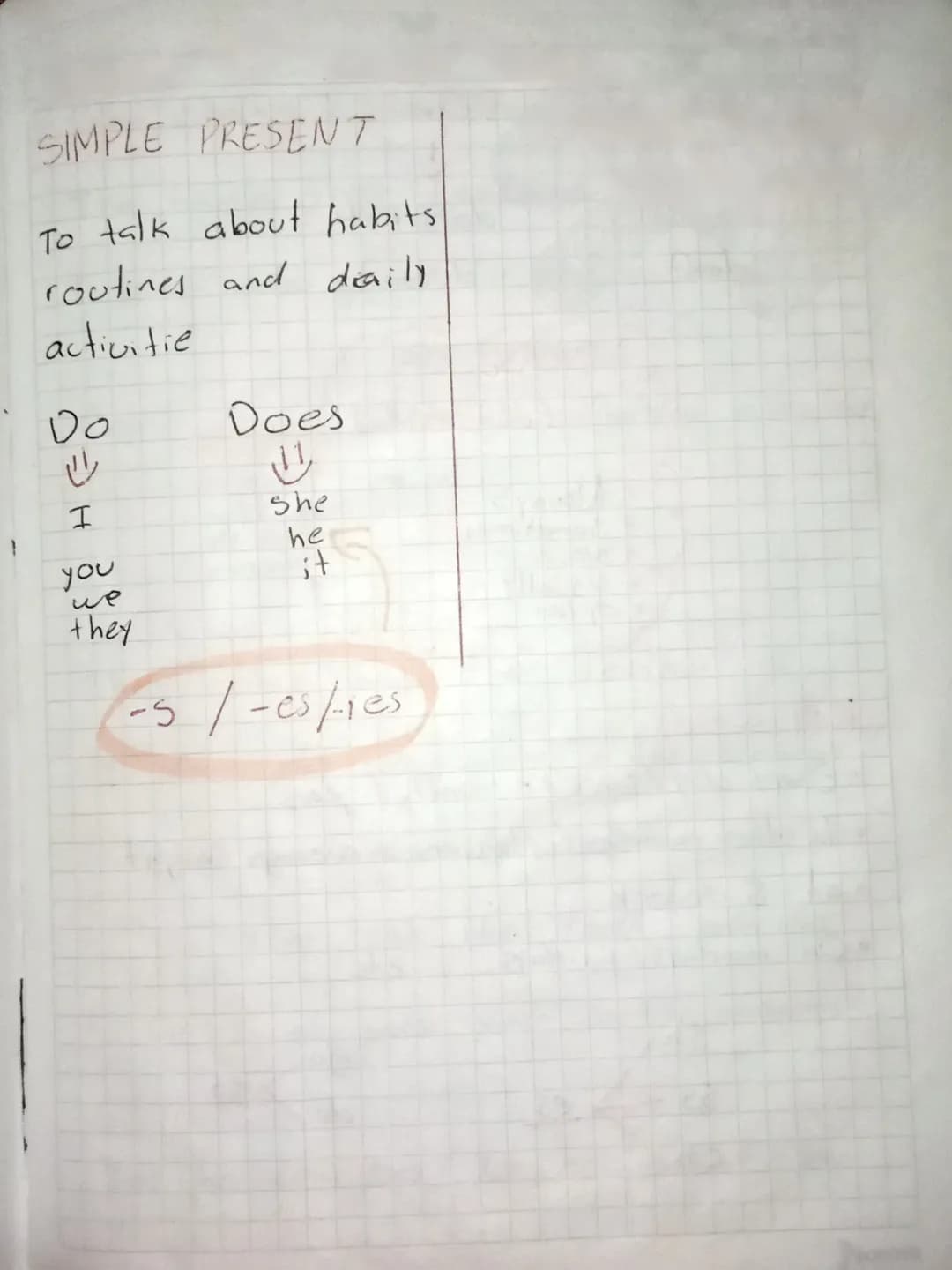
Presente Simple
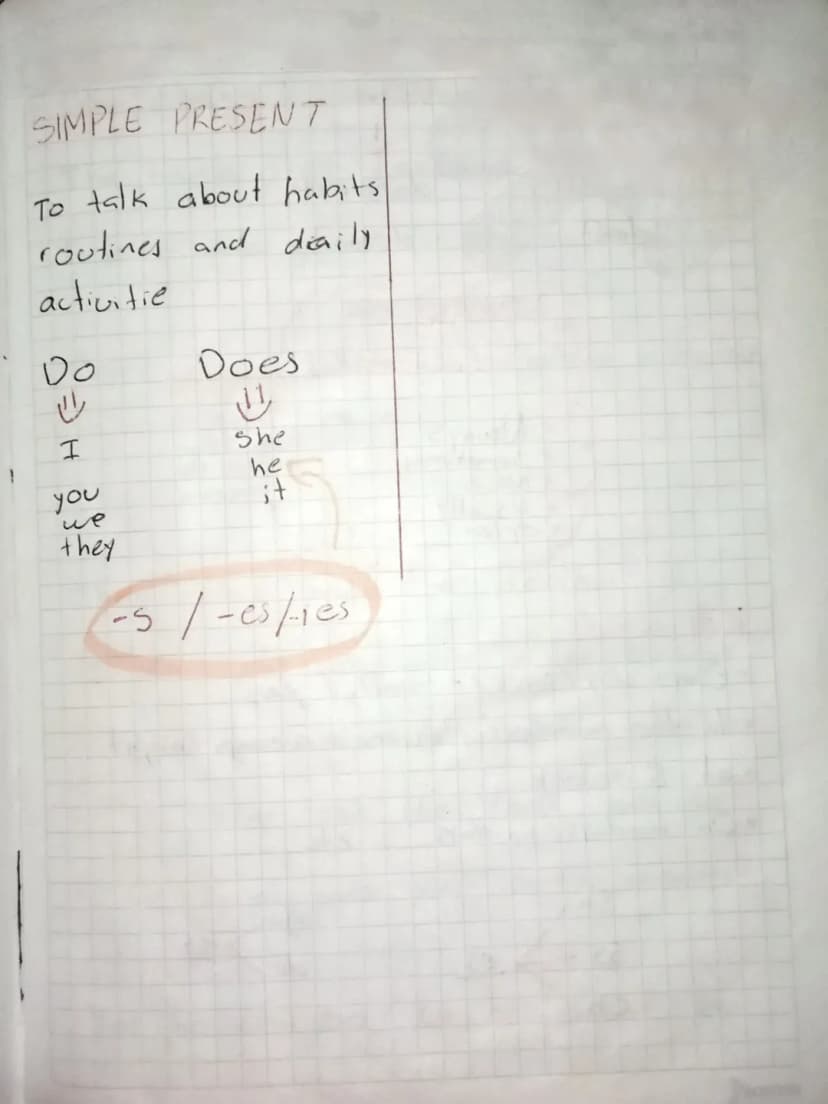
El presente simple se usa para hablar de hábitos, rutinas y actividades diarias. Su estructura es bastante sencilla:
Para formar preguntas usamos los auxiliares Do/Does. Con "I, you, we, they" usamos "Do", mientras que con "he, she, it" usamos "Does". Cuando usamos la tercera persona (he, she, it), debemos agregar -s, -es o -ies al final del verbo.
💡 ¡Recuerda! La terminación del verbo cambia solo en tercera persona (he, she, it). El resto de personas gramaticales mantienen el verbo en su forma base.
2
of 10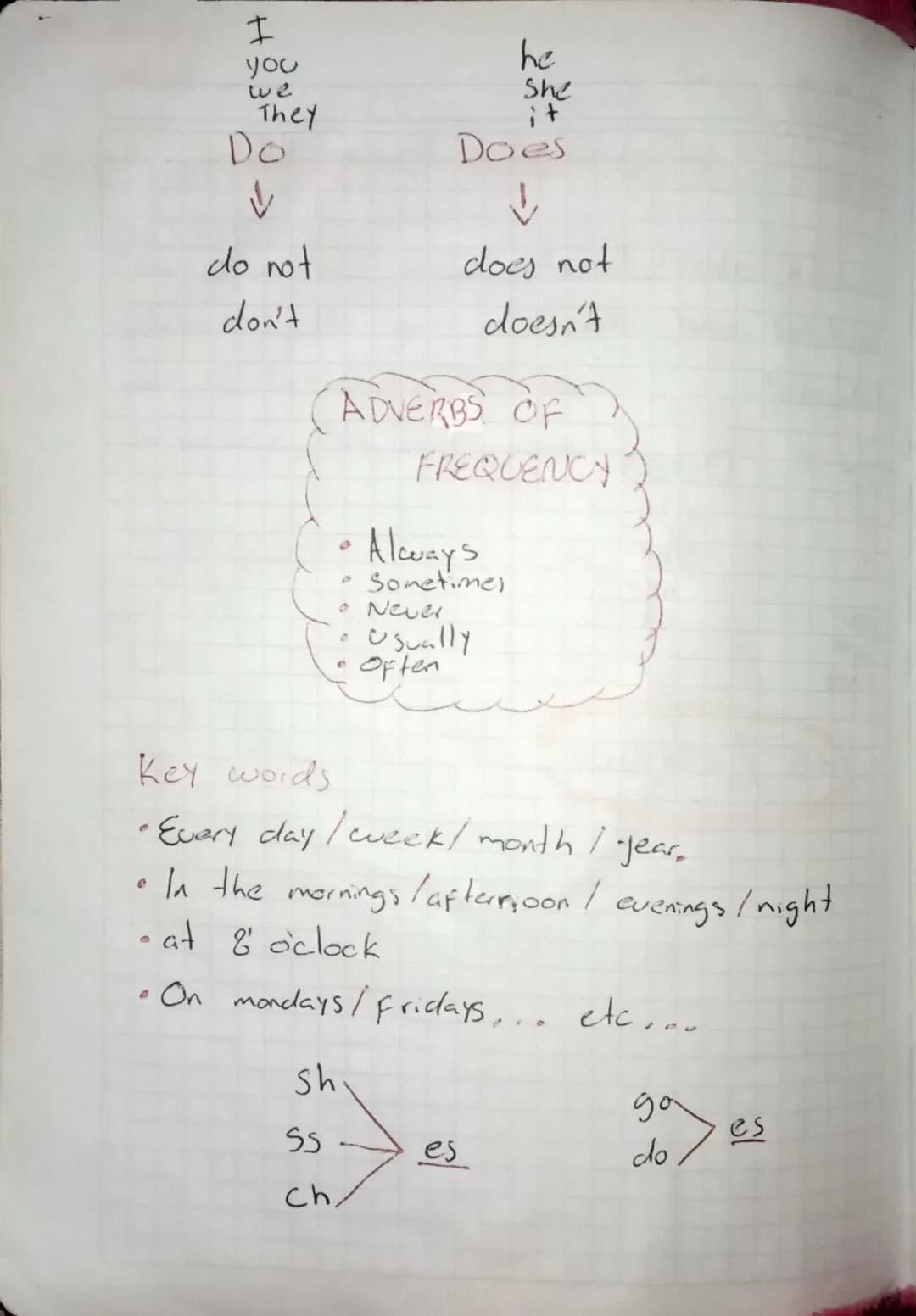
Negaciones y Adverbios de Frecuencia
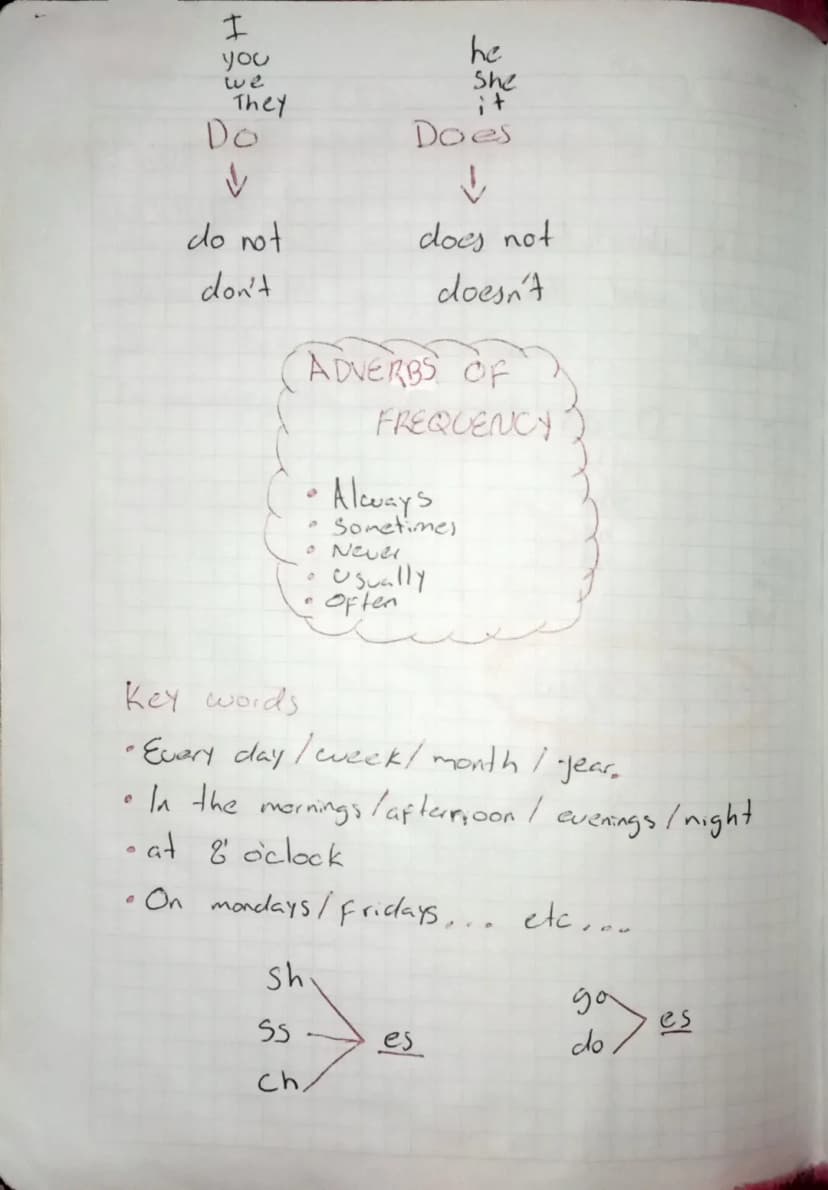
Para formar oraciones negativas en presente simple, usamos don't (do not) con "I, you, we, they" y doesn't (does not) con "he, she, it".
Los adverbios de frecuencia nos ayudan a expresar qué tan seguido ocurre una acción:
- Always (siempre)
- Sometimes (a veces)
- Never (nunca)
- Usually (usualmente)
- Often (frecuentemente)
Para indicar cuándo ocurre una acción, usamos palabras clave como: every day/week/month/year, in the morning/afternoon/evening, at 8 o'clock, o on Mondays/Fridays.
¿Sabías que algunos verbos requieren una terminación especial? Con verbos que terminan en sh, ch, ss, o, x, agregamos -es (como en "go → goes").
3
of 10
Ejemplos del Presente Simple
Veamos algunos ejemplos de cómo usar el presente simple:
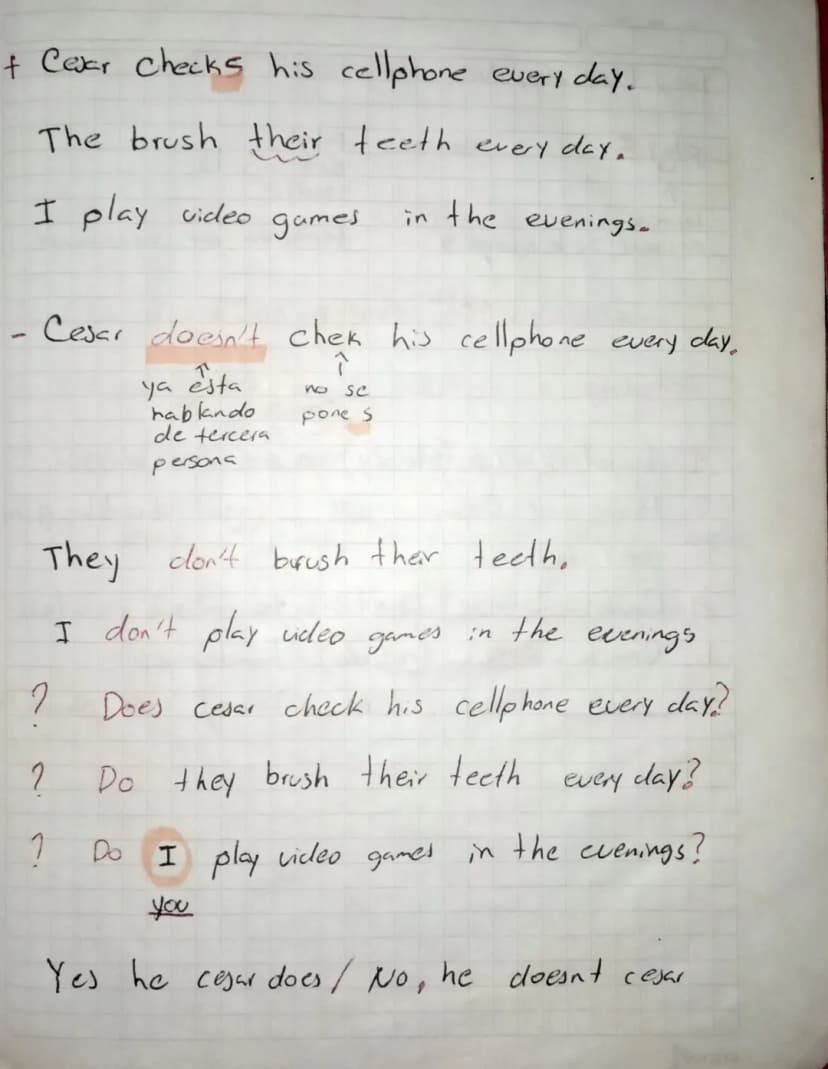
Afirmativo:
- Cesar checks his cellphone every day. (César revisa su celular todos los días)
- They brush their teeth every day. (Ellos se cepillan los dientes todos los días)
- I play video games in the evenings. (Yo juego videojuegos en las tardes)
Negativo:
- Cesar doesn't check his cellphone every day. (César no revisa su celular todos los días)
- They don't brush their teeth. (Ellos no se cepillan los dientes)
- I don't play video games in the evenings. (Yo no juego videojuegos en las tardes)
💡 Fíjate que en las oraciones negativas, el verbo principal vuelve a su forma base cuando usamos "doesn't" con tercera persona (he, she, it).
Interrogativo:
- Does Cesar check his cellphone every day? (¿César revisa su celular todos los días?)
- Do they brush their teeth every day? (¿Se cepillan los dientes todos los días?)
4
of 10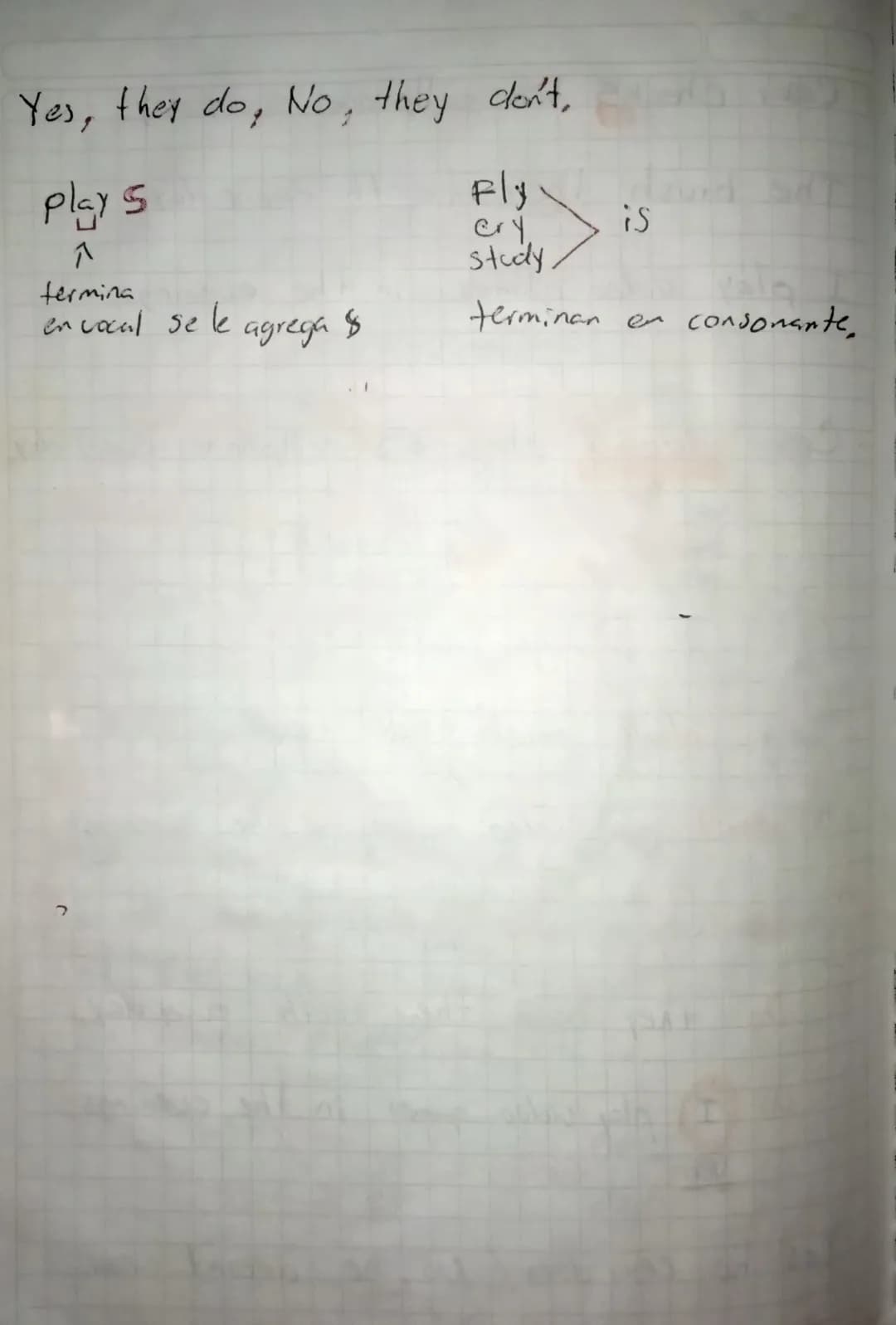
Terminaciones Especiales de Verbos
Los verbos en inglés tienen reglas especiales cuando están en tercera persona del singular (he, she, it):
Para verbos que terminan en vocal, simplemente agregamos -s:
- play → plays
Para verbos que terminan en consonante + y, cambiamos la y por i y agregamos -es:
- fly → flies
- cry → cries
- study → studies
💡 No olvides que estas reglas solo aplican cuando estamos hablando de "he", "she" o "it" en presente simple.
Estas reglas son importantes para hablar y escribir correctamente en inglés. Practica identificando qué terminación necesita cada verbo según cómo termine.
5
of 10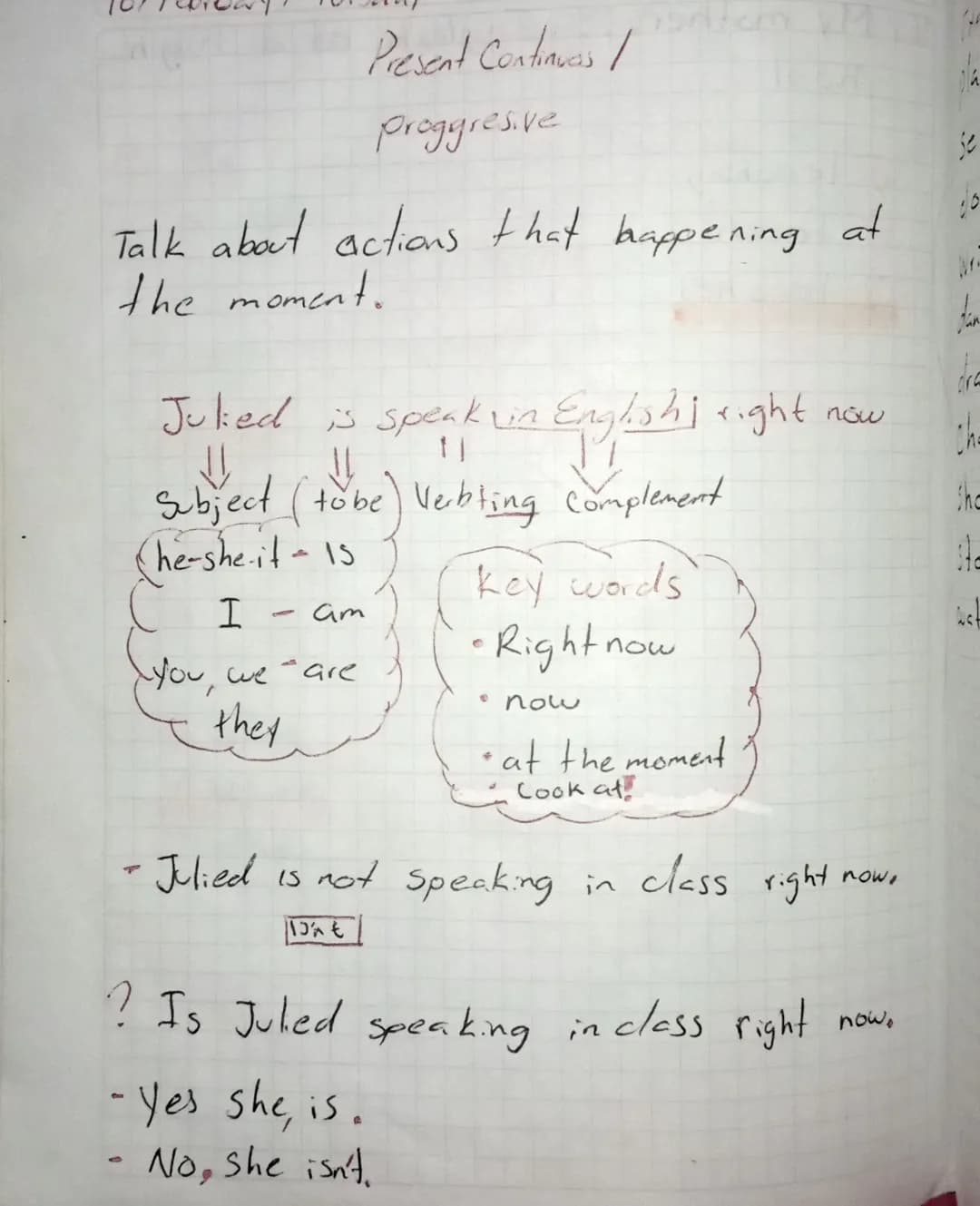
Presente Continuo/Progresivo
El presente continuo se usa para hablar de acciones que están ocurriendo en este momento. Su estructura es:
Sujeto + (to be) + verbo+ing + complemento
Ejemplos:
- Julied is speaking English right now. (Julied está hablando inglés ahora mismo)
Para formar este tiempo verbal, usamos el verbo to be según el sujeto:
- he/she/it → is
- I → am
- you/we/they → are
Las palabras clave que indican presente continuo son:
- Right now (ahora mismo)
- Now (ahora)
- At the moment (en este momento)
- Look at... (mira...)
💡 El presente continuo captura la imagen de lo que está sucediendo justo en este instante, como si tomaras una foto del momento.
6
of 10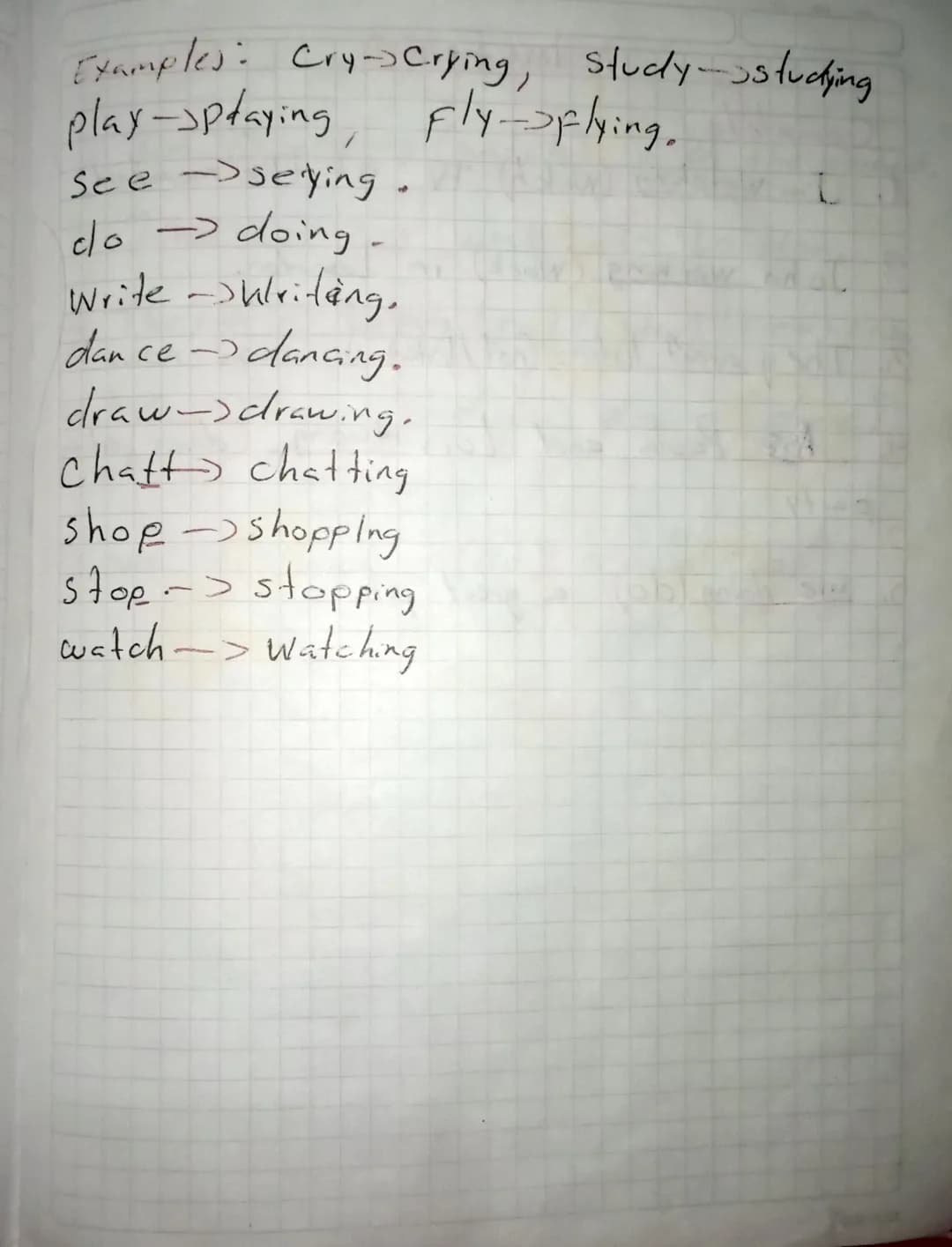
Formación del Gerundio
Para formar el presente continuo, debemos agregar -ing al verbo. Aquí hay algunos ejemplos de cómo se transforman los verbos:
- Verbos regulares: play → playing, cry → crying, study → studying, fly → flying
- Verbos que terminan en 'e': write → writing, dance → dancing (eliminamos la 'e' final)
- Verbos cortos con una vocal: stop → stopping, shop → shopping, chat → chatting (duplicamos la consonante final)
Otros ejemplos:
- see → seeing
- do → doing
- draw → drawing
- watch → watching
💡 Recuerda la regla de duplicar la consonante final: si el verbo termina en consonante-vocal-consonante y la sílaba final es tónica, se duplica la última consonante.
Practicar estos patrones te ayudará a formar correctamente los verbos en presente continuo sin cometer errores comunes.
7
of 10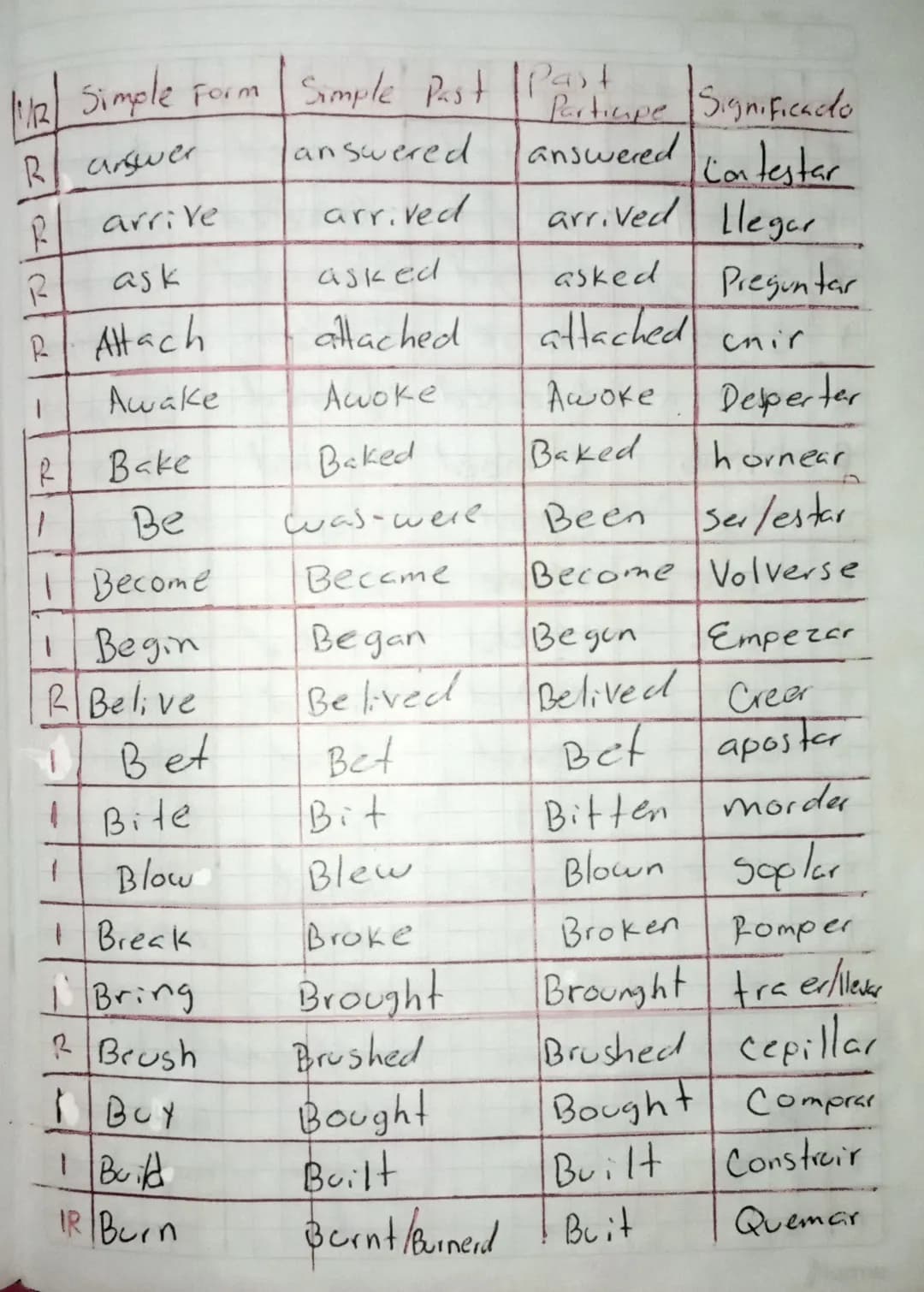
Verbos Irregulares (Parte 1)
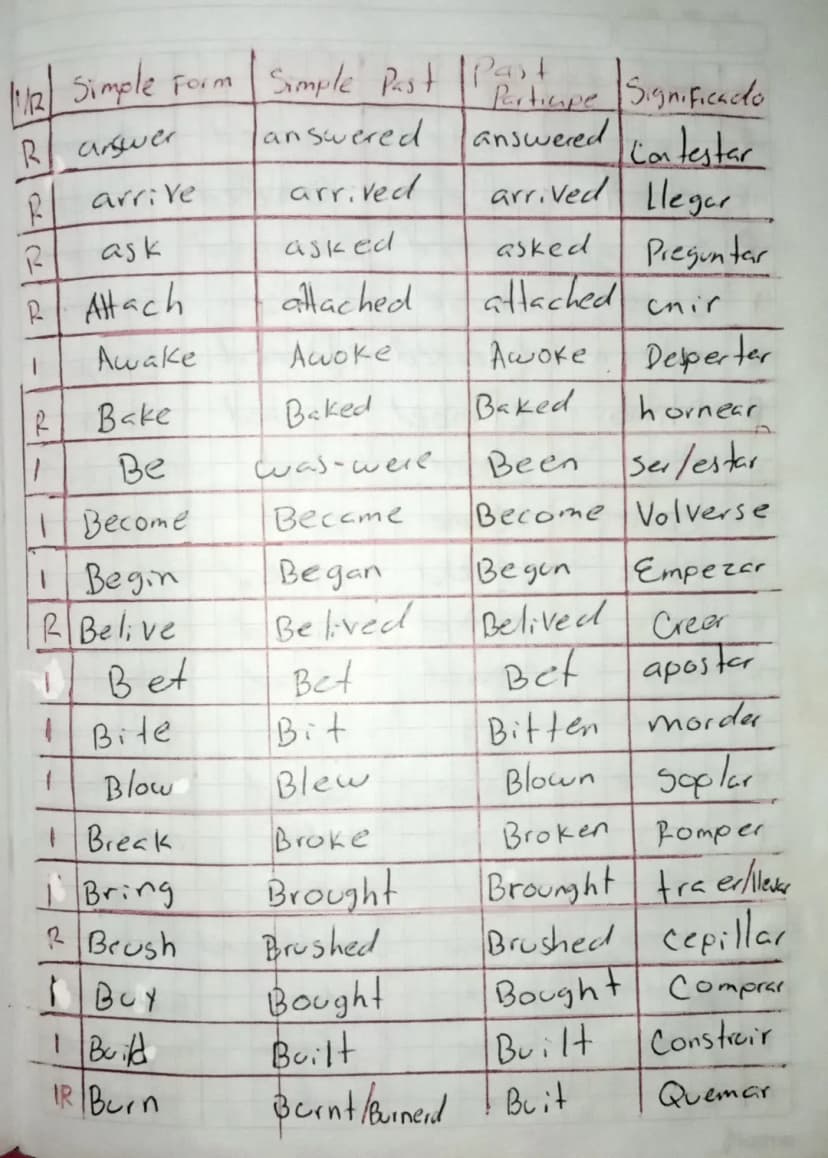
Los verbos irregulares son aquellos que no siguen patrones regulares de conjugación. Aquí tienes algunos fundamentales con sus formas en presente simple, pasado simple y participio pasado:
- answer → answered → answered (contestar)
- arrive → arrived → arrived (llegar)
- ask → asked → asked (preguntar)
- awake → awoke → awoken (despertar)
- be → was/were → been
- bake → baked → baked (hornear)
- become → became → become (volverse)
- begin → began → begun (empezar)
- believe → believed → believed (creer)
- bite → bit → bitten (morder)
💡 Memorizar estos verbos irregulares te dará mucha ventaja en tu aprendizaje de inglés. Intenta practicarlos creando oraciones simples.
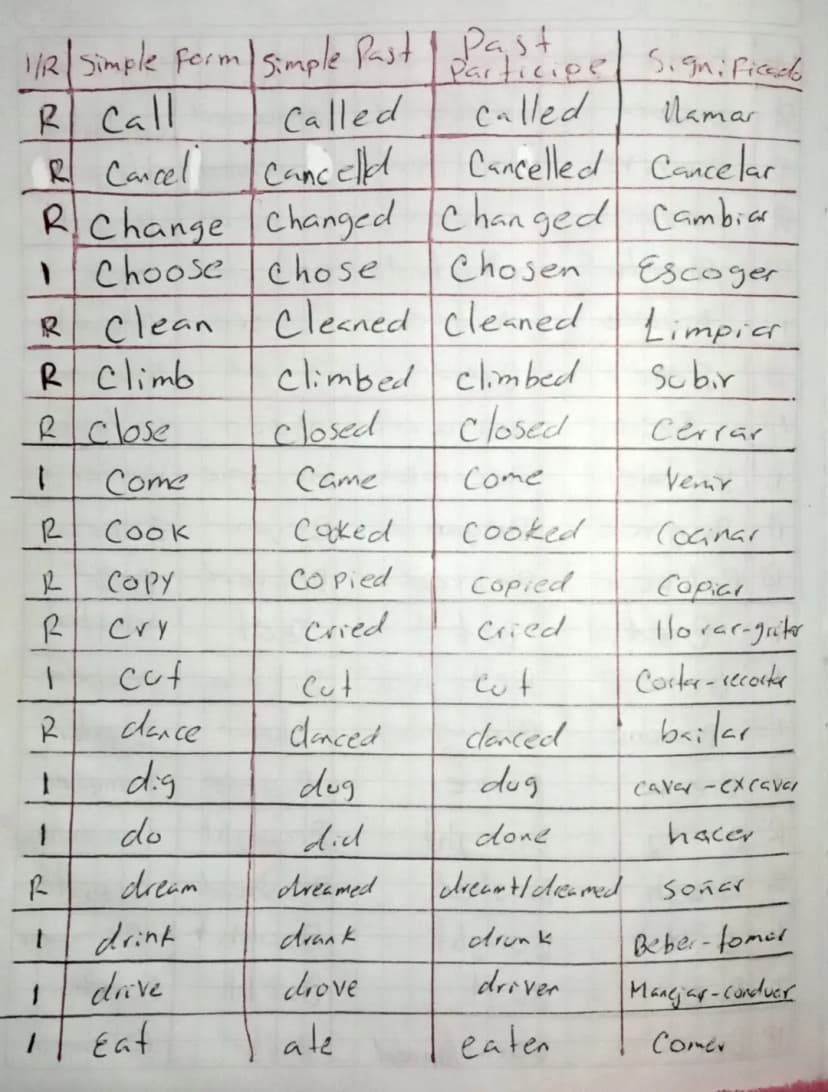
Algunos verbos irregulares más comunes incluyen: break (romper), bring (traer), buy (comprar) y build (construir).
8
of 10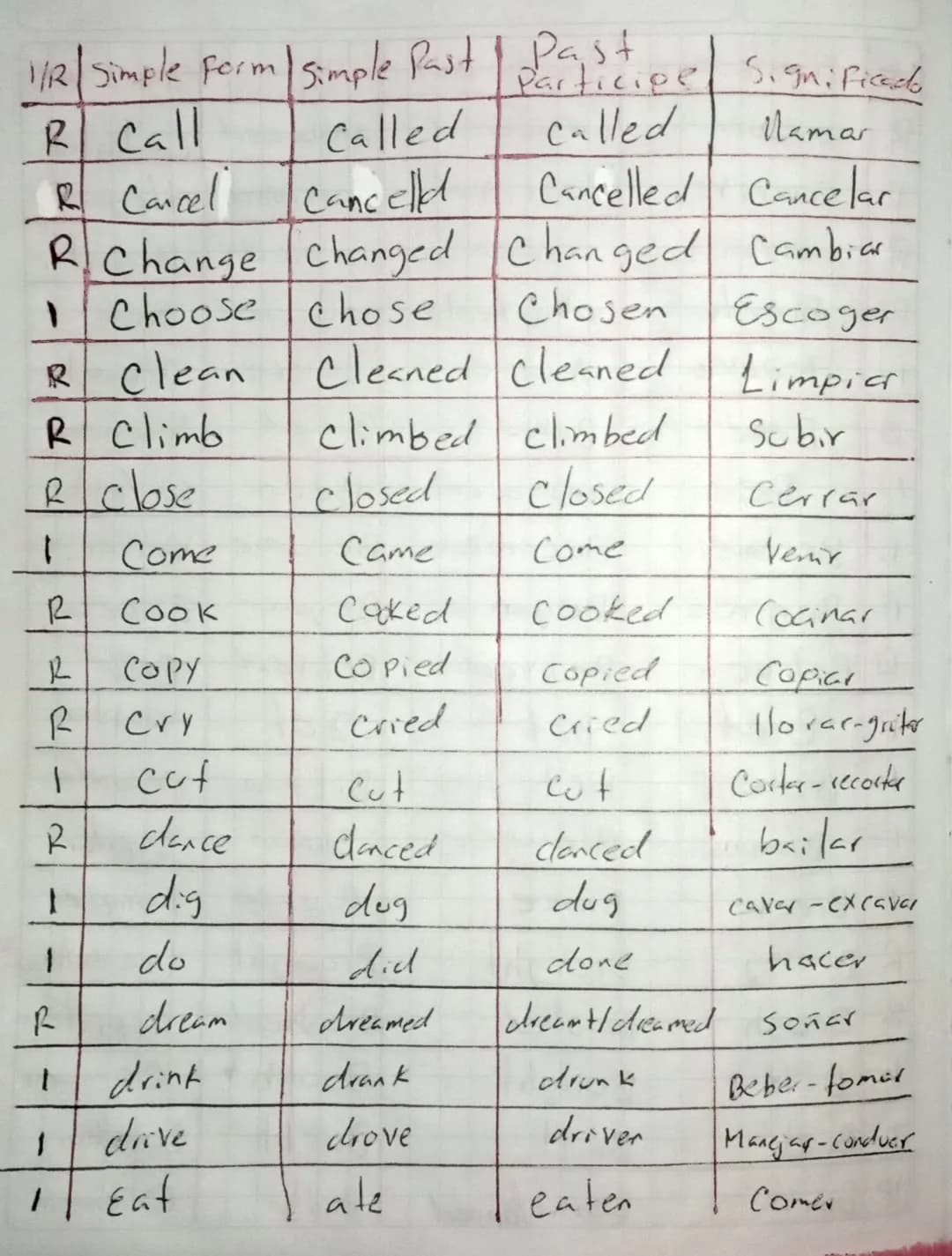
Verbos Irregulares (Parte 2)
Continuemos con más verbos irregulares esenciales:
- call → called → called (llamar)
- change → changed → changed (cambiar)
- choose → chose → chosen (escoger)
- clean → cleaned → cleaned (limpiar)
- close → closed → closed (cerrar)
- come → came → come (venir)
- cook → cooked → cooked (cocinar)
- copy → copied → copied (copiar)
- cry → cried → cried
- cut → cut → cut (cortar)
- do → did → done (hacer)
- drink → drank → drunk (beber)
- drive → drove → driven (conducir)
- eat → ate → eaten (comer)
💡 ¿Notaste que algunos verbos irregulares como "cut" mantienen la misma forma en todas sus conjugaciones? ¡Estos son los más fáciles de recordar!
Los verbos como "do" (hacer) son especialmente importantes porque también funcionan como auxiliares en oraciones negativas e interrogativas.
9
of 10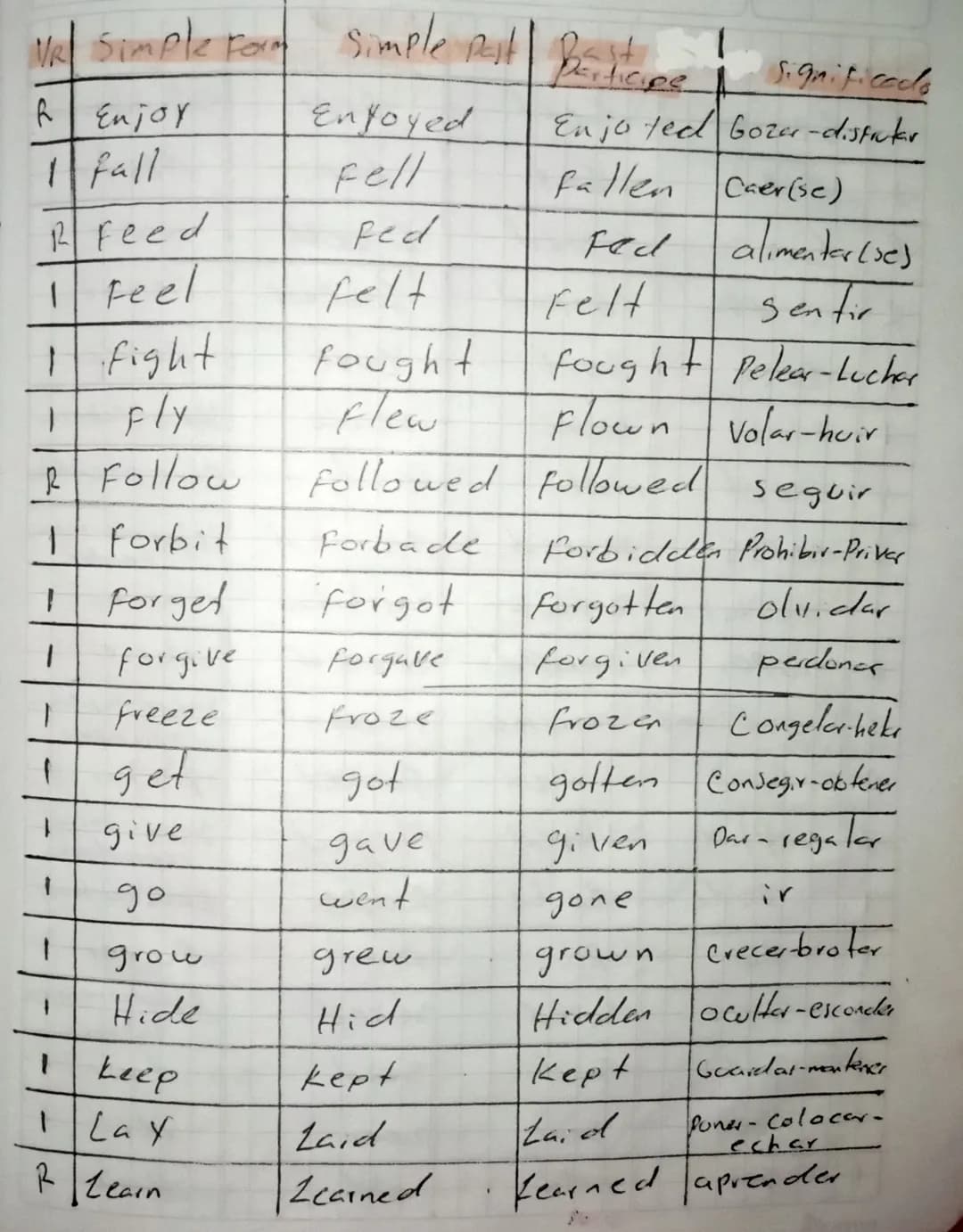
Verbos Irregulares (Parte 3)
Sigamos aprendiendo verbos irregulares importantes:
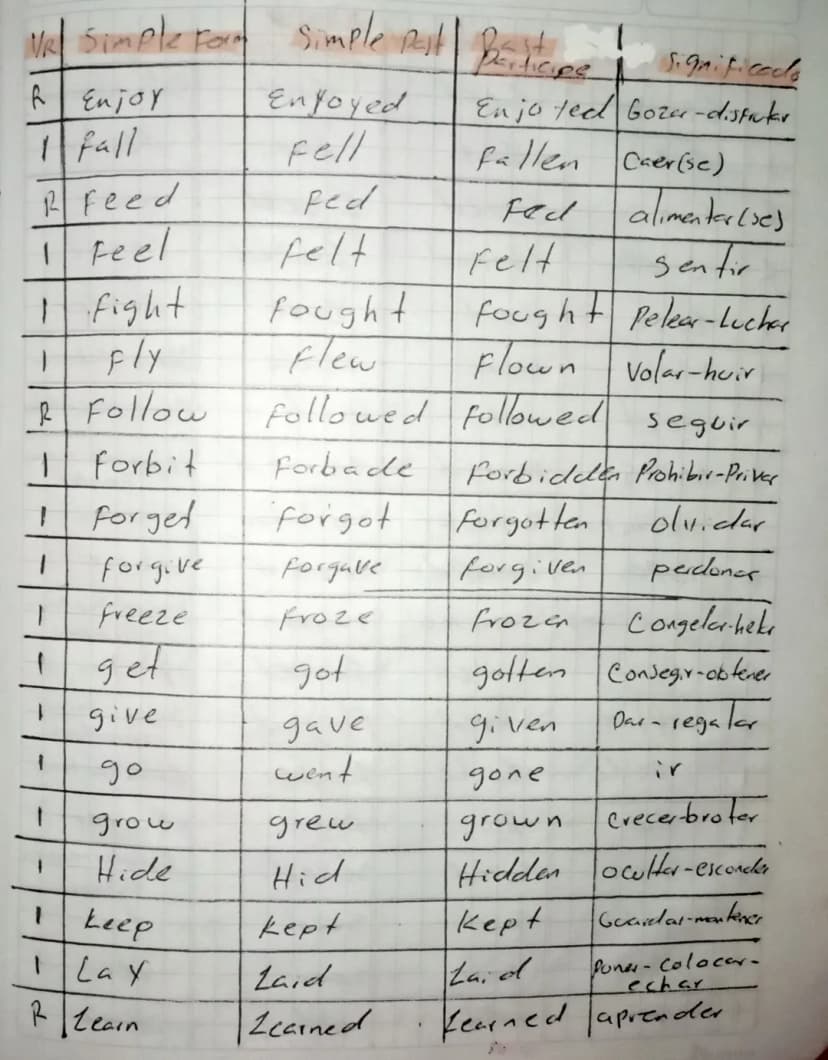
- enjoy → enjoyed → enjoyed (disfrutar)
- fall → fell → fallen (caer)
- feel → felt → felt (sentir)
- fight → fought → fought (pelear)
- fly → flew → flown (volar)
- follow → followed → followed (seguir)
- forget → forgot → forgotten (olvidar)
- forgive → forgave → forgiven (perdonar)
- get → got → gotten (obtener)
- give → gave → given (dar)
- go → went → gone (ir)
- grow → grew → grown (crecer)
- learn → learned → learned (aprender)
- leave → left → left
💡 Los verbos "go" (ir) y "get" (obtener) son de los más usados en inglés. Aprender bien sus formas te ayudará muchísimo en tu comunicación diaria.
Estos verbos irregulares aparecen constantemente en conversaciones cotidianas, por lo que vale la pena dedicar tiempo a aprenderlos.
10
of 10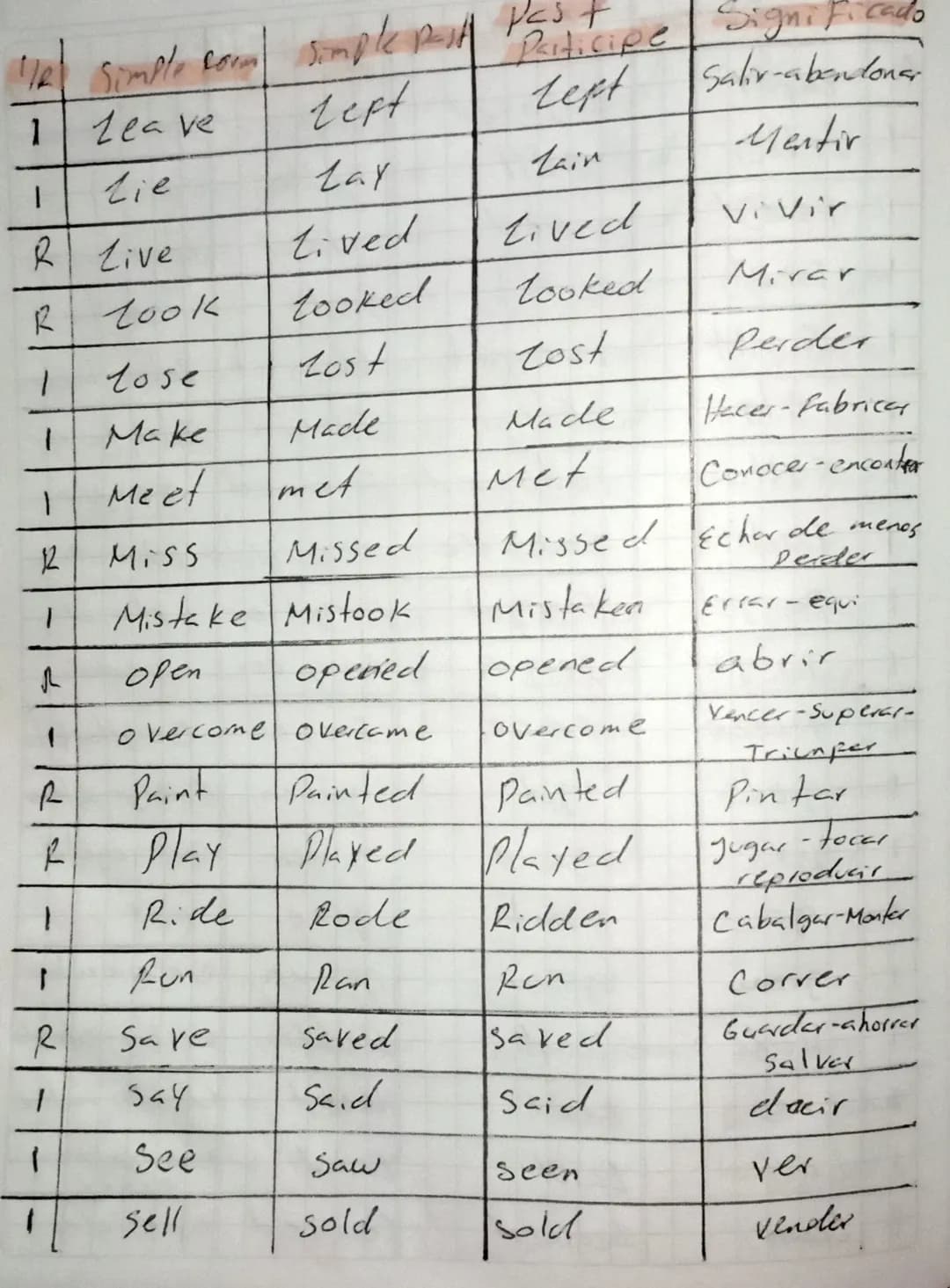
Verbos Irregulares (Parte 4)
Continuemos con más verbos irregulares frecuentes:
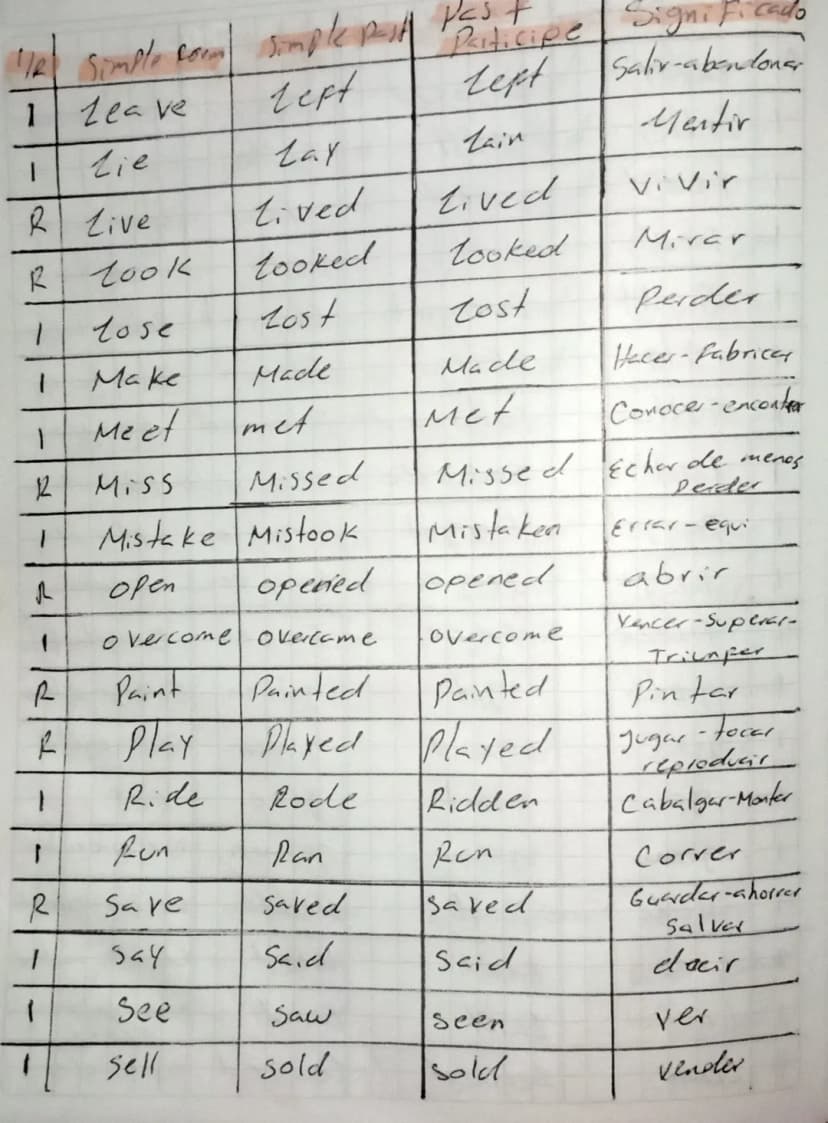
- live → lived → lived (vivir)
- look → looked → looked (mirar)
- lose → lost → lost (perder)
- make → made → made
- meet → met → met
- miss → missed → missed
- open → opened → opened (abrir)
- paint → painted → painted (pintar)
- play → played → played
- ride → rode → ridden (montar)
- run → ran → run (correr)
- say → said → said (decir)
- see → saw → seen (ver)
- sell → sold → sold (vender)
💡 Fíjate que verbos como "make" y "say" son muy irregulares en pasado, pero super comunes. Aprende primero los que más usarás en tu día a día.
Muchos de estos verbos son básicos para contar historias y hablar de experiencias pasadas, así que practícalos creando oraciones simples.
We thought you’d never ask...
What is the Knowunity AI companion?
Our AI companion is specifically built for the needs of students. Based on the millions of content pieces we have on the platform we can provide truly meaningful and relevant answers to students. But its not only about answers, the companion is even more about guiding students through their daily learning challenges, with personalised study plans, quizzes or content pieces in the chat and 100% personalisation based on the students skills and developments.
Where can I download the Knowunity app?
You can download the app in the Google Play Store and in the Apple App Store.
Is Knowunity really free of charge?
That's right! Enjoy free access to study content, connect with fellow students, and get instant help – all at your fingertips.
Similar Content
Most popular content in Inglés
9InglésVocabulario
Palabras en inglés y su significado
92,45627
Ingléspresente simple
como usar los pronombres en el presente simple y ejemplos
74699
InglésVerbos modales
Verbos modales (modal verbs)
113813
V
InglésVerbos: Presente, Pasado y Futuro
Conceptos clave sobre verbos en inglés: conjugación, tiempos y verbos irregulares.
10740
V
InglésVerbos en Presente Simple
Aprende a conjugar verbos en presente simple, incluyendo reglas y excepciones.
8530
P
InglésPronombres Personales en Inglés
Aprende los pronombres personales básicos en inglés y su significado en español.
6290
P
InglésPresente Simple: Frases Cotidianas
Aprende frases comunes en inglés usando el Presente Simple para el día a día.
7320
InglésZero conditional
Condicional cero y su uso
93101
V
InglésVerbos Irregulares en Inglés: Fundamentos Clave
Aprende los verbos irregulares esenciales para grado 8. ¡Mejora tu inglés!
8310
Most popular content
9 ICFES: Matemáticas
Simulacro ICFES primera sesión calendario B filtrado 2025
Este simulacro te ayudará a sacar un buen puntaje en las pruebas ICFES este 2025. Vamos por ese 500/500. Y poder ser admitido en la universidad que quieras, estudiar la carrera que quieres y no la que te toque. Vamos con toda para sacar un buen puntaje.
1016,900174
 ICFES: Lectura Crítica
Simulacro icfes
Simulacro
111,82946
ICFES: InglésCuadernillo Preguntaa Saber 11 Inglés.
Aprovecha los cuadernillos de Inglés para practicar y mejorar tus habilidades en el ítem de Inglés de la Prueba Saber 11. 🫡
Universidad82212
ICFES: MatemáticasMaterial de estudio ICFES
Material de estudio, preguntas icfes de matemáticas resueltas
116,996109
 Química
Trucos para ganar icfes
Lo mejor
111,03212
S
 Otros
Otrossimulacro icfes
Este simulacro evalúa tus conocimientos en las áreas clave del examen ICFES, preparándote para obtener un excelente puntaje.
114540
 ICFES: Sociales y Ciudadanas
SIMULACRO ICFES
Simulacro icfes
111,06015
ICFES: Lectura CríticaICFES segunda sesión calendario B 2025
Segunda sesión simulacro ICFES 2025 calendario B filtrado, aprovecha y se el mejor ICFES de tu colegio y poder ingresar a universidad, y estudiar aquella carrera con la que tanto sueñas.
119,795123
ICFES: Lectura CríticaPrueba icfes 2024
Prueba icfes para practicar todas las asignaturas
118227
Can't find what you're looking for? Explore other subjects.
Students love us — and so will you.
4.6/5App Store
4.7/5Google Play
The app is very easy to use and well designed. I have found everything I was looking for so far and have been able to learn a lot from the presentations! I will definitely use the app for a class assignment! And of course it also helps a lot as an inspiration.
Stefan SiOS user
This app is really great. There are so many study notes and help [...]. My problem subject is French, for example, and the app has so many options for help. Thanks to this app, I have improved my French. I would recommend it to anyone.
Samantha KlichAndroid user
Wow, I am really amazed. I just tried the app because I've seen it advertised many times and was absolutely stunned. This app is THE HELP you want for school and above all, it offers so many things, such as workouts and fact sheets, which have been VERY helpful to me personally.
AnnaiOS user
Inglés70 views·Updated Jun 18, 2026·16 pagesAprende Inglés: Usos de Do y Does
V
valeryvanessa993@valeryvanessa993_ywvx
El presente simple y el presente continuo son tiempos verbales fundamentales en inglés. Estos nos permiten hablar sobre rutinas diarias, hábitos y acciones que ocurren en este momento. Vamos a explorar cómo se forman y cuándo usar cada uno.
1
of 10
Sign up to see the content. It's free!
- Access to all documents
- Improve your grades
- Join milions of students
Presente Simple
El presente simple se usa para hablar de hábitos, rutinas y actividades diarias. Su estructura es bastante sencilla:
Para formar preguntas usamos los auxiliares Do/Does. Con "I, you, we, they" usamos "Do", mientras que con "he, she, it" usamos "Does". Cuando usamos la tercera persona (he, she, it), debemos agregar -s, -es o -ies al final del verbo.
💡 ¡Recuerda! La terminación del verbo cambia solo en tercera persona (he, she, it). El resto de personas gramaticales mantienen el verbo en su forma base.
2
of 10Sign up to see the content. It's free!
- Access to all documents
- Improve your grades
- Join milions of students
Negaciones y Adverbios de Frecuencia
Para formar oraciones negativas en presente simple, usamos don't (do not) con "I, you, we, they" y doesn't (does not) con "he, she, it".
Los adverbios de frecuencia nos ayudan a expresar qué tan seguido ocurre una acción:
- Always (siempre)
- Sometimes (a veces)
- Never (nunca)
- Usually (usualmente)
- Often (frecuentemente)
Para indicar cuándo ocurre una acción, usamos palabras clave como: every day/week/month/year, in the morning/afternoon/evening, at 8 o'clock, o on Mondays/Fridays.
¿Sabías que algunos verbos requieren una terminación especial? Con verbos que terminan en sh, ch, ss, o, x, agregamos -es (como en "go → goes").
3
of 10Sign up to see the content. It's free!
- Access to all documents
- Improve your grades
- Join milions of students
Ejemplos del Presente Simple
Veamos algunos ejemplos de cómo usar el presente simple:
Afirmativo:
- Cesar checks his cellphone every day. (César revisa su celular todos los días)
- They brush their teeth every day. (Ellos se cepillan los dientes todos los días)
- I play video games in the evenings. (Yo juego videojuegos en las tardes)
Negativo:
- Cesar doesn't check his cellphone every day. (César no revisa su celular todos los días)
- They don't brush their teeth. (Ellos no se cepillan los dientes)
- I don't play video games in the evenings. (Yo no juego videojuegos en las tardes)
💡 Fíjate que en las oraciones negativas, el verbo principal vuelve a su forma base cuando usamos "doesn't" con tercera persona (he, she, it).
Interrogativo:
- Does Cesar check his cellphone every day? (¿César revisa su celular todos los días?)
- Do they brush their teeth every day? (¿Se cepillan los dientes todos los días?)
4
of 10Sign up to see the content. It's free!
- Access to all documents
- Improve your grades
- Join milions of students
Terminaciones Especiales de Verbos
Los verbos en inglés tienen reglas especiales cuando están en tercera persona del singular (he, she, it):
Para verbos que terminan en vocal, simplemente agregamos -s:
- play → plays
Para verbos que terminan en consonante + y, cambiamos la y por i y agregamos -es:
- fly → flies
- cry → cries
- study → studies
💡 No olvides que estas reglas solo aplican cuando estamos hablando de "he", "she" o "it" en presente simple.
Estas reglas son importantes para hablar y escribir correctamente en inglés. Practica identificando qué terminación necesita cada verbo según cómo termine.
5
of 10Sign up to see the content. It's free!
- Access to all documents
- Improve your grades
- Join milions of students
Presente Continuo/Progresivo
El presente continuo se usa para hablar de acciones que están ocurriendo en este momento. Su estructura es:
Sujeto + (to be) + verbo+ing + complemento
Ejemplos:
- Julied is speaking English right now. (Julied está hablando inglés ahora mismo)
Para formar este tiempo verbal, usamos el verbo to be según el sujeto:
- he/she/it → is
- I → am
- you/we/they → are
Las palabras clave que indican presente continuo son:
- Right now (ahora mismo)
- Now (ahora)
- At the moment (en este momento)
- Look at... (mira...)
💡 El presente continuo captura la imagen de lo que está sucediendo justo en este instante, como si tomaras una foto del momento.
6
of 10Sign up to see the content. It's free!
- Access to all documents
- Improve your grades
- Join milions of students
Formación del Gerundio
Para formar el presente continuo, debemos agregar -ing al verbo. Aquí hay algunos ejemplos de cómo se transforman los verbos:
- Verbos regulares: play → playing, cry → crying, study → studying, fly → flying
- Verbos que terminan en 'e': write → writing, dance → dancing (eliminamos la 'e' final)
- Verbos cortos con una vocal: stop → stopping, shop → shopping, chat → chatting (duplicamos la consonante final)
Otros ejemplos:
- see → seeing
- do → doing
- draw → drawing
- watch → watching
💡 Recuerda la regla de duplicar la consonante final: si el verbo termina en consonante-vocal-consonante y la sílaba final es tónica, se duplica la última consonante.
Practicar estos patrones te ayudará a formar correctamente los verbos en presente continuo sin cometer errores comunes.
7
of 10Sign up to see the content. It's free!
- Access to all documents
- Improve your grades
- Join milions of students
Verbos Irregulares (Parte 1)
Los verbos irregulares son aquellos que no siguen patrones regulares de conjugación. Aquí tienes algunos fundamentales con sus formas en presente simple, pasado simple y participio pasado:
- answer → answered → answered (contestar)
- arrive → arrived → arrived (llegar)
- ask → asked → asked (preguntar)
- awake → awoke → awoken (despertar)
- be → was/were → been
- bake → baked → baked (hornear)
- become → became → become (volverse)
- begin → began → begun (empezar)
- believe → believed → believed (creer)
- bite → bit → bitten (morder)
💡 Memorizar estos verbos irregulares te dará mucha ventaja en tu aprendizaje de inglés. Intenta practicarlos creando oraciones simples.
Algunos verbos irregulares más comunes incluyen: break (romper), bring (traer), buy (comprar) y build (construir).
8
of 10Sign up to see the content. It's free!
- Access to all documents
- Improve your grades
- Join milions of students
Verbos Irregulares (Parte 2)
Continuemos con más verbos irregulares esenciales:
- call → called → called (llamar)
- change → changed → changed (cambiar)
- choose → chose → chosen (escoger)
- clean → cleaned → cleaned (limpiar)
- close → closed → closed (cerrar)
- come → came → come (venir)
- cook → cooked → cooked (cocinar)
- copy → copied → copied (copiar)
- cry → cried → cried
- cut → cut → cut (cortar)
- do → did → done (hacer)
- drink → drank → drunk (beber)
- drive → drove → driven (conducir)
- eat → ate → eaten (comer)
💡 ¿Notaste que algunos verbos irregulares como "cut" mantienen la misma forma en todas sus conjugaciones? ¡Estos son los más fáciles de recordar!
Los verbos como "do" (hacer) son especialmente importantes porque también funcionan como auxiliares en oraciones negativas e interrogativas.
9
of 10Sign up to see the content. It's free!
- Access to all documents
- Improve your grades
- Join milions of students
Verbos Irregulares (Parte 3)
Sigamos aprendiendo verbos irregulares importantes:
- enjoy → enjoyed → enjoyed (disfrutar)
- fall → fell → fallen (caer)
- feel → felt → felt (sentir)
- fight → fought → fought (pelear)
- fly → flew → flown (volar)
- follow → followed → followed (seguir)
- forget → forgot → forgotten (olvidar)
- forgive → forgave → forgiven (perdonar)
- get → got → gotten (obtener)
- give → gave → given (dar)
- go → went → gone (ir)
- grow → grew → grown (crecer)
- learn → learned → learned (aprender)
- leave → left → left
💡 Los verbos "go" (ir) y "get" (obtener) son de los más usados en inglés. Aprender bien sus formas te ayudará muchísimo en tu comunicación diaria.
Estos verbos irregulares aparecen constantemente en conversaciones cotidianas, por lo que vale la pena dedicar tiempo a aprenderlos.
10
of 10Sign up to see the content. It's free!
- Access to all documents
- Improve your grades
- Join milions of students
Verbos Irregulares (Parte 4)
Continuemos con más verbos irregulares frecuentes:
- live → lived → lived (vivir)
- look → looked → looked (mirar)
- lose → lost → lost (perder)
- make → made → made
- meet → met → met
- miss → missed → missed
- open → opened → opened (abrir)
- paint → painted → painted (pintar)
- play → played → played
- ride → rode → ridden (montar)
- run → ran → run (correr)
- say → said → said (decir)
- see → saw → seen (ver)
- sell → sold → sold (vender)
💡 Fíjate que verbos como "make" y "say" son muy irregulares en pasado, pero super comunes. Aprende primero los que más usarás en tu día a día.
Muchos de estos verbos son básicos para contar historias y hablar de experiencias pasadas, así que practícalos creando oraciones simples.
We thought you’d never ask...
What is the Knowunity AI companion?
Our AI companion is specifically built for the needs of students. Based on the millions of content pieces we have on the platform we can provide truly meaningful and relevant answers to students. But its not only about answers, the companion is even more about guiding students through their daily learning challenges, with personalised study plans, quizzes or content pieces in the chat and 100% personalisation based on the students skills and developments.
Where can I download the Knowunity app?
You can download the app in the Google Play Store and in the Apple App Store.
Is Knowunity really free of charge?
That's right! Enjoy free access to study content, connect with fellow students, and get instant help – all at your fingertips.
Similar Content
Most popular content in Inglés
9InglésVocabulario
Palabras en inglés y su significado
92,45627
Ingléspresente simple
como usar los pronombres en el presente simple y ejemplos
74699
InglésVerbos modales
Verbos modales (modal verbs)
113813
V
InglésVerbos: Presente, Pasado y Futuro
Conceptos clave sobre verbos en inglés: conjugación, tiempos y verbos irregulares.
10740
V
InglésVerbos en Presente Simple
Aprende a conjugar verbos en presente simple, incluyendo reglas y excepciones.
8530
P
InglésPronombres Personales en Inglés
Aprende los pronombres personales básicos en inglés y su significado en español.
6290
P
InglésPresente Simple: Frases Cotidianas
Aprende frases comunes en inglés usando el Presente Simple para el día a día.
7320
InglésZero conditional
Condicional cero y su uso
93101
V
InglésVerbos Irregulares en Inglés: Fundamentos Clave
Aprende los verbos irregulares esenciales para grado 8. ¡Mejora tu inglés!
8310
Most popular content
9ICFES: MatemáticasSimulacro ICFES primera sesión calendario B filtrado 2025
Este simulacro te ayudará a sacar un buen puntaje en las pruebas ICFES este 2025. Vamos por ese 500/500. Y poder ser admitido en la universidad que quieras, estudiar la carrera que quieres y no la que te toque. Vamos con toda para sacar un buen puntaje.
1016,900174
ICFES: Lectura CríticaSimulacro icfes
Simulacro
111,82946
ICFES: InglésCuadernillo Preguntaa Saber 11 Inglés.
Aprovecha los cuadernillos de Inglés para practicar y mejorar tus habilidades en el ítem de Inglés de la Prueba Saber 11. 🫡
Universidad82212
ICFES: MatemáticasMaterial de estudio ICFES
Material de estudio, preguntas icfes de matemáticas resueltas
116,996109
QuímicaTrucos para ganar icfes
Lo mejor
111,03212
S
Otrossimulacro icfes
Este simulacro evalúa tus conocimientos en las áreas clave del examen ICFES, preparándote para obtener un excelente puntaje.
114540
ICFES: Sociales y CiudadanasSIMULACRO ICFES
Simulacro icfes
111,06015
ICFES: Lectura CríticaICFES segunda sesión calendario B 2025
Segunda sesión simulacro ICFES 2025 calendario B filtrado, aprovecha y se el mejor ICFES de tu colegio y poder ingresar a universidad, y estudiar aquella carrera con la que tanto sueñas.
119,795123
ICFES: Lectura CríticaPrueba icfes 2024
Prueba icfes para practicar todas las asignaturas
118227
Can't find what you're looking for? Explore other subjects.
Students love us — and so will you.
4.6/5App Store
4.7/5Google Play
The app is very easy to use and well designed. I have found everything I was looking for so far and have been able to learn a lot from the presentations! I will definitely use the app for a class assignment! And of course it also helps a lot as an inspiration.
Stefan SiOS user
This app is really great. There are so many study notes and help [...]. My problem subject is French, for example, and the app has so many options for help. Thanks to this app, I have improved my French. I would recommend it to anyone.
Samantha KlichAndroid user
Wow, I am really amazed. I just tried the app because I've seen it advertised many times and was absolutely stunned. This app is THE HELP you want for school and above all, it offers so many things, such as workouts and fact sheets, which have been VERY helpful to me personally.
AnnaiOS user