
Este taller práctico te guiará por las operaciones con vectores...
 Matemáticas301 views·Updated Jun 25, 2026·2 pages
Aprende sobre Vectores en este Taller
A
ANDRES GIOVANNY REYES RODRIGUEZ@andresgiovannyr
1
of 2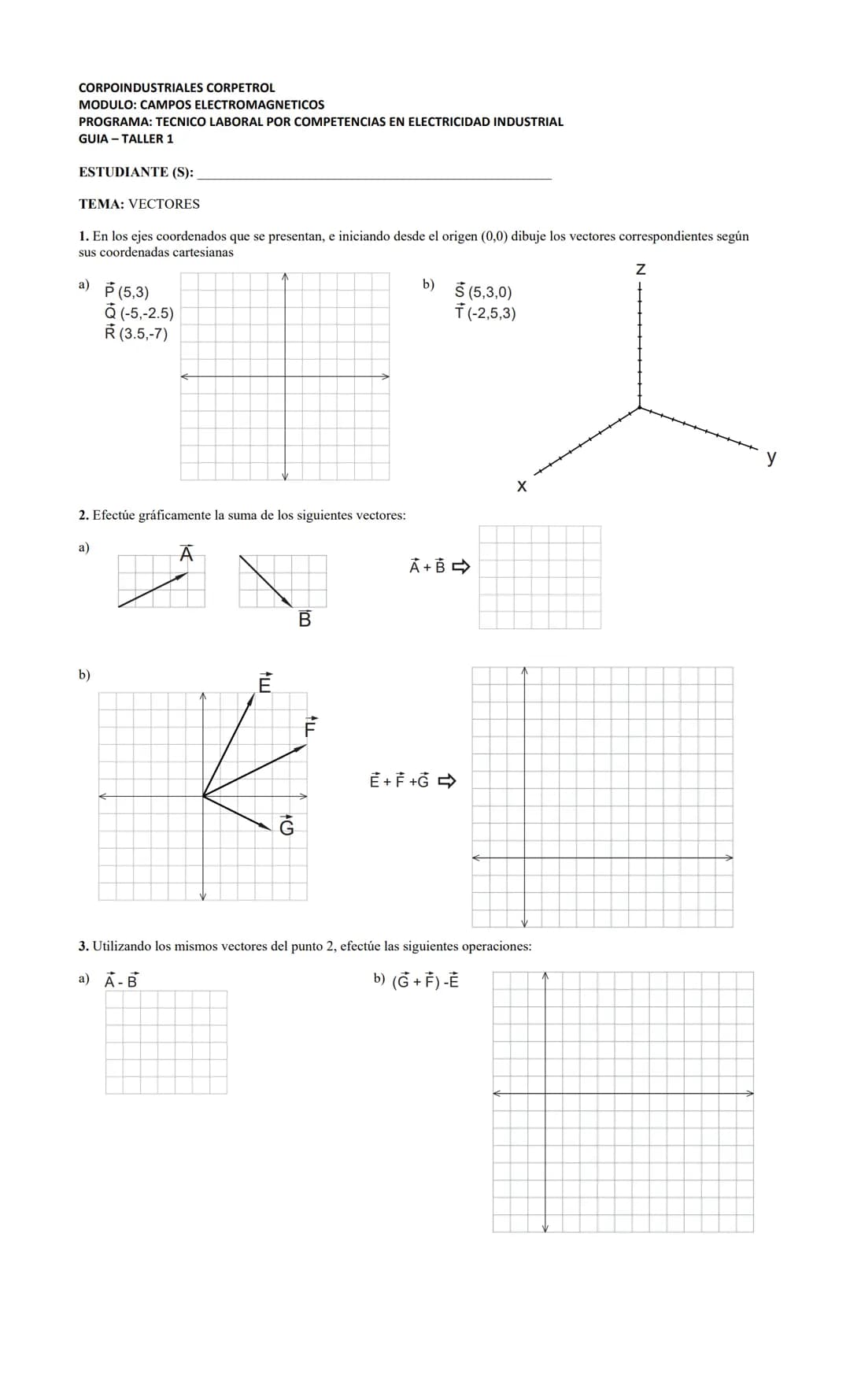
Representación y Suma de Vectores
Los vectores son magnitudes que tienen dirección y sentido, y son esenciales en la electricidad industrial. Para representarlos, usamos coordenadas cartesianas que nos indican su posición en un plano o espacio.
Para dibujar un vector, simplemente ubicamos el punto final según sus coordenadas, partiendo del origen (0,0). Por ejemplo, el vector (5,3) se dibuja trazando una flecha desde el origen hasta el punto (5,3) en el plano. Los vectores también pueden representarse en tres dimensiones, como (5,3,0) o (-2,5,3).
La suma de vectores puede realizarse gráficamente mediante el método del polígono o el método del paralelogramo. En el método del polígono, colocamos el origen del segundo vector en el extremo del primero, y el vector resultante va del origen del primero al extremo del último vector sumado.
💡 Consejo práctico: Cuando dibujes vectores, usa una escala adecuada y diferentes colores para distinguir cada vector y el resultado de las operaciones.
Para la resta de vectores como , primero convertimos - que es el vector $\vec{B}$ con dirección opuesta y luego sumamos . Esta operación es fundamental para resolver problemas complejos en campos electromagnéticos.
2
of 2
Operaciones Algebraicas y Magnitud de Vectores
Cuando trabajamos con vectores en forma algebraica, usamos las componentes para realizar operaciones. Por ejemplo, si y , la suma será .
Para la resta, como en , primero hallamos cambiando el signo de cada componente, luego sumamos normalmente. Si y , entonces y .
La magnitud o módulo de un vector es crucial para entender su "fuerza" o "intensidad". Se calcula aplicando el teorema de Pitágoras: , donde y son las componentes del vector en los ejes x e y respectivamente.
🔍 Observación importante: En física de campos electromagnéticos, la magnitud del vector representa la intensidad del campo, mientras que la dirección indica hacia dónde actúa la fuerza.
Después de realizar operaciones vectoriales, siempre es útil dibujar el resultado en ejes cartesianos para visualizar la dirección y sentido del vector resultante, lo que te ayudará a comprender mejor los fenómenos electromagnéticos.
We thought you’d never ask...
What is the Knowunity AI companion?
Our AI companion is specifically built for the needs of students. Based on the millions of content pieces we have on the platform we can provide truly meaningful and relevant answers to students. But its not only about answers, the companion is even more about guiding students through their daily learning challenges, with personalised study plans, quizzes or content pieces in the chat and 100% personalisation based on the students skills and developments.
Where can I download the Knowunity app?
You can download the app in the Google Play Store and in the Apple App Store.
Is Knowunity really free of charge?
That's right! Enjoy free access to study content, connect with fellow students, and get instant help – all at your fingertips.
Similar Content
Most popular content: Vector Addition
3MatemáticasSuma de vectores
Suma de vectores por método directo, del triángulos y del paralelogramo, con ejemplos
93127
MatemáticasMatemáticas grado 11 - Vectores geométricos
Vectores geométricos
4° Sec1242
MatemáticasMagnitudes vectoriales y operaciones entre vectores
Conceptos, ejemplos y gráficas de magnitudes vectoriales y operaciones entre ellos
10440
Most popular content in Matemáticas
9MatemáticasRacionalización
Definición caso uno caso dos ejemplos y ejercicios
98366
MatemáticasPropiedades de los exponentes
Diapositivas donde se explica el tema propiedades de los exponentes abarcado explicacion de Producto de potencias,Cociente de potencias,Potencia de una potencia,Potencia de un producto,Potencia de un cociente junto con ejemplos y actividad de la temática
94,878141
MatemáticasTeorema de pitágoras
Qué es el teorema de pitágoras, cuando se usa y su clasificación.
875417
MatemáticasRazones trigonométricas
Definición ejemplo y ejercicios
957510
L
MatemáticasLey de Signos: Suma y Resta de Enteros
Aprende las reglas de los signos para sumar y restar números enteros con ejemplos prácticos.
7900
Matemáticasoperaciones con fracciones número racional
Este cuestionario abarca operaciones básicas con fracciones y números racionales, incluyendo suma, resta, multiplicación y división.
82400
Matemáticasreducción de términos semejantes
Evalúa tu habilidad para simplificar expresiones algebraicas mediante la reducción de términos semejantes.
81120
MatemáticasTeorema de las derivadas
Clase de Calculo diferencial
105775
MatemáticasFormulario Áreas y Perímetros
Formulario Áreas y Perímetros
62,90645
Most popular content
9ICFES: MatemáticasSimulacro ICFES primera sesión calendario B filtrado 2025
Este simulacro te ayudará a sacar un buen puntaje en las pruebas ICFES este 2025. Vamos por ese 500/500. Y poder ser admitido en la universidad que quieras, estudiar la carrera que quieres y no la que te toque. Vamos con toda para sacar un buen puntaje.
1016,899174
 ICFES: Lectura Crítica
Simulacro icfes
Simulacro
111,82946
 ICFES: Inglés
Cuadernillo Preguntaa Saber 11 Inglés.
Aprovecha los cuadernillos de Inglés para practicar y mejorar tus habilidades en el ítem de Inglés de la Prueba Saber 11. 🫡
Universidad82212
ICFES: MatemáticasMaterial de estudio ICFES
Material de estudio, preguntas icfes de matemáticas resueltas
116,996109
 Química
Trucos para ganar icfes
Lo mejor
111,03112
S
 Otros
Otrossimulacro icfes
Este simulacro evalúa tus conocimientos en las áreas clave del examen ICFES, preparándote para obtener un excelente puntaje.
114540
 ICFES: Sociales y Ciudadanas
SIMULACRO ICFES
Simulacro icfes
111,06015
ICFES: Lectura CríticaICFES segunda sesión calendario B 2025
Segunda sesión simulacro ICFES 2025 calendario B filtrado, aprovecha y se el mejor ICFES de tu colegio y poder ingresar a universidad, y estudiar aquella carrera con la que tanto sueñas.
119,795123
ICFES: Lectura CríticaPrueba icfes 2024
Prueba icfes para practicar todas las asignaturas
118217
Can't find what you're looking for? Explore other subjects.
Students love us — and so will you.
4.6/5App Store
4.7/5Google Play
The app is very easy to use and well designed. I have found everything I was looking for so far and have been able to learn a lot from the presentations! I will definitely use the app for a class assignment! And of course it also helps a lot as an inspiration.
Stefan SiOS user
This app is really great. There are so many study notes and help [...]. My problem subject is French, for example, and the app has so many options for help. Thanks to this app, I have improved my French. I would recommend it to anyone.
Samantha KlichAndroid user
Wow, I am really amazed. I just tried the app because I've seen it advertised many times and was absolutely stunned. This app is THE HELP you want for school and above all, it offers so many things, such as workouts and fact sheets, which have been VERY helpful to me personally.
AnnaiOS user
Matemáticas301 views·Updated Jun 25, 2026·2 pagesAprende sobre Vectores en este Taller
A
ANDRES GIOVANNY REYES RODRIGUEZ@andresgiovannyr
Este taller práctico te guiará por las operaciones con vectores en el plano y en el espacio. Dominarás cómo representar vectores en coordenadas cartesianas y realizar operaciones básicas que son fundamentales para los campos electromagnéticos en electricidad industrial.
1
of 2
Sign up to see the content. It's free!
- Access to all documents
- Improve your grades
- Join milions of students
Representación y Suma de Vectores
Los vectores son magnitudes que tienen dirección y sentido, y son esenciales en la electricidad industrial. Para representarlos, usamos coordenadas cartesianas que nos indican su posición en un plano o espacio.
Para dibujar un vector, simplemente ubicamos el punto final según sus coordenadas, partiendo del origen (0,0). Por ejemplo, el vector (5,3) se dibuja trazando una flecha desde el origen hasta el punto (5,3) en el plano. Los vectores también pueden representarse en tres dimensiones, como (5,3,0) o (-2,5,3).
La suma de vectores puede realizarse gráficamente mediante el método del polígono o el método del paralelogramo. En el método del polígono, colocamos el origen del segundo vector en el extremo del primero, y el vector resultante va del origen del primero al extremo del último vector sumado.
💡 Consejo práctico: Cuando dibujes vectores, usa una escala adecuada y diferentes colores para distinguir cada vector y el resultado de las operaciones.
Para la resta de vectores como , primero convertimos - que es el vector $\vec{B}$ con dirección opuesta y luego sumamos . Esta operación es fundamental para resolver problemas complejos en campos electromagnéticos.
2
of 2Sign up to see the content. It's free!
- Access to all documents
- Improve your grades
- Join milions of students
Operaciones Algebraicas y Magnitud de Vectores
Cuando trabajamos con vectores en forma algebraica, usamos las componentes para realizar operaciones. Por ejemplo, si y , la suma será .
Para la resta, como en , primero hallamos cambiando el signo de cada componente, luego sumamos normalmente. Si y , entonces y .
La magnitud o módulo de un vector es crucial para entender su "fuerza" o "intensidad". Se calcula aplicando el teorema de Pitágoras: , donde y son las componentes del vector en los ejes x e y respectivamente.
🔍 Observación importante: En física de campos electromagnéticos, la magnitud del vector representa la intensidad del campo, mientras que la dirección indica hacia dónde actúa la fuerza.
Después de realizar operaciones vectoriales, siempre es útil dibujar el resultado en ejes cartesianos para visualizar la dirección y sentido del vector resultante, lo que te ayudará a comprender mejor los fenómenos electromagnéticos.
We thought you’d never ask...
What is the Knowunity AI companion?
Our AI companion is specifically built for the needs of students. Based on the millions of content pieces we have on the platform we can provide truly meaningful and relevant answers to students. But its not only about answers, the companion is even more about guiding students through their daily learning challenges, with personalised study plans, quizzes or content pieces in the chat and 100% personalisation based on the students skills and developments.
Where can I download the Knowunity app?
You can download the app in the Google Play Store and in the Apple App Store.
Is Knowunity really free of charge?
That's right! Enjoy free access to study content, connect with fellow students, and get instant help – all at your fingertips.
Similar Content
Most popular content: Vector Addition
3MatemáticasSuma de vectores
Suma de vectores por método directo, del triángulos y del paralelogramo, con ejemplos
93127
MatemáticasMatemáticas grado 11 - Vectores geométricos
Vectores geométricos
4° Sec1242
MatemáticasMagnitudes vectoriales y operaciones entre vectores
Conceptos, ejemplos y gráficas de magnitudes vectoriales y operaciones entre ellos
10440
Most popular content in Matemáticas
9MatemáticasRacionalización
Definición caso uno caso dos ejemplos y ejercicios
98366
MatemáticasPropiedades de los exponentes
Diapositivas donde se explica el tema propiedades de los exponentes abarcado explicacion de Producto de potencias,Cociente de potencias,Potencia de una potencia,Potencia de un producto,Potencia de un cociente junto con ejemplos y actividad de la temática
94,878141
MatemáticasTeorema de pitágoras
Qué es el teorema de pitágoras, cuando se usa y su clasificación.
875417
MatemáticasRazones trigonométricas
Definición ejemplo y ejercicios
957510
L
MatemáticasLey de Signos: Suma y Resta de Enteros
Aprende las reglas de los signos para sumar y restar números enteros con ejemplos prácticos.
7900
Matemáticasoperaciones con fracciones número racional
Este cuestionario abarca operaciones básicas con fracciones y números racionales, incluyendo suma, resta, multiplicación y división.
82400
Matemáticasreducción de términos semejantes
Evalúa tu habilidad para simplificar expresiones algebraicas mediante la reducción de términos semejantes.
81120
MatemáticasTeorema de las derivadas
Clase de Calculo diferencial
105775
MatemáticasFormulario Áreas y Perímetros
Formulario Áreas y Perímetros
62,90645
Most popular content
9ICFES: MatemáticasSimulacro ICFES primera sesión calendario B filtrado 2025
Este simulacro te ayudará a sacar un buen puntaje en las pruebas ICFES este 2025. Vamos por ese 500/500. Y poder ser admitido en la universidad que quieras, estudiar la carrera que quieres y no la que te toque. Vamos con toda para sacar un buen puntaje.
1016,899174
ICFES: Lectura CríticaSimulacro icfes
Simulacro
111,82946
ICFES: InglésCuadernillo Preguntaa Saber 11 Inglés.
Aprovecha los cuadernillos de Inglés para practicar y mejorar tus habilidades en el ítem de Inglés de la Prueba Saber 11. 🫡
Universidad82212
ICFES: MatemáticasMaterial de estudio ICFES
Material de estudio, preguntas icfes de matemáticas resueltas
116,996109
QuímicaTrucos para ganar icfes
Lo mejor
111,03112
S
Otrossimulacro icfes
Este simulacro evalúa tus conocimientos en las áreas clave del examen ICFES, preparándote para obtener un excelente puntaje.
114540
ICFES: Sociales y CiudadanasSIMULACRO ICFES
Simulacro icfes
111,06015
ICFES: Lectura CríticaICFES segunda sesión calendario B 2025
Segunda sesión simulacro ICFES 2025 calendario B filtrado, aprovecha y se el mejor ICFES de tu colegio y poder ingresar a universidad, y estudiar aquella carrera con la que tanto sueñas.
119,795123
ICFES: Lectura CríticaPrueba icfes 2024
Prueba icfes para practicar todas las asignaturas
118217
Can't find what you're looking for? Explore other subjects.
Students love us — and so will you.
4.6/5App Store
4.7/5Google Play
The app is very easy to use and well designed. I have found everything I was looking for so far and have been able to learn a lot from the presentations! I will definitely use the app for a class assignment! And of course it also helps a lot as an inspiration.
Stefan SiOS user
This app is really great. There are so many study notes and help [...]. My problem subject is French, for example, and the app has so many options for help. Thanks to this app, I have improved my French. I would recommend it to anyone.
Samantha KlichAndroid user
Wow, I am really amazed. I just tried the app because I've seen it advertised many times and was absolutely stunned. This app is THE HELP you want for school and above all, it offers so many things, such as workouts and fact sheets, which have been VERY helpful to me personally.
AnnaiOS user