
El Pasado Continuo (Past Continuous) te permite expresar acciones que...
 ICFES: Inglés245 views·Updated Jun 22, 2026·3 pages
El Pasado Continuo: Aprende Fácilmente
K
Kevin Gomez@kevingome_2fojo

1 / 3
1
of 3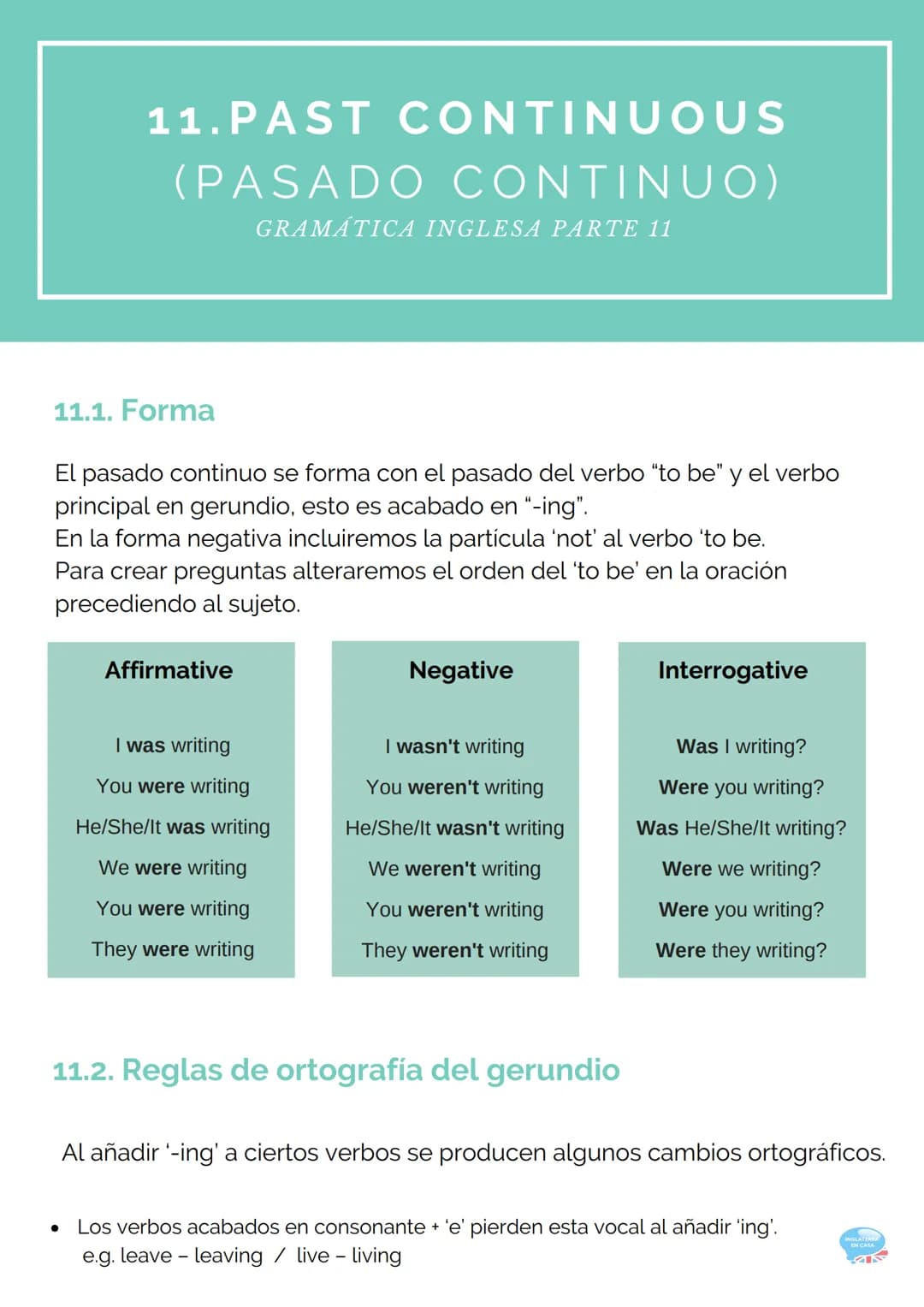
Formación del Pasado Continuo
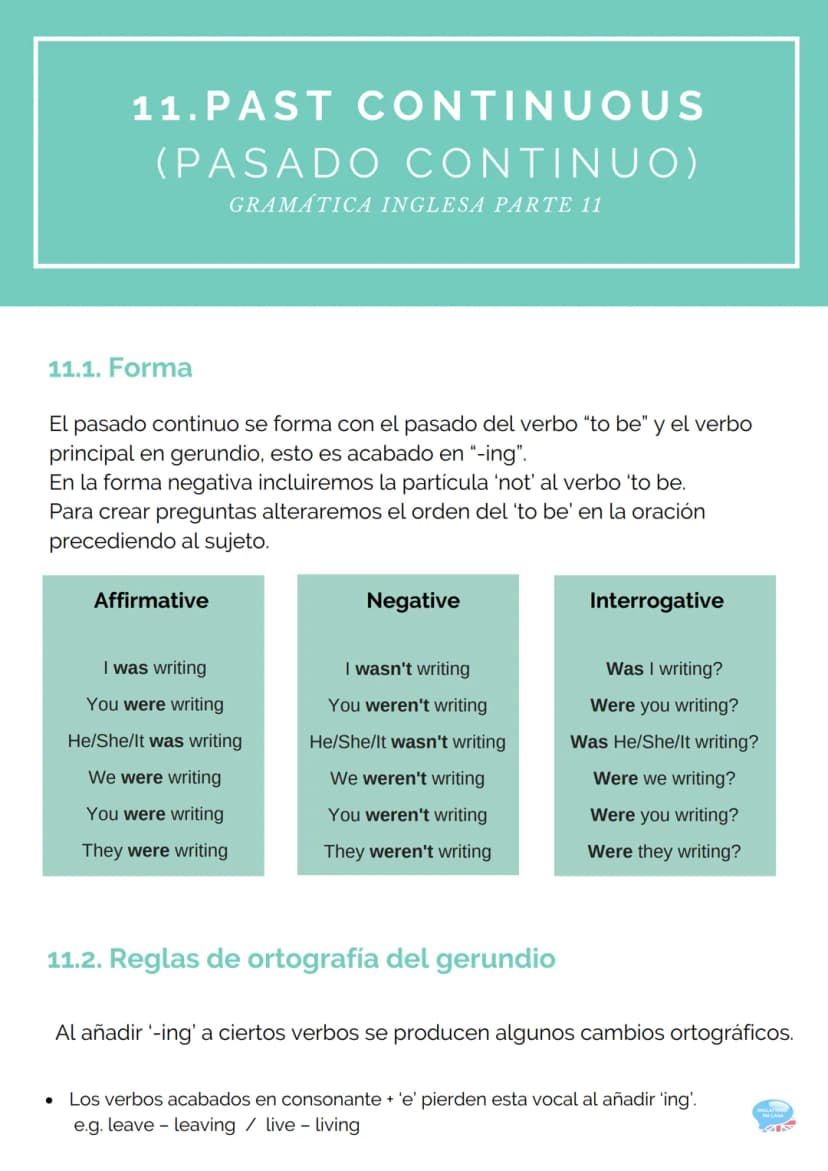
El Pasado Continuo se construye usando el pasado del verbo "to be" + el verbo principal con terminación -ing (gerundio). Es muy fácil de formar una vez que conoces la estructura.
Para las oraciones afirmativas, simplemente usa "was" (para I, he, she, it) o "were" (para you, we, they) seguido del gerundio. Por ejemplo: "I was writing" o "They were playing". En las negativas, añade "not" después del verbo "to be": "She wasn't listening".
Para hacer preguntas, invierte el orden colocando el "to be" antes del sujeto: "Were you studying?", "Was he working?". Recuerda que puedes contraer "was/were" con el sujeto en afirmativas y con "not" en negativas.
💡 Truco para recordar: Piensa en el pasado continuo como una "fotografía en movimiento" de algo que estaba sucediendo en el pasado.
2
of 3
Reglas de ortografía y usos
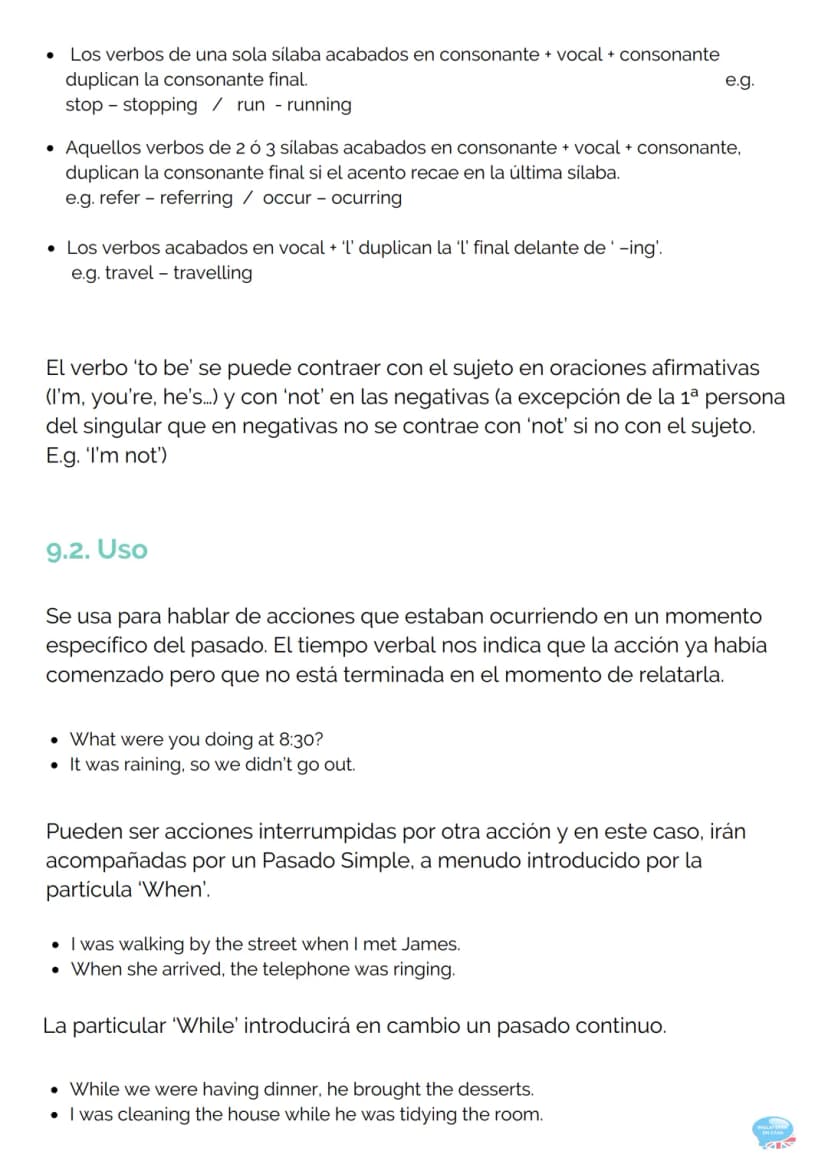
Al formar el gerundio con -ing, debes recordar algunas reglas ortográficas importantes. Si el verbo termina en consonante + "e", elimina la "e" (live → living). Los verbos de una sílaba que terminan en consonante-vocal-consonante duplican la última consonante (run → running).
El Pasado Continuo se usa principalmente para:
- Describir acciones que estaban en progreso en un momento específico del pasado: "It was raining, so we didn't go out".
- Narrar acciones interrumpidas por otra: "I was walking by the street when I met James".
- Describir dos acciones simultáneas usando "while": "While we were having dinner, he brought the desserts".
La palabra "when" suele introducir una acción en Pasado Simple que interrumpe una acción en Pasado Continuo, mientras que "while" normalmente introduce acciones en Pasado Continuo que ocurren simultáneamente.
🔑 Recuerda: El Pasado Continuo muestra que la acción ya había comenzado pero no había terminado en el momento del que hablamos.
3
of 3
Ejercicios prácticos
¡Ahora es tu turno de practicar! Los ejercicios te ayudan a consolidar tu comprensión del Pasado Continuo. Intenta completar oraciones como "He ___ all day yesterday" (was resting) o "We ___ through the window when mother came in" (were looking).
En estos ejercicios verás cómo el Pasado Continuo se combina frecuentemente con el Pasado Simple para narrar historias más completas. Por ejemplo: "When he ___ his garden he found a silver coin" (was digging).
La práctica es fundamental para dominar este tiempo verbal. Mientras completas los ejercicios, presta atención a cómo algunas oraciones describen acciones en progreso "She ___ when his friend arrived" mientras que otras muestran acciones simultáneas "While we ___ we heard a shot".
🌟 Consejo: Para verificar si has usado correctamente el Pasado Continuo, pregúntate: "¿Esta acción estaba en progreso en un momento específico del pasado?" Si la respuesta es sí, probablemente necesitas este tiempo verbal.
We thought you’d never ask...
What is the Knowunity AI companion?
Our AI companion is specifically built for the needs of students. Based on the millions of content pieces we have on the platform we can provide truly meaningful and relevant answers to students. But its not only about answers, the companion is even more about guiding students through their daily learning challenges, with personalised study plans, quizzes or content pieces in the chat and 100% personalisation based on the students skills and developments.
Where can I download the Knowunity app?
You can download the app in the Google Play Store and in the Apple App Store.
Is Knowunity really free of charge?
That's right! Enjoy free access to study content, connect with fellow students, and get instant help – all at your fingertips.
Similar Content
 Anglais
Most popular content: Auxiliary Verb
1Most popular content in ICFES: Inglés
9ICFES: InglésCuadernillo Preguntaa Saber 11 Inglés.
Aprovecha los cuadernillos de Inglés para practicar y mejorar tus habilidades en el ítem de Inglés de la Prueba Saber 11. 🫡
Universidad82212
 ICFES: Sociales y Ciudadanas
SIMULACRO ICFES
Simulacro icfes
111,06015
ICFES: Sociales y CiudadanasIcfes
Simulacro icfes
111,40224
 Sociales/Historia
Práctica-Icfes
Prepárate para q te valla bien
112572
ICFES: InglésVOCABULARY
Tema: Icfes
1166812
 ICFES: Matemáticas
Segunda sesión icfes
Espero y resulvas tus dudas
112,29925
InglésQuantifiers
Ocho cuantificadores
102010
ICFES: InglésPasado simple
Explica el pasado simple sus partes y como aplicarlo, en especial como aplicarlo en el icfes
113156
InglésPasado continuo
Pasado continuo en ingles
91841
Most popular content
9ICFES: MatemáticasSimulacro ICFES primera sesión calendario B filtrado 2025
Este simulacro te ayudará a sacar un buen puntaje en las pruebas ICFES este 2025. Vamos por ese 500/500. Y poder ser admitido en la universidad que quieras, estudiar la carrera que quieres y no la que te toque. Vamos con toda para sacar un buen puntaje.
1016,900174
 ICFES: Lectura Crítica
Simulacro icfes
Simulacro
111,82946
ICFES: InglésCuadernillo Preguntaa Saber 11 Inglés.
Aprovecha los cuadernillos de Inglés para practicar y mejorar tus habilidades en el ítem de Inglés de la Prueba Saber 11. 🫡
Universidad82212
ICFES: MatemáticasMaterial de estudio ICFES
Material de estudio, preguntas icfes de matemáticas resueltas
116,996109
 Química
Trucos para ganar icfes
Lo mejor
111,03212
S
 Otros
Otrossimulacro icfes
Este simulacro evalúa tus conocimientos en las áreas clave del examen ICFES, preparándote para obtener un excelente puntaje.
114540
ICFES: Sociales y CiudadanasSIMULACRO ICFES
Simulacro icfes
111,06015
ICFES: Lectura CríticaICFES segunda sesión calendario B 2025
Segunda sesión simulacro ICFES 2025 calendario B filtrado, aprovecha y se el mejor ICFES de tu colegio y poder ingresar a universidad, y estudiar aquella carrera con la que tanto sueñas.
119,795123
ICFES: Lectura CríticaPrueba icfes 2024
Prueba icfes para practicar todas las asignaturas
118217
Can't find what you're looking for? Explore other subjects.
Students love us — and so will you.
4.6/5App Store
4.7/5Google Play
The app is very easy to use and well designed. I have found everything I was looking for so far and have been able to learn a lot from the presentations! I will definitely use the app for a class assignment! And of course it also helps a lot as an inspiration.
Stefan SiOS user
This app is really great. There are so many study notes and help [...]. My problem subject is French, for example, and the app has so many options for help. Thanks to this app, I have improved my French. I would recommend it to anyone.
Samantha KlichAndroid user
Wow, I am really amazed. I just tried the app because I've seen it advertised many times and was absolutely stunned. This app is THE HELP you want for school and above all, it offers so many things, such as workouts and fact sheets, which have been VERY helpful to me personally.
AnnaiOS user
ICFES: Inglés245 views·Updated Jun 22, 2026·3 pagesEl Pasado Continuo: Aprende Fácilmente
K
Kevin Gomez@kevingome_2fojo
El Pasado Continuo (Past Continuous) te permite expresar acciones que estaban ocurriendo en un momento específico del pasado. Esta estructura gramatical es fundamental para narrar eventos, describir situaciones o explicar interrupciones en inglés.
1
of 3
Sign up to see the content. It's free!
- Access to all documents
- Improve your grades
- Join milions of students
Formación del Pasado Continuo
El Pasado Continuo se construye usando el pasado del verbo "to be" + el verbo principal con terminación -ing (gerundio). Es muy fácil de formar una vez que conoces la estructura.
Para las oraciones afirmativas, simplemente usa "was" (para I, he, she, it) o "were" (para you, we, they) seguido del gerundio. Por ejemplo: "I was writing" o "They were playing". En las negativas, añade "not" después del verbo "to be": "She wasn't listening".
Para hacer preguntas, invierte el orden colocando el "to be" antes del sujeto: "Were you studying?", "Was he working?". Recuerda que puedes contraer "was/were" con el sujeto en afirmativas y con "not" en negativas.
💡 Truco para recordar: Piensa en el pasado continuo como una "fotografía en movimiento" de algo que estaba sucediendo en el pasado.
2
of 3Sign up to see the content. It's free!
- Access to all documents
- Improve your grades
- Join milions of students
Reglas de ortografía y usos
Al formar el gerundio con -ing, debes recordar algunas reglas ortográficas importantes. Si el verbo termina en consonante + "e", elimina la "e" (live → living). Los verbos de una sílaba que terminan en consonante-vocal-consonante duplican la última consonante (run → running).
El Pasado Continuo se usa principalmente para:
- Describir acciones que estaban en progreso en un momento específico del pasado: "It was raining, so we didn't go out".
- Narrar acciones interrumpidas por otra: "I was walking by the street when I met James".
- Describir dos acciones simultáneas usando "while": "While we were having dinner, he brought the desserts".
La palabra "when" suele introducir una acción en Pasado Simple que interrumpe una acción en Pasado Continuo, mientras que "while" normalmente introduce acciones en Pasado Continuo que ocurren simultáneamente.
🔑 Recuerda: El Pasado Continuo muestra que la acción ya había comenzado pero no había terminado en el momento del que hablamos.
3
of 3Sign up to see the content. It's free!
- Access to all documents
- Improve your grades
- Join milions of students
Ejercicios prácticos
¡Ahora es tu turno de practicar! Los ejercicios te ayudan a consolidar tu comprensión del Pasado Continuo. Intenta completar oraciones como "He ___ all day yesterday" (was resting) o "We ___ through the window when mother came in" (were looking).
En estos ejercicios verás cómo el Pasado Continuo se combina frecuentemente con el Pasado Simple para narrar historias más completas. Por ejemplo: "When he ___ his garden he found a silver coin" (was digging).
La práctica es fundamental para dominar este tiempo verbal. Mientras completas los ejercicios, presta atención a cómo algunas oraciones describen acciones en progreso "She ___ when his friend arrived" mientras que otras muestran acciones simultáneas "While we ___ we heard a shot".
🌟 Consejo: Para verificar si has usado correctamente el Pasado Continuo, pregúntate: "¿Esta acción estaba en progreso en un momento específico del pasado?" Si la respuesta es sí, probablemente necesitas este tiempo verbal.
We thought you’d never ask...
What is the Knowunity AI companion?
Our AI companion is specifically built for the needs of students. Based on the millions of content pieces we have on the platform we can provide truly meaningful and relevant answers to students. But its not only about answers, the companion is even more about guiding students through their daily learning challenges, with personalised study plans, quizzes or content pieces in the chat and 100% personalisation based on the students skills and developments.
Where can I download the Knowunity app?
You can download the app in the Google Play Store and in the Apple App Store.
Is Knowunity really free of charge?
That's right! Enjoy free access to study content, connect with fellow students, and get instant help – all at your fingertips.
Similar Content
Most popular content: Auxiliary Verb
1Most popular content in ICFES: Inglés
9ICFES: InglésCuadernillo Preguntaa Saber 11 Inglés.
Aprovecha los cuadernillos de Inglés para practicar y mejorar tus habilidades en el ítem de Inglés de la Prueba Saber 11. 🫡
Universidad82212
ICFES: Sociales y CiudadanasSIMULACRO ICFES
Simulacro icfes
111,06015
ICFES: Sociales y CiudadanasIcfes
Simulacro icfes
111,40224
Sociales/HistoriaPráctica-Icfes
Prepárate para q te valla bien
112572
ICFES: InglésVOCABULARY
Tema: Icfes
1166812
ICFES: MatemáticasSegunda sesión icfes
Espero y resulvas tus dudas
112,29925
InglésQuantifiers
Ocho cuantificadores
102010
ICFES: InglésPasado simple
Explica el pasado simple sus partes y como aplicarlo, en especial como aplicarlo en el icfes
113156
InglésPasado continuo
Pasado continuo en ingles
91841
Most popular content
9ICFES: MatemáticasSimulacro ICFES primera sesión calendario B filtrado 2025
Este simulacro te ayudará a sacar un buen puntaje en las pruebas ICFES este 2025. Vamos por ese 500/500. Y poder ser admitido en la universidad que quieras, estudiar la carrera que quieres y no la que te toque. Vamos con toda para sacar un buen puntaje.
1016,900174
ICFES: Lectura CríticaSimulacro icfes
Simulacro
111,82946
ICFES: InglésCuadernillo Preguntaa Saber 11 Inglés.
Aprovecha los cuadernillos de Inglés para practicar y mejorar tus habilidades en el ítem de Inglés de la Prueba Saber 11. 🫡
Universidad82212
ICFES: MatemáticasMaterial de estudio ICFES
Material de estudio, preguntas icfes de matemáticas resueltas
116,996109
QuímicaTrucos para ganar icfes
Lo mejor
111,03212
S
Otrossimulacro icfes
Este simulacro evalúa tus conocimientos en las áreas clave del examen ICFES, preparándote para obtener un excelente puntaje.
114540
ICFES: Sociales y CiudadanasSIMULACRO ICFES
Simulacro icfes
111,06015
ICFES: Lectura CríticaICFES segunda sesión calendario B 2025
Segunda sesión simulacro ICFES 2025 calendario B filtrado, aprovecha y se el mejor ICFES de tu colegio y poder ingresar a universidad, y estudiar aquella carrera con la que tanto sueñas.
119,795123
ICFES: Lectura CríticaPrueba icfes 2024
Prueba icfes para practicar todas las asignaturas
118217
Can't find what you're looking for? Explore other subjects.
Students love us — and so will you.
4.6/5App Store
4.7/5Google Play
The app is very easy to use and well designed. I have found everything I was looking for so far and have been able to learn a lot from the presentations! I will definitely use the app for a class assignment! And of course it also helps a lot as an inspiration.
Stefan SiOS user
This app is really great. There are so many study notes and help [...]. My problem subject is French, for example, and the app has so many options for help. Thanks to this app, I have improved my French. I would recommend it to anyone.
Samantha KlichAndroid user
Wow, I am really amazed. I just tried the app because I've seen it advertised many times and was absolutely stunned. This app is THE HELP you want for school and above all, it offers so many things, such as workouts and fact sheets, which have been VERY helpful to me personally.
AnnaiOS user