
El pasado simple (past simple) en inglés es un tiempo...
 ICFES: Inglés315 views·Updated Jun 25, 2026·15 pages
Todo Sobre el Pasado Simple
B
bglaura.3003@bglaura.3003_ar9kmft
1 / 10
1
of 10
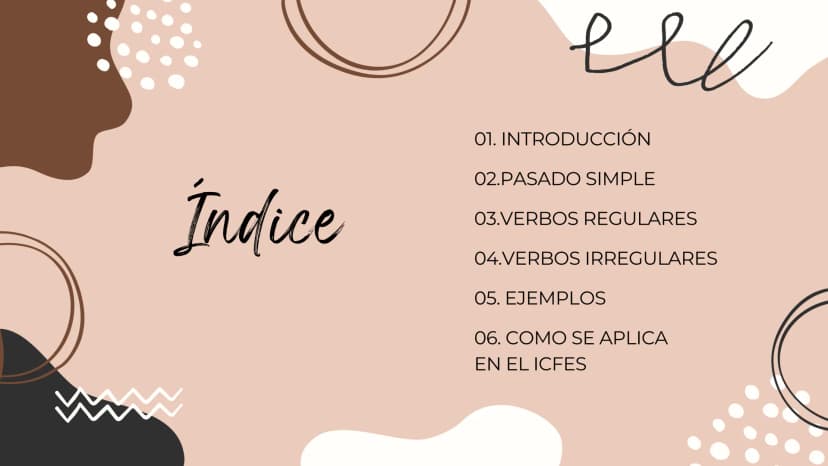
Past Simple
El pasado simple se utiliza para hablar de acciones que ya terminaron completamente. No importa si ocurrieron hace cinco minutos o hace cinco siglos.
Lo importante es entender que estas acciones ya no ocurren en el presente y están totalmente concluidas. Este tiempo verbal es esencial para narrar historias, hablar de experiencias personales o describir hechos históricos.
💡 Consejo clave: Cuando uses el pasado simple, concéntrate en el hecho de que la acción está terminada, no en cuándo exactamente ocurrió.
2
of 10
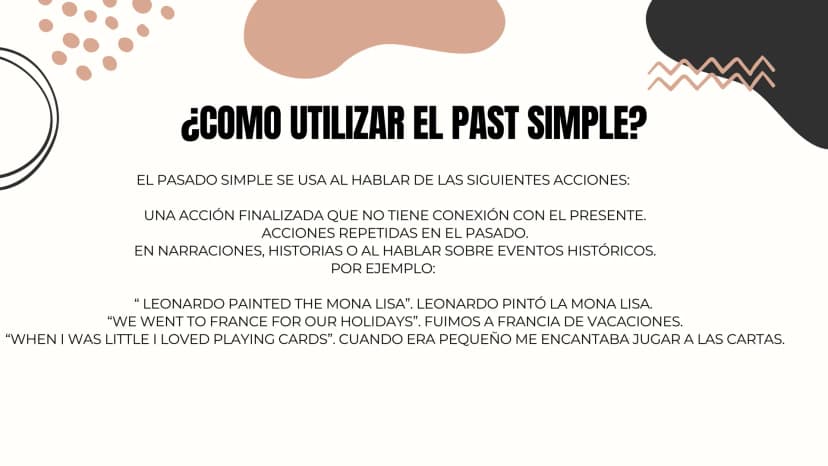
Usos del Past Simple
El pasado simple tiene tres usos principales que debes conocer. Se utiliza para expresar:
-
Acciones terminadas que no tienen conexión con el presente, como "Leonardo painted the Mona Lisa" (Leonardo pintó la Mona Lisa).
-
Acciones repetidas en el pasado: "When I was little I loved playing cards" (Cuando era pequeño me encantaba jugar a las cartas).
-
Narraciones, historias o eventos históricos: "We went to France for our holidays" (Fuimos a Francia de vacaciones).
🔑 Recuerda: El pasado simple es el tiempo verbal perfecto para contar anécdotas o experiencias pasadas en conversaciones cotidianas.
3
of 10
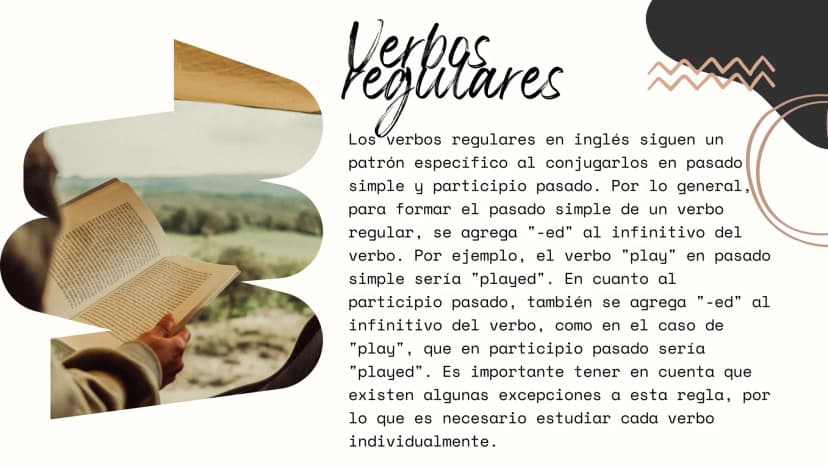
Verbos Regulares
Los verbos regulares siguen un patrón simple: se agrega "-ed" al final del verbo en infinitivo para formar el pasado. Por ejemplo, "play" se convierte en "played" en pasado simple.
Esta regla se aplica tanto para el pasado simple como para el participio pasado. Así, verbos como "walk" (caminar), "clean" (limpiar) y "watch" (mirar) se transforman en "walked", "cleaned" y "watched".
La buena noticia es que la mayoría de los verbos en inglés son regulares, lo que hace más fácil su aprendizaje.
🌟 Dato útil: Algunos verbos regulares tienen pequeñas variaciones ortográficas al agregar "-ed", como duplicar la consonante final (stop → stopped) o cambiar la "y" por "i" (study → studied).
4
of 10
Verbos Irregulares
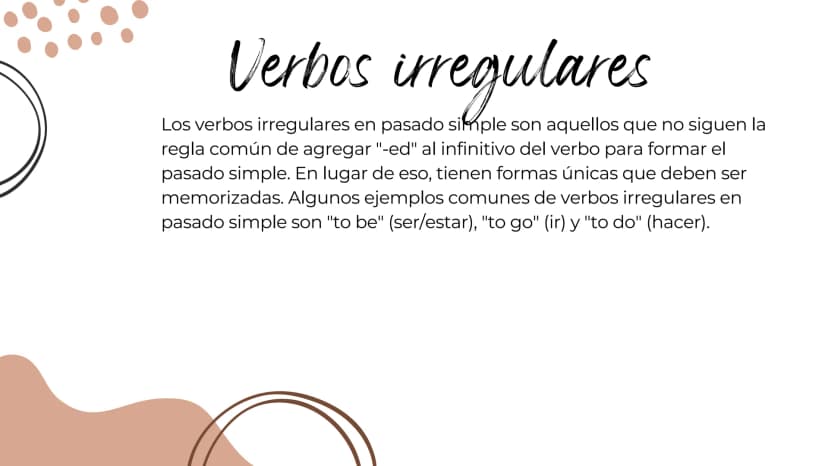
Los verbos irregulares son aquellos que no siguen la regla de agregar "-ed" para formar el pasado. En vez de esto, tienen formas propias que debes memorizar.
Algunos ejemplos comunes son: "to be" , "to go" (went), "to do" (did), "to eat" (ate), "to drive" (drove) y "to sing" (sang).
Aunque aprender estos verbos puede parecer complicado, con práctica se vuelve natural. Muchos de los verbos más usados en inglés son irregulares, así que vale la pena el esfuerzo.
🧠 Estrategia: Crea tarjetas de memoria con 5-10 verbos irregulares nuevos cada semana y practícalos en oraciones simples.
5
of 10
Ejemplos Prácticos
Para oraciones afirmativas simplemente usas el verbo en pasado: "I walked to the store" (regulares) o "She sang beautifully" (irregulares).
Para oraciones negativas utilizas "didn't" (did not) + verbo en infinitivo: "I didn't walk to the store" o "She didn't sing beautifully".
Para preguntas utilizas "Did" + sujeto + verbo en infinitivo: "Did you walk to the store?" o "Did she sing beautifully?".
🔄 Importante: Observa que en las negaciones y preguntas, el verbo principal vuelve a su forma infinitiva , ya que "did/didn't" ya lleva la marca de pasado.
6
of 10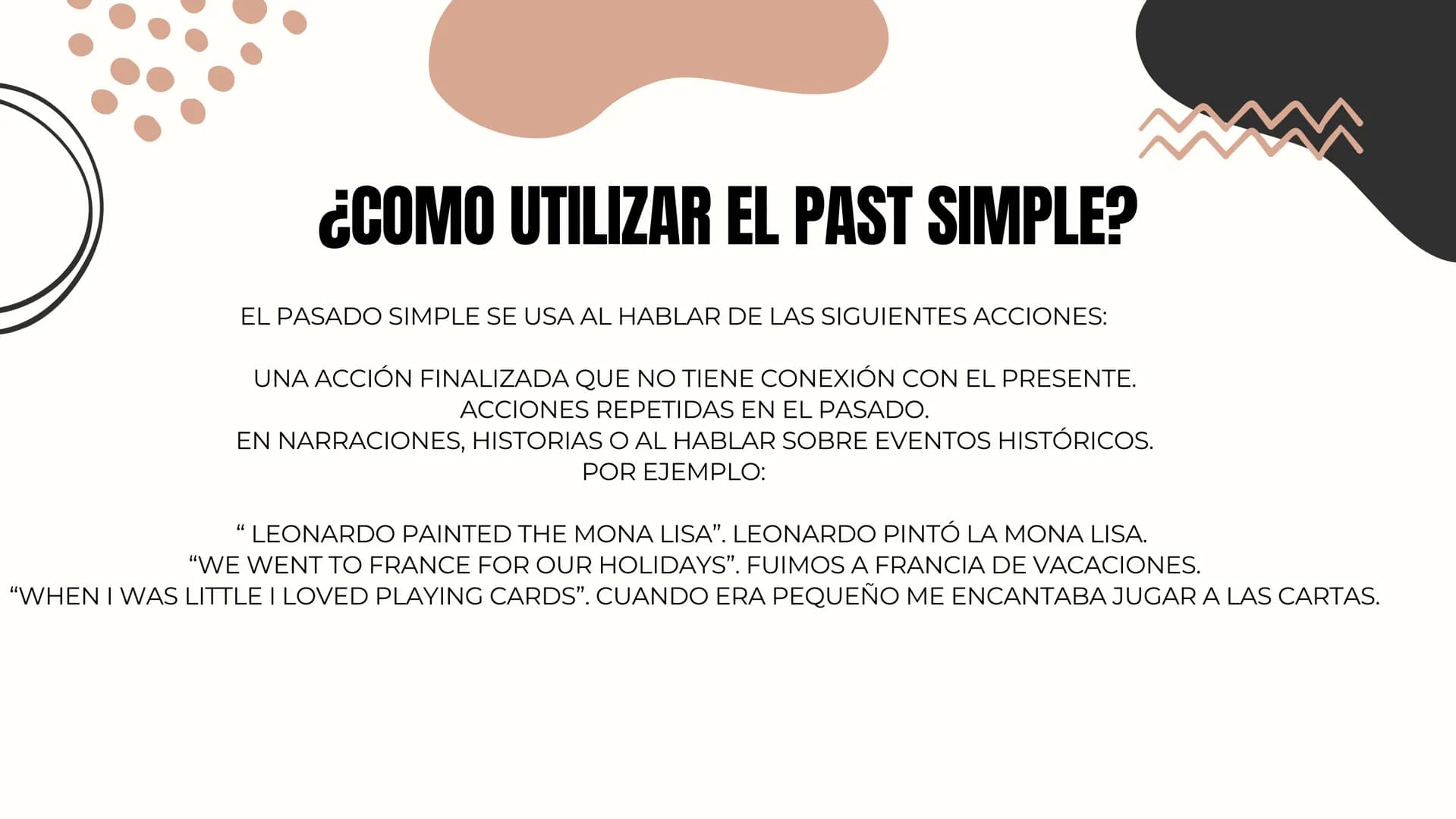
Aplicación en el ICFES
En el examen ICFES, el pasado simple aparece en varias secciones importantes. En comprensión de lectura encontrarás textos narrativos con verbos en pasado simple y preguntas sobre su uso correcto.
En comprensión auditiva escucharás diálogos y narraciones utilizando este tiempo verbal. También enfrentarás ejercicios de uso en contexto, donde completarás espacios en blanco con la forma correcta del verbo.
Ocasionalmente, podrías tener que escribir una narración usando correctamente el pasado simple, demostrando tu capacidad para contar historias en inglés.
🎯 Para el examen: Practica identificando verbos regulares e irregulares en textos, y crea tus propias historias cortas usando verbos en pasado simple.
7
of 10
8
of 10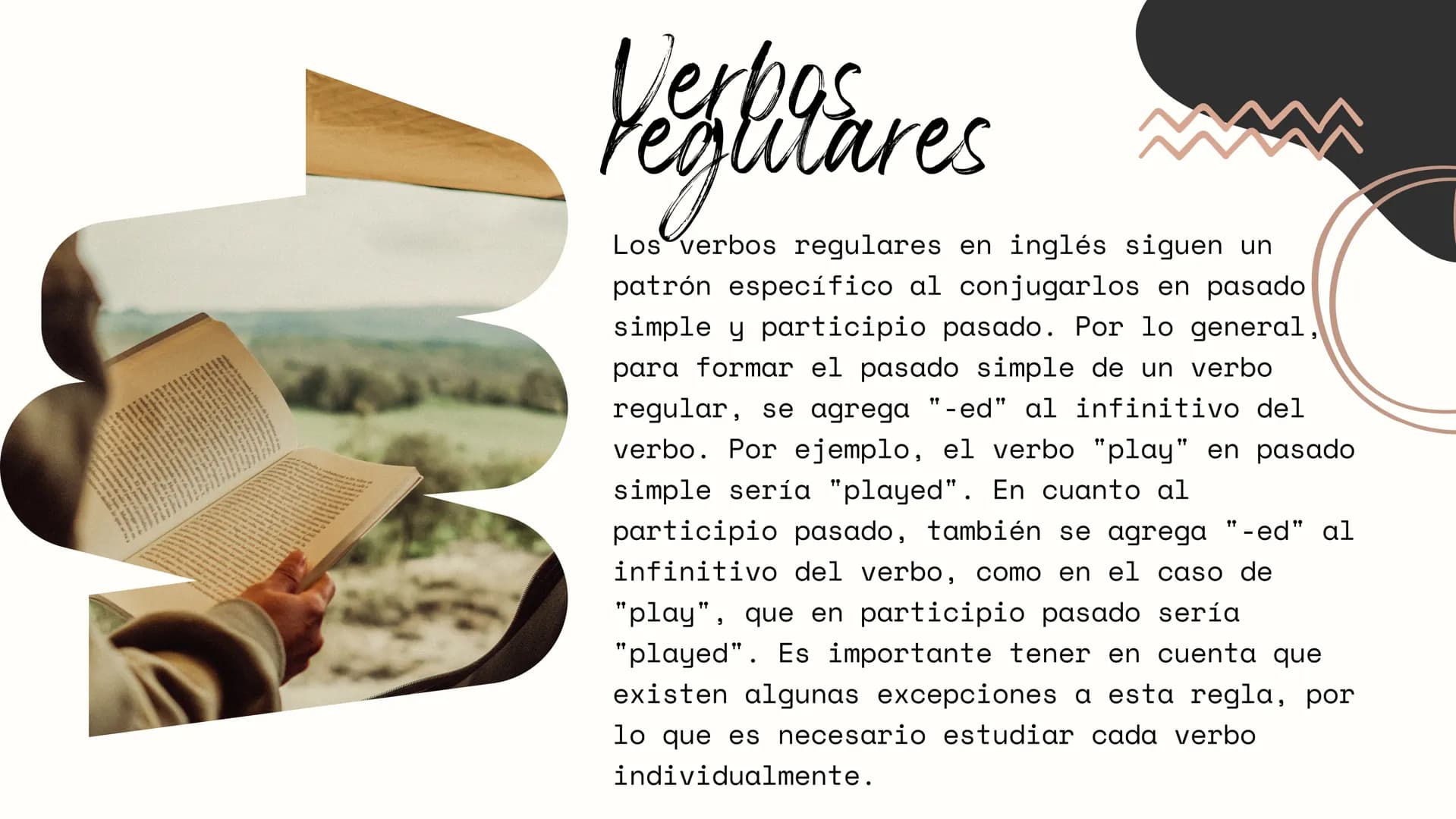
9
of 10
10
of 10
We thought you’d never ask...
What is the Knowunity AI companion?
Our AI companion is specifically built for the needs of students. Based on the millions of content pieces we have on the platform we can provide truly meaningful and relevant answers to students. But its not only about answers, the companion is even more about guiding students through their daily learning challenges, with personalised study plans, quizzes or content pieces in the chat and 100% personalisation based on the students skills and developments.
Where can I download the Knowunity app?
You can download the app in the Google Play Store and in the Apple App Store.
Is Knowunity really free of charge?
That's right! Enjoy free access to study content, connect with fellow students, and get instant help – all at your fingertips.
Similar Content
 Język angielski
Most popular content: Past Tense
9InglésPast simple, Pasado simple
Estructura del pasado simple, verbos en pasado simple, concepto pasado simple
91591
InglésPasado simple del ingles
Pasado simple en ingles
8852
InglésPasado simple
Pasado simple
91282
InglésPasado simple en inglés
Cuándo se usa, estructura afirmatíva, negatíva e interrogatíva diferencia entre verbos regulares e irregulares.
83330
InglésPasado simple
Pasado simple
91091
InglésPast Simple (Pasado simple)
Afirmative form, negative form, interrogative form, regular verbs rules
7801
ICFES: InglésPast Sentense
Explain the different pasts with some examples.
91672
InglésTabla de pronombres indefinidos
Pronombres indefinidos así como significado y tips
9580
InglésPast Simple
Past Simple y sus usos y estructuras
7571
Most popular content in ICFES: Inglés
9ICFES: InglésCuadernillo Preguntaa Saber 11 Inglés.
Aprovecha los cuadernillos de Inglés para practicar y mejorar tus habilidades en el ítem de Inglés de la Prueba Saber 11. 🫡
Universidad82212
 ICFES: Sociales y Ciudadanas
SIMULACRO ICFES
Simulacro icfes
111,06015
ICFES: Sociales y CiudadanasIcfes
Simulacro icfes
111,40224
 Sociales/Historia
Práctica-Icfes
Prepárate para q te valla bien
112572
ICFES: InglésVOCABULARY
Tema: Icfes
1166812
 ICFES: Matemáticas
Segunda sesión icfes
Espero y resulvas tus dudas
112,29925
InglésQuantifiers
Ocho cuantificadores
102010
InglésPasado continuo
Pasado continuo en ingles
91841
InglésVOCABULARIO EN INGLES 1
VOCABULARIO EN INGLES 1
91510
Most popular content
9ICFES: MatemáticasSimulacro ICFES primera sesión calendario B filtrado 2025
Este simulacro te ayudará a sacar un buen puntaje en las pruebas ICFES este 2025. Vamos por ese 500/500. Y poder ser admitido en la universidad que quieras, estudiar la carrera que quieres y no la que te toque. Vamos con toda para sacar un buen puntaje.
1016,899174
 ICFES: Lectura Crítica
Simulacro icfes
Simulacro
111,82946
ICFES: InglésCuadernillo Preguntaa Saber 11 Inglés.
Aprovecha los cuadernillos de Inglés para practicar y mejorar tus habilidades en el ítem de Inglés de la Prueba Saber 11. 🫡
Universidad82212
ICFES: MatemáticasMaterial de estudio ICFES
Material de estudio, preguntas icfes de matemáticas resueltas
116,994109
 Química
Trucos para ganar icfes
Lo mejor
111,03112
S
 Otros
Otrossimulacro icfes
Este simulacro evalúa tus conocimientos en las áreas clave del examen ICFES, preparándote para obtener un excelente puntaje.
114540
ICFES: Sociales y CiudadanasSIMULACRO ICFES
Simulacro icfes
111,06015
ICFES: Lectura CríticaICFES segunda sesión calendario B 2025
Segunda sesión simulacro ICFES 2025 calendario B filtrado, aprovecha y se el mejor ICFES de tu colegio y poder ingresar a universidad, y estudiar aquella carrera con la que tanto sueñas.
119,795123
ICFES: Lectura CríticaPrueba icfes 2024
Prueba icfes para practicar todas las asignaturas
118217
Can't find what you're looking for? Explore other subjects.
Students love us — and so will you.
4.6/5App Store
4.7/5Google Play
The app is very easy to use and well designed. I have found everything I was looking for so far and have been able to learn a lot from the presentations! I will definitely use the app for a class assignment! And of course it also helps a lot as an inspiration.
Stefan SiOS user
This app is really great. There are so many study notes and help [...]. My problem subject is French, for example, and the app has so many options for help. Thanks to this app, I have improved my French. I would recommend it to anyone.
Samantha KlichAndroid user
Wow, I am really amazed. I just tried the app because I've seen it advertised many times and was absolutely stunned. This app is THE HELP you want for school and above all, it offers so many things, such as workouts and fact sheets, which have been VERY helpful to me personally.
AnnaiOS user
ICFES: Inglés315 views·Updated Jun 25, 2026·15 pagesTodo Sobre el Pasado Simple
B
bglaura.3003@bglaura.3003_ar9kmft
El pasado simple (past simple) en inglés es un tiempo verbal fundamental para hablar de acciones completadas en el pasado. Este tiempo verbal te permite contar historias, describir experiencias pasadas y hablar de eventos históricos de forma clara y directa.
1
of 10
Sign up to see the content. It's free!
- Access to all documents
- Improve your grades
- Join milions of students
Past Simple
El pasado simple se utiliza para hablar de acciones que ya terminaron completamente. No importa si ocurrieron hace cinco minutos o hace cinco siglos.
Lo importante es entender que estas acciones ya no ocurren en el presente y están totalmente concluidas. Este tiempo verbal es esencial para narrar historias, hablar de experiencias personales o describir hechos históricos.
💡 Consejo clave: Cuando uses el pasado simple, concéntrate en el hecho de que la acción está terminada, no en cuándo exactamente ocurrió.
2
of 10Sign up to see the content. It's free!
- Access to all documents
- Improve your grades
- Join milions of students
Usos del Past Simple
El pasado simple tiene tres usos principales que debes conocer. Se utiliza para expresar:
-
Acciones terminadas que no tienen conexión con el presente, como "Leonardo painted the Mona Lisa" (Leonardo pintó la Mona Lisa).
-
Acciones repetidas en el pasado: "When I was little I loved playing cards" (Cuando era pequeño me encantaba jugar a las cartas).
-
Narraciones, historias o eventos históricos: "We went to France for our holidays" (Fuimos a Francia de vacaciones).
🔑 Recuerda: El pasado simple es el tiempo verbal perfecto para contar anécdotas o experiencias pasadas en conversaciones cotidianas.
3
of 10Sign up to see the content. It's free!
- Access to all documents
- Improve your grades
- Join milions of students
Verbos Regulares
Los verbos regulares siguen un patrón simple: se agrega "-ed" al final del verbo en infinitivo para formar el pasado. Por ejemplo, "play" se convierte en "played" en pasado simple.
Esta regla se aplica tanto para el pasado simple como para el participio pasado. Así, verbos como "walk" (caminar), "clean" (limpiar) y "watch" (mirar) se transforman en "walked", "cleaned" y "watched".
La buena noticia es que la mayoría de los verbos en inglés son regulares, lo que hace más fácil su aprendizaje.
🌟 Dato útil: Algunos verbos regulares tienen pequeñas variaciones ortográficas al agregar "-ed", como duplicar la consonante final (stop → stopped) o cambiar la "y" por "i" (study → studied).
4
of 10Sign up to see the content. It's free!
- Access to all documents
- Improve your grades
- Join milions of students
Verbos Irregulares
Los verbos irregulares son aquellos que no siguen la regla de agregar "-ed" para formar el pasado. En vez de esto, tienen formas propias que debes memorizar.
Algunos ejemplos comunes son: "to be" , "to go" (went), "to do" (did), "to eat" (ate), "to drive" (drove) y "to sing" (sang).
Aunque aprender estos verbos puede parecer complicado, con práctica se vuelve natural. Muchos de los verbos más usados en inglés son irregulares, así que vale la pena el esfuerzo.
🧠 Estrategia: Crea tarjetas de memoria con 5-10 verbos irregulares nuevos cada semana y practícalos en oraciones simples.
5
of 10Sign up to see the content. It's free!
- Access to all documents
- Improve your grades
- Join milions of students
Ejemplos Prácticos
Para oraciones afirmativas simplemente usas el verbo en pasado: "I walked to the store" (regulares) o "She sang beautifully" (irregulares).
Para oraciones negativas utilizas "didn't" (did not) + verbo en infinitivo: "I didn't walk to the store" o "She didn't sing beautifully".
Para preguntas utilizas "Did" + sujeto + verbo en infinitivo: "Did you walk to the store?" o "Did she sing beautifully?".
🔄 Importante: Observa que en las negaciones y preguntas, el verbo principal vuelve a su forma infinitiva , ya que "did/didn't" ya lleva la marca de pasado.
6
of 10Sign up to see the content. It's free!
- Access to all documents
- Improve your grades
- Join milions of students
Aplicación en el ICFES
En el examen ICFES, el pasado simple aparece en varias secciones importantes. En comprensión de lectura encontrarás textos narrativos con verbos en pasado simple y preguntas sobre su uso correcto.
En comprensión auditiva escucharás diálogos y narraciones utilizando este tiempo verbal. También enfrentarás ejercicios de uso en contexto, donde completarás espacios en blanco con la forma correcta del verbo.
Ocasionalmente, podrías tener que escribir una narración usando correctamente el pasado simple, demostrando tu capacidad para contar historias en inglés.
🎯 Para el examen: Practica identificando verbos regulares e irregulares en textos, y crea tus propias historias cortas usando verbos en pasado simple.
7
of 10Sign up to see the content. It's free!
- Access to all documents
- Improve your grades
- Join milions of students
8
of 10Sign up to see the content. It's free!
- Access to all documents
- Improve your grades
- Join milions of students
9
of 10Sign up to see the content. It's free!
- Access to all documents
- Improve your grades
- Join milions of students
10
of 10Sign up to see the content. It's free!
- Access to all documents
- Improve your grades
- Join milions of students
We thought you’d never ask...
What is the Knowunity AI companion?
Our AI companion is specifically built for the needs of students. Based on the millions of content pieces we have on the platform we can provide truly meaningful and relevant answers to students. But its not only about answers, the companion is even more about guiding students through their daily learning challenges, with personalised study plans, quizzes or content pieces in the chat and 100% personalisation based on the students skills and developments.
Where can I download the Knowunity app?
You can download the app in the Google Play Store and in the Apple App Store.
Is Knowunity really free of charge?
That's right! Enjoy free access to study content, connect with fellow students, and get instant help – all at your fingertips.
Similar Content
Most popular content: Past Tense
9InglésPast simple, Pasado simple
Estructura del pasado simple, verbos en pasado simple, concepto pasado simple
91591
InglésPasado simple del ingles
Pasado simple en ingles
8852
InglésPasado simple
Pasado simple
91282
InglésPasado simple en inglés
Cuándo se usa, estructura afirmatíva, negatíva e interrogatíva diferencia entre verbos regulares e irregulares.
83330
InglésPasado simple
Pasado simple
91091
InglésPast Simple (Pasado simple)
Afirmative form, negative form, interrogative form, regular verbs rules
7801
ICFES: InglésPast Sentense
Explain the different pasts with some examples.
91672
InglésTabla de pronombres indefinidos
Pronombres indefinidos así como significado y tips
9580
InglésPast Simple
Past Simple y sus usos y estructuras
7571
Most popular content in ICFES: Inglés
9ICFES: InglésCuadernillo Preguntaa Saber 11 Inglés.
Aprovecha los cuadernillos de Inglés para practicar y mejorar tus habilidades en el ítem de Inglés de la Prueba Saber 11. 🫡
Universidad82212
ICFES: Sociales y CiudadanasSIMULACRO ICFES
Simulacro icfes
111,06015
ICFES: Sociales y CiudadanasIcfes
Simulacro icfes
111,40224
Sociales/HistoriaPráctica-Icfes
Prepárate para q te valla bien
112572
ICFES: InglésVOCABULARY
Tema: Icfes
1166812
ICFES: MatemáticasSegunda sesión icfes
Espero y resulvas tus dudas
112,29925
InglésQuantifiers
Ocho cuantificadores
102010
InglésPasado continuo
Pasado continuo en ingles
91841
InglésVOCABULARIO EN INGLES 1
VOCABULARIO EN INGLES 1
91510
Most popular content
9ICFES: MatemáticasSimulacro ICFES primera sesión calendario B filtrado 2025
Este simulacro te ayudará a sacar un buen puntaje en las pruebas ICFES este 2025. Vamos por ese 500/500. Y poder ser admitido en la universidad que quieras, estudiar la carrera que quieres y no la que te toque. Vamos con toda para sacar un buen puntaje.
1016,899174
ICFES: Lectura CríticaSimulacro icfes
Simulacro
111,82946
ICFES: InglésCuadernillo Preguntaa Saber 11 Inglés.
Aprovecha los cuadernillos de Inglés para practicar y mejorar tus habilidades en el ítem de Inglés de la Prueba Saber 11. 🫡
Universidad82212
ICFES: MatemáticasMaterial de estudio ICFES
Material de estudio, preguntas icfes de matemáticas resueltas
116,994109
QuímicaTrucos para ganar icfes
Lo mejor
111,03112
S
Otrossimulacro icfes
Este simulacro evalúa tus conocimientos en las áreas clave del examen ICFES, preparándote para obtener un excelente puntaje.
114540
ICFES: Sociales y CiudadanasSIMULACRO ICFES
Simulacro icfes
111,06015
ICFES: Lectura CríticaICFES segunda sesión calendario B 2025
Segunda sesión simulacro ICFES 2025 calendario B filtrado, aprovecha y se el mejor ICFES de tu colegio y poder ingresar a universidad, y estudiar aquella carrera con la que tanto sueñas.
119,795123
ICFES: Lectura CríticaPrueba icfes 2024
Prueba icfes para practicar todas las asignaturas
118217
Can't find what you're looking for? Explore other subjects.
Students love us — and so will you.
4.6/5App Store
4.7/5Google Play
The app is very easy to use and well designed. I have found everything I was looking for so far and have been able to learn a lot from the presentations! I will definitely use the app for a class assignment! And of course it also helps a lot as an inspiration.
Stefan SiOS user
This app is really great. There are so many study notes and help [...]. My problem subject is French, for example, and the app has so many options for help. Thanks to this app, I have improved my French. I would recommend it to anyone.
Samantha KlichAndroid user
Wow, I am really amazed. I just tried the app because I've seen it advertised many times and was absolutely stunned. This app is THE HELP you want for school and above all, it offers so many things, such as workouts and fact sheets, which have been VERY helpful to me personally.
AnnaiOS user