
The Cold War Timeline GCSE Edexcelprovides a comprehensive overview...
 History2,125 views·Updated Jun 23, 2026·2 pages
Detailed Cold War Timeline GCSE Edexcel PDF Free

essie@academia_angel
1
of 2
Cold War Timeline: 1975-1991
The second page of the Cold War Timeline GCSE Edexcel focuses on the later years of the conflict, from 1975 to 1991. This period covers the transition from détente to renewed tensions and ultimately the end of the Cold War, making it crucial for GCSE AQA History Cold War studies.
The timeline begins with the Apollo-Soyuz Mission in July 1975, symbolizing a brief period of cooperation between the USA and USSR. It then progresses through key events such as the Soviet invasion of Afghanistan, the Reagan administration's Strategic Defense Initiative (SDI), and the series of summits between US and Soviet leaders in the 1980s.
Definition: The Brezhnev Doctrine was a Soviet foreign policy that justified the use of military force to prevent any Eastern Bloc country from abandoning communism.
Significant attention is given to the reforms introduced by Mikhail Gorbachev, including the Geneva Summit in 1985 and the INF Treaty in 1987. The timeline then accelerates through the rapid changes of 1989, including the fall of the Berlin Wall and the end of communist regimes across Eastern Europe.
Quote: "Gorbachev says Eastern bloc states can go their own way" - This October 1989 statement marked a pivotal moment in the collapse of Soviet control over Eastern Europe.
The document concludes with the dissolution of the USSR in December 1991, effectively marking the end of the Cold War. This comprehensive overview is essential for students preparing Annotated events cold war history gcse answers.
Highlight: The timeline emphasizes how Gorbachev's reforms and the weakening of Soviet control led to a rapid cascade of events ending the Cold War.
This page provides valuable context for understanding the final years of the Cold War, making it an indispensable resource for Cold war timeline mindmaps gcse history and comprehensive exam preparation.
2
of 2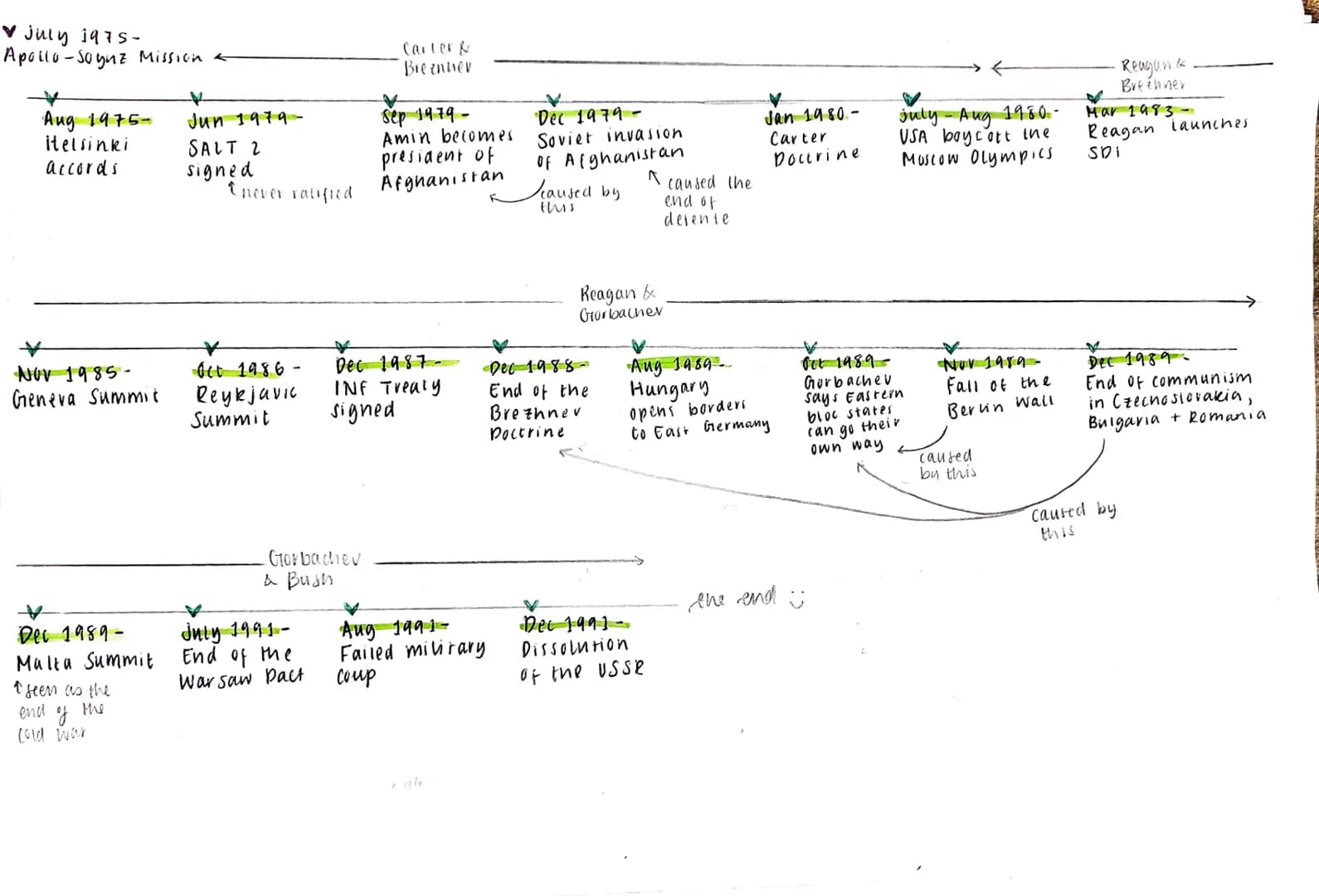
Cold War Timeline: 1943-1972
The first page of the Cold War Timeline GCSE Edexcel pdf covers the period from 1943 to 1972, detailing the origins and escalation of the Cold War. This comprehensive timeline is crucial for students studying GCSE History Cold War revision notes.
The timeline begins with the Tehran Conference in December 1943, marking the early stages of post-war planning among the Allied powers. It then progresses through key events such as the end of World War II, the formation of NATO, and the Berlin Blockade.
Highlight: The timeline emphasizes the importance of the Yalta and Potsdam conferences in 1945, which set the stage for post-war tensions between the USA and USSR.
The document covers significant Cold War milestones, including the Soviet Union's first atomic bomb test in 1949, the formation of East and West Germany, and the creation of the Warsaw Pact in 1955. It also details the escalation of tensions during the 1960s, with events like the Bay of Pigs invasion and the Cuban Missile Crisis.
Vocabulary: MAD - Mutually Assured Destruction, a doctrine that emerged as both superpowers developed nuclear capabilities.
The timeline concludes with the signing of SALT I in May 1972, marking a period of détente between the superpowers. Throughout, it highlights the interconnectedness of events, showing how one action often led to another in the complex web of Cold War politics.
Example: The formation of NATO in 1949 led to the creation of the Warsaw Pact in 1955, illustrating the escalating military alliances of the Cold War.
This page is an invaluable resource for students preparing for GCSE Edexcel History Cold War model answers, providing a clear chronology of events and their causes.
We thought you’d never ask...
What is the Knowunity AI companion?
Our AI companion is specifically built for the needs of students. Based on the millions of content pieces we have on the platform we can provide truly meaningful and relevant answers to students. But its not only about answers, the companion is even more about guiding students through their daily learning challenges, with personalised study plans, quizzes or content pieces in the chat and 100% personalisation based on the students skills and developments.
Where can I download the Knowunity app?
You can download the app in the Google Play Store and in the Apple App Store.
Is Knowunity really free of charge?
That's right! Enjoy free access to study content, connect with fellow students, and get instant help – all at your fingertips.
Similar Content
Most popular content: End of the Cold War
2HistoryCold War Mindmaps Overview
Explore comprehensive mindmaps covering key events and concepts of the Cold War, including the Cuban Missile Crisis, Gorbachev's reforms, and the end of the Cold War. Ideal for Edexcel GCSE History students seeking to enhance their understanding of superpower relations and significant historical events in Europe. This resource provides a visual summary to aid in revision and retention.
119,771195
HistoryCold War Events Overview
Explore a comprehensive timeline of the Cold War, detailing key events from the early tensions of 1945 to the end of the Cold War in 1991. This summary covers significant milestones such as the Cuban Missile Crisis, the formation of NATO and the Warsaw Pact, and the policies of leaders like Mikhail Gorbachev. Ideal for students studying Cold War history.
977033
Most popular content in History
9HistoryCold War Mindmaps Overview
Explore comprehensive mindmaps covering key events and concepts of the Cold War, including the Cuban Missile Crisis, Gorbachev's reforms, and the end of the Cold War. Ideal for Edexcel GCSE History students seeking to enhance their understanding of superpower relations and significant historical events in Europe. This resource provides a visual summary to aid in revision and retention.
119,771195
HistoryEvolution of Medicine
Explore the comprehensive timeline of medical advancements from medieval practices to modern healthcare. This revision resource covers key topics such as the Great Plague, Germ Theory, the development of antibiotics, and the evolution of public health reforms. Ideal for Edexcel GCSE History students seeking a thorough understanding of the progression of medical knowledge and practices.
1116,245719
W
HistoryWeimar Constitution
GCSE history Weimar and Nazi Germany - the Weimar Constitution
99924
HistoryElizabethan Conspiracies & Conflicts
Explore the key conspiracies and conflicts during Elizabeth I's reign, including the Ridolfi and Throckmorton plots, the Spanish Armada, and the impact of the Religious Settlement. This comprehensive revision guide covers essential topics for GCSE History, focusing on the political, religious, and social challenges faced by Elizabethan England.
105,219336
HistoryAnglo-Saxon & Norman England Overview
Explore the key events and societal changes in Anglo-Saxon and Norman England (c. 1060-1088). This comprehensive summary covers the feudal system, the role of the Church, significant battles, and the impact of William the Conqueror's reign. Ideal for history revision and exam preparation.
112,41078
HistoryElizabethan Governance & Challenges
Explore the complexities of Elizabeth I's reign with this comprehensive mindmap covering key topics such as the structure of Tudor government, the religious settlement, challenges from Mary Queen of Scots, and the impact of exploration. Ideal for Edexcel GCSE History students, this resource provides a clear overview of Elizabethan politics, foreign policy, and societal issues, helping you to understand the era's significant events and figures.
117,924408
M
Historymedicine through time
this is a history test most for yearr 10/11s to get you ready for exams!
104380
HistoryWeimar Republic Overview
Explore the key events and challenges of the Weimar Republic (1918-1929), including the November Revolution, Treaty of Versailles, economic crises, and the rise of political extremism. This summary covers the establishment of the Weimar Constitution, the impact of hyperinflation, and the cultural developments during the Golden Twenties. Ideal for students studying Weimar Germany and its historical significance.
111,99440
HistoryEvolution of Medicine in Britain
Explore the comprehensive journey of medicine in Britain from medieval times to the modern era. This study note covers key topics such as the Black Death, germ theory, the impact of the Renaissance, the evolution of public health, and the development of antibiotics. Ideal for GCSE History students studying the AQA curriculum, this resource provides essential insights into significant medical advancements and public health reforms.
1016,904974
Most popular content
9 Sociology
Sociology of Education Overview
Explore comprehensive A-Level Sociology notes on the education system, covering key theories, policies, and sociological perspectives. This resource includes insights on marketisation, gender roles, cultural deprivation, and educational inequalities, providing a thorough understanding of how education shapes social stratification and individual achievement. Ideal for exam preparation and in-depth study.
12102,8693,040
SociologySociology of Families: Comprehensive Revision
Dive into an extensive overview of family dynamics, perspectives, and patterns in sociology. This resource covers key concepts such as family diversity, gender roles, marriage, and the impact of social policies on family structures. Perfect for A-Level Sociology students preparing for Paper 2.
1273,6612,307
CriminologyCriminology: Crime & Punishment Overview
Comprehensive mindmaps covering key concepts in the Crime and Punishment topic for WJEC Criminology Unit 4. This resource includes detailed insights into the Criminal Justice System, crime prevention strategies, sentencing models, and the roles of various agencies. Ideal for A-Level revision, ensuring you grasp essential theories and legislative processes to excel in your exams.
1254,8691,059
SociologyComprehensive Crime & Deviance Overview
Explore an extensive revision of crime and deviance topics, including theories, types of crime, and the impact of media. This resource covers key concepts such as Marxism, functionalism, gender and crime, and the influence of globalization on criminal behavior. Ideal for students seeking a thorough understanding of criminology and its various theories. Type: Full Topic Revision.
1251,6541,399
C
 Biology
Cell Biology and Cell structure
cell structures
93,2470
 English Literature
An Inspector Calls: Character Insights
Explore in-depth analysis and key quotes for characters in J.B. Priestley's 'An Inspector Calls'. This resource covers Gerald Croft, Inspector Goole, Sheila Birling, Mrs. Birling, Eric Birling, and Eva Smith, focusing on themes of class, gender roles, and social responsibility. Ideal for students aiming for Grade 8 and above.
1025,429907
CriminologyWJEC Unit 4 Criminology
Criminology unit 4 detailed revision note
127,151125
CriminologyCriminology Theories Overview
Explore key criminology theories and their implications on crime and deviance. This comprehensive summary covers biological, psychological, and sociological perspectives, including labelling theory, right realism, and the impact of social campaigns on policy development. Ideal for A-Level criminology students seeking to understand the complexities of criminal behaviour and the factors influencing crime prevention strategies.
129,760210
English LiteratureRomeo and Juliet: Key themes
Key Romeo and Juliet themes and analysed quotes
106,708198
Can't find what you're looking for? Explore other subjects.
Students love us — and so will you.
4.6/5App Store
4.7/5Google Play
The app is very easy to use and well designed. I have found everything I was looking for so far and have been able to learn a lot from the presentations! I will definitely use the app for a class assignment! And of course it also helps a lot as an inspiration.
Stefan SiOS user
This app is really great. There are so many study notes and help [...]. My problem subject is French, for example, and the app has so many options for help. Thanks to this app, I have improved my French. I would recommend it to anyone.
Samantha KlichAndroid user
Wow, I am really amazed. I just tried the app because I've seen it advertised many times and was absolutely stunned. This app is THE HELP you want for school and above all, it offers so many things, such as workouts and fact sheets, which have been VERY helpful to me personally.
AnnaiOS user
History2,125 views·Updated Jun 23, 2026·2 pagesDetailed Cold War Timeline GCSE Edexcel PDF Free
essie@academia_angel
The Cold War Timeline GCSE Edexcel provides a comprehensive overview of key events from 1943 to 1991, detailing the tensions between the USA and USSR. This timeline is essential for students studying GCSE Edexcel History Cold Wartopics, offering a...
1
of 2
Sign up to see the content. It's free!
- Access to all documents
- Improve your grades
- Join milions of students
Cold War Timeline: 1975-1991
The second page of the Cold War Timeline GCSE Edexcel focuses on the later years of the conflict, from 1975 to 1991. This period covers the transition from détente to renewed tensions and ultimately the end of the Cold War, making it crucial for GCSE AQA History Cold War studies.
The timeline begins with the Apollo-Soyuz Mission in July 1975, symbolizing a brief period of cooperation between the USA and USSR. It then progresses through key events such as the Soviet invasion of Afghanistan, the Reagan administration's Strategic Defense Initiative (SDI), and the series of summits between US and Soviet leaders in the 1980s.
Definition: The Brezhnev Doctrine was a Soviet foreign policy that justified the use of military force to prevent any Eastern Bloc country from abandoning communism.
Significant attention is given to the reforms introduced by Mikhail Gorbachev, including the Geneva Summit in 1985 and the INF Treaty in 1987. The timeline then accelerates through the rapid changes of 1989, including the fall of the Berlin Wall and the end of communist regimes across Eastern Europe.
Quote: "Gorbachev says Eastern bloc states can go their own way" - This October 1989 statement marked a pivotal moment in the collapse of Soviet control over Eastern Europe.
The document concludes with the dissolution of the USSR in December 1991, effectively marking the end of the Cold War. This comprehensive overview is essential for students preparing Annotated events cold war history gcse answers.
Highlight: The timeline emphasizes how Gorbachev's reforms and the weakening of Soviet control led to a rapid cascade of events ending the Cold War.
This page provides valuable context for understanding the final years of the Cold War, making it an indispensable resource for Cold war timeline mindmaps gcse history and comprehensive exam preparation.
2
of 2Sign up to see the content. It's free!
- Access to all documents
- Improve your grades
- Join milions of students
Cold War Timeline: 1943-1972
The first page of the Cold War Timeline GCSE Edexcel pdf covers the period from 1943 to 1972, detailing the origins and escalation of the Cold War. This comprehensive timeline is crucial for students studying GCSE History Cold War revision notes.
The timeline begins with the Tehran Conference in December 1943, marking the early stages of post-war planning among the Allied powers. It then progresses through key events such as the end of World War II, the formation of NATO, and the Berlin Blockade.
Highlight: The timeline emphasizes the importance of the Yalta and Potsdam conferences in 1945, which set the stage for post-war tensions between the USA and USSR.
The document covers significant Cold War milestones, including the Soviet Union's first atomic bomb test in 1949, the formation of East and West Germany, and the creation of the Warsaw Pact in 1955. It also details the escalation of tensions during the 1960s, with events like the Bay of Pigs invasion and the Cuban Missile Crisis.
Vocabulary: MAD - Mutually Assured Destruction, a doctrine that emerged as both superpowers developed nuclear capabilities.
The timeline concludes with the signing of SALT I in May 1972, marking a period of détente between the superpowers. Throughout, it highlights the interconnectedness of events, showing how one action often led to another in the complex web of Cold War politics.
Example: The formation of NATO in 1949 led to the creation of the Warsaw Pact in 1955, illustrating the escalating military alliances of the Cold War.
This page is an invaluable resource for students preparing for GCSE Edexcel History Cold War model answers, providing a clear chronology of events and their causes.
We thought you’d never ask...
What is the Knowunity AI companion?
Our AI companion is specifically built for the needs of students. Based on the millions of content pieces we have on the platform we can provide truly meaningful and relevant answers to students. But its not only about answers, the companion is even more about guiding students through their daily learning challenges, with personalised study plans, quizzes or content pieces in the chat and 100% personalisation based on the students skills and developments.
Where can I download the Knowunity app?
You can download the app in the Google Play Store and in the Apple App Store.
Is Knowunity really free of charge?
That's right! Enjoy free access to study content, connect with fellow students, and get instant help – all at your fingertips.
Similar Content
Most popular content: End of the Cold War
2HistoryCold War Mindmaps Overview
Explore comprehensive mindmaps covering key events and concepts of the Cold War, including the Cuban Missile Crisis, Gorbachev's reforms, and the end of the Cold War. Ideal for Edexcel GCSE History students seeking to enhance their understanding of superpower relations and significant historical events in Europe. This resource provides a visual summary to aid in revision and retention.
119,771195
HistoryCold War Events Overview
Explore a comprehensive timeline of the Cold War, detailing key events from the early tensions of 1945 to the end of the Cold War in 1991. This summary covers significant milestones such as the Cuban Missile Crisis, the formation of NATO and the Warsaw Pact, and the policies of leaders like Mikhail Gorbachev. Ideal for students studying Cold War history.
977033
Most popular content in History
9HistoryCold War Mindmaps Overview
Explore comprehensive mindmaps covering key events and concepts of the Cold War, including the Cuban Missile Crisis, Gorbachev's reforms, and the end of the Cold War. Ideal for Edexcel GCSE History students seeking to enhance their understanding of superpower relations and significant historical events in Europe. This resource provides a visual summary to aid in revision and retention.
119,771195
HistoryEvolution of Medicine
Explore the comprehensive timeline of medical advancements from medieval practices to modern healthcare. This revision resource covers key topics such as the Great Plague, Germ Theory, the development of antibiotics, and the evolution of public health reforms. Ideal for Edexcel GCSE History students seeking a thorough understanding of the progression of medical knowledge and practices.
1116,245719
W
HistoryWeimar Constitution
GCSE history Weimar and Nazi Germany - the Weimar Constitution
99924
HistoryElizabethan Conspiracies & Conflicts
Explore the key conspiracies and conflicts during Elizabeth I's reign, including the Ridolfi and Throckmorton plots, the Spanish Armada, and the impact of the Religious Settlement. This comprehensive revision guide covers essential topics for GCSE History, focusing on the political, religious, and social challenges faced by Elizabethan England.
105,219336
HistoryAnglo-Saxon & Norman England Overview
Explore the key events and societal changes in Anglo-Saxon and Norman England (c. 1060-1088). This comprehensive summary covers the feudal system, the role of the Church, significant battles, and the impact of William the Conqueror's reign. Ideal for history revision and exam preparation.
112,41078
HistoryElizabethan Governance & Challenges
Explore the complexities of Elizabeth I's reign with this comprehensive mindmap covering key topics such as the structure of Tudor government, the religious settlement, challenges from Mary Queen of Scots, and the impact of exploration. Ideal for Edexcel GCSE History students, this resource provides a clear overview of Elizabethan politics, foreign policy, and societal issues, helping you to understand the era's significant events and figures.
117,924408
M
Historymedicine through time
this is a history test most for yearr 10/11s to get you ready for exams!
104380
HistoryWeimar Republic Overview
Explore the key events and challenges of the Weimar Republic (1918-1929), including the November Revolution, Treaty of Versailles, economic crises, and the rise of political extremism. This summary covers the establishment of the Weimar Constitution, the impact of hyperinflation, and the cultural developments during the Golden Twenties. Ideal for students studying Weimar Germany and its historical significance.
111,99440
HistoryEvolution of Medicine in Britain
Explore the comprehensive journey of medicine in Britain from medieval times to the modern era. This study note covers key topics such as the Black Death, germ theory, the impact of the Renaissance, the evolution of public health, and the development of antibiotics. Ideal for GCSE History students studying the AQA curriculum, this resource provides essential insights into significant medical advancements and public health reforms.
1016,904974
Most popular content
9SociologySociology of Education Overview
Explore comprehensive A-Level Sociology notes on the education system, covering key theories, policies, and sociological perspectives. This resource includes insights on marketisation, gender roles, cultural deprivation, and educational inequalities, providing a thorough understanding of how education shapes social stratification and individual achievement. Ideal for exam preparation and in-depth study.
12102,8693,040
SociologySociology of Families: Comprehensive Revision
Dive into an extensive overview of family dynamics, perspectives, and patterns in sociology. This resource covers key concepts such as family diversity, gender roles, marriage, and the impact of social policies on family structures. Perfect for A-Level Sociology students preparing for Paper 2.
1273,6612,307
CriminologyCriminology: Crime & Punishment Overview
Comprehensive mindmaps covering key concepts in the Crime and Punishment topic for WJEC Criminology Unit 4. This resource includes detailed insights into the Criminal Justice System, crime prevention strategies, sentencing models, and the roles of various agencies. Ideal for A-Level revision, ensuring you grasp essential theories and legislative processes to excel in your exams.
1254,8691,059
SociologyComprehensive Crime & Deviance Overview
Explore an extensive revision of crime and deviance topics, including theories, types of crime, and the impact of media. This resource covers key concepts such as Marxism, functionalism, gender and crime, and the influence of globalization on criminal behavior. Ideal for students seeking a thorough understanding of criminology and its various theories. Type: Full Topic Revision.
1251,6541,399
C
BiologyCell Biology and Cell structure
cell structures
93,2470
English LiteratureAn Inspector Calls: Character Insights
Explore in-depth analysis and key quotes for characters in J.B. Priestley's 'An Inspector Calls'. This resource covers Gerald Croft, Inspector Goole, Sheila Birling, Mrs. Birling, Eric Birling, and Eva Smith, focusing on themes of class, gender roles, and social responsibility. Ideal for students aiming for Grade 8 and above.
1025,429907
CriminologyWJEC Unit 4 Criminology
Criminology unit 4 detailed revision note
127,151125
CriminologyCriminology Theories Overview
Explore key criminology theories and their implications on crime and deviance. This comprehensive summary covers biological, psychological, and sociological perspectives, including labelling theory, right realism, and the impact of social campaigns on policy development. Ideal for A-Level criminology students seeking to understand the complexities of criminal behaviour and the factors influencing crime prevention strategies.
129,760210
English LiteratureRomeo and Juliet: Key themes
Key Romeo and Juliet themes and analysed quotes
106,708198
Can't find what you're looking for? Explore other subjects.
Students love us — and so will you.
4.6/5App Store
4.7/5Google Play
The app is very easy to use and well designed. I have found everything I was looking for so far and have been able to learn a lot from the presentations! I will definitely use the app for a class assignment! And of course it also helps a lot as an inspiration.
Stefan SiOS user
This app is really great. There are so many study notes and help [...]. My problem subject is French, for example, and the app has so many options for help. Thanks to this app, I have improved my French. I would recommend it to anyone.
Samantha KlichAndroid user
Wow, I am really amazed. I just tried the app because I've seen it advertised many times and was absolutely stunned. This app is THE HELP you want for school and above all, it offers so many things, such as workouts and fact sheets, which have been VERY helpful to me personally.
AnnaiOS user