
Empowermentin health and social care is all about helping...
 Health & Social Care382 views·Updated Jun 23, 2026·4 pages
Empowerment in Health and Social Care

Lilly Bopzin@lillybopzin
1 / 4
1
of 4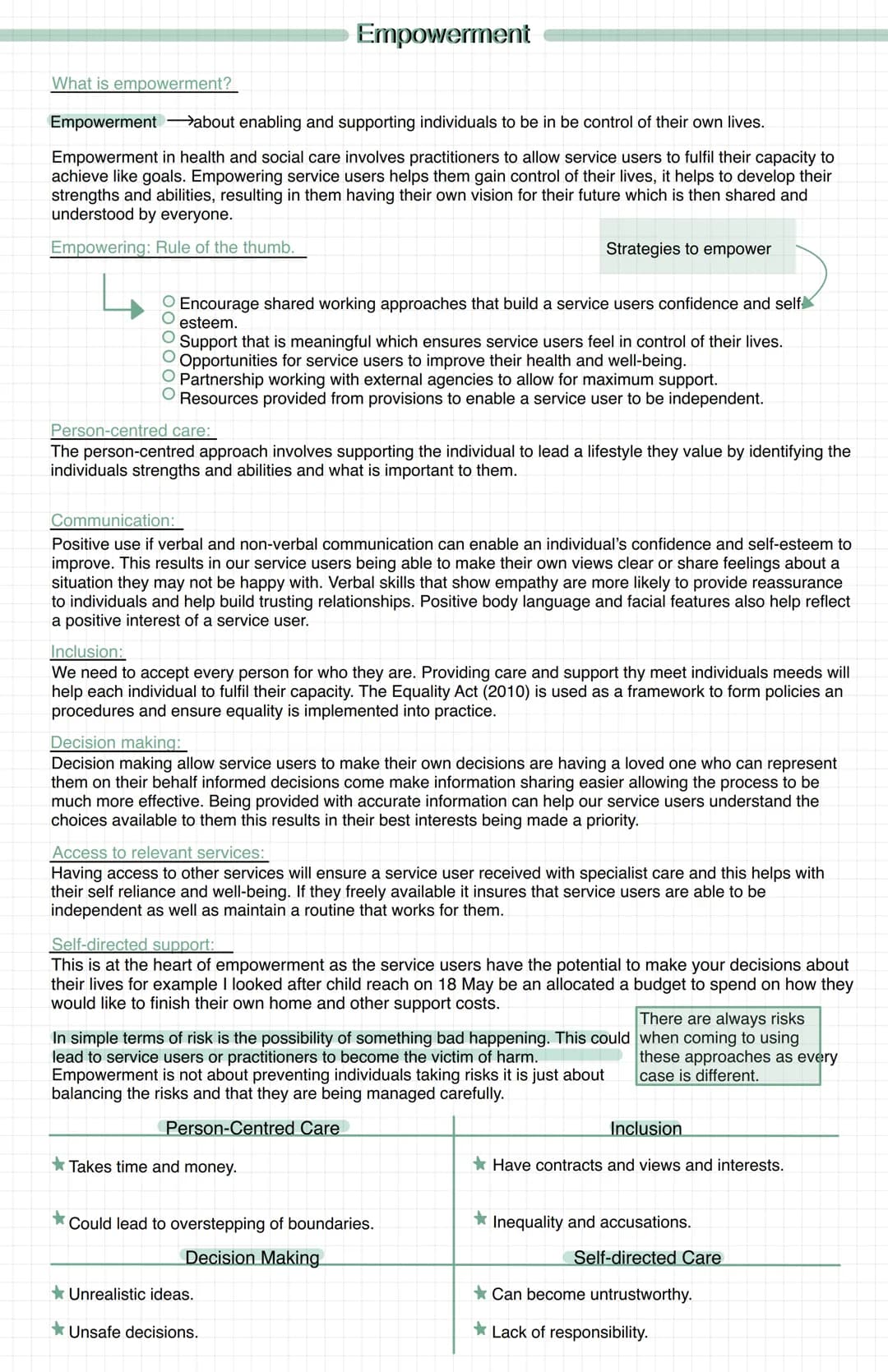
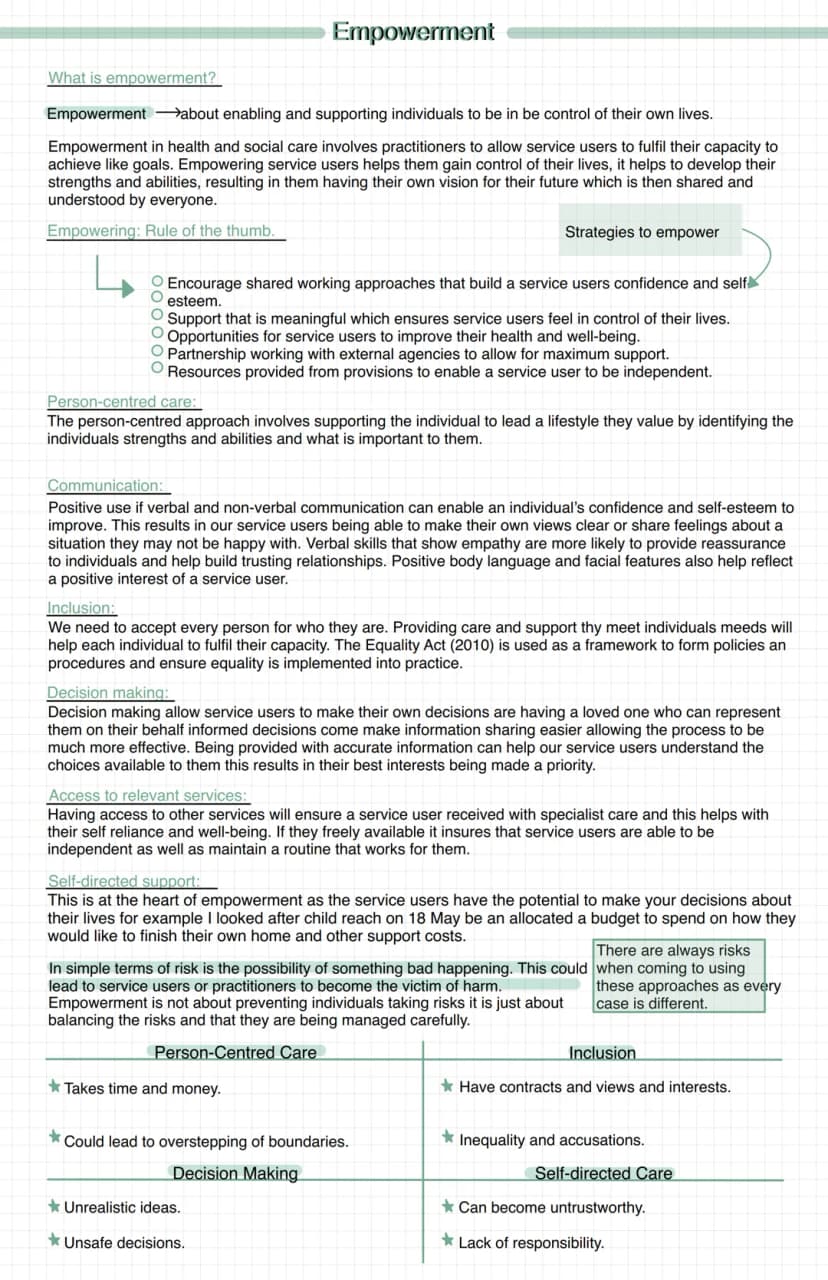
Understanding Empowerment in Care
Ever wondered why some people seem to thrive in care settings whilst others feel helpless? The answer often lies in empowerment - enabling individuals to have control over their own lives and decisions.
Person-centred care sits at the heart of empowerment. This means focusing on what matters to each individual, identifying their strengths, and supporting the lifestyle they value. It's not about what's easiest for the care provider - it's about what works for the person.
Communication plays a massive role here. Positive verbal and non-verbal communication builds confidence and self-esteem, helping people express their views and feelings clearly. When someone feels heard and understood, they're more likely to engage in making decisions about their care.
Key Point: Empowerment isn't about avoiding all risks - it's about balancing risks carefully so people can still make meaningful choices about their lives.
The approach includes several strategies: encouraging shared working to build confidence, providing meaningful support, creating opportunities for improved wellbeing, and ensuring access to resources that promote independence. However, there are always challenges - person-centred care takes time and money, and sometimes people make unsafe decisions or have unrealistic expectations.
2
of 4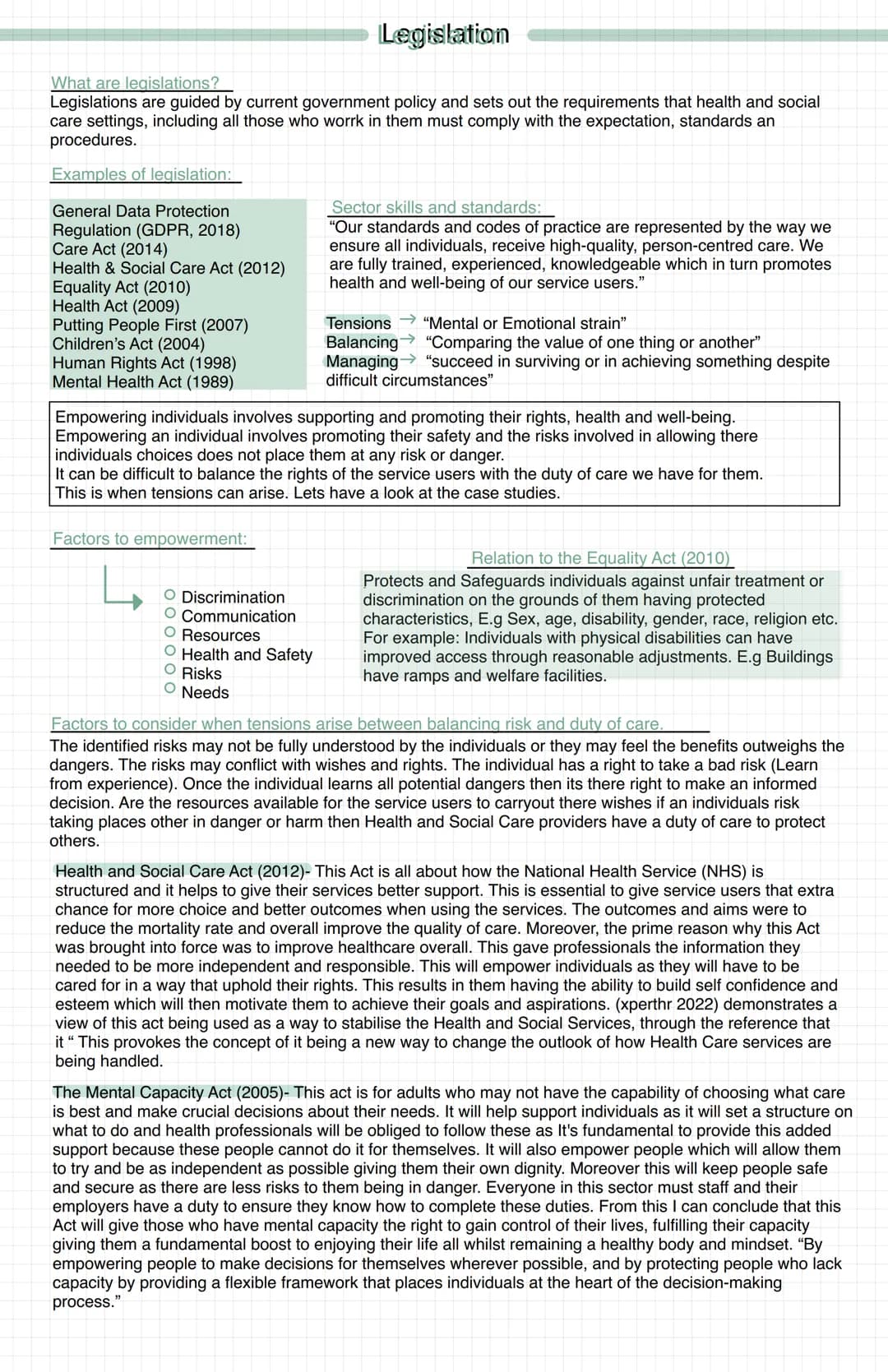
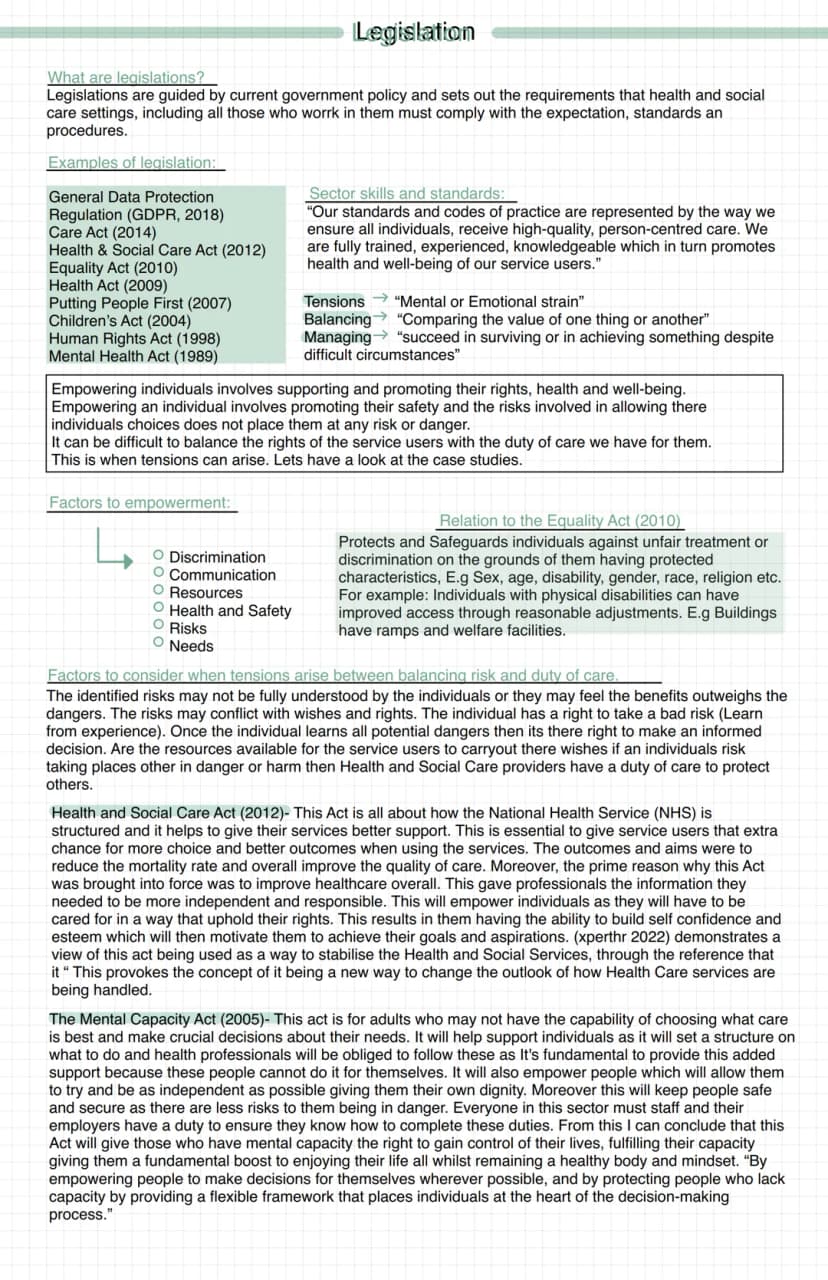
Legal Framework and Managing Tensions
You can't understand empowerment without knowing the legislation that governs it. Key laws like the Equality Act (2010), Mental Capacity Act (2005), and Health & Social Care Act (2012) set the standards that all care settings must follow.
The Equality Act (2010) is particularly important as it protects people from discrimination based on protected characteristics like age, disability, race, or gender. This means care providers must make reasonable adjustments - like installing ramps for wheelchair users - to ensure equal access.
Here's where it gets tricky: tensions often arise between empowering someone and keeping them safe. For example, should someone with epilepsy be allowed to live independently if there's a risk of seizures? The Mental Capacity Act (2005) helps navigate these situations by providing a framework for supporting people who may struggle with decision-making.
Remember: People have the right to make 'bad' decisions and learn from experience - as long as they understand the risks and aren't putting others in danger.
Several factors can create barriers to empowerment: discrimination, poor communication, lack of resources, and health and safety concerns. Care practitioners must learn to balance these challenges whilst still promoting individual choice and independence.
3
of 4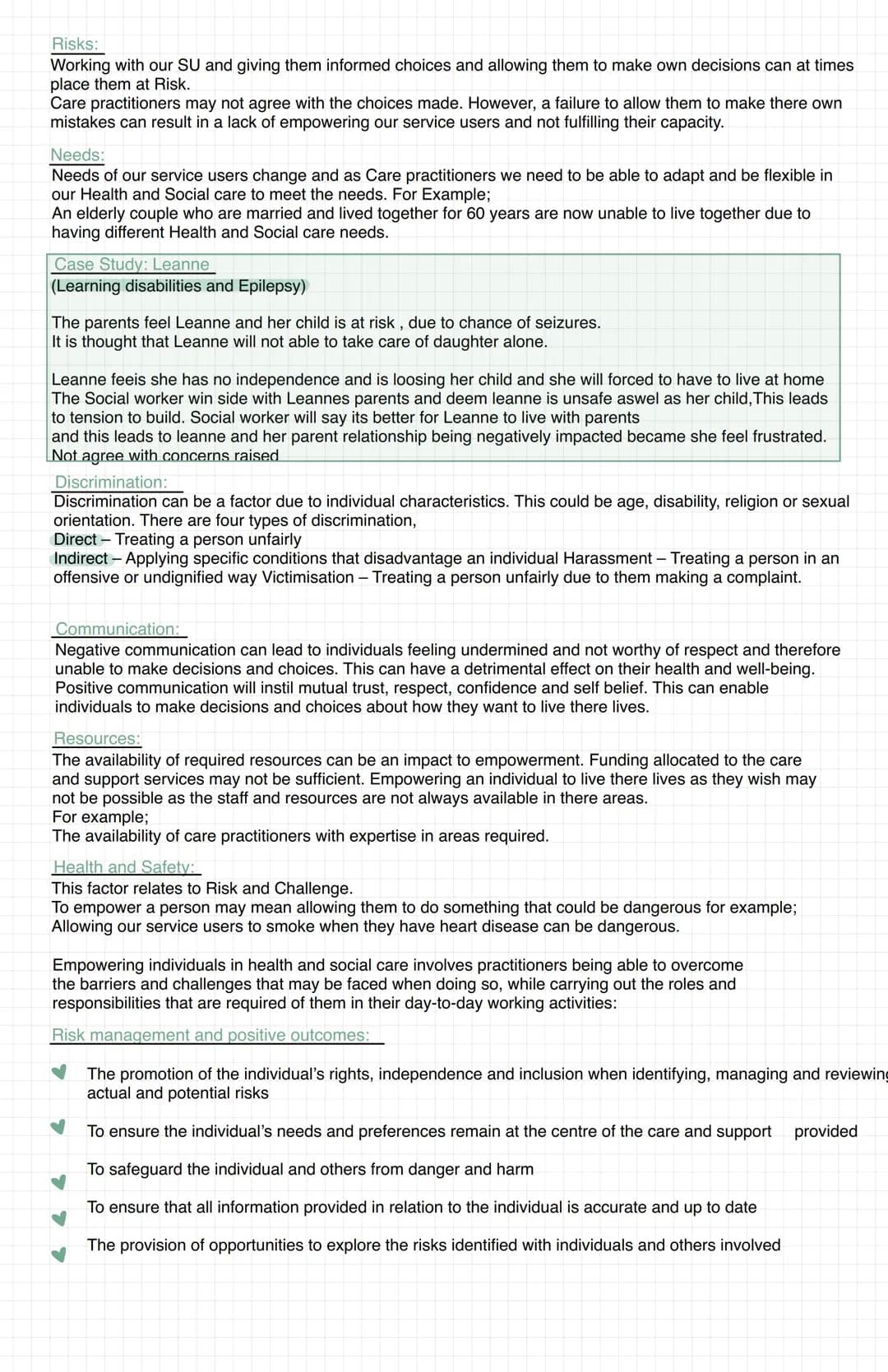
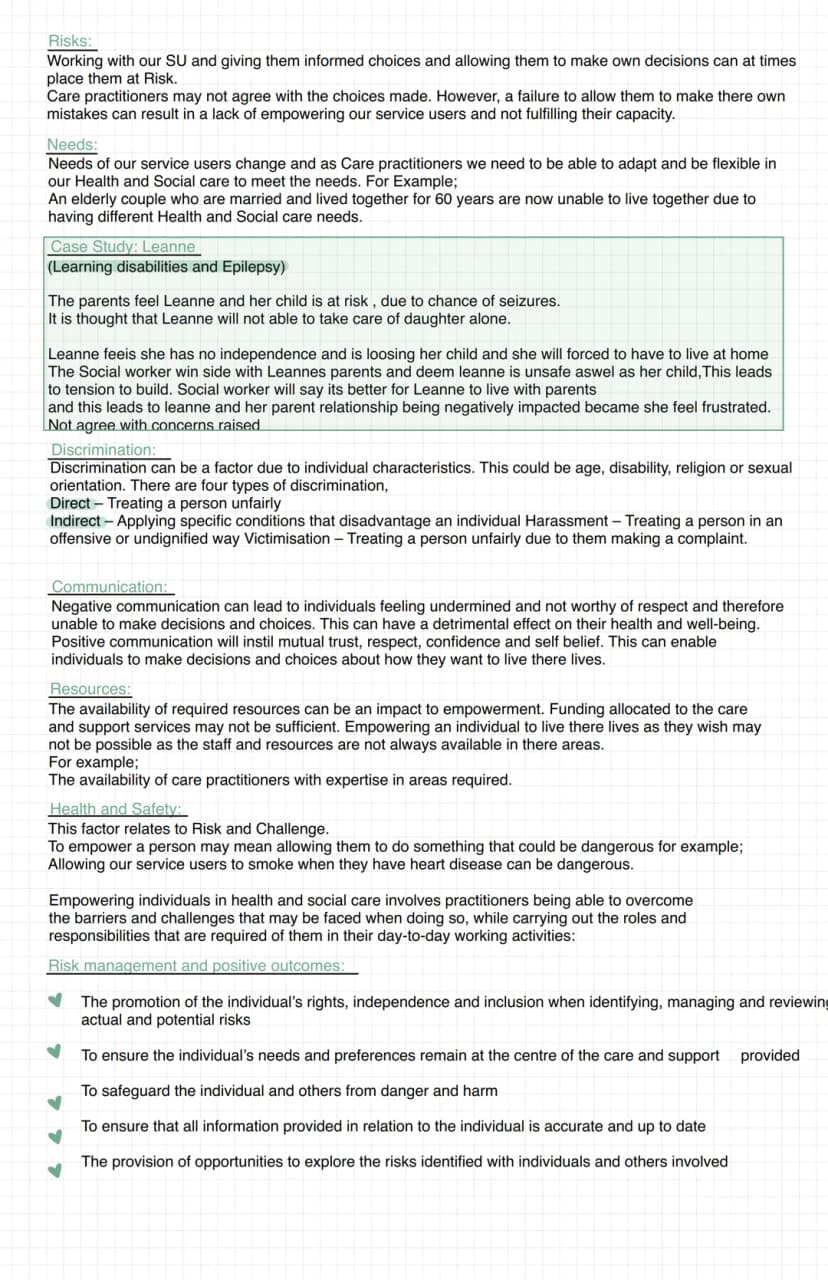
Real-World Challenges and Risk Management
Let's get real about the challenges care practitioners face daily. Working with service users and giving them informed choices can sometimes place them at risk - and that's where professional judgement becomes crucial.
Consider Leanne's case: she has learning disabilities and epilepsy but wants to live independently with her child. Her parents worry about seizures affecting her ability to care safely. The social worker must balance Leanne's right to independence with genuine safety concerns, which creates tension between all parties involved.
Discrimination remains a significant barrier, appearing in four forms: direct (unfair treatment), indirect (disadvantageous conditions), harassment (offensive behaviour), and victimisation (unfair treatment after complaints). Each type can seriously impact someone's ability to feel empowered.
Critical Insight: Negative communication undermines empowerment, whilst positive communication builds the mutual trust and confidence people need to make their own decisions.
Resource availability often determines what's actually possible. Limited funding, staff shortages, or lack of specialists in certain areas can prevent people from living as they wish. Health and safety factors add another layer - allowing someone with heart disease to smoke might respect their choice but could be dangerous. The key is risk management that promotes safety whilst maintaining individual rights and preferences.
4
of 4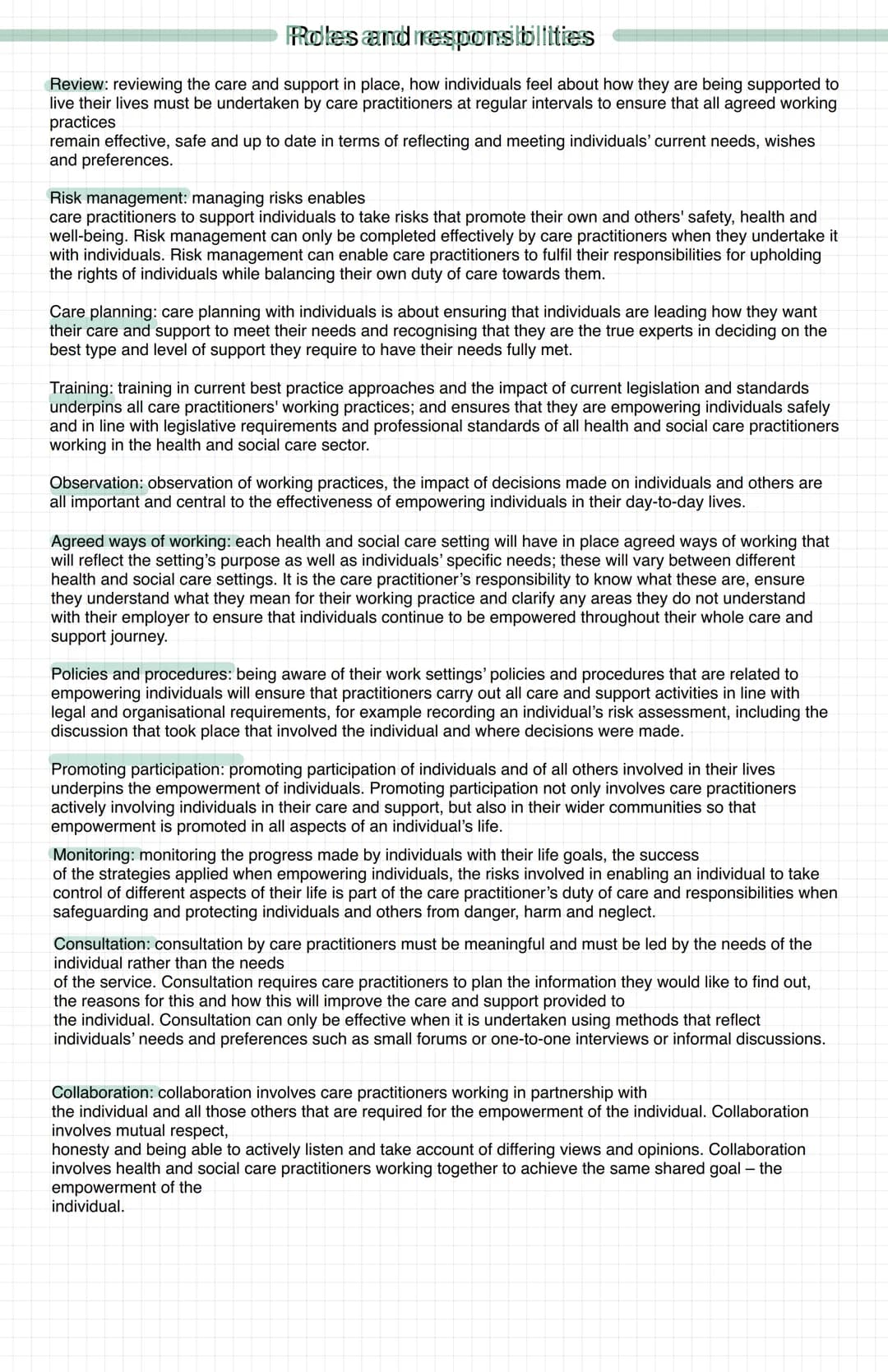
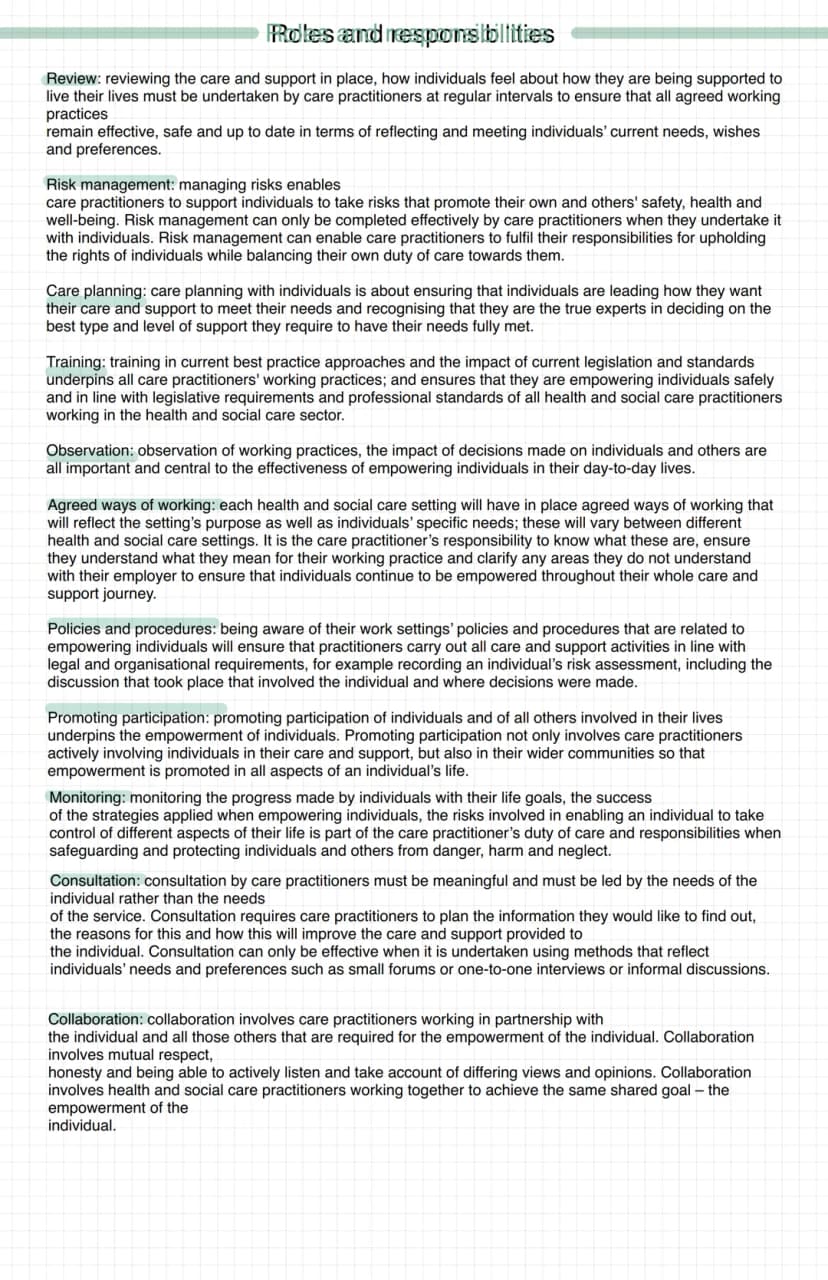
Professional Roles and Responsibilities
Care practitioners juggle multiple responsibilities when empowering individuals, and understanding these roles is essential for effective practice. Care planning should always be led by the individual themselves - after all, they're the real experts on what support they need.
Training in current best practices and legislation keeps practitioners up-to-date and ensures they're empowering people safely and legally. This links directly to following agreed ways of working and understanding policies and procedures specific to each care setting.
Regular review of care and support ensures that arrangements remain effective and reflect people's current needs and preferences. This connects to monitoring progress with life goals and assessing how well empowerment strategies are working in practice.
Professional Tip: Effective consultation must be meaningful and led by individual needs, not service requirements - plan what you need to find out and why it will improve their care.
Risk management enables practitioners to support people in taking risks that promote wellbeing whilst maintaining safety. This only works when done collaboratively with individuals, not imposed upon them.
Collaboration involves working in partnership with genuine mutual respect, active listening, and consideration of different viewpoints. The goal is always the same: empowering the individual whilst maintaining professional standards and legal requirements. Promoting participation extends beyond care settings into wider communities, ensuring empowerment touches all aspects of someone's life.
We thought you’d never ask...
What is the Knowunity AI companion?
Our AI companion is specifically built for the needs of students. Based on the millions of content pieces we have on the platform we can provide truly meaningful and relevant answers to students. But its not only about answers, the companion is even more about guiding students through their daily learning challenges, with personalised study plans, quizzes or content pieces in the chat and 100% personalisation based on the students skills and developments.
Where can I download the Knowunity app?
You can download the app in the Google Play Store and in the Apple App Store.
Is Knowunity really free of charge?
That's right! Enjoy free access to study content, connect with fellow students, and get instant help – all at your fingertips.
Similar Content
 Health & Medicine
Most popular content: Health Care System
9Health & Social CareLegislation on Rights & Equality
Explore key legislations impacting rights and equality in health and social care, including the Care Act, Equality Act, and Children and Families Act. This summary highlights the responsibilities of public authorities, the protection of vulnerable individuals, and the promotion of well-being. Ideal for A Level Health & Social Care students seeking to understand the legal framework surrounding civil rights and social justice.
1254515
Health & Social Care9 Person-Centred Values + The 6 C's
GCSE OCR Health + Social 9 Person-Centred Values Of Care With Examples Of Social Care And Health Care Settings And The 6 C's Meanings And Examples.
111223
Health & Social CareHealth & Social Care Overview
Explore essential concepts in Health and Social Care with this comprehensive guide. Covering roles, responsibilities, and key practices in the sector, this resource is designed for BTEC National students preparing for exams and coursework. Gain insights into service user needs, care values, and the impact of policies on health and social care delivery.
121,67220
Health & Social CareHealthcare Roles Overview
Explore the diverse roles within the healthcare system, including GPs, specialist doctors, nurses, midwives, healthcare assistants, occupational therapists, social workers, and youth workers. This summary highlights their responsibilities in patient care, treatment, and support, emphasizing the importance of collaboration in health and social care settings.
122,30428
Health & Social CareCore Principles of Care
Explore the essential 6 C's of care: Communication, Courage, Commitment, Compassion, Competence, and Care. This summary highlights their significance in fostering effective relationships and improving patient experiences in health and social care settings. Ideal for GCSE health and social care students seeking to understand the foundational values of caregiving.
112248
Health & Social CareHealth & Social Care Legislation
Explore key legislation impacting health and social care professionals, including the Care Act 2014, Equality Act 2010, and Data Protection Act 1948. This summary covers essential concepts such as confidentiality, service user rights, informed consent, and healthcare ethics, providing a comprehensive overview for students in the field.
1260915
Health & Social CareHealth & Social Care Essentials
Explore key concepts in health and social care, including service user rights, person-centered values, effective communication, and various care settings. This summary provides essential insights for understanding the importance of dignity, respect, and empowerment in care practices. Ideal for exam preparation and enhancing knowledge in health and social care.
114650
Health & Social CareHSC ~ Safeguarding & DBS
OCR level 3 Health and social care CTECH, Unit 3 - Health, safety and security
121292
Health & Social CareHealth & Social Care Roles
Explore essential job roles in health and social care, including responsibilities, care values, and the legislation that governs practice. This summary covers key concepts such as safeguarding, individual rights, and the importance of communication in providing quality care. Ideal for students preparing for exams or seeking to understand the framework of health and social care.
113996
Most popular content in Health & Social Care
9M
Health & Social CareMastering Health & Social Care: Essential Flashcards for Grade 11 Students
Boost your knowledge and ace your exams with these comprehensive flashcards covering key concepts in Health & Social Care.
113212
M
Health & Social CareMastering Health & Social Care Essentials
Ace your grade 12 Health & Social Care exams with this comprehensive flashcard set covering all the essential topics.
122120
Health & Social CareHSC Component 3 Overview
Comprehensive revision material for HSC Component 3, covering key topics such as health determinants, mental well-being, family dynamics, and the impact of lifestyle choices on health. This resource includes essential information on blood pressure, obesity, addiction, and the biopsychosocial model, designed to support students in their exam preparation.
111,38528
H
Health & Social Carehealth and social care quiz
this quiz is about life stages and what years they are.
94722
H
Health & Social CareHealth and social care quiz
quick health and social care quiz!
107354
H
 Citizenship
Health and Social Quiz
have fun and answer to the best of your knowledge
103843
U
Health & Social Careunit 1- human life span development- principles of growth
this is about the principles of growth in the life span development
131453
Health & Social CareHuman Growth & Development
Explore the PIES model of human growth and development across all life stages, from infancy to late adulthood. This comprehensive overview covers physical, intellectual, emotional, and social development, highlighting key changes and factors influencing each stage. Ideal for health and social care students preparing for exams or coursework.
104,462125
E
Health & Social CareEssential Health & Social Care Concepts
Master the fundamental concepts of Health & Social Care with these easy-to-understand flashcards.
101290
Most popular content
9SociologySociology of Education Overview
Explore comprehensive A-Level Sociology notes on the education system, covering key theories, policies, and sociological perspectives. This resource includes insights on marketisation, gender roles, cultural deprivation, and educational inequalities, providing a thorough understanding of how education shapes social stratification and individual achievement. Ideal for exam preparation and in-depth study.
12102,8703,040
SociologySociology of Families: Comprehensive Revision
Dive into an extensive overview of family dynamics, perspectives, and patterns in sociology. This resource covers key concepts such as family diversity, gender roles, marriage, and the impact of social policies on family structures. Perfect for A-Level Sociology students preparing for Paper 2.
1273,6662,307
CriminologyCriminology: Crime & Punishment Overview
Comprehensive mindmaps covering key concepts in the Crime and Punishment topic for WJEC Criminology Unit 4. This resource includes detailed insights into the Criminal Justice System, crime prevention strategies, sentencing models, and the roles of various agencies. Ideal for A-Level revision, ensuring you grasp essential theories and legislative processes to excel in your exams.
1254,8721,059
SociologyComprehensive Crime & Deviance Overview
Explore an extensive revision of crime and deviance topics, including theories, types of crime, and the impact of media. This resource covers key concepts such as Marxism, functionalism, gender and crime, and the influence of globalization on criminal behavior. Ideal for students seeking a thorough understanding of criminology and its various theories. Type: Full Topic Revision.
1251,6541,399
C
 Biology
Cell Biology and Cell structure
cell structures
93,2490
 English Literature
An Inspector Calls: Character Insights
Explore in-depth analysis and key quotes for characters in J.B. Priestley's 'An Inspector Calls'. This resource covers Gerald Croft, Inspector Goole, Sheila Birling, Mrs. Birling, Eric Birling, and Eva Smith, focusing on themes of class, gender roles, and social responsibility. Ideal for students aiming for Grade 8 and above.
1025,429907
CriminologyWJEC Unit 4 Criminology
Criminology unit 4 detailed revision note
127,154125
CriminologyCriminology Theories Overview
Explore key criminology theories and their implications on crime and deviance. This comprehensive summary covers biological, psychological, and sociological perspectives, including labelling theory, right realism, and the impact of social campaigns on policy development. Ideal for A-Level criminology students seeking to understand the complexities of criminal behaviour and the factors influencing crime prevention strategies.
129,760210
English LiteratureRomeo and Juliet: Key themes
Key Romeo and Juliet themes and analysed quotes
106,708198
Can't find what you're looking for? Explore other subjects.
Students love us — and so will you.
4.6/5App Store
4.7/5Google Play
The app is very easy to use and well designed. I have found everything I was looking for so far and have been able to learn a lot from the presentations! I will definitely use the app for a class assignment! And of course it also helps a lot as an inspiration.
Stefan SiOS user
This app is really great. There are so many study notes and help [...]. My problem subject is French, for example, and the app has so many options for help. Thanks to this app, I have improved my French. I would recommend it to anyone.
Samantha KlichAndroid user
Wow, I am really amazed. I just tried the app because I've seen it advertised many times and was absolutely stunned. This app is THE HELP you want for school and above all, it offers so many things, such as workouts and fact sheets, which have been VERY helpful to me personally.
AnnaiOS user
Health & Social Care382 views·Updated Jun 23, 2026·4 pagesEmpowerment in Health and Social Care
Lilly Bopzin@lillybopzin
Empowermentin health and social care is all about helping people take control of their own lives and make their own choices. It's a crucial concept that balances giving people independence whilst keeping them safe - something that creates interesting...
1
of 4
Sign up to see the content. It's free!
- Access to all documents
- Improve your grades
- Join milions of students
Understanding Empowerment in Care
Ever wondered why some people seem to thrive in care settings whilst others feel helpless? The answer often lies in empowerment - enabling individuals to have control over their own lives and decisions.
Person-centred care sits at the heart of empowerment. This means focusing on what matters to each individual, identifying their strengths, and supporting the lifestyle they value. It's not about what's easiest for the care provider - it's about what works for the person.
Communication plays a massive role here. Positive verbal and non-verbal communication builds confidence and self-esteem, helping people express their views and feelings clearly. When someone feels heard and understood, they're more likely to engage in making decisions about their care.
Key Point: Empowerment isn't about avoiding all risks - it's about balancing risks carefully so people can still make meaningful choices about their lives.
The approach includes several strategies: encouraging shared working to build confidence, providing meaningful support, creating opportunities for improved wellbeing, and ensuring access to resources that promote independence. However, there are always challenges - person-centred care takes time and money, and sometimes people make unsafe decisions or have unrealistic expectations.
2
of 4Sign up to see the content. It's free!
- Access to all documents
- Improve your grades
- Join milions of students
Legal Framework and Managing Tensions
You can't understand empowerment without knowing the legislation that governs it. Key laws like the Equality Act (2010), Mental Capacity Act (2005), and Health & Social Care Act (2012) set the standards that all care settings must follow.
The Equality Act (2010) is particularly important as it protects people from discrimination based on protected characteristics like age, disability, race, or gender. This means care providers must make reasonable adjustments - like installing ramps for wheelchair users - to ensure equal access.
Here's where it gets tricky: tensions often arise between empowering someone and keeping them safe. For example, should someone with epilepsy be allowed to live independently if there's a risk of seizures? The Mental Capacity Act (2005) helps navigate these situations by providing a framework for supporting people who may struggle with decision-making.
Remember: People have the right to make 'bad' decisions and learn from experience - as long as they understand the risks and aren't putting others in danger.
Several factors can create barriers to empowerment: discrimination, poor communication, lack of resources, and health and safety concerns. Care practitioners must learn to balance these challenges whilst still promoting individual choice and independence.
3
of 4Sign up to see the content. It's free!
- Access to all documents
- Improve your grades
- Join milions of students
Real-World Challenges and Risk Management
Let's get real about the challenges care practitioners face daily. Working with service users and giving them informed choices can sometimes place them at risk - and that's where professional judgement becomes crucial.
Consider Leanne's case: she has learning disabilities and epilepsy but wants to live independently with her child. Her parents worry about seizures affecting her ability to care safely. The social worker must balance Leanne's right to independence with genuine safety concerns, which creates tension between all parties involved.
Discrimination remains a significant barrier, appearing in four forms: direct (unfair treatment), indirect (disadvantageous conditions), harassment (offensive behaviour), and victimisation (unfair treatment after complaints). Each type can seriously impact someone's ability to feel empowered.
Critical Insight: Negative communication undermines empowerment, whilst positive communication builds the mutual trust and confidence people need to make their own decisions.
Resource availability often determines what's actually possible. Limited funding, staff shortages, or lack of specialists in certain areas can prevent people from living as they wish. Health and safety factors add another layer - allowing someone with heart disease to smoke might respect their choice but could be dangerous. The key is risk management that promotes safety whilst maintaining individual rights and preferences.
4
of 4Sign up to see the content. It's free!
- Access to all documents
- Improve your grades
- Join milions of students
Professional Roles and Responsibilities
Care practitioners juggle multiple responsibilities when empowering individuals, and understanding these roles is essential for effective practice. Care planning should always be led by the individual themselves - after all, they're the real experts on what support they need.
Training in current best practices and legislation keeps practitioners up-to-date and ensures they're empowering people safely and legally. This links directly to following agreed ways of working and understanding policies and procedures specific to each care setting.
Regular review of care and support ensures that arrangements remain effective and reflect people's current needs and preferences. This connects to monitoring progress with life goals and assessing how well empowerment strategies are working in practice.
Professional Tip: Effective consultation must be meaningful and led by individual needs, not service requirements - plan what you need to find out and why it will improve their care.
Risk management enables practitioners to support people in taking risks that promote wellbeing whilst maintaining safety. This only works when done collaboratively with individuals, not imposed upon them.
Collaboration involves working in partnership with genuine mutual respect, active listening, and consideration of different viewpoints. The goal is always the same: empowering the individual whilst maintaining professional standards and legal requirements. Promoting participation extends beyond care settings into wider communities, ensuring empowerment touches all aspects of someone's life.
We thought you’d never ask...
What is the Knowunity AI companion?
Our AI companion is specifically built for the needs of students. Based on the millions of content pieces we have on the platform we can provide truly meaningful and relevant answers to students. But its not only about answers, the companion is even more about guiding students through their daily learning challenges, with personalised study plans, quizzes or content pieces in the chat and 100% personalisation based on the students skills and developments.
Where can I download the Knowunity app?
You can download the app in the Google Play Store and in the Apple App Store.
Is Knowunity really free of charge?
That's right! Enjoy free access to study content, connect with fellow students, and get instant help – all at your fingertips.
Similar Content
Most popular content: Health Care System
9Health & Social CareLegislation on Rights & Equality
Explore key legislations impacting rights and equality in health and social care, including the Care Act, Equality Act, and Children and Families Act. This summary highlights the responsibilities of public authorities, the protection of vulnerable individuals, and the promotion of well-being. Ideal for A Level Health & Social Care students seeking to understand the legal framework surrounding civil rights and social justice.
1254515
Health & Social Care9 Person-Centred Values + The 6 C's
GCSE OCR Health + Social 9 Person-Centred Values Of Care With Examples Of Social Care And Health Care Settings And The 6 C's Meanings And Examples.
111223
Health & Social CareHealth & Social Care Overview
Explore essential concepts in Health and Social Care with this comprehensive guide. Covering roles, responsibilities, and key practices in the sector, this resource is designed for BTEC National students preparing for exams and coursework. Gain insights into service user needs, care values, and the impact of policies on health and social care delivery.
121,67220
Health & Social CareHealthcare Roles Overview
Explore the diverse roles within the healthcare system, including GPs, specialist doctors, nurses, midwives, healthcare assistants, occupational therapists, social workers, and youth workers. This summary highlights their responsibilities in patient care, treatment, and support, emphasizing the importance of collaboration in health and social care settings.
122,30428
Health & Social CareCore Principles of Care
Explore the essential 6 C's of care: Communication, Courage, Commitment, Compassion, Competence, and Care. This summary highlights their significance in fostering effective relationships and improving patient experiences in health and social care settings. Ideal for GCSE health and social care students seeking to understand the foundational values of caregiving.
112248
Health & Social CareHealth & Social Care Legislation
Explore key legislation impacting health and social care professionals, including the Care Act 2014, Equality Act 2010, and Data Protection Act 1948. This summary covers essential concepts such as confidentiality, service user rights, informed consent, and healthcare ethics, providing a comprehensive overview for students in the field.
1260915
Health & Social CareHealth & Social Care Essentials
Explore key concepts in health and social care, including service user rights, person-centered values, effective communication, and various care settings. This summary provides essential insights for understanding the importance of dignity, respect, and empowerment in care practices. Ideal for exam preparation and enhancing knowledge in health and social care.
114650
Health & Social CareHSC ~ Safeguarding & DBS
OCR level 3 Health and social care CTECH, Unit 3 - Health, safety and security
121292
Health & Social CareHealth & Social Care Roles
Explore essential job roles in health and social care, including responsibilities, care values, and the legislation that governs practice. This summary covers key concepts such as safeguarding, individual rights, and the importance of communication in providing quality care. Ideal for students preparing for exams or seeking to understand the framework of health and social care.
113996
Most popular content in Health & Social Care
9M
Health & Social CareMastering Health & Social Care: Essential Flashcards for Grade 11 Students
Boost your knowledge and ace your exams with these comprehensive flashcards covering key concepts in Health & Social Care.
113212
M
Health & Social CareMastering Health & Social Care Essentials
Ace your grade 12 Health & Social Care exams with this comprehensive flashcard set covering all the essential topics.
122120
Health & Social CareHSC Component 3 Overview
Comprehensive revision material for HSC Component 3, covering key topics such as health determinants, mental well-being, family dynamics, and the impact of lifestyle choices on health. This resource includes essential information on blood pressure, obesity, addiction, and the biopsychosocial model, designed to support students in their exam preparation.
111,38528
H
Health & Social Carehealth and social care quiz
this quiz is about life stages and what years they are.
94722
H
Health & Social CareHealth and social care quiz
quick health and social care quiz!
107354
H
CitizenshipHealth and Social Quiz
have fun and answer to the best of your knowledge
103843
U
Health & Social Careunit 1- human life span development- principles of growth
this is about the principles of growth in the life span development
131453
Health & Social CareHuman Growth & Development
Explore the PIES model of human growth and development across all life stages, from infancy to late adulthood. This comprehensive overview covers physical, intellectual, emotional, and social development, highlighting key changes and factors influencing each stage. Ideal for health and social care students preparing for exams or coursework.
104,462125
E
Health & Social CareEssential Health & Social Care Concepts
Master the fundamental concepts of Health & Social Care with these easy-to-understand flashcards.
101290
Most popular content
9SociologySociology of Education Overview
Explore comprehensive A-Level Sociology notes on the education system, covering key theories, policies, and sociological perspectives. This resource includes insights on marketisation, gender roles, cultural deprivation, and educational inequalities, providing a thorough understanding of how education shapes social stratification and individual achievement. Ideal for exam preparation and in-depth study.
12102,8703,040
SociologySociology of Families: Comprehensive Revision
Dive into an extensive overview of family dynamics, perspectives, and patterns in sociology. This resource covers key concepts such as family diversity, gender roles, marriage, and the impact of social policies on family structures. Perfect for A-Level Sociology students preparing for Paper 2.
1273,6662,307
CriminologyCriminology: Crime & Punishment Overview
Comprehensive mindmaps covering key concepts in the Crime and Punishment topic for WJEC Criminology Unit 4. This resource includes detailed insights into the Criminal Justice System, crime prevention strategies, sentencing models, and the roles of various agencies. Ideal for A-Level revision, ensuring you grasp essential theories and legislative processes to excel in your exams.
1254,8721,059
SociologyComprehensive Crime & Deviance Overview
Explore an extensive revision of crime and deviance topics, including theories, types of crime, and the impact of media. This resource covers key concepts such as Marxism, functionalism, gender and crime, and the influence of globalization on criminal behavior. Ideal for students seeking a thorough understanding of criminology and its various theories. Type: Full Topic Revision.
1251,6541,399
C
BiologyCell Biology and Cell structure
cell structures
93,2490
English LiteratureAn Inspector Calls: Character Insights
Explore in-depth analysis and key quotes for characters in J.B. Priestley's 'An Inspector Calls'. This resource covers Gerald Croft, Inspector Goole, Sheila Birling, Mrs. Birling, Eric Birling, and Eva Smith, focusing on themes of class, gender roles, and social responsibility. Ideal for students aiming for Grade 8 and above.
1025,429907
CriminologyWJEC Unit 4 Criminology
Criminology unit 4 detailed revision note
127,154125
CriminologyCriminology Theories Overview
Explore key criminology theories and their implications on crime and deviance. This comprehensive summary covers biological, psychological, and sociological perspectives, including labelling theory, right realism, and the impact of social campaigns on policy development. Ideal for A-Level criminology students seeking to understand the complexities of criminal behaviour and the factors influencing crime prevention strategies.
129,760210
English LiteratureRomeo and Juliet: Key themes
Key Romeo and Juliet themes and analysed quotes
106,708198
Can't find what you're looking for? Explore other subjects.
Students love us — and so will you.
4.6/5App Store
4.7/5Google Play
The app is very easy to use and well designed. I have found everything I was looking for so far and have been able to learn a lot from the presentations! I will definitely use the app for a class assignment! And of course it also helps a lot as an inspiration.
Stefan SiOS user
This app is really great. There are so many study notes and help [...]. My problem subject is French, for example, and the app has so many options for help. Thanks to this app, I have improved my French. I would recommend it to anyone.
Samantha KlichAndroid user
Wow, I am really amazed. I just tried the app because I've seen it advertised many times and was absolutely stunned. This app is THE HELP you want for school and above all, it offers so many things, such as workouts and fact sheets, which have been VERY helpful to me personally.
AnnaiOS user