
Leopold's Maneuver is a systematic examination technique used after 20...
 Health & Medicine18 views·Updated Jun 14, 2026·3 pages
Master Basic Maneuvering
P
Perp Chate@perpchate
1 / 3
1
of 3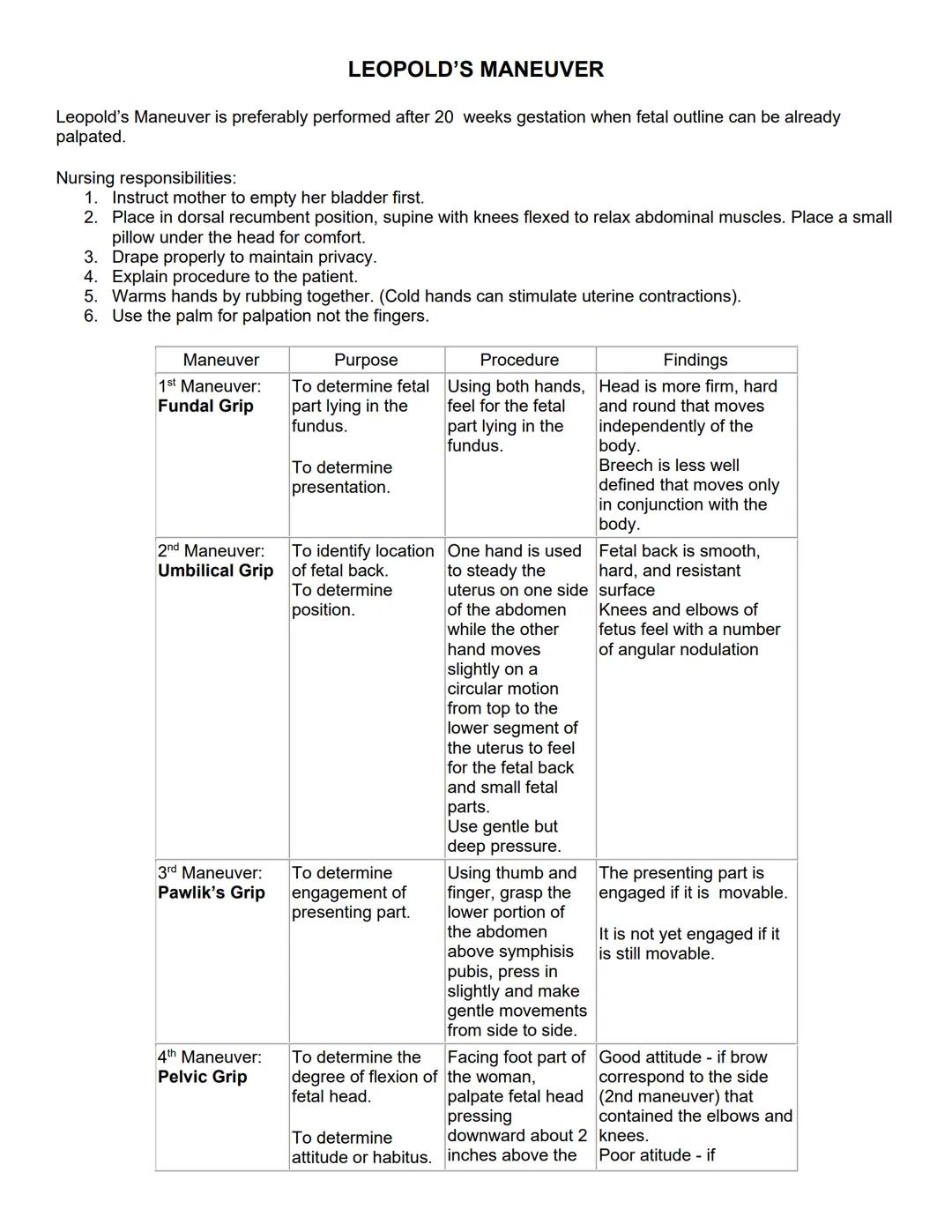
Understanding Leopold's Maneuver
Leopold's Maneuver is performed after 20 weeks gestation when the fetal outline becomes palpable through the mother's abdomen. Before beginning the examination, proper preparation is essential for both comfort and accuracy.
The nurse should first ask the mother to empty her bladder and position her in a dorsal recumbent position with knees slightly flexed to relax the abdominal muscles. Always warm your hands before touching the patient's abdomen, as cold hands can stimulate unwanted uterine contractions. Remember to use the palm of your hand for palpation rather than fingertips.
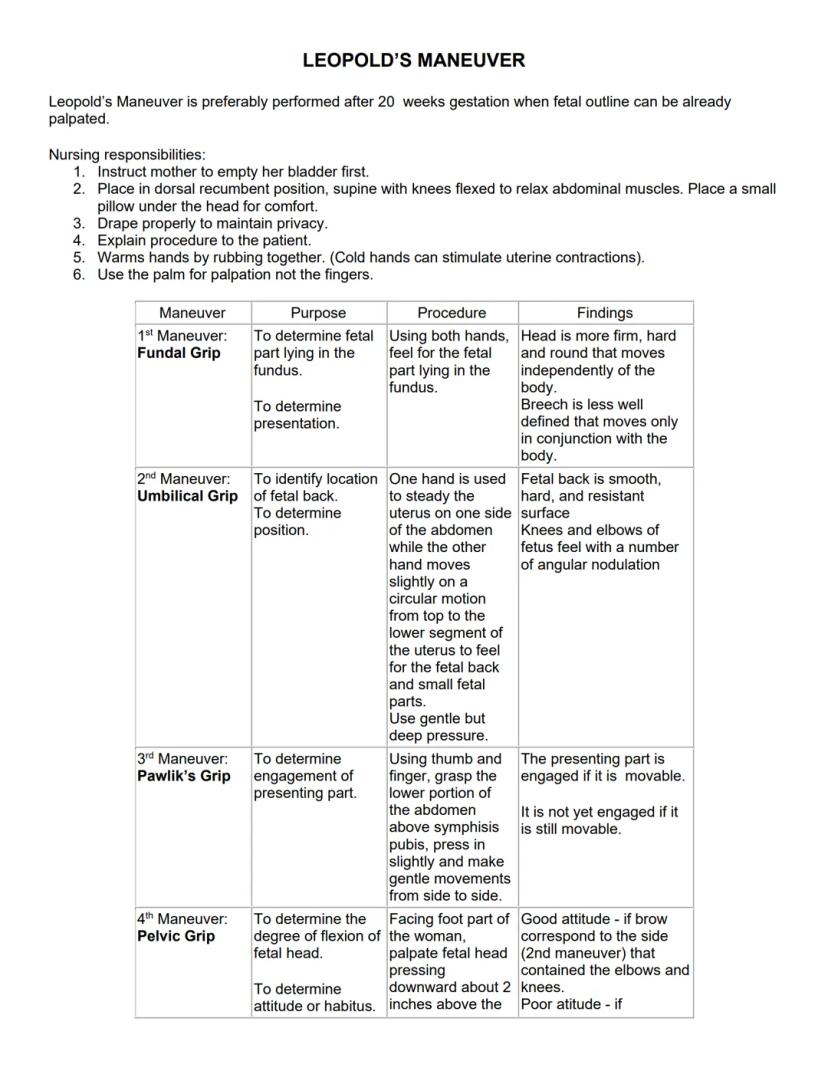
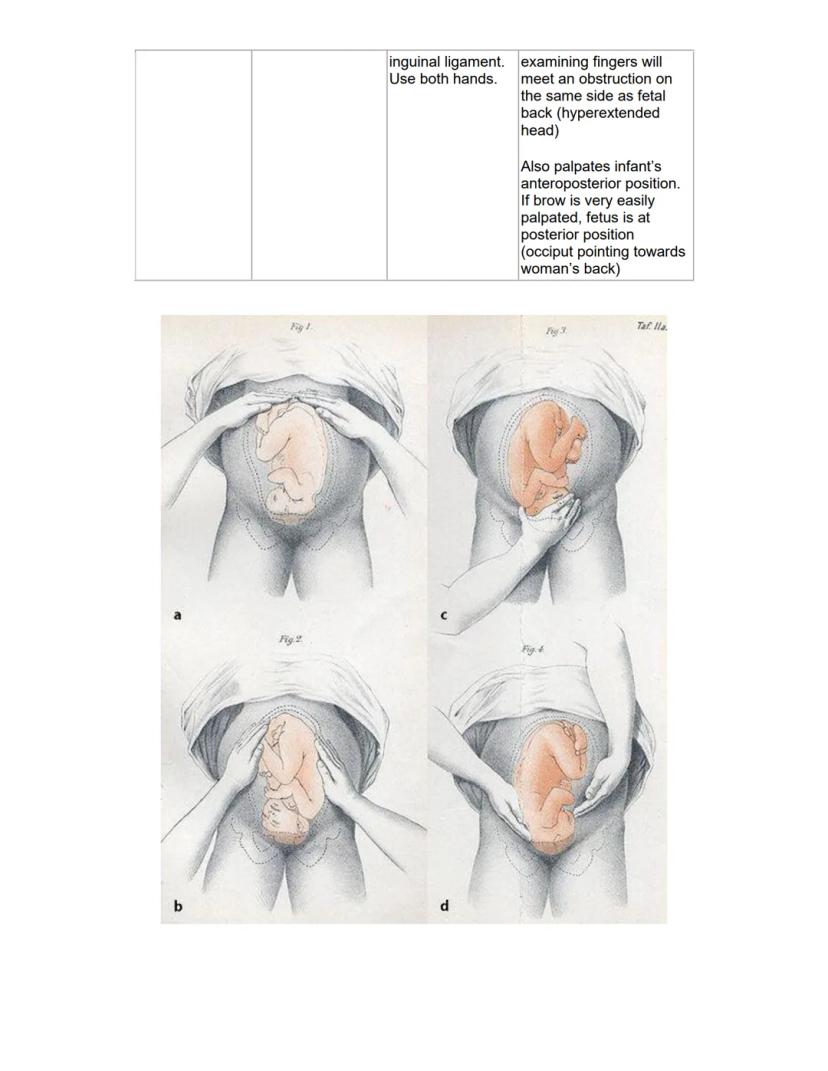
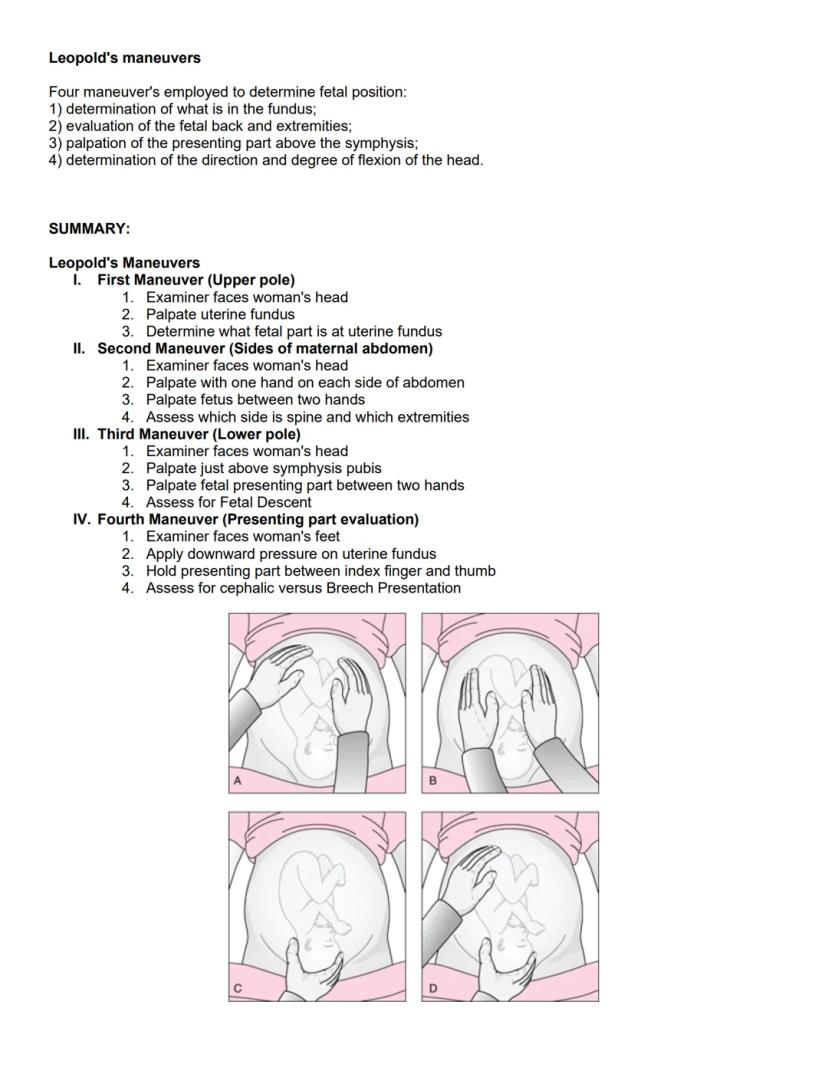
The first two maneuvers focus on identifying fetal parts. The Fundal Grip (1st Maneuver) determines which fetal part lies in the fundus by feeling the upper portion of the uterus. The Umbilical Grip (2nd Maneuver) identifies the location of the fetal back and small parts by steadying one side of the uterus while the other hand feels for the smooth, hard surface of the back versus the angular nodulations of knees and elbows.
Pro Tip: When performing Leopold's Maneuver, always explain each step to the mother before doing it. This reduces anxiety and increases cooperation during the examination.
2
of 3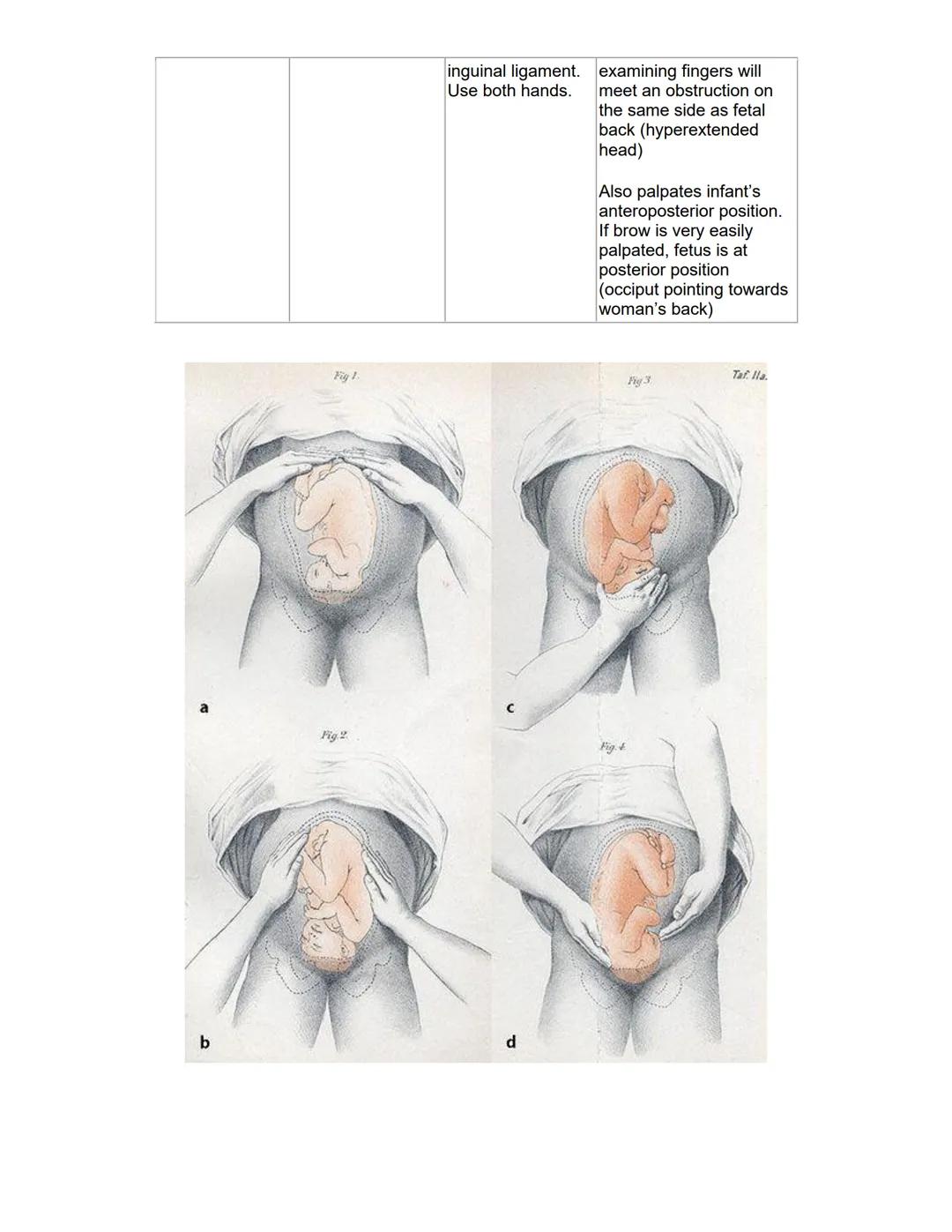
Completing the Assessment
The third and fourth maneuvers of Leopold's technique provide crucial information about fetal positioning and engagement. The Pawlik's Grip (3rd Maneuver) determines if the presenting part is engaged in the pelvis by grasping the lower portion of the abdomen with thumb and finger, then making gentle side-to-side movements.
During the Pelvic Grip (4th Maneuver), you'll face the foot part of the woman and press downward about 2 inches above the inguinal ligament to assess the degree of flexion of the fetal head. This tells you about the fetal attitude or habitus—whether the head is well-flexed (good attitude) or hyperextended (poor attitude).
The 4th maneuver also helps determine the baby's anteroposterior position. If the brow is easily palpated, the fetus is likely in a posterior position, with the back of the head (occiput) pointing toward the mother's back. This information is particularly valuable for anticipating labor progress and potential complications.
Remember: A properly engaged presenting part will feel fixed or less movable, while an unengaged part will still be freely movable above the pelvic inlet.
3
of 3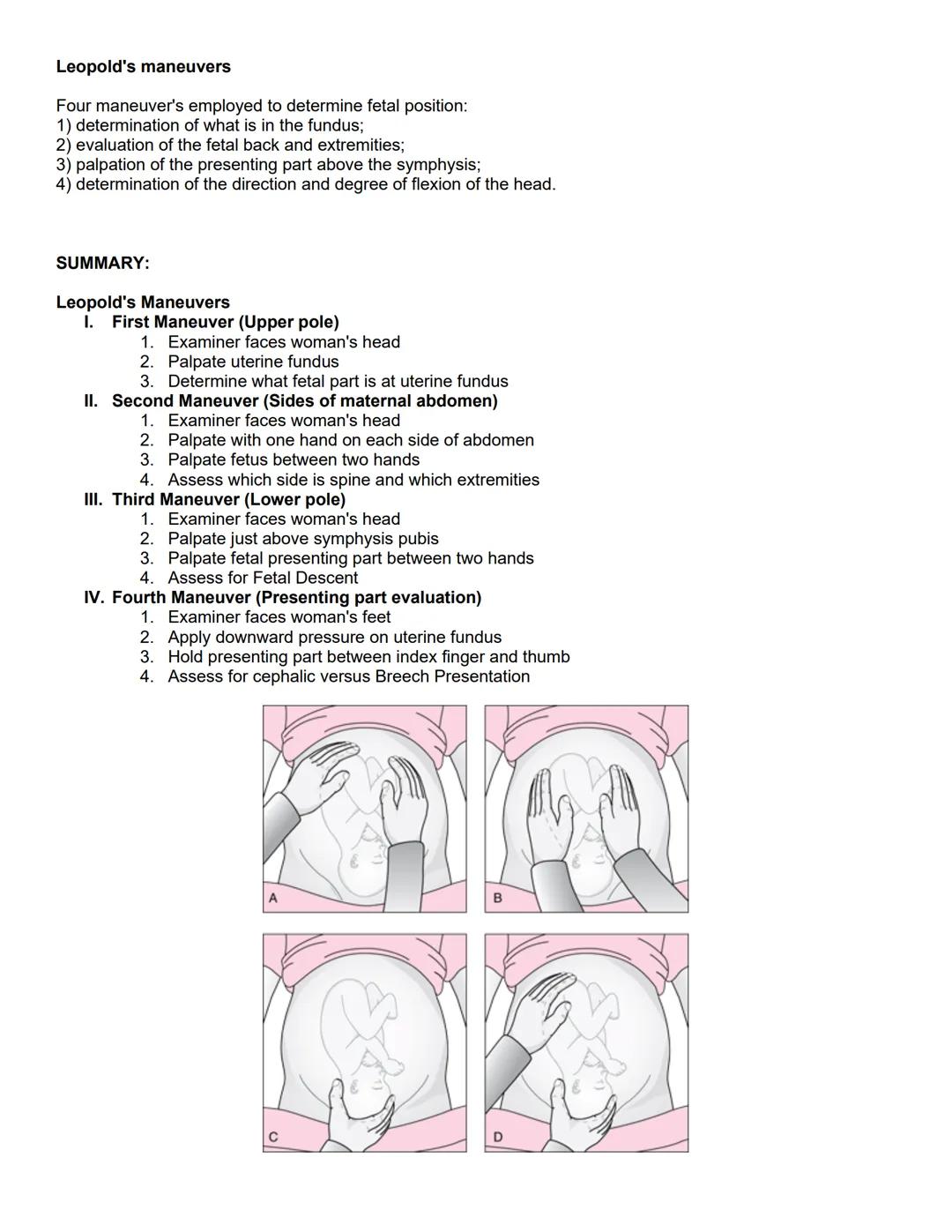
Clinical Application and Summary
Leopold's maneuvers create a complete picture of how the baby is positioned inside the uterus. These four systematic steps help clinicians gather critical information without using invasive techniques or technology.
When performing these maneuvers, maintain a consistent approach. For the first three maneuvers, face the woman's head. Only for the fourth maneuver will you face her feet. This standardized positioning helps ensure accuracy and allows for comparison between examinations over time.
The complete assessment tells you:
- Which fetal part occupies the fundus (head or buttocks)
- The location of the fetal back versus small parts (limbs)
- Whether the presenting part has descended into the pelvis
- How the fetal head is positioned (flexed or extended)
Clinical Insight: Mastering Leopold's maneuvers takes practice, but becomes an invaluable skill for assessing fetal position, especially in settings where ultrasound isn't readily available. You'll use these techniques throughout your career in maternal healthcare.
We thought you’d never ask...
What is the Knowunity AI companion?
Our AI companion is specifically built for the needs of students. Based on the millions of content pieces we have on the platform we can provide truly meaningful and relevant answers to students. But its not only about answers, the companion is even more about guiding students through their daily learning challenges, with personalised study plans, quizzes or content pieces in the chat and 100% personalisation based on the students skills and developments.
Where can I download the Knowunity app?
You can download the app in the Google Play Store and in the Apple App Store.
Is Knowunity really free of charge?
That's right! Enjoy free access to study content, connect with fellow students, and get instant help – all at your fingertips.
Most popular content in Health & Medicine
9M
Health & MedicineMedical Terminology Quiz
key concepts in med terminology
11th2030
Health & MedicineMark Klimek Nclex Review
Comphrensive Nclex Review
College781
 Fun Stuff
Anatomy and Physiology Chapter 1
Chpater 1 : The orientation of the body / College Level Anatomy and Physiology
84538
Health & MedicineHow to give CPR
How to give CPR
956
Health & MedicinePharmacology - Descriptions and Terms
Medical Terminology - Learn about descriptions of things related to pharmacology and additional terms about medications.
College1087
Health & MedicineCOVID-19 Informational Slideshow
COVID-19 slideshow about the disease.
1012
Health & MedicineMale Reproductive System
Health PDF
9th441
Health & MedicineMental & Emotional Problems Anxiety & Depression
PDF Health
9th692
Health & MedicineNHA module 1 study guide
Nia module I study guide
11th1532
Most popular content
9O
 AP US History
Origins and Dynamics of the Columbian Exchange
Analyze the ecological and economic motivations behind the initial transfer of goods, people, and diseases between the Old and New Worlds.
9th3,1280
I
AP US HistoryIntroduction to Early Cultural Interactions
Analyze the initial social and religious encounters between Europeans, Africans, and Indigenous peoples in the colonial Americas.
9th2,7730
O
 AP World History
Origins of Ancient River Civilizations
Analyze the environmental factors and technological innovations that led to the rise of early states in Mesopotamia, Egypt, and the Indus Valley.
9th3,1870
M
AP US HistoryMotivations for European Exploration
Analyze the economic, religious, and political factors that drove European powers to the Americas during the 15th and 16th centuries.
9th1,7780
F
 AP Psychology
Foundations of Ethical Guidelines in Research
Practice the core principles of the APA ethical code including informed consent, debriefing, and the role of Institutional Review Boards.
9th1,3360
I
AP US HistoryIntroduction to Native American Societies
Examine the diverse social, political, and economic structures of North American indigenous groups prior to European contact.
9th1,1100
I
 AP Biology
Introduction to Biological Elements of Life
Practice identifying the essential elements including carbon, nitrogen, phosphorus, and sulfur that compose biological macromolecules.
9th1,7390
I
AP US HistoryIntroduction to the Spanish Encomienda System
Explore the fundamental economic and social structures of the Spanish colonial system, focusing on the encomienda and the casta social hierarchy.
9th8890
O
AP World HistoryOrigins and Continuity of the Byzantine Empire
Analyze the political and cultural transitions from the Roman Empire to the Byzantine Empire, focusing on the reign of Justinian I and his code.
9th1,6320
Can't find what you're looking for? Explore other subjects.
Students love us — and so will you.
4.6/5App Store
4.7/5Google Play
The app is very easy to use and well designed. I have found everything I was looking for so far and have been able to learn a lot from the presentations! I will definitely use the app for a class assignment! And of course it also helps a lot as an inspiration.
Stefan SiOS user
This app is really great. There are so many study notes and help [...]. My problem subject is French, for example, and the app has so many options for help. Thanks to this app, I have improved my French. I would recommend it to anyone.
Samantha KlichAndroid user
Wow, I am really amazed. I just tried the app because I've seen it advertised many times and was absolutely stunned. This app is THE HELP you want for school and above all, it offers so many things, such as workouts and fact sheets, which have been VERY helpful to me personally.
AnnaiOS user
Health & Medicine18 views·Updated Jun 14, 2026·3 pagesMaster Basic Maneuvering
P
Perp Chate@perpchate
Leopold's Maneuver is a systematic examination technique used after 20 weeks of pregnancy to determine the position of the fetus in the uterus. This hands-on assessment helps healthcare providers identify the presentation, position, and engagement of the fetus through a...
1
of 3
Sign up to see the content. It's free!
- Access to all documents
- Improve your grades
- Join milions of students
Understanding Leopold's Maneuver
Leopold's Maneuver is performed after 20 weeks gestation when the fetal outline becomes palpable through the mother's abdomen. Before beginning the examination, proper preparation is essential for both comfort and accuracy.
The nurse should first ask the mother to empty her bladder and position her in a dorsal recumbent position with knees slightly flexed to relax the abdominal muscles. Always warm your hands before touching the patient's abdomen, as cold hands can stimulate unwanted uterine contractions. Remember to use the palm of your hand for palpation rather than fingertips.
The first two maneuvers focus on identifying fetal parts. The Fundal Grip (1st Maneuver) determines which fetal part lies in the fundus by feeling the upper portion of the uterus. The Umbilical Grip (2nd Maneuver) identifies the location of the fetal back and small parts by steadying one side of the uterus while the other hand feels for the smooth, hard surface of the back versus the angular nodulations of knees and elbows.
Pro Tip: When performing Leopold's Maneuver, always explain each step to the mother before doing it. This reduces anxiety and increases cooperation during the examination.
2
of 3Sign up to see the content. It's free!
- Access to all documents
- Improve your grades
- Join milions of students
Completing the Assessment
The third and fourth maneuvers of Leopold's technique provide crucial information about fetal positioning and engagement. The Pawlik's Grip (3rd Maneuver) determines if the presenting part is engaged in the pelvis by grasping the lower portion of the abdomen with thumb and finger, then making gentle side-to-side movements.
During the Pelvic Grip (4th Maneuver), you'll face the foot part of the woman and press downward about 2 inches above the inguinal ligament to assess the degree of flexion of the fetal head. This tells you about the fetal attitude or habitus—whether the head is well-flexed (good attitude) or hyperextended (poor attitude).
The 4th maneuver also helps determine the baby's anteroposterior position. If the brow is easily palpated, the fetus is likely in a posterior position, with the back of the head (occiput) pointing toward the mother's back. This information is particularly valuable for anticipating labor progress and potential complications.
Remember: A properly engaged presenting part will feel fixed or less movable, while an unengaged part will still be freely movable above the pelvic inlet.
3
of 3Sign up to see the content. It's free!
- Access to all documents
- Improve your grades
- Join milions of students
Clinical Application and Summary
Leopold's maneuvers create a complete picture of how the baby is positioned inside the uterus. These four systematic steps help clinicians gather critical information without using invasive techniques or technology.
When performing these maneuvers, maintain a consistent approach. For the first three maneuvers, face the woman's head. Only for the fourth maneuver will you face her feet. This standardized positioning helps ensure accuracy and allows for comparison between examinations over time.
The complete assessment tells you:
- Which fetal part occupies the fundus (head or buttocks)
- The location of the fetal back versus small parts (limbs)
- Whether the presenting part has descended into the pelvis
- How the fetal head is positioned (flexed or extended)
Clinical Insight: Mastering Leopold's maneuvers takes practice, but becomes an invaluable skill for assessing fetal position, especially in settings where ultrasound isn't readily available. You'll use these techniques throughout your career in maternal healthcare.
We thought you’d never ask...
What is the Knowunity AI companion?
Our AI companion is specifically built for the needs of students. Based on the millions of content pieces we have on the platform we can provide truly meaningful and relevant answers to students. But its not only about answers, the companion is even more about guiding students through their daily learning challenges, with personalised study plans, quizzes or content pieces in the chat and 100% personalisation based on the students skills and developments.
Where can I download the Knowunity app?
You can download the app in the Google Play Store and in the Apple App Store.
Is Knowunity really free of charge?
That's right! Enjoy free access to study content, connect with fellow students, and get instant help – all at your fingertips.
Most popular content in Health & Medicine
9M
Health & MedicineMedical Terminology Quiz
key concepts in med terminology
11th2030
Health & MedicineMark Klimek Nclex Review
Comphrensive Nclex Review
College781
Fun StuffAnatomy and Physiology Chapter 1
Chpater 1 : The orientation of the body / College Level Anatomy and Physiology
84538
Health & MedicineHow to give CPR
How to give CPR
956
Health & MedicinePharmacology - Descriptions and Terms
Medical Terminology - Learn about descriptions of things related to pharmacology and additional terms about medications.
College1087
Health & MedicineCOVID-19 Informational Slideshow
COVID-19 slideshow about the disease.
1012
Health & MedicineMale Reproductive System
Health PDF
9th441
Health & MedicineMental & Emotional Problems Anxiety & Depression
PDF Health
9th692
Health & MedicineNHA module 1 study guide
Nia module I study guide
11th1532
Most popular content
9O
AP US HistoryOrigins and Dynamics of the Columbian Exchange
Analyze the ecological and economic motivations behind the initial transfer of goods, people, and diseases between the Old and New Worlds.
9th3,1280
I
AP US HistoryIntroduction to Early Cultural Interactions
Analyze the initial social and religious encounters between Europeans, Africans, and Indigenous peoples in the colonial Americas.
9th2,7730
O
AP World HistoryOrigins of Ancient River Civilizations
Analyze the environmental factors and technological innovations that led to the rise of early states in Mesopotamia, Egypt, and the Indus Valley.
9th3,1870
M
AP US HistoryMotivations for European Exploration
Analyze the economic, religious, and political factors that drove European powers to the Americas during the 15th and 16th centuries.
9th1,7780
F
AP PsychologyFoundations of Ethical Guidelines in Research
Practice the core principles of the APA ethical code including informed consent, debriefing, and the role of Institutional Review Boards.
9th1,3360
I
AP US HistoryIntroduction to Native American Societies
Examine the diverse social, political, and economic structures of North American indigenous groups prior to European contact.
9th1,1100
I
AP BiologyIntroduction to Biological Elements of Life
Practice identifying the essential elements including carbon, nitrogen, phosphorus, and sulfur that compose biological macromolecules.
9th1,7390
I
AP US HistoryIntroduction to the Spanish Encomienda System
Explore the fundamental economic and social structures of the Spanish colonial system, focusing on the encomienda and the casta social hierarchy.
9th8890
O
AP World HistoryOrigins and Continuity of the Byzantine Empire
Analyze the political and cultural transitions from the Roman Empire to the Byzantine Empire, focusing on the reign of Justinian I and his code.
9th1,6320
Can't find what you're looking for? Explore other subjects.
Students love us — and so will you.
4.6/5App Store
4.7/5Google Play
The app is very easy to use and well designed. I have found everything I was looking for so far and have been able to learn a lot from the presentations! I will definitely use the app for a class assignment! And of course it also helps a lot as an inspiration.
Stefan SiOS user
This app is really great. There are so many study notes and help [...]. My problem subject is French, for example, and the app has so many options for help. Thanks to this app, I have improved my French. I would recommend it to anyone.
Samantha KlichAndroid user
Wow, I am really amazed. I just tried the app because I've seen it advertised many times and was absolutely stunned. This app is THE HELP you want for school and above all, it offers so many things, such as workouts and fact sheets, which have been VERY helpful to me personally.
AnnaiOS user