

Infection control is all about understanding how diseases spread and...
 Health & Medicine40 views·Updated Jun 7, 2026·2 pages
Effective Infection Control Practices
1
of 2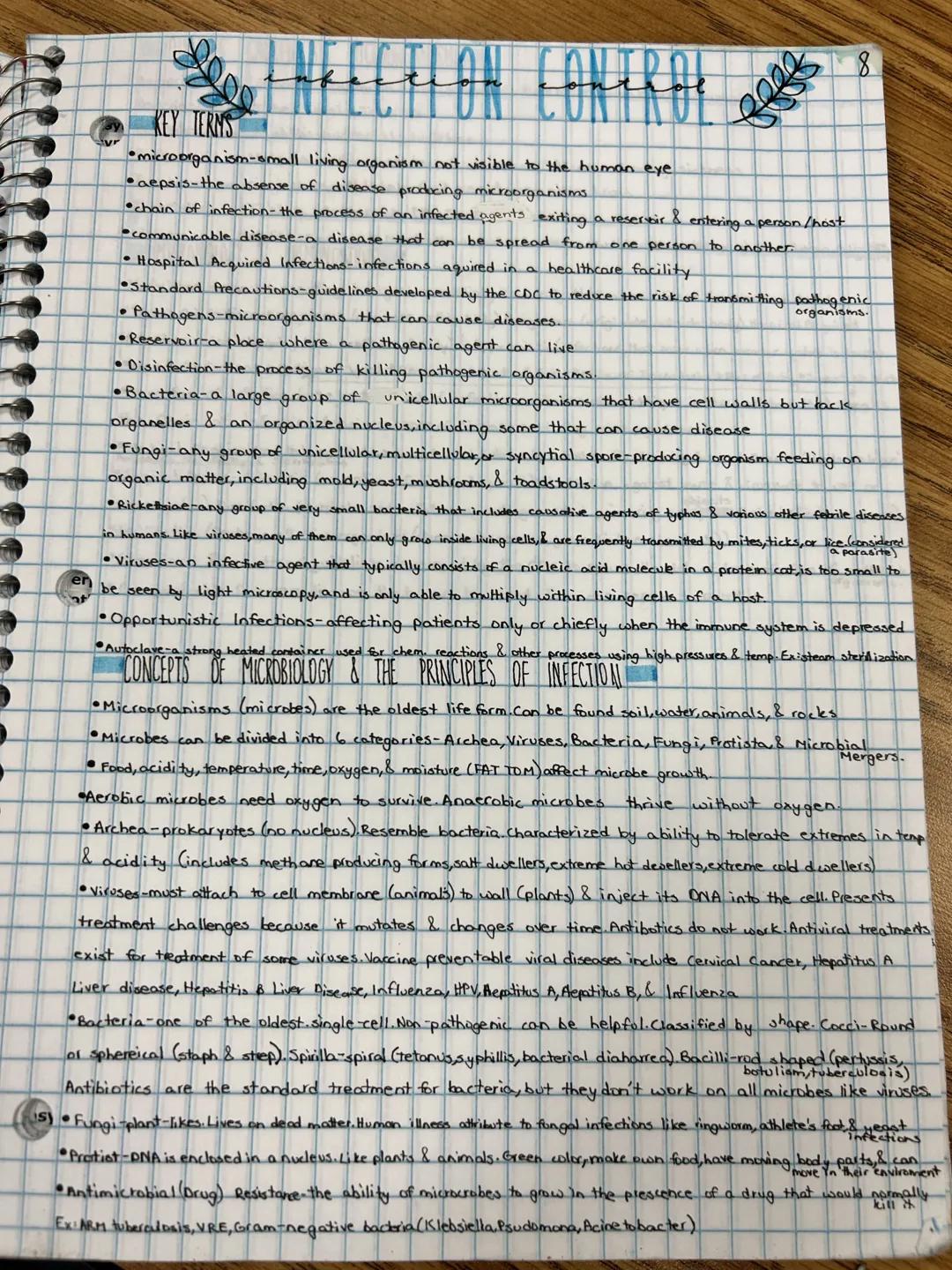
Infection Control Basics
Ever wondered why healthcare workers are so obsessed with handwashing? It's because microorganisms (tiny living organisms invisible to the naked eye) are everywhere! These microbes can be divided into six categories: Archaea, Viruses, Bacteria, Fungi, Protista, and Microbjergers.
Microbe growth depends on several factors remembered as "FAT TOM": Food, Acidity, Temperature, Time, Oxygen, and Moisture. Some microbes need oxygen to survive (aerobic), while others thrive without it (anaerobic). When these microorganisms multiply excessively in the body, they can cause infections and disease.
Bacteria are single-celled organisms classified by their shape: round cocci (like staph and strep), spiral spirilla (causing tetanus and syphilis), and rod-shaped bacilli (responsible for tuberculosis and pertussis). While antibiotics can treat many bacterial infections, they're useless against viruses. Viruses must attach to cell membranes and inject their DNA to replicate, making them challenging to treat as they constantly mutate.
Remember This! The concept of "asepsis" is the foundation of all infection control practices. Breaking the "chain of infection" prevents diseases from spreading.
2
of 2
Disease Prevention and Control
Infections don't just happen randomly - they follow a specific pattern called the chain of infection: infectious agent → reservoir → port of exit → mode of transmission → port of entry → susceptible host. Breaking any link in this chain can prevent disease spread!
There are several types of infections you should know about: endogenous (starting within the body), exogenous (coming from outside), hospital-acquired infections (contracted at healthcare facilities), and opportunistic infections (occurring when the immune system is weakened).
Prevention is always better than treatment when it comes to infection control. Healthcare settings use different levels of precautions: medical asepsis (clean technique including handwashing), surgical asepsis (sterile technique), antisepsis (preventing microbial growth), disinfection (killing pathogens on surfaces), and sterilization (destroying all microorganisms).
Standard Precautions are guidelines developed by the CDC that healthcare workers follow to reduce transmission of pathogens. These precautions assume that every person might be carrying infectious agents, which is why proper handwashing and personal protective equipment are so important in healthcare settings!
Remember This! Communicable diseases can spread from person to person, which is why understanding infection control is crucial for public health. From the common cold to COVID-19, these principles apply to countless illnesses.
We thought you’d never ask...
What is the Knowunity AI companion?
Our AI companion is specifically built for the needs of students. Based on the millions of content pieces we have on the platform we can provide truly meaningful and relevant answers to students. But its not only about answers, the companion is even more about guiding students through their daily learning challenges, with personalised study plans, quizzes or content pieces in the chat and 100% personalisation based on the students skills and developments.
Where can I download the Knowunity app?
You can download the app in the Google Play Store and in the Apple App Store.
Is Knowunity really free of charge?
That's right! Enjoy free access to study content, connect with fellow students, and get instant help – all at your fingertips.
Similar Content
Most popular content: Bacteria
1Most popular content in Health & Medicine
9M
Health & MedicineMedical Terminology Quiz
key concepts in med terminology
11th2030
Health & MedicineMark Klimek Nclex Review
Comphrensive Nclex Review
College781
Health & MedicinePharmacology - Descriptions and Terms
Medical Terminology - Learn about descriptions of things related to pharmacology and additional terms about medications.
College1087
Health & MedicineHow to give CPR
How to give CPR
956
 Fun Stuff
Anatomy and Physiology Chapter 1
Chpater 1 : The orientation of the body / College Level Anatomy and Physiology
84538
Health & MedicineED 101 Lesson 2
The Child and Adolescence Learners and Learning Principles
College1362
Health & MedicinePregnancy Notes
Trimesters and stages of development of a fetus during pregnancy
1819
Health & MedicineNHA module 1 study guide
Nia module I study guide
11th1532
Health & Medicinetfn
theoretical foundation in nursing
College1380
Most popular content
9O
 AP US History
Origins and Dynamics of the Columbian Exchange
Analyze the ecological and economic motivations behind the initial transfer of goods, people, and diseases between the Old and New Worlds.
9th3,1280
I
AP US HistoryIntroduction to Early Cultural Interactions
Analyze the initial social and religious encounters between Europeans, Africans, and Indigenous peoples in the colonial Americas.
9th2,7730
O
 AP World History
Origins of Ancient River Civilizations
Analyze the environmental factors and technological innovations that led to the rise of early states in Mesopotamia, Egypt, and the Indus Valley.
9th3,1870
M
AP US HistoryMotivations for European Exploration
Analyze the economic, religious, and political factors that drove European powers to the Americas during the 15th and 16th centuries.
9th1,7780
F
 AP Psychology
Foundations of Ethical Guidelines in Research
Practice the core principles of the APA ethical code including informed consent, debriefing, and the role of Institutional Review Boards.
9th1,3360
I
AP US HistoryIntroduction to Native American Societies
Examine the diverse social, political, and economic structures of North American indigenous groups prior to European contact.
9th1,1100
I
 AP Biology
Introduction to Biological Elements of Life
Practice identifying the essential elements including carbon, nitrogen, phosphorus, and sulfur that compose biological macromolecules.
9th1,7390
I
AP US HistoryIntroduction to the Spanish Encomienda System
Explore the fundamental economic and social structures of the Spanish colonial system, focusing on the encomienda and the casta social hierarchy.
9th8890
O
AP World HistoryOrigins and Continuity of the Byzantine Empire
Analyze the political and cultural transitions from the Roman Empire to the Byzantine Empire, focusing on the reign of Justinian I and his code.
9th1,6320
Can't find what you're looking for? Explore other subjects.
Students love us — and so will you.
4.6/5App Store
4.7/5Google Play
The app is very easy to use and well designed. I have found everything I was looking for so far and have been able to learn a lot from the presentations! I will definitely use the app for a class assignment! And of course it also helps a lot as an inspiration.
Stefan SiOS user
This app is really great. There are so many study notes and help [...]. My problem subject is French, for example, and the app has so many options for help. Thanks to this app, I have improved my French. I would recommend it to anyone.
Samantha KlichAndroid user
Wow, I am really amazed. I just tried the app because I've seen it advertised many times and was absolutely stunned. This app is THE HELP you want for school and above all, it offers so many things, such as workouts and fact sheets, which have been VERY helpful to me personally.
AnnaiOS user
Health & Medicine40 views·Updated Jun 7, 2026·2 pagesEffective Infection Control Practices
Infection control is all about understanding how diseases spread and how to stop them. This is crucial knowledge for healthcare workers and anyone interested in preventing illness. Let's explore the world of microorganisms, how they cause infections, and the methods...
1
of 2
Sign up to see the content. It's free!
- Access to all documents
- Improve your grades
- Join milions of students
Infection Control Basics
Ever wondered why healthcare workers are so obsessed with handwashing? It's because microorganisms (tiny living organisms invisible to the naked eye) are everywhere! These microbes can be divided into six categories: Archaea, Viruses, Bacteria, Fungi, Protista, and Microbjergers.
Microbe growth depends on several factors remembered as "FAT TOM": Food, Acidity, Temperature, Time, Oxygen, and Moisture. Some microbes need oxygen to survive (aerobic), while others thrive without it (anaerobic). When these microorganisms multiply excessively in the body, they can cause infections and disease.
Bacteria are single-celled organisms classified by their shape: round cocci (like staph and strep), spiral spirilla (causing tetanus and syphilis), and rod-shaped bacilli (responsible for tuberculosis and pertussis). While antibiotics can treat many bacterial infections, they're useless against viruses. Viruses must attach to cell membranes and inject their DNA to replicate, making them challenging to treat as they constantly mutate.
Remember This! The concept of "asepsis" is the foundation of all infection control practices. Breaking the "chain of infection" prevents diseases from spreading.
2
of 2Sign up to see the content. It's free!
- Access to all documents
- Improve your grades
- Join milions of students
Disease Prevention and Control
Infections don't just happen randomly - they follow a specific pattern called the chain of infection: infectious agent → reservoir → port of exit → mode of transmission → port of entry → susceptible host. Breaking any link in this chain can prevent disease spread!
There are several types of infections you should know about: endogenous (starting within the body), exogenous (coming from outside), hospital-acquired infections (contracted at healthcare facilities), and opportunistic infections (occurring when the immune system is weakened).
Prevention is always better than treatment when it comes to infection control. Healthcare settings use different levels of precautions: medical asepsis (clean technique including handwashing), surgical asepsis (sterile technique), antisepsis (preventing microbial growth), disinfection (killing pathogens on surfaces), and sterilization (destroying all microorganisms).
Standard Precautions are guidelines developed by the CDC that healthcare workers follow to reduce transmission of pathogens. These precautions assume that every person might be carrying infectious agents, which is why proper handwashing and personal protective equipment are so important in healthcare settings!
Remember This! Communicable diseases can spread from person to person, which is why understanding infection control is crucial for public health. From the common cold to COVID-19, these principles apply to countless illnesses.
We thought you’d never ask...
What is the Knowunity AI companion?
Our AI companion is specifically built for the needs of students. Based on the millions of content pieces we have on the platform we can provide truly meaningful and relevant answers to students. But its not only about answers, the companion is even more about guiding students through their daily learning challenges, with personalised study plans, quizzes or content pieces in the chat and 100% personalisation based on the students skills and developments.
Where can I download the Knowunity app?
You can download the app in the Google Play Store and in the Apple App Store.
Is Knowunity really free of charge?
That's right! Enjoy free access to study content, connect with fellow students, and get instant help – all at your fingertips.
Similar Content
Most popular content: Bacteria
1Most popular content in Health & Medicine
9M
Health & MedicineMedical Terminology Quiz
key concepts in med terminology
11th2030
Health & MedicineMark Klimek Nclex Review
Comphrensive Nclex Review
College781
Health & MedicinePharmacology - Descriptions and Terms
Medical Terminology - Learn about descriptions of things related to pharmacology and additional terms about medications.
College1087
Health & MedicineHow to give CPR
How to give CPR
956
Fun StuffAnatomy and Physiology Chapter 1
Chpater 1 : The orientation of the body / College Level Anatomy and Physiology
84538
Health & MedicineED 101 Lesson 2
The Child and Adolescence Learners and Learning Principles
College1362
Health & MedicinePregnancy Notes
Trimesters and stages of development of a fetus during pregnancy
1819
Health & MedicineNHA module 1 study guide
Nia module I study guide
11th1532
Health & Medicinetfn
theoretical foundation in nursing
College1380
Most popular content
9O
AP US HistoryOrigins and Dynamics of the Columbian Exchange
Analyze the ecological and economic motivations behind the initial transfer of goods, people, and diseases between the Old and New Worlds.
9th3,1280
I
AP US HistoryIntroduction to Early Cultural Interactions
Analyze the initial social and religious encounters between Europeans, Africans, and Indigenous peoples in the colonial Americas.
9th2,7730
O
AP World HistoryOrigins of Ancient River Civilizations
Analyze the environmental factors and technological innovations that led to the rise of early states in Mesopotamia, Egypt, and the Indus Valley.
9th3,1870
M
AP US HistoryMotivations for European Exploration
Analyze the economic, religious, and political factors that drove European powers to the Americas during the 15th and 16th centuries.
9th1,7780
F
AP PsychologyFoundations of Ethical Guidelines in Research
Practice the core principles of the APA ethical code including informed consent, debriefing, and the role of Institutional Review Boards.
9th1,3360
I
AP US HistoryIntroduction to Native American Societies
Examine the diverse social, political, and economic structures of North American indigenous groups prior to European contact.
9th1,1100
I
AP BiologyIntroduction to Biological Elements of Life
Practice identifying the essential elements including carbon, nitrogen, phosphorus, and sulfur that compose biological macromolecules.
9th1,7390
I
AP US HistoryIntroduction to the Spanish Encomienda System
Explore the fundamental economic and social structures of the Spanish colonial system, focusing on the encomienda and the casta social hierarchy.
9th8890
O
AP World HistoryOrigins and Continuity of the Byzantine Empire
Analyze the political and cultural transitions from the Roman Empire to the Byzantine Empire, focusing on the reign of Justinian I and his code.
9th1,6320
Can't find what you're looking for? Explore other subjects.
Students love us — and so will you.
4.6/5App Store
4.7/5Google Play
The app is very easy to use and well designed. I have found everything I was looking for so far and have been able to learn a lot from the presentations! I will definitely use the app for a class assignment! And of course it also helps a lot as an inspiration.
Stefan SiOS user
This app is really great. There are so many study notes and help [...]. My problem subject is French, for example, and the app has so many options for help. Thanks to this app, I have improved my French. I would recommend it to anyone.
Samantha KlichAndroid user
Wow, I am really amazed. I just tried the app because I've seen it advertised many times and was absolutely stunned. This app is THE HELP you want for school and above all, it offers so many things, such as workouts and fact sheets, which have been VERY helpful to me personally.
AnnaiOS user