
Geometry is all about understanding shapes, spaces, and their properties....
 Geometry304 views·Updated Jun 7, 2026·3 pages
Understanding Geometry: Key Concepts of Points, Lines, and Planes
D
Darilynn Fisher@darilynn_fisher
1 / 3
1
of 3
Geometry Basics: Points, Lines & Planes
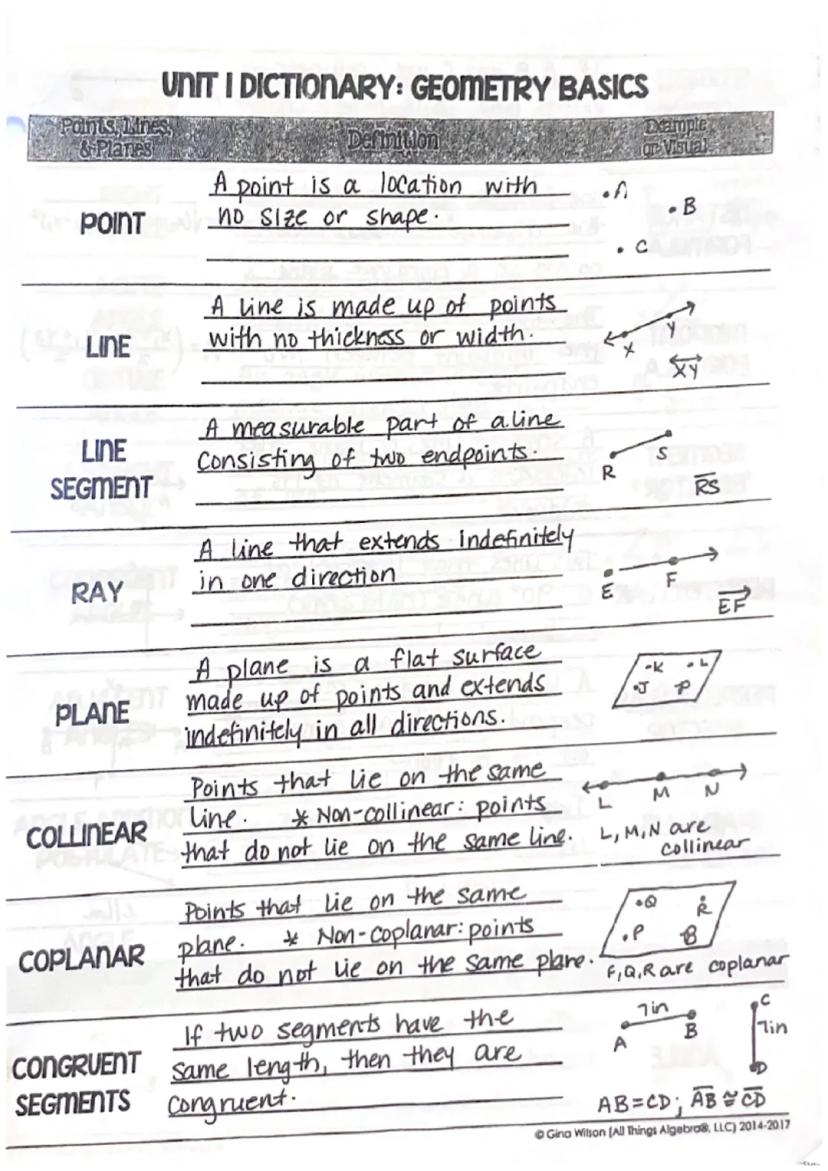
Imagine geometry as a language with its own vocabulary. A point is simply a location with no size or shape, usually labeled with a capital letter like A, B, or C. When points connect, they form a line that extends infinitely in both directions.
Sometimes we only need part of a line, which is where line segments come in. These have two endpoints and a measurable length. A ray is different - it has one endpoint and extends infinitely in one direction (think of a flashlight beam).
A plane is a flat surface that extends infinitely in all directions. Points can be collinear (lying on the same line) or coplanar (lying on the same plane). When line segments have the same length, we say they're congruent segments.
Think of it this way: Points are like stars, lines are like laser beams that go on forever, and planes are like endless sheets of paper that stretch in all directions!
2
of 3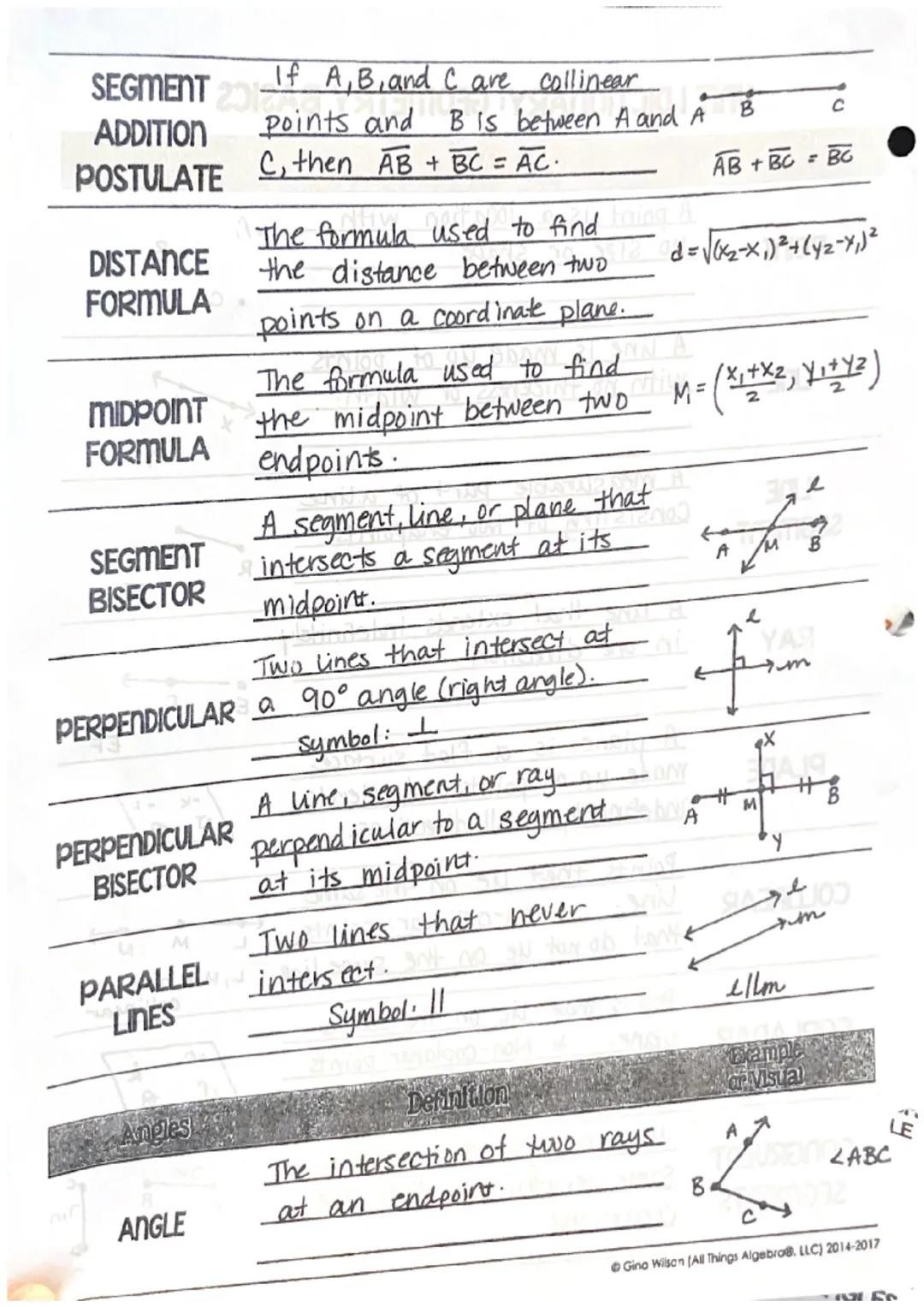
Measuring and Positioning in Geometry
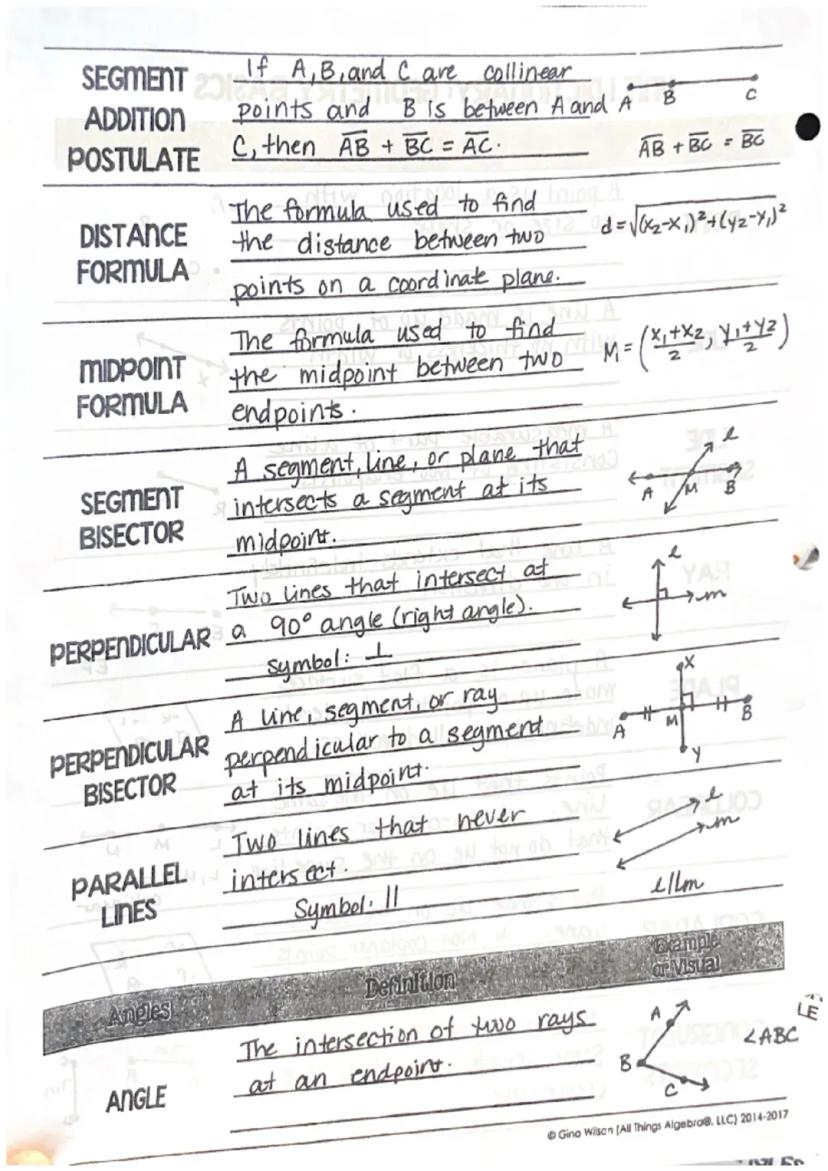
The Segment Addition Postulate tells us that if point B lies between points A and C on a line, then AB + BC = AC. This makes intuitive sense - the whole distance equals the sum of its parts!
When working with coordinates, the distance formula helps find the length between two points: d = √. Need to find the exact middle of a line segment? The midpoint formula gives you that point: M = .
A segment bisector cuts a line segment into two equal parts at its midpoint. When lines meet at 90° angles, they're perpendicular (shown by the ⊥ symbol). A perpendicular bisector combines these ideas - it's perpendicular to a segment at its midpoint.
Pro tip: Parallel lines (shown by the || symbol) never intersect, no matter how far you extend them - like railroad tracks that appear to meet in the distance but never actually do!
3
of 3
All About Angles
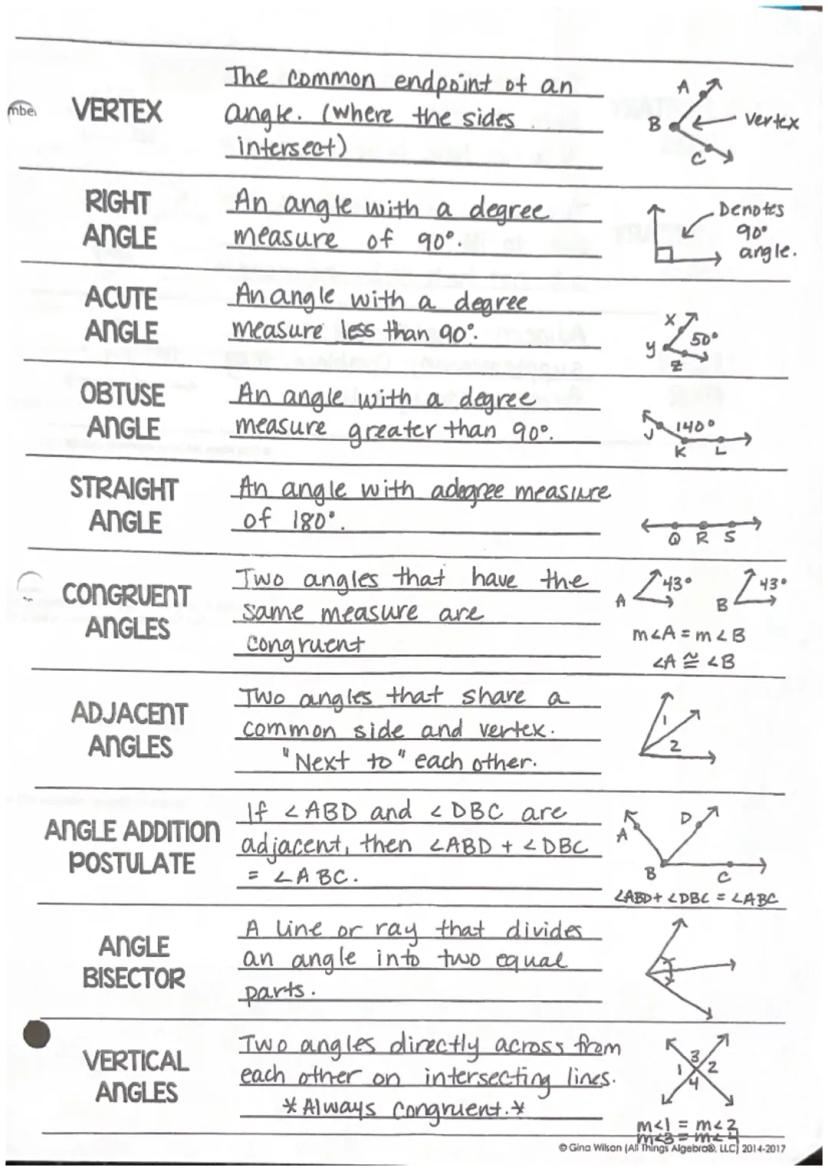
An angle forms when two rays meet at a common endpoint called the vertex. Angles come in different sizes: right angles measure exactly 90°, acute angles are less than 90°, obtuse angles are greater than 90°, and straight angles measure 180°.
When two angles have the same measure, they're congruent angles. Adjacent angles share both a common side and vertex - they're right next to each other. The Angle Addition Postulate states that if angles are adjacent, their measures add together to form the larger angle they create.
An angle bisector divides an angle into two equal parts. When lines intersect, they create pairs of vertical angles across from each other. Here's something cool: vertical angles are always congruent!
Remember this: You can identify angle types by thinking about a clock - right angle is at 3:00 (90°), acute is before 3:00 (less than 90°), and obtuse is after 3:00 but before 6:00 (between 90° and 180°).
We thought you’d never ask...
What is the Knowunity AI companion?
Our AI companion is specifically built for the needs of students. Based on the millions of content pieces we have on the platform we can provide truly meaningful and relevant answers to students. But its not only about answers, the companion is even more about guiding students through their daily learning challenges, with personalised study plans, quizzes or content pieces in the chat and 100% personalisation based on the students skills and developments.
Where can I download the Knowunity app?
You can download the app in the Google Play Store and in the Apple App Store.
Is Knowunity really free of charge?
That's right! Enjoy free access to study content, connect with fellow students, and get instant help – all at your fingertips.
Similar Content
Most popular content in Geometry
9M
GeometryMath Flashcards: Triangles, Angles, and Congruent Triangles
Master the fundamentals of geometry with these math flashcards covering triangle angles, parallel lines, and congruent triangles. Test your knowledge and ace your exams!
10th2520
G
GeometryGeometry Flashcards: Triangles, Proofs, Angles, and Lines
Master the fundamentals of geometry with these flashcards covering triangles, proofs, angles, and parallel lines. Test your knowledge and ace your exams!
9th3050
G
GeometryGeometry Essentials
Master the fundamentals of geometry with these flashcards covering angles, triangles, congruent triangles, parallel lines, and polygons.
10th3410
GeometryCongruent Chords & Arcs
This is a finished and completed worksheet that applies very helpful information for the subject.
10th9012
GeometryUnit 10: Circles Homework 2: Central Angles & Arc Measures
Geometry Homework, 100%
10th1,8948
GeometryTangent Lines Homework (unit 10:circles)
Unit 10-Circles
3,98723
Geometry10:4 Inscribed Angles
This is a finished and completed worksheet that applies very helpful information for the subject.
10th2,66127
GeometryQuiz 10-1: Intro to Circes, Central Angles, Arcs, and Chords
This is a finished and completed worksheet that applies very helpful information for the subject.
10th1,0879
GeometryUnit 7: Right Triangles & Trigonometry Homework 5: Trigonometry: Finding Sides And Angles
Geometry Homework, 100%
10th2,87317
Most popular content
9O
 AP US History
Origins and Dynamics of the Columbian Exchange
Analyze the ecological and economic motivations behind the initial transfer of goods, people, and diseases between the Old and New Worlds.
9th3,1280
I
AP US HistoryIntroduction to Early Cultural Interactions
Analyze the initial social and religious encounters between Europeans, Africans, and Indigenous peoples in the colonial Americas.
9th2,7730
O
 AP World History
Origins of Ancient River Civilizations
Analyze the environmental factors and technological innovations that led to the rise of early states in Mesopotamia, Egypt, and the Indus Valley.
9th3,1870
M
AP US HistoryMotivations for European Exploration
Analyze the economic, religious, and political factors that drove European powers to the Americas during the 15th and 16th centuries.
9th1,7780
F
 AP Psychology
Foundations of Ethical Guidelines in Research
Practice the core principles of the APA ethical code including informed consent, debriefing, and the role of Institutional Review Boards.
9th1,3360
I
AP US HistoryIntroduction to Native American Societies
Examine the diverse social, political, and economic structures of North American indigenous groups prior to European contact.
9th1,1100
I
 AP Biology
Introduction to Biological Elements of Life
Practice identifying the essential elements including carbon, nitrogen, phosphorus, and sulfur that compose biological macromolecules.
9th1,7390
I
AP US HistoryIntroduction to the Spanish Encomienda System
Explore the fundamental economic and social structures of the Spanish colonial system, focusing on the encomienda and the casta social hierarchy.
9th8890
O
AP World HistoryOrigins and Continuity of the Byzantine Empire
Analyze the political and cultural transitions from the Roman Empire to the Byzantine Empire, focusing on the reign of Justinian I and his code.
9th1,6320
Can't find what you're looking for? Explore other subjects.
Students love us — and so will you.
4.6/5App Store
4.7/5Google Play
The app is very easy to use and well designed. I have found everything I was looking for so far and have been able to learn a lot from the presentations! I will definitely use the app for a class assignment! And of course it also helps a lot as an inspiration.
Stefan SiOS user
This app is really great. There are so many study notes and help [...]. My problem subject is French, for example, and the app has so many options for help. Thanks to this app, I have improved my French. I would recommend it to anyone.
Samantha KlichAndroid user
Wow, I am really amazed. I just tried the app because I've seen it advertised many times and was absolutely stunned. This app is THE HELP you want for school and above all, it offers so many things, such as workouts and fact sheets, which have been VERY helpful to me personally.
AnnaiOS user
Geometry304 views·Updated Jun 7, 2026·3 pagesUnderstanding Geometry: Key Concepts of Points, Lines, and Planes
D
Darilynn Fisher@darilynn_fisher
Geometry is all about understanding shapes, spaces, and their properties. In these pages, we'll explore the basic building blocks of geometry including points, lines, planes, and angles. These fundamental concepts form the foundation for more complex geometric ideas you'll encounter...
1
of 3
Sign up to see the content. It's free!
- Access to all documents
- Improve your grades
- Join milions of students
Geometry Basics: Points, Lines & Planes
Imagine geometry as a language with its own vocabulary. A point is simply a location with no size or shape, usually labeled with a capital letter like A, B, or C. When points connect, they form a line that extends infinitely in both directions.
Sometimes we only need part of a line, which is where line segments come in. These have two endpoints and a measurable length. A ray is different - it has one endpoint and extends infinitely in one direction (think of a flashlight beam).
A plane is a flat surface that extends infinitely in all directions. Points can be collinear (lying on the same line) or coplanar (lying on the same plane). When line segments have the same length, we say they're congruent segments.
Think of it this way: Points are like stars, lines are like laser beams that go on forever, and planes are like endless sheets of paper that stretch in all directions!
2
of 3Sign up to see the content. It's free!
- Access to all documents
- Improve your grades
- Join milions of students
Measuring and Positioning in Geometry
The Segment Addition Postulate tells us that if point B lies between points A and C on a line, then AB + BC = AC. This makes intuitive sense - the whole distance equals the sum of its parts!
When working with coordinates, the distance formula helps find the length between two points: d = √. Need to find the exact middle of a line segment? The midpoint formula gives you that point: M = .
A segment bisector cuts a line segment into two equal parts at its midpoint. When lines meet at 90° angles, they're perpendicular (shown by the ⊥ symbol). A perpendicular bisector combines these ideas - it's perpendicular to a segment at its midpoint.
Pro tip: Parallel lines (shown by the || symbol) never intersect, no matter how far you extend them - like railroad tracks that appear to meet in the distance but never actually do!
3
of 3Sign up to see the content. It's free!
- Access to all documents
- Improve your grades
- Join milions of students
All About Angles
An angle forms when two rays meet at a common endpoint called the vertex. Angles come in different sizes: right angles measure exactly 90°, acute angles are less than 90°, obtuse angles are greater than 90°, and straight angles measure 180°.
When two angles have the same measure, they're congruent angles. Adjacent angles share both a common side and vertex - they're right next to each other. The Angle Addition Postulate states that if angles are adjacent, their measures add together to form the larger angle they create.
An angle bisector divides an angle into two equal parts. When lines intersect, they create pairs of vertical angles across from each other. Here's something cool: vertical angles are always congruent!
Remember this: You can identify angle types by thinking about a clock - right angle is at 3:00 (90°), acute is before 3:00 (less than 90°), and obtuse is after 3:00 but before 6:00 (between 90° and 180°).
We thought you’d never ask...
What is the Knowunity AI companion?
Our AI companion is specifically built for the needs of students. Based on the millions of content pieces we have on the platform we can provide truly meaningful and relevant answers to students. But its not only about answers, the companion is even more about guiding students through their daily learning challenges, with personalised study plans, quizzes or content pieces in the chat and 100% personalisation based on the students skills and developments.
Where can I download the Knowunity app?
You can download the app in the Google Play Store and in the Apple App Store.
Is Knowunity really free of charge?
That's right! Enjoy free access to study content, connect with fellow students, and get instant help – all at your fingertips.
Similar Content
Most popular content in Geometry
9M
GeometryMath Flashcards: Triangles, Angles, and Congruent Triangles
Master the fundamentals of geometry with these math flashcards covering triangle angles, parallel lines, and congruent triangles. Test your knowledge and ace your exams!
10th2520
G
GeometryGeometry Flashcards: Triangles, Proofs, Angles, and Lines
Master the fundamentals of geometry with these flashcards covering triangles, proofs, angles, and parallel lines. Test your knowledge and ace your exams!
9th3050
G
GeometryGeometry Essentials
Master the fundamentals of geometry with these flashcards covering angles, triangles, congruent triangles, parallel lines, and polygons.
10th3410
GeometryCongruent Chords & Arcs
This is a finished and completed worksheet that applies very helpful information for the subject.
10th9012
GeometryUnit 10: Circles Homework 2: Central Angles & Arc Measures
Geometry Homework, 100%
10th1,8948
GeometryTangent Lines Homework (unit 10:circles)
Unit 10-Circles
3,98723
Geometry10:4 Inscribed Angles
This is a finished and completed worksheet that applies very helpful information for the subject.
10th2,66127
GeometryQuiz 10-1: Intro to Circes, Central Angles, Arcs, and Chords
This is a finished and completed worksheet that applies very helpful information for the subject.
10th1,0879
GeometryUnit 7: Right Triangles & Trigonometry Homework 5: Trigonometry: Finding Sides And Angles
Geometry Homework, 100%
10th2,87317
Most popular content
9O
AP US HistoryOrigins and Dynamics of the Columbian Exchange
Analyze the ecological and economic motivations behind the initial transfer of goods, people, and diseases between the Old and New Worlds.
9th3,1280
I
AP US HistoryIntroduction to Early Cultural Interactions
Analyze the initial social and religious encounters between Europeans, Africans, and Indigenous peoples in the colonial Americas.
9th2,7730
O
AP World HistoryOrigins of Ancient River Civilizations
Analyze the environmental factors and technological innovations that led to the rise of early states in Mesopotamia, Egypt, and the Indus Valley.
9th3,1870
M
AP US HistoryMotivations for European Exploration
Analyze the economic, religious, and political factors that drove European powers to the Americas during the 15th and 16th centuries.
9th1,7780
F
AP PsychologyFoundations of Ethical Guidelines in Research
Practice the core principles of the APA ethical code including informed consent, debriefing, and the role of Institutional Review Boards.
9th1,3360
I
AP US HistoryIntroduction to Native American Societies
Examine the diverse social, political, and economic structures of North American indigenous groups prior to European contact.
9th1,1100
I
AP BiologyIntroduction to Biological Elements of Life
Practice identifying the essential elements including carbon, nitrogen, phosphorus, and sulfur that compose biological macromolecules.
9th1,7390
I
AP US HistoryIntroduction to the Spanish Encomienda System
Explore the fundamental economic and social structures of the Spanish colonial system, focusing on the encomienda and the casta social hierarchy.
9th8890
O
AP World HistoryOrigins and Continuity of the Byzantine Empire
Analyze the political and cultural transitions from the Roman Empire to the Byzantine Empire, focusing on the reign of Justinian I and his code.
9th1,6320
Can't find what you're looking for? Explore other subjects.
Students love us — and so will you.
4.6/5App Store
4.7/5Google Play
The app is very easy to use and well designed. I have found everything I was looking for so far and have been able to learn a lot from the presentations! I will definitely use the app for a class assignment! And of course it also helps a lot as an inspiration.
Stefan SiOS user
This app is really great. There are so many study notes and help [...]. My problem subject is French, for example, and the app has so many options for help. Thanks to this app, I have improved my French. I would recommend it to anyone.
Samantha KlichAndroid user
Wow, I am really amazed. I just tried the app because I've seen it advertised many times and was absolutely stunned. This app is THE HELP you want for school and above all, it offers so many things, such as workouts and fact sheets, which have been VERY helpful to me personally.
AnnaiOS user