
Tectonic processes and landformsshape Earth's surface through the movement...
 Geography317 views·Updated Jun 27, 2026·5 pages
Cool Tectonic Landforms and Volcanoes for Kids

nicole roberts @nicoleroberts

1 / 5
1
of 5
Types of Plate Boundaries and Their Effects
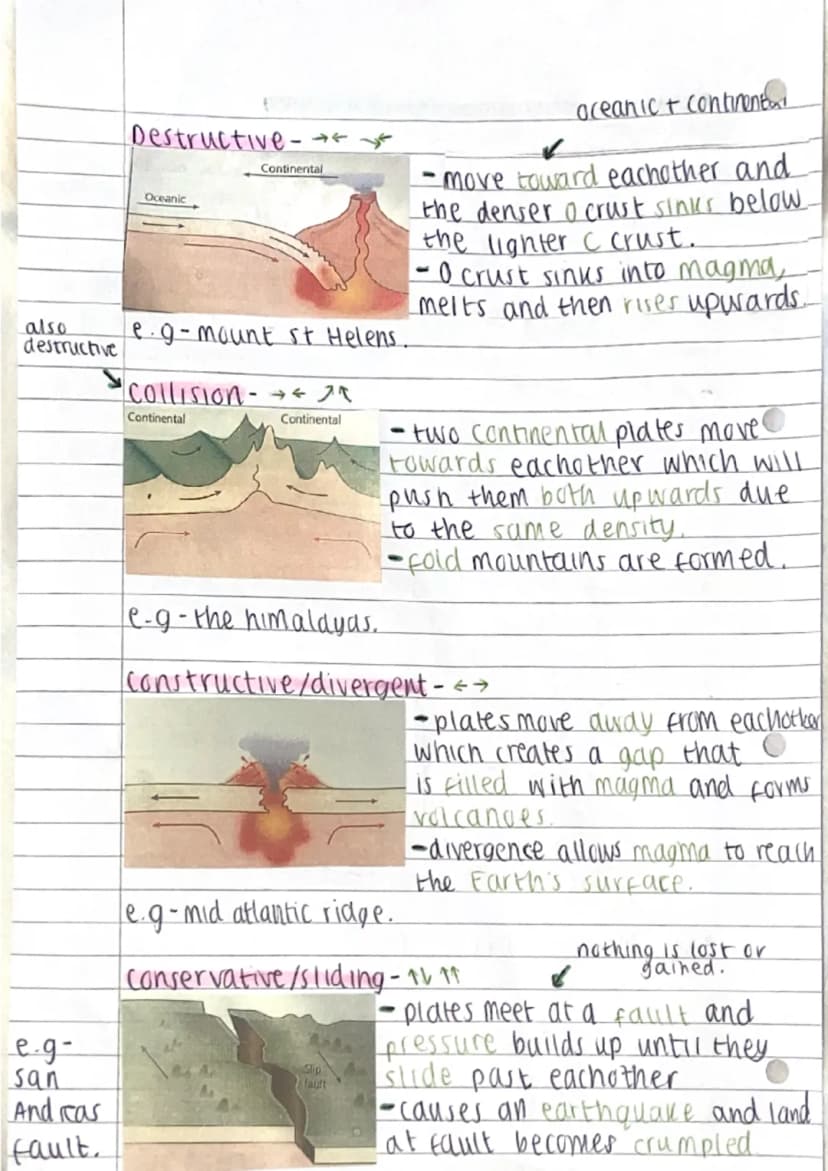
Tectonic plates interact at their boundaries, creating different types of margins that result in various tectonic features. These interactions are fundamental to understanding plate tectonics theory and the formation of landforms created by plate tectonics.
-
Destructive Boundaries: At destructive boundaries, plates move towards each other. When an oceanic plate meets a continental plate, the denser oceanic crust sinks beneath the lighter continental crust in a process called subduction. This process can lead to the formation of volcanoes, such as Mount St. Helens.
Definition: Subduction - The process by which one tectonic plate moves under another and sinks into the mantle.
-
Collision Boundaries: When two continental plates collide, neither can sink due to their similar densities. Instead, they push against each other, forming fold mountains like the Himalayas.
Example: The Himalayas are a famous landform created by plate tectonics, resulting from the collision between the Indian and Eurasian plates.
-
Constructive/Divergent Boundaries: At these boundaries, plates move away from each other, creating a gap that is filled with magma from below. This process forms new crust and can create volcanic islands or mid-ocean ridges.
Highlight: The Mid-Atlantic Ridge is an example of a constructive boundary where new oceanic crust is constantly being formed.
-
Conservative/Sliding Boundaries: Here, plates slide past each other along a fault line. While no crust is lost or gained, the movement can cause earthquakes as pressure builds up and is suddenly released.
Example: The San Andreas Fault in California is a well-known conservative boundary.
Understanding these plate interactions is crucial for explaining the forces that shape tectonic landforms and predicting geological events.
2
of 5
Theories of Plate Movement and Large-Scale Tectonic Features
The movement of tectonic plates is explained by several theories, which are essential for understanding how convection currents move tectonic plates and the formation of large-scale landforms.
Three theories of plate movement include:
-
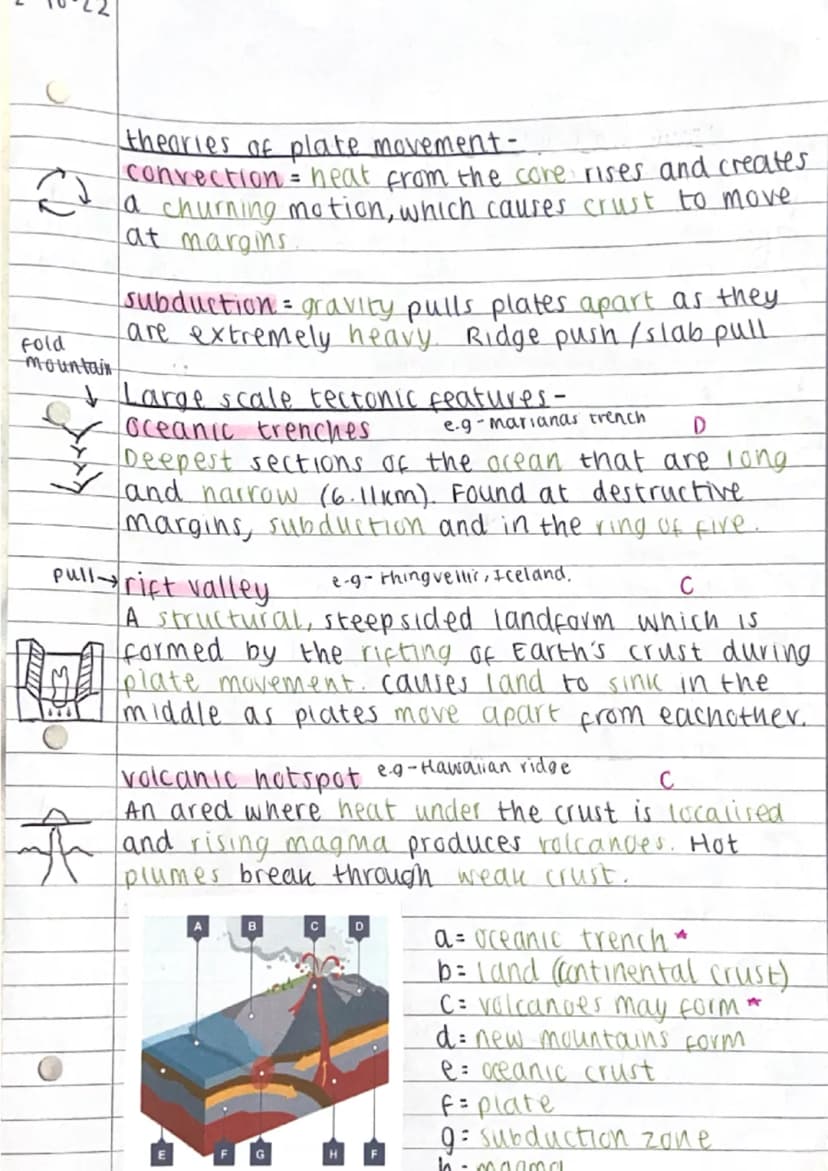
Convection: Heat from the Earth's core rises, creating a churning motion in the mantle that causes the crust to move at plate margins.
-
Subduction: The weight of tectonic plates causes gravity to pull them apart, particularly at subduction zones.
-
Ridge Push / Slab Pull: These forces work in tandem, with new crust at mid-ocean ridges pushing plates apart (ridge push) and the weight of subducting slabs pulling plates towards subduction zones (slab pull).
Highlight: These theories collectively explain the complex dynamics of plate tectonics and are crucial for GCSE Geography AQA and A-level Geography studies on plate tectonics.
Large-scale tectonic features resulting from these processes include:
-
Oceanic Trenches: Deep, narrow sections of the ocean floor found at destructive margins and in the Pacific Ring of Fire. The Mariana Trench is a notable example, reaching depths of over 11 km.
-
Rift Valleys: Steep-sided depressions formed by the rifting of Earth's crust as plates move apart. Thingvellir in Iceland is an example of a rift valley.
-
Volcanic Hotspots: Areas where localized heat under the crust causes rising magma to produce volcanoes, often in chains like the Hawaiian Ridge.
Example: The Hawaiian Ridge is a large landform formed from tectonic forces, created by the movement of the Pacific Plate over a stationary hotspot.
These features demonstrate how plate tectonics theory explains the formation of major landforms and continues to shape the Earth's surface.
3
of 5
Large-Scale Volcanic Features and Formations
Volcanic activity, driven by tectonic processes, creates a variety of large-scale volcanic features and formations. Understanding these formations is crucial for GCSE Geography and advanced studies in Earth sciences.
-
Shield Volcanoes: Large, wide volcanoes with gentle slopes, formed at constructive plate boundaries. They are built up by successive layers of fluid lava flows.
Example: Mauna Loa in Hawaii is a classic shield volcano, known for its massive size and gentle slopes.
-
Strato/Composite Volcanoes: Large, steep-sided volcanoes formed from alternating layers of lava, ash, and other pyroclastic materials. They are typically found at destructive plate boundaries.
Vocabulary: Pyroclastic materials - Rock fragments and particles ejected during a volcanic eruption.
-
Calderas: Large, circular depressions caused by the collapse of a volcano after a massive eruption. The pressure build-up leads to an explosion that removes the top part of the volcano, leaving a cauldron-shaped crater.
Highlight: Calderas can be massive in size and often form lakes after the volcanic activity subsides.
-
Lava Tubes: Natural tunnels formed when the surface of a lava flow cools and solidifies while the molten lava beneath continues to flow, eventually draining out and leaving a hollow tube.
These formations showcase the diverse ways in which volcanic activity shapes the Earth's surface, creating both hazards and unique landscapes.
Definition: Active volcanoes are those that have erupted recently or show signs of potential eruption, dormant volcanoes have not erupted in recent history but may erupt again, and extinct volcanoes are those that are not expected to erupt in the future.
4
of 5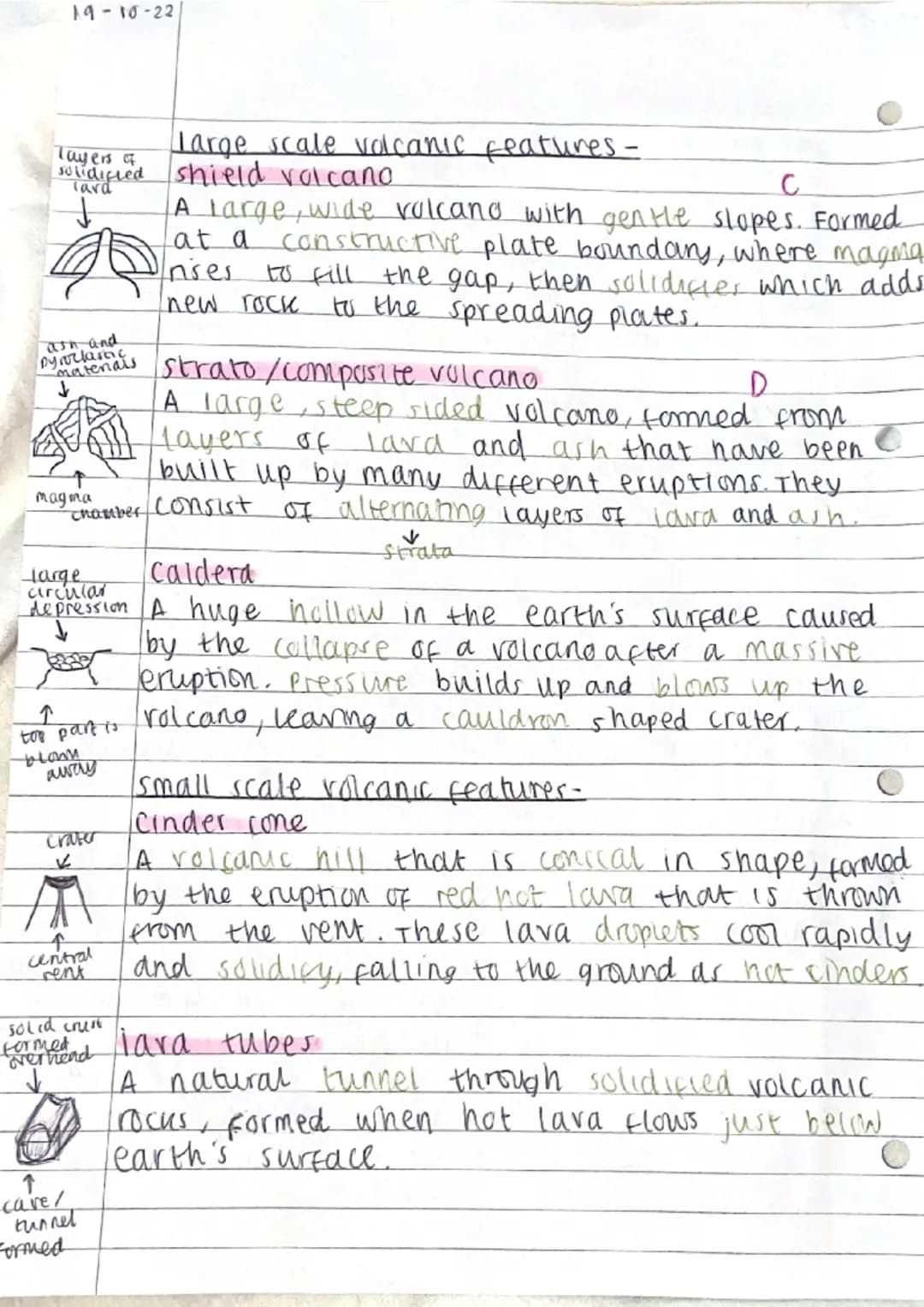
Small-Scale Volcanic Features and Geothermal Activity
In addition to large-scale formations, volcanic activity also produces smaller but significant features that contribute to the diverse landscape of volcanic regions.
Cinder Cones: Cinder cones are small, conical volcanic hills formed by the eruption of red-hot lava. As the lava is ejected from the vent, it cools rapidly in the air and falls as cinders, building up around the vent to form a cone-shaped hill.
Example: Paricutin in Mexico is a famous cinder cone volcano that emerged suddenly from a cornfield in 1943 and grew to a height of 424 meters within a year.
Geothermal Features: Volcanic regions often exhibit geothermal activity, where groundwater is heated by magma or hot rocks beneath the Earth's surface. This can lead to the formation of various features:
- Hot Springs: Natural pools of heated groundwater that rise to the surface.
- Geysers: Periodic eruptions of hot water and steam from underground reservoirs.
- Fumaroles: Openings in the Earth's surface that emit steam and gases.
Highlight: Geothermal activity not only creates unique natural features but also provides opportunities for renewable energy production in many volcanic regions.
These small-scale features and geothermal phenomena demonstrate the ongoing influence of volcanic and tectonic processes on the Earth's surface, even in areas without active large-scale eruptions.
5
of 5
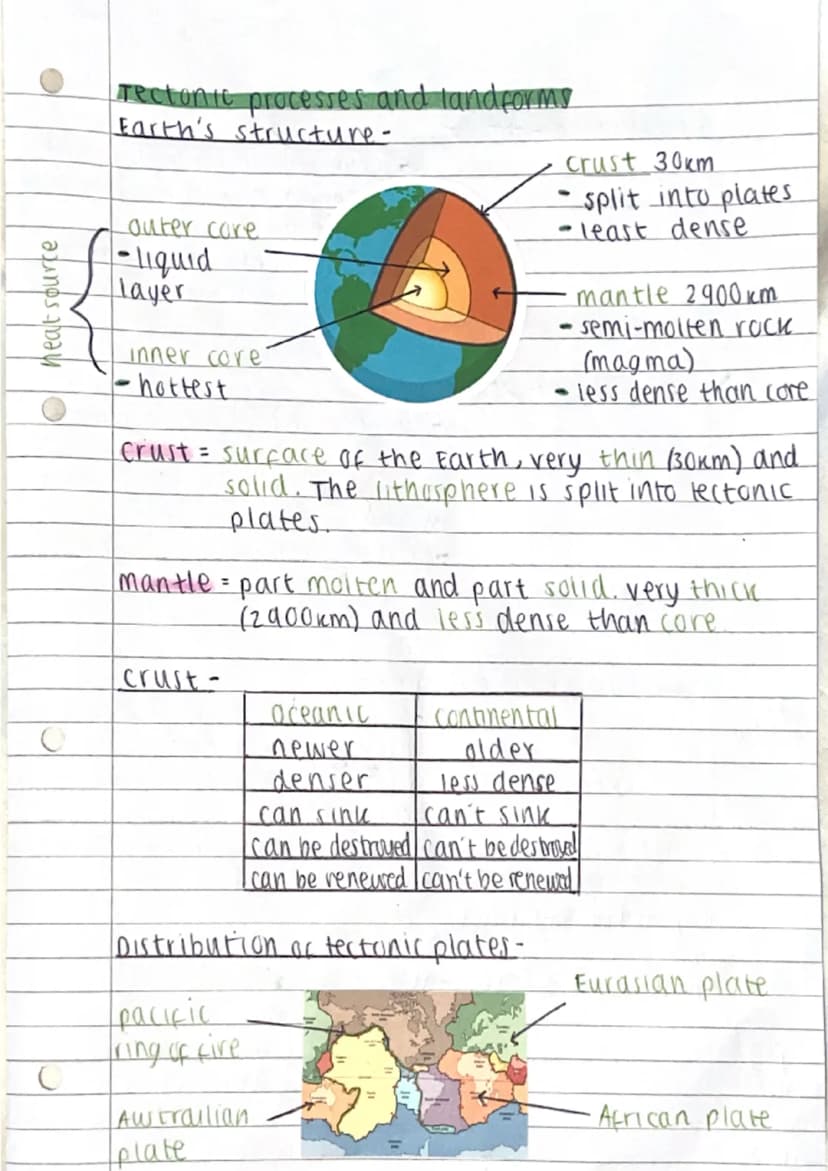
Earth's Structure and Tectonic Plates
Earth's structure is composed of distinct layers, each playing a crucial role in tectonic processes and landforms. The crust, the outermost layer, is thin (approximately 30km) and solid, forming the surface we live on. Beneath the crust lies the mantle, a thick (2900km) layer that is part molten and part solid, less dense than the core.
The lithosphere, which includes the crust and uppermost mantle, is divided into tectonic plates. These plates are categorized as either oceanic or continental, each with unique characteristics:
Highlight: Oceanic plates are newer, denser, and can be destroyed and renewed, while continental plates are older, less dense, and cannot sink or be destroyed.
The distribution of tectonic plates across the globe includes major plates such as the Pacific, Australian, Eurasian, and African plates. This arrangement of plates is responsible for the formation of various tectonic landforms and geological features.
Vocabulary: Lithosphere - The rigid outer part of the Earth, consisting of the crust and upper mantle.
Example: The Pacific Ring of Fire is a prime example of the interaction between tectonic plates, where numerous volcanoes and earthquake zones are found along the edges of the Pacific Plate.
We thought you’d never ask...
What is the Knowunity AI companion?
Our AI companion is specifically built for the needs of students. Based on the millions of content pieces we have on the platform we can provide truly meaningful and relevant answers to students. But its not only about answers, the companion is even more about guiding students through their daily learning challenges, with personalised study plans, quizzes or content pieces in the chat and 100% personalisation based on the students skills and developments.
Where can I download the Knowunity app?
You can download the app in the Google Play Store and in the Apple App Store.
Is Knowunity really free of charge?
That's right! Enjoy free access to study content, connect with fellow students, and get instant help – all at your fingertips.
Similar Content
Most popular content: Tectonic Plates
6GeographyTectonic Plate Dynamics
Explore the dynamics of tectonic plates, including oceanic and continental crust, and their role in earthquakes and volcanoes. This summary covers constructive, destructive, and conservative plate margins, highlighting the global distribution of tectonic hazards and processes.
122213
GeographyUnderstanding Plate Margins
Explore the dynamics of tectonic hazards, focusing on plate margins and their impact on earthquakes and volcanic activity. This summary covers the types of plate boundaries—constructive, destructive, and their geological implications, including subduction zones and magma formation. Ideal for students studying tectonic processes and their effects on the Earth's surface.
1149628
GeographyPlate Boundaries Explained
Explore the dynamics of plate tectonics, including divergent, convergent, and transform boundaries. Understand how convection currents drive plate movement and the geological features they create, such as volcanoes and mountains. This summary covers key concepts like subduction zones and the Earth's structure, making it essential for geography students studying tectonic processes.
1124212
GeographyTectonic Hazards Overview
Explore the dynamics of tectonic hazards, including earthquakes and volcanic activity, their causes, effects, and management strategies. This mindmap provides a comprehensive overview tailored for AQA GCSE Geography, focusing on key concepts such as plate tectonics, subduction zones, and case studies like the Nepal earthquake.
101,40322
GeographyHot Spot Dynamics
Explore the formation and characteristics of hot spots in geology. This summary covers the definition of hot spots, their role in volcanic activity, and their impact on tectonic plate movements. Key examples include the Hawaiian Islands and Iceland, illustrating how magma plumes create rift valleys and submarine volcanoes. Ideal for CCEA A2 Physical Geography students studying plate tectonics.
141931
GeographyTectonic Hazards Overview
Explore the dynamics of tectonic hazards, focusing on volcanic activity and earthquakes. This summary covers the formation of volcanoes, types of volcanoes, and the relationship between plate margins and seismic events. Understand the impact of these natural phenomena on communities and the environment, including short and long-term responses to disasters. Ideal for revision and exam preparation.
9601
Most popular content in Geography
9U
GeographyUrbanisation - AQA GCSE Geography
Some questions on key knowledge from the Urbanisation topic in GCSE Geography
98070
T
Geographytopic one- hazards flashcards set 1
Explore the fascinating world of geography with these flashcards covering diverse topics like continents, landmarks, and natural wonders. Enhance your knowledge and ace your exams!
114760
GeographyAQA GCSE Geography Paper 1 revision notes (excl. case studies)
Revision notes for the AQA GCSE Geography specification. Does not include case studies as they are selected by the school.
93,77086
E
GeographyExploring Natural Hazards: Causes and Effects
Discover the primary causes and common effects of natural hazards such as tsunamis, volcanic eruptions, hurricanes, wildfires, droughts, landslides, and more!
113230
I
GeographyIntroduction to Natural Hazard Types
Identify the differences between geological and meteorological hazards and understand the factors affecting hazard risk.
S32880
GeographyGeography Hazards & Landscapes
Explore key concepts in AQA Geography, covering rivers, coasts, natural hazards, and ecosystems. This summary highlights essential topics such as river processes, coastal management, desertification, and case studies on earthquakes and tropical storms. Ideal for exam preparation and understanding geographical systems.
103,064117
P
GeographyPaper 1? Down what else
Explore the fascinating world of geography with these flashcards covering diverse topics like continents, landmarks, and natural wonders. Enhance your knowledge and ace your exams!
114782
I
GeographyIntroduction to Global Urbanisation Concepts
Define urbanisation, explore rural-to-urban migration, and identify the push and pull factors driving global city growth.
112210
GeographyRio de Janeiro case study
AQA geography gcse
1095526
Most popular content
9 Sociology
Sociology of Education Overview
Explore comprehensive A-Level Sociology notes on the education system, covering key theories, policies, and sociological perspectives. This resource includes insights on marketisation, gender roles, cultural deprivation, and educational inequalities, providing a thorough understanding of how education shapes social stratification and individual achievement. Ideal for exam preparation and in-depth study.
12102,8693,040
SociologySociology of Families: Comprehensive Revision
Dive into an extensive overview of family dynamics, perspectives, and patterns in sociology. This resource covers key concepts such as family diversity, gender roles, marriage, and the impact of social policies on family structures. Perfect for A-Level Sociology students preparing for Paper 2.
1273,6662,307
CriminologyCriminology: Crime & Punishment Overview
Comprehensive mindmaps covering key concepts in the Crime and Punishment topic for WJEC Criminology Unit 4. This resource includes detailed insights into the Criminal Justice System, crime prevention strategies, sentencing models, and the roles of various agencies. Ideal for A-Level revision, ensuring you grasp essential theories and legislative processes to excel in your exams.
1254,8721,059
SociologyComprehensive Crime & Deviance Overview
Explore an extensive revision of crime and deviance topics, including theories, types of crime, and the impact of media. This resource covers key concepts such as Marxism, functionalism, gender and crime, and the influence of globalization on criminal behavior. Ideal for students seeking a thorough understanding of criminology and its various theories. Type: Full Topic Revision.
1251,6541,399
C
 Biology
Cell Biology and Cell structure
cell structures
93,2490
 English Literature
An Inspector Calls: Character Insights
Explore in-depth analysis and key quotes for characters in J.B. Priestley's 'An Inspector Calls'. This resource covers Gerald Croft, Inspector Goole, Sheila Birling, Mrs. Birling, Eric Birling, and Eva Smith, focusing on themes of class, gender roles, and social responsibility. Ideal for students aiming for Grade 8 and above.
1025,429907
CriminologyWJEC Unit 4 Criminology
Criminology unit 4 detailed revision note
127,151125
CriminologyCriminology Theories Overview
Explore key criminology theories and their implications on crime and deviance. This comprehensive summary covers biological, psychological, and sociological perspectives, including labelling theory, right realism, and the impact of social campaigns on policy development. Ideal for A-Level criminology students seeking to understand the complexities of criminal behaviour and the factors influencing crime prevention strategies.
129,760210
English LiteratureRomeo and Juliet: Key themes
Key Romeo and Juliet themes and analysed quotes
106,708198
Can't find what you're looking for? Explore other subjects.
Students love us — and so will you.
4.6/5App Store
4.7/5Google Play
The app is very easy to use and well designed. I have found everything I was looking for so far and have been able to learn a lot from the presentations! I will definitely use the app for a class assignment! And of course it also helps a lot as an inspiration.
Stefan SiOS user
This app is really great. There are so many study notes and help [...]. My problem subject is French, for example, and the app has so many options for help. Thanks to this app, I have improved my French. I would recommend it to anyone.
Samantha KlichAndroid user
Wow, I am really amazed. I just tried the app because I've seen it advertised many times and was absolutely stunned. This app is THE HELP you want for school and above all, it offers so many things, such as workouts and fact sheets, which have been VERY helpful to me personally.
AnnaiOS user
Geography317 views·Updated Jun 27, 2026·5 pagesCool Tectonic Landforms and Volcanoes for Kids
nicole roberts @nicoleroberts
Tectonic processes and landforms shape Earth's surface through the movement of tectonic plates, creating diverse geological features. This summary explores Earth's structure, plate tectonics, and the formation of large-scale landforms.
• Earth's structure consists of the crust, mantle, and core,...
1
of 5
Sign up to see the content. It's free!
- Access to all documents
- Improve your grades
- Join milions of students
Types of Plate Boundaries and Their Effects
Tectonic plates interact at their boundaries, creating different types of margins that result in various tectonic features. These interactions are fundamental to understanding plate tectonics theory and the formation of landforms created by plate tectonics.
-
Destructive Boundaries: At destructive boundaries, plates move towards each other. When an oceanic plate meets a continental plate, the denser oceanic crust sinks beneath the lighter continental crust in a process called subduction. This process can lead to the formation of volcanoes, such as Mount St. Helens.
Definition: Subduction - The process by which one tectonic plate moves under another and sinks into the mantle.
-
Collision Boundaries: When two continental plates collide, neither can sink due to their similar densities. Instead, they push against each other, forming fold mountains like the Himalayas.
Example: The Himalayas are a famous landform created by plate tectonics, resulting from the collision between the Indian and Eurasian plates.
-
Constructive/Divergent Boundaries: At these boundaries, plates move away from each other, creating a gap that is filled with magma from below. This process forms new crust and can create volcanic islands or mid-ocean ridges.
Highlight: The Mid-Atlantic Ridge is an example of a constructive boundary where new oceanic crust is constantly being formed.
-
Conservative/Sliding Boundaries: Here, plates slide past each other along a fault line. While no crust is lost or gained, the movement can cause earthquakes as pressure builds up and is suddenly released.
Example: The San Andreas Fault in California is a well-known conservative boundary.
Understanding these plate interactions is crucial for explaining the forces that shape tectonic landforms and predicting geological events.
2
of 5Sign up to see the content. It's free!
- Access to all documents
- Improve your grades
- Join milions of students
Theories of Plate Movement and Large-Scale Tectonic Features
The movement of tectonic plates is explained by several theories, which are essential for understanding how convection currents move tectonic plates and the formation of large-scale landforms.
Three theories of plate movement include:
-
Convection: Heat from the Earth's core rises, creating a churning motion in the mantle that causes the crust to move at plate margins.
-
Subduction: The weight of tectonic plates causes gravity to pull them apart, particularly at subduction zones.
-
Ridge Push / Slab Pull: These forces work in tandem, with new crust at mid-ocean ridges pushing plates apart (ridge push) and the weight of subducting slabs pulling plates towards subduction zones (slab pull).
Highlight: These theories collectively explain the complex dynamics of plate tectonics and are crucial for GCSE Geography AQA and A-level Geography studies on plate tectonics.
Large-scale tectonic features resulting from these processes include:
-
Oceanic Trenches: Deep, narrow sections of the ocean floor found at destructive margins and in the Pacific Ring of Fire. The Mariana Trench is a notable example, reaching depths of over 11 km.
-
Rift Valleys: Steep-sided depressions formed by the rifting of Earth's crust as plates move apart. Thingvellir in Iceland is an example of a rift valley.
-
Volcanic Hotspots: Areas where localized heat under the crust causes rising magma to produce volcanoes, often in chains like the Hawaiian Ridge.
Example: The Hawaiian Ridge is a large landform formed from tectonic forces, created by the movement of the Pacific Plate over a stationary hotspot.
These features demonstrate how plate tectonics theory explains the formation of major landforms and continues to shape the Earth's surface.
3
of 5Sign up to see the content. It's free!
- Access to all documents
- Improve your grades
- Join milions of students
Large-Scale Volcanic Features and Formations
Volcanic activity, driven by tectonic processes, creates a variety of large-scale volcanic features and formations. Understanding these formations is crucial for GCSE Geography and advanced studies in Earth sciences.
-
Shield Volcanoes: Large, wide volcanoes with gentle slopes, formed at constructive plate boundaries. They are built up by successive layers of fluid lava flows.
Example: Mauna Loa in Hawaii is a classic shield volcano, known for its massive size and gentle slopes.
-
Strato/Composite Volcanoes: Large, steep-sided volcanoes formed from alternating layers of lava, ash, and other pyroclastic materials. They are typically found at destructive plate boundaries.
Vocabulary: Pyroclastic materials - Rock fragments and particles ejected during a volcanic eruption.
-
Calderas: Large, circular depressions caused by the collapse of a volcano after a massive eruption. The pressure build-up leads to an explosion that removes the top part of the volcano, leaving a cauldron-shaped crater.
Highlight: Calderas can be massive in size and often form lakes after the volcanic activity subsides.
-
Lava Tubes: Natural tunnels formed when the surface of a lava flow cools and solidifies while the molten lava beneath continues to flow, eventually draining out and leaving a hollow tube.
These formations showcase the diverse ways in which volcanic activity shapes the Earth's surface, creating both hazards and unique landscapes.
Definition: Active volcanoes are those that have erupted recently or show signs of potential eruption, dormant volcanoes have not erupted in recent history but may erupt again, and extinct volcanoes are those that are not expected to erupt in the future.
4
of 5Sign up to see the content. It's free!
- Access to all documents
- Improve your grades
- Join milions of students
Small-Scale Volcanic Features and Geothermal Activity
In addition to large-scale formations, volcanic activity also produces smaller but significant features that contribute to the diverse landscape of volcanic regions.
Cinder Cones: Cinder cones are small, conical volcanic hills formed by the eruption of red-hot lava. As the lava is ejected from the vent, it cools rapidly in the air and falls as cinders, building up around the vent to form a cone-shaped hill.
Example: Paricutin in Mexico is a famous cinder cone volcano that emerged suddenly from a cornfield in 1943 and grew to a height of 424 meters within a year.
Geothermal Features: Volcanic regions often exhibit geothermal activity, where groundwater is heated by magma or hot rocks beneath the Earth's surface. This can lead to the formation of various features:
- Hot Springs: Natural pools of heated groundwater that rise to the surface.
- Geysers: Periodic eruptions of hot water and steam from underground reservoirs.
- Fumaroles: Openings in the Earth's surface that emit steam and gases.
Highlight: Geothermal activity not only creates unique natural features but also provides opportunities for renewable energy production in many volcanic regions.
These small-scale features and geothermal phenomena demonstrate the ongoing influence of volcanic and tectonic processes on the Earth's surface, even in areas without active large-scale eruptions.
5
of 5Sign up to see the content. It's free!
- Access to all documents
- Improve your grades
- Join milions of students
Earth's Structure and Tectonic Plates
Earth's structure is composed of distinct layers, each playing a crucial role in tectonic processes and landforms. The crust, the outermost layer, is thin (approximately 30km) and solid, forming the surface we live on. Beneath the crust lies the mantle, a thick (2900km) layer that is part molten and part solid, less dense than the core.
The lithosphere, which includes the crust and uppermost mantle, is divided into tectonic plates. These plates are categorized as either oceanic or continental, each with unique characteristics:
Highlight: Oceanic plates are newer, denser, and can be destroyed and renewed, while continental plates are older, less dense, and cannot sink or be destroyed.
The distribution of tectonic plates across the globe includes major plates such as the Pacific, Australian, Eurasian, and African plates. This arrangement of plates is responsible for the formation of various tectonic landforms and geological features.
Vocabulary: Lithosphere - The rigid outer part of the Earth, consisting of the crust and upper mantle.
Example: The Pacific Ring of Fire is a prime example of the interaction between tectonic plates, where numerous volcanoes and earthquake zones are found along the edges of the Pacific Plate.
We thought you’d never ask...
What is the Knowunity AI companion?
Our AI companion is specifically built for the needs of students. Based on the millions of content pieces we have on the platform we can provide truly meaningful and relevant answers to students. But its not only about answers, the companion is even more about guiding students through their daily learning challenges, with personalised study plans, quizzes or content pieces in the chat and 100% personalisation based on the students skills and developments.
Where can I download the Knowunity app?
You can download the app in the Google Play Store and in the Apple App Store.
Is Knowunity really free of charge?
That's right! Enjoy free access to study content, connect with fellow students, and get instant help – all at your fingertips.
Similar Content
Most popular content: Tectonic Plates
6GeographyTectonic Plate Dynamics
Explore the dynamics of tectonic plates, including oceanic and continental crust, and their role in earthquakes and volcanoes. This summary covers constructive, destructive, and conservative plate margins, highlighting the global distribution of tectonic hazards and processes.
122213
GeographyUnderstanding Plate Margins
Explore the dynamics of tectonic hazards, focusing on plate margins and their impact on earthquakes and volcanic activity. This summary covers the types of plate boundaries—constructive, destructive, and their geological implications, including subduction zones and magma formation. Ideal for students studying tectonic processes and their effects on the Earth's surface.
1149628
GeographyPlate Boundaries Explained
Explore the dynamics of plate tectonics, including divergent, convergent, and transform boundaries. Understand how convection currents drive plate movement and the geological features they create, such as volcanoes and mountains. This summary covers key concepts like subduction zones and the Earth's structure, making it essential for geography students studying tectonic processes.
1124212
GeographyTectonic Hazards Overview
Explore the dynamics of tectonic hazards, including earthquakes and volcanic activity, their causes, effects, and management strategies. This mindmap provides a comprehensive overview tailored for AQA GCSE Geography, focusing on key concepts such as plate tectonics, subduction zones, and case studies like the Nepal earthquake.
101,40322
GeographyHot Spot Dynamics
Explore the formation and characteristics of hot spots in geology. This summary covers the definition of hot spots, their role in volcanic activity, and their impact on tectonic plate movements. Key examples include the Hawaiian Islands and Iceland, illustrating how magma plumes create rift valleys and submarine volcanoes. Ideal for CCEA A2 Physical Geography students studying plate tectonics.
141931
GeographyTectonic Hazards Overview
Explore the dynamics of tectonic hazards, focusing on volcanic activity and earthquakes. This summary covers the formation of volcanoes, types of volcanoes, and the relationship between plate margins and seismic events. Understand the impact of these natural phenomena on communities and the environment, including short and long-term responses to disasters. Ideal for revision and exam preparation.
9601
Most popular content in Geography
9U
GeographyUrbanisation - AQA GCSE Geography
Some questions on key knowledge from the Urbanisation topic in GCSE Geography
98070
T
Geographytopic one- hazards flashcards set 1
Explore the fascinating world of geography with these flashcards covering diverse topics like continents, landmarks, and natural wonders. Enhance your knowledge and ace your exams!
114760
GeographyAQA GCSE Geography Paper 1 revision notes (excl. case studies)
Revision notes for the AQA GCSE Geography specification. Does not include case studies as they are selected by the school.
93,77086
E
GeographyExploring Natural Hazards: Causes and Effects
Discover the primary causes and common effects of natural hazards such as tsunamis, volcanic eruptions, hurricanes, wildfires, droughts, landslides, and more!
113230
I
GeographyIntroduction to Natural Hazard Types
Identify the differences between geological and meteorological hazards and understand the factors affecting hazard risk.
S32880
GeographyGeography Hazards & Landscapes
Explore key concepts in AQA Geography, covering rivers, coasts, natural hazards, and ecosystems. This summary highlights essential topics such as river processes, coastal management, desertification, and case studies on earthquakes and tropical storms. Ideal for exam preparation and understanding geographical systems.
103,064117
P
GeographyPaper 1? Down what else
Explore the fascinating world of geography with these flashcards covering diverse topics like continents, landmarks, and natural wonders. Enhance your knowledge and ace your exams!
114782
I
GeographyIntroduction to Global Urbanisation Concepts
Define urbanisation, explore rural-to-urban migration, and identify the push and pull factors driving global city growth.
112210
GeographyRio de Janeiro case study
AQA geography gcse
1095526
Most popular content
9SociologySociology of Education Overview
Explore comprehensive A-Level Sociology notes on the education system, covering key theories, policies, and sociological perspectives. This resource includes insights on marketisation, gender roles, cultural deprivation, and educational inequalities, providing a thorough understanding of how education shapes social stratification and individual achievement. Ideal for exam preparation and in-depth study.
12102,8693,040
SociologySociology of Families: Comprehensive Revision
Dive into an extensive overview of family dynamics, perspectives, and patterns in sociology. This resource covers key concepts such as family diversity, gender roles, marriage, and the impact of social policies on family structures. Perfect for A-Level Sociology students preparing for Paper 2.
1273,6662,307
CriminologyCriminology: Crime & Punishment Overview
Comprehensive mindmaps covering key concepts in the Crime and Punishment topic for WJEC Criminology Unit 4. This resource includes detailed insights into the Criminal Justice System, crime prevention strategies, sentencing models, and the roles of various agencies. Ideal for A-Level revision, ensuring you grasp essential theories and legislative processes to excel in your exams.
1254,8721,059
SociologyComprehensive Crime & Deviance Overview
Explore an extensive revision of crime and deviance topics, including theories, types of crime, and the impact of media. This resource covers key concepts such as Marxism, functionalism, gender and crime, and the influence of globalization on criminal behavior. Ideal for students seeking a thorough understanding of criminology and its various theories. Type: Full Topic Revision.
1251,6541,399
C
BiologyCell Biology and Cell structure
cell structures
93,2490
English LiteratureAn Inspector Calls: Character Insights
Explore in-depth analysis and key quotes for characters in J.B. Priestley's 'An Inspector Calls'. This resource covers Gerald Croft, Inspector Goole, Sheila Birling, Mrs. Birling, Eric Birling, and Eva Smith, focusing on themes of class, gender roles, and social responsibility. Ideal for students aiming for Grade 8 and above.
1025,429907
CriminologyWJEC Unit 4 Criminology
Criminology unit 4 detailed revision note
127,151125
CriminologyCriminology Theories Overview
Explore key criminology theories and their implications on crime and deviance. This comprehensive summary covers biological, psychological, and sociological perspectives, including labelling theory, right realism, and the impact of social campaigns on policy development. Ideal for A-Level criminology students seeking to understand the complexities of criminal behaviour and the factors influencing crime prevention strategies.
129,760210
English LiteratureRomeo and Juliet: Key themes
Key Romeo and Juliet themes and analysed quotes
106,708198
Can't find what you're looking for? Explore other subjects.
Students love us — and so will you.
4.6/5App Store
4.7/5Google Play
The app is very easy to use and well designed. I have found everything I was looking for so far and have been able to learn a lot from the presentations! I will definitely use the app for a class assignment! And of course it also helps a lot as an inspiration.
Stefan SiOS user
This app is really great. There are so many study notes and help [...]. My problem subject is French, for example, and the app has so many options for help. Thanks to this app, I have improved my French. I would recommend it to anyone.
Samantha KlichAndroid user
Wow, I am really amazed. I just tried the app because I've seen it advertised many times and was absolutely stunned. This app is THE HELP you want for school and above all, it offers so many things, such as workouts and fact sheets, which have been VERY helpful to me personally.
AnnaiOS user