
Ever wondered why weather patterns exist and why Earth's climate...
 Geography730 views·Updated Jun 21, 2026·3 pages
Complete Notes on Hazardous Earth for Edexcel B Geography GCSE
H
Hannah@hannnah_study
1 / 3
1
of 3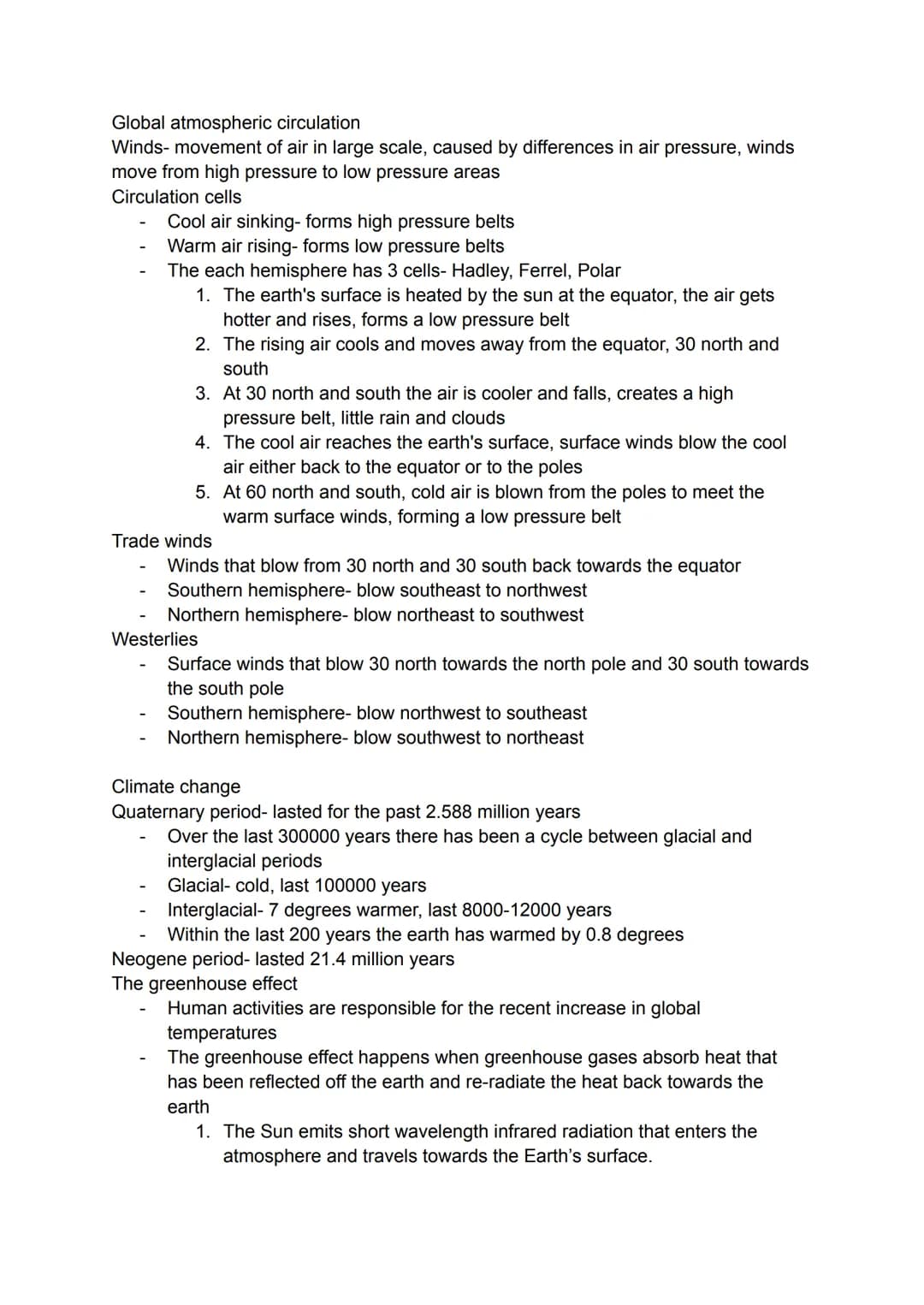
Global Atmospheric Circulation and Climate Patterns
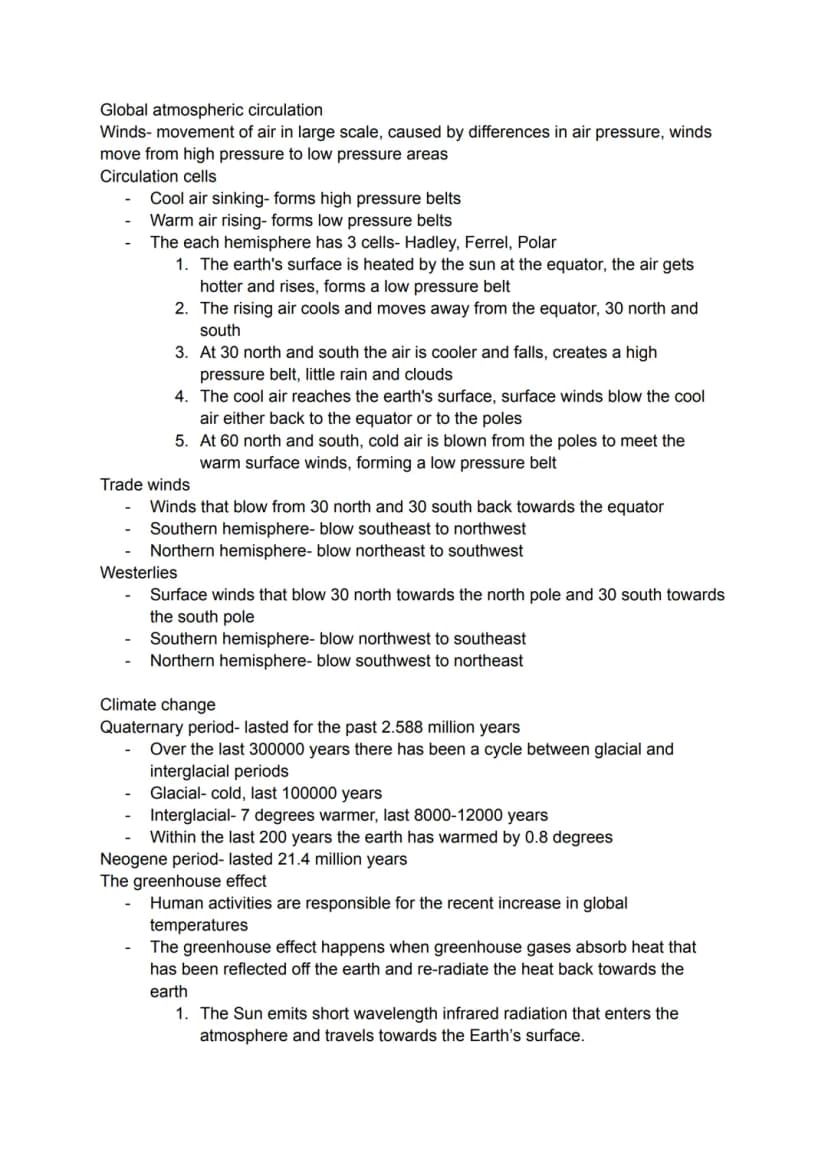
Think of Earth's atmosphere like a giant conveyor belt system that moves air around the planet. Winds form because air naturally flows from high pressure areas to low pressure areas, creating predictable patterns that drive our weather.
The atmosphere works through three circulation cells in each hemisphere: Hadley, Ferrel, and Polar cells. Here's how it works: the Sun heats air at the equator, making it rise and create low pressure. This warm air cools as it moves away from the equator, then sinks at 30° north and south, forming high pressure belts where you'll find many of the world's deserts.
Trade winds blow from these 30° zones back toward the equator, whilst westerlies blow from 30° toward the poles. Understanding this system helps explain why certain regions have consistent weather patterns and why storms move in predictable directions.
Climate has always changed naturally. During the Quaternary period (the last 2.6 million years), Earth cycled between cold glacial periods lasting 100,000 years and warmer interglacial periods lasting 8,000-12,000 years. However, in just the last 200 years, temperatures have risen 0.8°C - that's incredibly fast in geological terms.
Key Point: The greenhouse effect occurs when greenhouse gases absorb long-wave radiation reflected from Earth's surface and re-radiate it back, trapping heat in our atmosphere.
2
of 3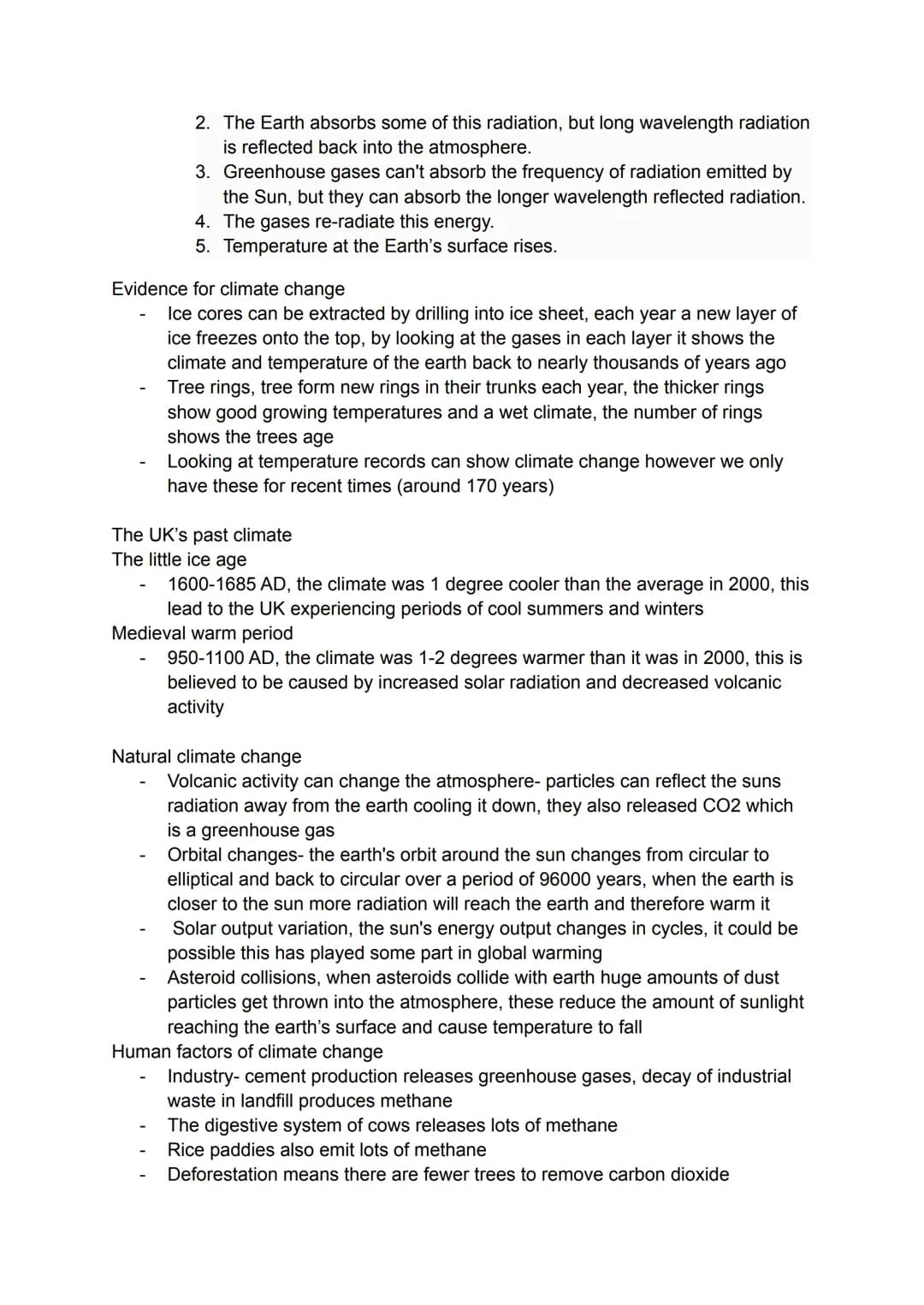
Evidence for Climate Change and UK's Climate History
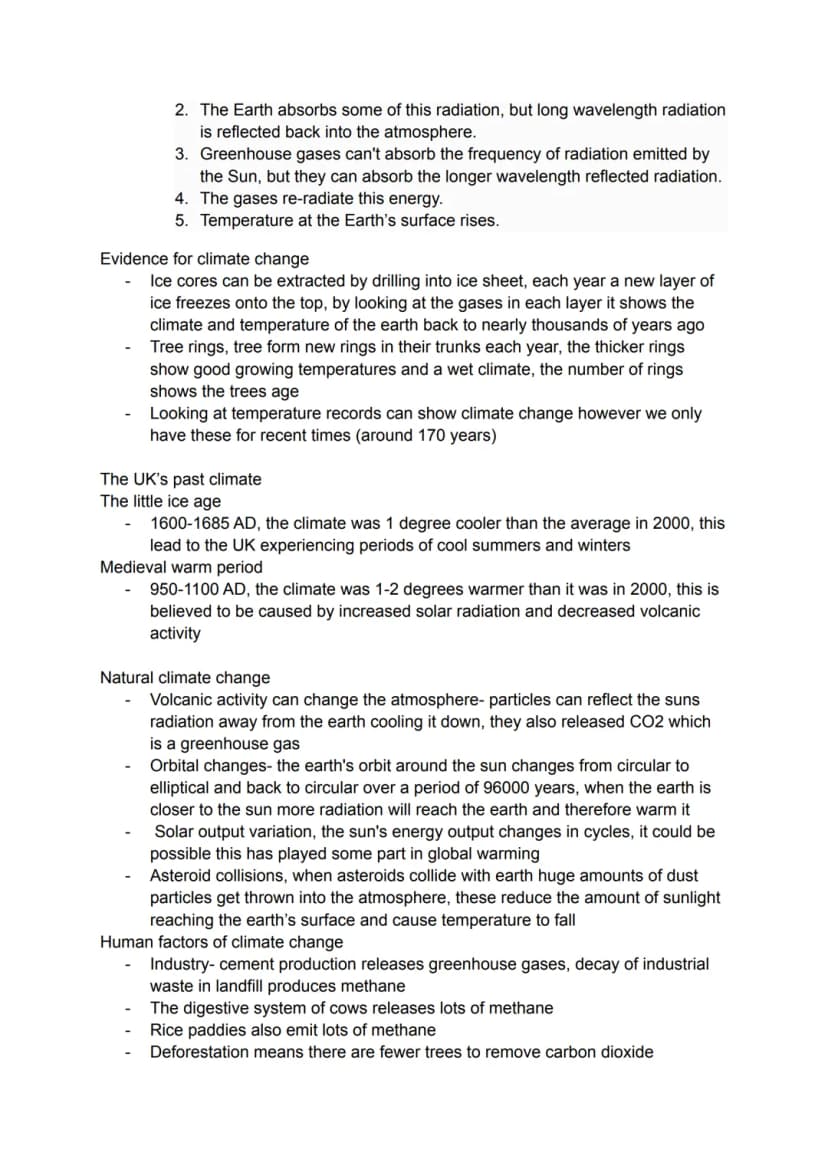
Scientists use clever methods to understand past climates. Ice cores act like frozen history books - each annual layer of ice contains gases that reveal ancient temperatures and atmospheric conditions stretching back thousands of years. Tree rings work similarly; thick rings indicate warm, wet growing seasons whilst thin rings show harsh conditions.
The UK has experienced dramatic climate shifts throughout history. During the Medieval Warm Period , temperatures were 1-2°C warmer than in 2000, likely due to increased solar radiation. Conversely, the Little Ice Age brought temperatures 1°C cooler, causing harsh winters and cool summers that affected agriculture and daily life.
Natural climate change happens through several mechanisms. Volcanic eruptions blast particles into the atmosphere that reflect sunlight away from Earth, cooling temperatures whilst also releasing CO₂. Earth's orbit changes from circular to elliptical over 96,000-year cycles, affecting how much solar radiation we receive.
Human factors now dominate climate change. Fossil fuels release massive amounts of greenhouse gases when burned for energy and transport. Deforestation removes trees that naturally absorb CO₂. Even agriculture contributes - cows produce methane through digestion, and rice paddies emit methane as organic matter decomposes underwater.
Key Point: Human activities now release greenhouse gases much faster than natural processes can absorb them, causing rapid warming.
3
of 3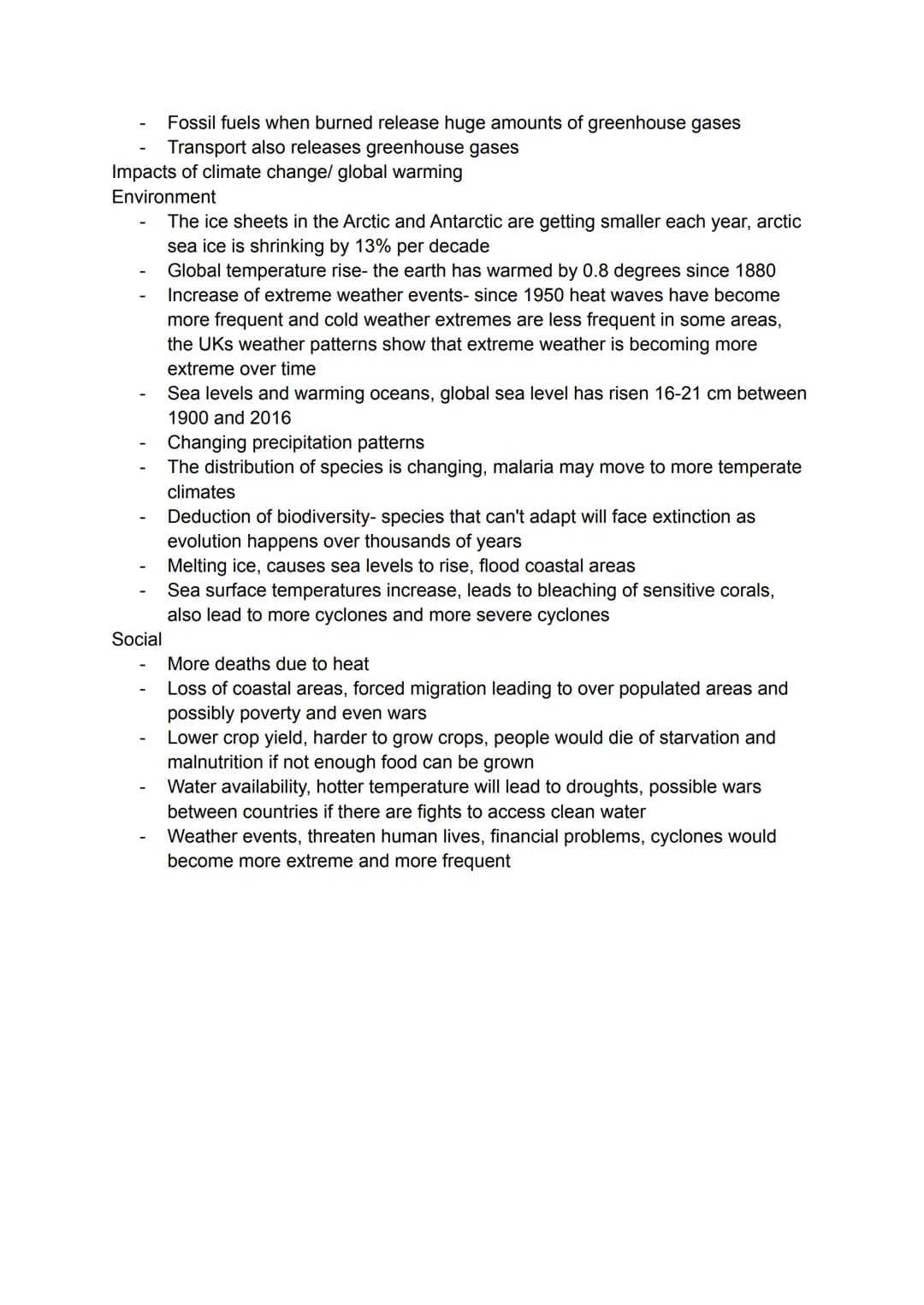
Impacts of Global Warming
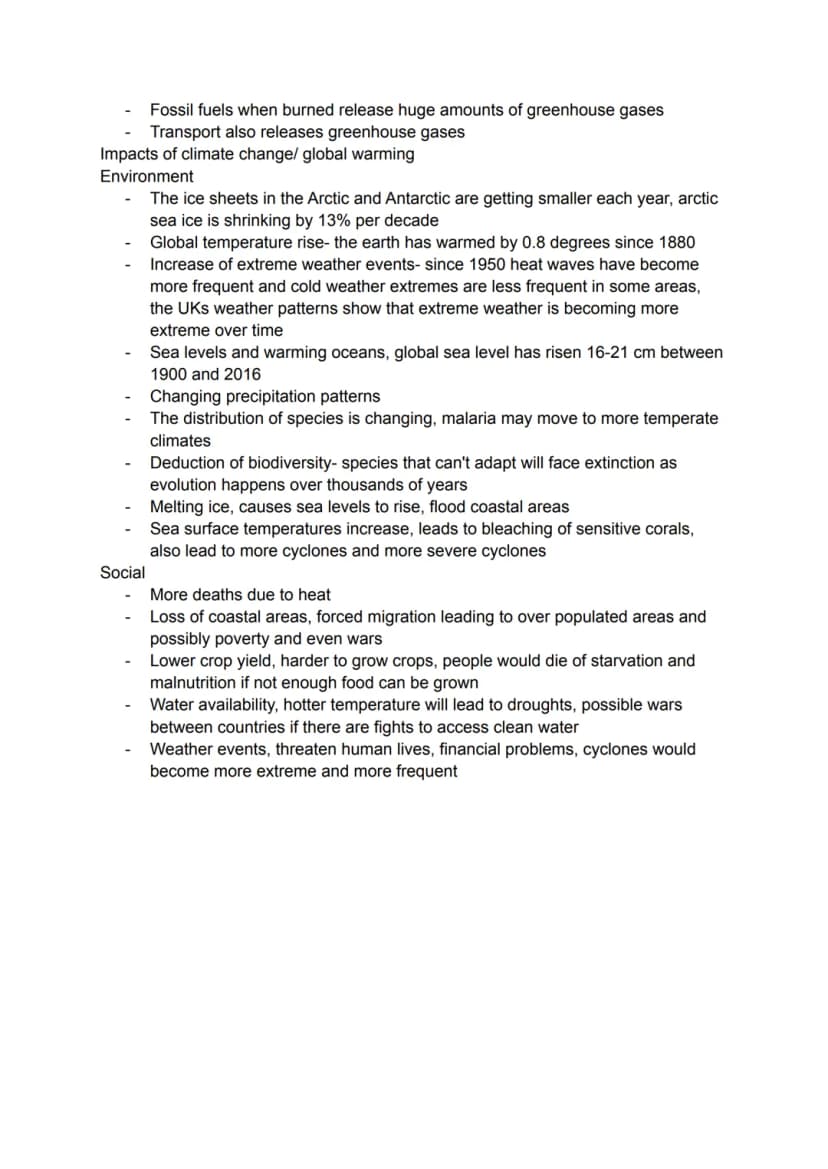
Climate change is already transforming our planet in measurable ways. Arctic sea ice shrinks by 13% per decade, and global sea levels rose 16-21 cm between 1900 and 2016. These aren't distant future problems - they're happening now.
Environmental impacts include more frequent heatwaves and extreme weather events since 1950. Rising sea surface temperatures cause coral bleaching and fuel stronger, more frequent cyclones. Species distributions are shifting as animals and plants struggle to adapt to rapidly changing conditions, with those unable to evolve quickly enough facing extinction.
Social impacts affect human communities directly. Coastal flooding from sea level rise forces people to migrate, potentially creating overcrowded areas and resource conflicts. Changing precipitation patterns and higher temperatures reduce crop yields in many regions, threatening food security.
Water availability becomes critical as hotter temperatures increase drought frequency. This could spark conflicts between nations competing for clean water resources. More heat-related deaths occur during extreme weather events, which also cause significant financial damage to communities.
The speed of current climate change is the real problem. Whilst species and ecosystems can adapt to gradual changes over thousands of years, the rapid pace of human-caused warming leaves little time for natural adaptation.
Key Point: Climate change impacts are interconnected - environmental changes directly affect human society through food, water, and housing security.
We thought you’d never ask...
What is the Knowunity AI companion?
Our AI companion is specifically built for the needs of students. Based on the millions of content pieces we have on the platform we can provide truly meaningful and relevant answers to students. But its not only about answers, the companion is even more about guiding students through their daily learning challenges, with personalised study plans, quizzes or content pieces in the chat and 100% personalisation based on the students skills and developments.
Where can I download the Knowunity app?
You can download the app in the Google Play Store and in the Apple App Store.
Is Knowunity really free of charge?
That's right! Enjoy free access to study content, connect with fellow students, and get instant help – all at your fingertips.
Similar Content
 Ens. Scient.
 Historia
Most popular content: Climate Change
6GeographyGeography knowledge organisers OCR B
AIMED AT OCR B
1097924
GeographyUnderstanding Climate Change
Explore the causes, impacts, and responses to climate change in this comprehensive overview. This study note covers key concepts such as the greenhouse effect, mitigation and adaptation strategies, and the UK's climate action plan. Ideal for GCSE Geography students seeking to grasp the complexities of climate change and its global implications.
115617
GeographyClimate Change Mitigation
Explore effective strategies for mitigating climate change, including afforestation, international agreements like the Kyoto Protocol and Paris Agreement, and alternative energy solutions. This summary covers the greenhouse effect, human and natural factors contributing to global warming, and adaptation strategies to combat climate impacts. Ideal for Geography GCSE (AQA) students.
111,31523
GeographyWeather and Climate Dynamics
Explore the intricate dynamics of weather and climate in this comprehensive study note. Covering key concepts such as global atmospheric circulation, the greenhouse effect, ocean currents, and the impact of climate change, this resource is essential for mastering the Geography GCSE syllabus. Ideal for revision for Paper 1 in Physical Geography.
101,73340
GeographyClimate Change Impacts on Tundra
Explore the effects of climate change on Arctic tundra ecosystems, focusing on rising temperatures, increased wildfires, and permafrost thawing. This summary evaluates both actual and potential impacts, including changes in wildlife habitats, water availability, and infrastructure costs. Ideal for students studying geography and environmental science.
131142
GeographyUK Weather Extremes: Beast from the East
Explore the impact of the Beast from the East, a significant weather event in the UK that occurred from February 24 to March 4, 2018. This case study covers the social, environmental, and economic effects of extreme weather, including heavy snowfall, school closures, and emergency responses. Understand the broader context of climate change and its implications for future weather patterns in the UK.
112862
Most popular content in Geography
9U
GeographyUrbanisation - AQA GCSE Geography
Some questions on key knowledge from the Urbanisation topic in GCSE Geography
98070
T
Geographytopic one- hazards flashcards set 1
Explore the fascinating world of geography with these flashcards covering diverse topics like continents, landmarks, and natural wonders. Enhance your knowledge and ace your exams!
114760
GeographyAQA GCSE Geography Paper 1 revision notes (excl. case studies)
Revision notes for the AQA GCSE Geography specification. Does not include case studies as they are selected by the school.
93,77086
E
GeographyExploring Natural Hazards: Causes and Effects
Discover the primary causes and common effects of natural hazards such as tsunamis, volcanic eruptions, hurricanes, wildfires, droughts, landslides, and more!
113230
I
GeographyIntroduction to Natural Hazard Types
Identify the differences between geological and meteorological hazards and understand the factors affecting hazard risk.
S32880
GeographyGeography Hazards & Landscapes
Explore key concepts in AQA Geography, covering rivers, coasts, natural hazards, and ecosystems. This summary highlights essential topics such as river processes, coastal management, desertification, and case studies on earthquakes and tropical storms. Ideal for exam preparation and understanding geographical systems.
103,064117
P
GeographyPaper 1? Down what else
Explore the fascinating world of geography with these flashcards covering diverse topics like continents, landmarks, and natural wonders. Enhance your knowledge and ace your exams!
114782
I
GeographyIntroduction to Global Urbanisation Concepts
Define urbanisation, explore rural-to-urban migration, and identify the push and pull factors driving global city growth.
112210
GeographyRio de Janeiro case study
AQA geography gcse
1095526
Most popular content
9 Sociology
Sociology of Education Overview
Explore comprehensive A-Level Sociology notes on the education system, covering key theories, policies, and sociological perspectives. This resource includes insights on marketisation, gender roles, cultural deprivation, and educational inequalities, providing a thorough understanding of how education shapes social stratification and individual achievement. Ideal for exam preparation and in-depth study.
12102,8693,040
SociologySociology of Families: Comprehensive Revision
Dive into an extensive overview of family dynamics, perspectives, and patterns in sociology. This resource covers key concepts such as family diversity, gender roles, marriage, and the impact of social policies on family structures. Perfect for A-Level Sociology students preparing for Paper 2.
1273,6612,307
CriminologyCriminology: Crime & Punishment Overview
Comprehensive mindmaps covering key concepts in the Crime and Punishment topic for WJEC Criminology Unit 4. This resource includes detailed insights into the Criminal Justice System, crime prevention strategies, sentencing models, and the roles of various agencies. Ideal for A-Level revision, ensuring you grasp essential theories and legislative processes to excel in your exams.
1254,8691,059
SociologyComprehensive Crime & Deviance Overview
Explore an extensive revision of crime and deviance topics, including theories, types of crime, and the impact of media. This resource covers key concepts such as Marxism, functionalism, gender and crime, and the influence of globalization on criminal behavior. Ideal for students seeking a thorough understanding of criminology and its various theories. Type: Full Topic Revision.
1251,6541,399
C
 Biology
Cell Biology and Cell structure
cell structures
93,2470
 English Literature
An Inspector Calls: Character Insights
Explore in-depth analysis and key quotes for characters in J.B. Priestley's 'An Inspector Calls'. This resource covers Gerald Croft, Inspector Goole, Sheila Birling, Mrs. Birling, Eric Birling, and Eva Smith, focusing on themes of class, gender roles, and social responsibility. Ideal for students aiming for Grade 8 and above.
1025,429907
CriminologyWJEC Unit 4 Criminology
Criminology unit 4 detailed revision note
127,151125
CriminologyCriminology Theories Overview
Explore key criminology theories and their implications on crime and deviance. This comprehensive summary covers biological, psychological, and sociological perspectives, including labelling theory, right realism, and the impact of social campaigns on policy development. Ideal for A-Level criminology students seeking to understand the complexities of criminal behaviour and the factors influencing crime prevention strategies.
129,760210
English LiteratureRomeo and Juliet: Key themes
Key Romeo and Juliet themes and analysed quotes
106,708198
Can't find what you're looking for? Explore other subjects.
Students love us — and so will you.
4.6/5App Store
4.7/5Google Play
The app is very easy to use and well designed. I have found everything I was looking for so far and have been able to learn a lot from the presentations! I will definitely use the app for a class assignment! And of course it also helps a lot as an inspiration.
Stefan SiOS user
This app is really great. There are so many study notes and help [...]. My problem subject is French, for example, and the app has so many options for help. Thanks to this app, I have improved my French. I would recommend it to anyone.
Samantha KlichAndroid user
Wow, I am really amazed. I just tried the app because I've seen it advertised many times and was absolutely stunned. This app is THE HELP you want for school and above all, it offers so many things, such as workouts and fact sheets, which have been VERY helpful to me personally.
AnnaiOS user
Geography730 views·Updated Jun 21, 2026·3 pagesComplete Notes on Hazardous Earth for Edexcel B Geography GCSE
H
Hannah@hannnah_study
Ever wondered why weather patterns exist and why Earth's climate is changing so rapidly? Global atmospheric circulation creates the winds and weather systems that shape our planet's climate, but human activities are now dramatically altering these natural patterns in ways...
1
of 3
Sign up to see the content. It's free!
- Access to all documents
- Improve your grades
- Join milions of students
Global Atmospheric Circulation and Climate Patterns
Think of Earth's atmosphere like a giant conveyor belt system that moves air around the planet. Winds form because air naturally flows from high pressure areas to low pressure areas, creating predictable patterns that drive our weather.
The atmosphere works through three circulation cells in each hemisphere: Hadley, Ferrel, and Polar cells. Here's how it works: the Sun heats air at the equator, making it rise and create low pressure. This warm air cools as it moves away from the equator, then sinks at 30° north and south, forming high pressure belts where you'll find many of the world's deserts.
Trade winds blow from these 30° zones back toward the equator, whilst westerlies blow from 30° toward the poles. Understanding this system helps explain why certain regions have consistent weather patterns and why storms move in predictable directions.
Climate has always changed naturally. During the Quaternary period (the last 2.6 million years), Earth cycled between cold glacial periods lasting 100,000 years and warmer interglacial periods lasting 8,000-12,000 years. However, in just the last 200 years, temperatures have risen 0.8°C - that's incredibly fast in geological terms.
Key Point: The greenhouse effect occurs when greenhouse gases absorb long-wave radiation reflected from Earth's surface and re-radiate it back, trapping heat in our atmosphere.
2
of 3Sign up to see the content. It's free!
- Access to all documents
- Improve your grades
- Join milions of students
Evidence for Climate Change and UK's Climate History
Scientists use clever methods to understand past climates. Ice cores act like frozen history books - each annual layer of ice contains gases that reveal ancient temperatures and atmospheric conditions stretching back thousands of years. Tree rings work similarly; thick rings indicate warm, wet growing seasons whilst thin rings show harsh conditions.
The UK has experienced dramatic climate shifts throughout history. During the Medieval Warm Period , temperatures were 1-2°C warmer than in 2000, likely due to increased solar radiation. Conversely, the Little Ice Age brought temperatures 1°C cooler, causing harsh winters and cool summers that affected agriculture and daily life.
Natural climate change happens through several mechanisms. Volcanic eruptions blast particles into the atmosphere that reflect sunlight away from Earth, cooling temperatures whilst also releasing CO₂. Earth's orbit changes from circular to elliptical over 96,000-year cycles, affecting how much solar radiation we receive.
Human factors now dominate climate change. Fossil fuels release massive amounts of greenhouse gases when burned for energy and transport. Deforestation removes trees that naturally absorb CO₂. Even agriculture contributes - cows produce methane through digestion, and rice paddies emit methane as organic matter decomposes underwater.
Key Point: Human activities now release greenhouse gases much faster than natural processes can absorb them, causing rapid warming.
3
of 3Sign up to see the content. It's free!
- Access to all documents
- Improve your grades
- Join milions of students
Impacts of Global Warming
Climate change is already transforming our planet in measurable ways. Arctic sea ice shrinks by 13% per decade, and global sea levels rose 16-21 cm between 1900 and 2016. These aren't distant future problems - they're happening now.
Environmental impacts include more frequent heatwaves and extreme weather events since 1950. Rising sea surface temperatures cause coral bleaching and fuel stronger, more frequent cyclones. Species distributions are shifting as animals and plants struggle to adapt to rapidly changing conditions, with those unable to evolve quickly enough facing extinction.
Social impacts affect human communities directly. Coastal flooding from sea level rise forces people to migrate, potentially creating overcrowded areas and resource conflicts. Changing precipitation patterns and higher temperatures reduce crop yields in many regions, threatening food security.
Water availability becomes critical as hotter temperatures increase drought frequency. This could spark conflicts between nations competing for clean water resources. More heat-related deaths occur during extreme weather events, which also cause significant financial damage to communities.
The speed of current climate change is the real problem. Whilst species and ecosystems can adapt to gradual changes over thousands of years, the rapid pace of human-caused warming leaves little time for natural adaptation.
Key Point: Climate change impacts are interconnected - environmental changes directly affect human society through food, water, and housing security.
We thought you’d never ask...
What is the Knowunity AI companion?
Our AI companion is specifically built for the needs of students. Based on the millions of content pieces we have on the platform we can provide truly meaningful and relevant answers to students. But its not only about answers, the companion is even more about guiding students through their daily learning challenges, with personalised study plans, quizzes or content pieces in the chat and 100% personalisation based on the students skills and developments.
Where can I download the Knowunity app?
You can download the app in the Google Play Store and in the Apple App Store.
Is Knowunity really free of charge?
That's right! Enjoy free access to study content, connect with fellow students, and get instant help – all at your fingertips.
Similar Content
Most popular content: Climate Change
6GeographyGeography knowledge organisers OCR B
AIMED AT OCR B
1097924
GeographyUnderstanding Climate Change
Explore the causes, impacts, and responses to climate change in this comprehensive overview. This study note covers key concepts such as the greenhouse effect, mitigation and adaptation strategies, and the UK's climate action plan. Ideal for GCSE Geography students seeking to grasp the complexities of climate change and its global implications.
115617
GeographyClimate Change Mitigation
Explore effective strategies for mitigating climate change, including afforestation, international agreements like the Kyoto Protocol and Paris Agreement, and alternative energy solutions. This summary covers the greenhouse effect, human and natural factors contributing to global warming, and adaptation strategies to combat climate impacts. Ideal for Geography GCSE (AQA) students.
111,31523
GeographyWeather and Climate Dynamics
Explore the intricate dynamics of weather and climate in this comprehensive study note. Covering key concepts such as global atmospheric circulation, the greenhouse effect, ocean currents, and the impact of climate change, this resource is essential for mastering the Geography GCSE syllabus. Ideal for revision for Paper 1 in Physical Geography.
101,73340
GeographyClimate Change Impacts on Tundra
Explore the effects of climate change on Arctic tundra ecosystems, focusing on rising temperatures, increased wildfires, and permafrost thawing. This summary evaluates both actual and potential impacts, including changes in wildlife habitats, water availability, and infrastructure costs. Ideal for students studying geography and environmental science.
131142
GeographyUK Weather Extremes: Beast from the East
Explore the impact of the Beast from the East, a significant weather event in the UK that occurred from February 24 to March 4, 2018. This case study covers the social, environmental, and economic effects of extreme weather, including heavy snowfall, school closures, and emergency responses. Understand the broader context of climate change and its implications for future weather patterns in the UK.
112862
Most popular content in Geography
9U
GeographyUrbanisation - AQA GCSE Geography
Some questions on key knowledge from the Urbanisation topic in GCSE Geography
98070
T
Geographytopic one- hazards flashcards set 1
Explore the fascinating world of geography with these flashcards covering diverse topics like continents, landmarks, and natural wonders. Enhance your knowledge and ace your exams!
114760
GeographyAQA GCSE Geography Paper 1 revision notes (excl. case studies)
Revision notes for the AQA GCSE Geography specification. Does not include case studies as they are selected by the school.
93,77086
E
GeographyExploring Natural Hazards: Causes and Effects
Discover the primary causes and common effects of natural hazards such as tsunamis, volcanic eruptions, hurricanes, wildfires, droughts, landslides, and more!
113230
I
GeographyIntroduction to Natural Hazard Types
Identify the differences between geological and meteorological hazards and understand the factors affecting hazard risk.
S32880
GeographyGeography Hazards & Landscapes
Explore key concepts in AQA Geography, covering rivers, coasts, natural hazards, and ecosystems. This summary highlights essential topics such as river processes, coastal management, desertification, and case studies on earthquakes and tropical storms. Ideal for exam preparation and understanding geographical systems.
103,064117
P
GeographyPaper 1? Down what else
Explore the fascinating world of geography with these flashcards covering diverse topics like continents, landmarks, and natural wonders. Enhance your knowledge and ace your exams!
114782
I
GeographyIntroduction to Global Urbanisation Concepts
Define urbanisation, explore rural-to-urban migration, and identify the push and pull factors driving global city growth.
112210
GeographyRio de Janeiro case study
AQA geography gcse
1095526
Most popular content
9SociologySociology of Education Overview
Explore comprehensive A-Level Sociology notes on the education system, covering key theories, policies, and sociological perspectives. This resource includes insights on marketisation, gender roles, cultural deprivation, and educational inequalities, providing a thorough understanding of how education shapes social stratification and individual achievement. Ideal for exam preparation and in-depth study.
12102,8693,040
SociologySociology of Families: Comprehensive Revision
Dive into an extensive overview of family dynamics, perspectives, and patterns in sociology. This resource covers key concepts such as family diversity, gender roles, marriage, and the impact of social policies on family structures. Perfect for A-Level Sociology students preparing for Paper 2.
1273,6612,307
CriminologyCriminology: Crime & Punishment Overview
Comprehensive mindmaps covering key concepts in the Crime and Punishment topic for WJEC Criminology Unit 4. This resource includes detailed insights into the Criminal Justice System, crime prevention strategies, sentencing models, and the roles of various agencies. Ideal for A-Level revision, ensuring you grasp essential theories and legislative processes to excel in your exams.
1254,8691,059
SociologyComprehensive Crime & Deviance Overview
Explore an extensive revision of crime and deviance topics, including theories, types of crime, and the impact of media. This resource covers key concepts such as Marxism, functionalism, gender and crime, and the influence of globalization on criminal behavior. Ideal for students seeking a thorough understanding of criminology and its various theories. Type: Full Topic Revision.
1251,6541,399
C
BiologyCell Biology and Cell structure
cell structures
93,2470
English LiteratureAn Inspector Calls: Character Insights
Explore in-depth analysis and key quotes for characters in J.B. Priestley's 'An Inspector Calls'. This resource covers Gerald Croft, Inspector Goole, Sheila Birling, Mrs. Birling, Eric Birling, and Eva Smith, focusing on themes of class, gender roles, and social responsibility. Ideal for students aiming for Grade 8 and above.
1025,429907
CriminologyWJEC Unit 4 Criminology
Criminology unit 4 detailed revision note
127,151125
CriminologyCriminology Theories Overview
Explore key criminology theories and their implications on crime and deviance. This comprehensive summary covers biological, psychological, and sociological perspectives, including labelling theory, right realism, and the impact of social campaigns on policy development. Ideal for A-Level criminology students seeking to understand the complexities of criminal behaviour and the factors influencing crime prevention strategies.
129,760210
English LiteratureRomeo and Juliet: Key themes
Key Romeo and Juliet themes and analysed quotes
106,708198
Can't find what you're looking for? Explore other subjects.
Students love us — and so will you.
4.6/5App Store
4.7/5Google Play
The app is very easy to use and well designed. I have found everything I was looking for so far and have been able to learn a lot from the presentations! I will definitely use the app for a class assignment! And of course it also helps a lot as an inspiration.
Stefan SiOS user
This app is really great. There are so many study notes and help [...]. My problem subject is French, for example, and the app has so many options for help. Thanks to this app, I have improved my French. I would recommend it to anyone.
Samantha KlichAndroid user
Wow, I am really amazed. I just tried the app because I've seen it advertised many times and was absolutely stunned. This app is THE HELP you want for school and above all, it offers so many things, such as workouts and fact sheets, which have been VERY helpful to me personally.
AnnaiOS user